Overview
Explaining behavior is a critical reasoning pattern that appears frequently throughout the LSAT Logical Reasoning sections. This pattern involves understanding how test-makers present puzzling or unexpected behaviors, actions, or phenomena, and then ask test-takers to identify, evaluate, or provide explanations for why these behaviors occur. Unlike pure causal reasoning that focuses on establishing cause-and-effect relationships, explaining behavior questions specifically deal with making sense of actions that seem counterintuitive, contradictory, or require justification. These questions test the ability to recognize what makes a satisfactory explanation and distinguish between genuine explanations and mere descriptions or irrelevant information.
The LSAT frequently presents scenarios where individuals, groups, or entities act in ways that appear paradoxical or require clarification. For instance, a stimulus might describe consumers who claim to prefer environmentally friendly products yet consistently purchase cheaper, less sustainable alternatives. The question then asks which answer choice best explains this apparent contradiction. Success on these questions requires understanding the logical structure of explanations, recognizing what information would resolve apparent inconsistencies, and identifying which factors genuinely account for the behavior in question rather than simply restating the behavior or introducing tangential information.
Within the broader framework of logical reasoning and causation and explanation, explaining behavior questions occupy a unique position. They bridge descriptive reasoning (what happened) and causal reasoning (why it happened), requiring test-takers to move beyond identifying correlations to understanding the motivations, constraints, circumstances, or mechanisms that make behaviors comprehensible. These questions connect closely to assumption questions, strengthen/weaken questions, and paradox resolution questions, as all require understanding the logical gaps between evidence and conclusions. Mastering this topic is essential because it appears in multiple question types and develops critical analytical skills that underpin success across the entire Logical Reasoning section.
Learning Objectives
- [ ] Identify how Explaining behavior appears in LSAT questions
- [ ] Explain the reasoning pattern behind Explaining behavior
- [ ] Apply Explaining behavior to solve LSAT-style problems accurately
- [ ] Distinguish between genuine explanations and mere restatements or descriptions of behavior
- [ ] Recognize the specific elements that make an explanation sufficient and relevant
- [ ] Evaluate competing explanations to determine which best accounts for the behavior in question
- [ ] Identify common structural patterns in behavior explanation questions across different contexts
Prerequisites
- Basic argument structure: Understanding premises, conclusions, and how claims support one another is essential because explaining behavior requires identifying what needs explanation and what would constitute adequate support.
- Causal reasoning fundamentals: Familiarity with cause-and-effect relationships helps distinguish between correlation and causation when evaluating whether an explanation genuinely accounts for behavior.
- Conditional logic: Understanding sufficient and necessary conditions aids in recognizing when an explanation provides adequate grounds for a behavior versus when it merely describes associated circumstances.
- Paradox recognition: The ability to identify apparent contradictions or surprising information is crucial since many behavior explanation questions present puzzling scenarios requiring resolution.
Why This Topic Matters
Understanding how to explain behavior has profound real-world applications beyond standardized testing. In professional contexts, lawyers must explain client behavior to juries, business analysts must account for consumer choices, policymakers must understand why populations respond to incentives in particular ways, and researchers must interpret experimental results. The ability to distinguish genuine explanations from superficial descriptions or post-hoc rationalizations is fundamental to critical thinking across disciplines. This skill prevents accepting inadequate explanations that merely restate observations without providing genuine insight into underlying mechanisms or motivations.
On the LSAT, lsat explaining behavior questions appear with remarkable frequency, typically comprising 10-15% of all Logical Reasoning questions across both sections. These questions manifest in several distinct question types: "Which one of the following, if true, most helps to explain...?", "Which one of the following, if true, most helps to resolve the apparent discrepancy...?", "Which one of the following best accounts for...?", and "Which one of the following, if true, most helps to justify...?" The prevalence of these questions reflects their importance in legal reasoning, where attorneys must constantly explain witness behavior, client decisions, and circumstantial evidence.
Common manifestations in exam passages include: consumer behavior that contradicts stated preferences, organizational decisions that seem counterproductive, scientific findings that appear inconsistent with established theories, historical events that defy simple explanation, and individual choices that appear irrational. The LSAT particularly favors scenarios involving economic behavior, voting patterns, health-related decisions, environmental choices, and professional conduct. Recognizing these common contexts helps test-takers quickly identify the reasoning pattern and activate appropriate analytical strategies.
Core Concepts
The Structure of Behavioral Explanations
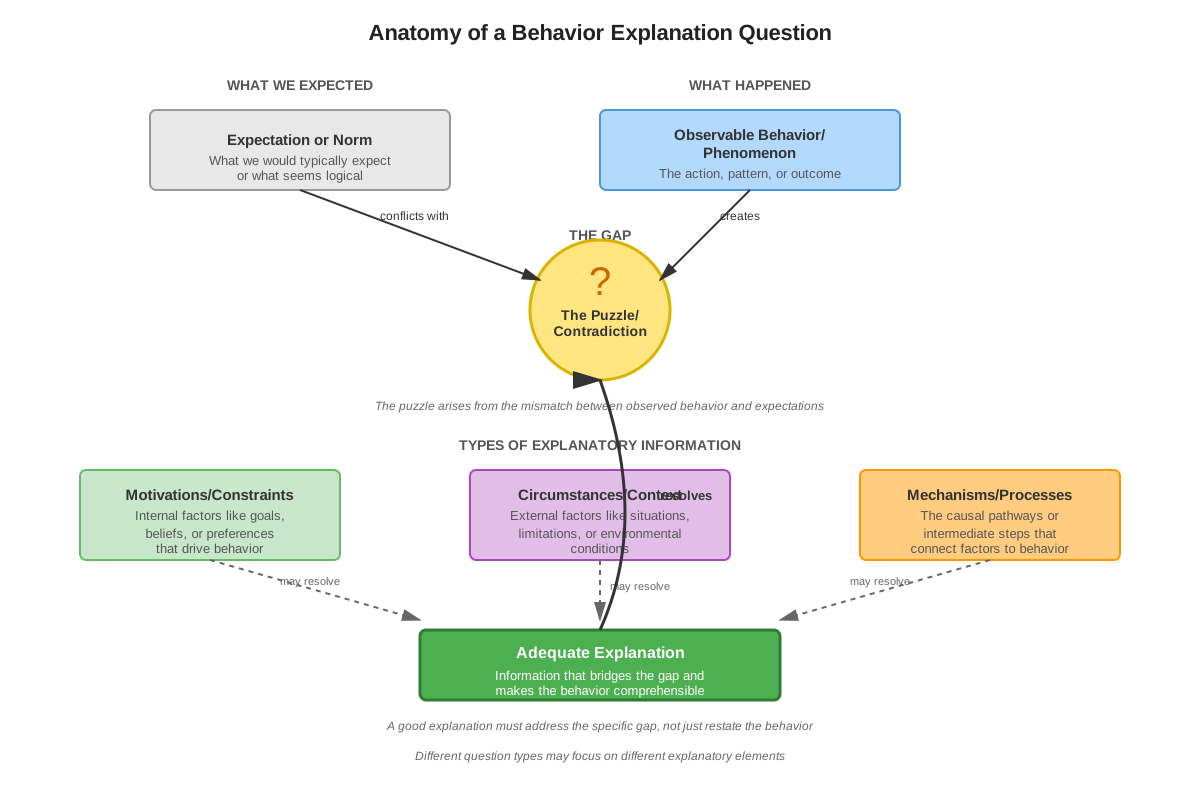
A behavioral explanation on the LSAT consists of three essential components: the behavior itself (the action, choice, or phenomenon requiring explanation), the explanatory gap (what makes the behavior puzzling, unexpected, or in need of justification), and the explanatory factor (the information that bridges the gap and makes the behavior comprehensible). Understanding this structure is fundamental to success on these questions.
The behavior component describes what happened—the observable action or pattern that forms the subject of inquiry. This might be a single decision ("Company X chose to raise prices during a recession"), a pattern ("Voters consistently support candidates whose policies they oppose"), or an outcome ("Students who study less perform better on certain exams"). The key is recognizing that the behavior itself is not in dispute; the stimulus presents it as factual.
The explanatory gap represents why the behavior seems puzzling or requires explanation. Sometimes this gap is explicit: "This is surprising because..." or "This seems to contradict..." More often, the gap is implicit, requiring test-takers to recognize what makes the behavior noteworthy. For instance, if a stimulus states that "despite higher prices, consumers purchased more of Product A," the implicit gap is that economic theory predicts inverse relationships between price and demand.
The explanatory factor is the new information that resolves the puzzle. Effective explanatory factors share several characteristics: they are relevant to the specific behavior in question, they are sufficient to account for the behavior given the circumstances, they introduce genuinely new information rather than restating what's already known, and they address the actual source of puzzlement rather than tangential issues.
Types of Behavioral Explanations
LSAT explaining behavior questions employ several distinct explanation types, each with characteristic logical structures:
Motivation-based explanations account for behavior by revealing the actor's goals, desires, or incentives. These explanations answer "why did they want to do this?" For example, explaining why employees work longer hours despite no additional pay might involve revealing that promotions depend on visible dedication rather than documented output. These explanations work by showing that the behavior, though initially puzzling, actually serves the actor's interests when properly understood.
Constraint-based explanations reveal limitations, obstacles, or circumstances that made the behavior necessary or optimal given restricted options. These answer "why did they have to do this?" or "what prevented alternatives?" For instance, explaining why a company uses expensive suppliers might involve showing that cheaper alternatives cannot meet regulatory requirements. The behavior becomes comprehensible not because actors wanted this outcome, but because circumstances left no better option.
Information-based explanations resolve puzzles by revealing what actors knew or believed that influenced their decisions. These address "what did they think was true?" For example, explaining why investors bought overvalued stocks might involve showing they had misleading information about company performance. The behavior makes sense given the actor's epistemic state, even if objectively suboptimal.
Mechanism-based explanations describe processes or causal pathways that produce the behavior. These answer "how did this come about?" For instance, explaining why a medication reduces symptoms might involve describing its biochemical effects. These explanations focus on the causal chain connecting circumstances to outcomes.
Distinguishing Explanations from Non-Explanations
A critical skill for logical reasoning questions is recognizing what does NOT constitute a genuine explanation:
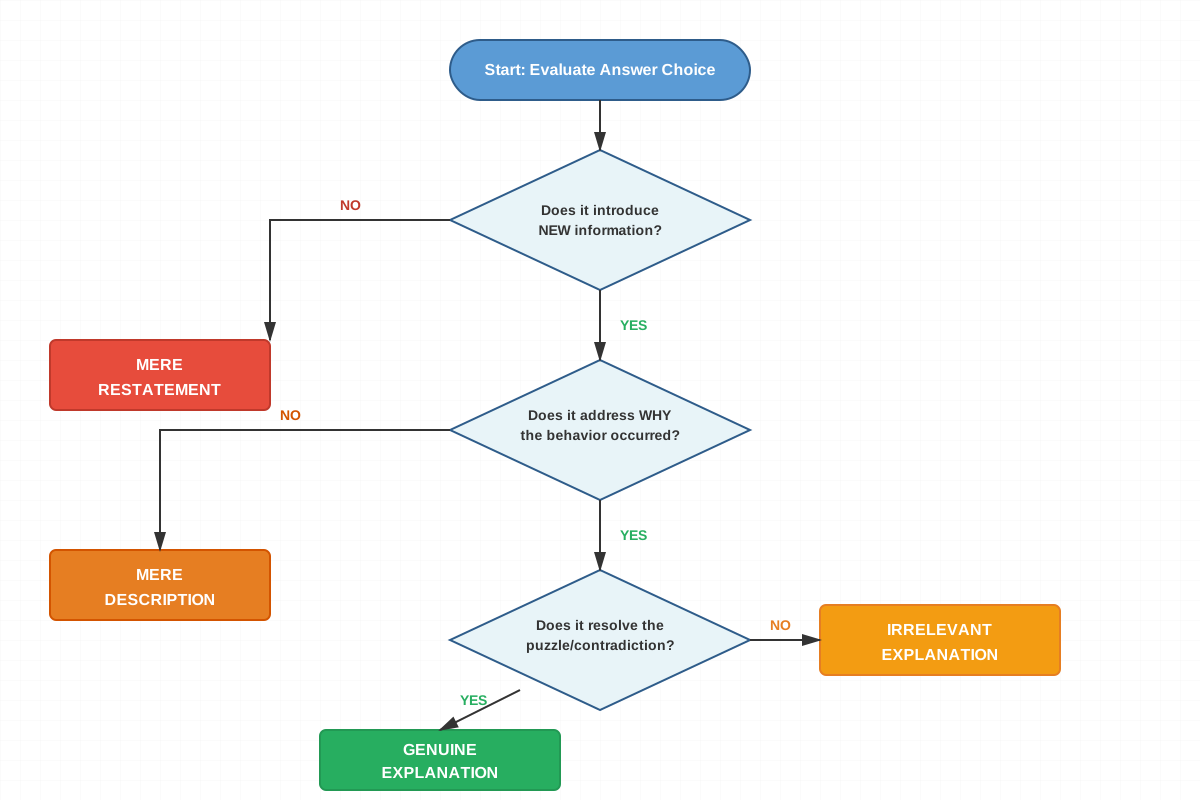
Restatements simply repeat the behavior in different words without adding explanatory information. If the puzzle is "why do consumers buy expensive organic food despite tight budgets?", answering "consumers prioritize organic food over saving money" merely restates the behavior without explaining why they prioritize this way.
Descriptions provide additional details about the behavior without revealing why it occurs. Stating "consumers buy organic food at specialty stores on weekends" adds descriptive information but doesn't explain the underlying motivation or constraint that makes this choice comprehensible.
Correlations without causal connection identify associated factors without showing how they produce the behavior. Noting "consumers who buy organic food also exercise regularly" identifies a correlation but doesn't explain why budget-conscious consumers choose expensive food.
Irrelevant factors introduce information that, while possibly true, doesn't address the specific explanatory gap. If the puzzle concerns why consumers choose expensive options despite budget constraints, explaining that "organic farming uses fewer pesticides" provides true information about organic food but doesn't address the budget puzzle.
The Sufficiency Principle in Explanations
An adequate explanation must be sufficient to account for the behavior given the circumstances described. This means the explanation, combined with the information in the stimulus, makes the behavior expected or at least comprehensible rather than puzzling. Test this by asking: "If this explanation is true, does the behavior still seem surprising?" If yes, the explanation is insufficient.
Consider this example: "Despite claiming environmental concerns motivate their purchases, consumers bought the product with excessive packaging." A sufficient explanation must address why environmentally concerned consumers would act contrary to their stated values. "The product was cheaper" provides some explanation but may be insufficient if the price difference is trivial. "The product was significantly cheaper and consumers face severe financial constraints" provides sufficient explanation by showing that financial necessity overrides environmental preferences. "The packaging was recyclable" is insufficient because it doesn't explain why excessive packaging would be acceptable to environmentally concerned consumers.
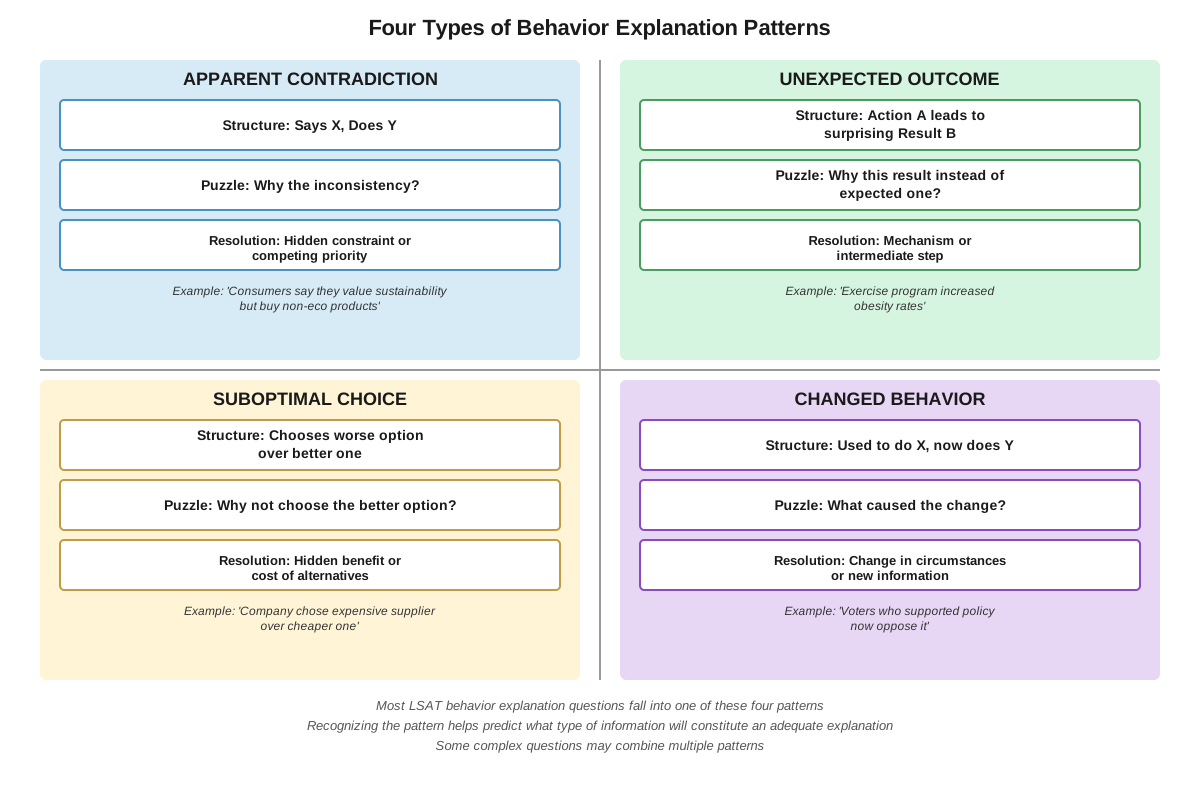
Common Explanation Patterns
| Pattern Type | Structure | Example Context | Key Recognition Feature |
|---|---|---|---|
| Hidden Incentive | Behavior seems contrary to interest, but explanation reveals aligned incentive | Workers accept lower wages at certain firms | Look for "despite" or "although" suggesting apparent contradiction |
| Missing Information | Behavior seems irrational, but explanation shows it's rational given what actor knew | Investors made seemingly poor choices | Look for knowledge gaps or information asymmetry |
| Competing Priorities | Behavior favors one value over another | Consumers choose convenience over stated environmental values | Look for multiple goals or values in tension |
| Unintended Consequence | Behavior produces unexpected result through indirect mechanism | Policy designed to help actually harms target group | Look for outcomes that differ from intentions |
| Threshold Effect | Behavior changes when some level is reached | Gradual changes produce no response until critical point | Look for sudden changes or tipping points |
Concept Relationships
The concepts within explaining behavior form an interconnected logical framework. The structure of behavioral explanations (behavior, gap, explanatory factor) provides the foundation for understanding all other concepts. This structure enables recognition of types of behavioral explanations because each type (motivation, constraint, information, mechanism) represents a different way of filling the explanatory gap. Understanding these types, in turn, makes it possible to distinguish explanations from non-explanations because genuine explanations must fit one of these types while non-explanations (restatements, descriptions, irrelevant correlations) fail to provide any of these explanation types.
The sufficiency principle operates as a quality control mechanism across all explanation types. Whether dealing with motivation-based, constraint-based, information-based, or mechanism-based explanations, the explanation must be sufficient to make the behavior comprehensible. This principle connects back to the explanatory gap concept: sufficiency means the gap is genuinely closed, not merely narrowed.
Common explanation patterns represent recurring instantiations of the explanation types in typical LSAT contexts. For instance, the "hidden incentive" pattern is a specific manifestation of motivation-based explanation, while "missing information" exemplifies information-based explanation. Recognizing these patterns accelerates question analysis by allowing test-takers to anticipate what kind of explanatory factor would be sufficient.
These concepts connect to prerequisite knowledge in several ways: Basic argument structure understanding enables identification of what constitutes the behavior (conclusion-like element) versus the explanation (premise-like element). Causal reasoning fundamentals inform mechanism-based explanations and help distinguish genuine causal explanations from mere correlations. Conditional logic helps evaluate whether explanations are sufficient (if explanation, then behavior makes sense) or merely necessary. Paradox recognition skills directly transfer to identifying explanatory gaps, as both involve spotting apparent contradictions or surprising information.
The relationship map flows as follows: Argument Structure → Behavior Identification → Explanatory Gap Recognition → Explanation Type Classification → Sufficiency Evaluation → Answer Selection. Each step depends on the previous one, and weakness at any stage compromises the entire analysis.
High-Yield Facts
⭐ An adequate explanation must introduce new information that bridges the gap between circumstances and behavior; merely restating the behavior in different words never constitutes a genuine explanation.
⭐ The correct answer to an explaining behavior question makes the behavior expected or comprehensible, not necessarily rational or optimal; behaviors can be explained even when they're mistakes.
⭐ Explanations must be sufficient given the specific circumstances described; an explanation that works in general may be insufficient for the particular case presented.
⭐ The explanatory gap is often implicit rather than explicit; identifying what makes the behavior puzzling is a critical first step that many test-takers skip.
⭐ Motivation-based explanations are the most common type on the LSAT, particularly in questions involving consumer behavior, voting patterns, and organizational decisions.
- Constraint-based explanations often involve revealing limited options, regulatory requirements, resource scarcity, or technological limitations that made the behavior necessary.
- Information-based explanations work by showing that behavior was rational given what actors knew, even if objectively suboptimal given complete information.
- Mechanism-based explanations are more common in scientific or technical contexts and describe causal processes rather than intentional choices.
- Wrong answers frequently provide true information that's simply irrelevant to the specific explanatory gap identified in the stimulus.
- Temporal sequence matters: the explanatory factor must exist before or during the behavior, not arise as a consequence of it.
- Explanations for group behavior often differ from explanations for individual behavior; aggregate patterns may result from individual motivations that don't match the group-level outcome.
- The strength of an explanation depends on how completely it resolves the puzzle; partial explanations that leave significant puzzlement are incorrect on the LSAT.
- Explanations involving multiple factors are only correct when each factor is necessary and together they're sufficient; single-factor explanations are preferred when adequate.
Quick check — test yourself on Explaining behavior so far.
Try Flashcards →Common Misconceptions
Misconception: Any true statement that relates to the behavior counts as an explanation. → Correction: An explanation must specifically address the explanatory gap—why the behavior is puzzling or unexpected. Many true statements about a situation are simply irrelevant to what makes the behavior require explanation. The explanation must make the surprising unsurprising or the puzzling comprehensible.
Misconception: The correct explanation must make the behavior seem rational or optimal. → Correction: Explanations account for why behaviors occurred, not whether they were good decisions. People and organizations often act suboptimally due to constraints, misinformation, or competing priorities. An adequate explanation shows why the behavior happened given the circumstances, even if better alternatives existed.
Misconception: Longer, more detailed answer choices are more likely to be correct explanations. → Correction: Explanation quality depends on relevance and sufficiency, not length. LSAT wrong answers often include extensive but irrelevant detail, while correct answers may be concise but precisely targeted to the explanatory gap. Evaluate based on logical connection to the puzzle, not word count.
Misconception: If an explanation accounts for part of the behavior, it's at least partially correct. → Correction: LSAT questions ask for the answer that "most helps to explain" or "best accounts for" the behavior, requiring sufficient explanation of the entire puzzle. Partial explanations that leave significant aspects unexplained are incorrect. The correct answer must resolve the complete explanatory gap presented.
Misconception: Explanations must identify the single true cause of the behavior. → Correction: Explaining behavior questions ask what would explain or help explain the behavior if true, not what definitely is the actual cause. Multiple potential explanations might work; the task is identifying which answer choice, if true, would make the behavior comprehensible, not determining which is factually accurate in reality.
Misconception: Statistical or general trends can explain specific individual behaviors. → Correction: General patterns may provide context but don't explain specific cases unless connected to the particular circumstances. If the puzzle is why this specific company made a decision, citing industry-wide trends doesn't explain this company's choice unless the answer shows why this company would follow the trend.
Misconception: Explanations work by eliminating alternative possibilities. → Correction: Explanations work by providing positive reasons why the behavior occurred, not by ruling out other options. An answer that says "other alternatives were unavailable" might work as a constraint-based explanation, but simply noting that something else didn't happen doesn't explain what did happen.
Worked Examples
Example 1: Consumer Behavior Puzzle
Stimulus: "A recent survey found that consumers who expressed the strongest concerns about data privacy were also the most likely to use social media platforms extensively and share personal information online. This is surprising because social media use involves sharing substantial personal data with corporations."
Question: Which one of the following, if true, most helps to explain the survey results?
Answer Choices:
(A) Consumers who are concerned about privacy often use privacy settings on social media platforms.
(B) Social media platforms have faced criticism for their data collection practices.
(C) Consumers most concerned about privacy are also most aware of which platforms have strong data protection policies and preferentially use those platforms.
(D) Many consumers are unaware of how much personal data social media platforms collect.
(E) Privacy-concerned consumers use social media more frequently than other consumers.
Analysis:
First, identify the behavior: Privacy-concerned consumers use social media extensively and share personal information.
Second, identify the explanatory gap: This seems contradictory because social media use involves exactly what privacy-concerned consumers should want to avoid—sharing personal data with corporations.
Third, evaluate each answer for whether it bridges this gap:
(A) Using privacy settings might reduce data sharing somewhat, but doesn't explain why privacy-concerned consumers would use platforms extensively in the first place. This partially addresses the puzzle but leaves the fundamental contradiction unresolved. Insufficient explanation.
(B) This is true but irrelevant. Knowing that platforms face criticism doesn't explain why privacy-concerned consumers would use them extensively. This describes context but provides no explanatory factor. Not an explanation—irrelevant information.
(C) This provides a motivation-based explanation that resolves the apparent contradiction. If privacy-concerned consumers specifically seek out and use platforms with strong data protection, their extensive use makes sense—they're not contradicting their values but rather acting on them by choosing platforms that align with their concerns. The behavior is no longer puzzling because we understand they're using platforms they've determined are privacy-respecting. Sufficient explanation.
(D) This might explain why some consumers aren't concerned about privacy, but it doesn't explain the behavior of consumers who ARE concerned yet still use social media extensively. This addresses the wrong group. Irrelevant to the specific puzzle.
(E) This merely restates the behavior in different words without explaining why privacy-concerned consumers would act this way. It's a restatement, not an explanation. Not an explanation—restatement.
Correct Answer: (C)
Connection to Learning Objectives: This example demonstrates how to identify the explanatory gap (apparent contradiction between values and behavior), distinguish genuine explanations from restatements and irrelevant information, and recognize that the correct explanation provides a motivation (seeking privacy-protecting platforms) that makes the behavior comprehensible rather than contradictory.
Example 2: Organizational Decision Puzzle
Stimulus: "TechCorp recently announced it would close its most profitable division and expand its least profitable division. Financial analysts were surprised by this decision, as companies typically allocate resources toward their most successful operations."
Question: Which one of the following, if true, most helps to explain TechCorp's decision?
Answer Choices:
(A) The profitable division operates in a market that is rapidly declining, while the unprofitable division operates in a market expected to grow substantially.
(B) TechCorp's competitors have also made unexpected strategic decisions recently.
(C) The profitable division has been successful for the past five years.
(D) TechCorp's executives have experience in the industry of the unprofitable division.
(E) Closing divisions is a common corporate strategy during economic uncertainty.
Analysis:
First, identify the behavior: TechCorp is closing its most profitable division and expanding its least profitable one.
Second, identify the explanatory gap: This contradicts normal business logic of investing in success and cutting losses. Why would a company do the opposite of what financial analysts expect?
Third, evaluate each answer:
(A) This provides a forward-looking constraint and incentive that explains the seemingly irrational decision. If the profitable division's market is dying while the unprofitable division's market is growing, the decision makes strategic sense—current profitability is less important than future potential. The company is positioning for future success rather than clinging to present success in a declining market. This transforms the decision from puzzling to rational. Sufficient explanation.
(B) This notes that other companies also made unexpected decisions but doesn't explain why TechCorp made this specific decision. Knowing others acted unexpectedly doesn't make TechCorp's decision comprehensible. Irrelevant information.
(C) This provides additional information about the profitable division but doesn't explain why TechCorp would close it. Past success makes the closure more puzzling, not less. Worsens the puzzle rather than resolving it.
(D) Executive experience in an industry might explain why they're comfortable expanding that division, but doesn't explain why they would close a profitable division. This addresses only half the decision and leaves the most puzzling part (closing the profitable division) unexplained. Insufficient—partial explanation only.
(E) This notes that closing divisions is common during uncertainty but doesn't explain the specific pattern of closing the profitable division while expanding the unprofitable one. Many companies close divisions, but they typically close unprofitable ones. Irrelevant to the specific puzzle.
Correct Answer: (A)
Connection to Learning Objectives: This example illustrates how explanations must address the specific puzzle (why this particular pattern of decisions), how constraint-based and incentive-based factors can combine (declining market constrains profitable division's future, growing market incentivizes expansion of unprofitable division), and how sufficient explanations transform apparently irrational behavior into comprehensible strategic choices.
Exam Strategy
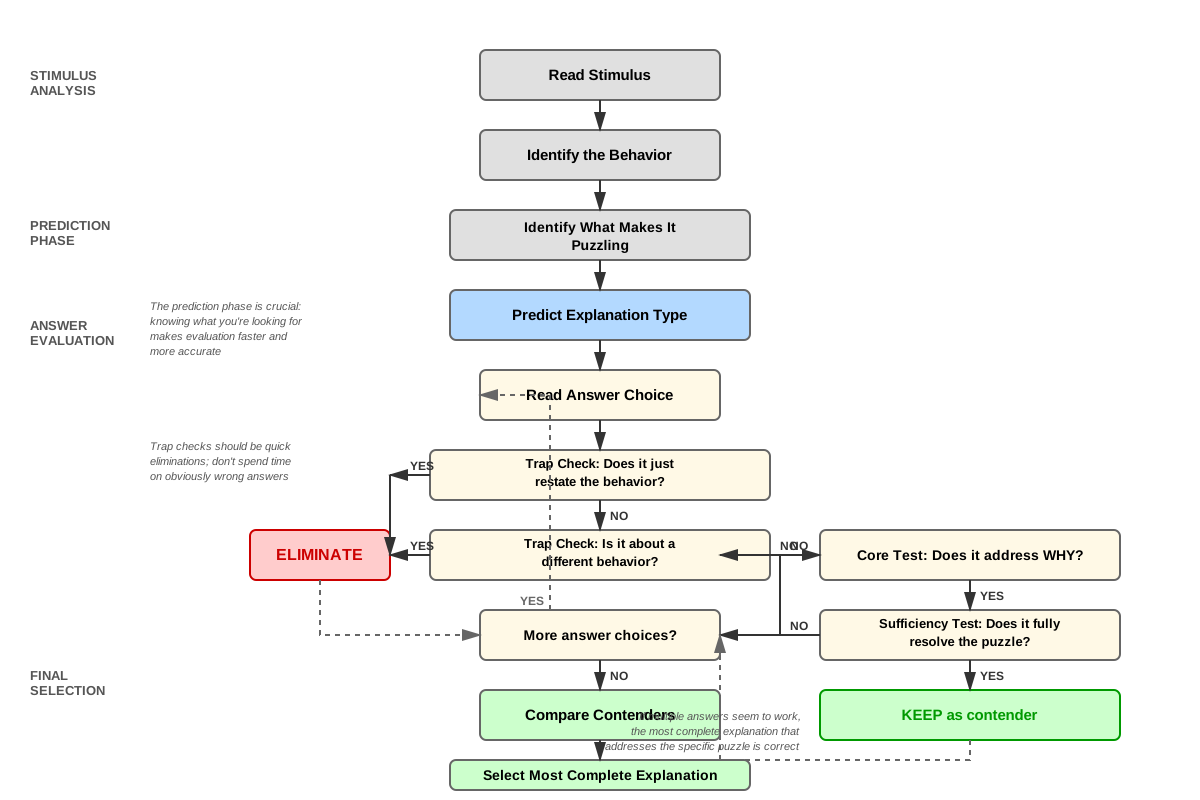
When approaching lsat explaining behavior questions, follow this systematic process:
Step 1: Identify the behavior precisely. Underline or mentally note exactly what action, choice, or pattern requires explanation. Be specific—"consumers bought Product A" is different from "consumers bought more of Product A despite price increases." The details matter for determining what would constitute an adequate explanation.
Step 2: Articulate the explanatory gap. Ask yourself: "What makes this behavior puzzling, surprising, or in need of explanation?" Sometimes the stimulus explicitly states this ("This is surprising because..."), but often you must infer it from context. The gap might be a contradiction between stated values and actions, a violation of expected patterns, an apparently irrational choice, or an outcome that seems inconsistent with circumstances.
Step 3: Predict the explanation type. Based on the gap, anticipate whether the explanation will likely involve motivation (revealing hidden incentives or goals), constraints (showing limited options), information (revealing what actors knew), or mechanisms (describing causal processes). This prediction helps you quickly identify promising answer choices.
Step 4: Evaluate each answer with the sufficiency test. For each choice, ask: "If this is true, does the behavior still seem puzzling?" If yes, eliminate it. The correct answer should make you think, "Oh, that makes sense now" or "Given that, the behavior is no longer surprising."
Trigger words and phrases that signal explaining behavior questions include:
- "Which one of the following, if true, most helps to explain..."
- "Which one of the following, if true, best accounts for..."
- "Which one of the following, if true, most helps to resolve the apparent discrepancy..."
- "Which one of the following, if true, most helps to justify..."
- "The situation described above is best explained by which one of the following..."
Process-of-elimination strategies specific to this topic:
Eliminate answers that merely restate the behavior in different words—these are never correct. Eliminate answers that provide true but irrelevant information that doesn't address the specific explanatory gap. Eliminate answers that explain only part of the behavior when the question asks about the entire pattern. Eliminate answers that describe consequences of the behavior rather than causes or reasons for it. Eliminate answers that provide general background without connecting to the specific puzzle.
Time allocation advice: Spend 15-20 seconds carefully reading the stimulus and identifying the explanatory gap. This upfront investment prevents wasting time on answer choices that address the wrong puzzle. Spend 30-40 seconds evaluating answer choices, using the sufficiency test to quickly eliminate inadequate explanations. If stuck between two answers, return to the explanatory gap and ask which answer more completely resolves the specific puzzle presented.
Exam Tip: The most common trap in explaining behavior questions is selecting an answer that's true and related to the topic but doesn't actually explain the specific behavior. Always return to the precise explanatory gap before selecting your answer.
Memory Techniques
BRIDGES mnemonic for evaluating explanations:
- Behavior: Does the answer address the specific behavior in question?
- Relevant: Is the information directly connected to the explanatory gap?
- Introduces: Does it provide new information rather than restating what's known?
- Direct: Does it directly explain rather than describe or correlate?
- Gap: Does it close the explanatory gap completely?
- Expected: Does it make the behavior expected rather than puzzling?
- Sufficient: Is it adequate to account for the behavior given the circumstances?
MICE acronym for explanation types:
- Motivation: Reveals goals, incentives, or desires
- Information: Shows what actors knew or believed
- Constraint: Identifies limitations or obstacles
- Explanation (mechanism): Describes causal processes
Visualization strategy: Picture the behavior as a puzzle with a missing piece. The explanatory gap is the shape of the missing piece. Wrong answers are pieces that don't fit the shape (wrong type), are too small (insufficient), or belong to a different puzzle (irrelevant). The correct answer is the piece that fits perfectly and completes the picture.
The "Surprise Test": Before reading answer choices, complete this sentence: "This behavior is surprising because..." Your completion identifies the explanatory gap. After reading each answer choice, ask: "Given this information, would I still be surprised?" If yes, eliminate that choice.
Summary
Explaining behavior is a fundamental reasoning pattern on the LSAT that requires understanding how to make puzzling, contradictory, or unexpected behaviors comprehensible. Success depends on three core skills: precisely identifying what behavior requires explanation, recognizing the specific explanatory gap that makes the behavior puzzling, and distinguishing genuine explanations that bridge this gap from restatements, descriptions, or irrelevant information. Explanations come in four main types—motivation-based (revealing goals and incentives), constraint-based (showing limited options), information-based (revealing what actors knew), and mechanism-based (describing causal processes)—and must be sufficient to make the behavior expected rather than surprising given the specific circumstances described. The most common errors involve selecting answers that are true but irrelevant to the specific puzzle, that merely restate the behavior without explaining it, or that provide partial explanations leaving significant aspects unresolved. Mastering this topic requires systematic analysis: identify the behavior, articulate the gap, predict the explanation type, and test each answer for sufficiency in resolving the complete puzzle.
Key Takeaways
- Explaining behavior questions require identifying both the behavior itself and the specific explanatory gap that makes it puzzling or unexpected; missing either element leads to selecting wrong answers.
- Genuine explanations introduce new information that bridges the gap between circumstances and behavior; restatements, descriptions, and correlations without causal connection are never adequate explanations.
- The correct explanation must be sufficient to make the entire behavior comprehensible, not merely address part of the puzzle; partial explanations are incorrect on the LSAT.
- Motivation-based explanations (revealing hidden incentives or goals) are the most common type, particularly for questions involving consumer behavior, voting patterns, and organizational decisions.
- The sufficiency test is the most reliable evaluation tool: if the answer is true, does the behavior still seem surprising? If yes, eliminate that answer choice.
- Explanations must address the specific puzzle presented, not provide general background or true-but-irrelevant information; always return to the precise explanatory gap before selecting an answer.
- Understanding the four explanation types (MICE: Motivation, Information, Constraint, Explanation/mechanism) accelerates answer evaluation by helping predict what kind of information would resolve the puzzle.
Related Topics
Paradox Resolution Questions: These questions present apparent contradictions and ask which answer resolves the paradox. Mastering explaining behavior provides the foundation for paradox questions, as both require identifying what makes a situation puzzling and what information would make it comprehensible. The key difference is that paradoxes involve two seemingly contradictory facts, while behavior explanations focus on actions that seem inconsistent with circumstances or expectations.
Assumption Questions: Understanding what assumptions underlie arguments connects to explaining behavior because assumptions often involve unstated explanations for why premises support conclusions. The skills of identifying logical gaps and recognizing what information would bridge them transfer directly between these question types.
Strengthen and Weaken Questions: These questions often involve strengthening or weakening causal explanations for phenomena. The ability to evaluate whether information genuinely explains behavior versus merely correlating with it is essential for both explaining behavior questions and strengthen/weaken questions involving causal reasoning.
Principle Application Questions: Some principle questions involve applying general principles about when behaviors are justified or explained. Understanding the structure of behavioral explanations helps identify which principles apply to specific cases and how general rules connect to particular instances.
Practice CTA
Now that you've mastered the core concepts of explaining behavior, it's time to apply these skills to actual LSAT questions. The practice questions and flashcards will reinforce your ability to identify explanatory gaps, distinguish genuine explanations from restatements and irrelevant information, and evaluate answer choices for sufficiency. Remember: explaining behavior questions reward systematic analysis and careful attention to the specific puzzle presented. Each practice question you complete strengthens your pattern recognition and builds the confidence needed for test day success. Start practicing now to transform these concepts from theoretical knowledge into automatic analytical skills!
Sign up free to keep reading
Create a free AnvayaPrep account to finish this LSAT guide on Explaining behavior — plus flashcards and practice questions.