Overview
Explaining policy outcomes is a critical reasoning pattern that appears frequently in LSAT Logical Reasoning sections, particularly in questions involving causation and explanation. This topic tests the ability to analyze why certain policies, programs, or interventions produce specific results—or fail to produce expected results. Students must evaluate competing explanations for observed outcomes, identify which factors genuinely caused the results, and distinguish between correlation and causation in policy contexts.
The LSAT frequently presents scenarios where a government, organization, or institution implements a policy and observes certain outcomes. Test-takers must then determine what best explains those outcomes, whether the policy itself caused the results, or whether other factors were responsible. This reasoning pattern appears across multiple question types, including Strengthen, Weaken, Assumption, Paradox/Resolve, and Inference questions. Mastering this topic requires understanding how to evaluate causal claims, recognize alternative explanations, and assess the logical relationship between policy implementation and observed effects.
Within the broader framework of logical reasoning, explaining policy outcomes connects directly to fundamental concepts of causal reasoning, evidence evaluation, and argument analysis. This topic builds upon basic causal reasoning by adding complexity: policies operate in real-world contexts with multiple variables, confounding factors, and temporal considerations. Success on these questions requires not just identifying cause-and-effect relationships, but also evaluating whether the evidence presented genuinely supports the causal claim being made about a policy's effectiveness or impact.
Learning Objectives
- [ ] Identify how Explaining policy outcomes appears in LSAT questions
- [ ] Explain the reasoning pattern behind Explaining policy outcomes
- [ ] Apply Explaining policy outcomes to solve LSAT-style problems accurately
- [ ] Distinguish between genuine causal explanations and mere correlations in policy contexts
- [ ] Evaluate alternative explanations for observed policy outcomes
- [ ] Recognize common confounding variables that affect policy analysis
- [ ] Assess the strength of evidence supporting causal claims about policy effectiveness
Prerequisites
- Basic causal reasoning: Understanding cause-and-effect relationships is fundamental to evaluating whether a policy caused an observed outcome or whether other factors were responsible.
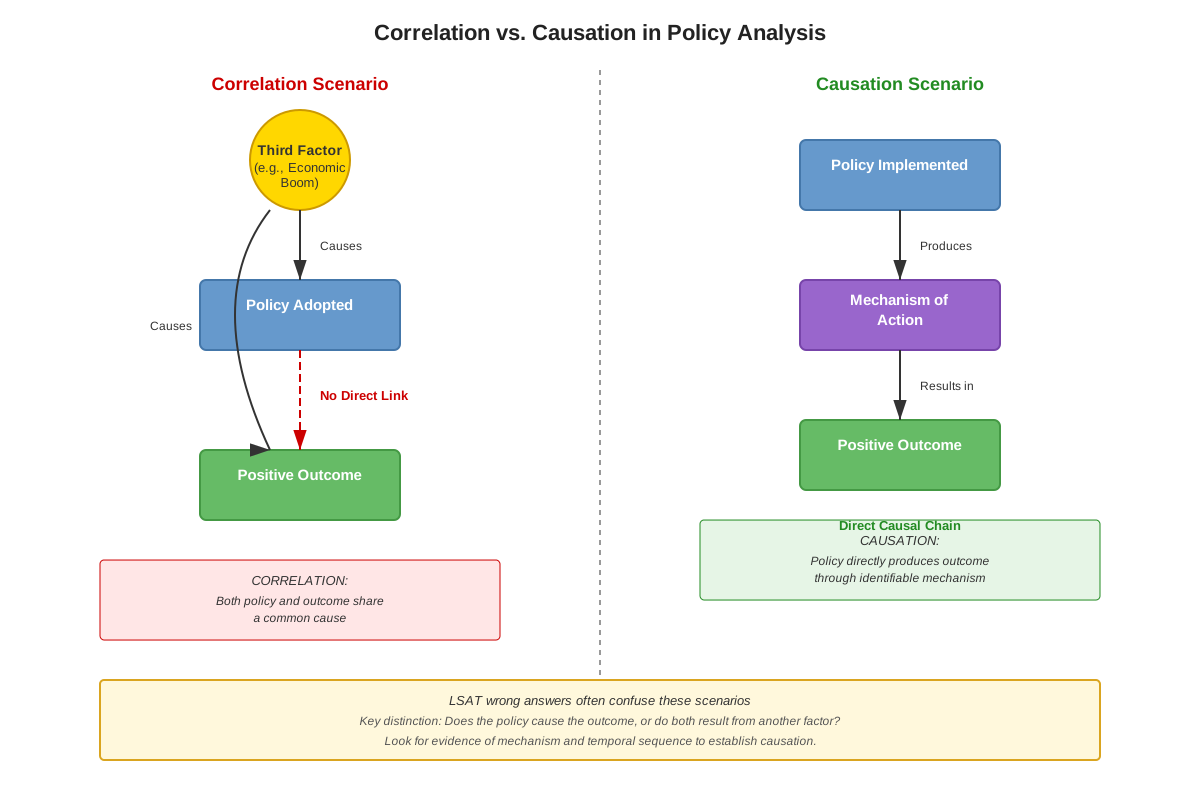
- Correlation vs. causation: Distinguishing between events that merely occur together and events where one actually causes the other is essential for policy outcome analysis.
- Argument structure: Recognizing premises, conclusions, and assumptions allows students to identify what evidence supports claims about policy effectiveness.
- Conditional reasoning: Understanding necessary and sufficient conditions helps evaluate whether a policy was required for an outcome or merely accompanied it.
- Evidence evaluation: Assessing the quality and relevance of evidence is crucial for determining which explanation best accounts for policy results.
Why This Topic Matters
In real-world contexts, policymakers, researchers, and citizens constantly evaluate whether government programs, organizational initiatives, and institutional reforms achieve their intended goals. The ability to accurately explain policy outcomes—distinguishing between effective policies and those that merely coincide with positive trends—has profound implications for resource allocation, program continuation, and evidence-based decision-making. This reasoning skill extends beyond government policy to business strategy, educational interventions, and personal decision-making about which actions produce desired results.
On the LSAT, explaining policy outcomes appears in approximately 15-20% of Logical Reasoning questions, making it a high-yield topic for test preparation. These questions most commonly appear as Strengthen/Weaken questions (where students must identify evidence that supports or undermines a causal claim about policy effectiveness), Paradox questions (where students must explain unexpected policy results), and Assumption questions (where students must identify what must be true for a policy explanation to hold). The topic also appears in Inference questions that require drawing conclusions about what caused observed outcomes.
LSAT explaining policy outcomes questions typically present scenarios such as: a city implements a traffic safety program and accident rates decline; a school adopts a new curriculum and test scores improve; a company changes its management structure and productivity increases. The test then asks whether the policy caused the outcome, what evidence would strengthen or weaken that claim, what alternative explanations exist, or what assumptions underlie the causal argument. Recognizing these patterns allows students to quickly identify the logical structure and apply appropriate analytical strategies.
Core Concepts
The Basic Structure of Policy Outcome Arguments
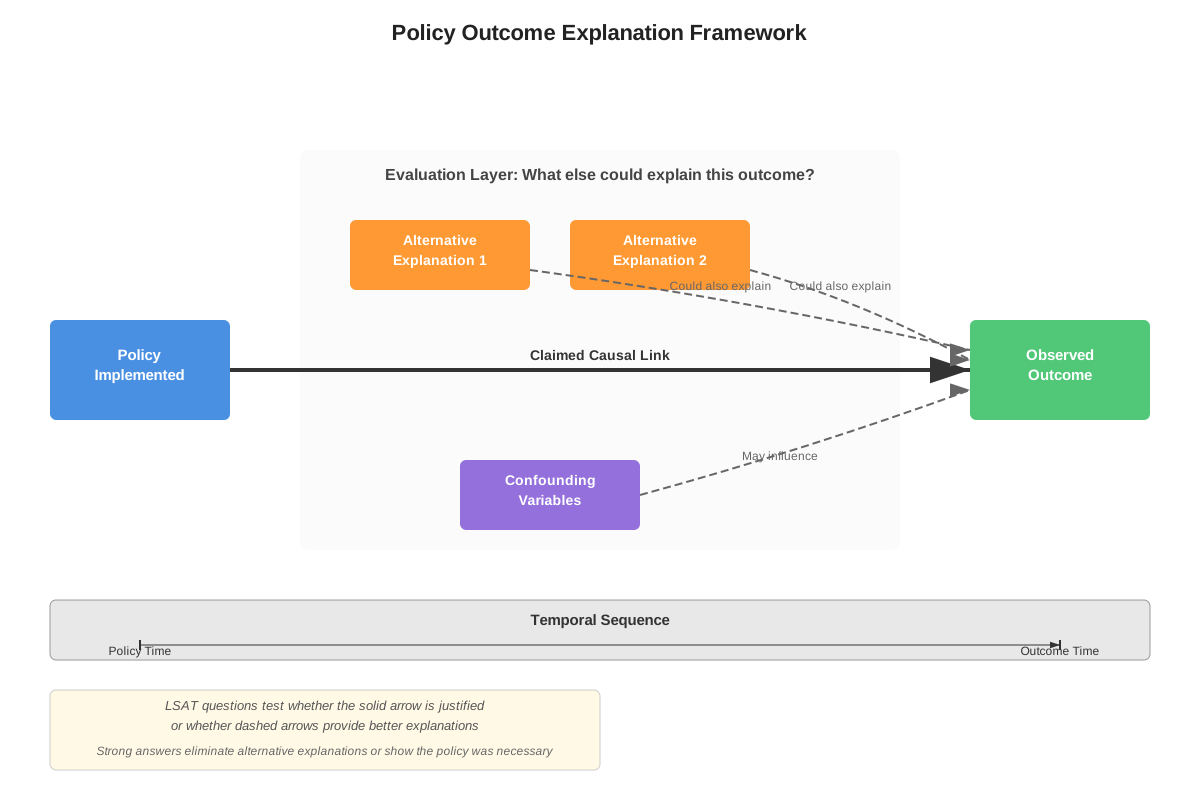
Explaining policy outcomes involves analyzing arguments that follow this general structure: (1) a policy, program, or intervention is implemented; (2) an outcome is observed following implementation; (3) a conclusion is drawn that the policy caused or contributed to the outcome. The logical challenge lies in evaluating whether the evidence genuinely supports the causal claim or whether alternative explanations better account for the results.
The temporal sequence is crucial: the policy must precede the outcome for a causal relationship to be plausible. However, temporal precedence alone does not establish causation—many factors may change between policy implementation and outcome observation. Strong policy outcome explanations must address why the policy, specifically, produced the result rather than other concurrent changes.
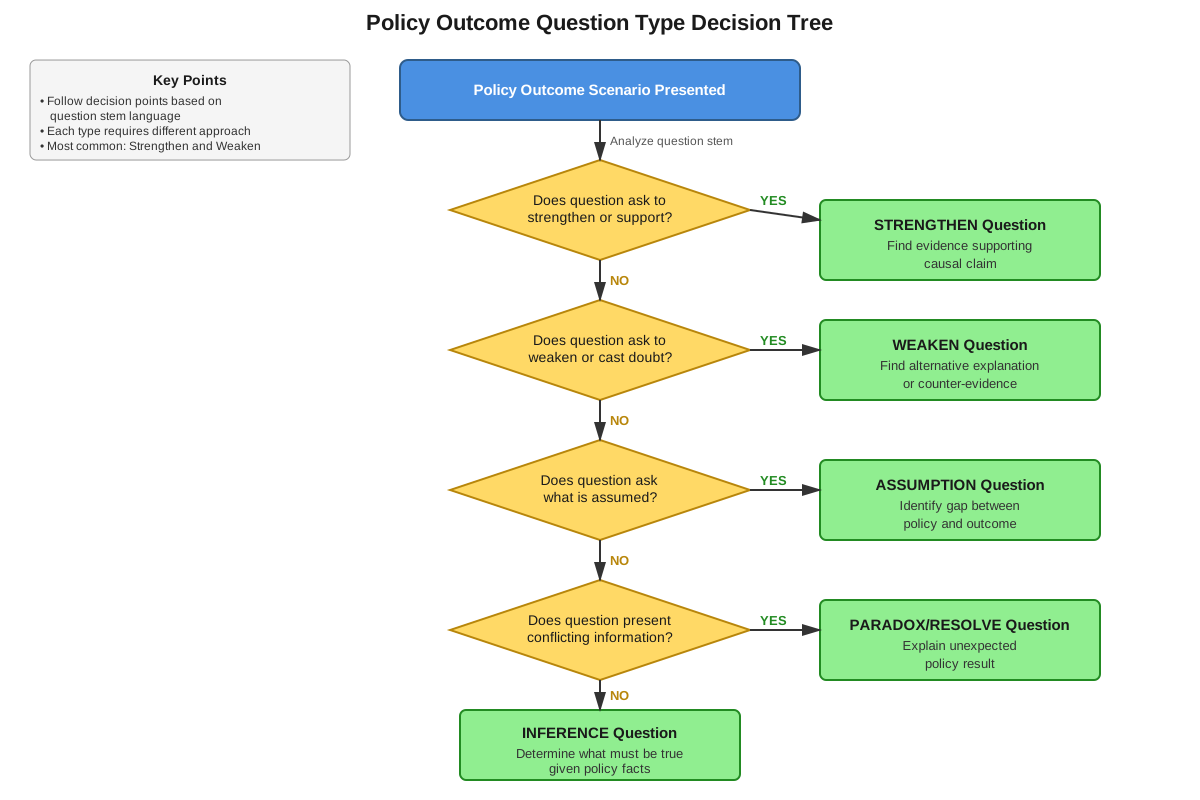
Types of Policy Outcome Questions
LSAT questions about policy outcomes fall into several categories:
| Question Type | What It Tests | Example Task |
|---|---|---|
| Strengthen | Evidence supporting causal claim | Identify data showing the policy caused the outcome |
| Weaken | Evidence undermining causal claim | Identify alternative explanations or contradictory evidence |
| Assumption | Unstated premises required | Identify what must be true for the causal claim to hold |
| Paradox/Resolve | Explaining unexpected results | Explain why a policy produced surprising outcomes |
| Inference | Drawing conclusions from data | Determine what can be concluded about policy effectiveness |
Alternative Explanations and Confounding Variables
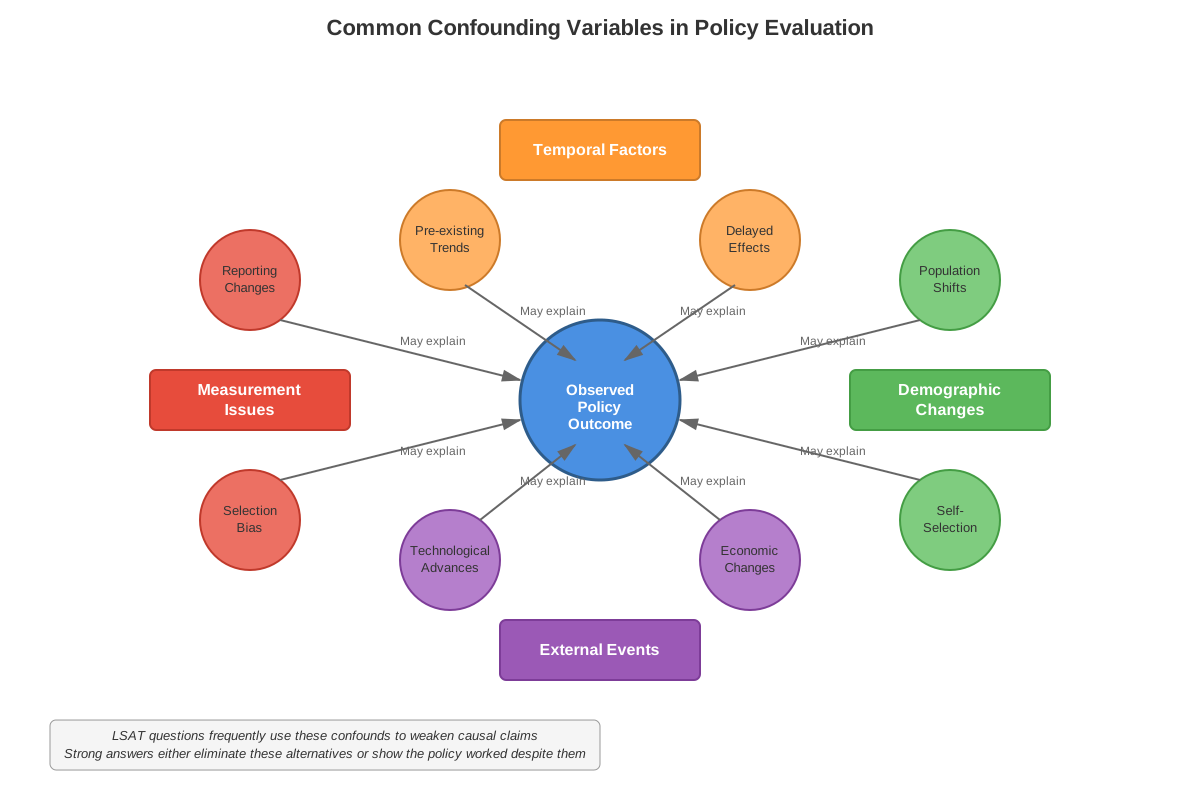
The most critical skill in analyzing policy outcomes is recognizing alternative explanations—factors other than the policy that could account for observed results. Common alternative explanations include:
- Pre-existing trends: The outcome was already improving before policy implementation
- External factors: Unrelated events or conditions changed simultaneously with the policy
- Natural cycles: The outcome fluctuates naturally, and observation occurred during an upswing
- Selection effects: The policy was implemented in contexts already predisposed to improvement
- Measurement changes: The outcome appears different due to how it's measured, not actual change
For example, if a city implements a crime reduction program and crime rates fall, alternative explanations might include: crime was already declining before the program started; economic conditions improved, reducing crime motivation; demographic shifts changed the population composition; or neighboring cities also experienced crime reductions without similar programs.
Establishing Genuine Causal Relationships
To establish that a policy genuinely caused an outcome, arguments must address several criteria:
Temporal precedence: The policy must occur before the outcome. If crime rates were already declining before the program started, the program cannot claim credit for the initial decline.
Covariation: The outcome should vary with the policy. If the policy is implemented in some locations but not others, outcomes should differ between these groups in predictable ways.
Elimination of alternatives: The argument must rule out or account for other plausible explanations. Strong arguments explicitly address why alternative factors cannot explain the results.
Mechanism: The argument should explain how the policy produced the outcome through a plausible causal mechanism. Simply showing that a policy preceded an outcome is weaker than explaining the process by which the policy generated the result.
The Role of Comparison Groups
Many strong policy outcome arguments rely on comparison groups or control conditions. If a school implements a new reading program and student scores improve, the improvement is more convincing if:
- Schools without the program did not experience similar improvements
- The improvement exceeded general trends in educational achievement
- Similar schools with different programs showed different results
Comparison groups help isolate the policy's effect from other factors affecting all similar contexts. LSAT questions often strengthen policy outcome arguments by introducing comparison data or weaken them by showing that comparison groups experienced identical outcomes without the policy.
Necessary vs. Sufficient Conditions in Policy Analysis
Understanding whether a policy was necessary (required for the outcome) or sufficient (adequate by itself to produce the outcome) clarifies causal claims:
- A policy is necessary if the outcome would not have occurred without it
- A policy is sufficient if it alone can produce the outcome, regardless of other factors
- Most policies are neither strictly necessary nor sufficient but contribute to outcomes alongside other factors
LSAT questions may test whether students recognize that a policy's correlation with an outcome does not establish that the policy was necessary or sufficient for that outcome.
Time Lag and Delayed Effects
Policy outcomes may not appear immediately after implementation. Some policies require time to produce effects, creating analytical challenges:
- Immediate attribution errors: Attributing outcomes to recent policies when earlier policies actually caused them
- Delayed effect recognition: Failing to credit policies whose effects emerge gradually
- Intervening factors: More time between policy and outcome allows more alternative explanations
Strong arguments about policy outcomes account for appropriate time lags and distinguish between immediate and long-term effects.
Concept Relationships
The concepts within explaining policy outcomes form an interconnected analytical framework. Alternative explanations directly challenge the basic causal claim that a policy produced an outcome, requiring arguments to address confounding variables through comparison groups or other evidence. The strength of a policy outcome explanation depends on how well it establishes temporal precedence, demonstrates covariation, and provides a plausible causal mechanism while eliminating competing explanations.
This topic connects to prerequisite knowledge of causation and explanation by applying general causal reasoning principles to the specific context of policy analysis. The distinction between correlation and causation becomes particularly important when evaluating whether a policy's temporal association with an outcome indicates genuine causal influence. Conditional reasoning helps determine whether a policy was necessary or sufficient for an outcome.
The relationship map flows as follows:
Policy Implementation → Observed Outcome → Causal Claim (policy caused outcome) → Evaluation (considering alternative explanations, confounding variables, comparison groups) → Conclusion (whether evidence supports causal claim)
This topic also connects forward to more advanced logical reasoning concepts including experimental design, statistical reasoning, and complex causal chains involving multiple factors.
High-Yield Facts
⭐ Temporal sequence alone does not establish causation—a policy occurring before an outcome does not prove the policy caused the outcome.
⭐ Pre-existing trends are the most common alternative explanation—if an outcome was already improving before policy implementation, the policy may not deserve credit.
⭐ Comparison groups strengthen causal claims—showing that similar contexts without the policy did not experience the same outcome supports the policy's causal role.
⭐ Multiple factors typically contribute to policy outcomes—real-world results rarely have single causes, so arguments claiming a policy was the sole cause are usually vulnerable.
⭐ Correlation between policy and outcome is necessary but not sufficient for causation—the policy and outcome must be associated, but association alone does not prove causation.
- Alternative explanations weaken arguments that a policy caused an outcome by providing other plausible causes.
- Eliminating alternative explanations strengthens arguments that a policy caused an outcome.
- Selection effects occur when policies are implemented in contexts already predisposed to the desired outcome.
- Natural cycles and regression to the mean can create the appearance of policy effectiveness when outcomes would have improved anyway.
- Measurement changes can create apparent outcome changes without actual substantive change.
- The mechanism by which a policy produces an outcome strengthens causal claims beyond mere temporal association.
- Time lags between policy implementation and outcome observation allow more opportunities for confounding variables.
- External factors affecting all similar contexts (like economic conditions) can produce outcomes independent of specific policies.
Quick check — test yourself on Explaining policy outcomes so far.
Try Flashcards →Common Misconceptions
Misconception: If a policy was implemented and the desired outcome occurred, the policy must have caused the outcome.
Correction: Temporal sequence does not establish causation. Many factors change over time, and the outcome might have occurred regardless of the policy. Strong causal claims require evidence eliminating alternative explanations and demonstrating that the policy specifically produced the result.
Misconception: If a policy was intended to produce an outcome and that outcome occurred, the policy was effective.
Correction: Intentions do not determine effectiveness. A policy designed to reduce crime might be implemented during a period when crime was already declining for unrelated reasons. Effectiveness requires showing the policy caused additional improvement beyond what would have occurred anyway.
Misconception: If no single alternative explanation fully accounts for an outcome, the policy must have caused it.
Correction: Multiple alternative factors might collectively explain the outcome without the policy playing a causal role. Additionally, the absence of a complete alternative explanation does not prove the policy explanation is correct—it may simply mean insufficient information exists to identify the true cause.
Misconception: If a policy is associated with positive outcomes in one context, it will produce similar outcomes in other contexts.
Correction: Policy effectiveness often depends on specific contextual factors. A program successful in one city might fail in another due to different demographics, resources, existing infrastructure, or cultural factors. Generalization requires evidence that the policy works across varied contexts.
Misconception: Strengthening a policy outcome argument requires showing the policy was the only factor that changed.
Correction: Showing the policy was the only change would strengthen the argument, but this is rarely possible in real-world contexts. Arguments can be strengthened by showing the policy was the most significant change, by providing comparison groups, or by demonstrating a plausible causal mechanism even when other factors also changed.
Misconception: If outcomes improved after a policy was implemented, any evidence of improvement supports the policy's effectiveness.
Correction: The improvement must exceed what would have occurred without the policy. If comparison groups without the policy showed equal or greater improvement, this actually weakens rather than strengthens the claim that the policy was effective.
Worked Examples
Example 1: Traffic Safety Program
Stimulus: "City officials implemented a new traffic safety program in January, including increased police patrols and public awareness campaigns. By December of that year, traffic fatalities had decreased by 15% compared to the previous year. The officials concluded that the traffic safety program successfully reduced traffic deaths."
Question: Which of the following, if true, most weakens the officials' conclusion?
Answer Choices:
(A) The traffic safety program cost less than initially projected.
(B) Traffic fatalities had been declining by approximately 15% annually for the previous three years.
(C) Surveys showed that 60% of residents were aware of the traffic safety program.
(D) Neighboring cities without similar programs also experienced traffic fatality reductions.
(E) The police officers involved in the program received specialized training.
Analysis:
The argument structure is: Policy implemented (traffic safety program) → Outcome observed (15% reduction in fatalities) → Conclusion (program caused the reduction).
To weaken this argument, we need evidence suggesting an alternative explanation or showing the outcome would have occurred without the policy.
(A) The program's cost is irrelevant to whether it caused the fatality reduction. This neither strengthens nor weakens the causal claim. Eliminate.
(B) This provides a pre-existing trend alternative explanation. If fatalities were already declining by 15% annually before the program started, the observed 15% decline might simply continue that trend rather than result from the program. This directly challenges the causal claim by suggesting the outcome would have occurred anyway. Strong contender.
(C) Public awareness might seem relevant, but this actually provides mild support for the program's effectiveness rather than weakening it. If residents were aware of the program, it's more plausible the program influenced behavior. Eliminate.
(D) This provides an external factor alternative explanation. If neighboring cities without the program experienced similar reductions, this suggests some other factor (regional economic conditions, weather patterns, vehicle safety improvements) caused the decline rather than the specific program. Strong contender.
(E) Specialized training for officers involved in the program, if anything, makes the program more likely to be effective. This does not weaken the argument. Eliminate.
Comparing (B) and (D): Both provide alternative explanations, but (B) is more direct and specific. The pre-existing trend of exactly 15% annual decline perfectly matches the observed outcome, suggesting the program added nothing beyond the existing trend. Choice (D) is also strong but less specific about the magnitude of reduction in neighboring cities.
Correct Answer: (B)
Connection to Learning Objectives: This example demonstrates identifying how explaining policy outcomes appears in LSAT questions (Weaken question type), explaining the reasoning pattern (policy → outcome → causal claim vulnerable to alternative explanations), and applying the concept to solve the problem by recognizing pre-existing trends as a powerful alternative explanation.
Example 2: Educational Intervention
Stimulus: "Riverside Elementary School implemented a new mathematics curriculum emphasizing hands-on learning. The following year, the school's average mathematics test scores increased by 12 points. However, during the same period, the district hired additional mathematics specialists who worked with struggling students across all elementary schools, and the state revised its mathematics standards, making the test somewhat easier. Nevertheless, the principal concluded that the new curriculum was responsible for the improved scores."
Question: The principal's conclusion is most vulnerable to criticism on the grounds that it:
Analysis:
This stimulus explicitly presents multiple factors that changed simultaneously with the curriculum implementation: (1) new curriculum, (2) additional mathematics specialists, (3) easier test. The principal attributes the improvement solely to the curriculum.
The argument's vulnerability lies in failing to eliminate alternative explanations. The principal has not established that the curriculum, rather than the specialists or easier test, caused the improvement.
The correct answer will identify this flaw: the argument fails to rule out that other factors caused the outcome.
Reasoning Pattern: This exemplifies a common LSAT pattern where multiple changes occur simultaneously, making it impossible to attribute the outcome to any single factor without additional evidence. Strong answers to "vulnerable to criticism" questions identify what the argument failed to consider or establish.
Key Insight: The presence of multiple confounding variables (specialists, easier test) means the curriculum might have contributed nothing to the improvement. Perhaps the specialists alone would have produced a 12-point increase, or perhaps the easier test fully accounts for the higher scores. Without comparison data (schools with the curriculum but without specialists, or schools with specialists but without the curriculum), the causal claim is unsupported.
Connection to Learning Objectives: This example shows how LSAT questions test the ability to recognize when arguments fail to account for confounding variables and alternative explanations. It demonstrates the reasoning pattern where multiple factors change simultaneously, requiring careful evaluation of which factor(s) caused the observed outcome.
Exam Strategy
Identifying Policy Outcome Questions
Watch for these trigger phrases that signal policy outcome questions:
- "The policy/program/intervention resulted in..."
- "Following implementation of..."
- "After the city/school/company adopted..."
- "The decline/increase can be attributed to..."
- "This shows that the policy was effective/successful..."
These phrases indicate arguments making causal claims about policy effectiveness that require evaluation.
Systematic Approach to Policy Outcome Questions
Step 1: Identify the policy and the outcome. Clearly distinguish what was implemented from what was observed.
Step 2: Identify the causal claim. What does the argument conclude about the relationship between policy and outcome?
Step 3: Consider alternative explanations. Before looking at answer choices, brainstorm what else might have caused the outcome:
- Was there a pre-existing trend?
- What external factors might have changed?
- Could this be a natural cycle or regression to the mean?
- Were there selection effects?
Step 4: For Strengthen questions, look for answers that:
- Provide comparison groups showing different outcomes without the policy
- Eliminate alternative explanations
- Demonstrate a plausible causal mechanism
- Show covariation between policy and outcome
Step 5: For Weaken questions, look for answers that:
- Introduce alternative explanations
- Show pre-existing trends
- Provide comparison groups with similar outcomes despite lacking the policy
- Demonstrate the outcome occurred before the policy
Step 6: For Assumption questions, identify what must be true for the causal claim to hold:
- No alternative explanation fully accounts for the outcome
- The outcome was not already occurring before the policy
- The policy reached the population experiencing the outcome
Time Management
Policy outcome questions typically require 60-90 seconds. Allocate time as follows:
- 20-30 seconds: Read and understand the stimulus, identifying policy, outcome, and causal claim
- 10-15 seconds: Consider alternative explanations before viewing choices
- 30-45 seconds: Evaluate answer choices, eliminating clear wrong answers and comparing strong contenders
Process of Elimination Tips
Eliminate answers that:
- Address irrelevant factors (cost, popularity, intentions) rather than causal relationships
- Strengthen when you need to weaken, or vice versa
- Introduce information that doesn't connect to the causal claim
- Are too weak to significantly impact the argument
Keep answers that:
- Directly address whether the policy caused the outcome
- Introduce or eliminate alternative explanations
- Provide comparison data
- Address temporal relationships between policy and outcome
Memory Techniques
PACT Mnemonic for Evaluating Policy Outcomes
Pre-existing trends: Was the outcome already occurring before the policy?
Alternative explanations: What else could have caused the outcome?
Comparison groups: Did similar contexts without the policy show different outcomes?
Temporal sequence: Did the policy actually precede the outcome?
Use PACT to systematically evaluate whether a policy genuinely caused an outcome.
The "Three Questions" Framework
When analyzing any policy outcome argument, ask:
- "What else changed?" (Identifies confounding variables and alternative explanations)
- "What would have happened anyway?" (Identifies pre-existing trends and natural cycles)
- "How do we know?" (Evaluates the quality of evidence supporting the causal claim)
Visualization Strategy
Picture a timeline with three points:
BEFORE (pre-policy baseline) → POLICY (implementation) → AFTER (observed outcome)
Strong causal claims require showing that AFTER differs from BEFORE in ways attributable to POLICY rather than other factors. Visualize alternative explanations as competing arrows pointing from BEFORE to AFTER that bypass POLICY.
Alternative Explanation Acronym: SPENT
Selection effects: Was the policy implemented where improvement was already likely?
Pre-existing trends: Was the outcome already improving?
External factors: What else changed in the environment?
Natural cycles: Does the outcome fluctuate naturally?
Testing/measurement changes: Did how we measure the outcome change?
Summary
Explaining policy outcomes is a high-yield LSAT topic testing the ability to evaluate causal claims about policy effectiveness. These questions present scenarios where a policy is implemented and an outcome is observed, then ask whether the policy caused the outcome. Success requires distinguishing genuine causal relationships from mere temporal associations by considering alternative explanations, pre-existing trends, confounding variables, and comparison groups. Strong policy outcome arguments establish temporal precedence, demonstrate covariation, provide plausible causal mechanisms, and eliminate alternative explanations. Weak arguments commit the post hoc fallacy of assuming that because an outcome followed a policy, the policy caused the outcome. LSAT questions test this reasoning pattern through Strengthen, Weaken, Assumption, and Paradox questions, requiring students to identify evidence that supports or undermines causal claims about policy effectiveness. Mastering this topic requires systematic evaluation of what else might have caused observed outcomes and whether the evidence genuinely supports attributing results to the policy rather than other factors.
Key Takeaways
- Temporal sequence does not equal causation: A policy occurring before an outcome does not prove the policy caused the outcome; alternative explanations must be eliminated.
- Pre-existing trends are the most powerful alternative explanation: If an outcome was already improving before policy implementation, the policy may not deserve credit for continued improvement.
- Comparison groups strengthen causal claims: Showing that contexts without the policy experienced different outcomes provides strong evidence for the policy's causal role.
- Multiple factors typically contribute to real-world outcomes: Arguments claiming a policy was the sole cause are vulnerable unless they eliminate other plausible contributing factors.
- Use PACT to evaluate policy outcomes systematically: Check for Pre-existing trends, Alternative explanations, Comparison groups, and Temporal sequence.
- Strengthen questions require evidence supporting the causal claim: Look for comparison data, eliminated alternatives, or demonstrated mechanisms.
- Weaken questions require alternative explanations or contradictory evidence: Pre-existing trends and comparison groups showing similar outcomes without the policy are particularly effective.
Related Topics
Causal Reasoning Fundamentals: Understanding basic cause-and-effect relationships provides the foundation for analyzing policy outcomes. Mastering policy outcome questions deepens causal reasoning skills by adding real-world complexity.
Experimental Design and Control Groups: Learning how scientific experiments establish causation through controlled conditions illuminates why comparison groups strengthen policy outcome arguments.
Statistical Reasoning: Understanding concepts like correlation, regression to the mean, and confounding variables enhances the ability to evaluate quantitative evidence about policy effectiveness.
Necessary and Sufficient Conditions: Analyzing whether policies are necessary or sufficient for outcomes refines understanding of causal relationships beyond simple "caused by" claims.
Argument Evaluation: The broader skill of assessing argument strength applies directly to evaluating whether evidence supports causal claims about policy outcomes.
Practice CTA
Now that you understand the reasoning patterns behind explaining policy outcomes, you're ready to apply these concepts to practice questions. Work through the practice problems systematically, using the PACT framework and the "Three Questions" to evaluate each argument. Pay special attention to identifying alternative explanations and recognizing when comparison groups strengthen or weaken causal claims. Review the flashcards to reinforce high-yield facts about pre-existing trends, confounding variables, and temporal relationships. Mastering this topic will significantly improve your performance on Logical Reasoning questions—these skills appear across 15-20% of questions and directly translate to higher scores. You've built a strong conceptual foundation; now solidify it through deliberate practice!
Sign up free to keep reading
Create a free AnvayaPrep account to finish this LSAT guide on Explaining policy outcomes — plus flashcards and practice questions.