Overview
Observational studies represent a critical category of evidence that appears frequently in LSAT Logical Reasoning questions, particularly within the domain of causation and explanation. Unlike controlled experiments where researchers actively manipulate variables, observational studies involve researchers passively observing and recording data about subjects without intervention. This distinction creates unique logical vulnerabilities that the LSAT exploits extensively to test a student's ability to evaluate arguments, identify flaws, and distinguish between correlation and causation.
Understanding observational studies is essential for LSAT success because these studies form the evidentiary basis for numerous arguments that appear in Logical Reasoning sections. The LSAT frequently presents arguments that draw causal conclusions from observational data, and test-takers must recognize the inherent limitations of such reasoning. Questions may ask students to identify assumptions, strengthen or weaken arguments, find flaws, or evaluate the logical structure of claims based on observational evidence. The ability to spot when an argument inappropriately infers causation from mere correlation—a hallmark weakness of observational studies—is a high-yield skill that appears across multiple question types.
Within the broader landscape of logical reasoning, observational studies connect intimately with concepts of causal reasoning, alternative explanations, necessary and sufficient conditions, and argument evaluation. Mastering this topic enables students to navigate complex arguments about scientific studies, policy recommendations, and explanatory hypotheses—all common LSAT territory. The reasoning patterns associated with observational studies also underpin many strengthen/weaken questions, flaw questions, and assumption questions, making this topic a cornerstone of comprehensive LSAT preparation.
Learning Objectives
- [ ] Identify how observational studies appears in LSAT questions
- [ ] Explain the reasoning pattern behind observational studies
- [ ] Apply observational studies to solve LSAT-style problems accurately
- [ ] Distinguish between observational studies and controlled experiments in argument contexts
- [ ] Recognize the three major confounding variable patterns that undermine causal claims from observational data
- [ ] Evaluate whether an argument's conclusion is appropriately supported by observational evidence
- [ ] Generate alternative explanations for correlations observed in study data
Prerequisites
- Basic understanding of correlation versus causation: Essential for recognizing when arguments inappropriately infer causal relationships from mere associations observed in data.
- Familiarity with argument structure (premise-conclusion relationships): Necessary to identify where observational study data functions as evidence and what claims are being made from that evidence.
- Understanding of necessary and sufficient conditions: Helps evaluate whether observed correlations establish the logical relationships claimed in conclusions.
- Knowledge of common argument flaws: Provides context for understanding why observational studies create specific vulnerabilities in logical reasoning.
Why This Topic Matters
Observational studies appear in real-world contexts ranging from medical research and public health policy to social science and business decision-making. Researchers use observational methods when controlled experiments are impractical, unethical, or impossible—for instance, studying the long-term health effects of smoking or examining the relationship between education levels and income. Understanding the logical limitations of observational evidence helps evaluate claims in professional, academic, and civic contexts where policy decisions rest on such research.
On the LSAT, observational studies appear with remarkable frequency, particularly in Logical Reasoning sections. Approximately 15-20% of Logical Reasoning questions involve arguments based on studies, surveys, or statistical evidence, with observational studies representing a substantial portion of these. The topic appears most commonly in:
- Flaw questions: Identifying that an argument improperly infers causation from correlation
- Weaken questions: Introducing alternative explanations or confounding variables
- Strengthen questions: Eliminating alternative explanations or addressing confounds
- Assumption questions: Recognizing unstated premises about the absence of confounding factors
- Method of reasoning questions: Describing how observational evidence functions in an argument
The LSAT favors observational studies because they create rich opportunities to test critical thinking about evidence, causation, and alternative explanations—core competencies for legal reasoning. Test-makers can craft sophisticated questions that require students to navigate the gap between "what was observed" and "what can legitimately be concluded."
Core Concepts
Definition and Characteristics of Observational Studies
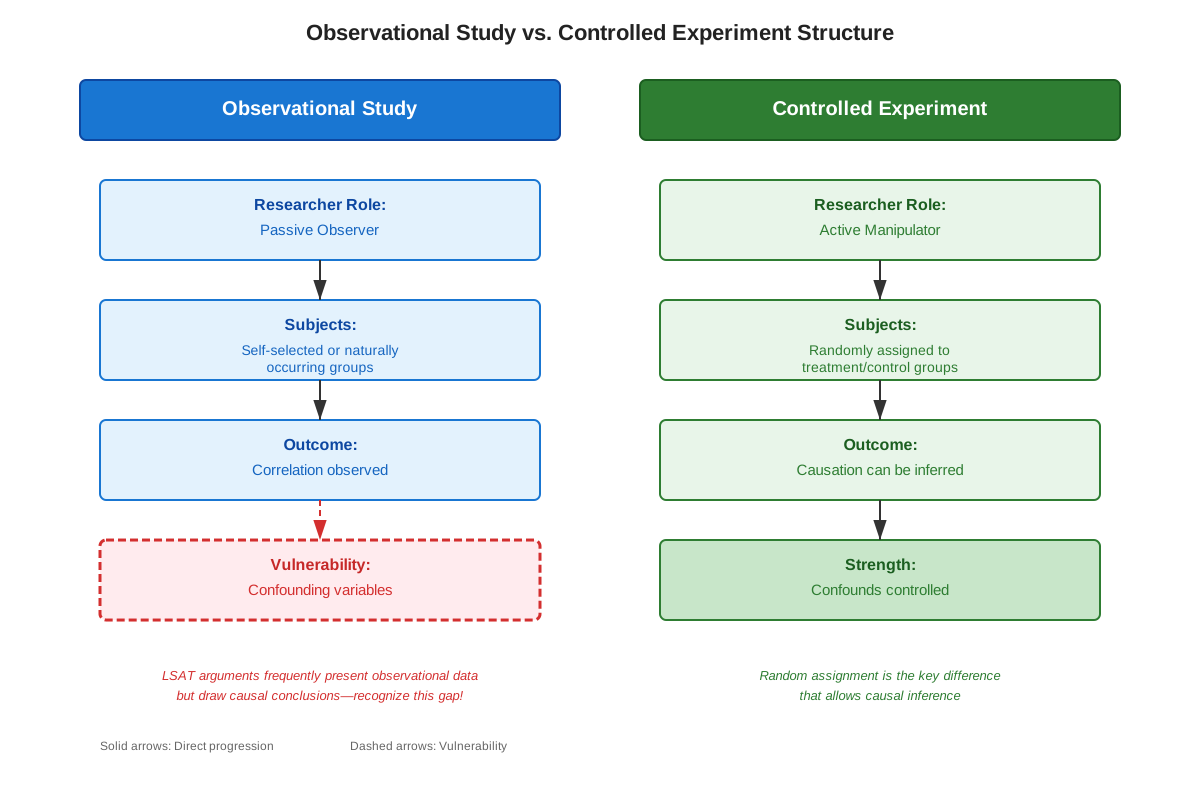
Observational studies are research investigations in which researchers observe and measure variables without actively manipulating or controlling them. Researchers record what naturally occurs, identifying patterns, correlations, and associations within the data. The defining characteristic is the absence of experimental intervention—subjects are not randomly assigned to treatment groups, and conditions are not artificially controlled.
Key features include:
- Passive data collection without researcher manipulation
- Subjects self-select into groups or categories based on existing characteristics
- Natural variation in variables rather than controlled variation
- Ability to identify correlations but limited capacity to establish causation
- Susceptibility to confounding variables and alternative explanations
The Correlation-Causation Gap
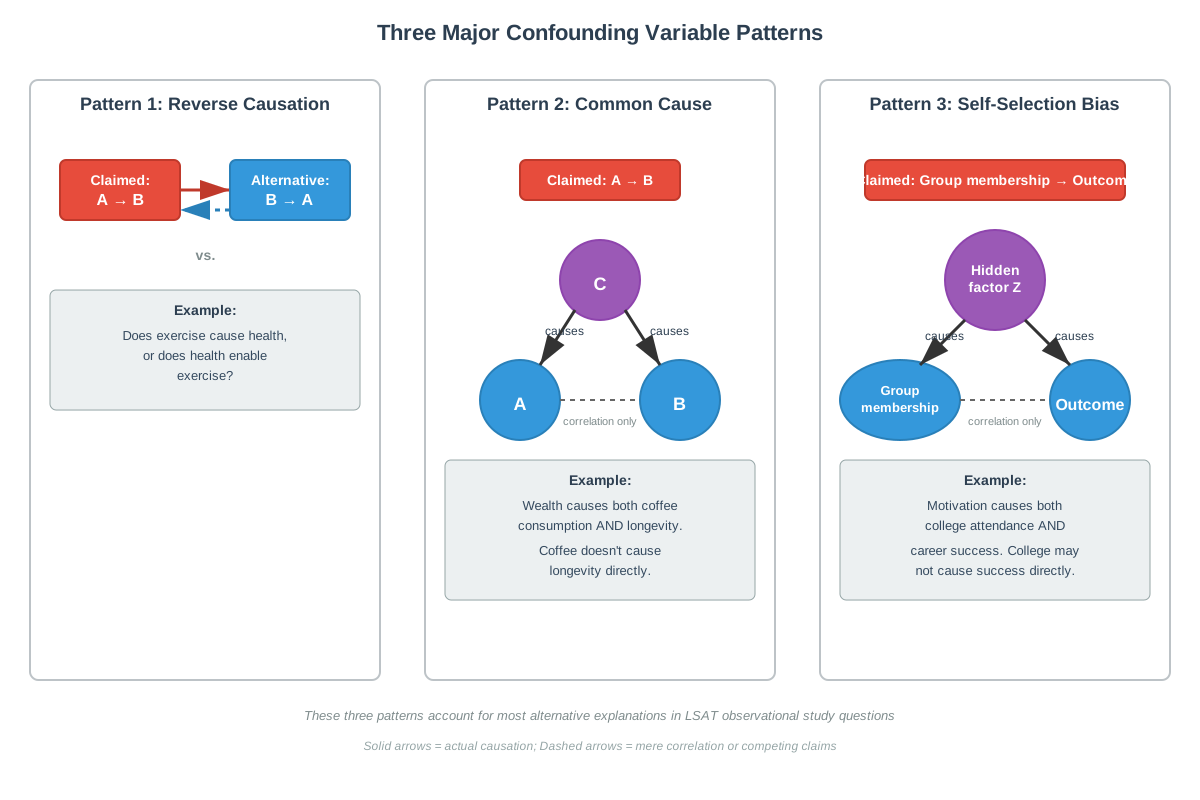
The central logical challenge with observational studies involves the distinction between correlation and causation. When two variables correlate (vary together in a predictable pattern), three possible relationships exist:
- A causes B: The first variable directly produces changes in the second
- B causes A: The second variable directly produces changes in the first (reverse causation)
- C causes both A and B: A third variable (confounding variable) produces changes in both observed variables
Observational studies can establish that correlation exists but cannot, by themselves, determine which causal relationship (if any) explains the correlation. The LSAT exploits this gap relentlessly, presenting arguments that leap from observed correlation to causal conclusion without adequate justification.
Confounding Variables
A confounding variable (or confound) is an unobserved or uncontrolled factor that influences both the independent and dependent variables in a study, creating a spurious correlation. Confounding variables represent the most common vulnerability in arguments based on observational data.
Example: An observational study finds that people who drink coffee regularly have higher rates of heart disease. Before concluding that coffee causes heart disease, consider potential confounds:
- Smoking (coffee drinkers may be more likely to smoke)
- Stress levels (stressed individuals may drink more coffee and have higher heart disease risk)
- Sleep patterns (poor sleep may lead to both coffee consumption and health problems)
The LSAT frequently tests whether students can identify confounding variables that undermine causal claims or recognize when an argument fails to account for such variables.
Three Major Confounding Patterns
| Pattern | Description | Example |
|---|---|---|
| Common Cause | A third variable causes both observed variables | Poverty causes both poor nutrition and poor health outcomes |
| Reverse Causation | The presumed effect actually causes the presumed cause | Poor health causes sedentary behavior (not vice versa) |
| Self-Selection Bias | Subjects' pre-existing characteristics determine group membership | Motivated students choose challenging courses and perform well |
Temporal Sequence and Causation
For A to cause B, A must precede B in time. Observational studies sometimes fail to establish clear temporal sequences, creating ambiguity about causal direction. The LSAT tests whether students recognize when temporal ordering is unclear or when reverse causation might explain observed correlations.
Example: A study observes that employees who take more vacation days receive higher performance ratings. Does vacation improve performance, or do high performers earn more vacation time? Without temporal data showing vacation preceded performance improvements, both explanations remain viable.
Sample Selection and Generalizability
Observational studies often involve non-random samples, limiting the generalizability of findings. The LSAT tests whether students recognize when:
- A study's sample differs systematically from the population about which conclusions are drawn
- Selection criteria create biased samples that don't represent broader groups
- Conclusions overgeneralize from limited observational data
Control Groups and Comparison
Strong observational studies include appropriate comparison groups, though these groups aren't randomly assigned as in experiments. The LSAT may present arguments that:
- Draw conclusions without any comparison group
- Use inappropriate comparison groups that differ in multiple ways
- Fail to account for baseline differences between compared groups
Mechanism and Plausibility
Even when observational data shows correlation, causal claims gain strength when a plausible mechanism explains how one variable influences another. The LSAT sometimes includes or omits mechanistic explanations to test whether students recognize this element of causal reasoning.
Concept Relationships
The concepts within observational studies form an interconnected logical framework. Observational studies establish correlations between variables, but the correlation-causation gap prevents direct causal inference. This gap exists because confounding variables may explain observed correlations through common cause, reverse causation, or self-selection bias patterns. Establishing causation requires addressing confounds, confirming temporal sequence, ensuring appropriate sample selection, and ideally identifying a plausible mechanism.
These concepts connect to prerequisite knowledge: understanding correlation versus causation provides the foundation for recognizing the correlation-causation gap; knowledge of argument structure helps identify where observational evidence serves as premises for causal conclusions; familiarity with argument flaws contextualizes why observational studies create logical vulnerabilities.
Observational studies also connect forward to related topics in causation and explanation: controlled experiments (which address confounding through randomization), sufficient and necessary conditions (which formalize causal relationships), and alternative explanations (which represent the practical application of identifying confounds). The reasoning patterns learned here apply broadly across strengthen/weaken questions, assumption questions, and flaw identification throughout Logical Reasoning sections.
Relationship Map:
Observational Study → Identifies Correlation → Correlation-Causation Gap → Requires Ruling Out Confounds → Three Confounding Patterns (Common Cause, Reverse Causation, Self-Selection) → Additional Requirements (Temporal Sequence, Appropriate Sample, Plausible Mechanism) → Justified Causal Conclusion
High-Yield Facts
⭐ Observational studies can establish correlation but cannot, by themselves, prove causation without addressing alternative explanations.
⭐ A confounding variable is a third factor that influences both the independent and dependent variables, creating a spurious correlation.
⭐ The three major confounding patterns are common cause, reverse causation, and self-selection bias.
⭐ For A to cause B, A must temporally precede B; observational studies sometimes fail to establish clear temporal sequences.
⭐ Weaken questions about observational studies typically introduce confounding variables or alternative explanations for observed correlations.
- Strengthen questions about observational studies often eliminate potential confounds or provide evidence of temporal sequence.
- Assumption questions may require recognizing that an argument assumes no confounding variables exist.
- Observational studies involve passive observation without researcher manipulation of variables.
- Self-selection bias occurs when subjects' pre-existing characteristics determine which group they belong to, confounding causal interpretation.
- Sample selection problems arise when the studied group differs systematically from the population about which conclusions are drawn.
- A plausible mechanism explaining how one variable influences another strengthens causal claims from observational data.
- Comparison groups in observational studies are not randomly assigned, unlike in controlled experiments.
Quick check — test yourself on Observational studies so far.
Try Flashcards →Common Misconceptions
Misconception: If two variables correlate strongly, one must cause the other.
→ Correction: Strong correlation indicates association but doesn't establish causation; a third variable (confound) might cause both, or the causal direction might be reversed. Correlation is necessary but not sufficient for causation.
Misconception: Observational studies are worthless because they can't prove causation.
→ Correction: Observational studies provide valuable evidence and can support causal claims when alternative explanations are systematically ruled out. They're often the only ethical or practical research method available for certain questions.
Misconception: If a study controls for one confounding variable, the causal conclusion is proven.
→ Correction: Controlling for one confound strengthens an argument but doesn't eliminate all alternative explanations. Multiple confounds may exist, and the LSAT often tests whether students recognize remaining vulnerabilities.
Misconception: Temporal sequence alone proves causation (if A precedes B, A causes B).
→ Correction: Temporal precedence is necessary for causation but not sufficient. A third variable might cause both A and B at different times, or the correlation might be coincidental.
Misconception: Large sample sizes in observational studies eliminate the correlation-causation problem.
→ Correction: Sample size affects statistical reliability but doesn't address confounding variables. A large observational study can reliably establish correlation while still failing to prove causation.
Misconception: Self-selection bias only matters when subjects consciously choose groups.
→ Correction: Self-selection includes any situation where pre-existing characteristics determine group membership, whether through conscious choice or other mechanisms. For example, genetic factors might "select" individuals into groups with different health outcomes.
Worked Examples
Example 1: Identifying Confounds in a Weaken Question
Stimulus: "A recent observational study found that adults who regularly eat breakfast have lower rates of obesity than adults who skip breakfast. Therefore, eating breakfast prevents obesity, and public health campaigns should encourage breakfast consumption."
Question: Which of the following, if true, most weakens the argument?
Answer Choices:
(A) Some people who eat breakfast still become obese.
(B) The study included participants from diverse geographic regions.
(C) People who eat breakfast regularly tend to have more structured daily routines and better overall health habits than those who skip breakfast.
(D) Breakfast foods vary widely in nutritional content.
(E) The study followed participants for five years.
Analysis:
Step 1: Identify the argument structure. The premise is an observed correlation (breakfast eaters have lower obesity rates). The conclusion is a causal claim (eating breakfast prevents obesity).
Step 2: Recognize this as an observational study with the classic correlation-causation gap. The argument assumes no confounding variables explain the correlation.
Step 3: Evaluate each answer choice for confounding variables or alternative explanations.
(A) This shows the causal relationship isn't absolute, but doesn't provide an alternative explanation. Weak weakener.
(B) Geographic diversity might strengthen the study's generalizability but doesn't introduce a confound. Irrelevant.
(C) This introduces a confounding variable: structured routines and better health habits. These factors might cause both breakfast eating AND lower obesity rates, making the correlation spurious. This is a "common cause" confound pattern. Strong weakener.
(D) Nutritional variation is relevant but doesn't provide an alternative explanation for the correlation. Weak.
(E) Study duration doesn't address confounding variables. Irrelevant to the causal claim.
Answer: (C)
Connection to Learning Objectives: This example demonstrates identifying observational studies in LSAT questions, explaining the reasoning pattern (correlation-causation gap with confounding variable), and applying this knowledge to solve the problem by recognizing the common cause confound pattern.
Example 2: Recognizing Reverse Causation in an Assumption Question
Stimulus: "Researchers observed that patients who received frequent visits from family members during hospital stays recovered more quickly than patients who received few visits. The researchers concluded that family visits accelerate patient recovery."
Question: The researchers' conclusion depends on which of the following assumptions?
Answer Choices:
(A) All patients in the study had family members who could potentially visit.
(B) Patients whose conditions were improving were not more likely to receive family visits than patients whose conditions were stable or worsening.
(C) Family visits reduce patient stress levels.
(D) The hospital encouraged family visits for all patients.
(E) Patients who recovered quickly did not leave the hospital before receiving many visits.
Analysis:
Step 1: Identify the observational study structure. Correlation: frequent visits associated with faster recovery. Conclusion: visits cause faster recovery.
Step 2: Consider potential confounds, particularly reverse causation. Could faster recovery cause more visits rather than visits causing faster recovery?
Step 3: Evaluate answer choices for necessary assumptions.
(A) This addresses sample composition but isn't necessary for the causal claim. Patients without family could simply be excluded.
(B) This directly addresses reverse causation. If improving patients attract more visits (perhaps family members are more motivated to visit when recovery is progressing), then recovery causes visits rather than visits causing recovery. The argument must assume this reverse causation doesn't occur. Necessary assumption.
(C) This provides a mechanism but isn't necessary—visits might accelerate recovery through other mechanisms.
(D) Hospital policy doesn't affect whether the observed correlation reflects causation.
(E) This addresses a sampling issue but doesn't relate to the causal direction.
Answer: (B)
Connection to Learning Objectives: This example shows how observational studies appear in assumption questions, demonstrates the reverse causation confounding pattern, and illustrates applying this knowledge to identify necessary assumptions that rule out alternative causal directions.
Exam Strategy
Trigger Words and Phrases
Watch for language indicating observational studies:
- "A study found/observed/showed that..."
- "Researchers noticed/recorded/documented..."
- "People who [characteristic] tend to..."
- "Those who [behavior] have higher/lower rates of..."
- "A correlation/association exists between..."
Causal conclusion indicators:
- "Therefore, X causes Y"
- "X prevents/produces/leads to Y"
- "X is responsible for Y"
- "X explains Y"
Systematic Approach to Observational Study Questions
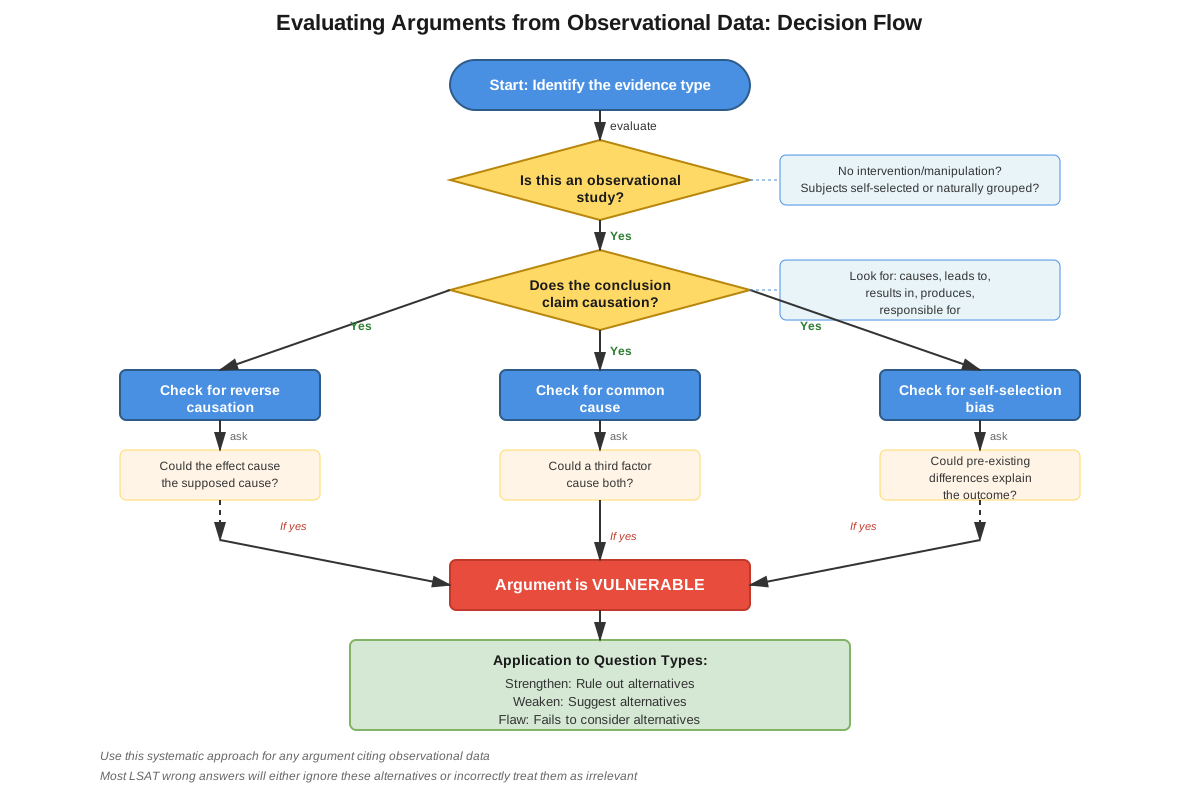
- Identify the study type: Confirm the argument involves observational rather than experimental evidence (no random assignment, no manipulation).
- Map the correlation: Clearly identify which two variables are associated.
- Identify the causal claim: Determine what causal relationship the argument concludes from the correlation.
- Consider the three confounding patterns:
- Common cause: What third variable might cause both?
- Reverse causation: Could the effect actually cause the supposed cause?
- Self-selection: Do pre-existing differences explain group membership?
- Apply to question type:
- Weaken: Look for answer choices introducing confounds or alternative explanations
- Strengthen: Look for answer choices eliminating confounds or confirming temporal sequence
- Assumption: Look for answer choices stating that confounds don't exist
- Flaw: Look for descriptions of the correlation-causation error
Process of Elimination Tips
For Weaken Questions:
- Eliminate answers that merely show the causal relationship isn't universal (some exceptions exist)
- Eliminate answers that strengthen by providing mechanisms or eliminating confounds
- Prioritize answers introducing specific alternative explanations or confounding variables
For Strengthen Questions:
- Eliminate answers that introduce new confounds or alternative explanations
- Eliminate answers that are merely consistent with the conclusion without providing additional support
- Prioritize answers that eliminate specific confounds or establish temporal sequence
For Assumption Questions:
- Eliminate answers that would be nice to have but aren't necessary
- Test each answer with the negation technique: if negating the answer destroys the argument, it's necessary
- Prioritize answers that rule out specific confounding patterns
Time Allocation
Observational study questions typically require 1:15-1:30 minutes. Allocate:
- 20-30 seconds: Read and map the argument structure
- 10-15 seconds: Identify the correlation-causation gap and potential confounds
- 30-45 seconds: Evaluate answer choices systematically
- 10-15 seconds: Confirm the answer and move on
Don't get trapped trying to generate every possible confound before reading answer choices. The LSAT provides the relevant confound in the correct answer; your job is to recognize it when you see it.
Memory Techniques
The "CCR" Mnemonic for Confounding Patterns
Common Cause
Causal Reversal (reverse causation)
Recruitment bias (self-selection)
When evaluating observational studies, mentally run through CCR to consider major alternative explanations.
The "STORM" Framework for Observational Study Analysis
Study type: Is this observational or experimental?
Temporal sequence: Does the cause precede the effect?
Observed correlation: What association was found?
Reverse causation: Could the effect cause the supposed cause?
Mediating variables: What confounds might explain the correlation?
Visualization Strategy
Picture observational studies as photographs versus experiments as videos you direct. A photograph captures what exists but doesn't show you what happens when you change things. This mental image reinforces that observational studies reveal associations in existing conditions but can't demonstrate what would happen under different circumstances—the essence of causal proof.
The "Third Variable" Mantra
When seeing correlation-to-causation arguments, mentally repeat: "Correlation, yes; causation, maybe—what's the third variable?" This automatic response triggers systematic consideration of confounds.
Summary
Observational studies represent a high-yield LSAT topic because they create a systematic logical vulnerability: the correlation-causation gap. These studies establish that variables correlate but cannot prove causation without addressing alternative explanations. The three major confounding patterns—common cause, reverse causation, and self-selection bias—explain how correlations can exist without causal relationships. LSAT questions exploit this gap across multiple question types, particularly weaken, strengthen, assumption, and flaw questions. Success requires recognizing observational study arguments, identifying the correlation-causation leap, systematically considering confounding variables, and applying this analysis to select answers that introduce confounds (weaken), eliminate confounds (strengthen), assume confounds don't exist (assumption), or describe the logical error (flaw). Mastering observational studies provides a framework for evaluating evidence-based arguments throughout Logical Reasoning sections, making this topic essential for achieving high LSAT scores.
Key Takeaways
- Observational studies establish correlation through passive observation but cannot prove causation without ruling out alternative explanations
- The three confounding patterns—common cause, reverse causation, and self-selection—represent the primary alternative explanations for observed correlations
- Weaken questions typically introduce confounds; strengthen questions eliminate confounds; assumption questions require assuming confounds don't exist
- Temporal sequence (cause preceding effect) is necessary but not sufficient for establishing causation
- The correlation-causation gap appears across multiple question types and represents one of the most frequently tested logical reasoning patterns on the LSAT
- Systematic analysis using frameworks like CCR or STORM prevents missing confounding variables under time pressure
- Self-selection bias occurs when pre-existing characteristics determine group membership, creating spurious correlations
Related Topics
Controlled Experiments: Understanding how randomization and experimental manipulation address the confounding variable problem that plagues observational studies. Mastering observational studies provides the foundation for appreciating why controlled experiments offer stronger causal evidence.
Sufficient and Necessary Conditions: Formalizing causal relationships using logical structures. The reasoning about observational studies connects to understanding when conditions are sufficient, necessary, both, or neither for producing effects.
Alternative Explanations: The broader category of reasoning that includes confounding variables as specific instances. Skills developed with observational studies transfer to evaluating alternative explanations in non-study contexts.
Statistical Reasoning: Understanding how sample size, statistical significance, and probability relate to the strength of evidence from observational studies. This topic builds on the foundation of recognizing what observational data can and cannot establish.
Argument Evaluation: The overarching skill of assessing whether premises adequately support conclusions. Observational studies provide concrete practice in this fundamental logical reasoning competency.
Practice CTA
Now that you've mastered the core concepts of observational studies, it's time to cement your understanding through active practice. Attempt the practice questions to apply these concepts under test-like conditions, focusing on identifying confounding patterns and the correlation-causation gap. Use the flashcards to reinforce high-yield facts and ensure automatic recognition of observational study arguments. Remember: understanding the theory is just the first step—LSAT success comes from repeatedly applying these concepts until recognizing and analyzing observational studies becomes second nature. You've built a powerful analytical framework; now sharpen it through deliberate practice!
Sign up free to keep reading
Create a free AnvayaPrep account to finish this LSAT guide on Observational studies — plus flashcards and practice questions.