Overview
Paradox stimulus structure represents one of the most distinctive and frequently tested question types in LSAT Logical Reasoning sections. These questions present an apparent contradiction or surprising set of facts that seem incompatible at first glance, challenging test-takers to identify information that would explain or resolve the tension between seemingly conflicting observations. Unlike assumption or strengthen/weaken questions that focus on argument evaluation, paradox questions test the ability to recognize explanatory relationships and understand how additional information can reconcile apparently inconsistent phenomena.
Mastering LSAT paradox stimulus structure is essential because these questions appear regularly on every LSAT administration, typically comprising 2-4 questions per test across both Logical Reasoning sections. The skills developed through paradox question practice extend far beyond this specific question type—understanding how to identify tensions between facts, recognize what counts as a genuine explanation, and distinguish between relevant and irrelevant information strengthens performance across all causation and explanation questions. These cognitive abilities form the foundation for legal reasoning, where attorneys must constantly reconcile conflicting evidence and construct coherent explanations for complex factual scenarios.
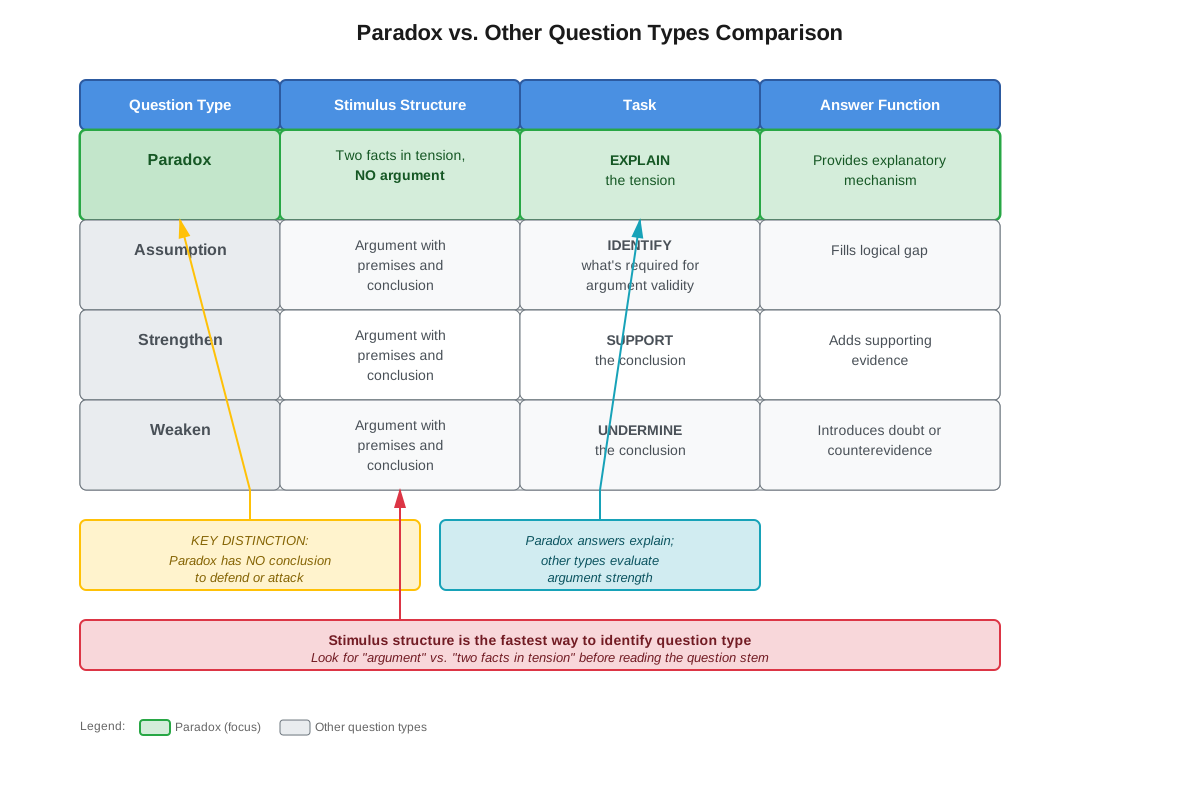
Within the broader landscape of Logical Reasoning, paradox questions occupy a unique position. While assumption questions ask what must be true for an argument to work and strengthen/weaken questions ask what would affect an argument's validity, paradox questions focus purely on explanation without requiring evaluation of argumentative strength. This makes them conceptually cleaner in some ways—there's no conclusion to defend or attack, only a puzzle to solve. Understanding this structural difference helps test-takers shift their analytical approach appropriately when encountering different question types.
Learning Objectives
- [ ] Identify how Paradox stimulus structure appears in LSAT questions
- [ ] Explain the reasoning pattern behind Paradox stimulus structure
- [ ] Apply Paradox stimulus structure to solve LSAT-style problems accurately
- [ ] Distinguish between genuine paradoxes and mere contrasts in stimulus presentation
- [ ] Evaluate answer choices to determine which provides the most complete resolution
- [ ] Recognize common wrong answer patterns in paradox questions
- [ ] Construct pre-phrase explanations before reviewing answer choices
Prerequisites
- Basic argument structure recognition: Understanding premises and conclusions helps distinguish paradox questions (which lack arguments) from other Logical Reasoning question types
- Causal reasoning fundamentals: Paradox resolutions often involve causal mechanisms, so recognizing cause-effect relationships is essential
- Conditional logic basics: Some paradoxes involve conditional relationships where understanding sufficient and necessary conditions aids in identifying the tension
- Reading comprehension skills: Accurately identifying the specific facts in tension requires careful, precise reading of stimulus language
Why This Topic Matters
Paradox questions test a fundamental cognitive skill that extends well beyond standardized testing: the ability to reconcile apparently conflicting information through explanatory reasoning. In legal practice, attorneys constantly encounter situations where evidence seems contradictory, witness testimony conflicts, or outcomes appear inconsistent with expectations. The mental framework developed through paradox question practice—identifying precisely what needs explanation, considering multiple potential explanations, and selecting the most complete resolution—directly translates to professional legal reasoning.
From an exam perspective, paradox questions appear with high frequency and predictability on the LSAT. Statistical analysis of recent LSAT administrations shows that paradox questions constitute approximately 8-12% of all Logical Reasoning questions, making them one of the most reliable question types to prepare for. These questions typically appear under stem language such as "Which one of the following, if true, most helps to resolve the apparent discrepancy?" or "Which one of the following, if true, most helps to explain the surprising result?" The consistency of their appearance and structure makes them high-yield study targets.
Paradox questions commonly appear in contexts involving scientific studies, business scenarios, historical observations, and social phenomena. Typical patterns include: unexpected research findings that contradict prior beliefs, business decisions that seem counterproductive but succeed, demographic trends that defy predictions, and policy implementations with surprising outcomes. Recognizing these common contexts helps test-takers quickly orient themselves when encountering new paradox stimuli.
Core Concepts
Defining the Paradox Stimulus Structure
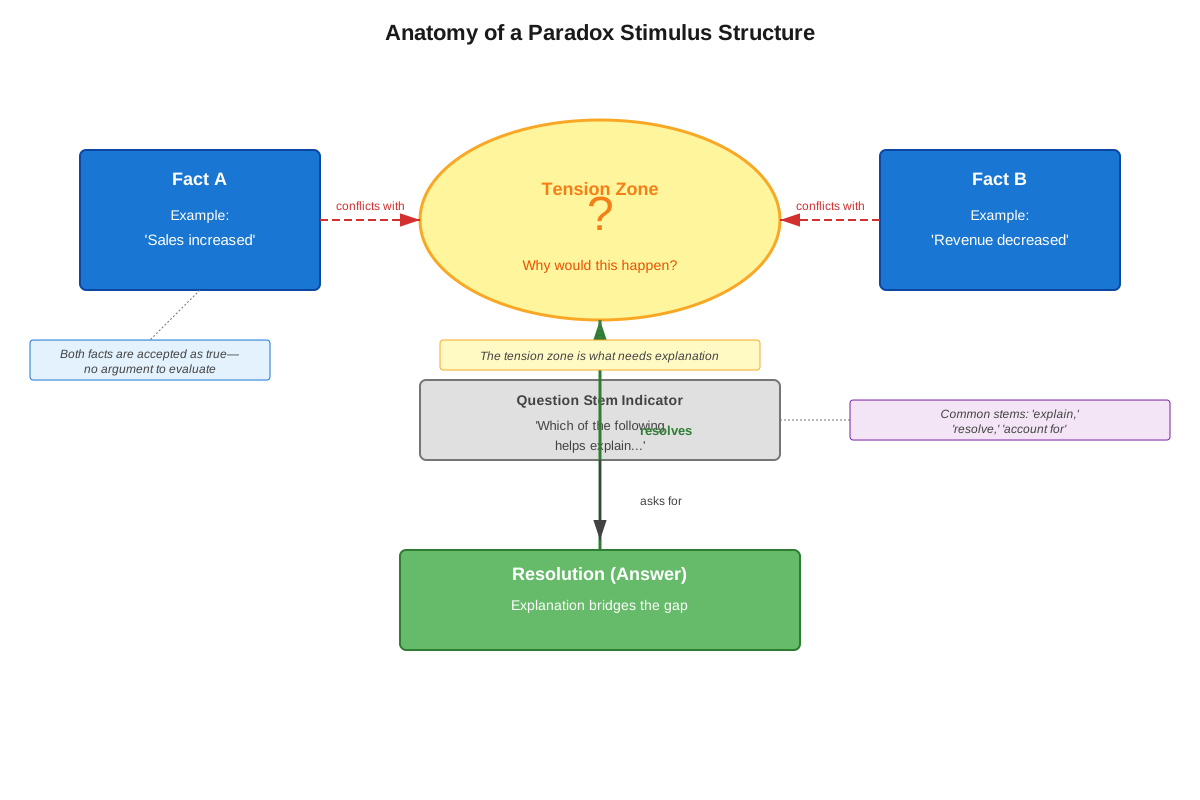
A paradox stimulus structure in LSAT Logical Reasoning consists of two or more factual statements that appear contradictory, surprising, or difficult to reconcile given common expectations or general knowledge. Critically, these are not true logical contradictions (where both statements cannot simultaneously be true), but rather apparent tensions that can be resolved through additional information. The stimulus presents facts without advancing an argument—there is no conclusion being defended, only a puzzling situation being described.
The structure typically follows one of these patterns:
- Expectation vs. Reality: A general principle or expectation is stated, followed by an observation that contradicts it
- Contrasting Trends: Two opposing trends or facts about the same subject are presented
- Surprising Outcome: An action or condition is described along with an unexpected result
- Internal Inconsistency: Different aspects of the same phenomenon point in opposite directions
Identifying the Tension
The key analytical skill in paradox questions is precisely identifying what needs explanation. Test-takers must pinpoint the specific relationship between facts that creates the apparent contradiction. This requires moving beyond surface-level reading to understand why the combination of facts is surprising or puzzling.
Consider this identification process:
- Isolate each factual claim: Separate the stimulus into distinct factual statements
- Identify the expectation: Determine what would normally be expected given one set of facts
- Locate the contradiction: Find where reality diverges from that expectation
- Articulate the puzzle: State in your own words what seems inconsistent
For example, if a stimulus states "Company X raised prices significantly, yet sales increased," the tension exists between the economic principle that higher prices typically reduce demand and the observed increase in sales. The puzzle is: why didn't higher prices reduce sales as expected?
The Resolution Mechanism
A correct answer to a paradox question provides information that makes both facts compatible—it shows how both can be true simultaneously without contradiction. The resolution doesn't eliminate either fact or suggest one is false; instead, it introduces a new consideration that explains why the apparently contradictory facts coexist.
Effective resolutions typically work through one of these mechanisms:
| Resolution Type | Mechanism | Example Context |
|---|---|---|
| Distinction | Differentiates between categories that appeared unified | "While overall sales decreased, sales to premium customers increased" |
| Temporal | Introduces a time-based explanation | "The decrease occurred before the new policy took effect" |
| Compensating Factor | Identifies an offsetting influence | "Although prices rose, quality improvements attracted new buyers" |
| Scope Limitation | Clarifies that facts apply to different domains | "Domestic sales fell while international sales rose" |
| Mechanism Explanation | Reveals the causal process connecting the facts | "Higher prices signaled luxury status, increasing desirability" |
Common Wrong Answer Patterns
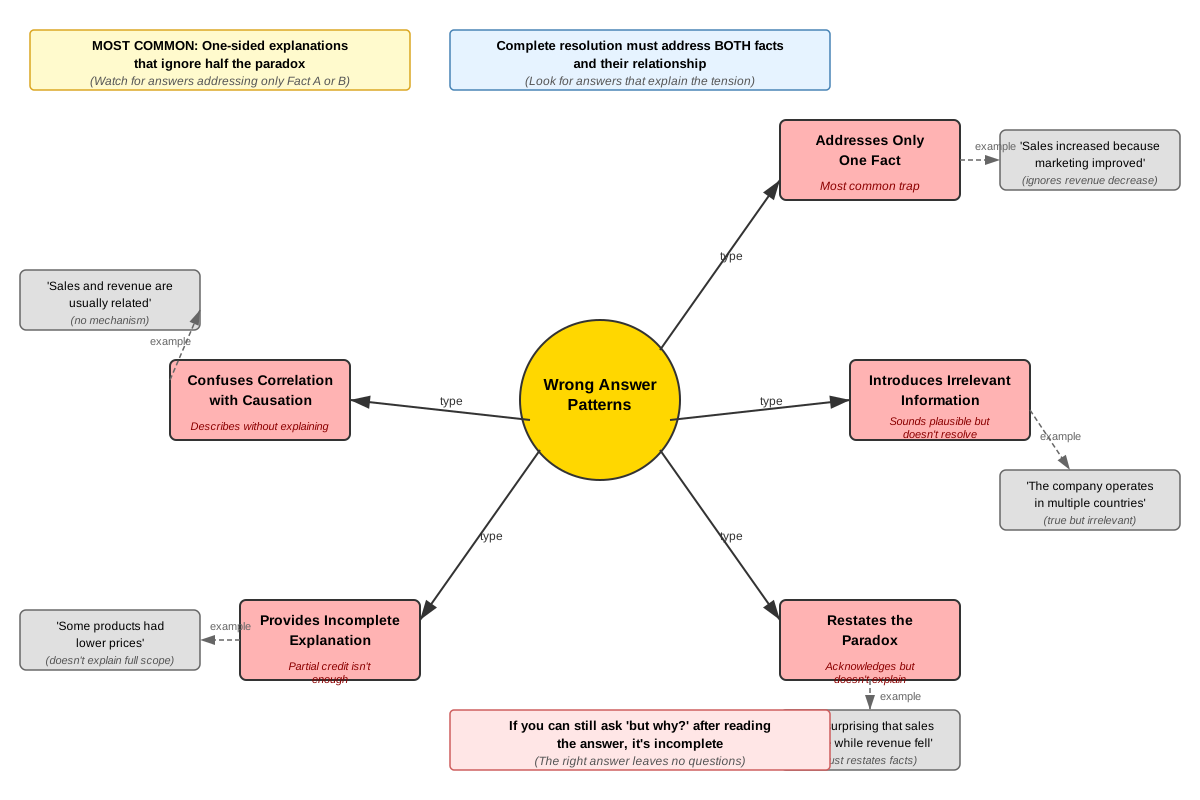
Understanding incorrect answer patterns is as important as recognizing correct resolutions. Wrong answers in paradox questions typically fall into these categories:
Irrelevant Information: Provides facts that don't address the specific tension. If the paradox concerns why sales increased despite price increases, an answer about the company's manufacturing process is irrelevant unless it connects to the price-sales relationship.
Partial Resolution: Addresses only one fact without explaining how both coexist. An answer that explains why prices increased but doesn't address the sales increase fails to resolve the paradox.
Deepens the Paradox: Actually makes the situation more puzzling by adding information that heightens the contradiction rather than resolving it.
Restates the Paradox: Simply repeats the surprising facts in different words without providing explanatory information.
Addresses Wrong Tension: Explains something that wasn't actually puzzling while ignoring the real source of tension.
The Role of Background Assumptions
Paradoxes depend on background assumptions or general knowledge that make certain combinations of facts surprising. Recognizing these implicit assumptions helps identify what needs explanation. For instance, the paradox "Restaurant prices increased but customer satisfaction also increased" relies on the assumption that customers prefer lower prices. The resolution might challenge this assumption (customers associate higher prices with better quality) or introduce information that outweighs price considerations (service quality improved dramatically).
Pre-Phrasing Strategy
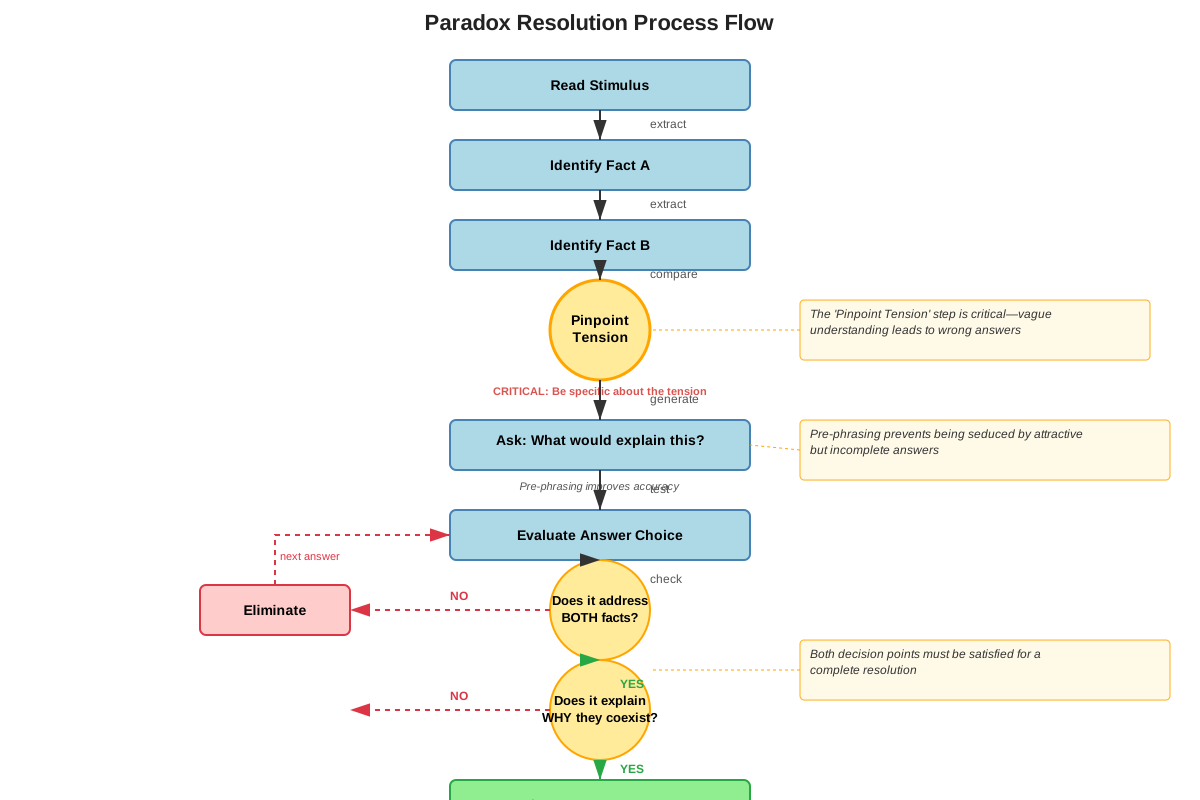
Before examining answer choices, effective test-takers formulate their own potential explanations. This pre-phrasing strategy involves asking: "What would make both of these facts make sense together?" While the pre-phrase may not match the correct answer exactly, the process of generating explanations primes the mind to recognize genuine resolutions and reject irrelevant information.
The pre-phrasing process:
- Clearly state the paradox in simple terms
- Brainstorm 2-3 possible explanations
- Consider what type of information would bridge the gap
- Look for answers that match the explanatory category, even if details differ
Concept Relationships
The paradox stimulus structure connects intimately with broader causation and explanation concepts in Logical Reasoning. While causal reasoning questions ask test-takers to evaluate whether one thing causes another, paradox questions assume certain causal or correlational relationships and ask for explanations when observations violate expectations based on those relationships. Understanding causation → enables recognition of when causal expectations are violated → which creates the foundation for identifying paradoxes.
Within the topic itself, the concepts form a logical progression: Paradox structure identification → Tension recognition → Resolution mechanism understanding → Answer evaluation. Each step depends on the previous one—without accurately identifying the structure, recognizing the specific tension becomes impossible; without understanding the tension, evaluating potential resolutions lacks direction.
Paradox questions also relate to assumption questions through their treatment of background knowledge. While assumption questions ask what unstated premise an argument requires, paradox questions implicitly rely on background assumptions that make certain facts surprising. Recognizing these implicit assumptions in paradox questions strengthens the ability to identify explicit assumptions in argument-based questions.
The connection to strengthen/weaken questions appears in the analytical skills required. Both question types demand understanding of what information would affect a relationship between facts or claims. However, paradox questions focus on explanation rather than evaluation—the goal is compatibility, not persuasion.
High-Yield Facts
⭐ Paradox stimuli present facts, not arguments—there is no conclusion to evaluate, only a puzzle to explain
⭐ The correct answer makes both facts compatible without eliminating either one—resolutions show how both can be true simultaneously
⭐ Identify the specific tension before looking at answer choices—knowing exactly what needs explanation prevents distraction by irrelevant information
⭐ Common stem language includes "resolve," "explain," "reconcile," and "apparent discrepancy"—these trigger words signal paradox questions
⭐ Wrong answers often address only one fact or introduce irrelevant information—both facts must be addressed for complete resolution
- Paradox questions typically appear 2-4 times per LSAT administration across both Logical Reasoning sections
- The resolution often involves introducing a distinction, temporal factor, or compensating influence not mentioned in the stimulus
- Pre-phrasing potential explanations before reviewing answers improves accuracy and speed
- Background assumptions that make facts surprising are often the key to understanding what needs explanation
- Paradoxes frequently involve unexpected research results, counterintuitive business outcomes, or surprising demographic trends
- The correct answer doesn't need to prove the facts are true—it only needs to show they're compatible
- Temporal confusion (mixing up before/after or cause/effect timing) is a common source of wrong answers
- Scope mismatches (explaining something broader or narrower than the actual paradox) characterize many incorrect choices
Quick check — test yourself on Paradox stimulus structure so far.
Try Flashcards →Common Misconceptions
Misconception: Paradox questions ask which answer choice is most surprising or unusual → Correction: Paradox questions ask which answer explains or resolves the surprising situation already presented in the stimulus; the correct answer makes the situation less surprising, not more
Misconception: The correct answer must address both facts explicitly and equally → Correction: While the resolution must make both facts compatible, it may do so by primarily explaining one fact in a way that shows why the other fact doesn't contradict it, rather than discussing both at length
Misconception: Paradox stimuli contain logical contradictions where both facts cannot be true → Correction: Paradox stimuli present apparent tensions or surprising combinations, not true logical contradictions; both facts are assumed to be true, and the task is explaining their coexistence
Misconception: The longest or most detailed answer choice is most likely correct → Correction: Correct resolutions are often concise and focused; length frequently indicates irrelevant elaboration rather than explanatory power
Misconception: Background knowledge about the subject matter should guide answer selection → Correction: While general reasoning principles apply, specific outside knowledge about the stimulus topic should not influence answer choice; all necessary information appears in the stimulus and answers
Misconception: If an answer choice explains one of the facts, it partially resolves the paradox → Correction: Explaining why one fact is true without addressing the tension between facts doesn't resolve anything; the puzzle is their coexistence, not their individual truth
Misconception: The correct answer will always introduce entirely new information → Correction: Effective resolutions sometimes reframe or clarify information implicit in the stimulus rather than introducing completely novel facts
Worked Examples
Example 1: Business Paradox
Stimulus: "A major retail chain announced it would close 15% of its stores nationwide. Shortly after this announcement, the company's stock price increased significantly, and financial analysts upgraded their recommendations for the stock."
Question Stem: "Which one of the following, if true, most helps to explain the analysts' reaction?"
Analysis:
First, identify the paradox: Store closures typically signal business problems and would be expected to decrease stock value, yet the stock price increased and analysts became more positive. The tension exists between the negative signal (store closures) and the positive market reaction.
What needs explanation? Why would closing stores lead to increased confidence in the company?
Pre-phrase potential resolutions:
- Perhaps the stores being closed were unprofitable
- Maybe the closures free up resources for better opportunities
- The closures might signal strategic refocusing
Answer Choices:
(A) The retail chain had been expanding rapidly over the previous five years
- This doesn't explain why closures would be viewed positively; if anything, it makes the closures more surprising
(B) The stores scheduled for closure had been operating at significant losses for several years
- CORRECT: This resolves the paradox by showing that closures eliminate drains on profitability, making the company financially healthier overall. Both facts are now compatible: stores are closing AND this is good for the company because those stores were losing money
(C) Several competing retail chains had also announced store closures
- This doesn't explain why closures would be positive for this specific company; it just shows closures are common
(D) The company plans to invest heavily in online sales infrastructure
- While potentially relevant to future strategy, this doesn't explain why the closures themselves prompted positive analyst reaction
(E) Consumer spending in the retail sector has been declining
- This might explain why closures are necessary but doesn't explain why they'd be viewed positively
Key Lesson: The correct answer introduces information (unprofitability of closing stores) that transforms closures from a negative signal into a positive strategic move, making both the closures and the positive market reaction compatible.
Example 2: Scientific Study Paradox
Stimulus: "Researchers studying sleep patterns found that participants who reported sleeping fewer than six hours per night had lower rates of a particular sleep disorder than participants who reported sleeping seven to eight hours per night. This finding surprised the researchers, who had expected sleep deprivation to increase vulnerability to sleep disorders."
Question Stem: "Which one of the following, if true, most helps to resolve the apparent discrepancy in the researchers' findings?"
Analysis:
Identify the paradox: The expectation was that less sleep → more sleep disorders, but the observation was less sleep → fewer disorders (of this particular type). The tension is between the general principle that sleep deprivation is harmful and the specific finding that short sleepers had lower rates of this disorder.
What needs explanation? Why would people sleeping less have fewer instances of this particular disorder?
Pre-phrase: Perhaps this specific disorder requires a certain amount of sleep to manifest, or maybe it occurs during specific sleep stages that short sleepers don't reach, or the disorder itself causes people to sleep longer.
Answer Choices:
(A) The particular sleep disorder studied occurs primarily during the later stages of sleep cycles
- CORRECT: This resolves the paradox by explaining that people sleeping fewer hours don't reach the sleep stages where this disorder occurs. Both facts are compatible: short sleepers have the disorder less often because they don't sleep long enough to reach the stages where it manifests
(B) Participants who slept fewer than six hours reported higher stress levels
- This doesn't explain the lower disorder rates; if anything, higher stress might be expected to increase disorders
(C) The study included participants from a wide range of age groups
- This provides no explanation for the relationship between sleep duration and disorder rates
(D) Many sleep disorders remain undiagnosed in the general population
- This doesn't explain the specific pattern observed; underdiagnosis would affect both groups
(E) Participants self-reported their sleep duration rather than being monitored
- This raises questions about data accuracy but doesn't explain the specific pattern found
Key Lesson: The resolution works by revealing a mechanism (disorder occurs in later sleep stages) that explains why the counterintuitive relationship exists. The answer doesn't dispute either fact but shows why they logically coexist.
Exam Strategy
When approaching paradox questions on the LSAT, implement this systematic process:
Step 1: Identify the Question Type (5 seconds)
Watch for trigger language: "resolve," "explain," "reconcile," "apparent discrepancy," "surprising," "paradox," or "puzzling." These words signal that you're dealing with a paradox question, not an argument evaluation question.
Step 2: Read for Facts, Not Arguments (20-30 seconds)
Unlike most Logical Reasoning questions, paradox stimuli don't contain conclusions to evaluate. Read to identify factual claims and spot which facts seem incompatible. Don't waste time looking for argumentative structure that isn't there.
Step 3: Articulate the Tension (10 seconds)
Before looking at answers, state in your own words: "The puzzle is that [fact 1] but [fact 2], which is surprising because normally [expectation]." This crystallizes exactly what needs explanation.
Step 4: Pre-Phrase (10 seconds)
Quickly consider: "What type of information would make both facts make sense?" You don't need the exact answer, just a sense of what category of explanation would work (distinction, temporal factor, compensating influence, etc.).
Step 5: Evaluate Answers Systematically (30-40 seconds)
For each answer, ask: "Does this make both facts compatible?" Eliminate answers that:
- Address only one fact
- Introduce irrelevant information
- Make the paradox worse
- Simply restate the facts
Exam Tip: If you're stuck between two answers, identify which one more directly addresses the specific tension you articulated in Step 3. The correct answer should make you think, "Oh, that's why both things can be true!"
Time Allocation: Paradox questions should take approximately 75-90 seconds total. They're often faster than assumption or strengthen/weaken questions because there's no argument structure to analyze. If you're spending more than 90 seconds, you may be overthinking—trust your initial identification of the tension and look for the answer that most directly addresses it.
Process of Elimination Strategy:
- First pass: Eliminate obviously irrelevant answers (usually 1-2 choices)
- Second pass: Eliminate answers that address only one fact (usually 1-2 more)
- Final evaluation: Between remaining choices, select the one that most completely bridges the gap between facts
Memory Techniques
PARADOX Acronym for approaching these questions:
- Pinpoint the facts in tension
- Articulate the expectation being violated
- Recognize what needs explanation
- Anticipate resolution types
- Distinguish relevant from irrelevant information
- Omit answers addressing only one fact
- X-out choices that deepen confusion
Visualization Strategy: Picture the two facts as puzzle pieces that don't seem to fit. The correct answer is the missing piece that shows how they connect. Wrong answers are pieces from different puzzles—they might be interesting, but they don't help these specific pieces fit together.
The "Both-And" Test: For any answer choice, say "This explains how both [fact 1] AND [fact 2] can be true because..." If you can't complete this sentence, the answer is wrong.
Resolution Type Mnemonic - "DTCS":
- Distinction (separates categories)
- Temporal (time-based explanation)
- Compensating factor (offsetting influence)
- Scope (different domains)
Remember: "Don't Take Confusing Stimuli" personally—there's always a logical resolution.
Summary
Paradox stimulus structure in LSAT Logical Reasoning presents apparently contradictory or surprising facts that require explanation rather than argument evaluation. These questions test the ability to identify specific tensions between facts, recognize what type of information would resolve those tensions, and distinguish genuine explanations from irrelevant or incomplete information. The key analytical skill is precisely articulating what makes the combination of facts surprising, which enables effective evaluation of answer choices. Correct resolutions make both facts compatible without eliminating either one, typically by introducing distinctions, temporal factors, compensating influences, or scope clarifications. Success on paradox questions requires reading for factual content rather than argumentative structure, pre-phrasing potential explanations before reviewing answers, and systematically eliminating choices that address only one fact or introduce irrelevant information. These questions appear consistently on every LSAT (2-4 per test) and develop reasoning skills essential for legal practice, where reconciling apparently conflicting evidence is a fundamental task.
Key Takeaways
- Paradox stimuli present facts without arguments—identify the tension between facts rather than evaluating a conclusion
- The correct answer makes both facts compatible simultaneously; it doesn't eliminate or dispute either fact
- Articulate the specific tension before reviewing answer choices to avoid distraction by irrelevant information
- Common resolution mechanisms include distinctions, temporal factors, compensating influences, and scope clarifications
- Wrong answers typically address only one fact, introduce irrelevant information, or deepen rather than resolve the paradox
- Pre-phrasing potential explanations improves accuracy and speed by priming recognition of genuine resolutions
- Paradox questions appear 2-4 times per LSAT and test reasoning skills fundamental to legal practice
Related Topics
Causal Reasoning Questions: Understanding cause-effect relationships deepens paradox resolution skills, as many paradoxes involve violated causal expectations. Mastering paradox structure provides foundation for evaluating causal claims.
Strengthen/Weaken Questions: These share the skill of identifying what information affects relationships between facts, though they focus on argument evaluation rather than explanation. Paradox mastery transfers to recognizing relevant strengthening/weakening information.
Assumption Questions: Both question types involve implicit background knowledge—assumptions in arguments and expectations in paradoxes. Understanding how unstated premises function aids in recognizing what makes facts surprising.
Method of Reasoning Questions: These require identifying argumentative techniques and structures. Understanding that paradox questions lack arguments helps distinguish them from method questions and adjust analytical approach accordingly.
Principle Questions: Some principle questions ask for general rules that explain specific situations, similar to how paradox resolutions explain specific fact patterns. The explanatory reasoning transfers between question types.
Practice CTA
Now that you understand paradox stimulus structure, it's time to apply these concepts to actual LSAT questions. Work through the practice questions systematically, using the PARADOX acronym and articulating the specific tension before reviewing answer choices. Each practice question strengthens your pattern recognition and resolution evaluation skills. Remember: paradox questions are highly predictable in structure, making them excellent opportunities to build confidence and accuracy. The reasoning skills you develop here—identifying tensions, generating explanations, and evaluating compatibility—extend far beyond this question type to strengthen your overall Logical Reasoning performance. Approach each practice question as an opportunity to refine your systematic process, and you'll find these questions becoming faster and more intuitive with each attempt.
Sign up free to keep reading
Create a free AnvayaPrep account to finish this LSAT guide on Paradox stimulus structure — plus flashcards and practice questions.