Overview
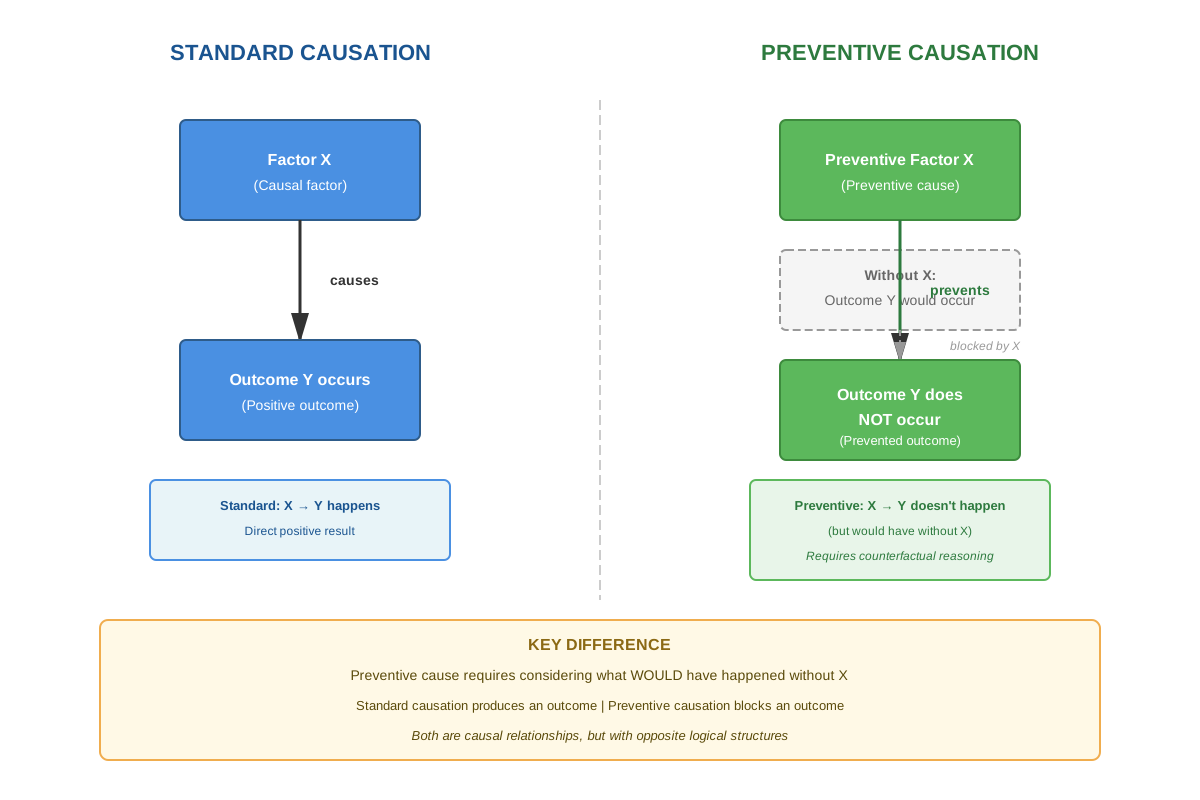
Preventive cause is a critical concept in LSAT Logical Reasoning that challenges students to recognize a unique form of causal relationship: when one factor prevents or reduces the occurrence of an outcome that would otherwise happen. Unlike standard causal reasoning where X causes Y to occur, preventive causation involves X causing Y not to occur, or causing Y to occur less frequently or less severely than it would without X's presence. This concept appears regularly on the LSAT and requires students to think counterfactually—considering what would have happened in the absence of the preventive factor.
Understanding preventive cause is essential for the LSAT because it tests sophisticated reasoning skills that go beyond simple cause-and-effect relationships. The exam frequently presents arguments where the conclusion involves a claim about prevention, or where evidence about prevention must be properly interpreted. Students who fail to recognize preventive causation often misidentify the logical structure of arguments, select incorrect answer choices in Strengthen/Weaken questions, or miss subtle flaws in reasoning. This topic sits at the intersection of causation and explanation, conditional reasoning, and evidence evaluation—all high-frequency LSAT domains.
Within the broader landscape of Logical Reasoning, preventive cause represents an advanced application of causal reasoning principles. While students typically master straightforward causal claims (smoking causes cancer), preventive causation requires understanding absence, counterfactuals, and negative outcomes. This concept connects directly to assumption questions, flaw questions, and strengthen/weaken questions, making it one of the most versatile and high-yield topics in the LSAT curriculum. Mastering preventive cause reasoning enables students to navigate complex argument structures and avoid common traps that test-makers deliberately construct around this concept.
Learning Objectives
- [ ] Identify how Preventive cause appears in LSAT questions
- [ ] Explain the reasoning pattern behind Preventive cause
- [ ] Apply Preventive cause to solve LSAT-style problems accurately
- [ ] Distinguish between preventive causation and standard causation in argument structures
- [ ] Recognize common flaws in arguments that involve preventive causal claims
- [ ] Evaluate evidence that supports or undermines preventive causal relationships
- [ ] Construct valid inferences from premises involving preventive factors
Prerequisites
- Basic causal reasoning: Understanding standard cause-and-effect relationships is necessary because preventive cause is a specialized form of causation that inverts the typical outcome.
- Conditional logic fundamentals: Recognizing sufficient and necessary conditions helps distinguish between what must happen and what is prevented from happening.
- Argument structure analysis: The ability to identify premises, conclusions, and assumptions is essential for recognizing how preventive cause functions within arguments.
- Counterfactual thinking: Understanding "what would have happened if" scenarios is crucial since preventive causation inherently involves comparing actual outcomes to hypothetical alternatives.
Why This Topic Matters
Preventive cause reasoning appears in real-world contexts constantly: vaccines prevent disease, safety regulations prevent accidents, and diplomatic interventions prevent conflicts. The ability to reason correctly about prevention is fundamental to public policy, medical decision-making, and risk assessment. When someone argues that a particular measure prevented a negative outcome, they're making a claim that requires specific types of evidence and involves particular logical vulnerabilities.
On the LSAT, preventive cause appears in approximately 10-15% of Logical Reasoning questions, making it a high-frequency topic that can significantly impact scores. This concept most commonly appears in:
- Strengthen/Weaken questions: Where answer choices must support or undermine claims about preventive relationships
- Flaw questions: Where arguments incorrectly infer preventive causation from insufficient evidence
- Assumption questions: Where the gap between premises and conclusion involves an unstated claim about prevention
- Method of Reasoning questions: Where the correct answer must describe an argument's use of preventive causal reasoning
- Parallel Reasoning questions: Where matching the preventive causal structure is essential
Test-makers favor preventive cause because it creates natural opportunities for subtle errors in reasoning. Students often confuse correlation with prevention, fail to consider alternative explanations for why something didn't occur, or incorrectly assume that because something didn't happen, a preventive cause must have been present. These predictable errors allow the LSAT to discriminate effectively between test-takers at different skill levels.
Core Concepts
Defining Preventive Cause
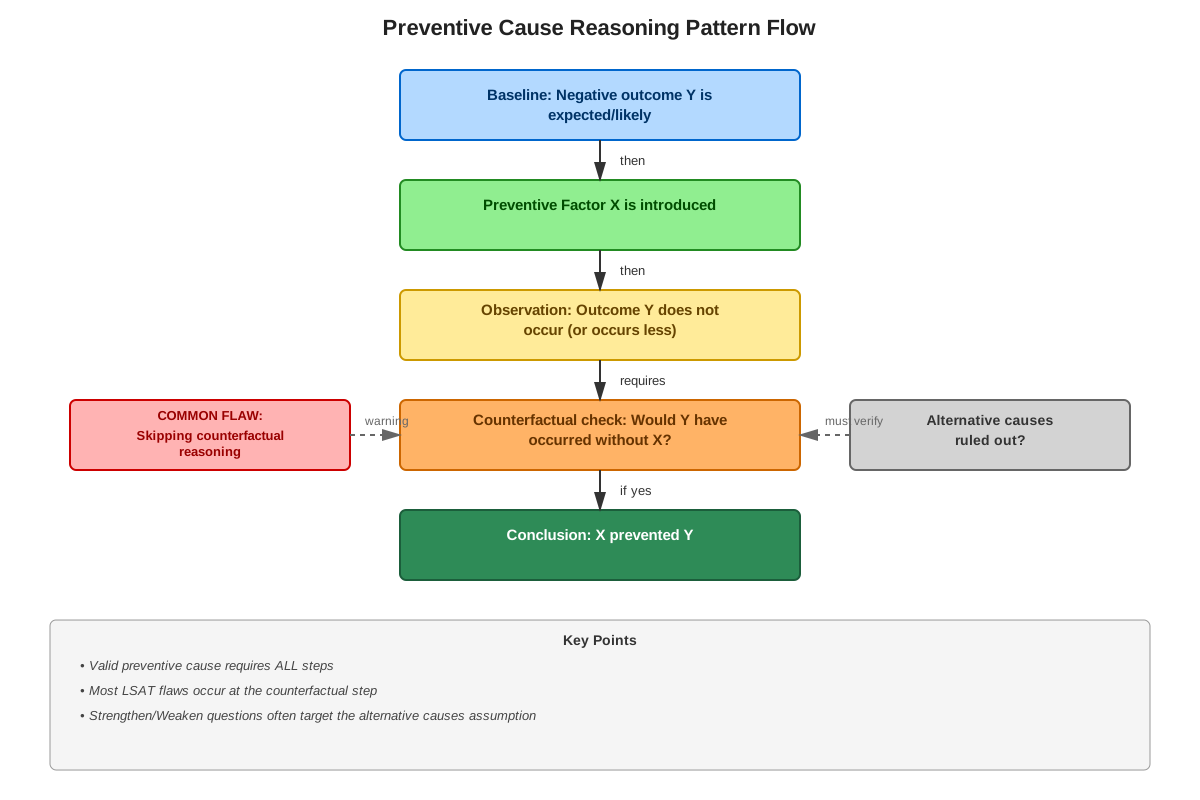
A preventive cause is a factor that stops, reduces, or mitigates an outcome that would otherwise occur or occur more frequently. The logical structure involves three key elements:
- An outcome that would normally occur (or occur at a certain rate)
- A preventive factor that intervenes
- The outcome not occurring (or occurring less frequently/severely) as a result
The crucial distinction from standard causation is that preventive cause involves bringing about an absence or reduction rather than a presence or increase. When we say "the vaccine prevented the disease," we mean the vaccine caused the disease not to occur in someone who would have contracted it otherwise.
The Counterfactual Nature of Prevention
Preventive causation is inherently counterfactual—it requires comparing what actually happened to what would have happened in an alternative scenario. This creates unique evidentiary challenges:
| Aspect | Standard Causation | Preventive Causation |
|---|---|---|
| Observable outcome | Presence of effect | Absence of effect |
| Comparison needed | Before/after or with/without cause | Actual outcome vs. hypothetical outcome |
| Evidence type | Direct observation of effect | Inference about what didn't happen |
| Verification difficulty | Moderate (can observe effect) | High (cannot observe non-occurrence directly) |
Consider: "The seatbelt saved her life." This preventive causal claim asserts that without the seatbelt, death would have occurred. We cannot directly observe this prevented death—we can only infer it from our understanding of accident mechanics and statistical patterns.
Logical Structure of Preventive Arguments
Arguments involving preventive cause typically follow this pattern:
- Premise: Factor X was present
- Premise: Outcome Y did not occur (or occurred less than expected)
- Conclusion: X prevented Y (or reduced Y)
The logical gap in such arguments involves the unstated assumption that Y would have occurred without X. This assumption is vulnerable to several challenges:
- Y might not have occurred anyway, even without X
- Some other factor Z might have prevented Y
- The baseline expectation that Y would occur might be incorrect
Types of Preventive Relationships
Complete Prevention: The preventive factor entirely stops an outcome that would otherwise occur with certainty or high probability.
- Example: "The firewall prevented the cyber attack from accessing sensitive data."
Partial Prevention/Mitigation: The preventive factor reduces the frequency, severity, or probability of an outcome without eliminating it entirely.
- Example: "The safety training reduced workplace accidents by 40%."
Threshold Prevention: The preventive factor keeps a variable below a critical threshold where negative outcomes would occur.
- Example: "The levee prevented flooding by keeping water levels below the critical point."
Evidence for Preventive Causation
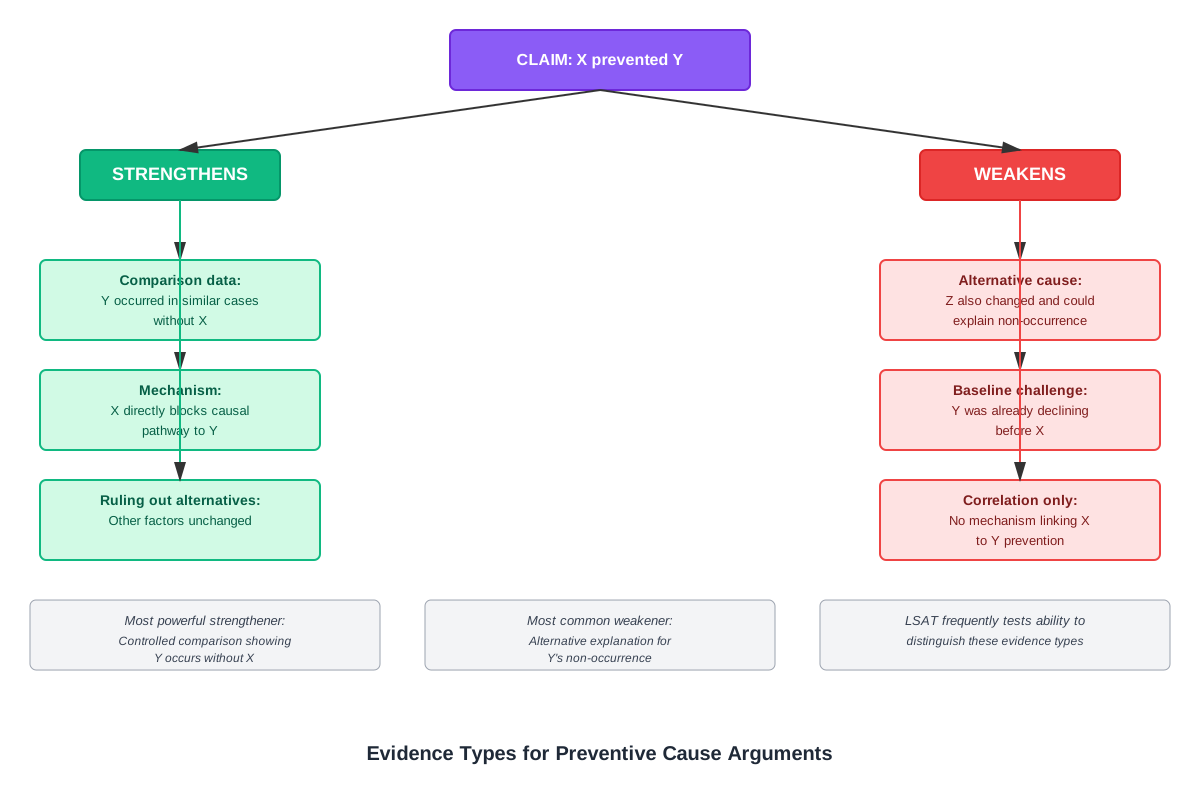
Establishing preventive causation requires specific types of evidence:
- Baseline data: Evidence about how frequently the outcome occurs without the preventive factor
- Comparative data: Evidence showing lower occurrence rates when the preventive factor is present
- Mechanism: An explanation of how the preventive factor interferes with the causal chain leading to the outcome
- Control for confounds: Evidence ruling out alternative explanations for the non-occurrence
Strong preventive causal claims are supported by controlled studies, temporal sequences (preventive factor precedes non-occurrence), and plausible mechanisms. Weak claims rely on mere correlation between a factor's presence and an outcome's absence.
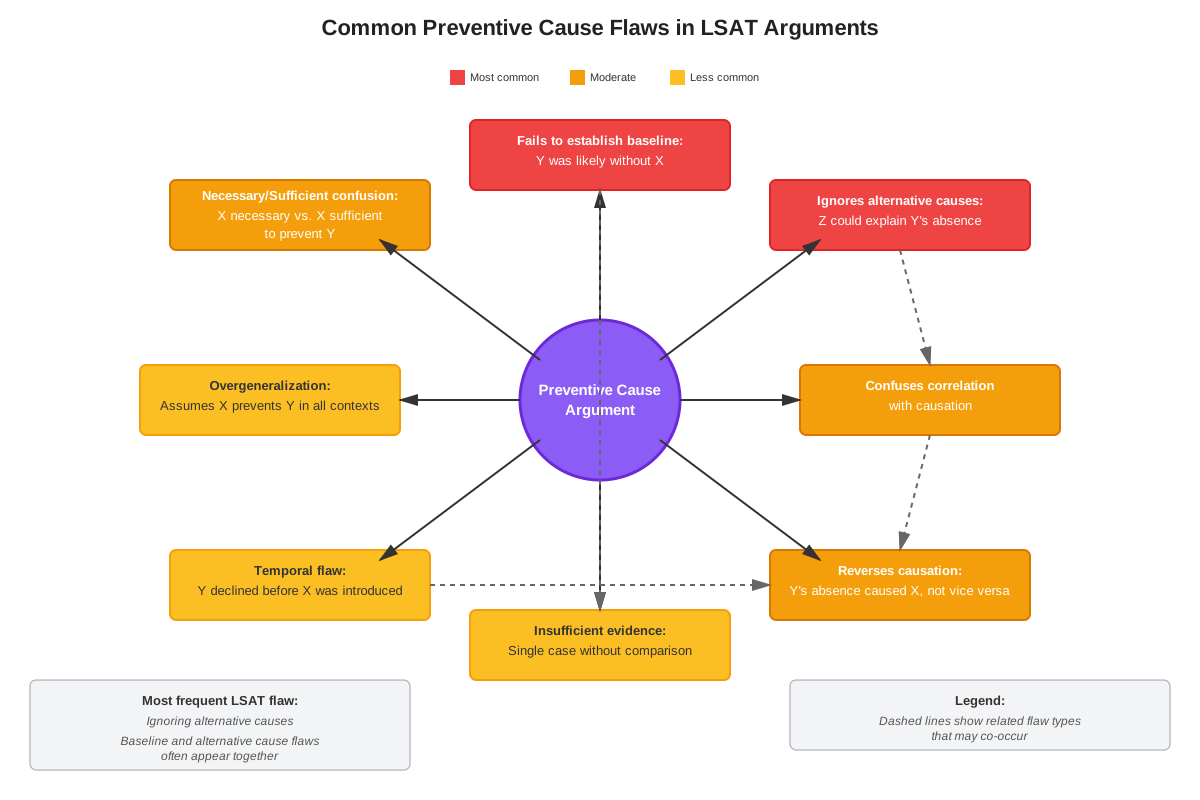
Common Flaws in Preventive Reasoning
Post hoc prevention fallacy: Assuming that because X was present and Y didn't occur, X must have prevented Y. This ignores that Y might not have occurred anyway.
Ignoring alternative preventive causes: Failing to consider that some other factor might have prevented the outcome.
Baseline error: Incorrectly assuming that the outcome would have occurred without the preventive factor, when in fact the baseline probability was low.
Confusing correlation with prevention: Observing that X and non-Y occur together, without establishing that X caused non-Y.
Concept Relationships
Preventive cause connects to multiple logical reasoning concepts in a hierarchical and functional network:
Causal Reasoning (parent concept) → Preventive Cause (specific type) → manifests in → Strengthen/Weaken Questions and Flaw Questions
The relationship flows as follows:
- Conditional Logic provides the framework for understanding necessary and sufficient conditions, which helps distinguish what must happen from what is prevented
- Standard Causation establishes the baseline understanding that preventive cause inverts (X causes Y vs. X causes not-Y)
- Preventive Cause requires Counterfactual Reasoning to evaluate what would have happened in alternative scenarios
- Evidence Evaluation skills apply to assessing whether data supports preventive causal claims
- Alternative Explanations must be considered when evaluating preventive arguments, as other factors might explain non-occurrence
Within the topic itself, the concepts connect as:
Complete Prevention → requires strongest evidence → most vulnerable to alternative explanations
Partial Prevention → requires comparative baseline data → involves quantitative claims
Both types → depend on counterfactual reasoning → require mechanism explanations
High-Yield Facts
⭐ Preventive cause involves a factor causing an outcome NOT to occur, rather than causing it to occur
⭐ Preventive causal claims are inherently counterfactual—they require comparing actual outcomes to hypothetical alternatives
⭐ The absence of an outcome does not by itself prove that a preventive cause was present
⭐ Strong evidence for preventive causation includes baseline data showing the outcome's normal frequency without the preventive factor
⭐ Arguments claiming prevention are vulnerable to the objection that the outcome wouldn't have occurred anyway
- Preventive cause appears most frequently in Strengthen/Weaken and Flaw questions on the LSAT
- Correlation between a factor's presence and an outcome's absence is insufficient to establish preventive causation
- Multiple factors can simultaneously contribute to preventing the same outcome
- Preventive causal claims require a plausible mechanism explaining how the factor interferes with the causal chain
- Temporal sequence matters: the preventive factor must be present before or during the time when the outcome would have occurred
- Partial prevention claims involve quantitative comparisons and require baseline rate data
- The strength of a preventive causal claim depends on ruling out alternative explanations for non-occurrence
Quick check — test yourself on Preventive cause so far.
Try Flashcards →Common Misconceptions
Misconception: If X is present and Y doesn't occur, then X must have prevented Y.
Correction: This commits the post hoc prevention fallacy. Y might not have occurred anyway, even without X. Establishing prevention requires evidence that Y would have occurred without X, not merely that Y didn't occur when X was present.
Misconception: Preventive cause is the same as a necessary condition.
Correction: These are distinct concepts. A necessary condition must be present for an outcome to occur, while a preventive cause stops an outcome from occurring. A preventive cause prevents something; a necessary condition enables something. The vaccine prevents disease (preventive cause), but oxygen is necessary for fire (necessary condition).
Misconception: If something is designed to prevent an outcome, and that outcome doesn't occur, the preventive measure must have worked.
Correction: The intended purpose of a measure doesn't establish its actual effectiveness. The outcome might not have occurred for other reasons. Evidence of actual preventive efficacy requires comparative data, not just design intent plus non-occurrence.
Misconception: Preventive causation can be established without baseline data about normal occurrence rates.
Correction: Without knowing how often the outcome occurs in the absence of the alleged preventive factor, we cannot determine whether the factor actually prevented anything. Baseline data is essential for evaluating preventive causal claims.
Misconception: If multiple factors are present and an outcome doesn't occur, we cannot determine which factor prevented it.
Correction: While multiple factors can complicate analysis, controlled comparisons, temporal sequences, and mechanism analysis can help identify which factors contributed to prevention. The presence of multiple factors doesn't make causal analysis impossible, just more complex.
Misconception: Preventive cause only involves complete prevention of outcomes.
Correction: Preventive causation includes both complete prevention (outcome doesn't occur at all) and partial prevention/mitigation (outcome occurs less frequently or less severely). Many real-world preventive measures reduce rather than eliminate risks.
Worked Examples
Example 1: Strengthen Question
Argument: "The new traffic light at the intersection has been effective in preventing accidents. Since its installation six months ago, there have been no accidents at that intersection."
Question: Which of the following, if true, most strengthens the argument?
Answer Choices:
A) Traffic lights at other intersections in the city have also been effective
B) Before the traffic light was installed, the intersection averaged two accidents per month
C) Drivers report feeling safer at intersections with traffic lights
D) The traffic light was expensive to install
E) Some intersections in the city still lack traffic lights
Analysis:
Step 1: Identify the argument structure
- Premise: Traffic light installed six months ago
- Premise: No accidents since installation
- Conclusion: Traffic light prevented accidents (preventive causal claim)
Step 2: Identify the logical gap
The argument assumes that accidents would have occurred without the traffic light. The gap is the lack of baseline data about accident frequency before the light was installed.
Step 3: Evaluate answer choices
- (B) is correct: This provides crucial baseline data showing that accidents were occurring regularly (2 per month) before the preventive measure. This strengthens the claim that the traffic light prevented accidents by establishing that the outcome (accidents) was occurring before the preventive factor was introduced.
- (A) is irrelevant: Other traffic lights' effectiveness doesn't tell us about this specific intersection's baseline
- (C) is weak: Subjective feelings don't establish actual prevention
- (D) is irrelevant: Cost doesn't affect whether prevention occurred
- (E) is irrelevant: Other intersections don't provide baseline data for this one
Connection to Learning Objectives: This example demonstrates how to identify preventive cause in LSAT questions (Objective 1), recognize the reasoning pattern requiring baseline data (Objective 2), and apply this understanding to select the correct answer (Objective 3).
Example 2: Flaw Question
Argument: "The government's new cybersecurity protocol must be working effectively. Since implementing the protocol last year, no major data breaches have been reported by government agencies. Clearly, the protocol is preventing cyberattacks that would otherwise have succeeded."
Question: The reasoning in the argument is flawed because it:
Answer Choices:
A) Assumes that all cyberattacks would result in data breaches
B) Fails to consider that there might not have been any serious cyberattack attempts during the period
C) Confuses the prevention of cyberattacks with the prevention of data breaches
D) Relies on the testimony of government agencies that have an interest in the protocol's success
E) Assumes that the protocol is the only factor that could prevent data breaches
Analysis:
Step 1: Identify the preventive causal claim
The argument concludes that the protocol is preventing cyberattacks from succeeding (preventive cause).
Step 2: Identify the evidence
- Protocol implemented
- No data breaches reported
- Conclusion: Protocol prevented breaches that would have occurred
Step 3: Identify the flaw
The argument assumes that cyberattacks would have occurred and succeeded without the protocol. It doesn't consider that perhaps no serious attacks were attempted.
Step 4: Evaluate answer choices
- (B) is correct: This identifies the baseline error—the argument assumes the outcome (successful attacks) would have occurred without considering that the baseline threat level might have been low. The non-occurrence of breaches doesn't prove prevention if there was nothing to prevent.
- (A) is incorrect: The argument doesn't make this assumption
- (C) is incorrect: The argument treats these as equivalent, which may be imprecise but isn't the main flaw
- (D) is incorrect: The argument doesn't rely on testimony
- (E) is tempting but less precise: While the argument does ignore alternative preventive factors, the more fundamental flaw is assuming attacks would have occurred at all
Connection to Learning Objectives: This example shows how to recognize common flaws in preventive reasoning (Objective 5), distinguish preventive causation from mere correlation (Objective 4), and evaluate the evidence supporting preventive claims (Objective 6).
Exam Strategy
Trigger Words and Phrases
Watch for these indicators of preventive cause in LSAT questions:
- "prevented," "stopped," "avoided," "averted"
- "reduced," "decreased," "lowered," "mitigated"
- "would have occurred," "would have happened"
- "without X, Y would have..."
- "thanks to," "due to" (when followed by non-occurrence)
- "kept from," "protected against"
Approach Strategy
Step 1: Identify the preventive causal structure
- What outcome allegedly didn't occur or occurred less?
- What factor allegedly prevented it?
- Is the claim about complete or partial prevention?
Step 2: Assess the baseline assumption
- Does the argument assume the outcome would have occurred?
- Is there evidence for this baseline expectation?
- Could the outcome have been unlikely even without the preventive factor?
Step 3: Consider alternative explanations
- Could other factors have prevented the outcome?
- Could the outcome have not occurred for unrelated reasons?
- Is there a confounding variable?
Step 4: Evaluate the evidence
- Is there comparative data (with/without the factor)?
- Is there a plausible mechanism?
- Is the temporal sequence appropriate?
Question-Type Specific Tips
For Strengthen Questions: Look for answer choices that:
- Provide baseline data showing the outcome occurred before the preventive factor
- Rule out alternative preventive causes
- Establish a mechanism for prevention
- Show the preventive factor preceded the non-occurrence
For Weaken Questions: Look for answer choices that:
- Suggest the outcome wouldn't have occurred anyway
- Introduce alternative preventive causes
- Challenge the baseline assumption
- Break the temporal sequence
For Flaw Questions: Common flaws include:
- Assuming prevention without baseline evidence
- Ignoring alternative explanations for non-occurrence
- Confusing correlation with prevention
- Treating absence of evidence as evidence of prevention
Exam Tip: When you see a preventive causal claim, immediately ask: "What evidence shows the outcome would have occurred without this factor?" If the argument lacks this evidence, you've likely found the logical gap.
Time Allocation
Preventive cause questions typically require 1:15-1:30 minutes because they demand:
- Careful identification of the counterfactual claim
- Consideration of multiple alternative explanations
- Evaluation of baseline assumptions
Don't rush these questions—the extra 15-20 seconds spent properly analyzing the preventive structure will improve accuracy significantly.
Memory Techniques
The PREVENT Acronym
Premise: What factor is claimed to prevent?
Result: What outcome didn't occur?
Evidence: What baseline data supports the claim?
Verify: Check temporal sequence
Eliminate: Rule out alternative causes
Necessity: Is the preventive factor necessary or just sufficient?
Test: Would the outcome have occurred without it?
Visualization Strategy
Picture a "ghost outcome"—the thing that didn't happen but allegedly would have. Visualize this ghost outcome as transparent or faded. The preventive cause is the barrier or shield blocking the ghost from becoming real. This helps maintain focus on the counterfactual nature of prevention.
The Baseline Question
Memorize this key question: "Says who?" When an argument claims something prevented an outcome, ask "Says who that it would have happened?" This triggers the search for baseline evidence.
Comparison Table Memory Device
Remember: "Prevention needs comparison"
- Before/After: Did it happen before the preventive factor?
- With/Without: Does it happen without the preventive factor?
- More/Less: Does it happen more without the preventive factor?
Summary
Preventive cause represents a sophisticated form of causal reasoning where a factor causes an outcome not to occur or to occur less frequently than it otherwise would. This concept is fundamental to LSAT Logical Reasoning because it tests the ability to reason counterfactually and evaluate evidence for claims about what didn't happen. The key challenge in preventive causation is that the effect (non-occurrence) cannot be directly observed—it must be inferred by comparing actual outcomes to hypothetical alternatives. Strong preventive causal arguments require baseline data showing the outcome's normal frequency, evidence ruling out alternative explanations, and a plausible mechanism. Common flaws include assuming prevention without baseline evidence, ignoring alternative causes of non-occurrence, and confusing correlation with causation. Success on LSAT questions involving preventive cause requires identifying the counterfactual claim, assessing baseline assumptions, considering alternative explanations, and evaluating whether the evidence actually supports the preventive relationship claimed.
Key Takeaways
- Preventive cause involves a factor causing an outcome NOT to occur, requiring counterfactual reasoning about what would have happened otherwise
- The absence of an outcome alone does not prove a preventive cause was present—baseline data is essential
- Strong preventive causal claims require evidence that the outcome would have occurred without the preventive factor
- LSAT questions on preventive cause most commonly appear in Strengthen/Weaken and Flaw question types
- Always consider alternative explanations for why an outcome didn't occur before accepting a preventive causal claim
- Temporal sequence matters: the preventive factor must precede or coincide with when the outcome would have occurred
- Distinguish between complete prevention (outcome doesn't occur) and partial prevention (outcome occurs less frequently or severely)
Related Topics
Sufficient and Necessary Conditions: Understanding the difference between factors that guarantee outcomes and factors that are required for outcomes helps clarify how preventive causes work by blocking necessary conditions or interfering with sufficient conditions.
Correlation vs. Causation: This foundational topic extends naturally to preventive cause, where students must distinguish between mere correlation (X present when Y absent) and actual prevention (X causing Y not to occur).
Alternative Explanations: Mastering preventive cause strengthens the ability to generate and evaluate alternative explanations, a skill essential for Weaken questions and assumption identification across all Logical Reasoning topics.
Conditional Logic and Contrapositive: The logical structure of prevention often involves conditional relationships, and understanding contrapositives helps analyze what must be true when prevention occurs.
Statistical Reasoning: Many preventive causal claims involve quantitative evidence about rates and frequencies, connecting this topic to questions involving percentages, proportions, and comparative statistics.
Practice CTA
Now that you understand the logical structure and common patterns of preventive cause reasoning, you're ready to apply these concepts to actual LSAT questions. The practice questions and flashcards will help solidify your ability to quickly identify preventive causal claims, spot flaws in preventive reasoning, and select answer choices that properly strengthen or weaken these arguments. Remember: mastering preventive cause isn't just about memorizing definitions—it's about developing the analytical reflexes to recognize counterfactual claims and evaluate them critically. Each practice question you work through builds these reflexes, transforming conceptual knowledge into test-day performance. You've invested the time to understand this high-yield topic; now invest the time to practice it until preventive cause questions become automatic points on test day.
Sign up free to keep reading
Create a free AnvayaPrep account to finish this LSAT guide on Preventive cause — plus flashcards and practice questions.