Overview
Conditional inference is one of the most fundamental and frequently tested concepts in LSAT Logical Reasoning. It forms the backbone of formal logic on the exam and appears in approximately 20-30% of all Logical Reasoning questions, either as the primary logical structure or as a component of more complex arguments. Mastering conditional inference is not optional for test-takers aiming for competitive scores—it is essential.
At its core, conditional logic deals with "if-then" relationships between statements. When the LSAT presents an argument containing conditional statements, test-takers must understand not only what the original statement means but also what can and cannot be validly inferred from it. The ability to recognize valid inferences while avoiding invalid ones separates high scorers from average performers. Questions testing this skill appear across multiple question types, including Must Be True, Sufficient Assumption, Necessary Assumption, and Flaw questions.
LSAT conditional inference connects to virtually every other aspect of Logical Reasoning. It underlies formal logic questions, strengthens understanding of argument structure, and provides tools for analyzing causal reasoning and necessary/sufficient conditions. Students who master conditional inference gain a significant advantage not only on explicit logic questions but also on questions where conditional relationships are embedded within more complex argumentative structures. This topic serves as a gateway to advanced logical reasoning skills and represents one of the highest-yield areas of study for LSAT preparation.
Learning Objectives
- [ ] Identify how Conditional inference appears in LSAT questions
- [ ] Explain the reasoning pattern behind Conditional inference
- [ ] Apply Conditional inference to solve LSAT-style problems accurately
- [ ] Distinguish between valid and invalid conditional inferences in complex argument structures
- [ ] Translate natural language conditional statements into formal logical notation
- [ ] Chain multiple conditional statements together to derive remote conclusions
- [ ] Recognize disguised conditional statements that do not use standard "if-then" language
Prerequisites
- Basic logical connectives: Understanding "and," "or," and "not" is essential because conditional statements often combine with these operators to create complex logical structures.
- Argument structure fundamentals: Recognizing premises and conclusions allows students to identify where conditional statements function within arguments.
- Sufficient and necessary conditions: Distinguishing between these two types of conditions is the foundation upon which all conditional inference is built.
- Contrapositive formation: The ability to form contrapositives is assumed knowledge that directly enables valid conditional inference.
Why This Topic Matters
Conditional inference represents one of the most practical applications of formal logic in everyday reasoning. Legal professionals—the target audience for the LSAT—regularly encounter conditional language in statutes, contracts, and case law. A statute might state "If a person operates a vehicle with a blood alcohol content exceeding 0.08%, then that person is guilty of DUI." Understanding what can and cannot be inferred from such statements is fundamental to legal analysis.
On the LSAT itself, conditional inference appears with remarkable frequency. Research on released LSAT exams shows that approximately 25% of Logical Reasoning questions involve conditional logic as a primary component. These questions appear across virtually all question types:
- Must Be True questions frequently test whether students can derive valid inferences from conditional premises
- Sufficient Assumption questions require identifying a conditional statement that, when added, makes an argument valid
- Necessary Assumption questions often involve recognizing unstated conditional relationships the argument depends upon
- Flaw questions commonly feature invalid conditional inferences as the logical error
- Parallel Reasoning questions may present conditional structures that must be matched
The topic appears in both straightforward forms ("If A, then B") and disguised forms using words like "only," "unless," "whenever," "requires," and "depends on." Test-takers who cannot quickly and accurately process conditional statements will struggle with a significant portion of the exam, making this one of the highest-yield topics in LSAT preparation.
Core Concepts
The Basic Conditional Statement
A conditional statement establishes a relationship between two propositions where one (the sufficient condition) guarantees the other (the necessary condition). The standard form is "If A, then B," which can be symbolized as A → B. In this structure:
- A is the sufficient condition: its occurrence is sufficient to guarantee B
- B is the necessary condition: it must occur whenever A occurs
For example: "If it is raining, then the ground is wet" (Rain → Wet Ground). The occurrence of rain is sufficient to guarantee wet ground, and wet ground is necessary whenever it rains.
Valid Inferences from Conditional Statements
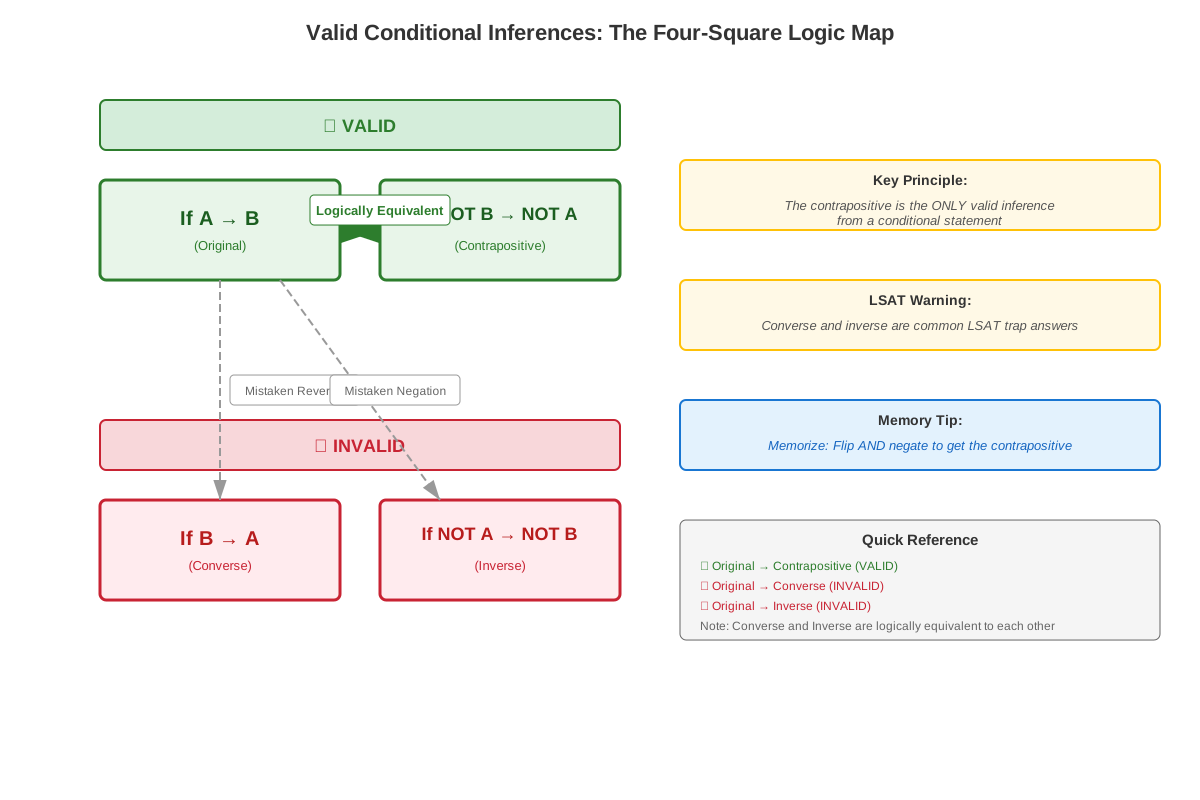
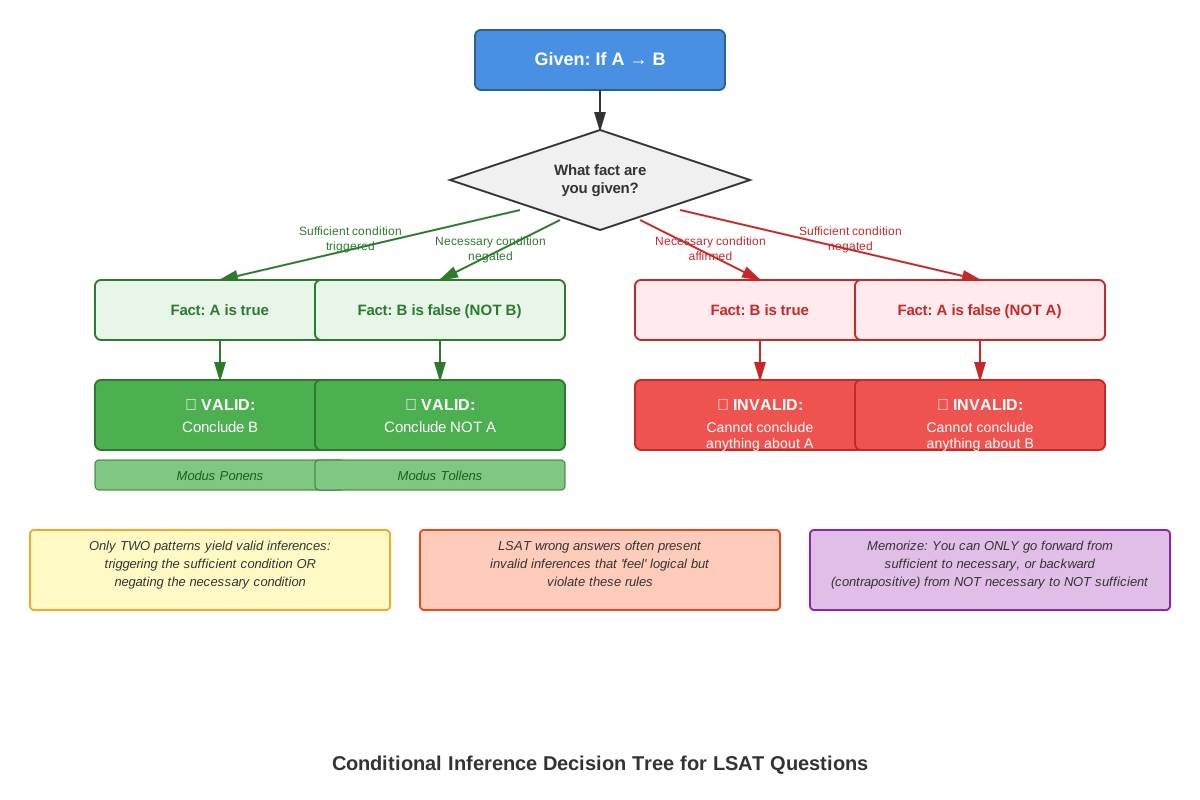
From any conditional statement A → B, only two valid inferences can be drawn:
- Modus Ponens (Affirming the Sufficient): If you know A is true, you can conclude B is true
- Given: A → B
- Given: A is true
- Conclusion: B is true
- Modus Tollens (Denying the Necessary): If you know B is false, you can conclude A is false
- Given: A → B
- Given: B is false (written as ~B)
- Conclusion: A is false (~A)
The second inference is also known as the contrapositive: ~B → ~A. The contrapositive is logically equivalent to the original statement, meaning they always have the same truth value.
Invalid Inferences (Logical Fallacies)
Two common invalid inferences plague test-takers and frequently appear as wrong answer choices:
- Affirming the Consequent (Affirming the Necessary): Incorrectly concluding that if B is true, then A must be true
- Given: A → B
- Given: B is true
- Invalid conclusion: A is true
- Example: "If it rains, the ground is wet. The ground is wet. Therefore, it rained." (The ground could be wet from a sprinkler)
- Denying the Antecedent (Denying the Sufficient): Incorrectly concluding that if A is false, then B must be false
- Given: A → B
- Given: A is false
- Invalid conclusion: B is false
- Example: "If it rains, the ground is wet. It is not raining. Therefore, the ground is not wet."
Conditional Chains
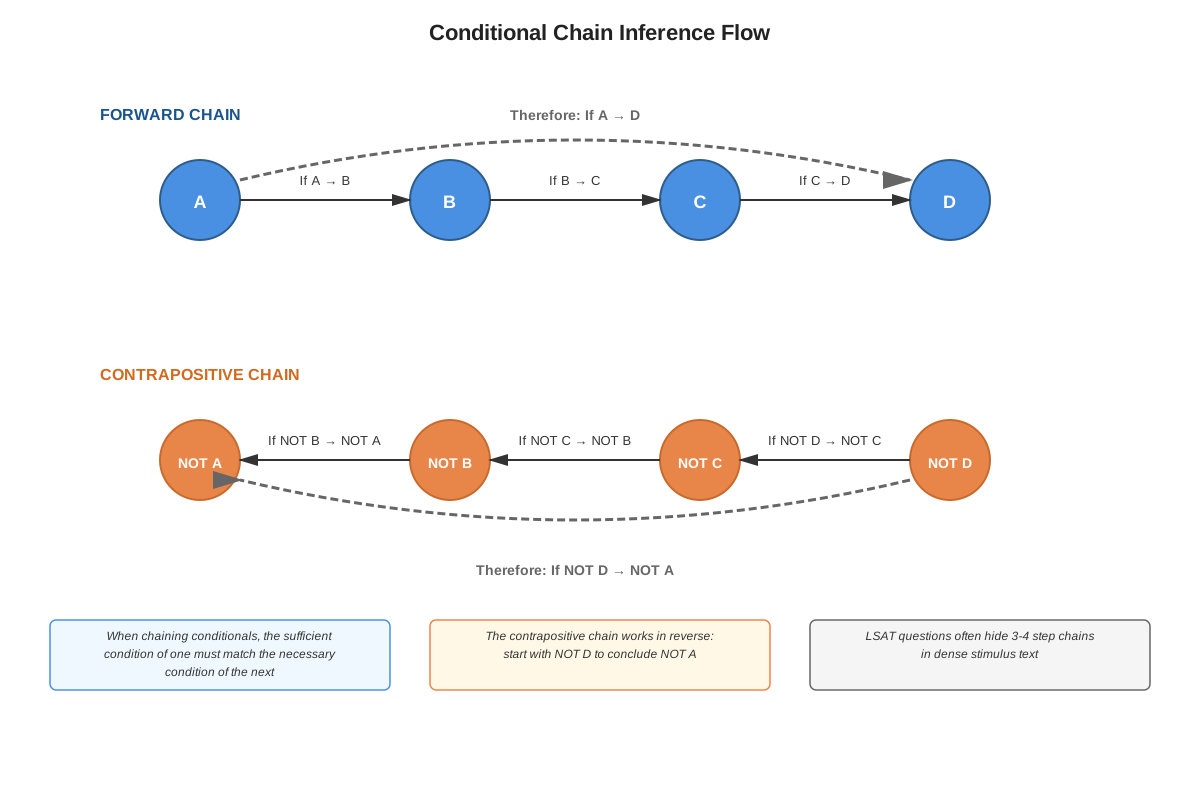
Multiple conditional statements can be linked together when the necessary condition of one statement matches the sufficient condition of another:
- Given: A → B
- Given: B → C
- Valid inference: A → C
This transitive property allows for extended chains: A → B → C → D, from which we can infer A → D. The contrapositive of the entire chain is equally valid: ~D → ~C → ~B → ~A.
Translating Natural Language
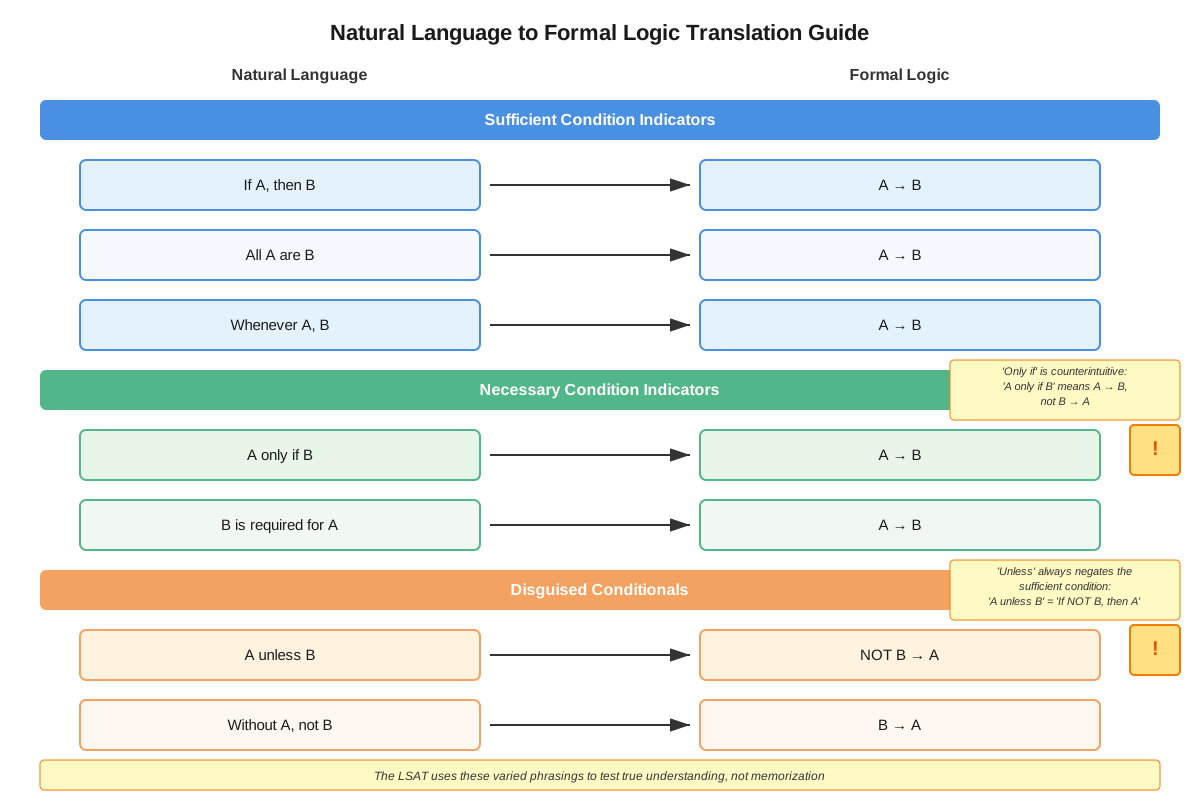
The LSAT rarely presents conditional statements in simple "if-then" format. Instead, it uses various linguistic constructions that must be translated:
| Natural Language | Logical Form | Example |
|---|---|---|
| If A, then B | A → B | If you study, you will pass |
| All A are B | A → B | All dogs are mammals |
| Only B if A | A → B | You pass only if you study |
| A only if B | A → B | You pass only if you study |
| Only A are B | B → A | Only citizens can vote |
| B if A | A → B | You pass if you study |
| B requires A | B → A | Voting requires citizenship |
| B depends on A | B → A | Success depends on effort |
| Unless A, B | ~A → B | Unless you study, you will fail |
| A unless B | ~B → A | You will fail unless you study |
The words "only" and "unless" cause the most confusion and require special attention. "Only" typically introduces the necessary condition, while "unless" means "if not" and introduces the sufficient condition after negation.
Compound Conditionals
Conditional statements can involve compound sufficient or necessary conditions using "and" or "or":
- A and B → C: Both A and B together are sufficient for C
- Contrapositive: ~C → ~A or ~B (if C doesn't occur, at least one of A or B didn't occur)
- A → B and C: A is sufficient for both B and C
- Contrapositive: ~B or ~C → ~A (if either B or C doesn't occur, A didn't occur)
- A or B → C: Either A or B alone is sufficient for C
- Contrapositive: ~C → ~A and ~B (if C doesn't occur, neither A nor B occurred)
Bi-Conditional Statements
A bi-conditional statement means "if and only if," indicating that the relationship works in both directions:
- A if and only if B means: A → B AND B → A
- This creates a two-way relationship where A and B always occur together or not at all
Concept Relationships
The concepts within conditional inference build upon each other in a hierarchical structure. Understanding the basic conditional statement (A → B) is the foundation. From this foundation, students must master valid inferences (modus ponens and contrapositive), which directly oppose invalid inferences (the two common fallacies). These three concepts form the core triad of conditional reasoning.
Translation skills connect natural language to formal logic, enabling students to recognize conditional statements regardless of how they are phrased. Once statements are properly translated, conditional chains allow multiple statements to be combined through the transitive property. Compound conditionals add complexity by introducing logical operators (and/or) into either the sufficient or necessary conditions.
The relationship map flows as follows:
Basic Conditional Statement → Valid Inferences (Modus Ponens & Contrapositive) → Conditional Chains → Compound Conditionals
Parallel to this main pathway:
Natural Language Variations → Translation → Basic Conditional Statement
And as a cautionary branch:
Basic Conditional Statement → Invalid Inferences (to be avoided)
This topic connects to prerequisite knowledge of sufficient and necessary conditions by providing the framework for applying those concepts. It connects forward to advanced topics like formal logic games, causal reasoning (which often involves conditional relationships), and argument evaluation (where conditional flaws must be identified).
Quick check — test yourself on Conditional inference so far.
Try Flashcards →High-Yield Facts
⭐ The contrapositive (~B → ~A) is the only logically equivalent transformation of a conditional statement (A → B)
⭐ Affirming the consequent and denying the antecedent are ALWAYS invalid inferences
⭐ "Only" typically introduces the necessary condition: "Only A are B" means B → A
⭐ "Unless" means "if not": "A unless B" translates to ~B → A
⭐ Conditional chains follow the transitive property: if A → B and B → C, then A → C
- A conditional statement tells you what must be true when the sufficient condition occurs, but says nothing definitive when it doesn't occur
- The necessary condition can occur without the sufficient condition occurring (B can be true even when A is false)
- "All A are B" is a conditional statement meaning A → B, not B → A
- Compound sufficient conditions connected by "and" require both elements to trigger the necessary condition
- Compound sufficient conditions connected by "or" mean either element alone can trigger the necessary condition
- The contrapositive of a chain is formed by reversing the order and negating each element
- "If and only if" creates a bi-conditional relationship where both directions are valid
- Multiple conditional statements can share elements, creating complex logical networks
- The absence of the sufficient condition tells you nothing about the necessary condition
- Conditional statements are about guarantees, not probabilities or typical occurrences
Common Misconceptions
Misconception: If A → B, and B is true, then A must be true.
Correction: This is the fallacy of affirming the consequent. The necessary condition (B) can occur without the sufficient condition (A). B might have other causes besides A.
Misconception: "Only if" and "if" mean the same thing.
Correction: These have opposite logical structures. "A if B" means B → A, while "A only if B" means A → B. The word "only" reverses the direction of the conditional relationship.
Misconception: The contrapositive is a different statement that might or might not be true.
Correction: The contrapositive is logically equivalent to the original statement—they always have the same truth value. If one is true, the other must be true; if one is false, the other must be false.
Misconception: "Unless" means "or" and creates two separate possibilities.
Correction: "Unless" creates a conditional statement meaning "if not." "A unless B" should be translated as ~B → A, not as a simple disjunction.
Misconception: If A → B, and A is false, then B must be false.
Correction: This is the fallacy of denying the antecedent. When the sufficient condition doesn't occur, the conditional statement makes no guarantee about the necessary condition. B could be true or false.
Misconception: Conditional statements describe what usually happens or what is likely.
Correction: Conditional statements on the LSAT describe absolute logical guarantees. "If A, then B" means B occurs 100% of the time when A occurs, not just usually or probably.
Misconception: In a conditional chain A → B → C, if C is true, then A must be true.
Correction: This commits the affirming the consequent fallacy. The chain tells you that A guarantees C, but C can occur without A. Only the contrapositive (~C → ~B → ~A) allows you to reason backward validly.
Worked Examples
Example 1: Must Be True Question
Stimulus: "All members of the city council support the new zoning ordinance. Anyone who supports the new zoning ordinance opposes the highway expansion project. No one who opposes the highway expansion project will vote for the mayor's infrastructure plan."
Question: If the statements above are true, which of the following must be true?
Step 1 - Translate to conditional form:
- Statement 1: City Council Member → Supports Zoning
- Statement 2: Supports Zoning → Opposes Highway
- Statement 3: Opposes Highway → ~Votes for Infrastructure Plan
Step 2 - Create the conditional chain:
City Council Member → Supports Zoning → Opposes Highway → ~Votes for Infrastructure Plan
Step 3 - Identify valid inferences:
From the chain, we can validly infer:
- City Council Member → ~Votes for Infrastructure Plan (by transitivity)
- Votes for Infrastructure Plan → ~City Council Member (contrapositive of the full chain)
Step 4 - Evaluate answer choices:
- (A) "If someone votes for the infrastructure plan, they are not on the city council" - CORRECT. This is the contrapositive of our derived inference.
- (B) "If someone is not on the city council, they vote for the infrastructure plan" - INCORRECT. This denies the antecedent.
- (C) "If someone opposes the highway expansion, they are on the city council" - INCORRECT. This affirms the consequent.
Connection to Learning Objectives: This example demonstrates how conditional inference appears in Must Be True questions (Objective 1), applies the reasoning pattern of conditional chains and contrapositives (Objective 2), and requires accurate application to solve the problem (Objective 3).
Example 2: Flaw Question
Stimulus: "The new medication will be approved by the FDA only if it passes clinical trials. The medication passed clinical trials. Therefore, the medication will be approved by the FDA."
Question: The reasoning in the argument is flawed because it:
Step 1 - Identify the conditional structure:
Premise: Approved → Passes Trials (translating "only if" correctly)
Premise: Passes Trials (true)
Conclusion: Approved (claimed)
Step 2 - Recognize the logical error:
The argument affirms the necessary condition (Passes Trials) and concludes the sufficient condition (Approved) must be true. This is the fallacy of affirming the consequent.
Step 3 - Understand why it's invalid:
Passing clinical trials is necessary for approval, but not sufficient. The medication might pass trials but still be rejected for other reasons (safety concerns, manufacturing issues, etc.). The conditional statement only guarantees that approval requires passing trials, not that passing trials guarantees approval.
Step 4 - Identify the correct answer:
The correct answer will describe this flaw, likely stating something like: "treats a condition necessary for the medication's approval as if it were sufficient for approval."
Connection to Learning Objectives: This example shows how conditional inference appears in Flaw questions (Objective 1), explains the reasoning pattern of the affirming the consequent fallacy (Objective 2), and demonstrates how to identify this error in LSAT arguments (Objective 3).
Exam Strategy
Recognition Triggers
Watch for these words and phrases that signal conditional relationships:
- Sufficient condition indicators: if, when, whenever, all, any, every, each
- Necessary condition indicators: only, only if, only when, requires, depends on, necessary, must
- Bi-conditional indicators: if and only if, necessary and sufficient
- Negation indicators: unless, without, except, until
Systematic Approach
- Identify and translate: When you spot conditional language, immediately translate it into A → B form. Write it down if working on paper or visualize it clearly.
- Form the contrapositive: Automatically generate the contrapositive (~B → ~A) since it's logically equivalent and often needed for correct answers.
- Build chains: If multiple conditional statements are present, look for opportunities to chain them together through shared terms.
- Eliminate invalid inferences: Actively watch for answer choices that affirm the consequent or deny the antecedent—these are almost always wrong.
Time Management
Conditional inference questions should be among your faster questions once you've mastered the patterns. Aim for:
- Simple conditional statements: 45-60 seconds
- Conditional chains: 60-90 seconds
- Complex compound conditionals: 90-120 seconds
If a question involves conditional logic and you're taking longer than these benchmarks, you may be overcomplicating it. Return to the basic structure: identify the conditional, form the contrapositive, and look for valid inferences only.
Process of Elimination Tips
- Eliminate any answer that commits affirming the consequent or denying the antecedent unless the question specifically asks you to identify a flaw
- Eliminate answers that reverse the conditional without negating (if the stimulus says A → B, an answer saying B → A is wrong unless it's a bi-conditional)
- Eliminate answers that go beyond what the conditional guarantees (conditional statements are about logical necessity, not probability or typicality)
- Keep answers that are contrapositives or valid chain inferences of the stimulus conditionals
Exam Tip: On difficult questions, if you can't immediately see the right answer, focus on eliminating the two most common wrong answer types: affirming the consequent and denying the antecedent. This often leaves you with 2-3 choices, significantly improving your odds.
Memory Techniques
The "Guarantee Flow" Visualization
Think of conditional statements as one-way pipes where water (truth) flows from sufficient to necessary. Water can only flow in one direction (A → B), but you can trace backward to find the source by following the contrapositive (~B → ~A). Water cannot flow backward through the original pipe.
Mnemonic for "Only"
Only Necessary: The word "only" introduces the necessary condition. "Only A are B" means B → A (B is sufficient, A is necessary).
The "Unless = If Not" Rule
Whenever you see "unless," replace it with "if not" and negate the following term:
- "A unless B" becomes "A if not B" which is ~B → A
Acronym for Valid Inferences: "MP-CP"
- Modus Ponens: Affirm the sufficient, conclude the necessary
- ContraPositive: Negate and reverse
These are your only two valid moves. Everything else is invalid.
The "Backward = Negate Both" Rule
To form a contrapositive (going backward through the conditional), you must negate both terms. Never reverse without negating, and never negate without reversing.
Summary
Conditional inference is the cornerstone of formal logic on the LSAT, appearing in approximately one-quarter of all Logical Reasoning questions. Mastery requires understanding that conditional statements (A → B) establish a guarantee relationship where the sufficient condition ensures the necessary condition. Only two valid inferences exist: modus ponens (affirming the sufficient) and the contrapositive (negating and reversing). The two most common invalid inferences—affirming the consequent and denying the antecedent—appear frequently in wrong answer choices and flawed arguments. Success demands the ability to translate diverse natural language constructions into formal conditional notation, particularly tricky phrasings involving "only" and "unless." Students must also master conditional chains, recognizing that multiple statements can be linked through shared terms to derive remote conclusions. The contrapositive remains logically equivalent to the original statement and is often the key to identifying correct answers. Understanding these principles and avoiding common fallacies enables test-takers to quickly and accurately navigate conditional inference questions across all Logical Reasoning question types.
Key Takeaways
- Conditional statements create one-way guarantee relationships: A → B means A is sufficient for B, and B is necessary for A
- The contrapositive (~B → ~A) is the only logically equivalent transformation and is always valid
- Affirming the consequent and denying the antecedent are invalid inferences that frequently appear in wrong answers
- "Only" introduces the necessary condition; "unless" means "if not" and creates a conditional after negation
- Conditional chains follow the transitive property, allowing remote inferences through shared terms
- Valid reasoning flows forward through the original conditional or backward through the contrapositive—never backward through the original
- Translating natural language accurately into formal notation is essential for avoiding errors and identifying correct answers
Related Topics
Formal Logic Games: Conditional inference skills directly transfer to Logic Games, where complex conditional rules must be combined to determine what must, could, or cannot be true. Mastering conditional inference in Logical Reasoning provides the foundation for handling the most challenging logic games.
Necessary and Sufficient Assumptions: These question types explicitly test understanding of conditional relationships. Sufficient Assumption questions require identifying a conditional that completes an argument, while Necessary Assumption questions involve recognizing unstated conditionals the argument depends upon.
Causal Reasoning: Many causal arguments can be analyzed using conditional logic. Understanding the relationship between causes (often sufficient conditions) and effects (often necessary conditions) deepens comprehension of both topics.
Argument Structure and Diagramming: Advanced argument analysis often involves mapping multiple conditional relationships within complex arguments. Mastering conditional inference enables more sophisticated argument diagramming techniques.
Practice CTA
Now that you've mastered the core concepts of conditional inference, it's time to put your knowledge into practice. Attempt the practice questions and flashcards to reinforce these patterns and build the automaticity needed for test day success. Remember: conditional inference is one of the highest-yield topics on the LSAT. Every minute spent practicing these skills translates directly into points on the exam. The difference between understanding conditional logic conceptually and applying it flawlessly under time pressure is simply practice. Start now, and watch your Logical Reasoning score improve dramatically.
Sign up free to keep reading
Create a free AnvayaPrep account to finish this LSAT guide on Conditional inference — plus flashcards and practice questions.