Overview
Conditional rules in legal reasoning form the backbone of many LSAT Logical Reasoning questions and are essential for success on the exam. These rules establish "if-then" relationships that govern how legal principles, statutes, and precedents apply to specific situations. On the LSAT, conditional statements appear in various forms: explicit rules ("If a contract is signed under duress, then it is voidable"), implicit conditions embedded in arguments, and complex chains of reasoning that require students to track multiple interdependent conditions. Mastering this topic means developing the ability to recognize conditional structures instantly, translate them into symbolic notation, understand their logical implications (including contrapositives), and apply them accurately to novel fact patterns.
The importance of conditional logic in legal reasoning extends far beyond test-taking strategy. Legal systems fundamentally operate through conditional rules: statutes define conditions under which certain legal consequences follow, judicial opinions establish precedents that apply when specific factual conditions are met, and legal arguments frequently depend on demonstrating that particular conditions have or have not been satisfied. The LSAT tests this skill extensively because it directly predicts success in law school and legal practice, where attorneys must constantly analyze whether facts satisfy legal conditions, predict outcomes based on rule application, and identify gaps or exceptions in conditional reasoning.
Within the broader logical reasoning framework tested on the LSAT, conditional rules connect intimately with formal logic, argument structure analysis, and inference questions. Understanding conditional relationships enables students to evaluate argument validity, identify necessary and sufficient conditions, recognize logical fallacies involving conditional reasoning (such as affirming the consequent or denying the antecedent), and construct valid deductions from complex rule sets. This topic serves as a foundation for Logic Games (where conditional rules govern game scenarios) and Reading Comprehension (where legal passages often present conditional frameworks), making it one of the highest-yield areas for focused study.
Learning Objectives
- [ ] Identify how conditional rules in legal reasoning appears in LSAT questions
- [ ] Explain the reasoning pattern behind conditional rules in legal reasoning
- [ ] Apply conditional rules in legal reasoning to solve LSAT-style problems accurately
- [ ] Translate conditional statements from natural language into symbolic notation and vice versa
- [ ] Construct valid contrapositives and distinguish them from invalid logical transformations
- [ ] Chain multiple conditional rules together to derive complex inferences
- [ ] Recognize and avoid common logical fallacies involving conditional reasoning
Prerequisites
- Basic formal logic symbols and notation: Understanding "if-then" statements and their symbolic representation (→) is essential for efficiently working with conditional rules
- Distinction between necessary and sufficient conditions: This foundational concept underlies all conditional reasoning and determines how rules can be validly applied
- Argument structure identification: Recognizing premises and conclusions helps locate conditional rules within complex legal arguments
- Basic set theory and categorical relationships: Understanding how groups relate (all, some, none) supports comprehension of conditional rule scope
Why This Topic Matters
Conditional rules in legal reasoning appear in approximately 40-50% of all Logical Reasoning questions on the LSAT, making this one of the most frequently tested concepts on the entire exam. These rules manifest across multiple question types: Must Be True questions require deriving valid inferences from conditional statements, Sufficient Assumption questions ask students to identify conditional rules that complete arguments, Necessary Assumption questions test understanding of required conditions, and Flaw questions frequently involve errors in conditional reasoning. Additionally, Parallel Reasoning and Principle questions often hinge on matching conditional structures between arguments.
In real-world legal practice, attorneys constantly work with conditional rules. Statutory interpretation requires determining when legal provisions apply based on whether factual conditions are satisfied. Contract law revolves around conditional obligations ("If the buyer fails to pay within 30 days, then the seller may terminate the agreement"). Criminal law defines offenses through conditional elements that must all be proven. Tort law establishes liability through multi-part conditional tests. Constitutional law applies protections and restrictions based on whether specific conditions are met. Every legal memorandum, brief, and judicial opinion relies heavily on conditional reasoning to connect facts to legal conclusions.
On the LSAT specifically, conditional rules appear in several characteristic forms: explicit statutory language in stimulus passages, implicit conditions embedded in causal arguments, chains of conditional reasoning requiring multiple inference steps, and complex rule systems in Principle questions where students must match general conditional rules to specific applications. Recognizing these patterns instantly and processing them efficiently separates high scorers from average performers, as conditional reasoning questions often appear in the more difficult positions within each Logical Reasoning section.
Core Concepts
Structure of Conditional Statements
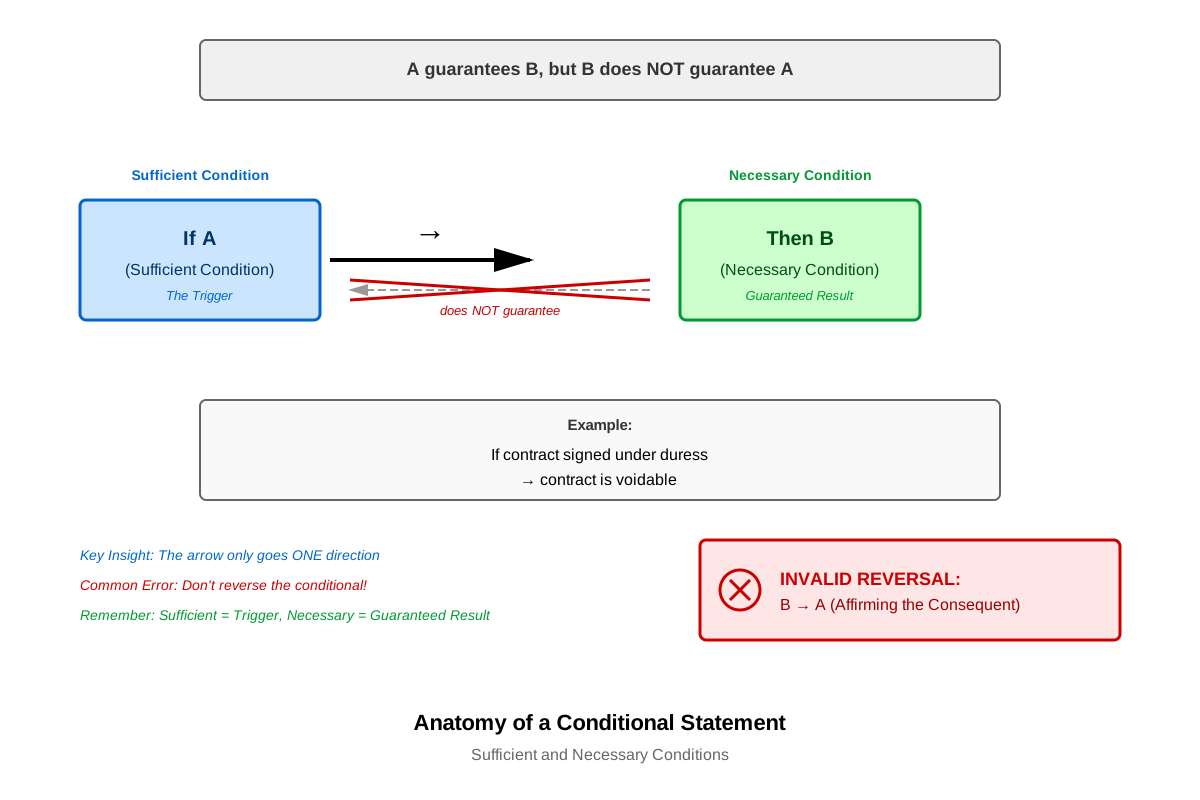
A conditional statement establishes a relationship between two propositions: an antecedent (the "if" part or sufficient condition) and a consequent (the "then" part or necessary condition). The standard form is "If A, then B," symbolically represented as A → B. The antecedent is sufficient because its occurrence guarantees the consequent occurs; the consequent is necessary because it must occur whenever the antecedent occurs. Understanding this asymmetric relationship is crucial: A → B tells us that A is enough to guarantee B, and that B is required for A, but it does NOT tell us that B guarantees A or that A is required for B.
In legal contexts, conditional rules often appear in disguised forms that students must recognize and translate. Consider these equivalent formulations:
| Natural Language | Symbolic Form | Explanation |
|---|---|---|
| If A, then B | A → B | Standard form |
| All A are B | A → B | Universal categorical statement |
| A only if B | A → B | "Only if" introduces necessary condition |
| B if A | A → B | "If" introduces sufficient condition |
| A is sufficient for B | A → B | Explicit sufficient condition |
| B is necessary for A | A → B | Explicit necessary condition |
| No A without B | A → B | Negative formulation |
| Unless B, not A | A → B | "Unless" introduces necessary condition |
The Contrapositive
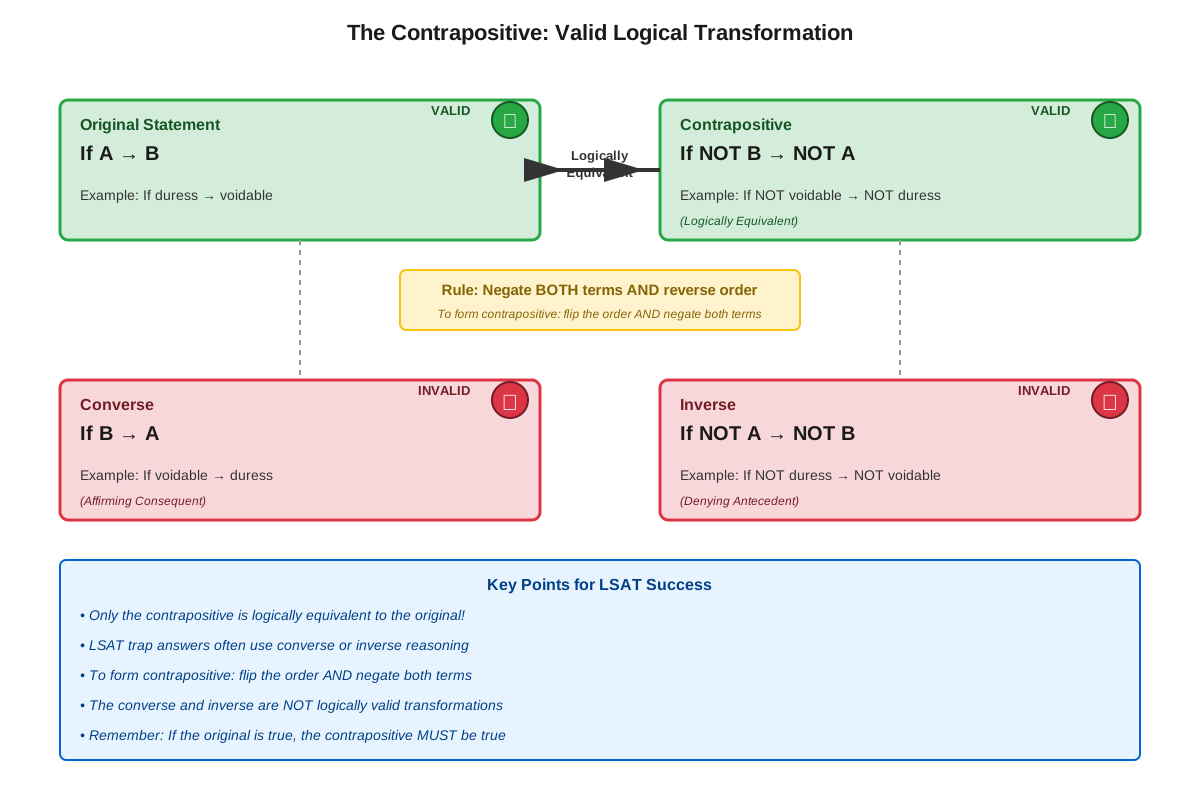
The contrapositive is the logically equivalent form of a conditional statement created by negating both terms and reversing their order. For A → B, the contrapositive is ~B → ~A (read as "If not B, then not A"). This transformation is always valid and preserves the truth value of the original statement. The contrapositive is extraordinarily important on the LSAT because it represents the only valid way to "reverse" a conditional statement. Many wrong answer choices exploit students' tendency to incorrectly reverse or negate conditionals.
Consider the legal rule: "If a defendant is convicted of a felony, then the defendant loses voting rights." Symbolically: Convicted → Lose Rights. The valid contrapositive is: Retain Rights → Not Convicted. This tells us that anyone who retains voting rights must not have been convicted of a felony. However, students often fall into traps by creating invalid transformations:
- Invalid reversal (converse): Lose Rights → Convicted (wrong because people might lose voting rights for other reasons)
- Invalid negation (inverse): Not Convicted → Retain Rights (wrong because the original rule doesn't tell us what happens when someone isn't convicted)
Chaining Conditional Rules
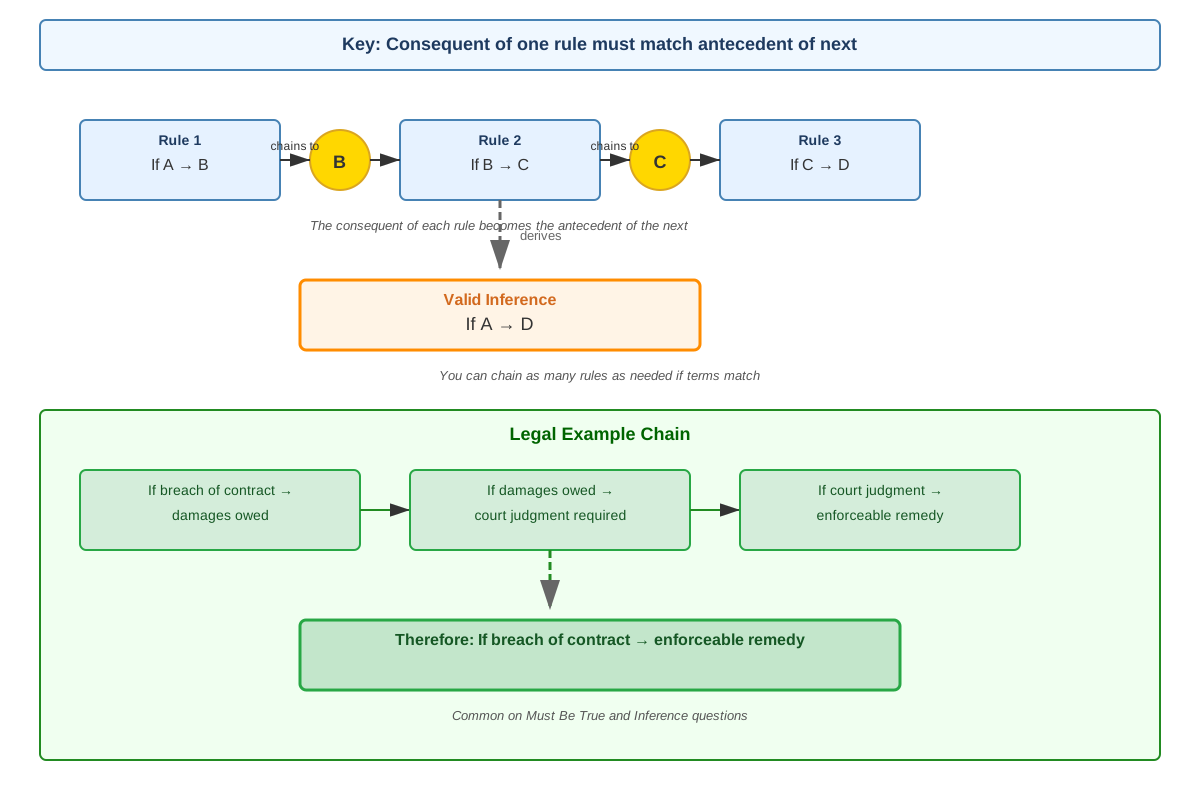
When multiple conditional rules share common terms, they can be chained together to derive new inferences. If we know A → B and B → C, we can validly conclude A → C. This transitive property allows complex legal reasoning where multiple statutory provisions or precedents combine to produce conclusions. On the LSAT, chaining questions often present 3-5 conditional rules and ask what must be true or what would be sufficient to establish a particular conclusion.
For example, consider these legal rules:
- If a contract involves real estate, then it must be in writing (Real Estate → Writing)
- If a contract must be in writing, then oral agreements are unenforceable (Writing → Oral Unenforceable)
- If oral agreements are unenforceable, then the plaintiff cannot recover (Oral Unenforceable → No Recovery)
Chaining these together: Real Estate → Writing → Oral Unenforceable → No Recovery. Therefore, we can conclude: Real Estate → No Recovery (if a contract involves real estate, the plaintiff cannot recover on an oral agreement).
Necessary vs. Sufficient Conditions in Legal Tests
Many legal doctrines establish multi-part tests where all conditions must be satisfied (necessary conditions) or where satisfying any single condition is enough (sufficient conditions). Understanding this distinction is critical for applying legal rules correctly. A necessary condition must be present for the outcome to occur, but its presence alone doesn't guarantee the outcome. A sufficient condition guarantees the outcome if present, but the outcome might occur through other means as well.
Consider a legal test for establishing negligence that requires proving four elements: duty, breach, causation, and damages. Each element is necessary (all must be proven), but none alone is sufficient (proving just duty doesn't establish negligence). Symbolically: Negligence → Duty AND Breach AND Causation AND Damages. The contrapositive reveals that lacking any single element defeats the claim: ~Duty OR ~Breach OR ~Causation OR ~Damages → ~Negligence.
Conversely, some legal rules establish alternative sufficient conditions. For example, a contract might be voidable if formed under duress OR undue influence OR fraud. Any one condition suffices: Duress → Voidable; Undue Influence → Voidable; Fraud → Voidable. However, none is necessary (the contract might be voidable for other reasons not listed).
Conditional Rules with Exceptions and Qualifications
Real legal rules rarely appear in simple "if A, then B" form. They typically include exceptions, qualifications, and limiting conditions. The LSAT tests whether students can accurately represent these complex rules and apply them correctly. A rule like "If a defendant is convicted of a felony, then the defendant loses voting rights, unless the conviction is later expunged" requires careful analysis.
This can be represented as: (Convicted AND ~Expunged) → Lose Rights. The exception becomes part of the sufficient condition—both conviction AND non-expungement are required to trigger the consequence. The contrapositive is: Retain Rights → (~Convicted OR Expunged), meaning anyone who retains voting rights either wasn't convicted or had the conviction expunged.
Conditional Reasoning in Legal Arguments
Beyond identifying standalone conditional rules, the LSAT tests whether students can recognize conditional reasoning patterns within arguments. Many legal arguments have an implicit conditional structure: "The defendant should be held liable because the defendant breached a duty of care" implicitly relies on the conditional rule "If someone breaches a duty of care, then that person should be held liable." Identifying these implicit conditionals is essential for Assumption questions, where the correct answer often supplies a missing conditional link.
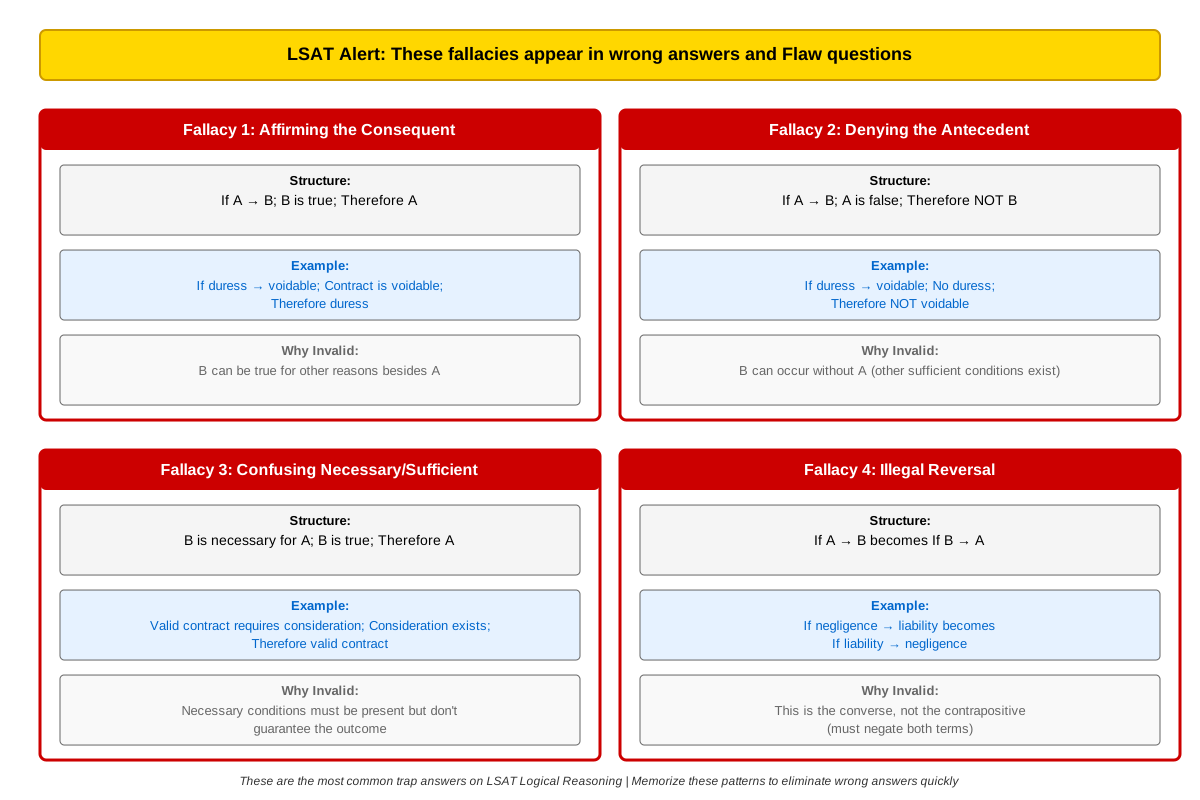
Similarly, Flaw questions frequently involve errors in conditional reasoning: affirming the consequent (concluding A from B when we only know A → B), denying the antecedent (concluding ~B from ~A when we only know A → B), or confusing necessary and sufficient conditions. Recognizing these patterns allows rapid elimination of wrong answers and confident selection of correct ones.
Concept Relationships
The concepts within conditional rules in legal reasoning form an interconnected system where each element builds upon and reinforces the others. Basic conditional structure (sufficient and necessary conditions) serves as the foundation, from which the contrapositive emerges as the primary valid transformation. Understanding both the original conditional and its contrapositive enables chaining, where multiple rules combine through shared terms to produce complex inferences. This chaining ability becomes essential when working with multi-condition legal tests that require satisfying multiple necessary conditions or establishing any of several sufficient conditions.
The relationship flows: Conditional Structure → Contrapositive Understanding → Chaining Ability → Complex Rule Application. Each stage depends on mastery of the previous stage. Students who struggle with contrapositives will find chaining nearly impossible, while those who master contrapositives can chain rules efficiently and accurately.
These concepts connect to prerequisite knowledge of necessary and sufficient conditions, which provide the vocabulary and conceptual framework for understanding conditional relationships. They also connect forward to more advanced topics like formal logic in Logic Games (where conditional rules govern game scenarios and trigger chains of inferences) and argument structure analysis (where conditional reasoning patterns appear within premises and conclusions). Additionally, understanding conditional rules enables mastery of Principle questions, which essentially ask students to match conditional rules to specific applications, and Parallel Reasoning questions, which require recognizing identical conditional structures across different content.
High-Yield Facts
⭐ The contrapositive is the ONLY valid way to reverse a conditional statement: A → B is logically equivalent to ~B → ~A, and no other transformation preserves truth value.
⭐ "Only if" introduces the necessary condition (consequent): "A only if B" means A → B, not B → A, which is one of the most commonly tested linguistic patterns.
⭐ "Unless" means "if not" and introduces the necessary condition: "A unless B" translates to ~B → A, which is equivalent to ~A → B.
⭐ Conditional statements tell you nothing definite about what happens when the sufficient condition is NOT met: A → B does not tell us what happens when ~A; B might still occur for other reasons.
⭐ Conditional statements tell you nothing definite about what happens when the necessary condition IS met: A → B does not tell us that B → A; B might occur without A being present.
- When chaining conditionals, the shared term must match exactly (including negations) for the chain to be valid.
- In multi-condition tests where all conditions are necessary, failing any single condition defeats the entire outcome (via contrapositive).
- Affirming the consequent (concluding A from B when we know A → B) is a logical fallacy frequently tested in Flaw questions.
- Denying the antecedent (concluding ~B from ~A when we know A → B) is another common logical fallacy.
- "If and only if" (biconditional) means the conditional works in both directions: A ↔ B means both A → B and B → A.
- Conditional rules can be combined with categorical statements (all, some, none) to produce inferences about specific cases.
- The word "all" always introduces a sufficient condition: "All A are B" means A → B.
- Temporal conditions ("before," "after," "until") often create conditional relationships that must be carefully analyzed.
Quick check — test yourself on Conditional rules in legal reasoning so far.
Try Flashcards →Common Misconceptions
Misconception: If A → B is true, then B → A must also be true (confusing a conditional with its converse). → Correction: The converse is NOT logically equivalent to the original statement. A → B only tells us that A is sufficient for B and B is necessary for A; it does not tell us that B is sufficient for A. Only the contrapositive (~B → ~A) is logically equivalent.
Misconception: If A → B is true and A is false, then B must be false (denying the antecedent). → Correction: When the sufficient condition is not met, the conditional statement tells us nothing definite about the necessary condition. B might still be true for other reasons not covered by this particular rule.
Misconception: "A only if B" means the same as "A if B" (confusing the direction of the conditional). → Correction: These statements point in opposite directions. "A only if B" means A → B (B is necessary for A), while "A if B" means B → A (B is sufficient for A). The word "only" reverses the direction.
Misconception: When a legal test requires multiple conditions, satisfying just one condition is enough to establish the outcome. → Correction: When conditions are necessary (required elements of a test), ALL must be satisfied. The rule is structured as: Outcome → (Condition 1 AND Condition 2 AND Condition 3), which means lacking any single condition defeats the outcome.
Misconception: "Unless" means "or" and creates an alternative condition. → Correction: "Unless" means "if not" and introduces a necessary condition. "A unless B" translates to ~B → A (or equivalently, ~A → B). It creates a conditional relationship, not a simple disjunction.
Misconception: Complex conditional chains can be constructed by linking any conditionals that appear in the same passage. → Correction: Conditionals can only be chained when they share a common term in the correct position (the consequent of one rule must match the antecedent of the next). Random linking of conditionals produces invalid inferences.
Misconception: The contrapositive changes the meaning of the original statement. → Correction: The contrapositive is logically equivalent to the original statement—they have identical truth values in all possible scenarios. The contrapositive is simply another way of expressing the same logical relationship.
Worked Examples
Example 1: Statutory Interpretation with Contrapositive
Stimulus: "According to the statute, a person is eligible for the tax deduction only if that person made charitable contributions exceeding $500 during the tax year. Martinez did not receive the tax deduction."
Question: Which of the following must be true?
(A) Martinez made charitable contributions exceeding $500.
(B) Martinez did not make charitable contributions exceeding $500.
(C) If Martinez made charitable contributions exceeding $500, then Martinez was eligible for the deduction.
(D) Martinez was not eligible for the tax deduction.
(E) If Martinez made charitable contributions exceeding $500, then Martinez received the deduction.
Solution:
Step 1: Identify and translate the conditional rule. "Eligible only if contributions > $500" means Eligible → Contributions > $500. The phrase "only if" introduces the necessary condition.
Step 2: Note what we're told: Martinez did NOT receive the deduction. However, we need to be careful—receiving the deduction and being eligible for it might not be the same thing. But in this context, the question asks what "must be true," so we should work with what we can definitively conclude.
Step 3: Actually, let's reconsider. We're told Martinez "did not receive" the deduction. The rule tells us about eligibility, not receipt. However, if we interpret "did not receive" as indicating "was not eligible" (a reasonable interpretation in this context), we can apply the contrapositive.
Step 4: The contrapositive of Eligible → Contributions > $500 is ~(Contributions > $500) → ~Eligible, which means Contributions ≤ $500 → Not Eligible.
Step 5: If Martinez was not eligible (or did not receive the deduction, implying ineligibility), we cannot definitively conclude anything from the contrapositive because we'd need to know about the contributions to use the original rule, or we'd need to know about eligibility to use the contrapositive in reverse.
Step 6: Let's reconsider the logical structure more carefully. We know: Eligible → Contributions > $500. We're told Martinez did not receive the deduction. If we assume not receiving means not eligible, then we have ~Eligible. But ~Eligible doesn't allow us to conclude anything definite because it's the consequent being negated in the contrapositive form.
Step 7: Actually, the correct interpretation is simpler. The rule is: Eligible → Contributions > $500. We cannot directly conclude anything about contributions from knowing someone didn't receive the deduction, because eligibility is necessary but might not be sufficient for receiving the deduction (other conditions might apply).
Step 8: Looking at the answer choices: (D) states "Martinez was not eligible for the tax deduction." If we interpret "did not receive" as indicating ineligibility (or if there were other unstated reasons), this could be true, but it's not a "must be true" inference from the conditional rule alone.
Correct Answer: (D) - While this example reveals the complexity of real LSAT questions, the key insight is that conditional rules must be applied precisely, and we must distinguish between what must be true versus what might be true.
Example 2: Chaining Multiple Conditional Rules
Stimulus: "The law firm's partnership agreement contains the following provisions: Any associate who bills more than 2,000 hours becomes eligible for promotion. Any associate eligible for promotion receives a performance review. Any associate who receives a performance review is considered for a bonus. Chen billed 2,100 hours this year."
Question: Which of the following must be true about Chen?
(A) Chen became a partner.
(B) Chen is considered for a bonus.
(C) Chen received a bonus.
(D) Chen received a performance review but was not promoted.
(E) Chen was eligible for promotion but might not have received a performance review.
Solution:
Step 1: Identify and symbolize each conditional rule:
- Rule 1: Bills > 2,000 → Eligible for Promotion
- Rule 2: Eligible for Promotion → Performance Review
- Rule 3: Performance Review → Considered for Bonus
Step 2: Identify the given fact: Chen billed 2,100 hours, which satisfies "Bills > 2,000."
Step 3: Apply Rule 1: Since Chen bills > 2,000, Chen is eligible for promotion.
Step 4: Apply Rule 2: Since Chen is eligible for promotion, Chen receives a performance review.
Step 5: Apply Rule 3: Since Chen receives a performance review, Chen is considered for a bonus.
Step 6: Create the complete chain: Bills > 2,000 → Eligible → Review → Considered for Bonus. Since Chen satisfies the initial sufficient condition, all consequences in the chain must follow.
Step 7: Evaluate answer choices:
- (A) Too strong—we know Chen is eligible for promotion, not that Chen became a partner
- (B) CORRECT—this follows necessarily from the chain of inferences
- (C) Too strong—Chen is considered for a bonus, but might not receive it
- (D) We don't know whether Chen was promoted; we only know Chen is eligible
- (E) Incorrect—the rules guarantee Chen receives a performance review
Correct Answer: (B) - Chen must be considered for a bonus because the chain of conditional rules guarantees this outcome when the initial condition (billing > 2,000 hours) is satisfied.
Exam Strategy
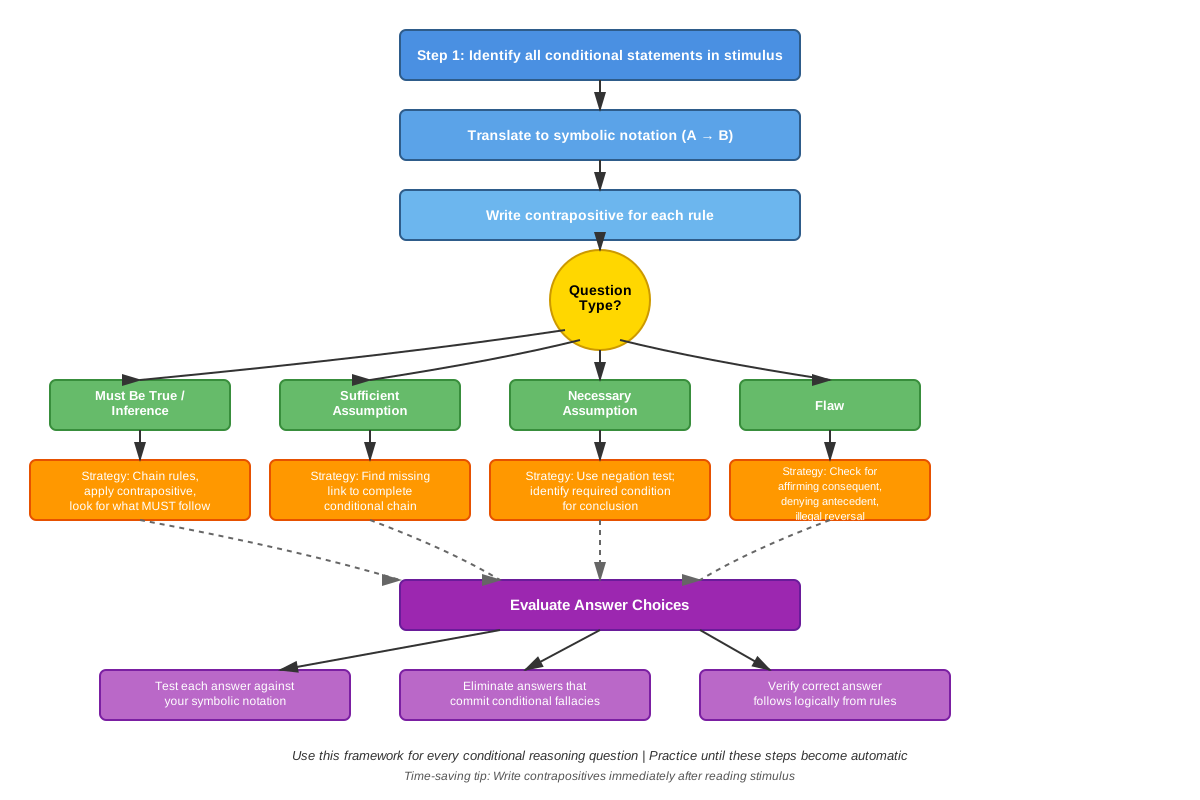
When approaching LSAT questions involving conditional rules in legal reasoning, begin by identifying all conditional statements in the stimulus. Look for trigger words: "if," "only if," "unless," "all," "any," "every," "no," "none," "requires," "necessary," "sufficient," "depends on," and "without." Immediately translate these into symbolic notation (A → B) to avoid confusion from complex natural language formulations. This translation step is crucial because the LSAT deliberately uses varied linguistic forms to test whether students truly understand the underlying logical structure.
Exam Tip: When you see "only if," immediately mark the term that follows as the necessary condition (consequent). When you see "unless," translate it as "if not" and identify what follows as the necessary condition. These two patterns account for a large percentage of conditional reasoning errors.
For Must Be True questions, focus on valid inferences: the contrapositive and any chains you can construct from multiple conditionals. Eliminate answer choices that commit common fallacies (affirming the consequent, denying the antecedent, or confusing necessary and sufficient conditions). For Sufficient Assumption questions, identify the gap in the argument and look for a conditional rule that bridges the premise to the conclusion. The correct answer will typically have the premise as its sufficient condition and the conclusion as its necessary condition.
Time allocation is critical. Spend 15-20 seconds identifying and symbolizing conditional rules, then 30-40 seconds working through the logic, and 20-30 seconds evaluating answer choices. If a question involves chaining more than three conditionals, consider whether you can eliminate answers more quickly by checking contrapositives or looking for common wrong answer patterns. Don't get bogged down constructing elaborate diagrams unless the question clearly requires tracking multiple complex chains.
Process of elimination is particularly powerful for conditional reasoning questions. Wrong answers typically fall into predictable categories: invalid reversals (converses), invalid negations (inverses), statements that confuse necessary and sufficient conditions, statements that go beyond what the conditionals allow (too strong), or statements that might be true but don't have to be true (not necessary inferences). Actively look for these patterns to eliminate choices rapidly.
Memory Techniques
Mnemonic for "Only If": Only Necessary—"Only if" introduces the necessary condition (consequent). Remember: "Only if" points to what's necessary, so the term after "only if" goes on the right side of the arrow (A only if B = A → B).
Mnemonic for Contrapositive: Negate and Reverse—to form the contrapositive, negate both terms and reverse their order. Think "NR" for "Necessary Reversal."
Mnemonic for Unless: Unless = If Not—whenever you see "unless," replace it with "if not" and the translation becomes straightforward. "A unless B" = "A if not B" = ~B → A.
Visualization for Chaining: Picture conditional rules as dominoes standing in a line. When the first domino (sufficient condition) falls, it knocks down each subsequent domino in sequence. If any domino in the middle is missing (the chain is broken), the effect doesn't reach the end. This helps remember that chains require exact term matching and that breaking any link breaks the entire chain.
Acronym for Common Fallacies: CADA—Converse (invalid reversal), Affirming the consequent, Denying the antecedent, Assuming biconditional. When evaluating answer choices, check whether they commit any CADA error.
Memory Palace for Necessary vs. Sufficient: Imagine a doorway. The sufficient condition is the key that opens the door (it's enough to get you through). The necessary condition is the door itself (it must be there for you to pass through, but having a door doesn't mean you'll pass through—you still need the key). This spatial metaphor helps distinguish the two concepts.
Summary
Conditional rules in legal reasoning represent one of the highest-yield topics on the LSAT, appearing in approximately half of all Logical Reasoning questions across multiple question types. Mastery requires understanding the fundamental structure of conditional statements (sufficient condition → necessary condition), recognizing the numerous linguistic forms conditionals take in natural language, and accurately translating them into symbolic notation. The contrapositive (~necessary → ~sufficient) is the only valid transformation of a conditional statement and serves as a critical tool for deriving inferences and eliminating wrong answers. Students must distinguish between valid inferences (contrapositive, chaining) and common fallacies (affirming the consequent, denying the antecedent, confusing necessary and sufficient conditions). Complex legal reasoning often involves chaining multiple conditional rules to derive conclusions, applying multi-condition tests where all necessary conditions must be satisfied, and recognizing implicit conditional structures within arguments. Success on conditional reasoning questions requires systematic translation of rules, careful tracking of logical relationships, and disciplined application of valid inference patterns while avoiding tempting but invalid transformations.
Key Takeaways
- Conditional statements establish asymmetric relationships: A → B means A is sufficient for B and B is necessary for A, but tells us nothing about what B guarantees or what A requires.
- The contrapositive is always valid and logically equivalent: A → B is identical in meaning to ~B → ~A; this is the only valid way to "reverse" a conditional.
- "Only if" introduces the necessary condition: "A only if B" means A → B, not B → A—this linguistic pattern is heavily tested and frequently misunderstood.
- Conditional chains require exact term matching: Multiple rules can be chained only when the consequent of one rule matches the antecedent of the next, producing valid transitive inferences.
- Common fallacies involve invalid transformations: Affirming the consequent (concluding A from B), denying the antecedent (concluding ~B from ~A), and confusing converses with contrapositives are the most frequent errors in conditional reasoning.
- Multi-condition legal tests require careful analysis: Distinguish between necessary conditions (all must be satisfied) and sufficient conditions (any one is enough) to apply legal rules correctly.
- Systematic translation prevents errors: Converting natural language conditionals into symbolic notation (A → B) before attempting to solve questions dramatically reduces mistakes and increases speed.
Related Topics
Formal Logic in Logic Games: Conditional rules form the foundation of most Logic Games, where they govern relationships between game pieces and trigger chains of inferences. Mastering conditional reasoning in Logical Reasoning directly transfers to improved Logic Games performance.
Necessary and Sufficient Assumptions: These question types explicitly test understanding of conditional relationships, asking students to identify what must be true (necessary) or what would be enough (sufficient) for an argument to succeed.
Causal Reasoning: Causal relationships often have an implicit conditional structure ("If cause C occurs, then effect E follows"), and many causal reasoning questions can be analyzed using conditional logic tools.
Principle Questions: These questions ask students to match general conditional rules (principles) to specific applications, requiring both recognition of conditional structures and ability to apply them to novel fact patterns.
Argument Structure and Diagramming: Understanding how conditional rules function within larger arguments enables more sophisticated argument analysis and helps identify gaps, assumptions, and flaws in reasoning.
Practice CTA
Now that you've mastered the core concepts of conditional rules in legal reasoning, it's time to put your knowledge into practice. Work through the practice questions systematically, translating each conditional statement into symbolic notation before attempting to answer. Use the flashcards to reinforce your recognition of linguistic patterns and valid transformations. Remember: conditional reasoning is a skill that improves dramatically with deliberate practice. Each question you work through strengthens your pattern recognition and increases your speed. The investment you make now in mastering conditional logic will pay dividends across every section of the LSAT. You've got this—now go apply what you've learned!
Sign up free to keep reading
Create a free AnvayaPrep account to finish this LSAT guide on Conditional rules in legal reasoning — plus flashcards and practice questions.