Overview
Conditional statements with all represent one of the most fundamental and frequently tested patterns in LSAT conditional logic. These statements establish universal relationships between categories, asserting that every member of one group possesses a particular characteristic or belongs to another group. On the LSAT, recognizing and properly translating statements containing "all" is essential for success across multiple question types, including Must Be True, Sufficient Assumption, Necessary Assumption, and Flaw questions.
The power of "all" statements lies in their absolute nature—they create sufficient conditions that guarantee specific outcomes. When the LSAT presents a statement like "All lawyers are college graduates," it establishes an ironclad rule: if something is a lawyer, then it must be a college graduate. This seemingly simple relationship becomes the foundation for complex logical chains, contrapositive reasoning, and the identification of valid versus invalid inferences. Mastering these statements requires understanding not only what they assert but also what they do not assert, as test-makers frequently exploit common misinterpretations.
Within the broader landscape of Logical Reasoning, conditional statements with "all" serve as building blocks for more sophisticated argument structures. They connect directly to contrapositive formation, formal logic translation, and the distinction between sufficient and necessary conditions. Students who achieve fluency with "all" statements gain a decisive advantage in quickly diagramming arguments, spotting logical gaps, and eliminating incorrect answer choices that commit common conditional reasoning errors.
Learning Objectives
- [ ] Identify how conditional statements with all appears in LSAT questions
- [ ] Explain the reasoning pattern behind conditional statements with all
- [ ] Apply conditional statements with all to solve LSAT-style problems accurately
- [ ] Translate various linguistic formulations of "all" statements into standard conditional notation
- [ ] Generate valid contrapositives from conditional statements with all
- [ ] Distinguish between valid and invalid inferences derived from "all" statements
- [ ] Recognize disguised "all" statements that use alternative phrasing
Prerequisites
- Basic understanding of sufficient and necessary conditions: Conditional statements with "all" create sufficient conditions, so students must understand the directional flow of conditional logic
- Familiarity with logical notation and diagramming: The ability to represent statements symbolically (e.g., A → B) enables efficient processing of complex argument structures
- Recognition of categorical relationships: Understanding how groups and categories relate prepares students for the universal claims that "all" statements make
- Contrapositive formation basics: Since every conditional has a logically equivalent contrapositive, students need this foundational skill to fully exploit "all" statements
Why This Topic Matters
Conditional statements with all appear in approximately 60-70% of LSAT Logical Reasoning sections, making them among the most frequently tested concepts on the exam. These statements form the backbone of formal logic questions and appear prominently in argument-based questions where the logical structure determines the correct answer. Test-makers favor "all" statements because they allow for precise logical manipulation while creating opportunities for attractive wrong answers that exploit common reasoning errors.
In real-world contexts, universal claims structure legal reasoning, policy arguments, and scientific generalizations. Attorneys regularly encounter rules that apply to all members of a category ("All contracts require consideration"), and the ability to reason precisely about such statements is fundamental to legal practice. The LSAT tests this skill because it directly predicts success in law school case analysis and statutory interpretation.
On the exam, conditional statements with all appear in multiple formats: straightforward categorical claims in stimulus arguments, answer choices that must follow from given premises, assumptions required to complete arguments, and flawed reasoning patterns that misapply universal statements. They frequently combine with other logical elements like "some" statements, "most" statements, and causal claims, creating layered arguments that require careful untangling. Question types that heavily feature these statements include Parallel Reasoning (where matching conditional structures is essential), Sufficient Assumption (where adding an "all" statement often completes the logic), and Must Be True (where valid inferences from "all" statements are tested).
Core Concepts
The Basic Structure of "All" Statements
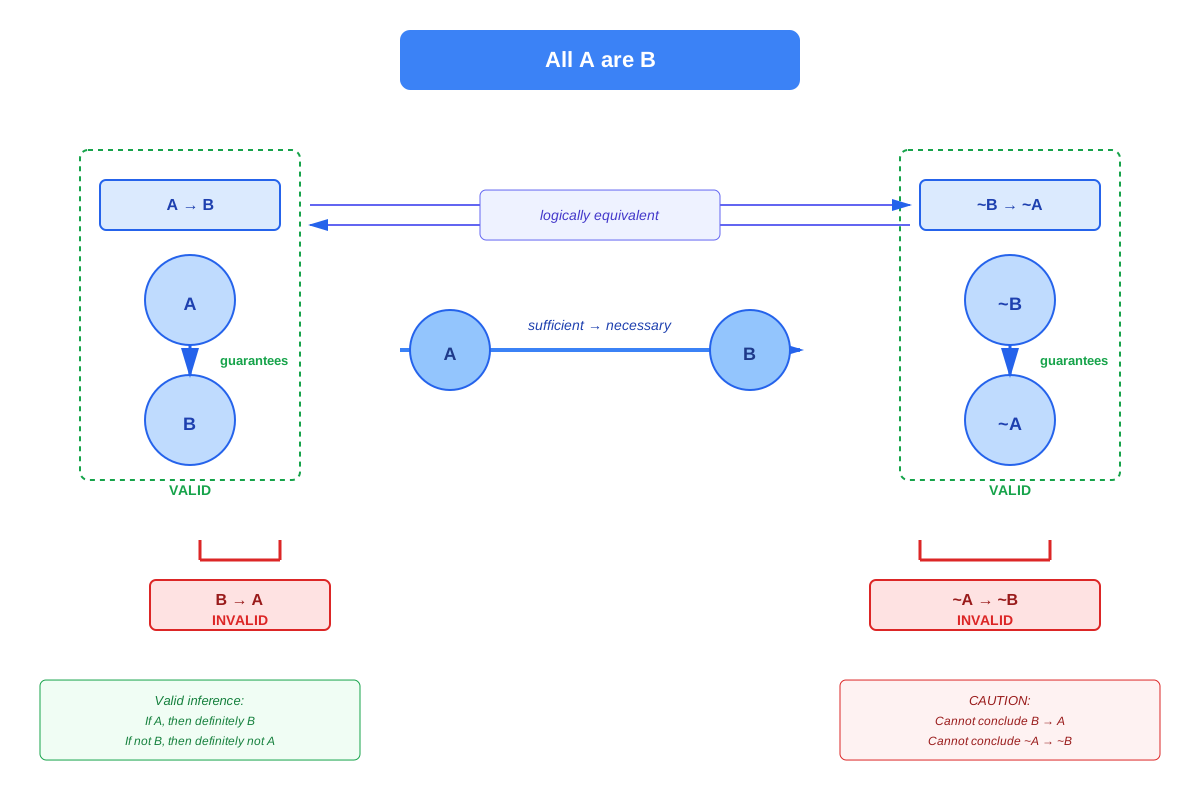
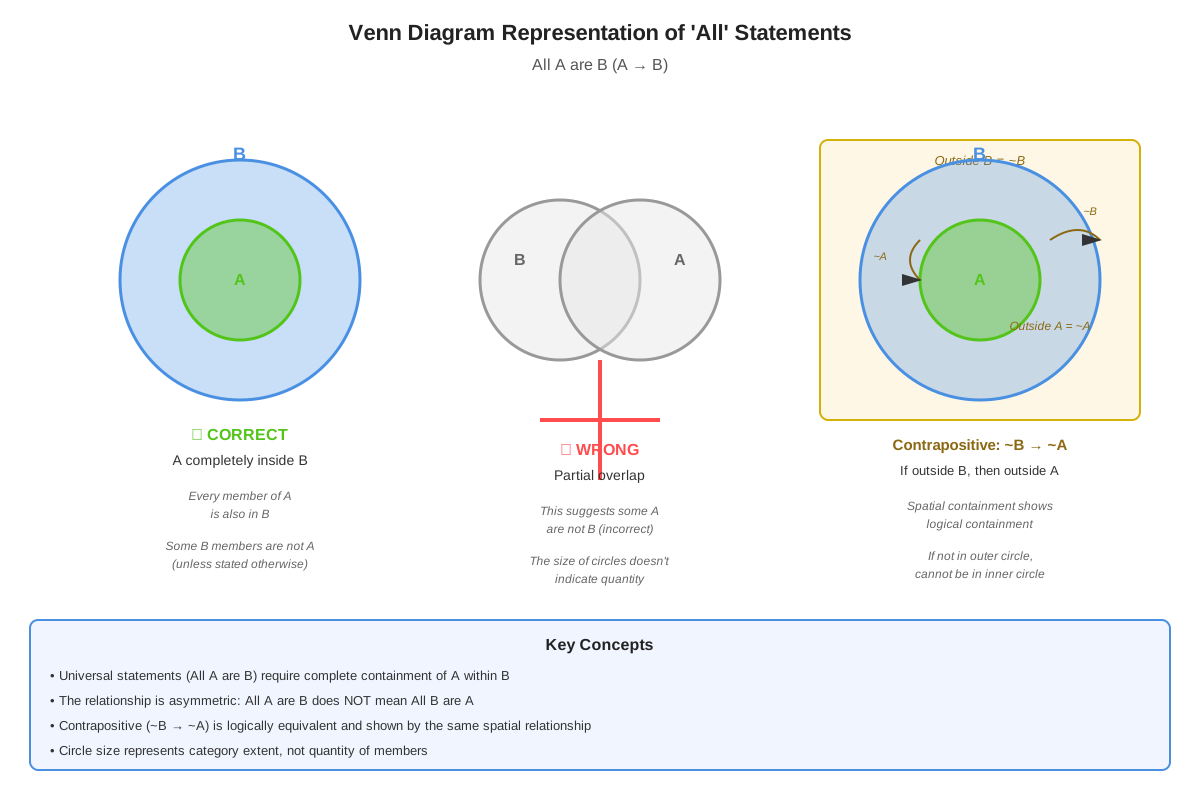
Conditional statements with all establish a sufficient condition relationship where membership in one category guarantees membership in another category or possession of a particular property. The standard form "All A are B" translates to the conditional: A → B. This notation captures the essential meaning: if something is an A, then it must be a B. The category mentioned after "all" (A) becomes the sufficient condition—its presence is sufficient to guarantee the necessary condition (B).
The directionality of this relationship is crucial. "All A are B" does NOT mean "All B are A." This distinction represents one of the most common sources of error on the LSAT. For example, "All dogs are mammals" does not permit the inference that "All mammals are dogs." The statement only provides information about what follows from being a dog; it makes no claims about what follows from being a mammal.
Translating "All" Statements into Conditional Notation
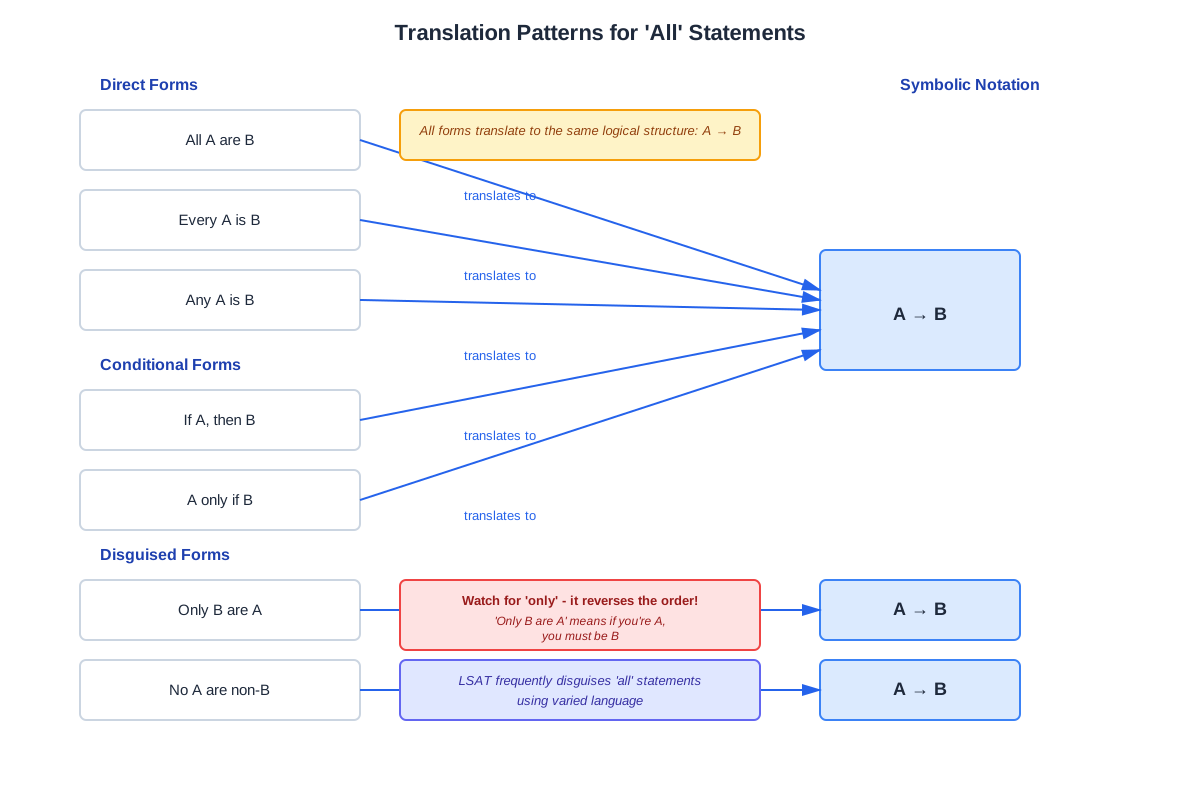
The LSAT presents "all" statements in numerous linguistic variations, and recognizing these alternative formulations is essential for rapid question processing:
| Linguistic Form | Example | Conditional Translation |
|---|---|---|
| All A are B | All students are hardworking | Student → Hardworking |
| Every A is B | Every lawyer passed the bar | Lawyer → Passed Bar |
| Any A is B | Any winner receives a prize | Winner → Prize |
| Each A is B | Each participant signed a waiver | Participant → Signed Waiver |
| A are all B | Senators are all elected officials | Senator → Elected Official |
| Only B are A | Only citizens can vote | Vote → Citizen |
Note that "only" statements reverse the order: "Only B are A" translates to A → B, not B → A. This reversal frequently appears in LSAT questions designed to test careful reading.
The Contrapositive Relationship
Every conditional statement has a logically equivalent contrapositive formed by negating both terms and reversing the direction. For "All A are B" (A → B), the contrapositive is "All non-B are non-A" (~B → ~A). This equivalence is absolute—the original statement and its contrapositive always have identical truth values.
The contrapositive provides a powerful inference tool. From "All lawyers are college graduates" (Lawyer → College Graduate), we can validly infer "All non-college graduates are non-lawyers" (~College Graduate → ~Lawyer). This means if someone did not graduate from college, they cannot be a lawyer. The LSAT frequently tests whether students recognize valid contrapositive inferences versus invalid converse or inverse statements.
Invalid Inferences: Converse and Inverse
Two common errors involve confusing the contrapositive with invalid transformations:
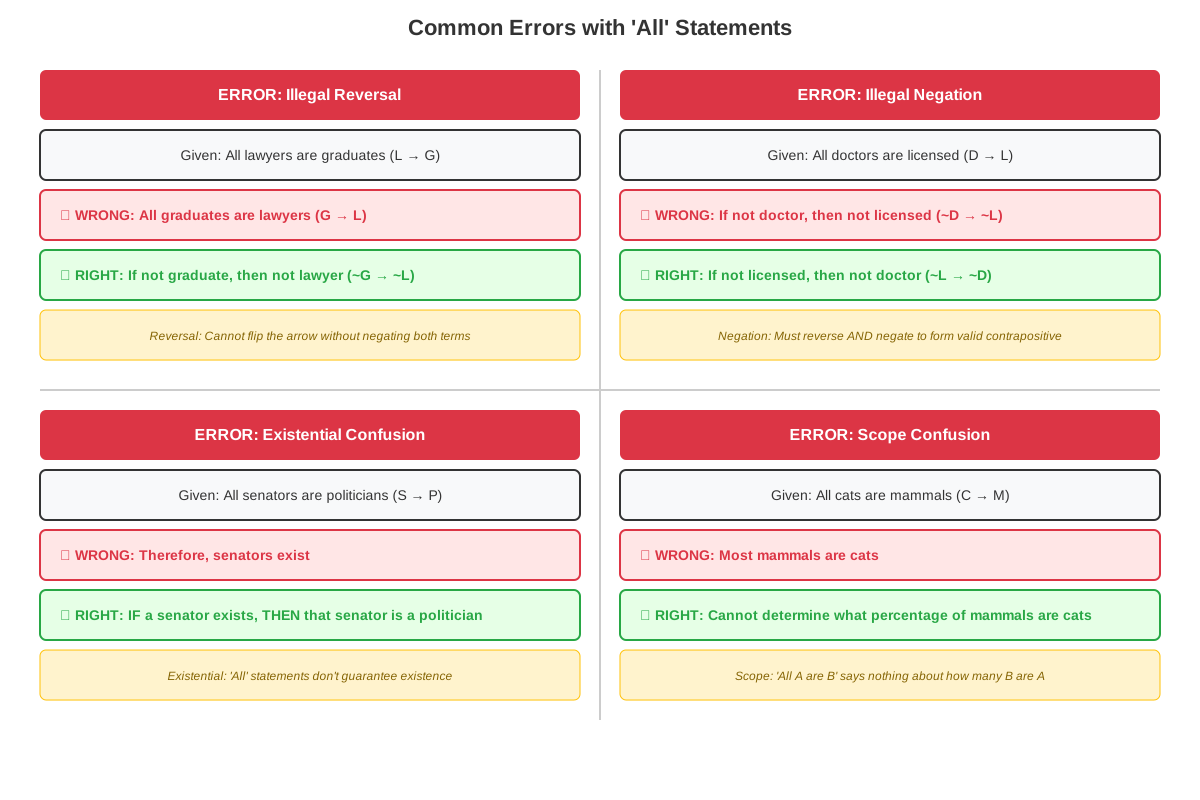
The Converse Error: Reversing the terms without negating them. From A → B, incorrectly inferring B → A. Example: From "All dogs are mammals," incorrectly concluding "All mammals are dogs."
The Inverse Error: Negating both terms without reversing them. From A → B, incorrectly inferring ~A → ~B. Example: From "All dogs are mammals," incorrectly concluding "All non-dogs are non-mammals."
The LSAT regularly includes answer choices that commit these errors, making them attractive to students who haven't mastered the distinction between valid and invalid conditional transformations.
Chaining Conditional Statements
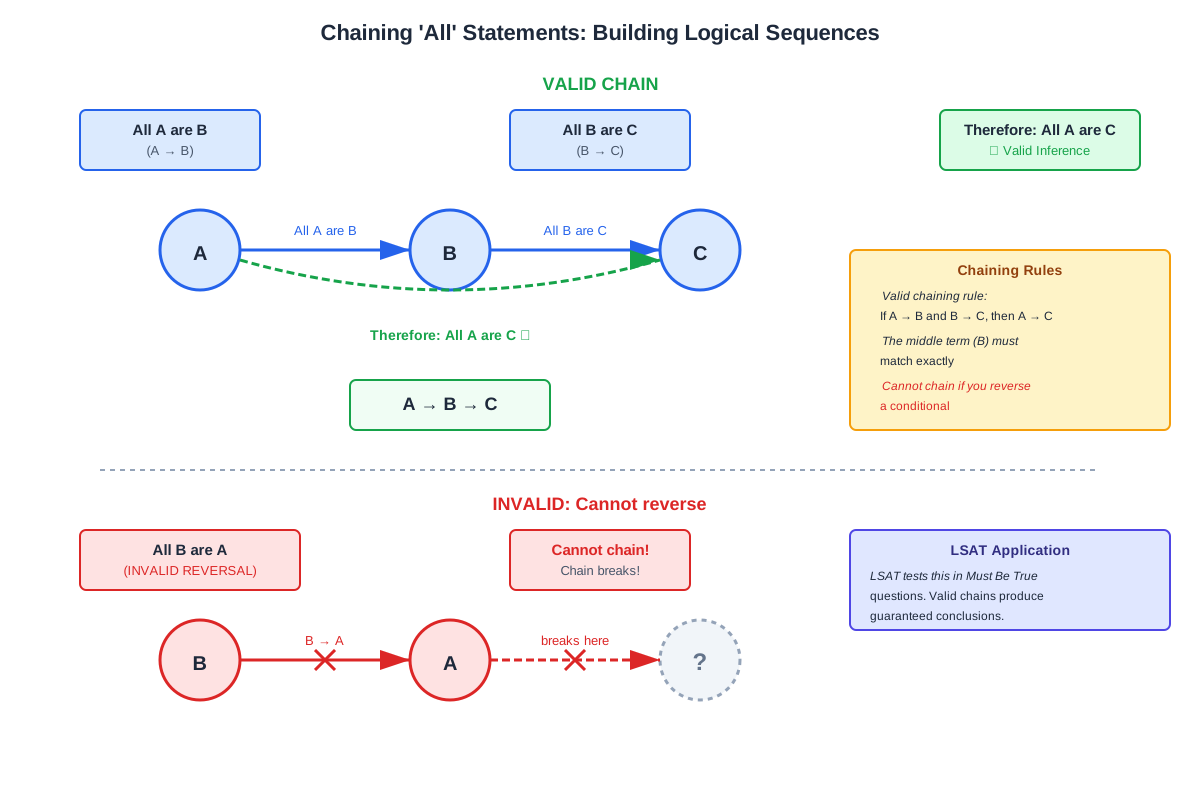
When multiple "all" statements share common terms, they can be chained together to produce new valid inferences. If "All A are B" (A → B) and "All B are C" (B → C), then we can validly conclude "All A are C" (A → C). This transitive property allows for extended logical chains.
Example chain:
- All philosophy majors are critical thinkers (Philosophy → Critical Thinker)
- All critical thinkers are good writers (Critical Thinker → Good Writer)
- Valid inference: All philosophy majors are good writers (Philosophy → Good Writer)
The LSAT frequently presents arguments with gaps in such chains, requiring students to identify the missing link as a necessary or sufficient assumption.
Quantifier Scope and Negation
Understanding what "all" statements do NOT claim is as important as understanding what they do claim. "All A are B" makes no assertion about:
- Whether any A actually exist
- Whether any B that are not A exist
- The proportion of B that are A
- Whether most, some, or few A exist
These gaps create opportunities for the LSAT to test precise logical thinking. An argument might validly establish "All successful applicants have high test scores" without providing any information about how many successful applicants exist or whether some people with high test scores are unsuccessful applicants.
Concept Relationships
The concepts within conditional statements with all form an interconnected logical system. The basic structure (All A are B → A → B) serves as the foundation, from which the contrapositive relationship (~B → ~A) necessarily follows. These two equivalent forms enable the identification of valid inferences while the understanding of invalid transformations (converse and inverse) prevents common reasoning errors.
Chaining relationships build upon the basic structure, demonstrating how multiple "all" statements combine through shared terms to produce extended conditional sequences. This chaining connects directly to the concept of transitive reasoning and forms the basis for identifying logical gaps in arguments—a skill tested heavily in Assumption questions.
The relationship map flows as follows:
Basic "All" Statement → generates → Contrapositive → enables → Valid Inferences
↓
Chaining with Other Conditionals → creates → Extended Logical Sequences
↓
Recognition of Invalid Transformations → prevents → Common Reasoning Errors
These concepts connect to prerequisite knowledge of sufficient and necessary conditions by instantiating those abstract relationships in concrete categorical claims. They also link forward to more advanced topics like formal logic games, complex conditional chains with multiple sufficient or necessary conditions, and the interaction between conditional statements and quantifiers like "some" and "most."
High-Yield Facts
⭐ "All A are B" translates to A → B, where A is the sufficient condition and B is the necessary condition
⭐ The contrapositive of A → B is ~B → ~A, and these two statements are logically equivalent
⭐ "All A are B" does NOT mean "All B are A"—this reversal (the converse) is an invalid inference
⭐ "Only B are A" translates to A → B (the term after "only" becomes the necessary condition)
⭐ Conditional statements can be chained: if A → B and B → C, then A → C
- "All," "every," "any," and "each" all introduce sufficient conditions in standard form statements
- The inverse (~A → ~B) is NOT logically equivalent to the original statement (A → B)
- "All A are B" makes no claim about whether any A actually exist
- From "All A are B," you cannot infer anything definite about non-A items
- Multiple sufficient conditions can lead to the same necessary condition without creating any relationship between those sufficient conditions
- "All A are B" is falsified by finding even one A that is not B
- Conditional statements express relationships, not causation—"All A are B" doesn't mean A causes B
Quick check — test yourself on Conditional statements with all so far.
Try Flashcards →Common Misconceptions
Misconception: "All A are B" means the same thing as "All B are A"
Correction: These statements are not equivalent. "All A are B" (A → B) only tells us what follows from being an A. It makes no claim about what follows from being a B. The categories may overlap differently—all of A might be a small subset of B.
Misconception: If "All A are B" is true, then "Some B are A" must also be true
Correction: This inference is invalid unless we know that at least one A exists. Conditional statements don't assert existence. "All unicorns are magical" could be true (vacuously) even if no unicorns exist, in which case "Some magical things are unicorns" would be false.
Misconception: The contrapositive is just another way to say the same thing, so it's not useful
Correction: While the contrapositive is logically equivalent, it often reveals inferences that aren't immediately obvious from the original statement. On the LSAT, correct answers frequently require recognizing contrapositive relationships, and many wrong answers exploit failure to consider the contrapositive.
Misconception: "All A are B" means that A causes B
Correction: Conditional statements express logical relationships, not causal relationships. "All Olympic athletes are dedicated" doesn't mean being an Olympic athlete causes dedication—the dedication likely preceded and enabled the Olympic achievement. Confusing correlation or logical connection with causation is a common LSAT trap.
Misconception: If you know "All A are B" and "All C are D," you can connect them somehow
Correction: Without a shared term, two conditional statements cannot be chained or combined. They remain independent pieces of information. The LSAT often includes irrelevant conditional statements in stimuli to test whether students inappropriately try to connect unrelated information.
Misconception: "Not all A are B" means "All A are not B" (or "No A are B")
Correction: "Not all A are B" means only that at least one A is not B—it's equivalent to "Some A are not B." This is much weaker than "No A are B," which would mean that zero A are B. The LSAT exploits this distinction in answer choices.
Worked Examples
Example 1: Basic Translation and Inference
Stimulus: "All members of the debate team have strong analytical skills. Every person with strong analytical skills excels at standardized tests. Therefore, all members of the debate team excel at standardized tests."
Analysis:
Step 1: Translate each statement into conditional notation
- Statement 1: "All members of the debate team have strong analytical skills"
- Debate Team → Strong Analytical Skills
- Statement 2: "Every person with strong analytical skills excels at standardized tests"
- Strong Analytical Skills → Excels at Tests
- Conclusion: "All members of the debate team excel at standardized tests"
- Debate Team → Excels at Tests
Step 2: Evaluate the logical structure
The argument chains two conditional statements through the shared term "strong analytical skills":
- Debate Team → Strong Analytical Skills → Excels at Tests
Step 3: Determine validity
By the transitive property of conditional statements, this chain validly produces the conclusion. If someone is on the debate team, they must have strong analytical skills (first conditional), and if they have strong analytical skills, they must excel at tests (second conditional). Therefore, debate team members must excel at tests.
Connection to Learning Objectives: This example demonstrates identifying conditional statements with all in LSAT questions, explaining the chaining reasoning pattern, and applying the logic to evaluate argument validity.
Example 2: Contrapositive Application and Invalid Inferences
Stimulus: "All successful entrepreneurs are risk-takers. Maria is not a risk-taker."
Question: Which of the following must be true?
(A) Maria is not a successful entrepreneur
(B) All risk-takers are successful entrepreneurs
(C) Some successful entrepreneurs are not risk-takers
(D) Maria might be a successful entrepreneur
(E) Most people who are not risk-takers are not successful entrepreneurs
Analysis:
Step 1: Translate the given information
- "All successful entrepreneurs are risk-takers"
- Successful Entrepreneur → Risk-Taker
- "Maria is not a risk-taker"
- Maria = ~Risk-Taker
Step 2: Form the contrapositive
- Original: Successful Entrepreneur → Risk-Taker
- Contrapositive: ~Risk-Taker → ~Successful Entrepreneur
Step 3: Apply the contrapositive to Maria
Since Maria is not a risk-taker (~Risk-Taker), and we have ~Risk-Taker → ~Successful Entrepreneur, we can validly conclude that Maria is not a successful entrepreneur (~Successful Entrepreneur).
Step 4: Evaluate each answer choice
(A) CORRECT: This is the valid contrapositive inference we derived above.
(B) INCORRECT: This commits the converse error. The original statement tells us Successful Entrepreneur → Risk-Taker, not Risk-Taker → Successful Entrepreneur. Many risk-takers might not be successful entrepreneurs.
(C) INCORRECT: This directly contradicts the original statement, which asserts that ALL successful entrepreneurs are risk-takers, meaning none are non-risk-takers.
(D) INCORRECT: This contradicts the valid inference we derived. Maria cannot be a successful entrepreneur because she's not a risk-taker, and all successful entrepreneurs must be risk-takers.
(E) INCORRECT: The original statement makes no claim about "most" people or about the proportion of non-risk-takers who are unsuccessful entrepreneurs. This introduces quantifier information not present in the stimulus.
Connection to Learning Objectives: This example demonstrates identifying conditional statements in question format, explaining contrapositive reasoning, distinguishing valid from invalid inferences, and applying the logic to eliminate wrong answers systematically.
Exam Strategy
When approaching LSAT questions involving conditional statements with all, implement this systematic process:
Step 1: Identify and Extract - Scan the stimulus for universal quantifiers ("all," "every," "any," "each," "only"). Underline or circle these trigger words immediately, as they signal conditional relationships that will likely be tested.
Step 2: Translate Immediately - Convert each "all" statement into conditional notation (A → B) as you read. This external representation prevents working memory overload and reduces errors. Write these translations in the margin or on scratch paper.
Step 3: Form Contrapositives - For each conditional statement, immediately write its contrapositive (~B → ~A). Many correct answers require contrapositive reasoning, and having these pre-written saves time and prevents errors under pressure.
Step 4: Look for Chains - Identify shared terms between conditional statements. If B appears as the necessary condition in one statement and the sufficient condition in another, you can chain them. Draw arrows connecting these chains visually.
Step 5: Predict Invalid Inferences - Before reading answer choices, anticipate common errors: converse (B → A), inverse (~A → ~B), and unwarranted existence claims. This primes you to eliminate wrong answers quickly.
Exam Tip: When time is limited, prioritize identifying the contrapositive over other inferences. Approximately 40% of correct answers involving "all" statements require contrapositive reasoning, making it the highest-yield inference pattern.
Trigger Phrases to Watch For:
- "Only" statements (remember the reversal: "Only B are A" = A → B)
- "The only" (similar reversal pattern)
- "No...unless" (translates to a conditional with negation)
- "All...except" (creates a conditional with an exception)
- Implicit "all" statements like "Dogs are mammals" (means "All dogs are mammals")
Time Allocation Advice: Spend 15-20 seconds translating and diagramming conditional statements upfront. This investment pays dividends by making answer choice evaluation much faster. Students who skip this step often spend 60+ seconds rereading the stimulus multiple times, ultimately taking longer and making more errors.
Process of Elimination Tips:
- Eliminate any answer that commits the converse error (reversing without negating)
- Eliminate any answer that makes existence claims not supported by the conditionals
- Eliminate any answer that introduces new conditional relationships not derivable from the given statements
- Be suspicious of answers using "some" or "most" when only "all" statements were provided—these often cannot be validly inferred
Memory Techniques
Mnemonic for Valid Transformations: "NERD" - Negate Everything, Reverse Direction
- To form a valid contrapositive, you must do both: negate both terms AND reverse the direction
- If you only do one (just negate OR just reverse), you've created an invalid transformation
Visualization Strategy: Picture "all" statements as one-way streets with a gate
- The sufficient condition (A) is the entrance gate—passing through it guarantees you'll reach the destination
- The necessary condition (B) is the destination—you must arrive there if you entered through gate A
- The contrapositive is the same street viewed from the opposite direction: if you're NOT at destination B, you couldn't have entered through gate A
Acronym for Common Invalid Inferences: "CIV" - Converse, Inverse, Vacuous
- Converse: reversing without negating (A → B becomes B → A) ❌
- Inverse: negating without reversing (A → B becomes ~A → ~B) ❌
- Vacuous: assuming existence when none is asserted ❌
Directional Memory Aid: "ALL points FORWARD"
- "All A are B" points from A forward to B (A → B)
- The arrow always points away from the term immediately following "all"
- Exception: "Only" points BACKWARD—"Only B are A" points from A back to B (A → B)
Chaining Visualization: Think of conditional chains as dominoes
- Each domino (conditional statement) can knock down the next if they're properly aligned (share a term)
- A → B and B → C are aligned (B connects them), so knocking down A knocks down C
- A → B and C → D are not aligned (no shared term), so they can't create a chain
Summary
Conditional statements with all form the foundation of formal logic on the LSAT, appearing in the majority of Logical Reasoning questions and requiring precise understanding for consistent high performance. These statements establish sufficient condition relationships where membership in one category guarantees membership in another, translating to the standard form A → B. Mastery requires fluency in multiple areas: recognizing diverse linguistic formulations of "all" statements, translating them into conditional notation, forming valid contrapositives (~B → ~A), distinguishing valid inferences from invalid transformations (converse and inverse), and chaining multiple conditionals through shared terms. The contrapositive relationship provides the most powerful inference tool, as it's logically equivalent to the original statement while often revealing non-obvious conclusions. Success on LSAT questions demands not only understanding what "all" statements assert but also recognizing what they do not assert—they make no claims about existence, proportions, or reverse relationships. Students who systematically translate statements, form contrapositives, and avoid common errors like the converse fallacy gain significant advantages in speed and accuracy across multiple question types.
Key Takeaways
- "All A are B" translates to A → B, establishing A as sufficient for B and B as necessary for A
- The contrapositive (~B → ~A) is the only valid transformation that preserves logical equivalence
- The converse (B → A) and inverse (~A → ~B) are invalid inferences that the LSAT frequently uses in wrong answers
- Conditional statements can be chained through shared terms to produce extended logical sequences
- "Only" reverses the standard order: "Only B are A" means A → B, not B → A
- "All" statements make no existence claims—they can be true even if no members of the sufficient condition category exist
- Systematic translation and diagramming upfront saves time and dramatically improves accuracy on conditional reasoning questions
Related Topics
Conditional Statements with "Some": While "all" statements create universal conditionals, "some" statements establish existential claims that interact with conditionals in specific ways. Mastering "all" statements provides the foundation for understanding how "some" statements can and cannot be combined with conditionals.
Conditional Statements with "Most": "Most" statements create a different logical structure than "all" statements, with distinct inference rules. Understanding the absolute nature of "all" helps clarify the probabilistic nature of "most" reasoning.
Formal Logic and Grouping Games: The conditional logic mastered through "all" statements applies directly to Logic Games, particularly grouping games where rules establish conditional relationships between game pieces.
Necessary and Sufficient Assumptions: Many Assumption questions require identifying missing conditional links. Fluency with "all" statements enables rapid recognition of what conditional statement would complete an argument's logic.
Flaw Questions and Conditional Reasoning Errors: Understanding valid conditional reasoning illuminates common flaws like confusing sufficient and necessary conditions, affirming the consequent, and denying the antecedent—all of which involve misapplying "all" statement logic.
Practice CTA
Now that you've mastered the core concepts of conditional statements with all, it's time to cement your understanding through active practice. Attempt the practice questions associated with this topic, focusing on applying the systematic translation and contrapositive formation strategies you've learned. Work through the flashcards to build automatic recognition of the various linguistic formulations of "all" statements. Remember: conditional logic is a skill that improves dramatically with deliberate practice. Each question you work through strengthens your pattern recognition and increases your speed on test day. You've built the foundation—now construct mastery through application!
Sign up free to keep reading
Create a free AnvayaPrep account to finish this LSAT guide on Conditional statements with all — plus flashcards and practice questions.