Overview
Conditional statements with unless represent one of the most frequently tested and challenging aspects of logical reasoning on the LSAT. These statements appear throughout the Logical Reasoning sections and form the backbone of many argument structures that test-takers must analyze, strengthen, weaken, or evaluate. Understanding how "unless" functions in conditional logic is not merely an academic exercise—it directly impacts performance on 15-20% of all Logical Reasoning questions and appears regularly in Logic Games as well.
The word "unless" creates a specific type of conditional relationship that students often misinterpret, leading to systematic errors in reasoning. Unlike straightforward "if-then" statements, LSAT conditional statements with unless require translation into standard conditional form before analysis can proceed. This translation process is mechanical and learnable, but it demands precision and practice. Mastering this skill enables test-takers to quickly identify necessary and sufficient conditions, recognize contrapositive relationships, and evaluate the logical validity of complex arguments.
Within the broader framework of conditional logic, "unless" statements occupy a critical position. They connect to fundamental concepts like sufficient and necessary conditions, contrapositive reasoning, and formal logic notation. Students who master conditional statements with "unless" gain access to powerful analytical tools that extend far beyond this single word—they develop the ability to decode any conditional relationship, regardless of how it's linguistically packaged. This foundational skill supports success across multiple question types, including Must Be True, Sufficient Assumption, Necessary Assumption, and Flaw questions.
Learning Objectives
- [ ] Identify how Conditional statements with unless appears in LSAT questions
- [ ] Explain the reasoning pattern behind Conditional statements with unless
- [ ] Apply Conditional statements with unless to solve LSAT-style problems accurately
- [ ] Translate "unless" statements into standard conditional form (if-then structure) within 10 seconds
- [ ] Construct accurate contrapositives of conditional statements containing "unless"
- [ ] Distinguish between "unless" and other conditional indicators (e.g., "until," "except," "without")
- [ ] Chain multiple conditional statements involving "unless" to reach valid conclusions
Prerequisites
- Basic conditional logic (if-then statements): Understanding standard conditional form is essential because "unless" statements must be translated into this format for analysis
- Sufficient and necessary conditions: Recognizing which condition is sufficient and which is necessary allows proper interpretation of the logical relationship "unless" creates
- Contrapositive reasoning: The ability to form and apply contrapositives is required because "unless" statements often appear in contrapositive form on the LSAT
- Logical negation: Translating "unless" requires negating one part of the statement, making comfort with negation fundamental
- Formal logic notation: Familiarity with arrow notation (→) and negation symbols (~) streamlines the translation and analysis process
Why This Topic Matters
In real-world contexts, conditional statements with "unless" appear constantly in legal documents, contracts, policy statements, and everyday reasoning. Attorneys must interpret clauses like "The contract is void unless payment is received within 30 days" with absolute precision. Policymakers craft regulations using "unless" to create exceptions and conditions. The LSAT tests this skill because legal reasoning demands the ability to parse complex conditional relationships and understand their logical implications.
On the LSAT specifically, "unless" appears in approximately 15-20% of Logical Reasoning questions across both sections. This translates to roughly 8-10 questions per test—a significant portion of the exam. The word appears most frequently in:
- Sufficient Assumption questions: Where the correct answer often contains an "unless" statement that completes the logical chain
- Must Be True questions: Where "unless" statements in the stimulus create conditional relationships that lead to necessary inferences
- Flaw questions: Where arguments improperly handle "unless" conditions or confuse necessary and sufficient conditions
- Strengthen/Weaken questions: Where understanding the conditional structure reveals what would support or undermine the argument
- Logic Games: Where rules containing "unless" establish critical constraints on possible arrangements
The LSAT deliberately uses "unless" because it's linguistically complex and easily misinterpreted. Test-takers who haven't mastered this concept systematically choose wrong answers that reverse the conditional relationship or misidentify what's necessary versus sufficient. Conversely, students who can instantly and accurately translate "unless" statements gain a significant competitive advantage, often completing questions 30-45 seconds faster than their peers.
Core Concepts
The Fundamental Translation Rule
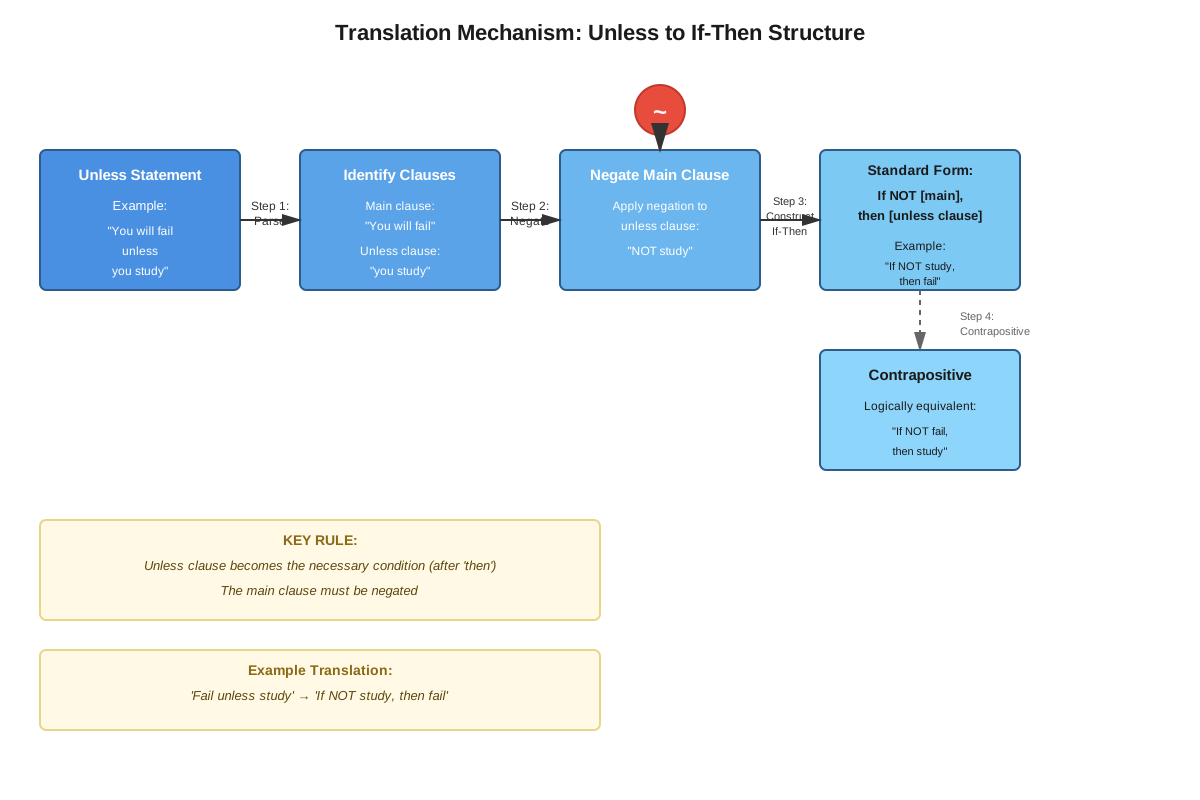
Conditional statements with unless follow a specific, mechanical translation rule that never varies. The rule states: "A unless B" translates to "If not B, then A" or in formal notation: ~B → A. This translation has two critical components:
- The condition that follows "unless" (B) becomes the sufficient condition when negated (~B)
- The other statement (A) becomes the necessary condition without negation
Consider the statement: "The defendant is guilty unless the alibi is verified." Following the translation rule:
- A = "The defendant is guilty"
- B = "The alibi is verified"
- Translation: "If the alibi is NOT verified, then the defendant is guilty"
- Formal notation: ~Alibi Verified → Guilty
This translation reveals the logical structure: an unverified alibi is sufficient to establish guilt, while guilt is necessary when the alibi isn't verified.
Why This Translation Works
The logic behind this translation stems from how "unless" functions as an exception marker. When someone says "A unless B," they're stating that A is the default outcome except when B occurs. B prevents A from happening. This prevention relationship creates a conditional: when B is absent (negated), A must occur.
Linguistically, "unless" means "except if" or "if not." These equivalent phrasings make the translation more intuitive:
- "The store closes unless customers arrive" = "The store closes except if customers arrive" = "If customers do NOT arrive, then the store closes"
The Contrapositive of Unless Statements
Every conditional statement has a logically equivalent contrapositive formed by negating both conditions and reversing their order. For "unless" statements, this process yields particularly important results.
Starting with: "A unless B" → ~B → A
The contrapositive is: ~A → B (read as "If not A, then B")
Using our previous example:
- Original: ~Alibi Verified → Guilty
- Contrapositive: ~Guilty → Alibi Verified
This contrapositive reveals a crucial insight: if the defendant is NOT guilty, then the alibi MUST be verified. The contrapositive often appears in correct answer choices or represents the logical inference the LSAT expects test-takers to recognize.
Common Linguistic Variations
The LSAT presents "unless" in various grammatical structures, all requiring the same translation approach:
| Statement Structure | Example | Translation |
|---|---|---|
| A unless B | "She succeeds unless she quits" | ~Quits → Succeeds |
| Unless B, A | "Unless he studies, he fails" | ~Studies → Fails |
| A, unless B | "The plan works, unless funding stops" | ~Funding Continues → Plan Works |
| Not A unless B | "The door won't open unless you have a key" | ~Key → ~Door Opens |
The last variation—"not A unless B"—requires special attention because it contains two negations. The translation becomes: ~B → ~A. For example, "The door won't open unless you have a key" translates to "If you don't have a key, then the door won't open" (~Key → ~Open).
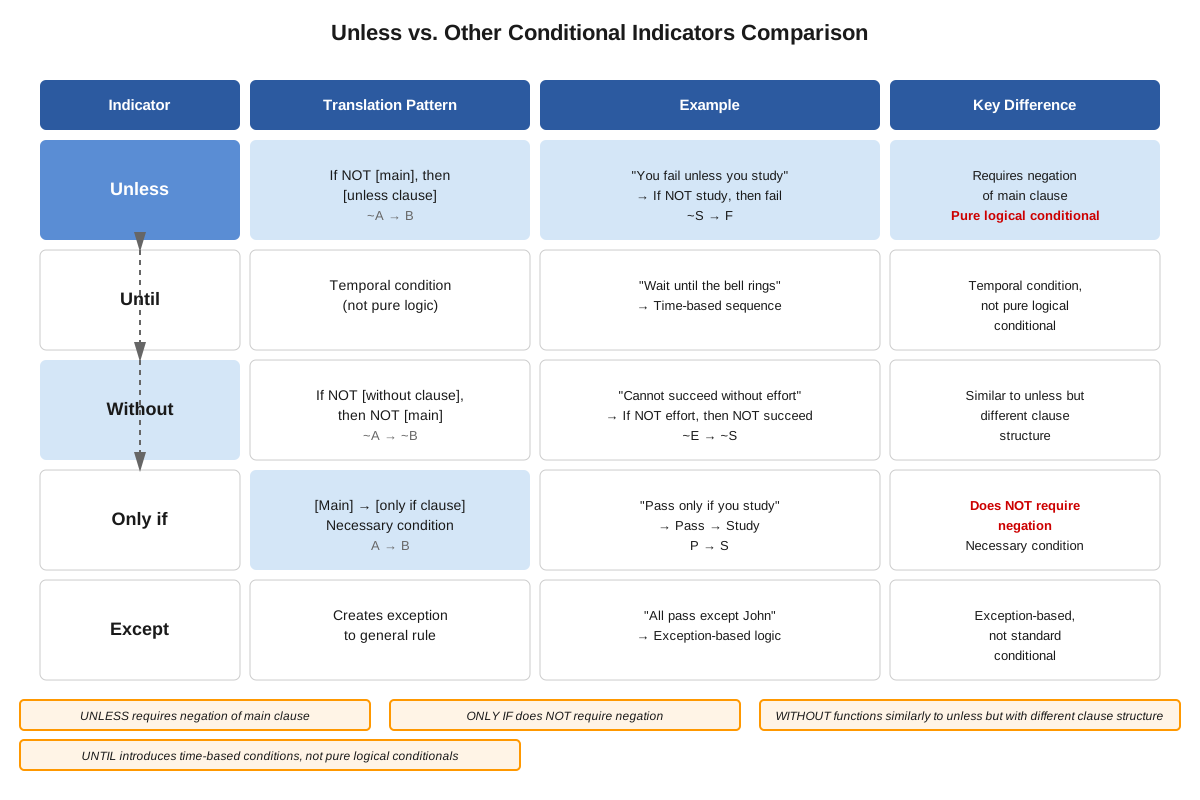
Distinguishing "Unless" from Similar Terms
Several words create conditional relationships but function differently from "unless":
Until: Creates a temporal condition but doesn't negate. "A until B" means A continues up to the point when B occurs, but doesn't translate to ~B → A.
Without: Functions identically to "unless" in most contexts. "A without B" translates to ~B → A, just like "unless."
Except: When used conditionally, functions like "unless." "A except when B" means ~B → A.
Only if: Creates a different conditional relationship. "A only if B" translates to A → B (not ~B → A), making B necessary for A rather than preventing A.
Chaining Unless Statements
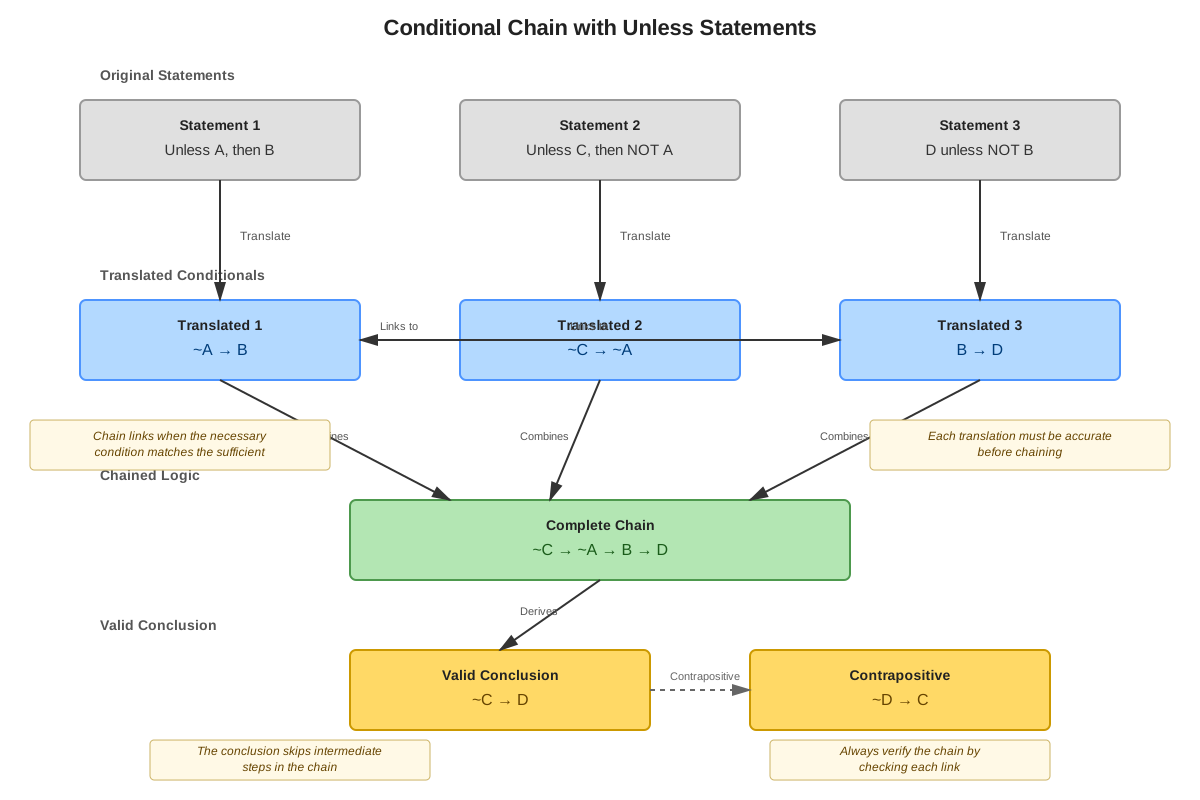
The LSAT frequently presents multiple conditional statements that must be chained together to reach a conclusion. When "unless" statements appear in chains, translate each one individually, then connect them through shared terms.
Example chain:
- "The project succeeds unless funding is cut" → ~Funding Cut → Project Succeeds
- "Funding is cut unless donations increase" → ~Donations Increase → Funding Cut
To chain these, notice that "Funding Cut" appears in both statements:
- Statement 2 gives us: ~Donations Increase → Funding Cut
- Statement 1's contrapositive gives us: ~Project Succeeds → Funding Cut
We can also chain forward:
- ~Donations Increase → Funding Cut → ~Project Succeeds (using statement 1's contrapositive)
Therefore: If donations don't increase, the project doesn't succeed.
Formal Logic Notation
Using consistent notation prevents errors and speeds analysis:
- → represents "if...then" (the conditional arrow)
- ~ represents negation ("not")
- "Unless" statements: A unless B becomes ~B → A
- Contrapositive: Negate both sides and reverse: ~B → A becomes ~A → B
Practice writing statements in notation immediately upon reading them. This externalization of logic reduces cognitive load and makes errors visible.
Concept Relationships
The concepts within conditional statements with "unless" form a tightly integrated system. The fundamental translation rule serves as the foundation, enabling all other operations. This rule directly connects to negation (required to translate the "unless" clause) and sufficient/necessary condition identification (determining which element becomes sufficient and which becomes necessary).
Once translation is complete, contrapositive formation becomes accessible. The contrapositive represents the logical equivalent of the original statement and often appears in correct answer choices. Understanding contrapositives requires mastery of both negation and the reversal operation.
Chaining builds upon all previous concepts. To chain conditional statements, one must: (1) translate any "unless" statements into standard form, (2) identify shared terms between statements, (3) potentially form contrapositives to enable connections, and (4) follow the logical chain to valid conclusions.
The relationship map flows as follows:
Translation Rule → Standard Conditional Form → Contrapositive Formation → Chaining Multiple Statements → Valid Inferences
Additionally, distinguishing "unless" from similar terms connects to linguistic analysis and precise interpretation—skills that extend throughout Logical Reasoning. Recognizing that "without" functions like "unless" while "only if" creates a different relationship prevents systematic errors across question types.
These concepts also connect to prerequisite knowledge: basic conditional logic provides the framework into which "unless" statements are translated, while understanding sufficient and necessary conditions enables proper interpretation of the translated form.
High-Yield Facts
⭐ "A unless B" always translates to "If not B, then A" (~B → A)—the "unless" clause becomes the sufficient condition when negated
⭐ The contrapositive of an "unless" statement is formed by negating both conditions and reversing: ~B → A becomes ~A → B
⭐ "Unless" and "without" function identically in conditional logic and require the same translation
⭐ "Not A unless B" translates to "If not B, then not A" (~B → ~A), containing two negations
⭐ The condition following "unless" is what prevents the other condition from occurring—it's the exception to the rule
- "Only if" creates a different relationship than "unless": "A only if B" means A → B, not ~B → A
- When chaining conditional statements, the necessary condition of one statement must match the sufficient condition of another to create a valid chain
- "Until" does not function like "unless" and should not be translated using the same rule
- Every conditional statement has exactly one logically equivalent contrapositive, but multiple logically consistent statements
- In formal logic notation, double negation cancels out: ~~A is logically equivalent to A
- The LSAT never requires assuming unstated conditional relationships—all necessary conditions appear explicitly in the stimulus
- Conditional statements tell us what must be true when the sufficient condition is met, but say nothing about what happens when it's not met
- "Unless" statements can appear in any grammatical position (beginning, middle, or end of sentence) without changing the translation rule
Quick check — test yourself on Conditional statements with unless so far.
Try Flashcards →Common Misconceptions
Misconception: "A unless B" means "If A, then B" (treating "unless" like "if")
Correction: "Unless" requires negating the condition that follows it. "A unless B" translates to "If not B, then A" (~B → A), not A → B. The word "unless" introduces an exception or prevention, not a straightforward conditional trigger.
Misconception: The contrapositive of "A unless B" is "B unless A"
Correction: Contrapositives are formed through logical operations (negation and reversal), not by swapping words. "A unless B" translates to ~B → A, which has the contrapositive ~A → B. This cannot be accurately expressed using "unless" in the reverse direction without careful attention to what's being negated.
Misconception: "Unless" and "until" are interchangeable in conditional logic
Correction: "Unless" creates a conditional relationship with negation (~B → A), while "until" creates a temporal relationship without the same logical structure. "The alarm sounds unless you enter the code" is conditional, but "The alarm sounds until you enter the code" describes duration, not a conditional trigger.
Misconception: When an "unless" statement appears in an argument, both the original statement and its contrapositive can be used as separate pieces of evidence
Correction: The original conditional and its contrapositive are logically equivalent—they're the same statement expressed differently. Using both doesn't provide additional information; it's the same fact stated twice. Only one should be used in logical analysis.
Misconception: "Not A unless B" means the same as "A unless B"
Correction: The additional negation fundamentally changes the translation. "A unless B" becomes ~B → A, while "Not A unless B" becomes ~B → ~A. The necessary condition is negated in the second version. For example, "The door opens unless it's locked" (~Locked → Opens) differs from "The door doesn't open unless you have a key" (~Key → ~Opens).
Misconception: If the sufficient condition of an "unless" statement isn't met, the necessary condition must be false
Correction: Conditional statements only tell us what must happen when the sufficient condition is satisfied. If ~B is false (meaning B is true), we cannot conclude anything definite about A from the statement ~B → A. The necessary condition might be true or false—the conditional simply doesn't apply.
Misconception: "Unless" statements are rare on the LSAT and can be skipped during preparation
Correction: "Unless" appears in approximately 15-20% of Logical Reasoning questions and regularly in Logic Games. Skipping this topic guarantees missing multiple questions per test. Mastery of "unless" is essential for competitive LSAT scores.
Worked Examples
Example 1: Basic Translation and Application
Stimulus: "The museum will close its new exhibit unless attendance increases significantly. The museum director announced that attendance has not increased significantly."
Question: Which of the following must be true based on the statements above?
Step 1 - Identify the conditional statement: "The museum will close its new exhibit unless attendance increases significantly"
Step 2 - Translate using the unless rule:
- A = "The museum will close its new exhibit"
- B = "Attendance increases significantly"
- Translation: ~B → A
- In words: "If attendance does NOT increase significantly, then the museum will close its new exhibit"
Step 3 - Identify what we know: "Attendance has not increased significantly" = ~B
Step 4 - Apply the conditional: We have ~B (the sufficient condition), so we can conclude A must be true.
Conclusion: The museum will close its new exhibit.
Step 5 - Form the contrapositive for completeness: ~A → B ("If the museum does NOT close its new exhibit, then attendance increased significantly")
This example demonstrates the core learning objective of applying conditional statements with unless to reach valid conclusions. The mechanical translation process (~B → A) combined with the given information (~B) leads directly to the necessary inference (A).
Example 2: Complex Chaining with Multiple Unless Statements
Stimulus: "The company will not expand unless profits increase. Profits will not increase unless the new product succeeds. The new product will not succeed unless the marketing campaign is effective."
Question: If the company expands, what must be true?
Step 1 - Translate each unless statement:
Statement 1: "The company will not expand unless profits increase"
- Translation: ~Profits Increase → ~Company Expands
- Contrapositive: Company Expands → Profits Increase
Statement 2: "Profits will not increase unless the new product succeeds"
- Translation: ~New Product Succeeds → ~Profits Increase
- Contrapositive: Profits Increase → New Product Succeeds
Statement 3: "The new product will not succeed unless the marketing campaign is effective"
- Translation: ~Marketing Effective → ~New Product Succeeds
- Contrapositive: New Product Succeeds → Marketing Effective
Step 2 - Identify what we're given: "The company expands" = Company Expands
Step 3 - Chain the contrapositives (since we're working backward from a necessary condition):
Company Expands → Profits Increase (from Statement 1 contrapositive)
Profits Increase → New Product Succeeds (from Statement 2 contrapositive)
New Product Succeeds → Marketing Effective (from Statement 3 contrapositive)
Step 4 - Follow the complete chain:
Company Expands → Profits Increase → New Product Succeeds → Marketing Effective
Conclusion: If the company expands, then the marketing campaign must be effective. Additionally, profits must have increased, and the new product must have succeeded.
This example illustrates advanced application: translating multiple "unless" statements, recognizing when to use contrapositives (working backward from a necessary condition), and chaining conditional statements to reach distant but valid conclusions. This type of reasoning appears frequently in both Logical Reasoning and Logic Games on the LSAT.
Exam Strategy
Immediate Recognition Triggers
When reading LSAT questions, train your eye to immediately flag the word "unless" (and its functional equivalents "without" and "except when"). The moment you see "unless," pause and translate before continuing. This prevents the natural tendency to misinterpret the statement based on conversational English understanding.
Exam Tip: Circle or underline "unless" every time it appears. This physical action triggers the translation protocol and prevents overlooking these critical logical structures.
The Three-Step Translation Protocol
- Identify the two conditions: Determine what comes before "unless" (A) and what follows it (B)
- Negate the unless clause: The condition following "unless" becomes the sufficient condition when negated (~B)
- Write the conditional: ~B → A, then immediately write the contrapositive ~A → B
This entire process should take 5-10 seconds with practice. Writing both the conditional and contrapositive immediately prevents having to reconstruct them later when evaluating answer choices.
Answer Choice Evaluation Strategy
For Must Be True questions with "unless" statements:
- Eliminate any answer that states the sufficient condition is false—this tells us nothing
- Look for answers that match either the necessary condition (when the sufficient is true) or the contrapositive
- Be suspicious of answers that reverse the conditional relationship
For Sufficient Assumption questions:
- The correct answer often contains an "unless" statement that completes a conditional chain
- Translate the answer choice immediately and check if it bridges the gap in the argument
- Verify that the chain leads from premise to conclusion
For Flaw questions:
- Look for arguments that treat "unless" as "if" (reversing the conditional)
- Watch for arguments that assume the necessary condition is false when the sufficient condition isn't met
- Identify reasoning that confuses an "unless" statement with its contrapositive as if they were separate facts
Time Management
Allocate 15-20 seconds for translating and notating "unless" statements in the stimulus. This upfront investment saves 30-45 seconds during answer choice evaluation because the logical structure is already clear. Students who skip formal translation often spend excessive time re-reading the stimulus while evaluating each answer choice.
Common Wrong Answer Patterns
The LSAT predictably includes wrong answers that:
- Reverse the conditional relationship (A → ~B instead of ~B → A)
- State the contrapositive as if it were a separate, additional fact
- Confuse "unless" with "only if" (creating A → B instead of ~B → A)
- Make claims about what happens when the sufficient condition is false
Recognizing these patterns enables rapid elimination of 2-3 answer choices, significantly improving accuracy and speed.
Memory Techniques
The "Unless = If Not" Mnemonic
The simplest and most effective mnemonic: "Unless" = "If Not"
Whenever you see "unless," mentally replace it with "if not" and adjust the sentence structure accordingly. "A unless B" becomes "A if not B," which naturally translates to "If not B, then A."
The Exception Visualization
Visualize "unless" as creating an exception to a rule. The default outcome is A, but B is the exception that prevents A. When the exception (B) doesn't occur, the default (A) happens.
Example: "The alarm sounds unless you enter the code"
- Default: Alarm sounds
- Exception: Entering the code prevents the alarm
- When exception doesn't occur (no code entered): Default happens (alarm sounds)
- Translation: ~Code Entered → Alarm Sounds
The NEGATE Acronym
Notice "unless"
Extract the two conditions
Get the "unless" clause
Add negation to it
Then make it sufficient
Everything else is necessary
This acronym guides the translation process step-by-step, particularly useful when first learning the concept.
The Contrapositive Flip-and-Negate
For forming contrapositives of any conditional (including translated "unless" statements):
"Flip the arrow, negate both sides"
~B → A becomes ~A → B (flip the arrow direction, add negation to both conditions)
This simple phrase captures the entire contrapositive operation and works for all conditional statements.
The "Without = Unless" Reminder
Create a mental link: "Without" = "Unless" = "If Not"
These three expressions function identically in conditional logic. Whenever you see any of them, apply the same translation rule.
Summary
Conditional statements with unless represent a high-frequency, high-impact topic on the LSAT that demands mechanical precision and consistent application. The fundamental translation rule—"A unless B" becomes "If not B, then A" (~B → A)—never varies and must become automatic. This translation reveals that the condition following "unless" becomes the sufficient condition when negated, while the other statement becomes the necessary condition. Every "unless" statement has a logically equivalent contrapositive formed by negating both conditions and reversing their order, and this contrapositive frequently appears in correct answer choices or represents the inference the LSAT expects test-takers to recognize. The word "unless" appears in approximately 15-20% of Logical Reasoning questions across multiple question types, making mastery essential for competitive scores. Success requires immediate recognition of "unless" and its functional equivalents ("without," "except when"), rapid translation into standard conditional form, accurate contrapositive formation, and the ability to chain multiple conditional statements to reach valid conclusions. Students must distinguish "unless" from similar-sounding but logically different terms like "only if" and "until," and must avoid common errors such as reversing the conditional relationship or treating the contrapositive as separate evidence. With deliberate practice, the translation and application of "unless" statements becomes a mechanical process that takes 10-15 seconds and provides a significant competitive advantage on test day.
Key Takeaways
- "A unless B" always translates to "If not B, then A" (~B → A)—the "unless" clause becomes the sufficient condition when negated
- The contrapositive of ~B → A is ~A → B, formed by negating both conditions and reversing the arrow direction
- "Unless" appears in 15-20% of Logical Reasoning questions and regularly in Logic Games, making it essential for competitive LSAT scores
- "Unless" and "without" function identically in conditional logic, while "only if" and "until" create different logical relationships
- Translate "unless" statements immediately upon recognition—this 10-second investment prevents errors and saves time during answer evaluation
- When chaining conditional statements, use contrapositives to work backward from conclusions to necessary premises
- The LSAT predictably includes wrong answers that reverse the conditional relationship or confuse "unless" with "only if"—recognizing these patterns enables rapid elimination
Related Topics
Sufficient and Necessary Conditions: Understanding the distinction between sufficient and necessary conditions deepens comprehension of why "unless" creates the specific conditional relationship it does. This topic explores how to identify which condition guarantees another versus which condition is required for another.
Formal Logic and Conditional Chains: Building on "unless" statements, this topic covers complex conditional reasoning involving multiple linked statements, including how to diagram arguments, identify valid inferences, and recognize logical gaps that assumptions must fill.
Contrapositive and Logical Equivalence: A deeper exploration of contrapositive reasoning, including why contrapositives are logically equivalent to original statements, how to use contrapositives strategically in different question types, and common errors in contrapositive formation.
Conditional Logic in Logic Games: Applying conditional reasoning to Logic Games rules, including how "unless" statements create constraints, how to combine conditional rules with other rule types, and how to make deductions from conditional chains in game scenarios.
Negation and Logical Operators: Mastering negation is essential for "unless" statements and extends to necessary assumption questions, where the negation test determines correct answers. This topic covers complex negation, including negating quantified statements and compound conditions.
Practice CTA
Now that you've mastered the core concepts of conditional statements with "unless," it's time to cement your understanding through active practice. The translation rule is mechanical and learnable, but only deliberate practice makes it automatic. Attempt the practice questions associated with this topic, focusing on speed and accuracy in translation. Use the flashcards to drill the fundamental translation rule until you can apply it instantly without conscious thought. Remember: every "unless" statement you correctly translate on test day is a question you'll answer correctly while your competitors struggle. The investment you make in practice now directly translates to points on your LSAT score. You've built the foundation—now build the automaticity that leads to test day success.
Sign up free to keep reading
Create a free AnvayaPrep account to finish this LSAT guide on Conditional statements with unless — plus flashcards and practice questions.