Overview
If and only if statements represent one of the most powerful and precise forms of conditional logic in logical reasoning. Unlike simple conditional statements that establish a one-way relationship between ideas, LSAT if and only if statements create a bidirectional logical connection, establishing both necessity and sufficiency simultaneously. This unique characteristic makes them essential tools for constructing airtight arguments and identifying logical relationships in LSAT questions.
On the LSAT, mastering if and only if statements is crucial because they appear frequently in both Logical Reasoning and Logic Games sections, often forming the backbone of complex argument structures. These statements compress two conditional relationships into a single expression, requiring test-takers to recognize that when two conditions are linked by "if and only if," each condition is both necessary and sufficient for the other. This bidirectional nature means that if one condition is true, the other must be true, and if one is false, the other must be false—a relationship that test-makers exploit to create challenging questions that separate high scorers from average performers.
Within the broader framework of conditional logic, if and only if statements represent the strongest possible logical connection between two propositions. While standard conditional statements (if-then) establish only that the sufficient condition guarantees the necessary condition, if and only if statements go further by establishing complete logical equivalence. Understanding this relationship is fundamental to success on the LSAT, as it enables test-takers to make valid inferences, identify flawed reasoning, and navigate complex logical structures with confidence. This topic builds directly on foundational conditional logic principles while introducing the sophisticated concept of biconditional relationships that appear in the most challenging LSAT questions.
Learning Objectives
- [ ] Identify how if and only if statements appear in LSAT questions
- [ ] Explain the reasoning pattern behind if and only if statements
- [ ] Apply if and only if statements to solve LSAT-style problems accurately
- [ ] Translate if and only if statements into their component conditional statements
- [ ] Recognize equivalent expressions and paraphrases of biconditional relationships
- [ ] Distinguish between simple conditionals and biconditionals in complex argument structures
- [ ] Construct valid inferences from if and only if statements using both directions of implication
Prerequisites
- Basic conditional logic (if-then statements): Understanding simple sufficient and necessary conditions is essential because if and only if statements combine two conditional relationships.
- Contrapositive formation: The ability to form contrapositives is required to fully exploit both directions of biconditional statements.
- Logical notation and diagramming: Familiarity with symbolic representation helps visualize the bidirectional nature of if and only if relationships.
- Necessary vs. sufficient conditions: Distinguishing these concepts is fundamental because if and only if statements establish that each condition is both necessary and sufficient for the other.
Why This Topic Matters
If and only if statements appear in approximately 10-15% of Logical Reasoning questions on the LSAT, making them a high-yield topic for test preparation. They are particularly common in Sufficient Assumption questions, Must Be True questions, and Parallel Reasoning questions, where the precise logical relationships between conditions determine the correct answer. Understanding biconditional logic is also essential for Logic Games, where rules often establish if and only if relationships between variables, and recognizing these relationships can unlock entire game boards.
In real-world applications, if and only if statements represent the language of definitions, equivalences, and precise logical specifications. Legal reasoning—the foundation of law school and legal practice—frequently employs biconditional logic to establish clear criteria, define terms with precision, and create unambiguous standards. For example, legal definitions often take the form "X is Y if and only if conditions A, B, and C are met," establishing both what is required for X to be Y and what is guaranteed when those conditions are satisfied.
On the LSAT, if and only if statements commonly appear in several forms: explicit use of the phrase "if and only if," statements establishing definitions ("X is defined as Y"), expressions of necessary and sufficient conditions together ("X is both necessary and sufficient for Y"), and equivalent formulations ("X exactly when Y" or "X just in case Y"). Test-makers also disguise biconditional relationships within complex argument structures, requiring students to recognize when an argument implicitly treats two conditions as equivalent. The ability to identify and manipulate these relationships separates top scorers from those who struggle with the most challenging logical reasoning questions.
Core Concepts
The Biconditional Relationship
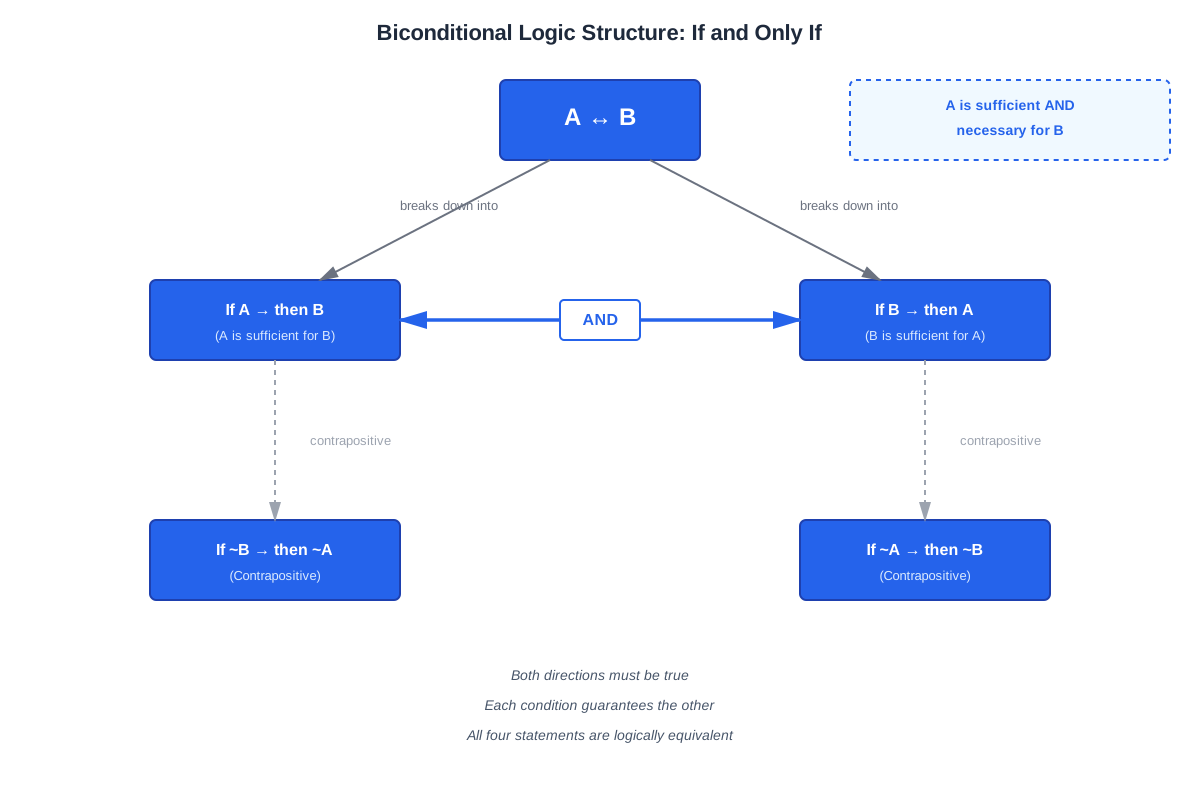
An if and only if statement creates a biconditional relationship between two propositions, establishing that each is both necessary and sufficient for the other. When we say "A if and only if B," we are making two simultaneous claims: (1) if A, then B, and (2) if B, then A. This creates complete logical equivalence—A and B must always have the same truth value. If A is true, B must be true; if A is false, B must be false; and the same holds in reverse.
The power of biconditional statements lies in their ability to compress two conditional relationships into a single expression. Consider the statement: "A student passes the course if and only if the student scores 70% or higher." This single sentence establishes both that scoring 70% or higher guarantees passing (sufficiency) and that passing requires scoring 70% or higher (necessity). No other outcome is possible—the two conditions are logically locked together.
Symbolic Representation
In logical notation, if and only if statements are represented with a double-headed arrow (↔) or the abbreviation "iff." The statement "A if and only if B" can be written as:
A ↔ BThis notation emphasizes the bidirectional nature of the relationship. It is equivalent to writing both:
A → B (if A, then B)
B → A (if B, then A)
Understanding this equivalence is crucial for LSAT success because test questions may present one form and require you to recognize or apply the other. The biconditional relationship also means that the contrapositives of both conditional statements are valid:
~B → ~A (if not B, then not A)
~A → ~B (if not A, then not B)
Components of If and Only If Statements
Every if and only if statement contains two distinct components that must be clearly identified:
- The "if" component: This establishes the sufficient condition in one direction (if A, then B)
- The "only if" component: This establishes the necessary condition in the other direction (if B, then A)
When combined, these components create complete logical equivalence. Consider the statement: "The alarm sounds if and only if motion is detected." Breaking this down:
- "The alarm sounds if motion is detected" means: motion detected → alarm sounds
- "The alarm sounds only if motion is detected" means: alarm sounds → motion detected
Together, these establish that the alarm and motion detection always occur together—one cannot happen without the other.
Common Linguistic Variations
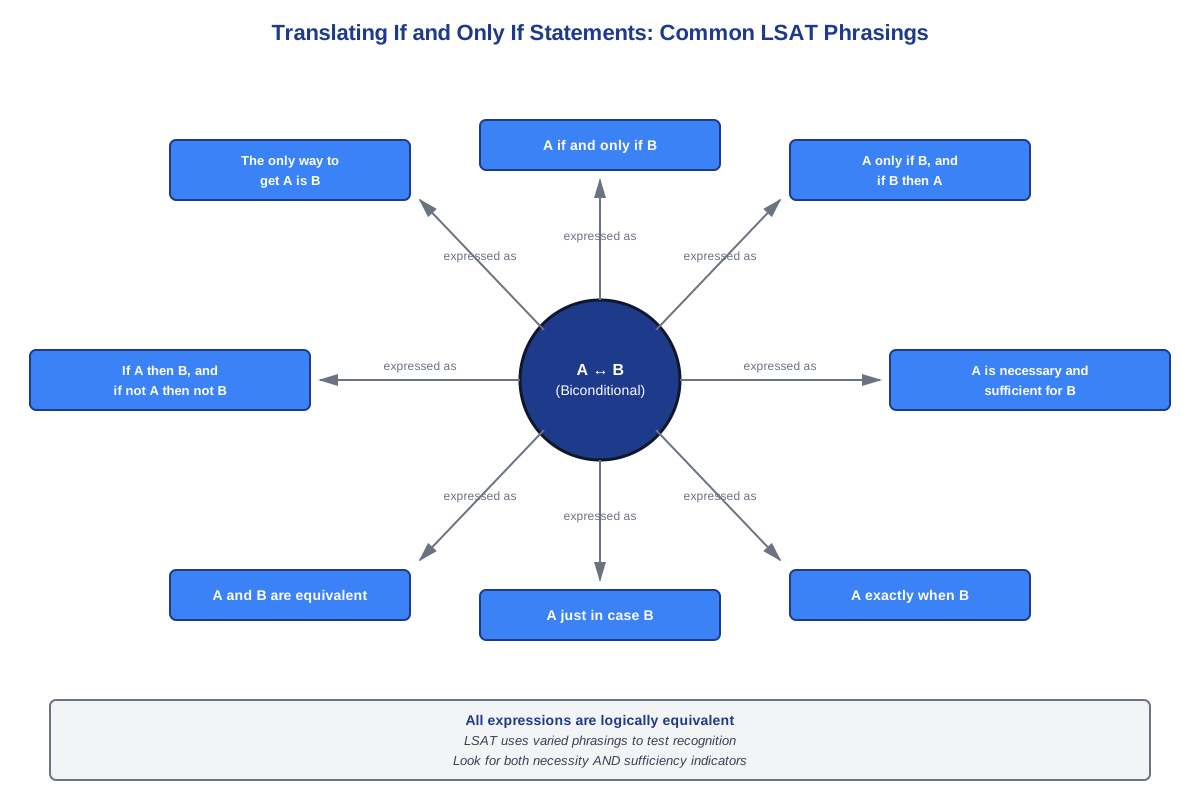
The LSAT presents biconditional relationships in various linguistic forms, and recognizing these variations is essential for identifying if and only if statements in test questions:
| Expression | Example | Logical Meaning |
|---|---|---|
| If and only if | A if and only if B | A ↔ B |
| Just in case | A just in case B | A ↔ B |
| Exactly when | A exactly when B | A ↔ B |
| Is equivalent to | A is equivalent to B | A ↔ B |
| Means the same as | A means the same as B | A ↔ B |
| Is defined as | A is defined as B | A ↔ B |
| Necessary and sufficient | A is necessary and sufficient for B | A ↔ B |
Each of these expressions establishes the same bidirectional logical relationship, though they may appear in different contexts. Definitional statements are particularly common on the LSAT and almost always establish biconditional relationships.
Truth Conditions for Biconditionals
Understanding when if and only if statements are true or false is essential for evaluating arguments and making valid inferences. A biconditional statement is true in exactly two scenarios:
- Both components are true: When A is true and B is true, "A if and only if B" is true
- Both components are false: When A is false and B is false, "A if and only if B" is true
The biconditional is false in the remaining two scenarios:
- A is true but B is false: This violates the "if A then B" component
- B is true but A is false: This violates the "if B then A" component
This truth structure means that biconditional statements are more restrictive than simple conditionals. A simple conditional "if A then B" is violated only when A is true and B is false, but a biconditional is violated whenever the two components have different truth values.
Making Valid Inferences
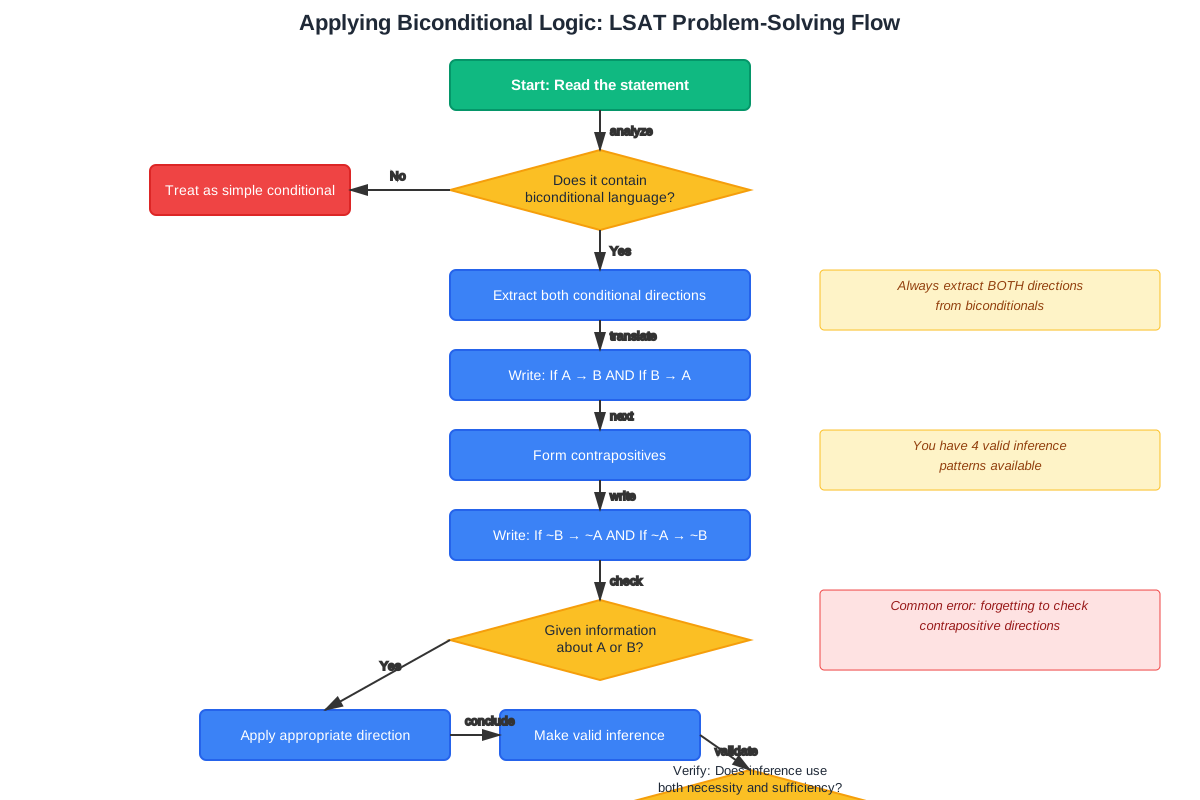
The bidirectional nature of if and only if statements enables four valid inference patterns:
- Forward inference: If A is true, then B must be true
- Reverse inference: If B is true, then A must be true
- Contrapositive (forward): If B is false, then A must be false
- Contrapositive (reverse): If A is false, then B must be false
These four patterns give test-takers multiple pathways to reach correct conclusions. On the LSAT, questions often provide information about one component and ask what must be true about the other, requiring application of one of these inference patterns.
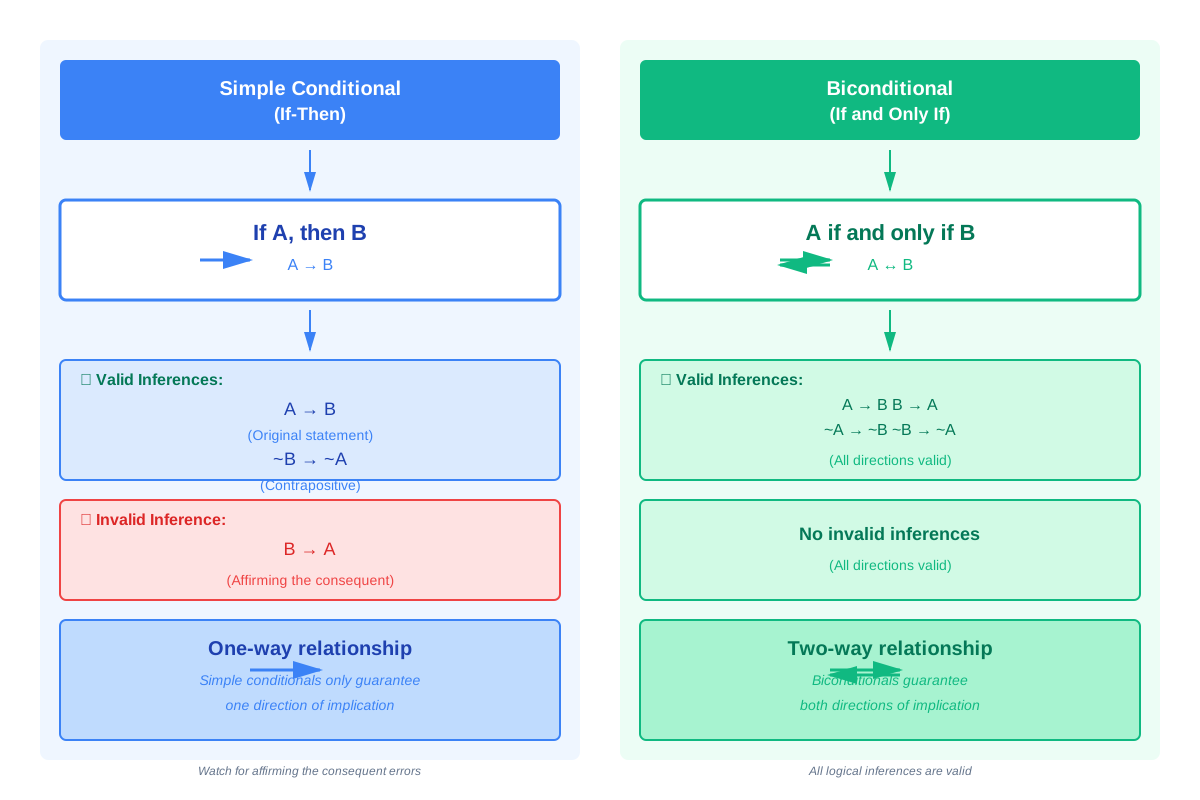
Distinguishing Simple Conditionals from Biconditionals
A critical skill for LSAT success is recognizing when a statement establishes only a simple conditional relationship versus a full biconditional. Consider these two statements:
- Simple conditional: "If it rains, the game is cancelled" (rain → cancelled)
- Biconditional: "The game is cancelled if and only if it rains" (rain ↔ cancelled)
The simple conditional tells us only that rain guarantees cancellation; the game might be cancelled for other reasons (lightning, equipment failure, etc.). The biconditional tells us that rain is the only reason for cancellation—if the game is cancelled, it must have rained, and if it didn't rain, the game was not cancelled.
Many LSAT wrong answers exploit confusion between these two types of relationships, presenting a simple conditional and asking test-takers to draw conclusions that would be valid only for a biconditional.
Concept Relationships
The concepts within if and only if statements build upon each other in a hierarchical structure. The biconditional relationship serves as the foundation, establishing the core principle of mutual necessity and sufficiency. This foundation enables understanding of symbolic representation, which provides a visual and formal method for expressing the bidirectional nature of these statements. The symbolic representation, in turn, clarifies the components of if and only if statements, showing how the "if" and "only if" parts work together to create logical equivalence.
Understanding these components is prerequisite to recognizing linguistic variations, as each variation expresses the same underlying biconditional structure in different words. Mastery of linguistic variations enables accurate identification of if and only if statements in LSAT passages, which is essential for applying truth conditions correctly. The truth conditions determine when biconditional statements are satisfied or violated, which directly informs the valid inference patterns that test-takers can use to answer questions.
Finally, all of these concepts converge in the critical skill of distinguishing simple conditionals from biconditionals, which requires synthesizing knowledge of how biconditionals differ from their simpler counterparts in structure, truth conditions, and inferential power.
This topic connects to prerequisite knowledge of basic conditional logic by extending the unidirectional if-then relationship into a bidirectional equivalence. It relates to contrapositive formation because biconditionals generate two sets of contrapositives (one for each direction). The topic also connects forward to more advanced logical reasoning concepts, including formal logic in Logic Games, complex argument structures in Logical Reasoning, and the evaluation of necessary and sufficient assumptions.
Quick check — test yourself on If and only if statements so far.
Try Flashcards →High-Yield Facts
⭐ An if and only if statement establishes that two conditions are logically equivalent—they must always have the same truth value.
⭐ Every if and only if statement can be decomposed into two conditional statements: A → B and B → A.
⭐ The phrase "only if" by itself establishes a necessary condition, but "if and only if" establishes both necessity and sufficiency.
⭐ Definitional statements on the LSAT almost always establish biconditional relationships, even when "if and only if" is not explicitly stated.
⭐ A biconditional is violated whenever the two components have different truth values—one true and one false.
- The expressions "just in case," "exactly when," and "if and only if" are logically equivalent and interchangeable.
- From a biconditional A ↔ B, four valid inferences can be drawn: A → B, B → A, ~A → ~B, and ~B → ~A.
- Simple conditionals allow for alternative sufficient conditions, but biconditionals exclude all alternatives.
- When an argument treats a necessary condition as if it were also sufficient, it may be implicitly (and often incorrectly) assuming a biconditional relationship.
- In Logic Games, rules stating "X is selected if and only if Y is selected" create powerful constraints that often determine multiple variable placements.
- The negation of a biconditional is true when the two components have different truth values (one true, one false).
- Biconditional statements are more restrictive than simple conditionals and therefore provide more inferential power.
Common Misconceptions
Misconception: "If and only if" means the same thing as a simple "if-then" statement.
Correction: If and only if statements are much stronger than simple conditionals. While "if A then B" establishes only that A is sufficient for B, "A if and only if B" establishes that A and B are completely equivalent—each is both necessary and sufficient for the other. This means you can infer in both directions, not just one.
Misconception: When you see "only if," you can treat it the same as "if and only if."
Correction: "Only if" by itself establishes only a necessary condition (one direction), while "if and only if" establishes both necessity and sufficiency (both directions). "A only if B" means A → B, but "A if and only if B" means both A → B and B → A. The addition of "if" to "only if" fundamentally changes the logical relationship.
Misconception: If a statement says "X is necessary and sufficient for Y," then X and Y are in a biconditional relationship.
Correction: This is actually correct, but the misconception arises in the directionality. If X is necessary and sufficient for Y, then Y → X and X → Y, which means Y ↔ X. However, students often confuse which direction each component establishes. "Necessary for" points backward (Y → X), while "sufficient for" points forward (X → Y).
Misconception: Biconditional statements can be true even when one component is true and the other is false.
Correction: Biconditional statements are false whenever the two components have different truth values. The statement "A if and only if B" is true only when both A and B are true or both are false. If they differ in truth value, the biconditional is violated.
Misconception: All definitions establish only one-way relationships.
Correction: Definitions establish biconditional relationships. When something is defined (e.g., "A bachelor is an unmarried man"), the definition works in both directions: all bachelors are unmarried men, and all unmarried men are bachelors. This bidirectionality is what makes definitions useful for classification and identification.
Misconception: You can add conditions to one side of a biconditional without affecting the logical relationship.
Correction: Modifying either side of a biconditional changes the entire relationship. If "A if and only if B" is true, you cannot conclude that "A if and only if (B and C)" is true. The addition of C creates a different, more restrictive condition that may not maintain the biconditional relationship.
Worked Examples
Example 1: Identifying and Applying Biconditional Logic
Question: A university policy states: "A student receives honors if and only if the student maintains a GPA of 3.5 or higher." Which of the following must be true?
(A) If a student has a 3.4 GPA, the student might still receive honors.
(B) If a student receives honors, the student must have a GPA of 3.5 or higher.
(C) If a student has a 3.6 GPA, the student might not receive honors.
(D) A student can receive honors with a GPA below 3.5 if the student has exceptional extracurricular activities.
(E) Maintaining a 3.5 GPA is sufficient but not necessary for receiving honors.
Solution:
Step 1: Identify the biconditional relationship. The statement "A student receives honors if and only if the student maintains a GPA of 3.5 or higher" establishes:
- Honors ↔ GPA ≥ 3.5
Step 2: Break down into component conditionals:
- If honors, then GPA ≥ 3.5 (honors → GPA ≥ 3.5)
- If GPA ≥ 3.5, then honors (GPA ≥ 3.5 → honors)
Step 3: Evaluate each answer choice:
(A) False. If a student has a 3.4 GPA (which is not ≥ 3.5), the biconditional tells us the student does NOT receive honors. There is no "might" here—the biconditional excludes this possibility.
(B) Correct. This directly applies the "if honors, then GPA ≥ 3.5" component of the biconditional. This must be true.
(C) False. A 3.6 GPA satisfies the "GPA ≥ 3.5" condition, so the biconditional guarantees honors. The student must receive honors, not "might not."
(D) False. The biconditional establishes that GPA ≥ 3.5 is the only way to receive honors. No alternative paths (like extracurricular activities) are possible.
(E) False. The biconditional establishes that maintaining a 3.5 GPA is both necessary AND sufficient for honors, not just sufficient.
Key Takeaway: This example demonstrates how biconditional statements eliminate alternative possibilities and require strict logical equivalence between conditions.
Example 2: Distinguishing Biconditionals from Simple Conditionals
Question: Consider these two statements:
Statement 1: "The security system activates if motion is detected."
Statement 2: "The security system activates if and only if motion is detected."
If the security system is currently activated, what can we validly conclude under each statement?
Solution:
Analysis of Statement 1 (Simple Conditional):
- Logical form: Motion detected → Security system activates
- This tells us that motion detection is sufficient to activate the system
- However, it does NOT tell us that motion is necessary for activation
- The system might activate for other reasons (manual activation, timer, temperature sensor, etc.)
If the security system is activated under Statement 1:
- We CANNOT conclude that motion was detected
- The activation could have been triggered by any number of causes
- The conditional only guarantees the consequent when the antecedent is true, not vice versa
Analysis of Statement 2 (Biconditional):
- Logical form: Security system activates ↔ Motion detected
- This establishes two conditionals:
- Motion detected → Security system activates
- Security system activates → Motion detected
- Motion is both necessary and sufficient for activation
If the security system is activated under Statement 2:
- We CAN conclude that motion was detected
- The biconditional guarantees that activation occurs if and only if motion is detected
- No other cause of activation is possible
Key Differences:
- Statement 1 allows multiple sufficient conditions for activation; Statement 2 allows only one
- Statement 1 permits activation without motion; Statement 2 does not
- Statement 1 supports only forward inference (motion → activation); Statement 2 supports inference in both directions
Key Takeaway: This example illustrates the critical distinction between simple conditionals and biconditionals. The addition of "only if" to "if" fundamentally changes what can be inferred, particularly when reasoning backward from the consequent to the antecedent. Many LSAT wrong answers exploit this distinction by presenting a simple conditional and asking for conclusions that would be valid only under a biconditional.
Exam Strategy
When approaching LSAT questions involving if and only if statements, begin by identifying whether the statement is explicitly biconditional or merely a simple conditional. Look for trigger phrases: "if and only if," "just in case," "exactly when," "is defined as," or explicit statements that something is "both necessary and sufficient." These phrases signal biconditional relationships that enable inference in both directions.
Exam Tip: When you identify a biconditional, immediately write out both component conditionals (A → B and B → A) in your scratch work. This prevents errors and makes valid inferences obvious.
For questions that present definitional statements, treat them as biconditionals even if "if and only if" is not explicitly stated. Legal and technical definitions on the LSAT establish complete equivalence between the term being defined and its definition. If a passage states "Negligence is defined as failure to exercise reasonable care," treat this as "Negligence ↔ Failure to exercise reasonable care."
Watch for wrong answer choices that confuse simple conditionals with biconditionals. These wrong answers typically:
- Take a simple conditional (if A then B) and conclude the reverse (if B then A)
- Take a biconditional and treat it as allowing alternative sufficient conditions
- Claim that a necessary condition is not sufficient when a biconditional has been established
- Assert that exceptions are possible when a biconditional has been stated
When eliminating answer choices, use the truth conditions for biconditionals: if the two components have different truth values, the biconditional is violated. Any answer choice that suggests one component can be true while the other is false can be immediately eliminated when a biconditional relationship has been established.
Time Management: Biconditional questions often appear in Must Be True and Sufficient Assumption question types. Allocate 1:30-2:00 minutes for these questions, as they require careful logical analysis but reward systematic application of inference rules.
For Logic Games, if and only if rules are among the most powerful constraints. When you encounter such a rule, immediately note that it creates a "linked pair"—the two variables must always have the same status (both in or both out, both selected or both not selected). This often triggers chain reactions with other rules and can unlock significant portions of the game board.
Memory Techniques
The "Double Arrow" Visualization: When you see "if and only if," visualize a double-headed arrow (↔) connecting the two conditions. This visual reminder emphasizes that the relationship works in both directions, unlike the single arrow (→) of simple conditionals.
The "IFF" Acronym: Mathematicians and logicians abbreviate "if and only if" as "iff" (with two f's). Remember: two f's = two directions. This helps distinguish "if and only if" from simple "if" statements.
The "Definition Test": When uncertain whether a statement establishes a biconditional, ask yourself: "Is this a definition?" Definitions are always biconditional. If you can rephrase the statement as "X is defined as Y" or "X means Y," it's a biconditional.
The "Locked Together" Metaphor: Think of the two components of a biconditional as locked together with handcuffs. Wherever one goes, the other must follow. If one is true, the other is true; if one is false, the other is false. They cannot be separated.
The "JEDI" Mnemonic for biconditional trigger phrases:
- Just in case
- Exactly when
- Defined as
- If and only if
Each of these phrases establishes a biconditional relationship.
Summary
If and only if statements represent the strongest form of conditional logic on the LSAT, establishing complete logical equivalence between two propositions. Unlike simple conditionals that create one-way relationships, biconditionals establish that each condition is both necessary and sufficient for the other, enabling valid inferences in both directions. Recognizing these statements—whether explicitly marked by "if and only if" or disguised in definitional language—is essential for success on Logical Reasoning and Logic Games questions. The key to mastering this topic lies in understanding that biconditionals decompose into two component conditionals (A → B and B → A), that they are violated whenever the two components have different truth values, and that they exclude alternative sufficient conditions. Students must distinguish carefully between simple conditionals and biconditionals, as many wrong answers exploit confusion between these two relationship types. By systematically applying the four valid inference patterns (forward, reverse, and both contrapositives) and recognizing common linguistic variations, test-takers can confidently navigate even the most complex biconditional logic on the LSAT.
Key Takeaways
- If and only if statements establish bidirectional logical relationships where each condition is both necessary and sufficient for the other
- Every biconditional can be decomposed into two conditional statements that work in opposite directions
- Definitional statements almost always establish biconditional relationships, even without explicit "if and only if" language
- A biconditional is violated whenever its two components have different truth values (one true, one false)
- Simple conditionals allow alternative sufficient conditions, but biconditionals exclude all alternatives—there is only one way to satisfy each side
- The phrases "if and only if," "just in case," "exactly when," and "is defined as" are logically equivalent expressions of biconditional relationships
- From any biconditional, four valid inferences can be drawn: two forward conditionals and two contrapositives
Related Topics
Formal Logic in Logic Games: Mastering if and only if statements provides the foundation for understanding complex rule interactions in Logic Games, where biconditional rules create powerful constraints that determine multiple variable placements simultaneously.
Necessary and Sufficient Assumptions: Understanding biconditionals deepens comprehension of assumption questions, particularly those asking for sufficient assumptions that, when added to an argument, guarantee the conclusion through biconditional relationships.
Parallel Reasoning Questions: These questions often test the ability to recognize logical structures, including biconditional relationships, and match them across different content domains.
Formal Fallacies: Many formal fallacies involve treating simple conditionals as if they were biconditionals (affirming the consequent, denying the antecedent), making biconditional mastery essential for identifying flawed reasoning.
Practice CTA
Now that you understand the logical structure and application of if and only if statements, it's time to reinforce this knowledge through active practice. Attempt the practice questions to test your ability to identify biconditional relationships, make valid inferences, and distinguish these statements from simple conditionals. Use the flashcards to drill the key concepts, trigger phrases, and inference patterns until they become automatic. Remember: mastery of biconditional logic is one of the highest-yield investments you can make in your LSAT preparation, as it appears frequently and separates top scorers from the rest. Each practice question you complete builds the pattern recognition and logical reasoning skills that will serve you throughout the exam. You've got this!
Sign up free to keep reading
Create a free AnvayaPrep account to finish this LSAT guide on If and only if statements — plus flashcards and practice questions.