Overview
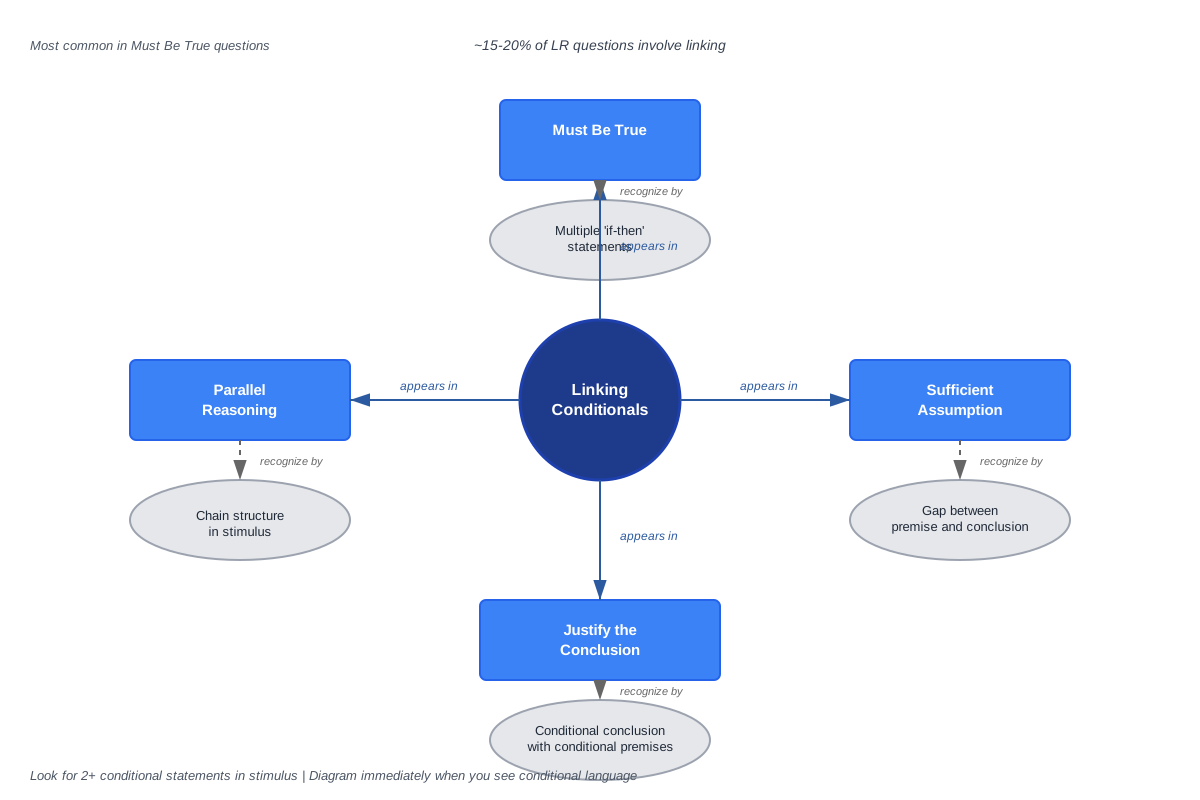
Linking conditionals is one of the most powerful and frequently tested concepts in LSAT Logical Reasoning. This technique involves connecting two or more conditional statements by matching the consequent (necessary condition) of one statement with the sufficient condition of another, creating a logical chain. When conditionals are properly linked, they allow test-takers to derive new conclusions that weren't explicitly stated in the original premises—a skill that appears across multiple question types including Must Be True, Sufficient Assumption, and Justify the Conclusion questions.
Mastering conditional logic through linking is essential because the LSAT regularly presents arguments where the conclusion depends on recognizing how separate conditional statements connect. A typical LSAT question might provide two or three conditional statements scattered throughout a stimulus, requiring the test-taker to mentally chain them together to identify what must be true or what assumption bridges a logical gap. Students who can quickly and accurately link conditionals gain a significant advantage, often solving complex questions in under a minute while others struggle to see the connections.
Within the broader landscape of Logical Reasoning, linking conditionals represents an intermediate application of conditional logic fundamentals. While basic conditional reasoning involves understanding single if-then statements and their contrapositives, linking conditionals requires recognizing patterns across multiple statements and understanding how logical relationships compound. This skill serves as a foundation for more advanced topics like formal logic games and complex argument structures, making it a cornerstone concept that supports performance across the entire LSAT.
Learning Objectives
- [ ] Identify how linking conditionals appears in LSAT questions
- [ ] Explain the reasoning pattern behind linking conditionals
- [ ] Apply linking conditionals to solve LSAT-style problems accurately
- [ ] Recognize when conditional statements can be linked versus when they cannot
- [ ] Construct valid chains from three or more conditional statements
- [ ] Distinguish between valid linked conclusions and invalid logical leaps
- [ ] Apply contrapositive reasoning within linked conditional chains
Prerequisites
- Basic conditional statement structure (sufficient and necessary conditions): Understanding "if A then B" notation is essential because linking requires identifying which parts of different conditionals match.
- Contrapositive formation: Linking often requires recognizing contrapositives to connect statements that don't initially appear to link directly.
- Logical notation and diagramming: Familiarity with arrow notation (A → B) speeds up the process of visualizing how conditionals connect.
- Distinction between sufficient and necessary conditions: Linking only works when matching the correct parts of conditionals—confusing these elements leads to invalid chains.
Why This Topic Matters
In real-world reasoning, linking conditionals mirrors how we construct logical arguments in law, policy analysis, and scientific reasoning. Attorneys regularly chain together legal precedents and statutory requirements to build cases, while policy analysts connect conditional relationships to predict outcomes. The ability to see how separate rules or principles connect to produce new conclusions is fundamental to analytical thinking in professional contexts.
On the LSAT, lsat linking conditionals appears with remarkable frequency. Research on recent LSAT administrations suggests that approximately 15-20% of Logical Reasoning questions either directly test or significantly benefit from the ability to link conditionals. This translates to roughly 4-6 questions per test section, making it one of the highest-yield topics for score improvement. The concept appears most commonly in Must Be True questions (where linking reveals what necessarily follows), Sufficient Assumption questions (where the correct answer provides the missing link in a chain), and Justify the Conclusion questions (where linking demonstrates how premises support a conclusion).
Common manifestations in LSAT passages include: arguments presenting multiple conditional rules or principles that must be combined; stimuli containing conditional statements in different sentences that share common terms; questions asking what must be true if certain conditions are met; and answer choices that represent either valid or invalid attempts to link given conditionals. The LSAT often disguises conditional statements in natural language rather than explicit "if-then" format, requiring test-takers to first translate statements into conditional form before recognizing linking opportunities.
Core Concepts
The Fundamental Structure of Linked Conditionals
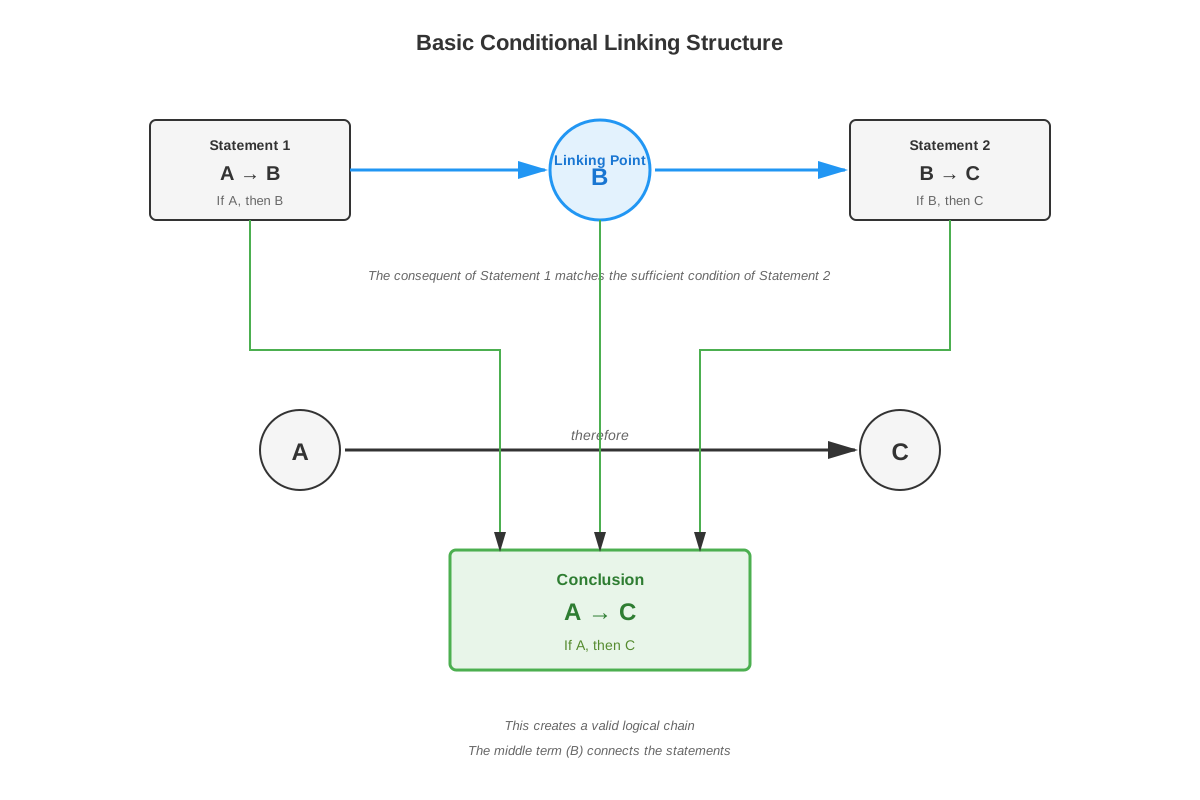
Linking conditionals occurs when the necessary condition (consequent) of one conditional statement matches the sufficient condition (antecedent) of another conditional statement. This creates a logical chain where the sufficient condition of the first statement guarantees the necessary condition of the second statement. The formal structure follows this pattern:
- Statement 1: A → B (If A, then B)
- Statement 2: B → C (If B, then C)
- Valid Conclusion: A → C (If A, then C)
The key principle is that when B appears as the necessary condition in the first statement and the sufficient condition in the second statement, the two conditionals "link" together. This creates a transitive relationship: anything sufficient to guarantee B is also sufficient to guarantee C, because B itself guarantees C.
Consider this concrete example:
- If someone is a Supreme Court Justice, then they are a federal judge. (SCJ → FJ)
- If someone is a federal judge, then they have a law degree. (FJ → LD)
- Valid conclusion: If someone is a Supreme Court Justice, then they have a law degree. (SCJ → LD)
The middle term (federal judge) serves as the connecting link, appearing on the right side of the first conditional and the left side of the second conditional.
Recognizing Linkable Conditionals
Not all conditional statements can be linked. For linking to work, there must be exact or equivalent matching between terms. The LSAT tests whether students can distinguish between conditionals that genuinely link versus those that merely share similar-sounding but logically distinct terms.
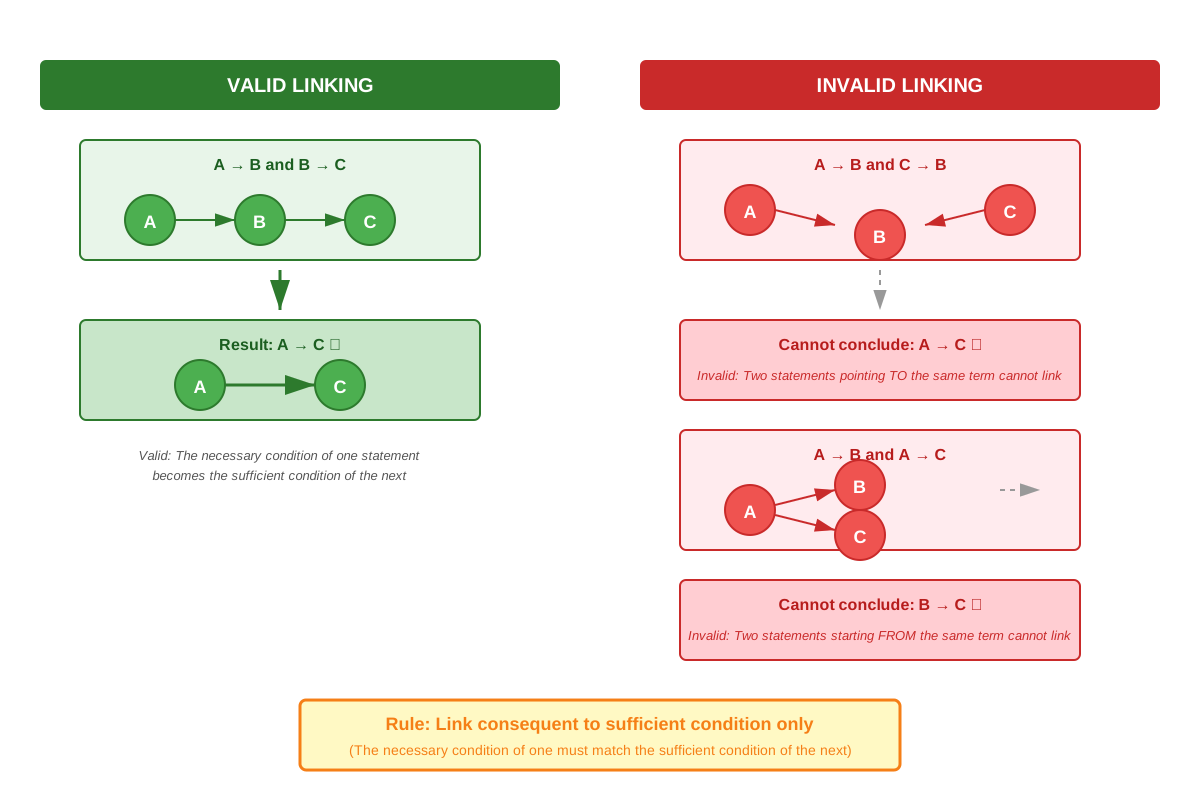
Valid linking requirements:
- The matching term must be identical or explicitly defined as equivalent
- The matching term must appear as a necessary condition in one statement and a sufficient condition in the other
- The logical direction must flow consistently through the chain
Invalid linking patterns to avoid:
- Matching sufficient conditions to sufficient conditions (A → B and C → B does NOT yield A → C)
- Matching necessary conditions to necessary conditions (A → B and C → D does NOT link even if B and C seem related)
- Assuming similar terms are identical without explicit equivalence (e.g., "happy" and "content" may seem similar but aren't logically identical)
The Role of Contrapositives in Linking
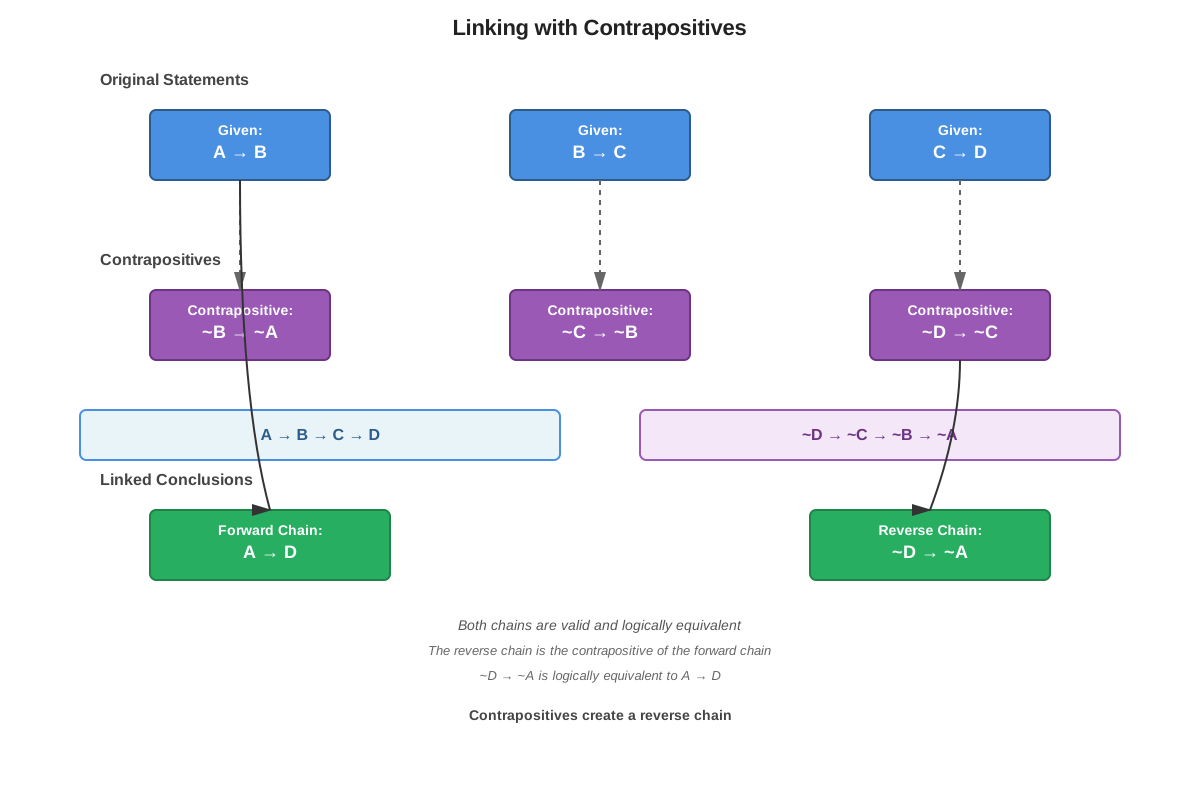
Understanding contrapositives dramatically expands linking opportunities. The contrapositive of a conditional statement (A → B becomes ~B → ~A) is logically equivalent to the original, meaning it can be used interchangeably when linking conditionals.
Consider this scenario where direct linking isn't immediately apparent:
- Statement 1: A → B
- Statement 2: C → ~A
These don't appear to link directly. However, taking the contrapositive of Statement 1 yields: ~B → ~A
Now we can link:
- Statement 2: C → ~A
- Contrapositive of Statement 1: ~B → ~A
- This doesn't create a valid link because both have ~A as necessary conditions
Instead, consider:
- Statement 1: A → B
- Statement 2: ~B → C
Taking the contrapositive of Statement 1: ~B → ~A
Now attempting to link Statement 2 with the original Statement 1:
- Statement 2: ~B → C
- Statement 1: A → B
- These don't link directly, but we can link using the contrapositive:
- Statement 1: A → B
- Statement 2 (contrapositive): ~C → B
- These still don't link properly
The correct approach:
- Statement 1: A → B
- Statement 2: B → C
- Conclusion: A → C
- Contrapositive of conclusion: ~C → ~A
This demonstrates that contrapositives of linked chains are also valid conclusions.
Multi-Step Conditional Chains
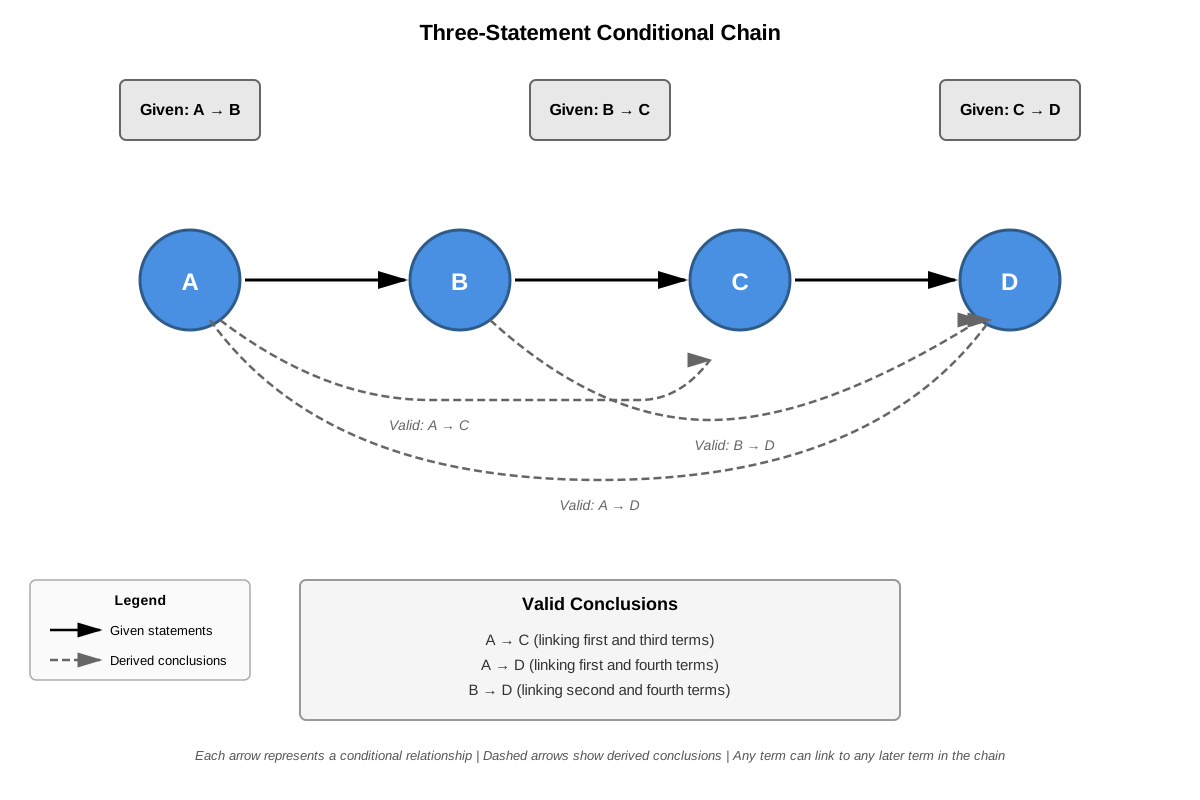
LSAT linking conditionals frequently involves three or more conditional statements. The same principles apply, but the complexity increases:
- Statement 1: A → B
- Statement 2: B → C
- Statement 3: C → D
- Valid conclusion: A → D (and any intermediate link: A → C, B → D)
Each link in the chain must be valid. A single broken link invalidates the entire chain. The LSAT tests this by including answer choices that skip necessary intermediate steps or assume connections that weren't established.
Common Linking Patterns in LSAT Questions
| Pattern Type | Structure | Example | Common Question Type |
|---|---|---|---|
| Simple Chain | A → B, B → C, therefore A → C | Citizen → Voter, Voter → Adult, therefore Citizen → Adult | Must Be True |
| Contrapositive Link | A → B, ~C → ~B, therefore A → C | Pass → Study, ~Graduate → ~Study, therefore Pass → Graduate | Must Be True |
| Missing Link | A → B, C → D, need B → C | Premise gap identification | Sufficient Assumption |
| Reverse Chain Error | A → B, C → B, falsely conclude A → C | Common wrong answer | Flaw |
| Necessary Confusion | A → B, A → C, falsely conclude B → C | Common wrong answer | Flaw |
Translating Natural Language into Linkable Conditionals
The LSAT rarely presents conditionals in explicit "if-then" format. Instead, conditional relationships appear in various linguistic forms:
Sufficient condition indicators (these introduce the "if" part):
- If, when, whenever, all, any, every, each
- Anyone who, everyone who, people who
- Requires, depends on, only if (when following the necessary condition)
Necessary condition indicators (these introduce the "then" part):
- Then, must, requires, needs
- Only, only if (when preceding the necessary condition)
- Unless (introduces necessary condition in negative form)
Example translation:
"All attorneys must pass the bar exam, and anyone who passes the bar exam has completed law school."
- Translation: Attorney → Pass Bar, Pass Bar → Complete Law School
- Linked conclusion: Attorney → Complete Law School
Concept Relationships
The concepts within linking conditionals build upon each other hierarchically. Basic conditional structure serves as the foundation, establishing the sufficient-necessary relationship that makes linking possible. From this foundation, recognizing linkable conditionals emerges as the next skill—identifying when the necessary condition of one statement matches the sufficient condition of another. This recognition skill then enables constructing valid chains, where multiple conditionals connect in sequence.
Contrapositive reasoning intersects with linking at every level, functioning as both a prerequisite skill and an advanced application. When conditionals don't appear to link directly, contrapositive formation often reveals hidden connections. This relationship can be mapped as: Basic Conditionals → Contrapositive Formation → Recognition of Linkable Patterns → Chain Construction → Complex Multi-Step Reasoning.
The connection to prerequisite topics is direct: without understanding sufficient and necessary conditions, students cannot identify which parts of conditionals should match when linking. Without contrapositive fluency, students miss approximately 40% of linking opportunities that require recognizing reversed and negated forms.
Looking forward, linking conditionals enables progression to formal logic games (where multiple rules must be combined), complex argument analysis (where unstated assumptions often involve missing conditional links), and parallel reasoning questions (where recognizing conditional structures helps identify matching argument patterns). The skill also supports understanding of necessary and sufficient assumptions, as these question types often require identifying what conditional link would complete or is required by an argument chain.
High-Yield Facts
⭐ Linking requires matching the necessary condition of one statement with the sufficient condition of another—never sufficient to sufficient or necessary to necessary.
⭐ The contrapositive of any conditional in a chain is also valid and can be used to create additional links.
⭐ In a valid chain A → B → C, you can conclude A → C, but you cannot conclude C → A without additional information.
⭐ When the LSAT asks what "must be true," linked conditionals often provide the answer by revealing non-obvious implications.
⭐ The most common wrong answers in linking questions reverse the logical direction or connect the wrong parts of conditionals.
- A chain is only as strong as its weakest link—one invalid connection invalidates all conclusions drawn from that chain.
- Terms must be identical or explicitly defined as equivalent for linking to work; similar-sounding terms are insufficient.
- Multiple conditionals can share the same sufficient condition (A → B, A → C) without creating a link between B and C.
- The LSAT frequently presents conditionals in non-standard language requiring translation before linking becomes apparent.
- Linked chains can extend indefinitely (A → B → C → D → E...) with each intermediate conclusion being valid.
- Sufficient assumption questions often require identifying the exact conditional link missing from a chain.
- When a stimulus contains three or more conditional statements, the LSAT almost certainly expects you to link them.
Quick check — test yourself on Linking conditionals so far.
Try Flashcards →Common Misconceptions
Misconception: If two conditionals share any common term, they can be linked.
Correction: Conditionals can only be linked when a term appears as the necessary condition in one statement and the sufficient condition in another. Sharing a term in other positions doesn't create a valid link. For example, A → B and C → B share term B, but this doesn't allow concluding A → C.
Misconception: Linking conditionals works in both directions, so if A → B → C, then C → A.
Correction: Conditional logic is unidirectional. A → B → C only allows concluding A → C. To conclude C → A, you would need the contrapositive chain: ~C → ~B → ~A, which does validly conclude ~C → ~A, not C → A.
Misconception: When the LSAT uses similar or related terms, they can be treated as identical for linking purposes.
Correction: The LSAT is precise with language. "Happy" and "content," or "lawyer" and "attorney," cannot be assumed equivalent unless explicitly stated. Many wrong answers exploit this by creating invalid links between similar but distinct concepts.
Misconception: If A → B and B → C, then B → A and C → B are also true.
Correction: This confuses conditionals with biconditionals. The original statements only establish one-way relationships. The valid additional conclusions are the contrapositives: ~B → ~A and ~C → ~B, not the reverses.
Misconception: In a chain A → B → C, knowing that C is true allows you to conclude A is true.
Correction: Conditionals only allow conclusions when the sufficient condition is met. Knowing C is true tells you nothing about whether A or B is true—the chain only works forward from A. This is the classic error of affirming the consequent.
Misconception: Linking conditionals is only useful for Must Be True questions.
Correction: While linking appears most obviously in Must Be True questions, it's equally important for Sufficient Assumption questions (where the answer provides a missing link), Justify questions (where linking shows how premises support conclusions), and even Flaw questions (where wrong answers often involve invalid linking).
Worked Examples
Example 1: Basic Linking with Translation
Stimulus: "Every member of the debate team has strong public speaking skills. All students with strong public speaking skills have taken at least one communications course. Therefore, every member of the debate team has taken at least one communications course."
Step 1: Identify and translate conditionals
- "Every member of the debate team has strong public speaking skills"
- Translation: Debate Team Member → Strong Public Speaking Skills (DT → SPS)
- "All students with strong public speaking skills have taken at least one communications course"
- Translation: Strong Public Speaking Skills → Communications Course (SPS → CC)
Step 2: Identify the linking opportunity
The necessary condition of the first statement (SPS) matches the sufficient condition of the second statement (SPS). This creates a valid link.
Step 3: Construct the chain
DT → SPS → CC
Step 4: Derive the conclusion
Following the chain from beginning to end: DT → CC
This matches the stated conclusion: "every member of the debate team has taken at least one communications course."
Step 5: Verify with contrapositive
The contrapositive of our conclusion should also be valid:
~CC → ~DT (If someone hasn't taken a communications course, they're not on the debate team)
This makes logical sense given our premises, confirming our linking is correct.
Connection to learning objectives: This example demonstrates identifying linking conditionals in natural language (Objective 1), explaining the reasoning pattern of matching necessary to sufficient conditions (Objective 2), and applying the technique to reach a valid conclusion (Objective 3).
Example 2: Multi-Step Chain with Sufficient Assumption
Stimulus: "All effective managers are good listeners. Anyone who is a good listener is empathetic. Therefore, all effective managers are patient."
Question: Which of the following, if assumed, allows the conclusion to be properly drawn?
Step 1: Translate the given conditionals
- Premise 1: Effective Manager → Good Listener (EM → GL)
- Premise 2: Good Listener → Empathetic (GL → E)
- Conclusion: Effective Manager → Patient (EM → P)
Step 2: Link the given premises
EM → GL → E
This gives us: EM → E
Step 3: Identify the gap
We can conclude EM → E from our premises, but the conclusion states EM → P. There's a missing link between E (Empathetic) and P (Patient).
Step 4: Determine what assumption would complete the chain
To get from EM → E to EM → P, we need: E → P (If someone is empathetic, then they are patient)
Step 5: Verify the complete chain
With the assumption E → P, our complete chain becomes:
EM → GL → E → P
Therefore: EM → P ✓
Answer: The correct answer would be something like "All empathetic people are patient" or "Anyone who is empathetic is patient."
Common wrong answers and why they fail:
- "All patient people are empathetic" (P → E): This reverses the needed direction
- "All good listeners are patient" (GL → P): While this would work, it's not the most precise answer; the gap is specifically between E and P
- "Some effective managers are patient": This is too weak; we need a conditional that guarantees all effective managers are patient
Connection to learning objectives: This example shows how to identify missing links in conditional chains (Objective 4), construct chains from multiple statements (Objective 5), and distinguish valid from invalid linking attempts (Objective 6).
Exam Strategy
When approaching LSAT questions involving linking conditionals, follow this systematic process:
Step 1: Scan for conditional indicators (30 seconds)
Quickly read through the stimulus looking for words like "all," "every," "if," "only," "must," "requires," and "unless." These signal conditional statements that may need linking.
Step 2: Translate and diagram (30-45 seconds)
Convert each conditional into arrow notation. Use consistent abbreviations for repeated terms. Write these out on your scratch paper—mental linking alone leads to errors under time pressure.
Step 3: Look for matching terms (15 seconds)
Scan your diagrams for terms that appear in multiple conditionals. Circle or highlight terms that appear as both necessary and sufficient conditions in different statements.
Step 4: Construct the chain (20 seconds)
Draw the linked chain, ensuring each connection is valid (necessary to sufficient). If conditionals don't link directly, consider whether contrapositives would create connections.
Step 5: Identify what can be concluded (20 seconds)
From your chain, determine what must be true. Remember that you can conclude any connection that follows the chain's direction.
Exam Tip: If a stimulus contains three or more conditional statements, the question almost certainly requires linking them. Don't waste time looking for alternative approaches—start diagramming immediately.
Trigger phrases that signal linking questions:
- "Which of the following must be true..."
- "The conclusion follows logically if which assumption is made..."
- "Which of the following, if assumed, allows the conclusion to be properly drawn..."
- "If the statements above are true, which of the following must also be true..."
Process of elimination strategies:
- Eliminate answers that reverse conditional direction (if the chain gives you A → C, eliminate answers suggesting C → A)
- Eliminate answers that connect terms appearing as sufficient conditions in multiple statements (A → B and A → C doesn't yield B → C)
- Eliminate answers that connect terms appearing as necessary conditions in multiple statements (A → C and B → C doesn't yield A → B)
- Eliminate answers that assume similar terms are identical without explicit equivalence
- In Sufficient Assumption questions, eliminate answers that are too weak (some, might, could) or too strong (only if, must and only must)
Time allocation:
- Simple two-conditional linking: 60-90 seconds total
- Three-conditional chains: 90-120 seconds total
- Complex chains with contrapositives: 120-150 seconds total
If you're exceeding these times, you may be overcomplicating the problem. Return to basic diagramming and look for the most straightforward linking path.
Memory Techniques
The "LINK" Acronym for Valid Linking:
- Locate all conditionals in the stimulus
- Identify matching terms (necessary in one, sufficient in another)
- Notate the chain with arrows
- Keep direction consistent (always sufficient → necessary)
The "Chain Rule" Visualization:
Picture a physical chain where each link connects at specific points. Just as a chain link has two ends that must connect properly to the next link, conditionals have two parts (sufficient and necessary) that must connect in the right configuration. The "open end" (necessary condition) of one link must connect to the "closed end" (sufficient condition) of the next.
The "Traffic Flow" Metaphor:
Think of conditional chains as one-way streets. Traffic (logical flow) moves from sufficient conditions to necessary conditions. You can follow the traffic from A → B → C to reach C from A, but you can't drive backward against traffic. The contrapositive is like a parallel one-way street going the opposite direction: ~C → ~B → ~A.
Mnemonic for What Can't Be Linked:
"Sufficient to Sufficient Stinks" and "Necessary to Necessary Never works"
This reminds you that A → B and C → B (both B as necessary) don't link, and A → B and A → C (both A as sufficient) don't link.
The "Middle Term Must Match" Rule:
In any valid link, the middle term must appear exactly once on each side of your chain. If you diagram A → B → C, the term B appears once on the right (as necessary) and once on the left (as sufficient). If a term appears twice on the same side, you don't have a valid link.
Summary
Linking conditionals represents a fundamental reasoning pattern in LSAT Logical Reasoning where multiple conditional statements connect to produce new conclusions. The core principle requires matching the necessary condition of one statement with the sufficient condition of another, creating a logical chain that flows from the sufficient condition of the first statement to the necessary condition of the last. Mastery involves three essential skills: accurately translating natural language into conditional form, recognizing when and how conditionals can be validly linked, and applying contrapositive reasoning to identify non-obvious connections. The LSAT tests this concept across multiple question types, most prominently in Must Be True and Sufficient Assumption questions, where success depends on quickly diagramming conditional relationships and constructing valid chains. Common errors include reversing logical direction, connecting the wrong parts of conditionals, and assuming similar terms are equivalent without explicit justification. Students who master linking conditionals gain the ability to solve complex multi-step reasoning problems efficiently, often identifying correct answers within 90 seconds while others struggle to see the logical connections.
Key Takeaways
- Linking conditionals requires matching necessary conditions to sufficient conditions—the necessary condition of one statement must be identical to the sufficient condition of another for valid linking
- Valid chains allow you to conclude that the sufficient condition of the first statement guarantees the necessary condition of the last statement (A → B → C yields A → C)
- Contrapositive reasoning expands linking opportunities by providing alternative forms of conditionals that may connect when original statements don't
- The LSAT disguises conditionals in natural language; translating statements into arrow notation is essential for recognizing linking patterns
- Common wrong answers exploit invalid linking patterns: reversing direction, connecting sufficient to sufficient, connecting necessary to necessary, or assuming term equivalence
- Approximately 15-20% of Logical Reasoning questions directly test or significantly benefit from linking conditionals, making this a high-yield topic for score improvement
- Systematic diagramming on scratch paper prevents errors that occur when attempting to link conditionals mentally under time pressure
Related Topics
Necessary and Sufficient Assumptions: Building on linking conditionals, this topic explores how to identify what must be true for an argument to work (necessary assumptions) or what would guarantee an argument's conclusion (sufficient assumptions). Mastering linking conditionals provides the foundation for recognizing when an assumption serves as a missing link in a conditional chain.
Formal Logic and Grouping Games: Logic Games frequently require linking multiple conditional rules to determine what must or could be true. The diagramming and chaining skills developed through linking conditionals transfer directly to efficiently solving complex game scenarios.
Contrapositive and Negation: While introduced as a prerequisite, deeper exploration of contrapositive reasoning reveals advanced applications in linking, including how to recognize when taking contrapositives of multiple statements in a chain creates additional valid conclusions.
Argument Structure and Gaps: Understanding linking conditionals enhances the ability to identify logical gaps in arguments, particularly when an author assumes a conditional connection without stating it explicitly. This connects to Flaw, Weaken, and Strengthen question types.
Practice CTA
Now that you've mastered the conceptual framework of linking conditionals, it's time to cement your understanding through active practice. The practice questions and flashcards designed for this topic will challenge you to apply these principles under timed conditions, exposing any remaining gaps in your understanding. Remember that linking conditionals is a skill that improves dramatically with deliberate practice—each question you work through strengthens your pattern recognition and speeds up your diagramming process. Approach the practice materials systematically: diagram every conditional, identify linking opportunities, and verify your reasoning before selecting answers. Your investment in mastering this high-yield topic will pay dividends across multiple question types throughout the LSAT. You've built the foundation—now it's time to build the speed and confidence that comes from application.
Sign up free to keep reading
Create a free AnvayaPrep account to finish this LSAT guide on Linking conditionals — plus flashcards and practice questions.