Overview
Necessary assumption conditionals represent a critical intersection of two fundamental LSAT skills: understanding conditional logic and identifying necessary assumptions in arguments. This topic appears frequently on the Logical Reasoning sections of the LSAT, where test-makers challenge students to recognize when an argument's validity depends on a conditional relationship that the author has left unstated. Mastering this concept requires both technical proficiency with conditional logic structures (if-then relationships, contrapositives, and sufficient/necessary conditions) and the analytical skill to spot logical gaps in arguments.
The LSAT frequently presents arguments that contain explicit conditional statements while simultaneously relying on unstated conditional relationships to reach their conclusions. For example, an argument might state "If the company implements the new policy, costs will decrease" and conclude "Therefore, the company should implement the new policy to improve profitability." The necessary assumption here involves a conditional: "If costs decrease, then profitability will improve." Without this conditional link, the argument falls apart. Recognizing these hidden conditional assumptions separates high scorers from average performers on the LSAT.
Understanding necessary assumption conditionals builds directly on foundational knowledge of both conditional reasoning and assumption identification. This topic serves as a bridge between pure logical form (the mechanics of conditional statements) and argument analysis (evaluating whether conclusions follow from premises). Students who master this concept gain a significant advantage not only on Necessary Assumption questions but also on Strengthen, Weaken, and Sufficient Assumption questions, where conditional relationships frequently appear as answer choices or within stimulus arguments.
Learning Objectives
- [ ] Identify how necessary assumption conditionals appears in LSAT questions
- [ ] Explain the reasoning pattern behind necessary assumption conditionals
- [ ] Apply necessary assumption conditionals to solve LSAT-style problems accurately
- [ ] Distinguish between conditional necessary assumptions and other types of necessary assumptions
- [ ] Construct valid contrapositives of conditional necessary assumptions to eliminate incorrect answer choices
- [ ] Recognize when an argument's conditional chain contains a missing link that must be assumed
- [ ] Evaluate answer choices using the negation technique specifically for conditional assumptions
Prerequisites
- Basic conditional logic notation and terminology: Understanding "if-then" statements, sufficient and necessary conditions, and contrapositive formation is essential because necessary assumption conditionals build directly on these logical structures.
- Necessary vs. Sufficient Assumptions: Distinguishing between what an argument must assume (necessary) versus what would guarantee the conclusion (sufficient) provides the foundation for identifying which conditional relationships are required versus merely helpful.
- Argument structure analysis: The ability to identify premises, conclusions, and logical gaps enables students to spot where conditional assumptions bridge reasoning gaps.
- The Negation Technique: Familiarity with testing assumptions by negating them and checking whether the argument falls apart is crucial for verifying conditional necessary assumptions.
Why This Topic Matters
Necessary assumption conditionals appear in approximately 15-20% of all Logical Reasoning questions on the LSAT, making this one of the highest-yield topics for score improvement. These questions appear most frequently in Necessary Assumption question types (obviously), but also regularly surface in Strengthen, Weaken, Flaw, and Sufficient Assumption questions. The LSAT test-makers favor this concept because it simultaneously tests logical reasoning skills and careful reading comprehension—students must both understand the formal logic and recognize subtle gaps in everyday reasoning.
In real-world applications, conditional necessary assumptions underlie legal reasoning, policy analysis, and scientific methodology. Attorneys constantly evaluate whether legal arguments depend on unstated conditional relationships: "If this precedent applies, then my client's case succeeds" requires the assumption "If the facts match, then the precedent applies." Understanding these logical structures prepares law students for the analytical demands of legal practice.
On the LSAT, necessary assumption conditionals typically appear in arguments that: (1) contain at least one explicit conditional statement in the premises, (2) introduce new terminology or concepts in the conclusion, or (3) make causal claims that depend on conditional relationships. Common patterns include arguments about policies (if implemented, then outcome), predictions (if condition occurs, then result follows), and recommendations (if action taken, then goal achieved). Recognizing these patterns allows students to anticipate when conditional assumptions will be tested.
Core Concepts
Understanding Necessary Assumptions
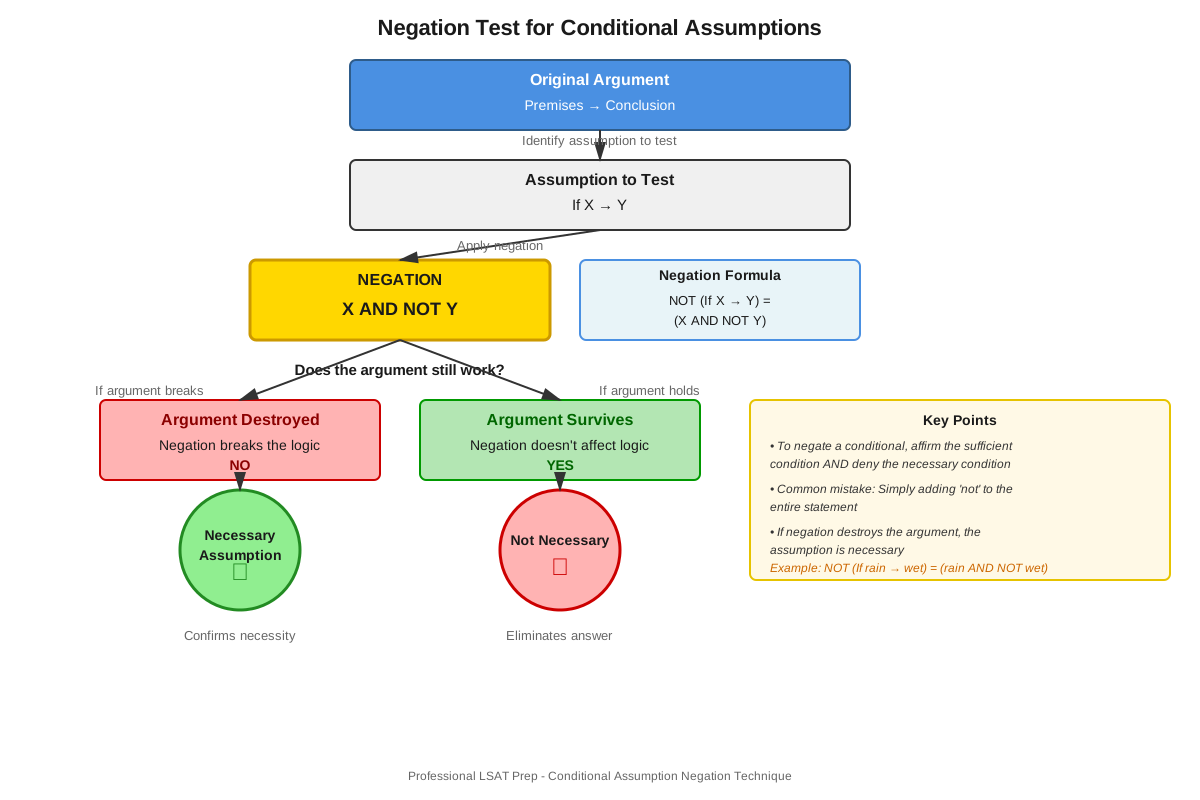
A necessary assumption is an unstated premise that must be true for an argument's conclusion to follow logically from its stated premises. If a necessary assumption is false, the argument completely falls apart. The defining test for necessary assumptions is the negation technique: negate the assumption, and if the argument is destroyed, you've identified a necessary assumption.
Necessary assumptions differ from sufficient assumptions in a crucial way. A sufficient assumption, when added to the premises, guarantees the conclusion is true. A necessary assumption is merely required—it's a minimum condition without which the argument fails, but it may not be enough by itself to prove the conclusion.
Conditional Logic Fundamentals
Conditional logic involves "if-then" relationships where one condition (the sufficient condition) guarantees another (the necessary condition). The standard form is: If A, then B (symbolized as A → B). In this structure:
- A is the sufficient condition (its occurrence is sufficient to guarantee B)
- B is the necessary condition (it must occur whenever A occurs)
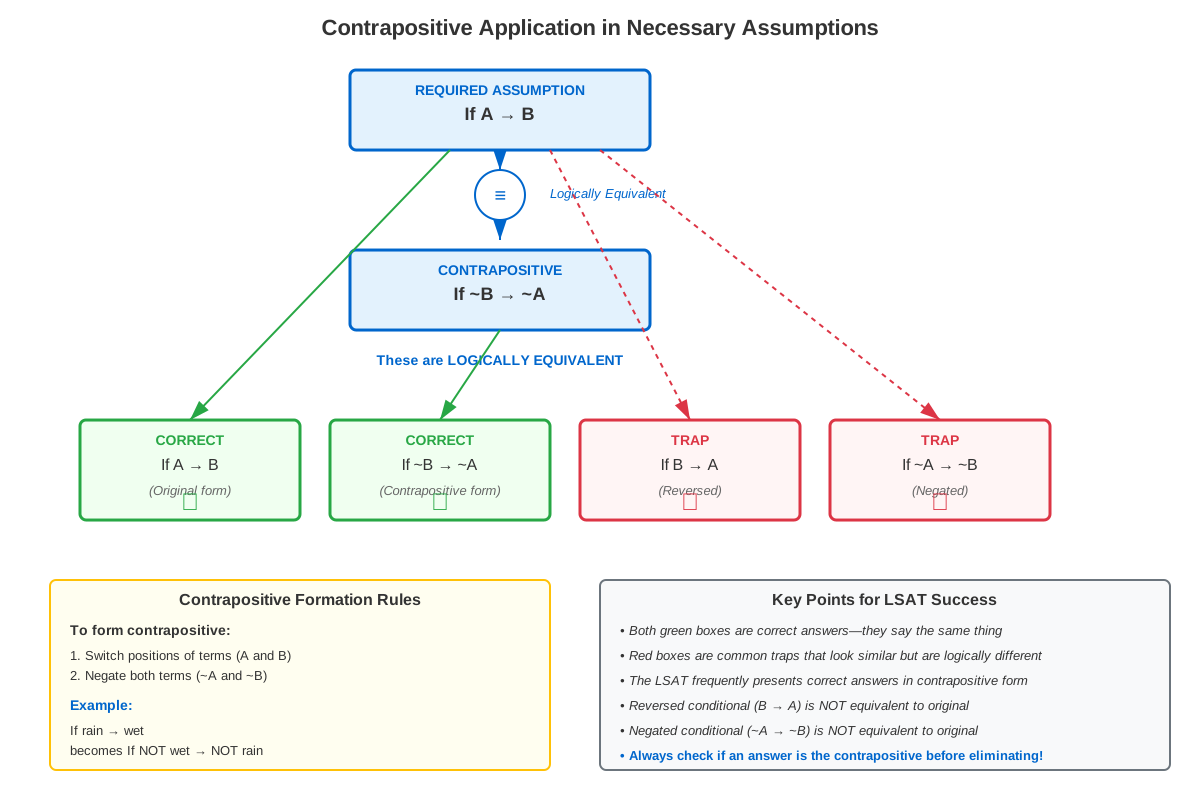
The contrapositive of any conditional statement is logically equivalent to the original: If A → B, then NOT B → NOT A. This equivalence is crucial for identifying necessary assumption conditionals because correct answers may be stated as contrapositives.
What Makes an Assumption "Conditional"
A necessary assumption conditional is a necessary assumption that takes the form of a conditional statement. The argument requires that a specific if-then relationship be true, even though this relationship is never explicitly stated. These assumptions typically serve one of three functions:
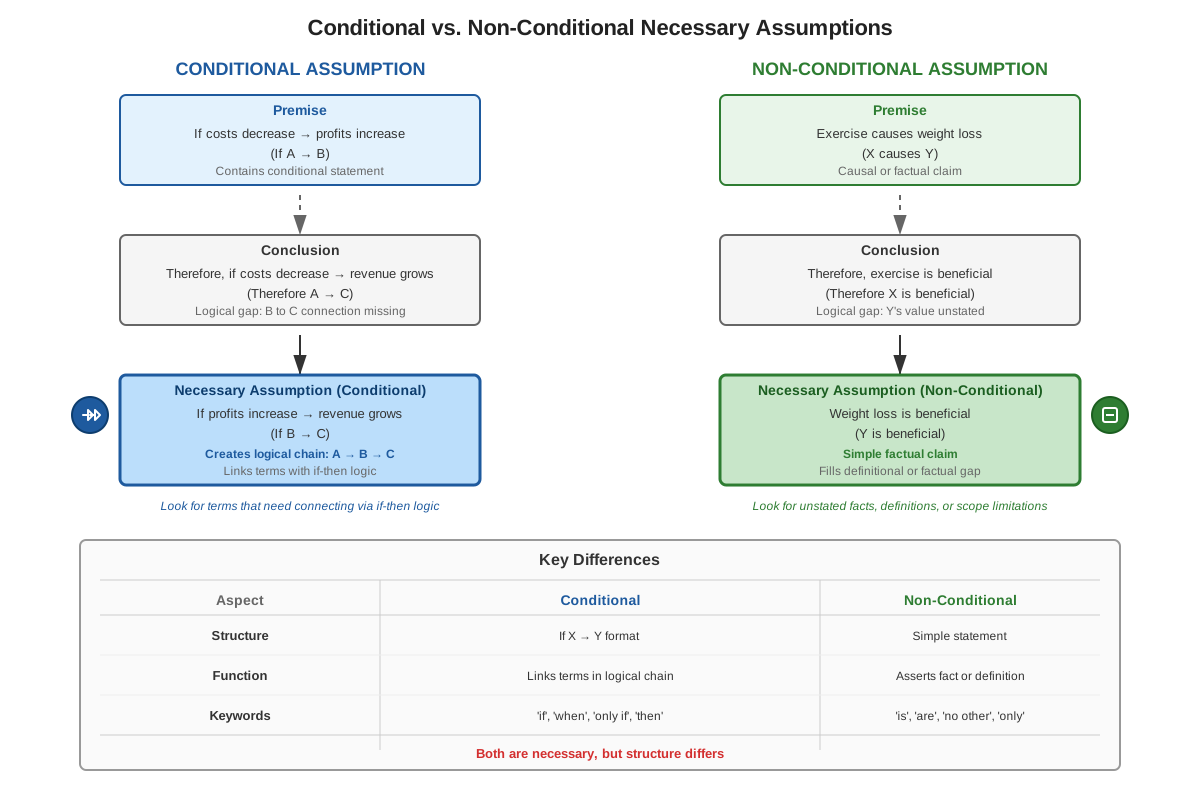
- Linking new terms: The conclusion introduces a term not mentioned in the premises, requiring a conditional bridge (If [premise term], then [conclusion term])
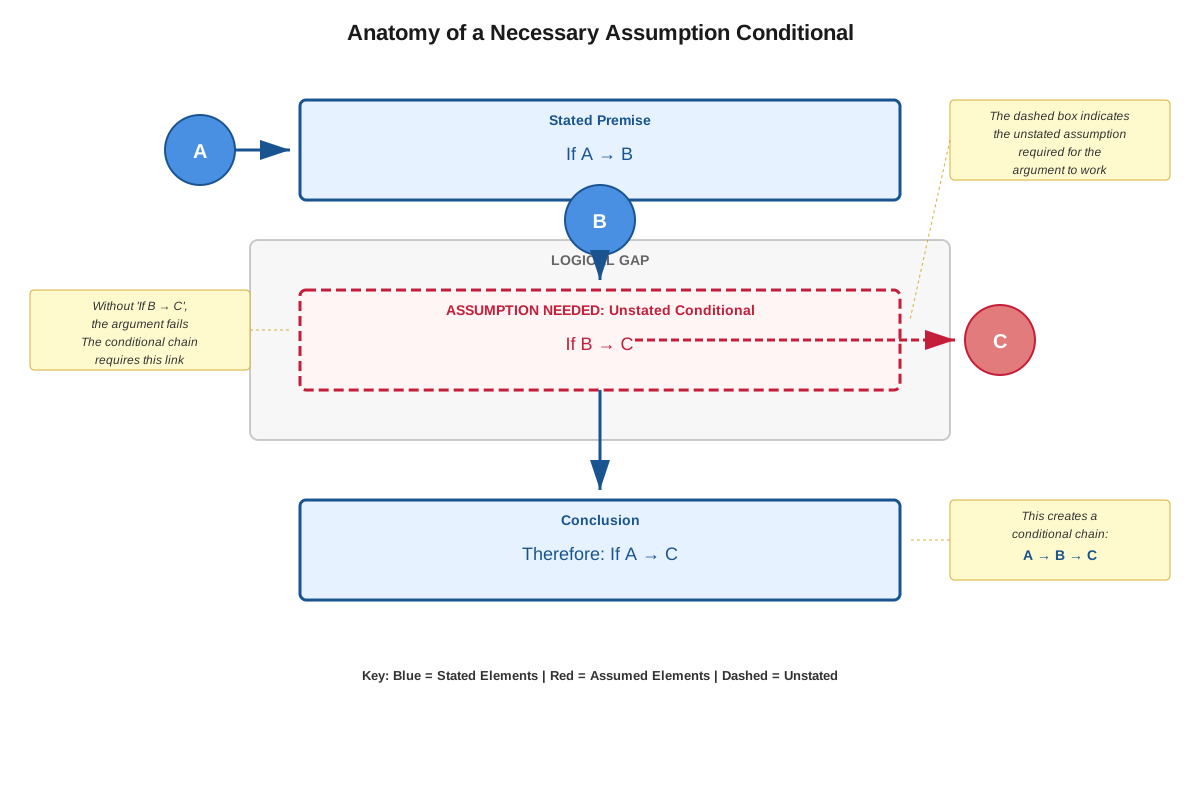
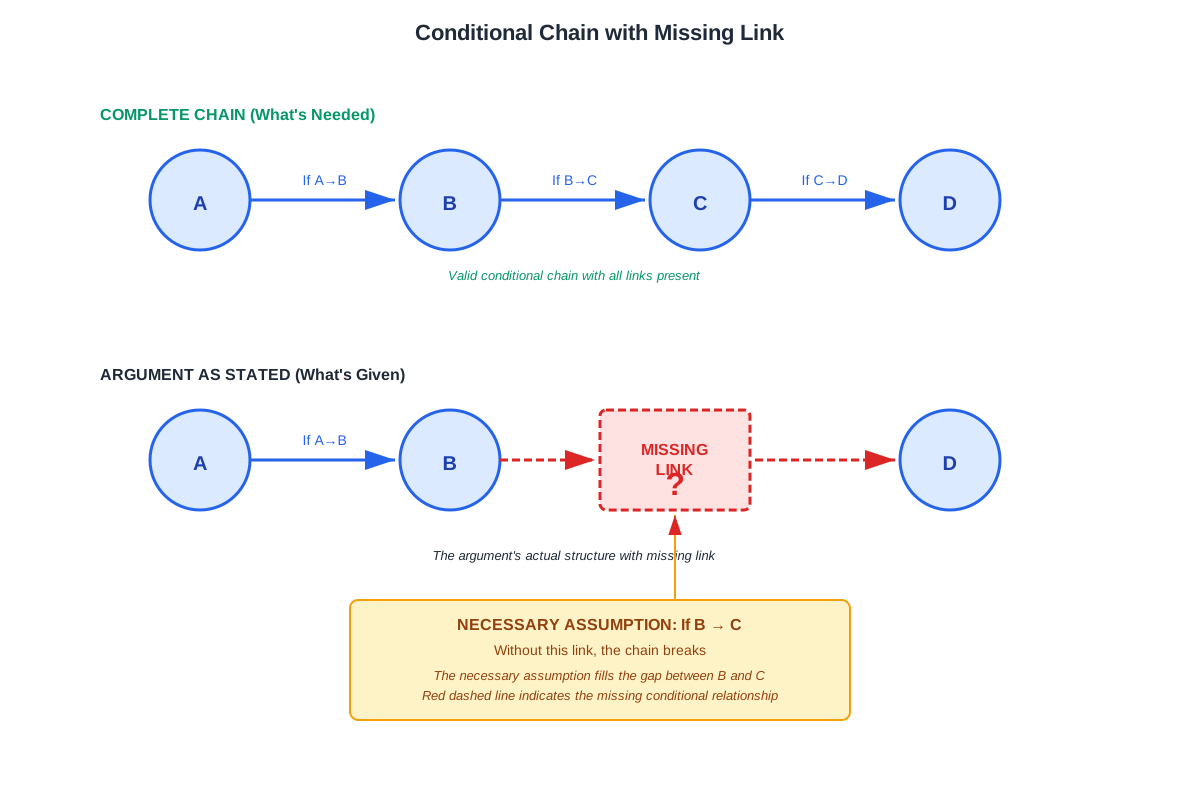
- Completing conditional chains: The premises establish A → B and the conclusion claims A → C, requiring the assumption B → C
- Establishing prerequisite conditions: The argument assumes that certain conditions must be met for a stated conditional to apply
The Conditional Chain Pattern
Many LSAT arguments present incomplete conditional chains. Consider this structure:
Premise: A → B
Conclusion: A → C
This argument has a gap. To validly conclude A → C, we need the conditional link B → C. This missing link is a necessary assumption conditional. Without it, there's no logical path from the premise to the conclusion.
The LSAT frequently tests this pattern by:
- Providing the first link explicitly
- Stating a conclusion that requires additional links
- Asking students to identify the missing conditional connection
The New Term Pattern
When an argument's conclusion contains a term absent from the premises, a conditional assumption often bridges this gap:
Premise: The policy will reduce costs.
Conclusion: Therefore, the policy will improve the company's competitive position.
The necessary assumption conditional: If costs are reduced, then competitive position improves (or at minimum, cost reduction is relevant to competitive position). This conditional connects the premise term (costs) to the conclusion term (competitive position).
Conditional Assumptions vs. Conditional Statements in Premises
Students must distinguish between:
- Conditional statements in premises: Explicitly stated if-then relationships that are given as facts
- Conditional necessary assumptions: Unstated if-then relationships that the argument requires to be true
An argument might state "If we hire more staff, productivity will increase" (conditional premise) while assuming "If productivity increases, profits will increase" (conditional necessary assumption). The first is given; the second must be identified as an unstated requirement.
Testing Conditional Assumptions with Negation
The negation technique works differently for conditional assumptions than for categorical assumptions. To negate a conditional (A → B), you must assert that the sufficient condition can occur without the necessary condition: A can occur without B (symbolized as A and NOT B).
For example:
- Original conditional assumption: If sales increase → profits increase
- Proper negation: Sales can increase without profits increasing
- If this negation destroys the argument, the conditional is a necessary assumption
Contrapositive Recognition in Answer Choices
LSAT answer choices frequently present necessary assumption conditionals in contrapositive form. If the argument requires A → B, the correct answer might state NOT B → NOT A. Students must recognize these as logically equivalent.
Example:
- Required assumption: If the treatment is effective → side effects are minimal
- Answer choice (contrapositive): If side effects are not minimal → the treatment is not effective
Both express the same logical relationship and would be correct.
Concept Relationships
The concepts within necessary assumption conditionals form an integrated system. Conditional logic fundamentals provide the structural framework → this enables recognition of conditional chains and new term patterns → these patterns reveal where conditional necessary assumptions are required → negation testing and contrapositive recognition serve as verification tools to confirm identified assumptions.
Necessary assumption conditionals connect to prerequisite topics through direct dependency relationships. Basic conditional logic (sufficient/necessary conditions, contrapositive formation) → serves as the foundation for → necessary assumption conditionals. Similarly, general necessary assumption identification → combines with → conditional logic → to produce → necessary assumption conditionals.
This topic also bridges to advanced concepts. Mastering necessary assumption conditionals enables progression to sufficient assumption questions (where students must identify conditionals that guarantee conclusions), parallel reasoning with conditionals (matching logical structures), and formal logic games (where conditional chains determine valid inferences).
The relationship map: Conditional Logic Basics → Necessary Assumptions → Necessary Assumption Conditionals → Sufficient Assumptions & Formal Logic → Advanced Conditional Reasoning
High-Yield Facts
⭐ A necessary assumption conditional is an unstated if-then relationship that an argument requires to be true for its conclusion to follow from its premises.
⭐ The most common pattern involves conditional chains with missing links: if premises establish A → B and the conclusion claims A → C, the necessary assumption is B → C.
⭐ When a conclusion introduces a new term not present in the premises, look for a conditional assumption linking the premise terms to the new conclusion term.
⭐ To negate a conditional assumption (A → B), state that A can occur without B; if this destroys the argument, the conditional is necessary.
⭐ Correct answer choices may present the required conditional assumption in contrapositive form (NOT B → NOT A instead of A → B); both are logically equivalent.
- Conditional necessary assumptions differ from categorical necessary assumptions in that they establish relationships between conditions rather than asserting facts about single terms.
- Arguments with explicit conditional statements in their premises frequently rely on additional unstated conditional relationships to reach their conclusions.
- The sufficient condition in a necessary assumption conditional often appears in the premises, while the necessary condition often appears in the conclusion.
- Multiple conditional assumptions may be necessary for a single argument, creating a chain of required if-then relationships.
- Conditional necessary assumptions can be disguised using causal language ("causes," "leads to," "results in") which implies underlying conditional relationships.
- When evaluating answer choices, eliminate options that reverse the conditional (stating B → A when A → B is required), as these are not logically equivalent.
- Temporal or sequential language ("before," "after," "only when") often signals conditional relationships that may be necessary assumptions.
Quick check — test yourself on Necessary assumption conditionals so far.
Try Flashcards →Common Misconceptions
Misconception: Any conditional statement in an answer choice is a necessary assumption conditional for arguments containing conditionals. → Correction: The conditional in the answer choice must specifically bridge a gap in the argument's reasoning. Many conditional statements are irrelevant to the argument's logical structure, even when the argument contains other conditionals.
Misconception: Reversing a conditional (changing A → B to B → A) produces an equivalent statement. → Correction: Reversing a conditional produces an invalid inference called the "converse." Only the contrapositive (NOT B → NOT A) is logically equivalent to the original conditional. This distinction is crucial when evaluating answer choices.
Misconception: If an argument's conclusion is conditional, the necessary assumption must also be conditional. → Correction: While arguments with conditional conclusions often require conditional assumptions, they may also require categorical assumptions about whether sufficient conditions are met or whether terms are properly defined.
Misconception: The negation of "If A, then B" is "If A, then NOT B." → Correction: The proper negation of a conditional is "A can occur without B" or "A and NOT B." This is not itself a conditional statement but rather an assertion that the conditional relationship doesn't hold.
Misconception: Necessary assumption conditionals must use explicit "if-then" language. → Correction: Conditional relationships can be expressed through various linguistic forms including "only if," "requires," "depends on," "whenever," "unless," and causal language. Students must recognize the underlying logical structure regardless of surface grammar.
Misconception: A conditional assumption is necessary only if it appears in the exact form needed to complete a conditional chain. → Correction: A conditional assumption may be necessary even if it provides only part of a required relationship or establishes a prerequisite condition. The test is whether its negation destroys the argument, not whether it perfectly completes a formal logical chain.
Worked Examples
Example 1: Missing Link in Conditional Chain
Stimulus: "The new environmental regulation will reduce industrial emissions by 30%. Therefore, implementing this regulation will significantly improve public health in the region."
Question: Which of the following is an assumption required by the argument?
Analysis:
Step 1: Identify the argument structure
- Premise: Regulation → 30% reduction in emissions
- Conclusion: Regulation → significant improvement in public health
- Gap: The argument jumps from "emissions reduction" to "public health improvement"
Step 2: Recognize the pattern
This is a classic conditional chain with a missing link. The premises establish A → B (regulation → emissions reduction), and the conclusion claims A → C (regulation → public health improvement). The necessary assumption must be B → C.
Step 3: Formulate the required assumption
The argument requires: If emissions are reduced by 30% → public health will significantly improve (or at minimum, emissions reduction is relevant to public health).
Step 4: Apply the negation test
Negation: "A 30% reduction in emissions would NOT lead to significant public health improvement."
If this is true, the argument completely falls apart—there would be no reason to conclude that the regulation improves public health just because it reduces emissions.
Correct Answer Pattern: "Reducing industrial emissions by 30% would be sufficient to produce significant public health improvements in the region."
Alternative Correct Answer (Contrapositive): "If public health does not significantly improve, then industrial emissions were not reduced by 30%."
This example demonstrates the conditional chain pattern and shows how the same necessary assumption can be expressed in standard or contrapositive form.
Example 2: New Term Introduction
Stimulus: "The company's new marketing strategy has increased brand awareness among consumers aged 18-34 by 40%. The board should therefore approve the marketing budget increase proposed by the marketing department."
Question: The argument depends on assuming which of the following?
Analysis:
Step 1: Identify premise and conclusion terms
- Premise term: "increased brand awareness among 18-34 age group"
- Conclusion term: "should approve budget increase"
- New terms in conclusion: "approve budget increase" (not mentioned in premises)
Step 2: Recognize the new term pattern
The conclusion introduces a recommendation (budget approval) based on a result (increased awareness). The argument assumes a conditional relationship between these terms.
Step 3: Formulate the required conditional assumption
The argument requires: If a marketing strategy increases brand awareness (especially in the target demographic) → the budget for that strategy should be approved.
More precisely: If the marketing strategy achieves its goals → it warrants continued/increased funding.
Step 4: Apply negation test
Negation: "Increasing brand awareness among the target demographic is NOT a sufficient reason to approve a budget increase."
If this is true, the argument fails—the premise about increased awareness would provide no support for the conclusion about budget approval.
Step 5: Evaluate answer choices
- Wrong: "Consumers aged 18-34 are the most important demographic." (This strengthens but isn't necessary—the argument works even if this group is merely important, not most important)
- Wrong: "Brand awareness always leads to increased sales." (Too strong—the argument doesn't require this absolute claim)
- Correct: "Achieving significant increases in brand awareness among target demographics justifies approving proposed budget increases for the responsible marketing initiatives."
This example illustrates how conditional necessary assumptions bridge gaps between premise evidence and conclusion recommendations, particularly when new evaluative terms appear in conclusions.
Exam Strategy
Identification Triggers
Watch for these signals that a question involves necessary assumption conditionals:
- Explicit conditionals in premises: When the stimulus contains "if-then" statements, consider whether the argument requires additional unstated conditionals
- New terminology in conclusions: Terms appearing in conclusions but not premises often require conditional bridges
- Causal or predictive language: Words like "will result in," "leads to," "causes," or "ensures" suggest underlying conditional relationships
- Recommendation or policy arguments: Arguments concluding "should implement" or "ought to adopt" often assume conditionals linking outcomes to value judgments
Systematic Approach
- Map the explicit conditional structure: Identify any stated if-then relationships and diagram them (A → B)
- Identify the conclusion's claim: Determine what conditional relationship the conclusion asserts or implies
- Spot the gap: Find missing links in conditional chains or connections between premise terms and conclusion terms
- Predict the assumption: Formulate the conditional relationship needed to bridge the gap
- Evaluate answer choices: Look for your predicted assumption in standard or contrapositive form
Process of Elimination Tips
Eliminate answer choices that:
- Reverse the required conditional (B → A when A → B is needed)
- State conditionals irrelevant to the argument's logical gap
- Are too strong (using "only," "always," "never" when the argument requires weaker conditionals)
- Address the wrong terms (connecting concepts not present in the argument)
- Would be sufficient assumptions rather than necessary ones (guaranteeing the conclusion rather than merely being required)
Keep answer choices that:
- Connect premise terms to conclusion terms via conditional relationships
- Complete conditional chains with missing links
- Can be stated as contrapositives of your predicted assumption
- When negated, destroy the argument's reasoning
Time Management
Allocate approximately:
- 30-45 seconds: Reading and understanding the stimulus
- 15-20 seconds: Identifying the conditional structure and gap
- 10-15 seconds: Predicting the necessary assumption
- 30-40 seconds: Evaluating answer choices
- Total: 90-120 seconds per question
For difficult necessary assumption conditional questions, invest the extra time in accurately mapping the conditional structure. This upfront investment prevents costly errors in answer choice evaluation.
Exam Tip: When stuck between two answer choices, apply the negation test to both. The correct answer, when negated, will completely destroy the argument. An incorrect answer, when negated, may weaken the argument but won't make it fall apart entirely.
Memory Techniques
The CHAIN Acronym
Conditional structure - Map all explicit if-then relationships
Hunt for gaps - Identify missing links or new terms
Assumption prediction - Formulate the required conditional
Invert for contrapositive - Remember correct answers may be flipped
Negate to test - Verify by checking if negation destroys the argument
Visualization Strategy
Picture conditional arguments as physical chains with links. Each conditional statement is a link (A → B is one link, B → C is another). When links are missing, the chain breaks. Your task is to identify which link is missing but assumed to be present. Visualize the argument as:
[Premise Term] → [?] → [Conclusion Term]
The question mark represents the necessary assumption conditional you must identify.
The "Bridge Builder" Mental Model
Think of necessary assumption conditionals as bridges connecting islands. The premises are one island, the conclusion is another island. The argument assumes a bridge (conditional relationship) exists between them. Your job is to identify what that bridge must look like. If the bridge doesn't exist (negation), you can't get from the premise island to the conclusion island.
Contrapositive Quick Check
Remember: "Flip and Negate" produces the contrapositive.
- Original: If A → then B
- Contrapositive: If NOT B → then NOT A
Create a mental habit: whenever you identify a necessary assumption conditional, immediately formulate its contrapositive. This doubles your ability to recognize correct answers.
Summary
Necessary assumption conditionals represent a high-yield intersection of conditional logic and argument analysis on the LSAT. These questions test whether students can identify unstated if-then relationships that arguments require to be valid. The two most common patterns involve conditional chains with missing links (where A → B and the conclusion claims A → C, requiring the assumption B → C) and new term introduction (where conclusions contain terms absent from premises, requiring conditional bridges). Success requires mastering conditional logic fundamentals, recognizing structural patterns, applying the negation test correctly, and identifying contrapositives in answer choices. Students must distinguish between conditional statements explicitly stated in premises and conditional relationships that remain unstated but necessary. The key skill is mapping an argument's logical structure, identifying gaps in reasoning, and predicting which conditional assumption fills those gaps. This topic appears in 15-20% of Logical Reasoning questions and provides a foundation for advanced logical reasoning skills tested throughout the LSAT.
Key Takeaways
- Necessary assumption conditionals are unstated if-then relationships that arguments require to be true; without them, the reasoning fails completely
- The conditional chain pattern (A → B in premises, A → C in conclusion, requiring B → C assumption) is the most frequently tested structure
- When conclusions introduce new terms not present in premises, look for conditional assumptions linking premise concepts to conclusion concepts
- Correct answers may present required assumptions in contrapositive form (NOT B → NOT A instead of A → B); both are logically equivalent
- Apply the negation test by asserting the sufficient condition can occur without the necessary condition; if this destroys the argument, you've identified a necessary assumption
- Distinguish between reversing a conditional (invalid) and forming the contrapositive (valid and equivalent)
- Map explicit conditional structures first, then identify gaps where unstated conditionals must bridge reasoning from premises to conclusion
Related Topics
Sufficient Assumption Questions: After mastering necessary assumption conditionals, students progress to sufficient assumptions, where the task is identifying conditional statements that, when added to premises, guarantee conclusions. This builds on the same conditional logic skills but requires stronger logical relationships.
Conditional Logic in Logic Games: The formal logic tested in necessary assumption conditionals directly applies to Logic Games, where conditional rules create chains of inferences. Mastering conditional assumptions strengthens overall conditional reasoning ability.
Strengthen and Weaken Questions with Conditionals: Many Strengthen/Weaken questions involve conditional relationships. Understanding necessary assumption conditionals helps identify which conditional statements would support or undermine arguments.
Flaw Questions - Conditional Reasoning Errors: Common logical flaws involve misusing conditionals (affirming the consequent, denying the antecedent). Recognizing necessary assumption conditionals helps identify when arguments improperly assume conditional relationships.
Parallel Reasoning with Conditional Structures: Advanced parallel reasoning questions require matching conditional logical structures. Facility with necessary assumption conditionals enables accurate structural analysis.
Practice CTA
Now that you've mastered the conceptual framework of necessary assumption conditionals, it's time to cement your understanding through active practice. Attempt the practice questions designed for this topic, focusing on applying the systematic approach outlined in the Exam Strategy section. As you work through problems, consciously map conditional structures, identify gaps, predict assumptions, and verify your answers using the negation test. The flashcards will help you internalize key patterns and trigger words that signal necessary assumption conditionals on test day. Remember: recognizing these patterns quickly and accurately is a skill that improves dramatically with deliberate practice. Each question you analyze strengthens your ability to spot conditional assumptions under timed conditions, directly translating to points on test day. You've built the foundation—now build the speed and confidence that come from application.
Sign up free to keep reading
Create a free AnvayaPrep account to finish this LSAT guide on Necessary assumption conditionals — plus flashcards and practice questions.