Overview
Only if statements represent one of the most critical and frequently tested components of conditional logic on the LSAT. These statements establish necessary conditions that must be satisfied for a sufficient condition to occur, and they appear throughout the Logical Reasoning section in various question types including Must Be True, Sufficient Assumption, Necessary Assumption, and Flaw questions. Understanding how to properly translate and manipulate only if statements is fundamental to achieving a competitive score on the LSAT.
The challenge with only if statements lies in their counterintuitive structure. While everyday language might suggest that "only if" introduces a requirement that comes first, the logical structure actually reverses this intuition. When someone says "You can graduate only if you pass the exam," the passing of the exam is not what guarantees graduation—rather, it's a necessary prerequisite without which graduation cannot occur. This reversal trips up countless test-takers who fail to recognize that "only if" introduces the necessary condition, not the sufficient one. Mastering this distinction is non-negotiable for LSAT success.
Within the broader framework of logical reasoning, only if statements connect directly to the fundamental architecture of conditional relationships. They work in tandem with if-then statements, sufficient conditions, necessary conditions, contrapositives, and logical chains. A solid grasp of only if statements enables students to quickly diagram complex argument structures, identify logical gaps, recognize valid inferences, and spot reasoning flaws—all essential skills for the LSAT's Logical Reasoning and even the Logic Games sections.
Learning Objectives
- [ ] Identify how only if statements appear in LSAT questions
- [ ] Explain the reasoning pattern behind only if statements
- [ ] Apply only if statements to solve LSAT-style problems accurately
- [ ] Translate only if statements into proper conditional notation within 5 seconds
- [ ] Distinguish between sufficient and necessary conditions in only if constructions
- [ ] Form valid contrapositives from only if statements without error
- [ ] Recognize disguised or embedded only if statements in complex sentence structures
Prerequisites
- Basic conditional logic structure (if-then statements): Understanding standard conditional relationships provides the foundation for recognizing how only if statements modify and reverse typical conditional structures.
- Sufficient and necessary conditions: Distinguishing between what guarantees an outcome (sufficient) versus what is required for an outcome (necessary) is essential for properly interpreting only if statements.
- Contrapositive formation: The ability to form valid contrapositives allows students to recognize all valid inferences from only if statements.
- Logical notation systems: Familiarity with arrow notation (→) or other symbolic representations enables quick diagramming of complex conditional chains.
Why This Topic Matters
Only if statements appear with remarkable frequency on the LSAT, showing up in approximately 60-70% of Logical Reasoning sections across multiple question types. The LSAT deliberately tests whether students can navigate the counterintuitive structure of these statements, making them a high-yield area for score improvement. Students who master only if statements gain a significant competitive advantage, as these constructions often appear in the most challenging questions that separate top scorers from the rest of the field.
In real-world applications, only if statements mirror the logical structure of legal reasoning, contractual obligations, and regulatory compliance—all central to legal practice. Attorneys must constantly identify necessary conditions for legal outcomes: "A contract is valid only if there is consideration" or "A search is constitutional only if there is probable cause." The LSAT's emphasis on only if statements directly reflects the reasoning patterns lawyers use daily.
On the exam, only if statements appear in several distinct ways: embedded within stimulus arguments where recognizing the conditional structure is essential for identifying assumptions or flaws; in answer choices where students must match the logical structure of the original argument; in Must Be True questions where the only if statement establishes what can be validly inferred; and in Sufficient Assumption questions where adding an only if statement can complete a logical chain. The versatility of this construction across question types makes it one of the most important topics in the entire LSAT curriculum.
Core Concepts
The Basic Structure of Only If Statements
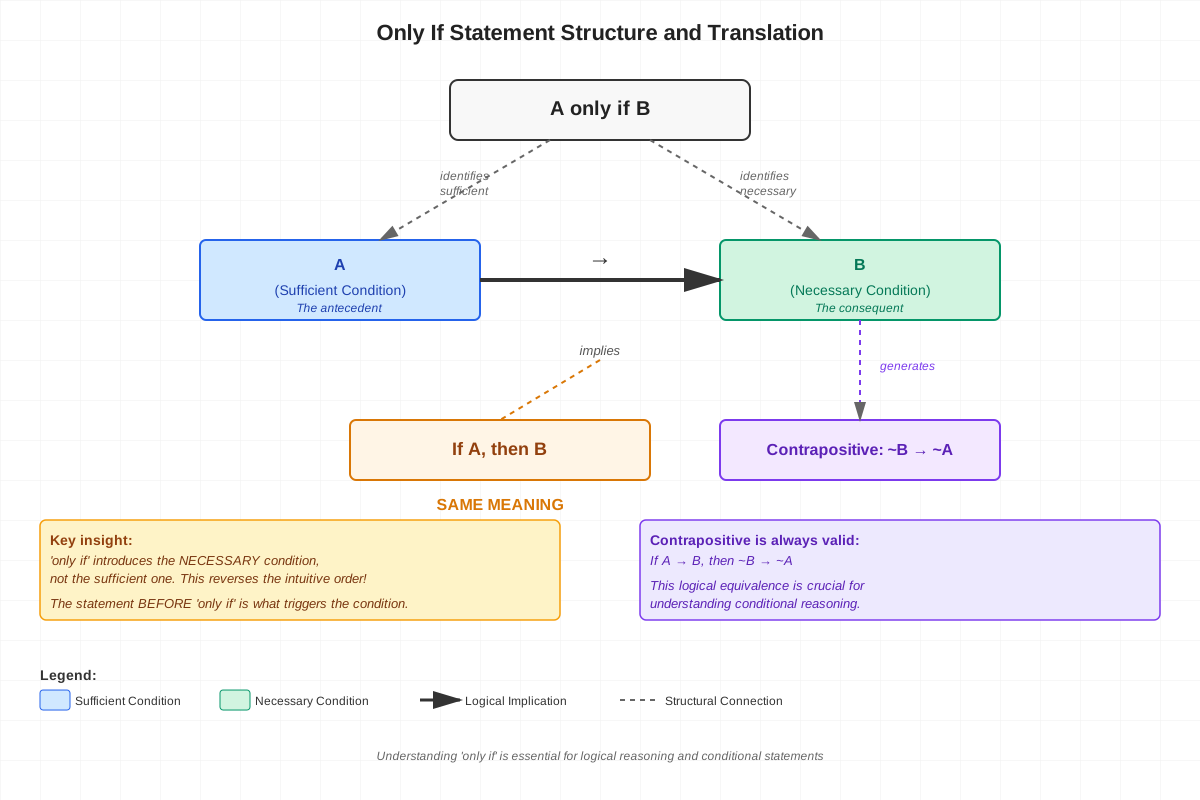
Only if statements establish a necessary condition for a sufficient condition to occur. The fundamental rule is straightforward but counterintuitive: whatever follows "only if" is the necessary condition, and whatever precedes "only if" is the sufficient condition. This can be represented as:
A only if B translates to: A → B
Where A is the sufficient condition and B is the necessary condition. This means: If A occurs, then B must occur. Alternatively stated: A cannot occur without B occurring.
Consider the statement: "You can enter the building only if you have a keycard." This translates to:
Enter Building → Have Keycard
The having of a keycard is necessary for entering the building. Without the keycard, entry is impossible. However—and this is crucial—having a keycard does not guarantee entry. There might be other requirements (proper authorization, correct time of day, etc.). The keycard is necessary but not sufficient for entry.
Why Only If Reverses Intuition
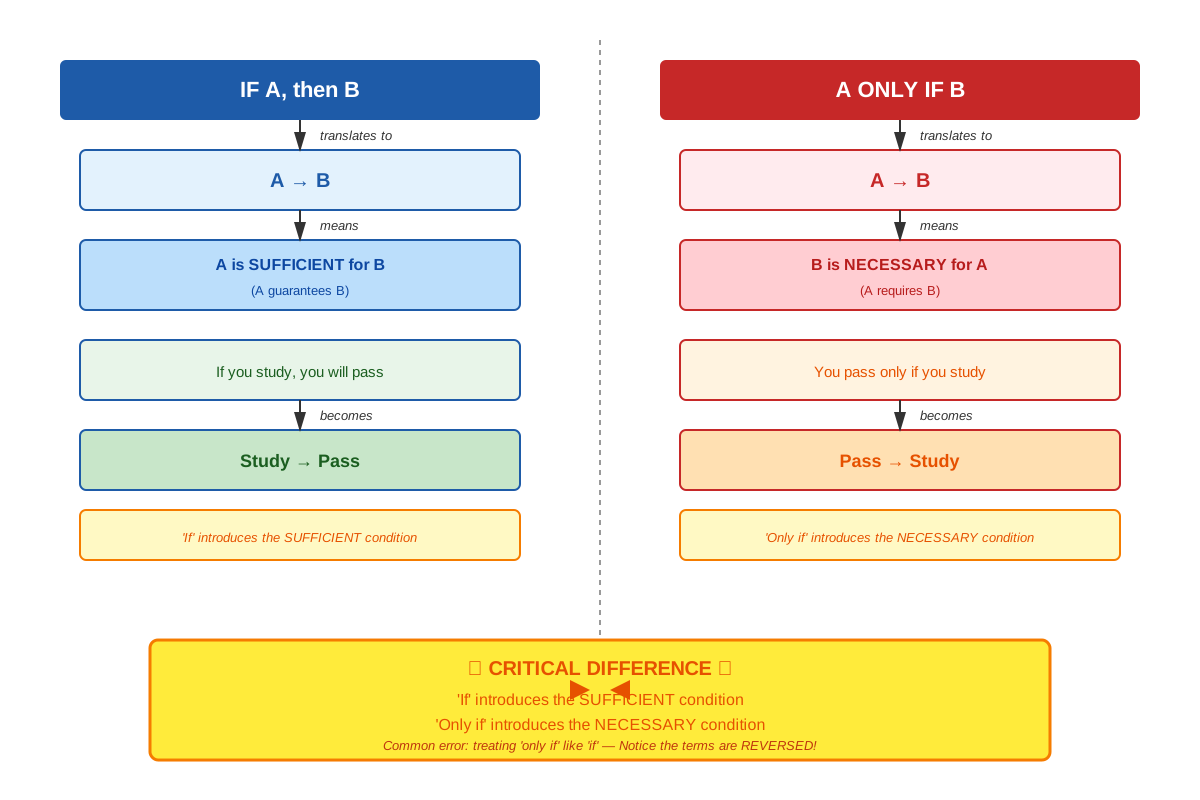
The counterintuitive nature of only if statements stems from how they differ from standard if-then constructions. Compare these two statements:
- "If you have a keycard, you can enter the building" → Keycard → Enter
- "You can enter the building only if you have a keycard" → Enter → Keycard
Notice that the logical relationship reverses completely. In statement 1, having the keycard is sufficient for entry. In statement 2, having the keycard is necessary for entry. The word "only" fundamentally changes the conditional relationship by restricting when the first condition can occur—it can occur ONLY in the presence of the second condition.
Translation Patterns and Variations
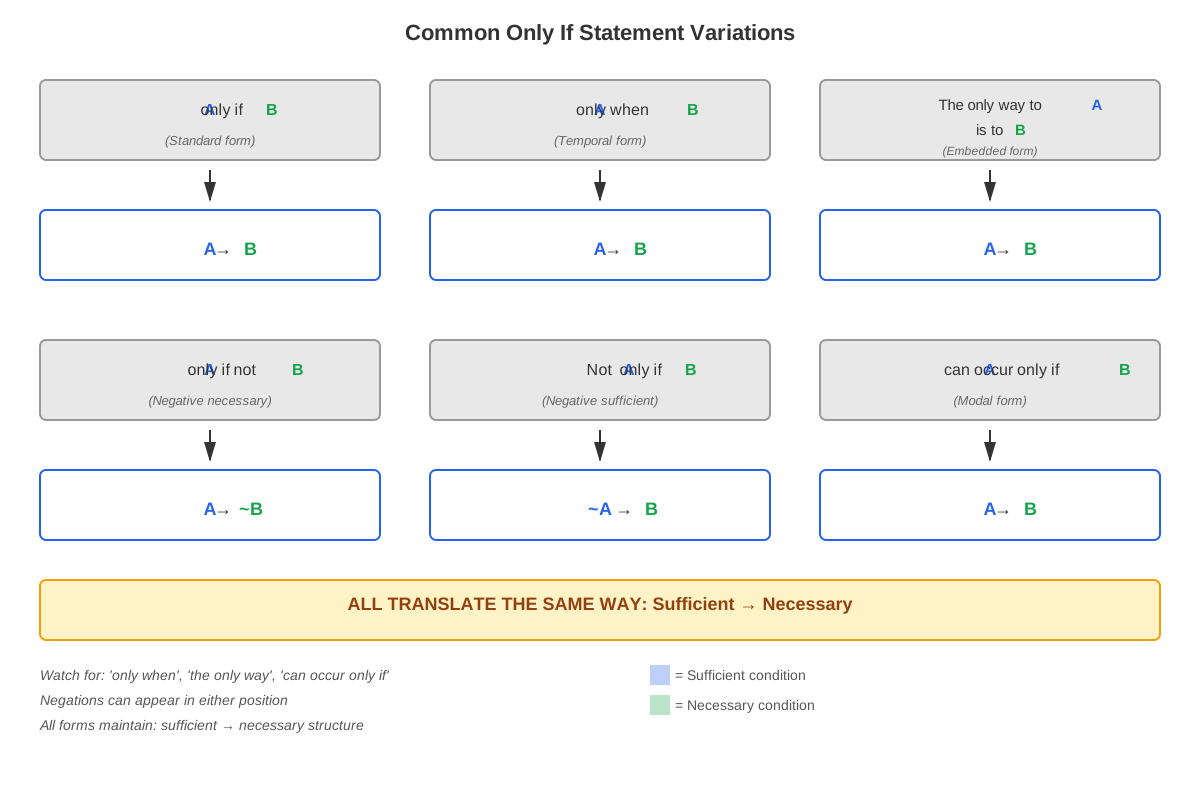
Only if statements appear in numerous linguistic variations on the LSAT, and recognizing these variations is essential for quick, accurate diagramming:
| Statement Form | Translation | Example |
|---|---|---|
| A only if B | A → B | "Graduate only if pass exam" = Graduate → Pass |
| Only if B, A | A → B | "Only if you study will you succeed" = Succeed → Study |
| A, but only if B | A → B | "You may leave, but only if finished" = Leave → Finished |
| The only way A is if B | A → B | "The only way to win is if you practice" = Win → Practice |
| A if, but only if, B | A ↔ B (biconditional) | "Hired if, but only if, qualified" = Hired ↔ Qualified |
The last pattern creates a biconditional relationship where each condition is both necessary and sufficient for the other. This is relatively rare on the LSAT but appears in particularly challenging questions.
Forming the Contrapositive
Every conditional statement has a logically equivalent contrapositive formed by negating both conditions and reversing the arrow. For only if statements:
Original: A only if B → A → B
Contrapositive: ~B → ~A
This reads: "If not B, then not A" or "Without B, you cannot have A."
Using our building example:
- Original: Enter Building → Have Keycard
- Contrapositive: No Keycard → Cannot Enter Building
The contrapositive is always valid and often appears in correct answer choices on Must Be True questions. Recognizing that the contrapositive is the only valid inference from a conditional statement is crucial for eliminating wrong answers that commit the fallacy of affirming the consequent or denying the antecedent.
Invalid Inferences from Only If Statements
Students must recognize what CANNOT be validly inferred from only if statements. Given "A only if B" (A → B), the following are INVALID:
- Affirming the consequent: B → A (Having a keycard means you can enter)
- Denying the antecedent: ~A → ~B (Not entering means no keycard)
- Reversing the arrow: B → A (Same as affirming the consequent)
These invalid inferences frequently appear as trap answers in Logical Reasoning questions. The LSAT tests whether students can distinguish between valid contrapositives and invalid reverses.
Combining Only If Statements in Conditional Chains
Only if statements often appear as links in longer conditional chains. When multiple conditionals connect, students must carefully track the direction of each arrow:
- "You can graduate only if you pass the exam"
- "You can pass the exam only if you attend class"
Translation:
- Graduate → Pass Exam
- Pass Exam → Attend Class
Combined chain: Graduate → Pass Exam → Attend Class
From this chain, we can validly infer: "You can graduate only if you attend class" (Graduate → Attend Class). We can also form the contrapositive of the entire chain: "If you don't attend class, you cannot graduate" (~Attend Class → ~Graduate).
Embedded and Complex Only If Constructions
Advanced LSAT questions embed only if statements within complex sentence structures, requiring careful parsing:
"The committee will approve the proposal only if both the budget is balanced and the timeline is realistic."
Translation: Approve → (Balanced Budget AND Realistic Timeline)
When the necessary condition includes "and," both elements must be present. The contrapositive uses "or":
Contrapositive: (~Balanced Budget OR ~Realistic Timeline) → ~Approve
This means if either the budget isn't balanced or the timeline isn't realistic (or both), the proposal won't be approved.
Concept Relationships
Only if statements exist within a hierarchical structure of conditional logic concepts. At the foundation level, understanding sufficient and necessary conditions enables proper interpretation of only if statements. Once only if statements are mastered, they connect directly to contrapositive formation—every only if statement generates a valid contrapositive that represents an equivalent logical claim.
The relationship map flows as follows:
Sufficient/Necessary Conditions → enables understanding of → Only If Statements → generates → Contrapositives → combines into → Conditional Chains → appears in → Complex Arguments
Only if statements also relate horizontally to other conditional indicators like "unless," "without," "requires," and "depends on." Each of these terms establishes necessary conditions but uses different linguistic structures. Understanding only if statements provides a template for mastering these related constructions.
Within LSAT questions, only if statements connect to assumption identification (recognizing unstated necessary conditions), flaw detection (spotting invalid inferences from conditionals), and formal logic (applying conditional rules in Logic Games). The skill of quickly translating only if statements transfers directly to these related question types, making it a foundational competency that supports performance across multiple LSAT sections.
High-Yield Facts
⭐ Only if introduces the necessary condition, not the sufficient condition: Whatever follows "only if" is what must be true, not what guarantees the outcome.
⭐ The translation of "A only if B" is always A → B: The condition before "only if" is sufficient; the condition after "only if" is necessary.
⭐ The contrapositive of an only if statement is always valid: From "A only if B" (A → B), you can always infer "not B, therefore not A" (~B → ~A).
⭐ Reversing an only if statement creates an invalid inference: From "A only if B," you cannot conclude "B only if A" or "if B, then A."
⭐ Only if statements can chain together: When multiple only if statements connect, follow the arrows to determine what can be validly inferred.
- "If and only if" creates a biconditional relationship where both conditions are necessary and sufficient for each other.
- When the necessary condition contains "and," both elements must be present; the contrapositive uses "or."
- When the necessary condition contains "or," at least one element must be present; the contrapositive uses "and."
- "The only way" and "the only condition" are synonymous with "only if" and introduce necessary conditions.
- Temporal only if statements ("only after," "only when") follow the same logical structure as standard only if statements.
- Multiple sufficient conditions can lead to the same necessary condition without creating a logical problem.
- A necessary condition can fail to occur even when the sufficient condition doesn't occur—necessary conditions are only guaranteed when the sufficient condition is present.
Quick check — test yourself on Only if statements so far.
Try Flashcards →Common Misconceptions
Misconception: "Only if" means the same thing as "if" and can be translated the same way.
Correction: "Only if" reverses the standard if-then relationship. "If A then B" translates to A → B, but "A only if B" also translates to A → B, meaning the linguistic position of the conditions reverses while the logical structure remains consistent with what comes before "only if" being sufficient.
Misconception: If "A only if B" is true, then having B means you have A.
Correction: This commits the fallacy of affirming the consequent. "A only if B" means A → B, which tells us nothing about what happens when B occurs. B is necessary for A but not sufficient for A.
Misconception: The contrapositive of "A only if B" is "B only if A."
Correction: The contrapositive of "A only if B" (A → B) is "not B, therefore not A" (~B → ~A), not a reversal of the only if statement. Reversing the only if statement creates an invalid inference.
Misconception: "Only if" and "if" can be used interchangeably in casual conversation, so they're logically equivalent.
Correction: While casual speech may blur these distinctions, the LSAT tests precise logical relationships. "Only if" establishes necessity, while "if" establishes sufficiency—these are fundamentally different logical relationships.
Misconception: When an only if statement appears in the conclusion of an argument, the correct answer must also use "only if."
Correction: The LSAT tests logical equivalence, not linguistic matching. A conclusion with "only if" can be supported by an answer choice using different conditional language (like "requires" or "depends on") as long as the logical structure matches.
Misconception: If multiple conditions follow "only if," all of them must be present (treating "or" as "and").
Correction: When "only if" is followed by conditions connected with "or," at least one must be present, not all. "A only if B or C" means A → (B or C), so having either B or C (or both) satisfies the necessary condition.
Worked Examples
Example 1: Must Be True Question
Stimulus: "A student can receive honors only if that student maintains a GPA above 3.5 and completes a senior thesis. Every student who completes a senior thesis must work with a faculty advisor."
Question: Which one of the following must be true?
Step 1 - Translate the conditionals:
- "Receive honors only if [GPA > 3.5 AND thesis]"
- Honors → (GPA > 3.5 AND Thesis)
- "Every student who completes thesis must work with advisor"
- Thesis → Advisor
Step 2 - Combine the conditional chain:
- Honors → (GPA > 3.5 AND Thesis)
- Thesis → Advisor
- Combined: Honors → GPA > 3.5 AND Thesis → Advisor
Step 3 - Identify valid inferences:
From the chain, we can validly conclude:
- If a student receives honors, that student works with a faculty advisor (Honors → Advisor)
- If a student doesn't work with a faculty advisor, that student doesn't receive honors (~Advisor → ~Honors)
- If a student's GPA is not above 3.5, that student doesn't receive honors (~GPA > 3.5 → ~Honors)
Step 4 - Evaluate answer choices:
The correct answer would be something like: "Any student who receives honors works with a faculty advisor." This follows directly from our conditional chain.
Wrong answer types to eliminate:
- "Any student who works with a faculty advisor receives honors" (reverses the arrow - invalid)
- "Any student with a GPA above 3.5 receives honors" (affirms only part of the necessary condition - invalid)
- "Any student who doesn't receive honors doesn't work with an advisor" (denies the antecedent - invalid)
Example 2: Sufficient Assumption Question
Stimulus: "The city council will approve the new park project. After all, the project has strong community support."
Question: Which one of the following, if assumed, allows the conclusion to be properly drawn?
Step 1 - Identify the logical gap:
- Premise: Strong community support
- Conclusion: Council will approve
- Gap: We need to connect community support to council approval
Step 2 - Determine what type of conditional is needed:
To make the argument valid, we need: Community Support → Council Approval
This could be expressed as an only if statement in the answer choices.
Step 3 - Evaluate answer choices:
(A) "The council will approve the project only if it has strong community support."
- Translation: Approve → Community Support
- This makes community support necessary for approval, but doesn't guarantee approval when support exists. INCORRECT - this is backwards.
(B) "The council approves projects only if they have strong community support."
- Same as (A), just rephrased. INCORRECT.
(C) "Any project with strong community support will be approved by the council."
- Translation: Community Support → Approve
- This makes community support sufficient for approval, which is exactly what we need. CORRECT.
(D) "Strong community support is necessary for council approval."
- Translation: Approve → Community Support
- This is the same as (A) and (B), just using "necessary" language instead of "only if." INCORRECT.
Key Lesson: In sufficient assumption questions, be careful to distinguish between answer choices that make the premise necessary versus sufficient. The correct answer must make the premise sufficient for the conclusion. "Only if" statements make conditions necessary, not sufficient, so they often appear as trap answers in sufficient assumption questions.
Exam Strategy
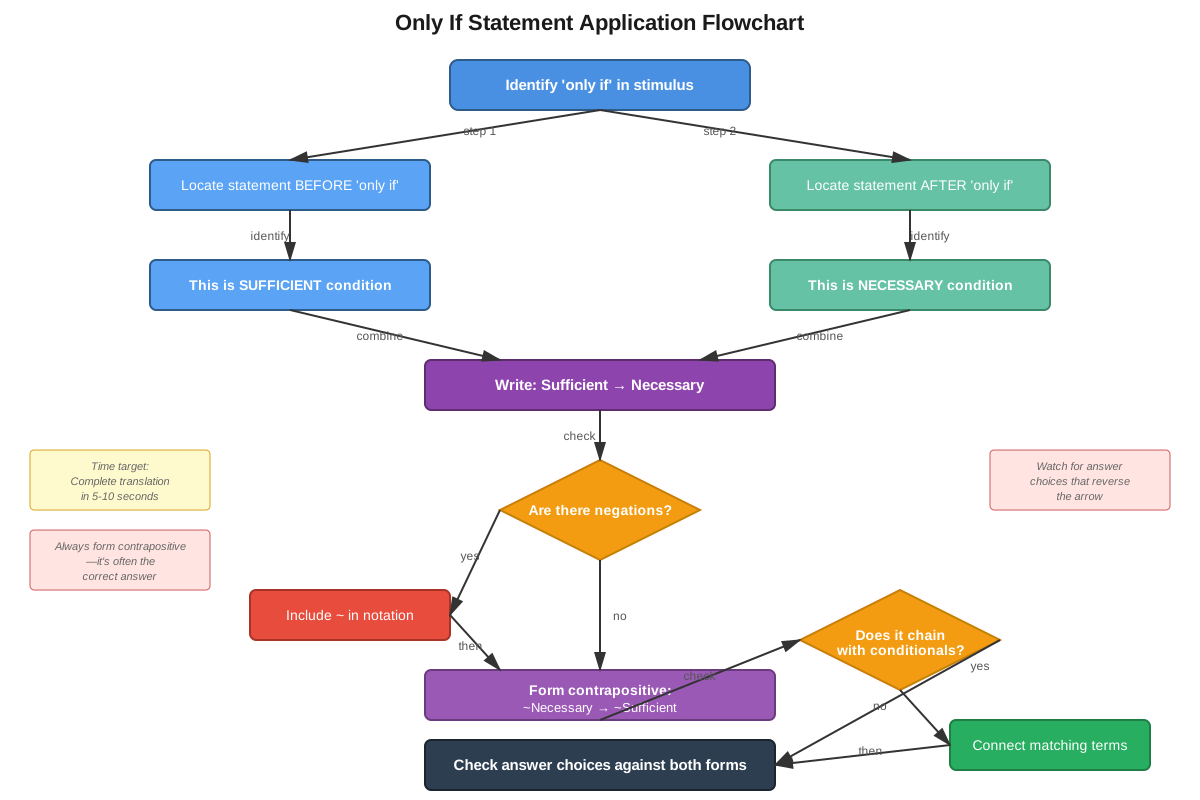
When approaching LSAT questions involving only if statements, implement this systematic process:
Step 1 - Identify the conditional indicator: Scan for "only if," "the only way," "only when," or similar phrases. Highlight or underline these immediately.
Step 2 - Translate before reading further: As soon as you spot "only if," mentally translate the statement into arrow notation. Write "A → B" in the margin if working on paper, or visualize the arrow clearly if working digitally. This prevents confusion later.
Step 3 - Form the contrapositive immediately: After translating the original statement, write or visualize the contrapositive (~B → ~A). Many correct answers are contrapositives rather than the original conditional.
Step 4 - Watch for conditional chains: If multiple only if statements appear, diagram how they connect. Look for opportunities to chain conditionals together to reach new valid inferences.
Step 5 - Eliminate invalid inferences: In Must Be True questions, aggressively eliminate answer choices that reverse the arrow, affirm the consequent, or deny the antecedent. These are the most common trap answers.
Trigger words and phrases to watch for:
- "only if" (most common)
- "only when"
- "only after"
- "the only way"
- "the only condition"
- "the only circumstance"
- "but only if"
- "if, but only if" (signals biconditional)
Time allocation advice: Spend 10-15 seconds translating and diagramming only if statements when they appear. This upfront investment saves 30-60 seconds later by preventing confusion and enabling rapid answer choice elimination. For questions with multiple conditionals, spend up to 20 seconds creating a clear diagram before evaluating answer choices.
Process of elimination tips:
- In Must Be True questions, eliminate any answer that reverses the conditional relationship
- In Sufficient Assumption questions, eliminate "only if" answers—they make conditions necessary, not sufficient
- In Necessary Assumption questions, "only if" answers are often correct because they establish required conditions
- In Flaw questions, look for answer choices describing "treating a necessary condition as sufficient" when the argument misuses an only if statement
Memory Techniques
The "ONLY Reverses" Mnemonic: Remember that "ONLY" reverses the intuitive order. When you see "only if," think "ONLY = Opposite Natural Logic Yields." This reminds you that the natural reading order reverses in the logical translation.
The Keycard Visualization: Visualize a keycard and a door. "Enter only if you have a keycard" means the keycard is necessary—you can't enter without it. But having the keycard doesn't guarantee entry (the door might be locked for other reasons). This concrete image helps cement that "only if" introduces necessary, not sufficient, conditions.
The Arrow Direction Acronym - BONS: "Before Only, iN Sufficient"
- Before "only if" = sufficient condition
- Only if introduces necessary
- iN = what comes after "only if" is Necessary
- Sufficient comes before
The Contrapositive Flip-Flop: Visualize the contrapositive as a gymnast doing a flip—everything flips and reverses. The arrow flips direction, and both conditions flip from positive to negative (or vice versa). This kinesthetic image helps remember that forming a contrapositive requires two simultaneous reversals.
The "AND/OR" Switch Rule: When forming contrapositives, remember "AND becomes OR, OR becomes AND." Visualize a light switch that toggles between AND and OR whenever you negate a compound condition. This prevents errors when dealing with complex necessary conditions.
Summary
Only if statements represent a cornerstone of conditional logic on the LSAT, establishing necessary conditions that must be satisfied for sufficient conditions to occur. The fundamental translation rule—that "A only if B" means A → B, where A is sufficient and B is necessary—reverses the intuitive reading order and creates a common trap for unprepared test-takers. Mastering only if statements requires recognizing their various linguistic forms, accurately translating them into conditional notation, forming valid contrapositives, and avoiding invalid inferences like reversing the arrow or affirming the consequent. These statements appear across multiple question types, from Must Be True to Sufficient Assumption questions, and often serve as links in longer conditional chains that require careful diagramming. Success with only if statements depends on immediate recognition, systematic translation, and disciplined application of valid inference rules. Students who internalize the counterintuitive structure of only if statements and practice rapid translation gain a significant advantage on the LSAT, as these constructions appear in the most challenging questions that separate top scorers from the rest of the field.
Key Takeaways
- Only if always introduces the necessary condition: Whatever follows "only if" is what must be true, and whatever precedes "only if" is sufficient for that necessary condition.
- Translation is non-negotiable: "A only if B" translates to A → B, where the arrow points from the sufficient condition (A) to the necessary condition (B).
- The contrapositive is the only valid inference: From A → B, you can only conclude ~B → ~A; reversing the arrow or affirming the consequent creates invalid inferences.
- Only if statements chain together: Multiple conditionals can connect to create longer chains, enabling inferences that span multiple logical steps.
- Distinguish only if from if: "If" introduces sufficient conditions, while "only if" introduces necessary conditions—these are fundamentally different logical relationships.
- Watch for compound necessary conditions: When "only if" is followed by "and," both elements must be present; when followed by "or," at least one must be present.
- Speed comes from systematic translation: Invest 10-15 seconds upfront to diagram only if statements accurately, saving time and preventing errors when evaluating answer choices.
Related Topics
Unless Statements: These conditional indicators also establish necessary conditions but use different linguistic structures. Mastering only if statements provides a foundation for understanding how "unless" creates conditional relationships.
Sufficient vs. Necessary Conditions: A deeper exploration of the distinction between what guarantees an outcome versus what is required for an outcome enhances understanding of why only if statements function as they do.
Conditional Chains and Transitive Properties: Building on only if statements, this topic explores how multiple conditionals connect and what can be validly inferred from extended logical chains.
Formal Logic in Logic Games: The conditional reasoning skills developed through only if statements transfer directly to Logic Games, where rules often establish necessary and sufficient conditions for game piece placement.
Biconditional Statements: Understanding "if and only if" constructions builds on only if statements by creating relationships where conditions are both necessary and sufficient for each other.
Practice CTA
Now that you've mastered the core concepts of only if statements, it's time to cement your understanding through active practice. Work through the practice questions and flashcards designed specifically for this topic, focusing on rapid translation and accurate inference formation. Each practice problem you complete strengthens your ability to recognize and correctly interpret only if statements under timed conditions. Remember: the difference between understanding only if statements conceptually and applying them flawlessly under pressure comes down to deliberate practice. Challenge yourself to translate every only if statement you encounter in under 5 seconds, and you'll build the automaticity needed for LSAT success. Your investment in mastering this high-yield topic will pay dividends across multiple question types and significantly boost your Logical Reasoning score.
Sign up free to keep reading
Create a free AnvayaPrep account to finish this LSAT guide on Only if statements — plus flashcards and practice questions.