Overview
The answering yes no test is a powerful analytical tool used in LSAT Logical Reasoning questions, particularly within the "Evaluate and Complete the Argument" question family. This technique helps test-takers identify which piece of information would most strengthen, weaken, or complete an argument by determining whether different answers to a proposed question would have opposite effects on the argument's validity. When a question asks "Which of the following would be most useful to know in evaluating the argument?" or similar phrasings, the answering yes no test provides a systematic method for selecting the correct answer.
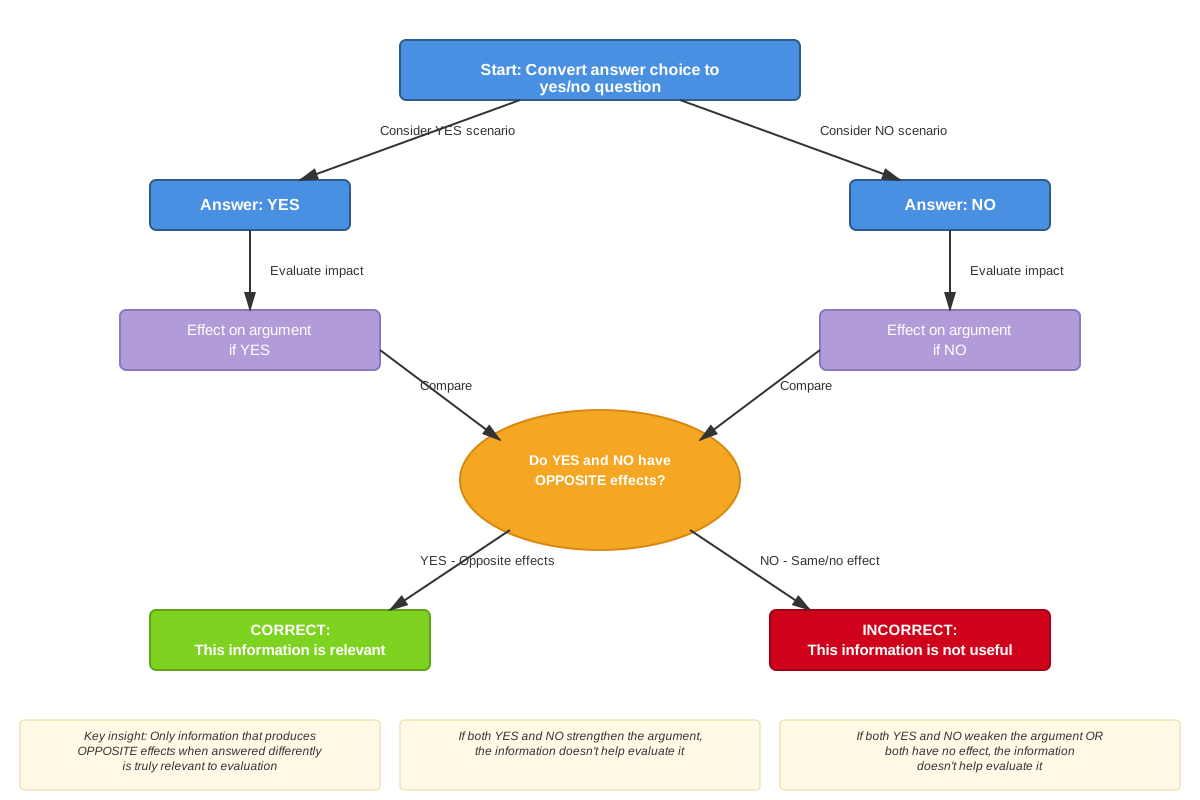
Understanding this test is essential because it transforms what might seem like subjective evaluation into an objective, mechanical process. The core principle is straightforward: if answering "yes" to a question strengthens an argument while answering "no" weakens it (or vice versa), then that question addresses information that is genuinely relevant to evaluating the argument's soundness. Conversely, if both "yes" and "no" answers have the same effect—or no effect at all—on the argument, then that information is not useful for evaluation purposes. This distinction is precisely what the LSAT tests, as it measures a student's ability to identify which additional information would actually matter in assessing logical validity.
The lsat answering yes no test connects to broader Logical Reasoning skills including assumption identification, argument structure analysis, and gap recognition. When students master this technique, they develop a more sophisticated understanding of how arguments depend on unstated premises and how additional information can expose or fill logical gaps. This topic serves as a bridge between basic argument analysis and advanced critical reasoning, making it a high-value skill for achieving competitive LSAT scores.
Learning Objectives
- [ ] Identify how Answering yes no test appears in LSAT questions
- [ ] Explain the reasoning pattern behind Answering yes no test
- [ ] Apply Answering yes no test to solve LSAT-style problems accurately
- [ ] Distinguish between information that is relevant versus irrelevant to argument evaluation
- [ ] Predict how different answers to evaluation questions would affect argument strength
- [ ] Recognize the connection between the answering yes no test and identifying unstated assumptions
- [ ] Execute the test efficiently under timed conditions to maximize accuracy
Prerequisites
- Basic argument structure: Understanding premises, conclusions, and how they connect is necessary because the answering yes no test evaluates the relationship between evidence and claims.
- Assumption identification: Recognizing what an argument takes for granted enables students to see which additional information would matter most.
- Strengthen and weaken question types: Familiarity with how information can support or undermine arguments provides the foundation for understanding why opposite answers produce opposite effects.
- Conditional reasoning fundamentals: Many arguments that require evaluation involve conditional relationships, and understanding these helps predict how new information affects validity.
Why This Topic Matters
The answering yes no test represents a critical thinking skill that extends far beyond standardized testing. In legal practice, attorneys constantly evaluate which facts would be most relevant to establishing or refuting a case. In business, executives must determine which data points would most significantly impact strategic decisions. In scientific research, investigators identify which variables would most meaningfully test hypotheses. The LSAT tests this skill because it directly correlates with the analytical reasoning required for law school success and legal practice.
On the LSAT itself, evaluation questions appear with significant frequency—typically 2-4 questions per Logical Reasoning section, which translates to approximately 8-16% of all Logical Reasoning questions. These questions carry the same weight as any other question type, making them high-value targets for score improvement. Students who master the answering yes no test often see immediate score gains because this technique provides a clear, systematic approach to questions that otherwise might seem ambiguous or subjective.
Common question stems that signal the need for this test include: "Which of the following would be most useful to know in order to evaluate the argument?", "The answer to which of the following questions would be most helpful in assessing the argument?", "Which of the following would it be most important to determine in evaluating the conclusion?", and variations on these phrasings. Additionally, some "complete the argument" questions benefit from this approach when the completion must address a critical gap that could go either way depending on additional information.
Core Concepts
The Fundamental Mechanism
The answering yes no test operates on a simple but powerful principle: relevant information for evaluating an argument must have the potential to affect the argument's strength in different directions depending on what that information reveals. When applying this test, students mentally answer a proposed question with both "yes" and "no" (or with opposite factual scenarios), then assess whether these different answers would push the argument in opposite directions.
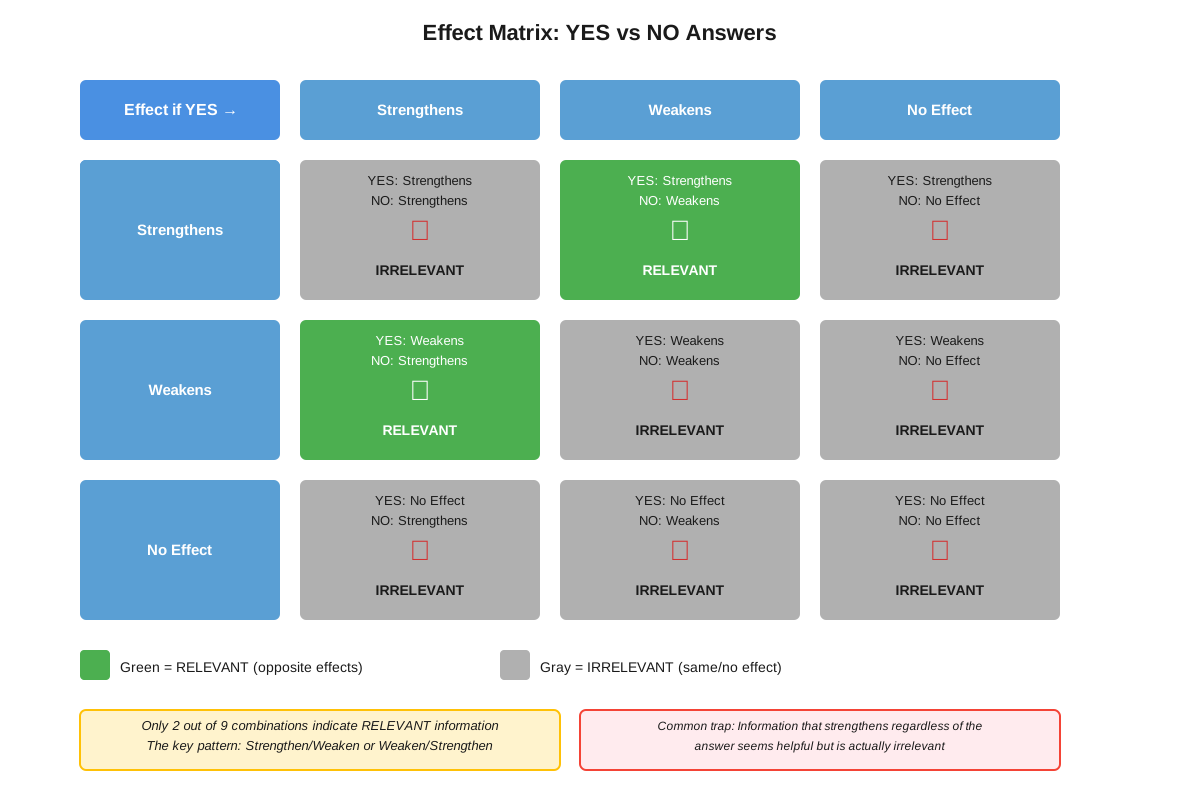
The test works because truly relevant evaluation information creates a fork in the logical road. If knowing X is true would strengthen the argument, but knowing X is false would weaken it, then X represents information that genuinely matters to the argument's validity. This bidirectional impact distinguishes relevant from irrelevant information. Information that strengthens the argument regardless of whether it's true or false, or that has no impact either way, fails the test and should be eliminated as an answer choice.
The Three-Step Application Process
- Identify the argument's conclusion and reasoning structure: Before applying the test, clearly understand what the argument claims and why. Locate the main conclusion, identify the premises offered in support, and recognize any logical gaps or assumptions.
- For each answer choice, formulate both possible answers: Take the question or scenario presented in the answer choice and consider what would happen if the answer were "yes" versus "no" (or if one scenario were true versus another). Be specific about what each answer would mean.
- Evaluate the directional impact: Determine whether the "yes" and "no" answers (or alternative scenarios) would have opposite effects on the argument's strength. If one strengthens while the other weakens, the information passes the test. If both have the same effect or no effect, eliminate that choice.
Recognizing Relevant Versus Irrelevant Information
| Information Type | Effect on Argument | Test Result | Action |
|---|---|---|---|
| Bidirectional impact | Yes strengthens, No weakens (or vice versa) | Passes test | Strong candidate for correct answer |
| Unidirectional impact | Both Yes and No strengthen (or both weaken) | Fails test | Eliminate |
| No impact | Neither Yes nor No affects argument | Fails test | Eliminate |
| Tangential information | Relates to topic but not to logical connection | Fails test | Eliminate |
The Connection to Assumptions
The answering yes no test is intimately connected to assumption identification because the information that most affects an argument's evaluation typically relates to its unstated assumptions. When an argument assumes X is true, knowing whether X is actually true or false becomes highly relevant to evaluating the argument. The test essentially asks: "What assumption, if confirmed or denied, would most significantly impact our assessment of this argument?"
For example, if an argument concludes that a new policy will save money based on evidence about reduced staffing costs, it likely assumes that other costs won't increase to offset the savings. A question asking "Will the new policy increase other operational expenses?" would pass the answering yes no test because a "yes" answer weakens the argument while a "no" answer strengthens it.
Common Argument Structures That Require Evaluation
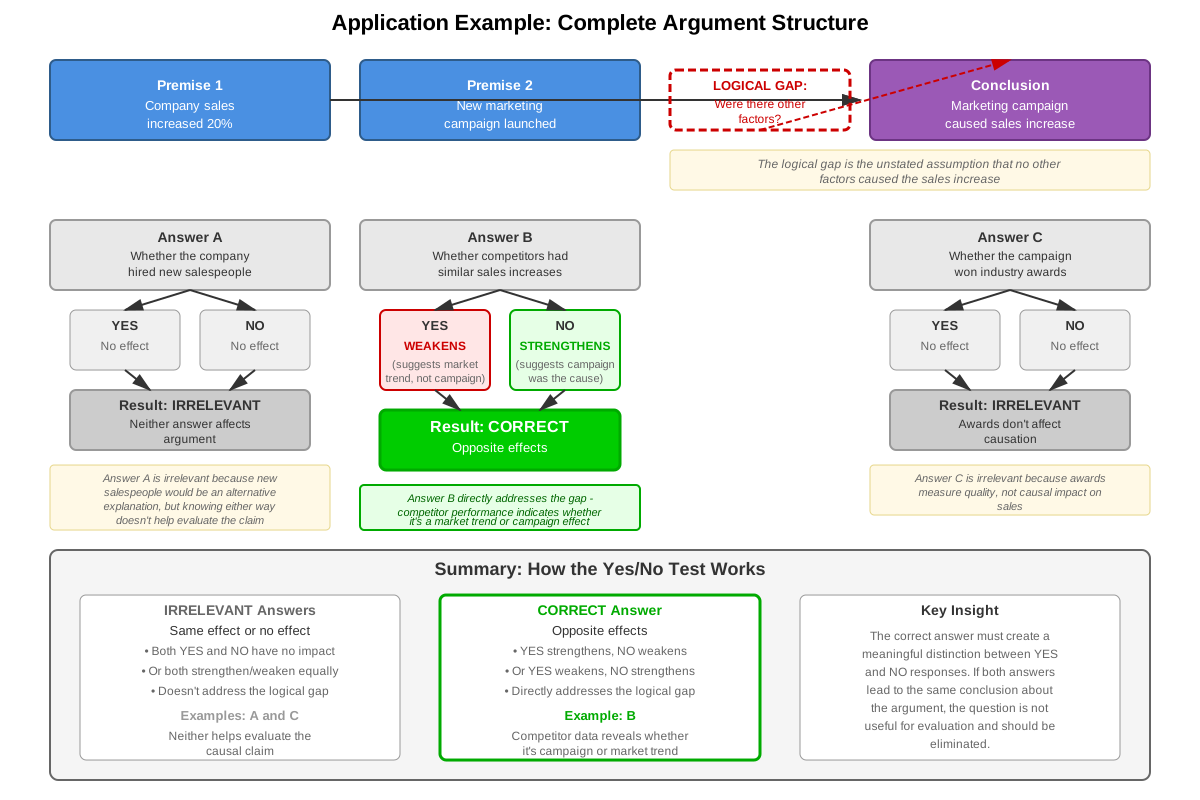
Causal arguments frequently appear in evaluation questions. These arguments claim that X causes Y based on correlation or limited evidence. The answering yes no test helps identify whether information about alternative causes, temporal relationships, or mechanism would be relevant. For instance, if an argument claims that a new teaching method caused improved test scores, asking "Were there other changes in the school during this period?" passes the test because different answers have opposite implications.
Comparative arguments also commonly require evaluation. When an argument claims that option A is better than option B based on certain criteria, information about whether those criteria are actually the most important, or whether other factors favor B, becomes relevant through the answering yes no test.
Predictive arguments that forecast future outcomes based on past patterns benefit from evaluation questions about whether conditions remain similar, whether the sample is representative, or whether intervening factors might alter the pattern.
Distinguishing Degrees of Relevance
Not all information that passes the answering yes no test is equally relevant. The LSAT often includes multiple answer choices that would have some impact on the argument, requiring students to identify which would be most useful or most important to know. The correct answer typically addresses the argument's central assumption or most significant logical gap, while incorrect answers might address peripheral issues or minor considerations.
When comparing answer choices that both pass the test, consider: (1) Which addresses the core logical connection between premises and conclusion? (2) Which would have the greatest magnitude of impact on the argument's strength? (3) Which relates most directly to the argument's explicit reasoning rather than tangential issues?
Concept Relationships
The answering yes no test serves as a practical application tool that synthesizes multiple foundational Logical Reasoning concepts. It begins with argument structure analysis → which enables assumption identification → which reveals logical gaps → which the answering yes no test then evaluates for relevance. This progression shows how the test doesn't exist in isolation but rather represents the culmination of several analytical skills.
The test also connects bidirectionally with strengthen and weaken questions. Understanding how information can strengthen or weaken arguments provides the conceptual foundation for the answering yes no test, while mastering the test enhances the ability to predict how different facts would affect argument strength. This relationship means that practice with one question type improves performance on the other.
Within the broader "Evaluate and Complete the Argument" unit, the answering yes no test specifically addresses evaluation questions, while related techniques handle completion questions. However, the underlying skill—identifying what information would most significantly impact an argument—applies across both question types. The test represents the evaluation-specific application of the general principle that good arguments depend on the truth of their assumptions and the validity of their logical connections.
High-Yield Facts
⭐ The answering yes no test requires that opposite answers produce opposite effects on the argument's strength—if both "yes" and "no" strengthen (or both weaken), the information is not useful for evaluation.
⭐ The correct answer to evaluation questions typically addresses the argument's central unstated assumption rather than peripheral details.
⭐ Information can be factually related to an argument's topic but still fail the answering yes no test if it doesn't affect the logical connection between premises and conclusion.
⭐ When multiple answer choices pass the test, select the one that addresses the most significant logical gap or has the greatest potential impact on argument validity.
⭐ The test works for both explicit questions ("Would X be true?") and implicit scenarios ("If X were the case...")—the key is considering opposite possibilities.
- Evaluation questions typically use stems containing "useful to know," "helpful in assessing," or "important to determine."
- The answering yes no test is most efficient when applied after eliminating obviously irrelevant answer choices through quick topic screening.
- Information about the argument's scope, representativeness of evidence, or alternative explanations frequently passes the test.
- Background information that's true regardless of the argument's validity typically fails the test.
- The test applies to both formal logical arguments and informal reasoning about practical matters.
- Correct answers often involve questions about whether a key term means the same thing in premises and conclusion, or whether conditions remain constant across compared situations.
Quick check — test yourself on Answering yes no test so far.
Try Flashcards →Common Misconceptions
Misconception: Any information related to the argument's topic is relevant for evaluation. → Correction: Information must specifically affect the logical connection between premises and conclusion to be relevant. Topic relatedness is necessary but not sufficient—the information must have the potential to strengthen or weaken the argument depending on what it reveals.
Misconception: If answering "yes" to a question strengthens the argument, that question must be the right answer. → Correction: The question must pass the full test—answering "no" should weaken the argument (or vice versa). If both answers have the same directional effect, the information doesn't help evaluate the argument because it doesn't distinguish between scenarios where the argument is strong versus weak.
Misconception: The answering yes no test only works with questions that can be answered with literal "yes" or "no." → Correction: The test applies to any information that has two opposite possibilities, even if phrased as scenarios, quantities, or conditions. For example, "Is the rate higher or lower?" or "Did X happen before or after Y?" can be evaluated using the same principle of opposite impacts.
Misconception: Information that reveals an assumption must be the correct answer. → Correction: While correct answers often relate to assumptions, not every assumption is equally important. The LSAT tests the ability to identify which assumption, if confirmed or denied, would most significantly impact the argument's evaluation. Minor or tangential assumptions may be less relevant than central ones.
Misconception: Applying the answering yes no test takes too much time under test conditions. → Correction: With practice, the test becomes a rapid mental process taking 5-10 seconds per answer choice. The time investment prevents the greater time loss of re-reading questions multiple times or second-guessing answers, and it dramatically improves accuracy.
Misconception: If an answer choice introduces new information not mentioned in the argument, it can't be correct. → Correction: Evaluation questions specifically test the ability to identify what additional information would be useful. The correct answer will almost always introduce something not explicitly stated in the stimulus—that's the point of evaluation questions.
Worked Examples
Example 1: Causal Argument Evaluation
Stimulus: "City officials report that traffic accidents at the intersection of Main and Oak Streets decreased by 40% after a new traffic light was installed. Therefore, the new traffic light has made the intersection safer."
Question: Which of the following would be most useful to know in evaluating the argument?
Answer Choices:
(A) Whether traffic volume at the intersection decreased during the same period
(B) Whether the traffic light was expensive to install
(C) Whether other intersections in the city also have traffic lights
(D) Whether drivers generally approve of the new traffic light
(E) Whether the intersection is in a residential or commercial area
Application of the Answering Yes No Test:
(A) Whether traffic volume at the intersection decreased during the same period
- If YES (volume decreased): This would weaken the argument because fewer cars naturally means fewer accidents, suggesting the light might not be the cause of improved safety.
- If NO (volume stayed the same or increased): This would strengthen the argument because the accident reduction occurred despite similar or greater traffic, supporting the light as the cause.
- Result: Opposite effects—PASSES the test. This is highly relevant.
(B) Whether the traffic light was expensive to install
- If YES (expensive): This doesn't affect whether the light made the intersection safer—it only affects cost-benefit analysis.
- If NO (inexpensive): Same result—doesn't affect the safety claim.
- Result: No impact on argument strength—FAILS the test.
(C) Whether other intersections in the city also have traffic lights
- If YES: Doesn't tell us whether this particular light caused this particular safety improvement.
- If NO: Still doesn't affect the causal claim about this intersection.
- Result: No impact—FAILS the test.
(D) Whether drivers generally approve of the new traffic light
- If YES: Driver approval doesn't determine actual safety improvement.
- If NO: Disapproval doesn't mean the light didn't improve safety.
- Result: No impact on the safety claim—FAILS the test.
(E) Whether the intersection is in a residential or commercial area
- If residential: Doesn't affect whether the light caused the accident reduction.
- If commercial: Same—location type doesn't address the causal relationship.
- Result: No impact—FAILS the test.
Correct Answer: (A) because it's the only choice that passes the answering yes no test with opposite directional impacts on the argument's strength. It addresses the key assumption that other factors didn't cause the accident reduction.
Example 2: Comparative Argument Evaluation
Stimulus: "Employees at companies that allow flexible work schedules report higher job satisfaction than employees at companies with fixed schedules. Therefore, implementing flexible schedules will increase job satisfaction at any company."
Question: The answer to which of the following questions would be most helpful in assessing the argument's conclusion?
Answer Choices:
(A) Do employees at companies with flexible schedules earn higher salaries?
(B) Are companies that offer flexible schedules generally larger or smaller than those that don't?
(C) Do companies that attract employees who value flexibility tend to offer flexible schedules?
(D) Are flexible schedules becoming more common in the industry?
(E) Do employees understand what flexible schedules entail?
Application of the Answering Yes No Test:
(A) Do employees at companies with flexible schedules earn higher salaries?
- If YES: Higher salaries might explain satisfaction, but the argument is about whether implementing flexibility will increase satisfaction, not about what currently explains it.
- If NO: Doesn't strengthen the causal claim that flexibility itself will increase satisfaction.
- Result: Weak impact—this addresses correlation but not the predictive claim. Borderline.
(B) Are companies that offer flexible schedules generally larger or smaller than those that don't?
- If larger: Company size doesn't address whether flexibility causes satisfaction.
- If smaller: Same—doesn't affect the causal relationship.
- Result: No impact—FAILS the test.
(C) Do companies that attract employees who value flexibility tend to offer flexible schedules?
- If YES: This would significantly weaken the argument because it suggests self-selection—people who value flexibility choose those companies, so the satisfaction might not be caused by the flexibility itself. Implementing flexibility at a company with different employees might not have the same effect.
- If NO: This would strengthen the argument because it suggests the flexibility itself causes satisfaction rather than pre-existing employee preferences.
- Result: Strong opposite effects—PASSES the test powerfully. This addresses the key assumption about causation versus self-selection.
(D) Are flexible schedules becoming more common in the industry?
- If YES: Popularity doesn't determine effectiveness.
- If NO: Rarity doesn't determine effectiveness either.
- Result: No impact on whether flexibility causes satisfaction—FAILS the test.
(E) Do employees understand what flexible schedules entail?
- If YES: Understanding doesn't tell us whether implementation will increase satisfaction.
- If NO: Lack of understanding doesn't address the causal claim.
- Result: No impact—FAILS the test.
Correct Answer: (C) because it addresses the critical distinction between correlation and causation through the self-selection alternative explanation. This represents the argument's central vulnerability and passes the answering yes no test with the strongest opposite directional impacts.
Exam Strategy
When approaching evaluation questions on the LSAT, begin by investing 15-20 seconds in thoroughly understanding the argument's structure before looking at answer choices. Identify the conclusion, note the evidence provided, and mentally flag any logical gaps or assumptions. This upfront investment prevents the need to repeatedly return to the stimulus while evaluating answer choices.
Trigger words and phrases that signal evaluation questions include: "useful to know," "helpful in assessing," "important to determine," "relevant to evaluating," "most strengthen the evaluation," and "would most aid in judging." When these phrases appear, immediately prepare to apply the answering yes no test systematically to each answer choice.
For process of elimination, first screen out answer choices that are clearly off-topic or that address issues unrelated to the logical connection between premises and conclusion. This quick first pass often eliminates 2-3 choices immediately. Then apply the answering yes no test to remaining choices, mentally articulating both possible answers and their effects. If an answer choice seems confusing, rephrase it in your own words before testing it.
Time allocation for evaluation questions should be approximately 1:15 to 1:30 per question. Spend 15-20 seconds understanding the argument, 10-15 seconds per answer choice applying the test (50-75 seconds total for five choices), and 10-15 seconds confirming your selection. If you find yourself spending more than 90 seconds, make your best judgment and move on—these questions test analytical skill, not the ability to overthink.
When comparing answer choices that both seem to pass the test, apply these tiebreakers: (1) Which addresses the argument's explicit reasoning rather than tangential issues? (2) Which would have greater magnitude of impact? (3) Which relates to the core assumption rather than a secondary one? The LSAT rewards identifying the most significant piece of evaluative information, not just any relevant information.
Exam Tip: If you're unsure whether an answer choice passes the test, try to articulate specific scenarios for both "yes" and "no" answers, then describe in concrete terms how each would affect the argument. This forces precision and often clarifies whether the impacts are truly opposite.
Memory Techniques
Mnemonic for the test itself: "OPPOSITE"
- Opposite answers
- Produce
- Polarized effects
- On argument strength—
- Strengthening or weakening
- In
- Two different directions
- Evaluates relevance
Visualization strategy: Picture the argument as a bridge spanning a gap between premises and conclusion. Information that passes the answering yes no test is like a structural engineer's report that could either confirm the bridge is safe (strengthening) or reveal it's unstable (weakening). Information that fails the test is like knowing the bridge's color—related to the bridge but irrelevant to its structural integrity.
Acronym for common relevant information types: "SCARE"
- Scope (Does the evidence actually cover what the conclusion claims?)
- Causation (Is the claimed cause really responsible, or are there alternatives?)
- Assumptions (Are the unstated premises actually true?)
- Representativeness (Is the sample or example typical?)
- Equivocation (Do key terms mean the same thing throughout?)
Summary
The answering yes no test is a systematic method for identifying which information would be most useful in evaluating an argument on the LSAT. By determining whether opposite answers to a proposed question would have opposite effects on an argument's strength, test-takers can objectively distinguish relevant from irrelevant information. This technique directly addresses the core skill tested in evaluation questions: recognizing which additional facts would most significantly impact the assessment of an argument's validity. The test works because truly relevant information creates a fork in logical assessment—one answer strengthens the argument while the opposite weakens it. Information that has the same effect regardless of what it reveals, or no effect at all, fails the test and should be eliminated. Mastering this approach requires understanding argument structure, identifying assumptions, and predicting how different facts would affect logical connections. The test applies most powerfully to arguments involving causation, comparison, prediction, and scope issues, where unstated assumptions create vulnerabilities that additional information could expose or confirm.
Key Takeaways
- The answering yes no test identifies relevant evaluation information by checking whether opposite answers produce opposite effects on argument strength
- Information passes the test only when one answer strengthens while the opposite weakens (or vice versa)—same-direction or no-impact information fails
- The correct answer typically addresses the argument's central assumption or most significant logical gap, not peripheral details
- Apply the test systematically to each answer choice by mentally formulating both possible answers and assessing their directional impact
- Topic relatedness is necessary but insufficient—information must affect the logical connection between premises and conclusion to be relevant
- The test synthesizes multiple Logical Reasoning skills including argument analysis, assumption identification, and understanding of strengthen/weaken dynamics
- With practice, the test becomes a rapid mental process that significantly improves both accuracy and confidence on evaluation questions
Related Topics
Assumption Questions: Understanding how to identify unstated premises that arguments depend upon directly enhances the ability to apply the answering yes no test, since relevant evaluation information typically relates to key assumptions. Mastering the answering yes no test conversely improves assumption identification skills.
Strengthen and Weaken Questions: These question types share the underlying concept of how additional information affects argument validity. The answering yes no test essentially combines strengthen and weaken analysis by requiring recognition of bidirectional impact.
Flaw Questions: Recognizing common logical flaws helps predict what information would be most relevant for evaluation, since evaluation questions often test whether a potential flaw actually undermines the argument.
Sufficient Assumption Questions: These questions require identifying what information, if true, would guarantee the conclusion follows from the premises. This relates to evaluation questions by highlighting what logical gaps need to be addressed.
Parallel Reasoning: Understanding argument structure at a deep level—necessary for parallel reasoning questions—enhances the ability to quickly identify what information would affect an argument's evaluation.
Practice CTA
Now that you understand the answering yes no test and how to apply it systematically, it's time to reinforce these skills through deliberate practice. Attempt the practice questions associated with this topic, applying the three-step process to each answer choice and articulating why correct answers pass the test while incorrect answers fail. Use the flashcards to drill recognition of evaluation question stems and common argument structures that require this technique. Remember that this skill becomes faster and more intuitive with repetition—each practice question strengthens your ability to rapidly distinguish relevant from irrelevant information. Your investment in mastering this high-yield technique will pay dividends across multiple questions on test day, making it one of the most efficient uses of your study time.
Sign up free to keep reading
Create a free AnvayaPrep account to finish this LSAT guide on Answering yes no test — plus flashcards and practice questions.