Overview
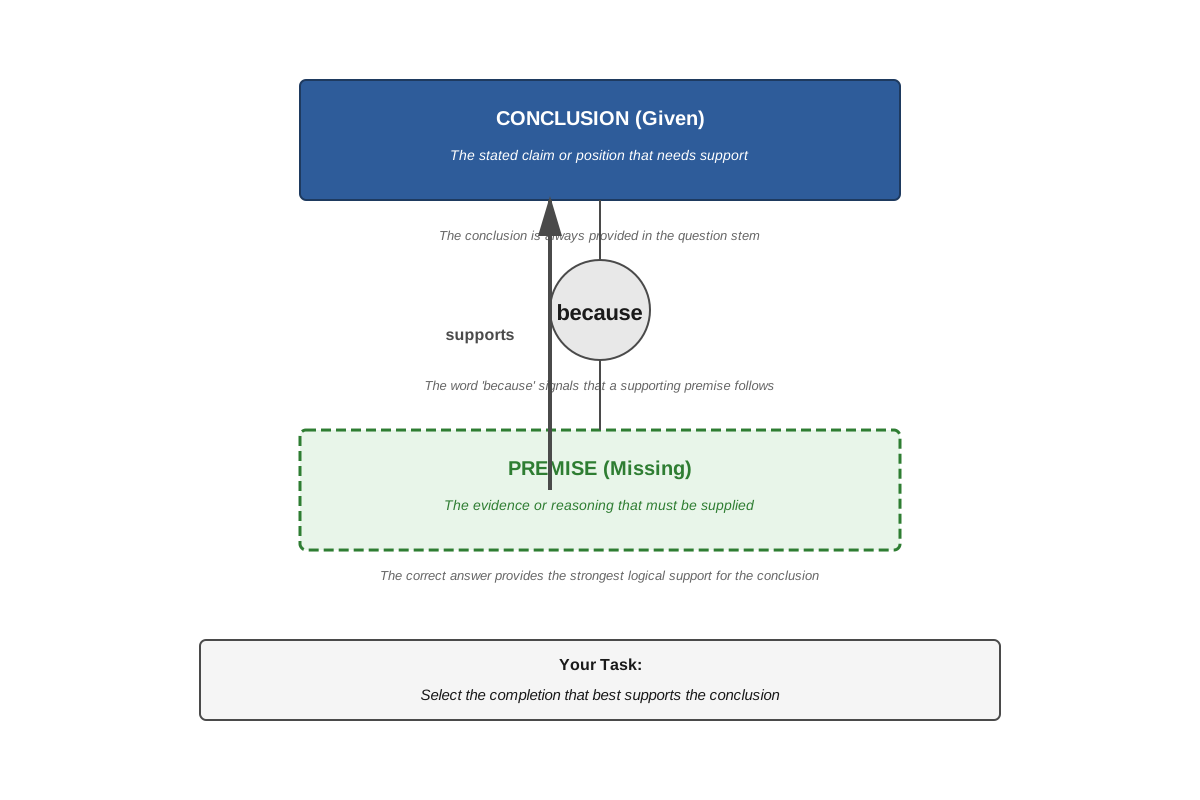
Completion with because questions represent a distinctive and frequently tested question type within LSAT Logical Reasoning sections. These questions present an incomplete argument that ends with the word "because," requiring test-takers to select the answer choice that best completes the reasoning by providing an appropriate premise or justification. Unlike other completion questions that might ask for conclusions or intermediate steps, completion with because questions specifically test the ability to identify what evidence or reasoning would best support a stated conclusion.
This question type is essential for LSAT success because it directly assesses a fundamental skill in legal reasoning: understanding the relationship between conclusions and their supporting premises. In legal practice, attorneys must constantly construct and evaluate arguments by identifying what evidence or reasoning justifies particular conclusions. The LSAT tests this skill by presenting arguments where the conclusion is stated but the supporting reason is missing, challenging test-takers to recognize what type of premise would create a logically sound argument structure.
Within the broader landscape of Logical Reasoning questions, completion with because questions bridge several critical skills. They require understanding argument structure (identifying conclusions versus premises), recognizing logical relationships (what types of evidence support what types of claims), and evaluating argument strength (determining which completion creates the most compelling reasoning). These questions connect closely to assumption questions, strengthen/weaken questions, and other tasks within the evaluate and complete the argument family, making them a high-yield topic that reinforces multiple testing domains simultaneously.
Learning Objectives
- [ ] Identify how Completion with because appears in LSAT questions
- [ ] Explain the reasoning pattern behind Completion with because
- [ ] Apply Completion with because to solve LSAT-style problems accurately
- [ ] Distinguish between relevant and irrelevant premise completions for a given conclusion
- [ ] Evaluate the logical strength of different "because" clause completions
- [ ] Recognize common trap answers in completion with because questions
- [ ] Connect completion with because skills to other argument evaluation question types
Prerequisites
- Basic argument structure: Understanding the distinction between premises (evidence) and conclusions (claims supported by evidence) is essential because completion with because questions require identifying what premise would support a given conclusion
- Conditional reasoning fundamentals: Recognizing if-then relationships helps because many completion with because questions involve conditional logic where the completion must establish a necessary connection
- Causal reasoning basics: Understanding cause-and-effect relationships is relevant because many "because" completions establish causal connections between phenomena
- Reading comprehension skills: The ability to parse complex sentences and identify the main point is necessary because these questions often embed the conclusion within sophisticated sentence structures
Why This Topic Matters
In legal reasoning and practice, the ability to construct well-supported arguments is paramount. Attorneys must constantly justify their positions by providing appropriate evidence and reasoning—exactly the skill tested by completion with because questions. When a lawyer argues "The defendant should be found liable because..." or "This statute should be interpreted to mean X because...", they must provide compelling reasons that logically support their conclusions. The LSAT tests this foundational legal skill through completion with because questions.
On the LSAT, completion with because questions appear with moderate to high frequency, typically comprising 2-4 questions per test across both Logical Reasoning sections. These questions fall within the broader "Complete the Argument" question family, which collectively represents approximately 5-8% of all Logical Reasoning questions. However, their importance exceeds their frequency because mastering the skills they test—understanding premise-conclusion relationships and evaluating logical support—directly improves performance on numerous other question types including Assumption, Strengthen, Weaken, and Justify questions.
These questions commonly appear in several formats: arguments about policy recommendations ("The city should implement policy X because..."), causal explanations ("Phenomenon Y occurred because..."), predictions ("Event Z will likely happen because..."), and evaluative judgments ("Action A was inappropriate because..."). The LSAT frequently embeds these questions within contexts involving scientific studies, business decisions, political debates, and everyday reasoning scenarios, requiring test-takers to apply logical principles across diverse content domains.
Core Concepts
The Structure of Completion with Because Questions
Completion with because questions present an argument that contains a clearly stated conclusion followed by the word "because" and then a blank or incomplete statement. The question stem typically asks which answer choice "most logically completes the argument" or provides similar language indicating that test-takers must select the best premise to support the stated conclusion.
The fundamental structure follows this pattern:
- Context or background information (optional)
- Conclusion statement
- The word "because" followed by an incomplete thought
- Question stem asking for the best completion
For example: "The company should expand into international markets because _____." The conclusion ("should expand into international markets") is stated, and test-takers must identify what premise would best justify this conclusion.
The Logical Relationship: Premise to Conclusion
Understanding the logical reasoning behind these questions requires recognizing that premises must provide relevant support for conclusions. The completion must establish a connection that makes the conclusion more reasonable or justified. This connection can take several forms:
Direct evidential support: The premise provides factual information that directly supports the conclusion. For instance, if the conclusion is "The medication is effective," a strong completion might be "clinical trials showed significant improvement in 85% of patients."
Causal reasoning: The premise establishes a cause-and-effect relationship that explains why the conclusion follows. If the conclusion is "Sales will increase next quarter," a completion might be "the company is launching a major advertising campaign that has historically boosted sales by 30%."
Comparative reasoning: The premise draws a comparison that supports the conclusion. For a conclusion like "Option A is preferable to Option B," a completion might be "Option A achieves the same results at half the cost."
Principle application: The premise states a general principle or rule that, when applied to the specific situation, supports the conclusion. For a conclusion like "The policy should be changed," a completion might be "any policy that fails to achieve its stated objectives should be revised."
Evaluating Completion Strength
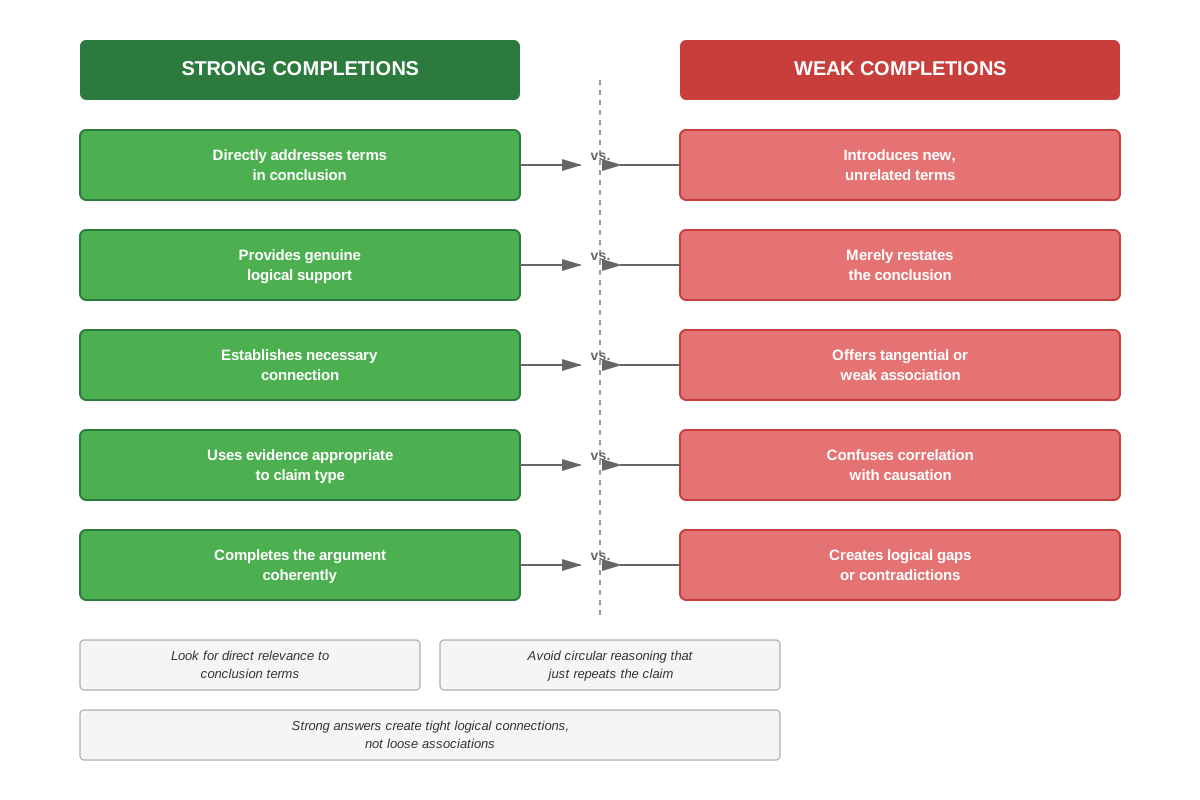
Not all completions that relate to the conclusion are equally strong. The best completion creates the most direct, relevant, and sufficient support for the conclusion. When evaluating and completing the argument, consider these criteria:
| Criterion | Strong Completion | Weak Completion |
|---|---|---|
| Relevance | Directly addresses the specific conclusion | Relates to the topic but not the specific claim |
| Sufficiency | Provides adequate reason to accept the conclusion | Offers minimal or insufficient support |
| Directness | Creates clear logical connection | Requires multiple inferential leaps |
| Specificity | Matches the scope and specificity of the conclusion | Too broad or too narrow for the conclusion |
Common Reasoning Patterns
Several reasoning patterns appear frequently in LSAT completion with because questions:
Necessity-based reasoning: The completion establishes that something is necessary, making the conclusion follow. Pattern: "Action X should be taken because it is necessary to achieve goal Y."
Sufficiency-based reasoning: The completion shows that certain conditions are sufficient to justify the conclusion. Pattern: "Outcome X will occur because conditions sufficient for X are present."
Elimination reasoning: The completion eliminates alternatives, making the conclusion the best remaining option. Pattern: "Option X is best because all other options have been ruled out or are inferior."
Precedent-based reasoning: The completion cites past examples or patterns that support the conclusion. Pattern: "Event X will occur because similar circumstances have consistently produced X in the past."
Cost-benefit reasoning: The completion establishes that benefits outweigh costs or vice versa. Pattern: "Action X should be taken because its benefits substantially exceed its costs."
Identifying the Conclusion
A critical skill in completion with because questions is correctly identifying what the conclusion actually claims. The conclusion appears before the word "because," but it may be embedded within complex sentence structures. Look for:
- Recommendation indicators: "should," "ought to," "must," "needs to"
- Prediction indicators: "will," "is likely to," "probably"
- Evaluative indicators: "is better," "is preferable," "is more effective"
- Causal claim indicators: "causes," "results in," "leads to"
The conclusion's scope, strength, and specific claim determine what type of premise would appropriately support it. A strong, definitive conclusion ("X definitely will occur") requires stronger evidential support than a qualified conclusion ("X might occur").
Matching Premise to Conclusion Type
Different types of conclusions require different types of supporting premises:
Prescriptive conclusions (what should be done) require premises about goals, values, effectiveness, or necessity. If the conclusion recommends an action, the premise should explain why that action would achieve desired outcomes or align with important principles.
Predictive conclusions (what will happen) require premises about causal mechanisms, patterns, or sufficient conditions. If the conclusion predicts an outcome, the premise should establish why those conditions lead to that outcome.
Evaluative conclusions (comparative judgments) require premises about criteria and how options measure against those criteria. If the conclusion claims one option is better, the premise should establish relevant standards and show how the options compare.
Explanatory conclusions (why something occurred) require premises about causal factors or mechanisms. If the conclusion explains a phenomenon, the premise should identify what brought it about.
Concept Relationships
The concepts within completion with because questions form an interconnected logical framework. Argument structure recognition serves as the foundation → enabling conclusion identification → which determines premise type requirements → guiding completion evaluation → leading to answer selection.
This topic connects directly to prerequisite knowledge of basic argument structure, as understanding premises and conclusions is essential for recognizing what type of premise would complete an argument. The skills developed here extend to related topics including Assumption questions (identifying unstated premises), Strengthen questions (adding premises that support conclusions), and Justify questions (finding premises that make conclusions follow logically).
Completion with because questions also relate to conditional reasoning because many completions establish conditional relationships ("because if X then Y, and X is true"). They connect to causal reasoning when completions establish cause-and-effect relationships. Understanding these connections allows test-takers to apply multiple logical reasoning frameworks simultaneously, improving both speed and accuracy.
The relationship between conclusion type and appropriate premise type represents a crucial internal connection. Recognizing whether a conclusion is prescriptive, predictive, evaluative, or explanatory immediately constrains what types of completions could work, allowing efficient elimination of irrelevant answer choices.
High-Yield Facts
⭐ The completion must directly support the specific conclusion stated, not merely relate to the general topic
⭐ The word "because" signals a premise-conclusion relationship where the completion provides the reason for the conclusion
⭐ Strong completions match the scope and strength of the conclusion—neither too broad nor too narrow, neither too strong nor too weak
⭐ The conclusion always appears before the word "because" in these questions
⭐ Trap answers often provide relevant information that doesn't actually support the specific conclusion
- Completion with because questions test the ability to identify appropriate premises for stated conclusions
- The best completion creates the most direct logical connection between evidence and claim
- Different conclusion types (prescriptive, predictive, evaluative, explanatory) require different premise types
- Eliminating answer choices that are irrelevant to the specific conclusion is often the fastest path to the correct answer
- The completion should not introduce new terms or concepts that aren't connected to the conclusion
- Causal completions are common when conclusions involve predictions or explanations
- Comparative completions are common when conclusions involve evaluative judgments
- The completion must be sufficient to make the conclusion reasonable, not merely provide weak support
- Reading the argument with each answer choice inserted helps evaluate logical flow
- The correct completion often addresses potential objections or alternative explanations
Quick check — test yourself on Completion with because so far.
Try Flashcards →Common Misconceptions
Misconception: Any answer choice that is true and relates to the topic is a good completion → Correction: The completion must specifically support the stated conclusion, not merely be relevant to the general subject matter. A true statement about the topic that doesn't support the conclusion is incorrect.
Misconception: The longest or most detailed answer choice is usually correct → Correction: Length and detail don't determine correctness. The best completion is the one that most directly and efficiently supports the conclusion, which may be stated concisely.
Misconception: The completion should introduce new information or perspectives → Correction: While the completion adds information, it should connect directly to concepts already present in the argument. Completions that introduce entirely new considerations often fail to support the specific conclusion.
Misconception: If the completion makes sense on its own, it's correct → Correction: The completion must make sense specifically as support for the given conclusion. An independently sensible statement may not provide appropriate support for the particular claim being made.
Misconception: Emotional or strongly worded completions are more persuasive → Correction: The LSAT tests logical support, not rhetorical persuasion. The best completion provides logical reasons, not emotional appeals or extreme language.
Misconception: The completion should restate the conclusion in different words → Correction: Restating the conclusion is circular reasoning and provides no actual support. The completion must offer new information that serves as evidence or reasoning for the conclusion.
Misconception: All answer choices that could support the conclusion are equally good → Correction: Even among answer choices that provide some support, one will create the strongest, most direct logical connection. The LSAT asks for the best completion, not merely an acceptable one.
Worked Examples
Example 1: Policy Recommendation
Argument: "The city council should approve the new public transportation initiative because _____."
Answer Choices:
A) public transportation is used in many major cities
B) the initiative would reduce traffic congestion by 30% while costing less than road expansion
C) some council members support the initiative
D) transportation is an important issue for residents
E) the initiative was proposed by the mayor
Analysis:
First, identify the conclusion: "The city council should approve the new public transportation initiative." This is a prescriptive conclusion recommending a specific action.
For a prescriptive conclusion, we need a premise that explains why taking this action would be beneficial, necessary, or preferable to alternatives. The completion should address outcomes, effectiveness, or comparative advantages.
Evaluating each choice:
Choice A states that public transportation exists elsewhere. This is relevant to the topic but doesn't explain why this city should approve this specific initiative. It provides no information about benefits or necessity. Eliminate.
Choice B provides concrete benefits (reducing congestion by 30%) and establishes comparative advantage (costs less than the alternative of road expansion). This directly supports why the council should approve the initiative by showing it achieves desirable outcomes efficiently. Strong candidate.
Choice C mentions political support but doesn't explain why the initiative merits approval based on its qualities or effects. Political support doesn't constitute a logical reason for approval. Eliminate.
Choice D states that transportation is important but doesn't explain why this particular initiative should be approved. Importance of the general topic doesn't support the specific action. Eliminate.
Choice E identifies who proposed the initiative but doesn't provide reasoning about why it should be approved. The source of a proposal doesn't determine its merit. Eliminate.
Correct Answer: B
This completion creates a strong logical connection by providing specific benefits (reduced congestion) and establishing that the initiative is cost-effective compared to alternatives. It directly answers why the council should approve the initiative.
Example 2: Causal Explanation
Argument: "The company's profits increased significantly in the third quarter because _____."
Answer Choices:
A) profits are important to shareholders
B) the company had experienced losses in previous quarters
C) the company launched a successful new product line that captured 15% market share
D) many companies saw profit increases in the third quarter
E) the CEO predicted profit increases at the beginning of the year
Analysis:
The conclusion is explanatory: "The company's profits increased significantly in the third quarter." The completion must explain what caused this increase.
For an explanatory conclusion about a specific outcome, we need a premise that identifies a causal factor—something that brought about the profit increase.
Evaluating each choice:
Choice A states that profits matter to shareholders. This is true but doesn't explain what caused the increase. It addresses why profits are important, not why they increased. Eliminate.
Choice B mentions previous losses but doesn't explain what caused the third quarter increase. Past performance doesn't cause future results without a connecting mechanism. Eliminate.
Choice C identifies a specific action (launching a new product line) and its result (capturing market share). This provides a clear causal mechanism: new products generating sales would directly cause profit increases. Strong candidate.
Choice D notes that other companies also saw increases. This might suggest an industry trend but doesn't explain what specifically caused this company's increase. It's descriptive rather than explanatory. Eliminate.
Choice E mentions a prediction but predictions don't cause outcomes. The CEO's forecast doesn't explain what actually drove the profit increase. Eliminate.
Correct Answer: C
This completion provides a causal explanation by identifying a specific action (product launch) and its direct effect (market share capture), which logically explains increased profits. It establishes the mechanism by which the outcome occurred.
Exam Strategy
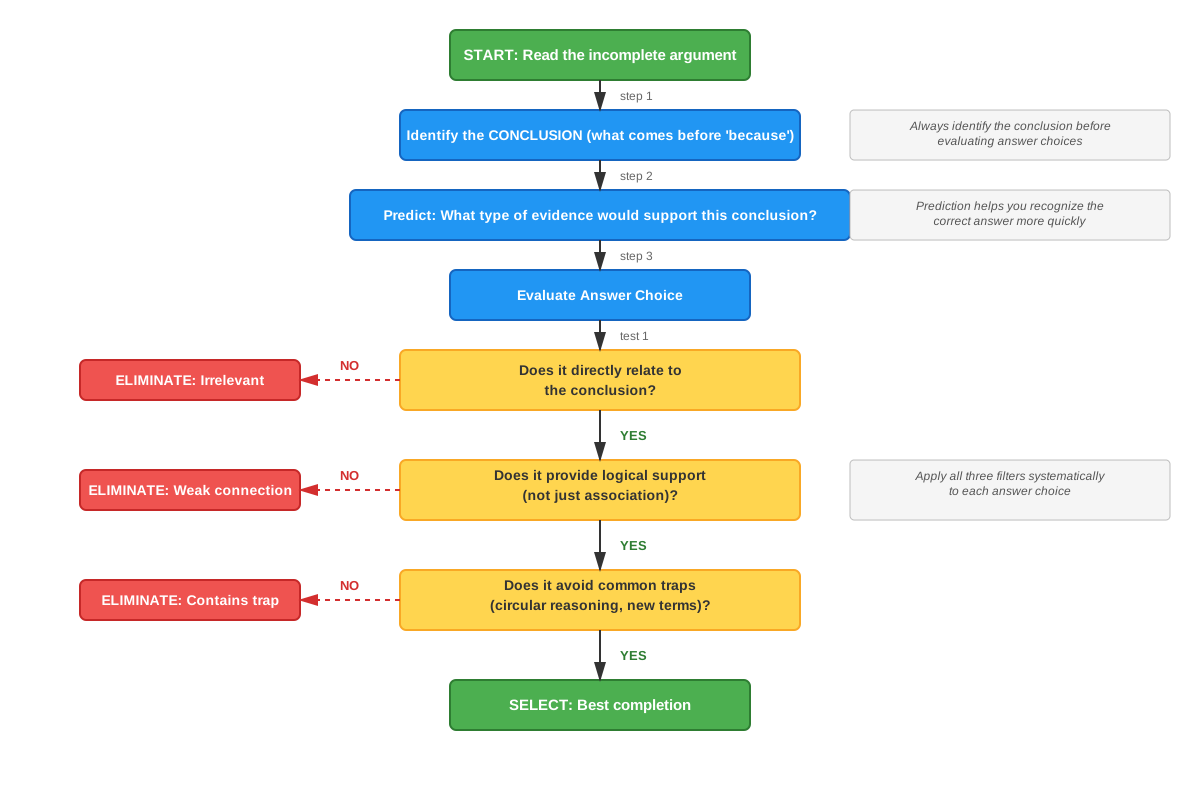
When approaching completion with because questions on the LSAT, follow this systematic process:
Step 1: Identify and analyze the conclusion (15-20 seconds)
Read carefully to determine exactly what claim appears before "because." Note whether it's prescriptive (recommending action), predictive (forecasting outcomes), evaluative (making judgments), or explanatory (identifying causes). The conclusion type determines what kind of premise you need.
Step 2: Anticipate the completion type (10 seconds)
Before reading answer choices, briefly consider what type of information would support this conclusion. For recommendations, think about benefits or necessity. For predictions, think about causal factors or patterns. For evaluations, think about criteria and comparisons. For explanations, think about causal mechanisms.
Step 3: Eliminate clearly irrelevant choices (20-30 seconds)
Quickly scan answer choices and eliminate any that don't relate specifically to the conclusion. Watch for choices that discuss the general topic but don't support the specific claim, or that provide information about different aspects of the situation.
Step 4: Evaluate remaining choices for logical strength (30-40 seconds)
For choices that seem relevant, mentally insert each into the argument and assess whether it creates a strong logical connection. The correct answer will make the conclusion follow most directly and compellingly.
Exam Tip: Trigger words to watch for include "should," "will," "because," "since," "is better than," and "explains why." These signal the logical relationship being tested.
Time allocation: Spend approximately 1:15-1:30 on completion with because questions. They typically require less time than complex inference questions but more than straightforward identification questions.
Process of elimination tips specific to this question type:
- Eliminate answer choices that merely restate the conclusion or provide circular reasoning
- Eliminate choices that introduce completely new concepts unconnected to the argument
- Eliminate choices that provide weak or tangential support when stronger, more direct support is available
- Eliminate choices that mismatch the conclusion's scope (too broad or too narrow)
- Eliminate choices that provide the wrong type of support (e.g., descriptive information when causal explanation is needed)
Common trap patterns to avoid:
- The "true but irrelevant" trap: Answer choices that state accurate information about the topic but don't support the specific conclusion
- The "reversal" trap: Answer choices that would be good conclusions based on the given information, but don't serve as premises for the stated conclusion
- The "scope mismatch" trap: Answer choices that address a broader or narrower claim than the actual conclusion
- The "wrong relationship" trap: Answer choices that establish a relationship between concepts but not the relationship needed to support the conclusion
Memory Techniques
BECAUSE Acronym for evaluating completions:
- Builds on the conclusion (doesn't introduce unrelated concepts)
- Establishes logical connection (creates clear support)
- Connects directly (minimal inferential leaps required)
- Addresses the specific claim (not just the general topic)
- Uses appropriate reasoning type (causal, comparative, evidential, etc.)
- Sufficient support (makes conclusion reasonable)
- Eliminates circularity (doesn't just restate the conclusion)
Visualization strategy: Picture the argument as a bridge. The conclusion is the destination on one side, and the completion is the supporting structure that allows you to reach it. A strong completion creates a direct, sturdy bridge. Weak completions create indirect paths, shaky structures, or bridges to the wrong destination.
The "Why Test": When evaluating a completion, ask "Does this answer WHY the conclusion should be accepted?" If you can't clearly explain how the completion supports the conclusion, it's likely incorrect.
Conclusion Type Mnemonic - PREP:
- Prescriptive conclusions need premises about benefits, effectiveness, or necessity
- Retrodictive/explanatory conclusions need premises about causes or mechanisms
- Evaluative conclusions need premises about criteria and comparisons
- Predictive conclusions need premises about patterns, conditions, or causal factors
Summary
Completion with because questions test a fundamental logical reasoning skill: identifying appropriate premises that support stated conclusions. These questions present arguments where the conclusion is explicit but the supporting reason is incomplete, requiring test-takers to select the answer choice that best completes the logical relationship. Success requires accurately identifying the conclusion, understanding what type of premise would support that specific conclusion type, and evaluating answer choices for relevance, sufficiency, and directness of support. The key distinction is between answer choices that merely relate to the topic and those that specifically support the stated conclusion. Strong completions create clear logical connections, match the scope and strength of the conclusion, and provide the appropriate type of reasoning (causal, comparative, evidential, or principle-based) for the conclusion type. Mastering this question type reinforces essential skills for numerous other Logical Reasoning question types and reflects the core legal reasoning ability to construct well-supported arguments.
Key Takeaways
- Completion with because questions require identifying premises that support stated conclusions, not merely information related to the topic
- The conclusion always appears before "because" and determines what type of premise completion is needed
- Strong completions create direct, relevant, and sufficient support for the specific conclusion stated
- Different conclusion types (prescriptive, predictive, evaluative, explanatory) require different premise types
- The most common trap answers provide true or relevant information that doesn't actually support the specific conclusion
- Systematic evaluation—identifying the conclusion, anticipating completion type, eliminating irrelevant choices, and comparing logical strength—leads to accurate answers
- Skills developed for completion with because questions transfer directly to assumption, strengthen, weaken, and justify questions
Related Topics
Assumption Questions: These questions ask test-takers to identify unstated premises that arguments depend on. Mastering completion with because questions builds the skill of recognizing what premises support conclusions, which directly applies to identifying necessary assumptions.
Strengthen and Weaken Questions: These question types require adding information that increases or decreases argument strength. Understanding what types of premises support different conclusions (learned through completion with because questions) is essential for these tasks.
Justify Questions: Also called "sufficient assumption" questions, these ask for premises that would make conclusions follow logically. The skills of matching premise types to conclusion types developed in completion with because questions apply directly to justify questions.
Argument Structure Questions: These questions test the ability to identify the roles different statements play in arguments. Understanding premise-conclusion relationships through completion with because questions strengthens this analytical skill.
Practice CTA
Now that you've mastered the core concepts of completion with because questions, it's time to apply these skills to actual LSAT-style problems. The practice questions and flashcards will reinforce your understanding of how to identify conclusions, evaluate completion strength, and avoid common traps. Remember that these questions test a fundamental legal reasoning skill—constructing well-supported arguments—that appears throughout the LSAT and in legal practice. Each practice question you complete strengthens your ability to recognize logical relationships and evaluate argument quality. Approach the practice materials systematically, applying the strategies and frameworks you've learned, and you'll see consistent improvement in both accuracy and speed.
Sign up free to keep reading
Create a free AnvayaPrep account to finish this LSAT guide on Completion with because — plus flashcards and practice questions.