Overview
Argument structure questions represent a critical category within the LSAT's Logical Reasoning sections, falling under the broader umbrella of method, role, and structure questions. These questions test a student's ability to analyze how an argument is constructed rather than evaluating whether the argument is valid or sound. Unlike assumption or strengthen/weaken questions that focus on content, argument structure questions require examinees to step back and describe the argumentative technique, the function of specific statements, or the overall organizational pattern the author employs. Mastering this question type is essential because it appears with high frequency on every LSAT administration and demands a unique analytical skill set that differs from content-based reasoning.
The fundamental challenge of LSAT argument structure questions lies in their meta-cognitive nature: students must think about thinking, analyzing not what the argument says but how it says it. This requires recognizing common argumentative moves such as presenting a counterexample, offering an analogy, citing authority, eliminating alternatives, or providing supporting evidence for an intermediate conclusion. The LSAT tests whether examinees can identify these structural elements and describe them accurately using the precise language that appears in answer choices. This skill directly translates to legal reasoning, where attorneys must understand not just the substance of arguments but their logical architecture.
Within the broader landscape of logical reasoning, argument structure questions serve as a bridge between basic comprehension and advanced critical reasoning. They require solid understanding of argument components (premises, conclusions, evidence) while also demanding recognition of rhetorical strategies and logical relationships. Success with these questions builds the foundation for tackling more complex question types and develops the analytical precision that characterizes high-scoring LSAT performance.
Learning Objectives
- [ ] Identify how argument structure questions appear in LSAT questions by recognizing characteristic question stems and formats
- [ ] Explain the reasoning pattern behind argument structure questions by describing common argumentative techniques and organizational strategies
- [ ] Apply argument structure questions to solve LSAT-style problems accurately by matching argument components to their structural descriptions
- [ ] Distinguish between the three subtypes of structure questions: method of reasoning, role of a statement, and overall argument structure
- [ ] Analyze complex arguments to identify multiple structural layers including main conclusions, subsidiary conclusions, and supporting evidence
- [ ] Evaluate answer choices by eliminating options that mischaracterize the argument's logical architecture or confuse content with structure
Prerequisites
- Basic argument anatomy: Understanding premises, conclusions, and evidence is essential because structure questions require identifying these components before analyzing their relationships
- Indicator words and phrases: Recognizing conclusion indicators ("therefore," "thus") and premise indicators ("because," "since") enables quick identification of argument components
- Logical relationships: Familiarity with support, opposition, and causal relationships provides the foundation for understanding how argument parts connect
- Reading comprehension fundamentals: The ability to parse complex sentences and identify main ideas ensures accurate understanding before structural analysis begins
Why This Topic Matters
Argument structure questions appear in approximately 15-20% of all Logical Reasoning questions on the LSAT, making them one of the most frequently tested question types. Each LSAT typically contains 4-6 of these questions across its two Logical Reasoning sections, and they consistently appear at various difficulty levels throughout each section. This high frequency means that mastering argument structure questions can directly impact overall LSAT scores, particularly for students aiming for scores above the 160 threshold.
Beyond test performance, the analytical skills developed through argument structure questions have profound real-world applications. Legal professionals constantly analyze how arguments are constructed in briefs, opinions, and oral arguments. Understanding whether an attorney is arguing by analogy, citing precedent, eliminating alternatives, or attacking a counterargument is crucial for effective legal analysis. Judges must recognize argumentative strategies to evaluate their persuasiveness and logical validity. These same skills transfer to business negotiations, policy analysis, and any field requiring critical evaluation of complex reasoning.
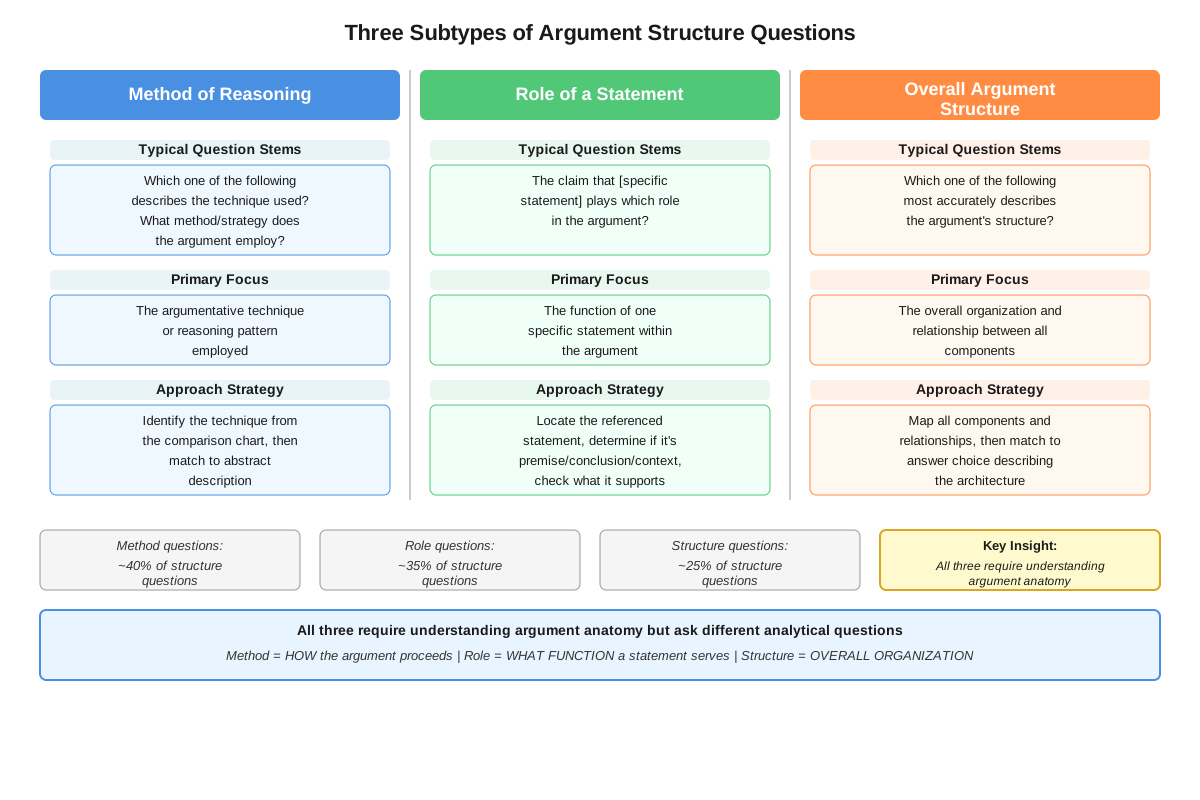
On the LSAT, argument structure questions typically appear in three distinct formats: method of reasoning questions that ask how an argument proceeds or what technique it employs; role of a statement questions that ask what function a specific claim serves within the argument; and argument structure questions that ask about the overall organization or relationship between components. Each format requires slightly different analytical approaches, but all demand the ability to abstract from content to form, describing the logical architecture rather than evaluating the argument's merits.
Core Concepts
Understanding Argument Structure Questions
Argument structure questions ask examinees to describe how an argument is organized, what technique it employs, or what role a particular statement plays within the argumentative framework. These questions focus exclusively on form rather than content—the "how" rather than the "what" or "whether." The LSAT tests this skill because legal reasoning requires constant awareness of argumentative strategies and the ability to articulate precisely how reasoning unfolds.
The key distinguishing feature of structure questions is their meta-analytical nature. While strengthen/weaken questions ask "does this affect the argument?" and assumption questions ask "what must be true?", structure questions ask "what is the argument doing?" This shift from content to form requires a different cognitive approach: students must mentally step outside the argument and observe its construction as if examining a blueprint rather than evaluating a building's quality.
Recognizing Question Stems
LSAT argument structure questions can be identified through characteristic question stems that explicitly ask about argumentative technique, organization, or function. Common phrasings include:
- "The argument proceeds by..."
- "The method of reasoning employed is..."
- "Which one of the following describes the technique of reasoning used?"
- "The claim that [specific statement] plays which role in the argument?"
- "The argument does which of the following?"
- "The argument employs which of the following argumentative strategies?"
- "In the argument, the portion in boldface plays which role?"
These stems signal that answer choices will describe structural features using abstract language rather than addressing the argument's content or validity. Recognizing these stems immediately triggers the appropriate analytical approach: mapping the argument's architecture rather than evaluating its strength.
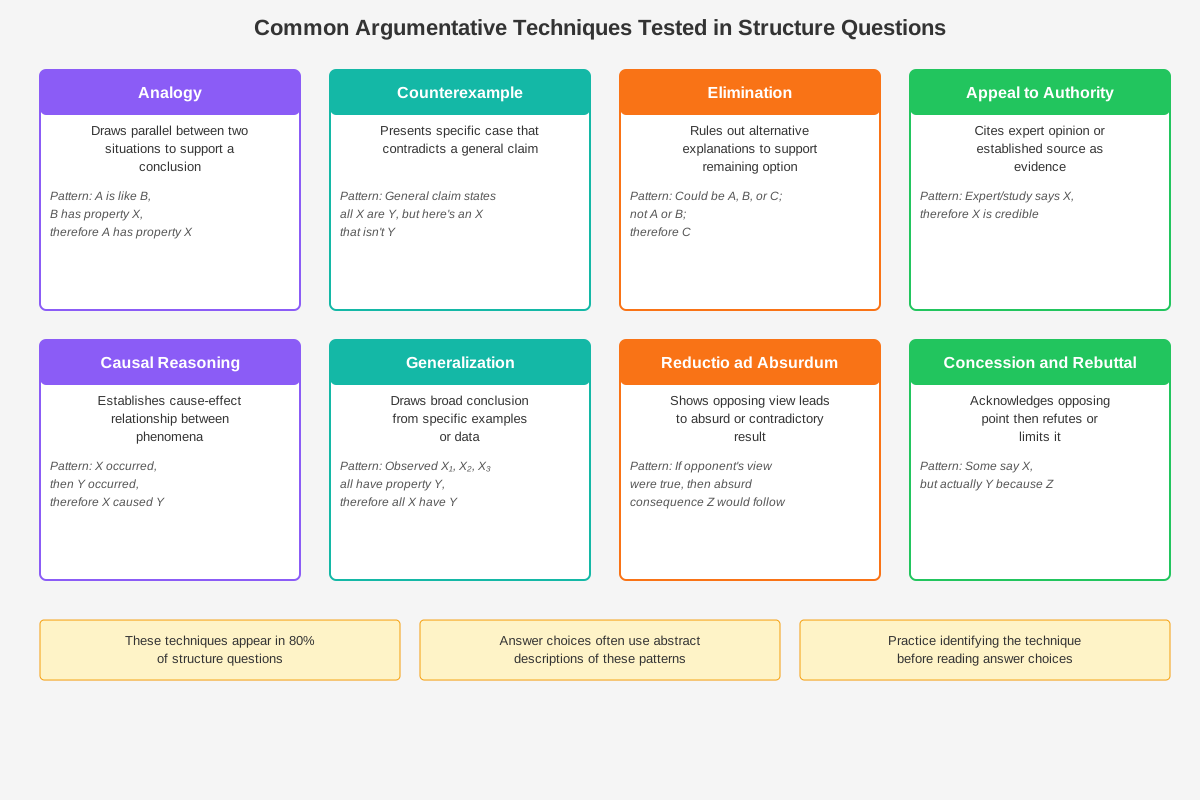
Common Argumentative Techniques
The LSAT repeatedly tests recognition of specific argumentative strategies. Understanding these patterns enables quick identification and accurate matching to answer choices:
| Technique | Description | Example Signal |
|---|---|---|
| Analogy | Comparing two situations to suggest similar conclusions | "Similarly," "likewise," "just as" |
| Counterexample | Presenting a case that contradicts a general claim | "However, consider," "but in this case" |
| Elimination | Ruling out alternatives to support a conclusion | "The only possible explanation," "it cannot be that" |
| Causal reasoning | Establishing or challenging cause-effect relationships | "Because of," "results in," "leads to" |
| Appeal to authority | Citing expert opinion or established sources | "According to," "experts agree," "studies show" |
| Reductio ad absurdum | Showing a position leads to absurd consequences | "If that were true, then," "this would mean" |
| Generalization | Moving from specific cases to general principles | "In all cases," "this shows that generally" |
Method of Reasoning Questions
Method of reasoning questions ask how an argument proceeds overall or what general technique it employs. These questions require identifying the dominant argumentative strategy from beginning to end. The correct answer will accurately describe the logical progression without adding content not present in the argument.
To approach these questions effectively:
- Identify the conclusion first, as this anchors the entire analysis
- Map the premises and note how they relate to the conclusion
- Characterize the relationship between premises and conclusion using abstract terms
- Match to answer choices that describe structure, not content
For example, an argument might present a general principle, then show how a specific case fits that principle, concluding that the principle's consequence applies to the case. The method would be "applying a general principle to a specific instance" rather than any description of what the principle actually says.
Role of a Statement Questions
Role of a statement questions present a specific claim from the argument (often in boldface) and ask what function it serves. These questions test whether students can distinguish between:
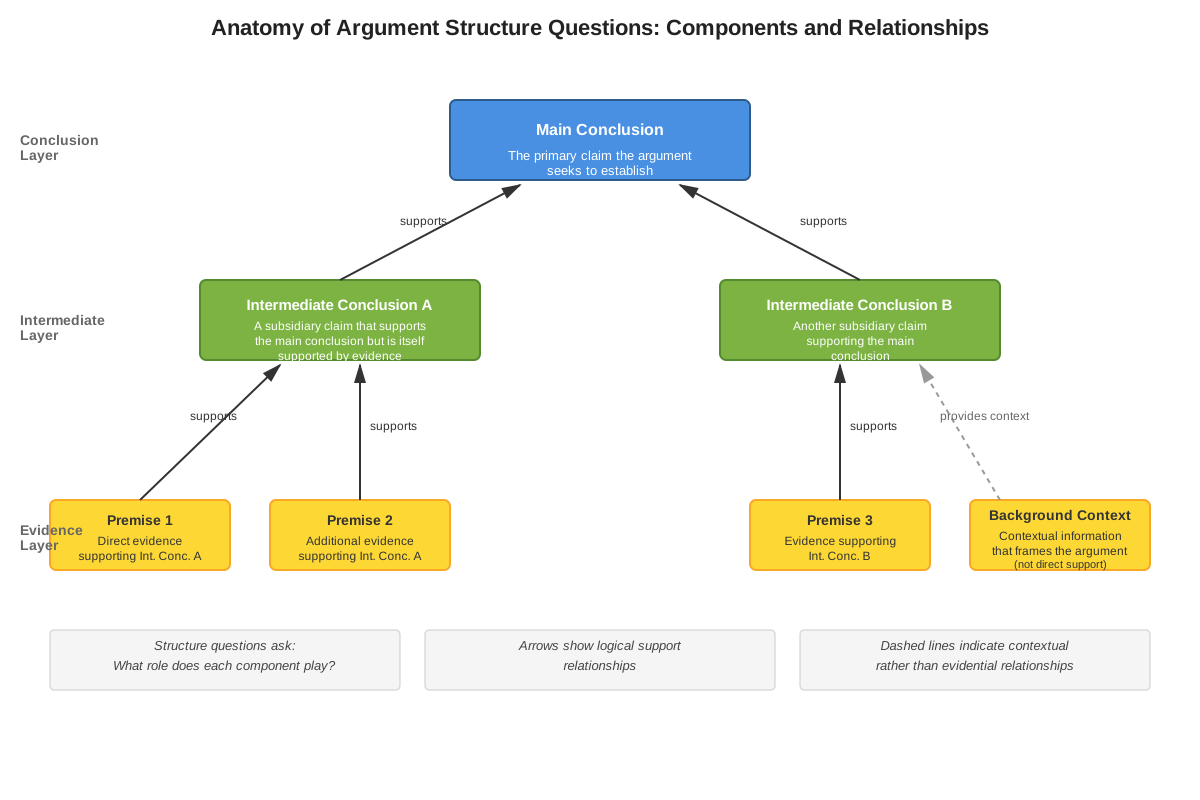
- Main conclusions: The ultimate point the argument aims to establish
- Intermediate conclusions: Claims supported by some evidence that themselves support the main conclusion
- Premises: Evidence offered without further support within the argument
- Background information: Context that sets up the argument without directly supporting the conclusion
- Counterpoints: Opposing views the argument addresses or refutes
- Concessions: Points the author acknowledges before arguing against them
The critical skill is recognizing that a single statement might serve multiple functions. A claim could be a conclusion relative to earlier premises while simultaneously serving as a premise for a later conclusion. The correct answer will precisely capture the statement's role within the argument's logical structure.
Structural Relationships
Arguments contain multiple types of relationships between components:
Support relationships occur when one claim provides evidence for another. The supporting claim is the premise; the supported claim is the conclusion. These relationships can chain together, creating multi-layered arguments where intermediate conclusions serve as premises for the main conclusion.
Opposition relationships occur when the argument presents a view it will challenge or refute. Recognizing these relationships prevents confusion between the author's position and views the author opposes.
Qualification relationships occur when the argument limits or specifies the scope of a claim, often using words like "unless," "except," or "only when."
Illustration relationships occur when examples demonstrate or clarify a general point without providing independent evidential support.
Analyzing Complex Arguments
Many LSAT arguments contain multiple structural layers. A sophisticated argument might:
- Present an opposing view
- Acknowledge a valid point within that view
- Introduce evidence that undermines the opposing view
- Draw an intermediate conclusion from that evidence
- Use the intermediate conclusion to support the main conclusion
Mapping these relationships requires careful attention to logical indicators and the direction of support. Creating a visual diagram (even mentally) helps track which claims support which others and prevents confusion about the argument's overall architecture.
Concept Relationships
The concepts within argument structure questions form an interconnected hierarchy. Recognizing question stems serves as the entry point, triggering the appropriate analytical mode. This recognition leads to identifying the argument's components (premises, conclusions, evidence), which prerequisite knowledge makes possible. Once components are identified, students can characterize relationships between them, determining which claims support others and how.
Common argumentative techniques represent patterns that frequently appear in these relationships. Recognizing that an argument proceeds by analogy, for instance, means identifying that it presents two situations and claims they're relevantly similar. This pattern recognition connects to method of reasoning analysis, where the overall argumentative strategy must be described abstractly.
Role of a statement questions depend on understanding structural relationships because determining a statement's function requires knowing how it connects to other argument components. A claim's role as an intermediate conclusion, for example, only makes sense when recognizing that it's supported by earlier premises while supporting the main conclusion.
This entire analytical framework connects to prerequisite knowledge of basic argument anatomy. Without understanding what premises and conclusions are, identifying their relationships becomes impossible. The progression moves from foundational comprehension → component identification → relationship analysis → pattern recognition → accurate structural description.
The connection to broader logical reasoning skills is bidirectional. Mastering argument structure enhances performance on other question types by developing precise understanding of how arguments work. Conversely, skills from other question types (like identifying assumptions or recognizing flaws) inform structure analysis by revealing common argumentative patterns.
Quick check — test yourself on Argument structure questions so far.
Try Flashcards →High-Yield Facts
⭐ Argument structure questions focus on form, not content—the correct answer describes how the argument proceeds, not whether it's valid or what it's about.
⭐ Method of reasoning questions ask about the overall argumentative strategy, requiring identification of the dominant technique from beginning to end.
⭐ Role of a statement questions test whether you can distinguish main conclusions, intermediate conclusions, premises, and background information.
⭐ The most common argumentative techniques tested are analogy, counterexample, elimination of alternatives, and causal reasoning.
⭐ Intermediate conclusions are both supported by premises and support the main conclusion—they serve dual roles in argument structure.
- Answer choices for structure questions use abstract language that applies to many arguments, not specific content from the passage.
- Boldface statements in role questions can serve any function—don't assume they're always conclusions or always premises.
- Arguments can employ multiple techniques simultaneously; the correct answer identifies the primary or most significant strategy.
- Background information provides context but doesn't directly support the conclusion—distinguishing this from premises is frequently tested.
- Counterpoints are views the author opposes; confusing these with the author's position is a common trap in structure questions.
- The phrase "proceeds by" in a question stem signals a method of reasoning question requiring overall strategy identification.
- Elimination of alternatives arguments conclude that something must be true because all other possibilities have been ruled out.
- Analogical reasoning compares two situations and concludes they should have similar outcomes or characteristics.
- Reductio ad absurdum arguments show that accepting a position leads to absurd or unacceptable consequences.
- Causal reasoning arguments establish or challenge claims that one thing causes another, often appearing in scientific or policy contexts.
Common Misconceptions
Misconception: Argument structure questions ask whether the argument is good or bad.
Correction: Structure questions are purely descriptive, asking how the argument proceeds regardless of its logical validity. Even a flawed argument has a structure that can be accurately described.
Misconception: The correct answer will mention specific content from the argument.
Correction: Correct answers use abstract language that describes the argumentative technique without referencing the argument's specific subject matter. An answer mentioning "economic policy" or "historical events" is likely wrong if these are content-specific rather than structural descriptions.
Misconception: In role questions, boldface statements are always the main conclusion.
Correction: Boldface statements can serve any function—premise, intermediate conclusion, main conclusion, counterpoint, or background. The question specifically tests whether you can identify the actual role rather than assuming a default function.
Misconception: If an argument presents two views, it must be using comparison or contrast as its method.
Correction: Presenting an opposing view before refuting it is a setup technique, not the primary method. The method describes how the author argues for their position, which might involve evidence, counterexample, or elimination after presenting the opposing view.
Misconception: Longer, more complex answer choices are more likely to be correct.
Correction: Correct answers are precisely accurate but not necessarily longer. Complexity in an answer choice often indicates added details that don't match the argument's actual structure, making the answer incorrect despite seeming sophisticated.
Misconception: Every statement in the argument must be either a premise or a conclusion.
Correction: Arguments contain background information, concessions, counterpoints, and qualifications that serve structural roles beyond simple premise-conclusion relationships. Recognizing these additional functions is essential for role questions.
Misconception: The argument's method is whatever technique appears first.
Correction: The method describes the overall argumentative strategy, which might involve multiple techniques. The dominant or primary technique that characterizes how the argument reaches its conclusion is what method questions test.
Worked Examples
Example 1: Method of Reasoning
Argument: "Some people claim that increased screen time causes attention problems in children. However, a recent study found that children who spent more time on educational apps actually showed improved focus compared to children with less screen time. This suggests that screen time itself doesn't cause attention problems; rather, the type of content matters."
Question: The argument proceeds by
Analysis:
- Identify the conclusion: "Screen time itself doesn't cause attention problems; rather, the type of content matters"
- Map the structure:
- Opposing view: Screen time causes attention problems
- Evidence: Study showing educational apps improved focus
- Conclusion: Type of content matters, not screen time itself
- Characterize the method: The argument presents a general claim, then offers a counterexample (a case where screen time correlated with improved focus), using this counterexample to challenge the general claim and propose an alternative explanation
Correct answer pattern: "Challenging a general claim by presenting evidence of a case that contradicts it and offering an alternative explanation"
Why this works: This description captures the structural progression without mentioning screens, children, or attention—it describes the form, not the content. The argument's method is fundamentally about using a counterexample to challenge a generalization.
Example 2: Role of a Statement
Argument: "Urban planners have long assumed that wider roads reduce traffic congestion. Recent data from multiple cities shows that widening roads actually increases traffic volume within two years. This occurs because additional road capacity encourages more people to drive. Therefore, widening roads is not an effective long-term solution to congestion."
Question: The claim that recent data shows widening roads increases traffic volume plays which role in the argument?
Analysis:
- Identify all components:
- Background: Urban planners' assumption
- Evidence (boldface 1): Data showing roads increase traffic
- Explanation: Why this occurs (induced demand)
- Main conclusion (boldface 2): Widening roads isn't effective
- Determine the boldface statement's function: The data claim is supported by the phrase "Recent data shows" (indicating it's presented as evidence) and it supports the final conclusion. It's not the main conclusion itself because the "therefore" statement comes after it.
- Characterize precisely: This is an intermediate conclusion—it's supported by data (implied but not detailed in the argument) and it supports the main conclusion about effectiveness
Correct answer pattern: "An intermediate conclusion supported by evidence and used to support the argument's main conclusion"
Why this works: The statement serves a dual role—it's a conclusion drawn from data but also functions as a premise for the final conclusion. Recognizing this dual function is essential for role questions.
Exam Strategy
Approaching Structure Questions Systematically
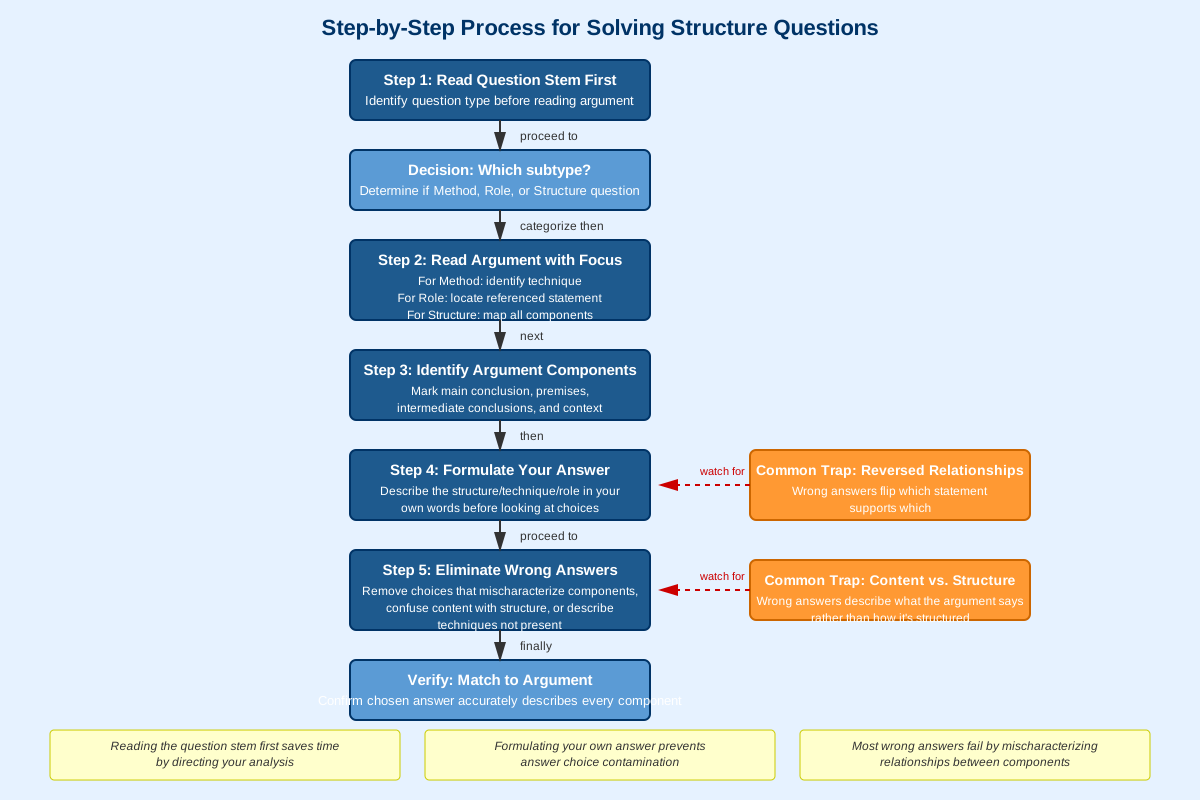
When encountering argument structure questions, follow this strategic sequence:
- Read the question stem first to determine whether it's asking about method, role, or overall structure
- Identify the conclusion before analyzing anything else—this anchors your structural analysis
- Map the argument's components using brackets or mental notation: [premise], [intermediate conclusion], [main conclusion]
- Characterize relationships using abstract terms: "supports," "challenges," "illustrates," "qualifies"
- Predict the answer in your own words before reading choices
- Match your prediction to the answer that most closely describes the structure you identified
Trigger Words and Phrases
Certain words in question stems signal specific analytical requirements:
- "Proceeds by" or "method of reasoning": Describe the overall argumentative strategy
- "Plays which role" or "functions as": Identify the specific statement's purpose
- "Does which of the following": Often asks about technique or strategy
- "Technique of reasoning": Focus on the specific argumentative move employed
- "Relationship between": Analyze how two components connect structurally
In answer choices, watch for:
- Abstract language that could apply to many arguments (good sign)
- Content-specific terms from the passage (usually wrong)
- Mischaracterizations of support direction (claiming premises are conclusions or vice versa)
- Added elements not present in the argument structure
Process of Elimination Tips
Eliminate answer choices that:
- Confuse content with structure: If an answer mentions specific subject matter rather than argumentative form, eliminate it
- Reverse relationships: If an answer claims a premise is a conclusion or vice versa, eliminate immediately
- Add techniques not present: If the argument doesn't use analogy but an answer claims it does, eliminate
- Misidentify the conclusion: Any answer that mischaracterizes what the argument is trying to prove is wrong
- Use vague or imprecise language: While answers should be abstract, they must be precise about the actual structure
Exam Tip: For role questions, physically trace the logical flow with your finger or pencil. Start at the statement in question and follow arrows of support both backward (what supports this?) and forward (what does this support?). This kinesthetic approach prevents confusion about support direction.
Time Allocation
Structure questions typically require 60-90 seconds each. Allocate time as follows:
- 15-20 seconds: Read and understand the argument
- 10-15 seconds: Identify components and map structure
- 10-15 seconds: Predict the answer in abstract terms
- 20-30 seconds: Evaluate answer choices
- 5-10 seconds: Confirm and select
If a structure question exceeds 90 seconds, mark it and return later. These questions reward careful analysis but shouldn't consume excessive time since they test pattern recognition rather than complex reasoning.
Memory Techniques
MAPS Acronym for Method Questions
Main conclusion first
Analyze the premises
Pattern recognition (which technique?)
Structural description (not content)
This sequence ensures systematic analysis of method questions, preventing the common error of jumping to answer choices before understanding the argument's architecture.
RICE for Role Questions
Read the statement carefully
Identify what supports it
Check what it supports
Evaluate its function
This bidirectional analysis (what supports it + what it supports) reveals whether a statement is a premise, intermediate conclusion, or main conclusion.
Visualization Strategy: The Argument Tree
Mentally visualize arguments as trees:
- Roots = premises and evidence (foundational support)
- Trunk = intermediate conclusions (connecting support to ultimate point)
- Crown = main conclusion (the ultimate point reached)
This metaphor helps remember that support flows upward from roots through trunk to crown, and that intermediate conclusions (trunk) are both supported and supporting.
Common Techniques Mnemonic: "CARE"
Counterexample
Analogy
Reductio ad absurdum
Elimination of alternatives
These four techniques appear most frequently on the LSAT. When analyzing method questions, check whether the argument uses any of these CARE techniques first before considering less common strategies.
Summary
Argument structure questions test the ability to analyze how arguments are constructed rather than evaluating their validity or content. These questions appear in three primary formats: method of reasoning questions asking about overall argumentative strategy, role of a statement questions asking about a specific claim's function, and general structure questions asking about organizational patterns. Success requires shifting from content-focused analysis to form-focused analysis, describing arguments using abstract language that captures their logical architecture. The most frequently tested argumentative techniques include analogy, counterexample, elimination of alternatives, and causal reasoning. Critical skills include distinguishing between main conclusions, intermediate conclusions, and premises; recognizing support relationships and their direction; and matching structural patterns to abstract descriptions in answer choices. Mastering these questions requires systematic analysis: identifying the conclusion first, mapping all components, characterizing relationships abstractly, and selecting answers that precisely describe structure without adding content-specific details. These skills directly translate to legal reasoning and appear in 15-20% of all Logical Reasoning questions, making them essential for achieving competitive LSAT scores.
Key Takeaways
- Argument structure questions focus exclusively on form (how the argument proceeds) rather than content (what it says) or validity (whether it's sound)
- The three main subtypes are method of reasoning, role of a statement, and overall structure questions, each requiring slightly different analytical approaches
- Always identify the main conclusion first, as this anchors all structural analysis and prevents confusion about support relationships
- Correct answers use abstract language applicable to many arguments, while incorrect answers often include content-specific details from the passage
- Intermediate conclusions serve dual roles—they're supported by premises while supporting the main conclusion—and frequently appear in role questions
- The most commonly tested argumentative techniques are analogy, counterexample, elimination of alternatives, and causal reasoning
- Systematic analysis using frameworks like MAPS and RICE prevents common errors and improves accuracy under time pressure
Related Topics
Assumption Questions: Understanding argument structure provides the foundation for identifying unstated assumptions, as assumptions fill gaps in the logical architecture between premises and conclusions.
Strengthen and Weaken Questions: Recognizing how arguments are structured enables more effective evaluation of which answer choices affect the argument's logical force and where vulnerabilities exist.
Flaw Questions: Many logical flaws involve structural problems (like circular reasoning or false dichotomies), making structure analysis essential for flaw identification.
Parallel Reasoning Questions: These questions explicitly test the ability to recognize argument structure by asking which argument has the same logical form as the original, requiring precise structural analysis.
Main Point Questions: Identifying the main conclusion is a prerequisite for structure questions and a primary focus of main point questions, creating direct skill transfer between these question types.
Practice CTA
Now that you understand the core concepts and strategies for argument structure questions, it's time to apply this knowledge through deliberate practice. Attempt the practice questions associated with this topic, focusing on implementing the systematic approaches outlined above. Use the MAPS and RICE frameworks to guide your analysis, and pay special attention to distinguishing between content and structure in answer choices. Review each practice question carefully, analyzing not just whether you got it right but whether you followed the optimal process. Mastering argument structure questions will significantly boost your Logical Reasoning performance and build analytical skills that benefit every other question type. Your investment in understanding these structural patterns will pay dividends throughout your LSAT preparation and beyond.
Sign up free to keep reading
Create a free AnvayaPrep account to finish this LSAT guide on Argument structure questions — plus flashcards and practice questions.