Overview
Completion with however represents a critical question type within LSAT Logical Reasoning sections where test-takers must identify the appropriate conclusion or premise that follows a "however" transition. This question format tests the ability to recognize logical pivots, understand argumentative structure, and predict how an argument will shift direction after introducing a contrasting element. The "however" signal indicates that the argument is about to present information that contrasts with, limits, or complicates what came before, requiring students to understand both the initial claim and the nature of the logical reversal.
These questions appear regularly on the LSAT and demand sophisticated comprehension of argument structure. Unlike simple completion questions where any logically consistent statement might work, lsat completion with however questions require recognizing the specific type of contrast or limitation the argument demands. Students must identify not just what could follow logically, but what must follow given the argumentative direction established by the "however" pivot. This involves understanding the relationship between premises and conclusions, recognizing implicit assumptions, and predicting how arguments develop when introducing counterpoints or qualifications.
Mastering completion with however questions strengthens broader evaluate and complete the argument skills essential throughout Logical Reasoning sections. These questions connect directly to assumption identification, argument structure analysis, and inference drawing—all fundamental LSAT competencies. Success with these questions demonstrates the ability to think dynamically about arguments, anticipating how logical structures unfold and recognizing the constraints that prior statements place on subsequent claims.
Learning Objectives
- [ ] Identify how Completion with however appears in LSAT questions
- [ ] Explain the reasoning pattern behind Completion with however
- [ ] Apply Completion with however to solve LSAT-style problems accurately
- [ ] Distinguish between different types of contrasts that "however" can introduce
- [ ] Predict the logical constraints that preceding statements place on post-"however" content
- [ ] Evaluate answer choices by testing their logical fit with both pre- and post-"however" argument components
- [ ] Recognize common trap answers that fail to establish appropriate contrast or maintain logical coherence
Prerequisites
- Basic argument structure: Understanding premises, conclusions, and how they connect is essential because completion questions require recognizing what role the missing statement plays in the overall argument
- Transition word recognition: Familiarity with logical connectors (therefore, thus, but, although) provides context for understanding how "however" functions as a specific type of contrasting transition
- Inference skills: The ability to draw logical conclusions from given information enables prediction of what must follow in an argument's development
- Assumption identification: Recognizing unstated premises helps identify what information an argument needs to maintain coherence across a "however" transition
Why This Topic Matters
Completion with however questions appear with notable frequency on LSAT Logical Reasoning sections, typically comprising 2-4 questions per test across both LR sections. These questions assess critical thinking skills that extend far beyond test-taking: the ability to follow complex arguments, anticipate counterarguments, and understand how qualifications and limitations affect claims. Legal reasoning constantly involves presenting positions and then addressing limitations, exceptions, or opposing viewpoints—precisely the skill these questions test.
In professional legal contexts, attorneys must construct arguments that acknowledge contrary evidence or opposing positions while maintaining their overall thesis. The "however" construction mirrors the argumentative structure of legal briefs, where lawyers present favorable facts but must also address unfavorable information or opposing arguments. Understanding how to complete such arguments demonstrates the analytical flexibility essential for legal practice.
On the LSAT, these questions typically appear as "Which one of the following most logically completes the argument?" with the stimulus containing a "however" transition followed by a blank. They may also appear in variants where students must identify which statement, if added, would create the most logical argument structure. The questions test whether students can maintain argumentative coherence while navigating logical pivots, making them high-yield targets for score improvement since they follow predictable patterns once understood.
Core Concepts
The Function of "However" in Logical Arguments
The word "however" serves as a contrasting transition that signals the argument is about to introduce information that limits, qualifies, contradicts, or complicates what preceded it. Unlike "therefore" or "thus" which indicate logical continuation, "however" creates a logical pivot point. Understanding this function is fundamental to completion with however questions because the missing statement must create an appropriate contrast with earlier content while maintaining overall argument coherence.
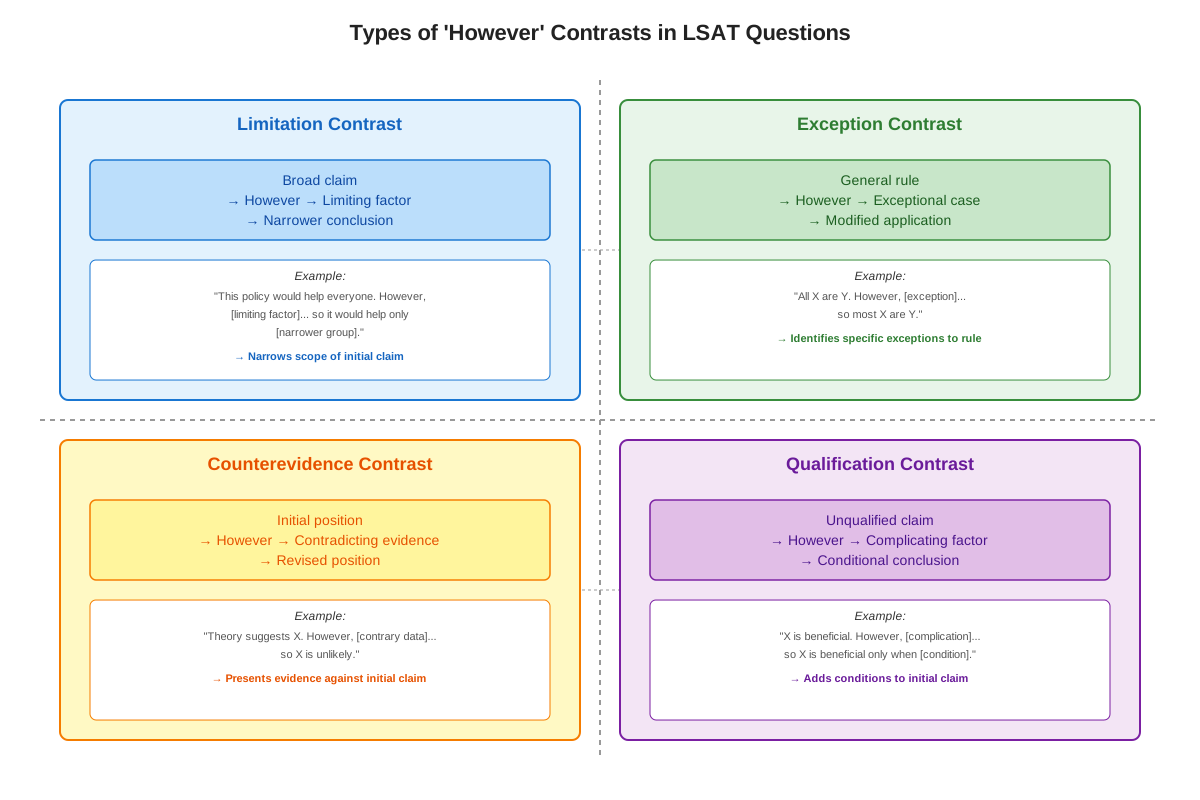
The contrast introduced by "however" can take several forms:
- Direct contradiction: Presenting evidence that opposes a previous claim
- Limitation: Restricting the scope or applicability of a previous statement
- Qualification: Adding conditions or exceptions to a general rule
- Complication: Introducing factors that make a situation more complex than initially presented
- Alternative perspective: Offering a different viewpoint on the same situation
Structural Patterns in However-Completion Questions
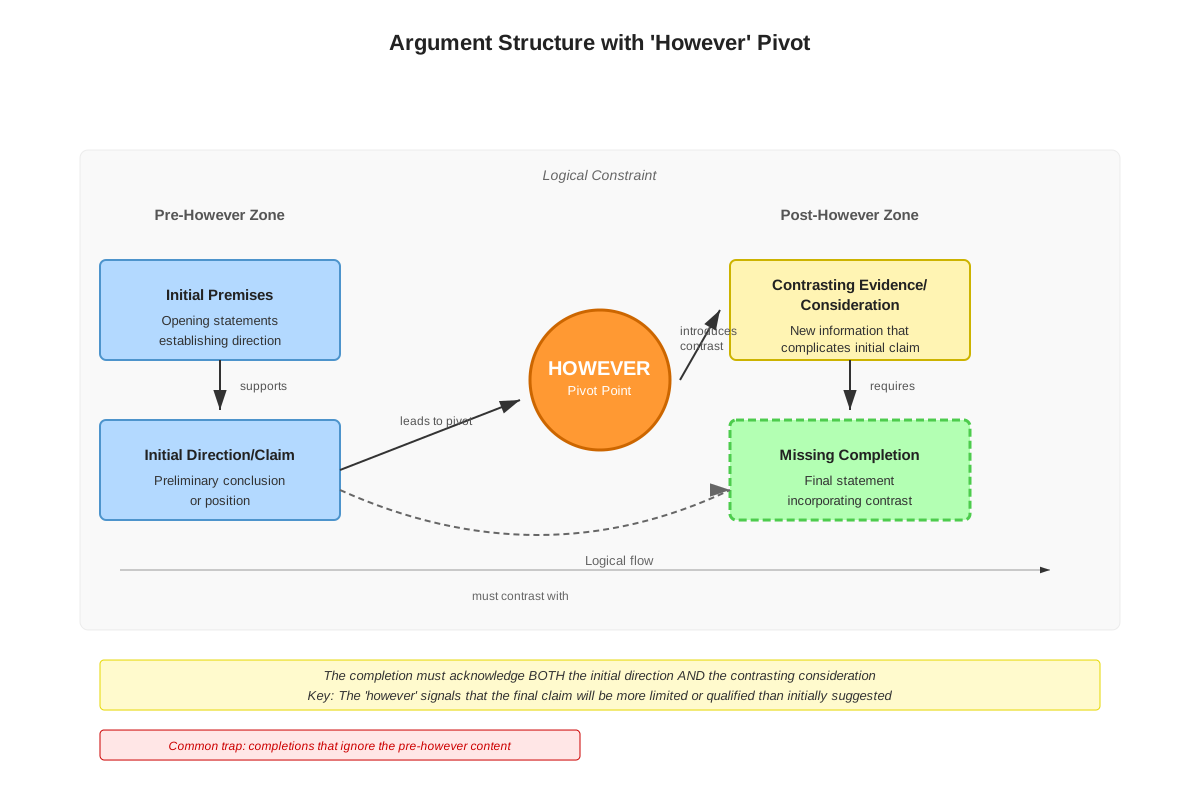
LSAT completion with however questions follow recognizable structural patterns. The most common pattern presents:
- Initial claim or evidence (before "however")
- The "however" transition (signaling contrast)
- Additional information (after "however," before the blank)
- The blank (requiring completion)
The completion must satisfy two constraints simultaneously: it must contrast appropriately with the pre-"however" content AND it must follow logically from the post-"however" information. This dual constraint makes these questions challenging but also predictable.
Consider this structure:
[Claim A supporting position X]. However, [Evidence B]. Therefore, _____.The blank must present a conclusion that accounts for Evidence B's limiting effect on Claim A. The answer cannot simply restate Claim A (ignoring the "however" pivot) nor can it completely contradict Claim A (ignoring that it remains part of the argument). Instead, it must present a modified or qualified version of the position that incorporates both elements.
Types of Logical Relationships Across "However"
Understanding the specific logical relationship that "however" creates helps predict what must follow. Common relationship types include:
| Relationship Type | Pre-However Content | Post-However Content | Required Completion |
|---|---|---|---|
| Evidence vs. Counter-evidence | Supporting evidence for claim | Contradicting evidence | Qualified conclusion acknowledging both |
| General vs. Exception | Broad rule or pattern | Specific exception | Limited application of rule |
| Advantage vs. Disadvantage | Positive aspects | Negative aspects | Balanced assessment |
| Theory vs. Reality | Theoretical expectation | Actual observation | Explanation of discrepancy |
| Initial vs. Additional | First consideration | Further factor | Revised judgment |
The Principle of Logical Coherence
Correct answers to evaluate and complete the argument questions with "however" must maintain logical coherence throughout the entire argument. This means:
- Acknowledging the pivot: The completion cannot ignore that "however" introduced contrasting information
- Respecting both sides: The answer must account for both pre- and post-"however" content
- Maintaining argumentative purpose: The completion should advance the argument's overall point rather than abandoning it
- Following logical necessity: The answer should be what must follow, not merely what could follow
Prediction Strategy
Before examining answer choices, strong test-takers predict what type of statement must complete the argument. This prediction process involves:
- Identifying the pre-however position: What claim, evidence, or perspective appears before the pivot?
- Analyzing the post-however contrast: What type of limitation, contradiction, or complication does the "however" introduce?
- Determining the logical consequence: Given both elements, what conclusion or statement must follow?
- Formulating a prediction: Create a rough prediction of the completion's content and logical function
This prediction serves as a filter when evaluating answer choices, making it easier to eliminate options that fail to create the necessary logical relationship.
Common Completion Functions
The blank in however-completion questions typically serves one of several functions:
- Modified conclusion: A conclusion that qualifies or limits an initial claim based on contrasting evidence
- Explanation: An account of why the "however" information creates the contrast it does
- Recommendation: A course of action that accounts for both favorable and limiting factors
- Prediction: A forecast that incorporates both supporting and contradicting evidence
- Evaluation: An assessment that balances positive and negative considerations
Concept Relationships
The concepts within completion with however questions form an interconnected system. The function of "however" as a contrasting transition establishes the fundamental requirement that drives all other concepts. This function creates the structural patterns that these questions follow, where the "however" pivot divides the argument into contrasting segments that the completion must reconcile.
Understanding types of logical relationships across "however" enables effective application of the prediction strategy. By identifying which specific relationship type a question employs (evidence vs. counter-evidence, general vs. exception, etc.), test-takers can predict more accurately what logical function the completion must serve. This prediction then guides evaluation of answer choices using the principle of logical coherence, which serves as the ultimate test of whether a completion successfully integrates both pre- and post-"however" content.
The relationship map flows as follows:
Function of "however" → establishes need for → Logical relationship type → enables → Prediction strategy → guides → Answer evaluation → tested by → Principle of logical coherence → which ensures → Appropriate completion function
These concepts connect to prerequisite knowledge of argument structure (providing the framework for understanding how completions function within arguments) and inference skills (enabling prediction of what must follow logically). They also relate to broader logical reasoning competencies, particularly assumption identification (recognizing what unstated premises connect pre- and post-"however" content) and argument evaluation (assessing whether the completed argument succeeds logically).
High-Yield Facts
⭐ The word "however" always signals that the argument is introducing information that contrasts with, limits, or complicates what came before
⭐ Correct completions must acknowledge BOTH the pre-however content AND the post-however content—answers that ignore either side are incorrect
⭐ The completion typically presents a qualified or modified version of the initial position rather than completely abandoning it
⭐ Predicting the general type of statement needed before reading answer choices significantly improves accuracy
⭐ The most common trap answers either ignore the "however" pivot entirely or overreact by completely contradicting the initial claim
- The blank in however-completion questions most frequently appears after the "however" clause, requiring a conclusion that accounts for the contrast
- "However" creates a stronger contrast than "but" and typically introduces more significant limitations or contradictions
- Completion questions test the same logical reasoning skills as assumption questions, but in reverse—finding what must be added rather than what's already assumed
- Time-efficient test-takers read however-completion questions with special attention to the sentence immediately before "however" and the clause immediately after it
- Answer choices that introduce entirely new topics or considerations not mentioned in the stimulus are almost always incorrect
- The correct answer often contains qualifying language like "some," "may," "in certain cases," or "to a limited extent" that reflects the modified nature of the conclusion
Quick check — test yourself on Completion with however so far.
Try Flashcards →Common Misconceptions
Misconception: The completion should simply contradict whatever came before "however" since "however" means contrast.
Correction: "However" introduces contrast, but the completion must integrate both sides of the argument into a coherent whole, not simply negate the initial claim. The goal is qualified synthesis, not outright contradiction.
Misconception: Any logically consistent statement that could follow "however" is acceptable.
Correction: The completion must not merely be possible but must be what the argument's logic requires. The specific content before and after "however" constrains what can appropriately complete the argument.
Misconception: The completion should always be a conclusion since it comes at the end of the argument.
Correction: While completions often serve as conclusions, they may also function as additional premises, explanations, or intermediate steps in reasoning. The completion's function depends on the argument's structure and what's needed to maintain coherence.
Misconception: Longer, more detailed answer choices are more likely to be correct because they're more complete.
Correction: LSAT correct answers are typically precise and efficient. Longer answers often introduce irrelevant information or overreach beyond what the argument supports. The best completion says exactly what's needed—no more, no less.
Misconception: If the pre-however content presents a positive view, the completion should present a negative view (or vice versa).
Correction: The completion should present a balanced or qualified view that accounts for both positive and negative elements. Simple reversal from positive to negative ignores the requirement to integrate both sides of the argument.
Misconception: The "however" transition means the argument is changing topics.
Correction: "However" signals a shift in perspective or a limitation on the same topic, not a topic change. The completion must remain focused on the same subject matter while incorporating the contrasting information.
Worked Examples
Example 1: Evidence vs. Counter-Evidence Pattern
Stimulus: "Studies have consistently shown that regular exercise reduces the risk of heart disease by improving cardiovascular function and reducing blood pressure. However, recent research indicates that excessive high-intensity exercise may actually increase cardiac stress in individuals over 60. Therefore, _____."
Analysis:
Step 1: Identify pre-however content
The argument initially presents evidence that exercise reduces heart disease risk through specific mechanisms (improved cardiovascular function, reduced blood pressure).
Step 2: Analyze the post-however contrast
The "however" introduces counter-evidence: excessive high-intensity exercise may harm (not help) cardiac health in a specific population (over 60).
Step 3: Determine logical consequence
The completion must present a conclusion that acknowledges both the benefits of exercise generally AND the specific risk for older adults doing high-intensity exercise. It should qualify the initial claim rather than abandon it.
Step 4: Predict completion type
We need a qualified recommendation or conclusion that limits the application of the initial claim based on the contrasting evidence—something like "exercise recommendations should be tailored to age and intensity level."
Correct Answer: "older adults should engage in moderate rather than high-intensity exercise to gain cardiovascular benefits while avoiding excessive cardiac stress"
Why it works: This completion acknowledges the benefits of exercise (pre-however), incorporates the limitation about high-intensity exercise in older adults (post-however), and provides a qualified recommendation that synthesizes both pieces of information.
Wrong Answer Example: "exercise does not reduce heart disease risk"
Why it fails: This ignores the pre-however evidence entirely and overreacts to the limitation by completely negating the initial claim.
Example 2: General Rule vs. Exception Pattern
Stimulus: "Legal precedent establishes that contracts signed under duress are not enforceable, as genuine consent is absent when one party faces threats or coercion. However, courts have recognized that _____."
Analysis:
Step 1: Identify pre-however content
The argument presents a general legal rule: contracts under duress are unenforceable because they lack genuine consent.
Step 2: Analyze the post-however contrast
The "however" signals that courts have recognized something that contrasts with or limits this general rule. The blank comes immediately after "however," so we need to identify what exception or qualification courts have made.
Step 3: Determine logical consequence
The completion must present an exception to the general rule about duress and contracts. It should identify circumstances where contracts might be enforceable despite some element of pressure or where the definition of duress is limited.
Step 4: Predict completion type
We need a statement that presents a specific exception or limitation to the broad rule—something that narrows when the duress defense applies while maintaining the general principle.
Correct Answer: "economic pressure or difficult financial circumstances alone do not constitute duress sufficient to void a contract"
Why it works: This completion creates an appropriate exception to the general rule by distinguishing between actual duress (threats/coercion) and mere economic pressure, thereby limiting the application of the duress defense while maintaining the core principle.
Wrong Answer Example: "all contracts require genuine consent to be enforceable"
Why it fails: This simply restates the principle without introducing any contrast or exception, failing to create the logical pivot that "however" requires.
Exam Strategy
Approaching However-Completion Questions
When encountering completion with however questions on the LSAT, follow this systematic approach:
- Read the entire stimulus carefully, paying special attention to the sentence before "however" and the content after it
- Identify the logical relationship being established (evidence vs. counter-evidence, general vs. exception, etc.)
- Formulate a prediction of what type of statement must complete the argument before looking at answers
- Evaluate each answer choice against both pre- and post-however content
- Eliminate answers that ignore either side of the "however" pivot
Exam Tip: The sentence immediately before "however" and the clause immediately after it are the highest-yield parts of the stimulus. These contain the contrasting elements that the completion must reconcile.
Trigger Words and Phrases
Watch for these indicators that signal how the completion should function:
- "Therefore" before the blank: The completion will be a conclusion synthesizing both sides
- "This is because" before the blank: The completion will explain the contrast or limitation
- "For this reason" before the blank: The completion will present a consequence of the contrast
- Qualifying language in answer choices ("some," "certain," "may," "often"): Often indicates appropriate qualification
- Absolute language in answer choices ("all," "never," "must," "always"): Often indicates overreach
Process of Elimination Tips
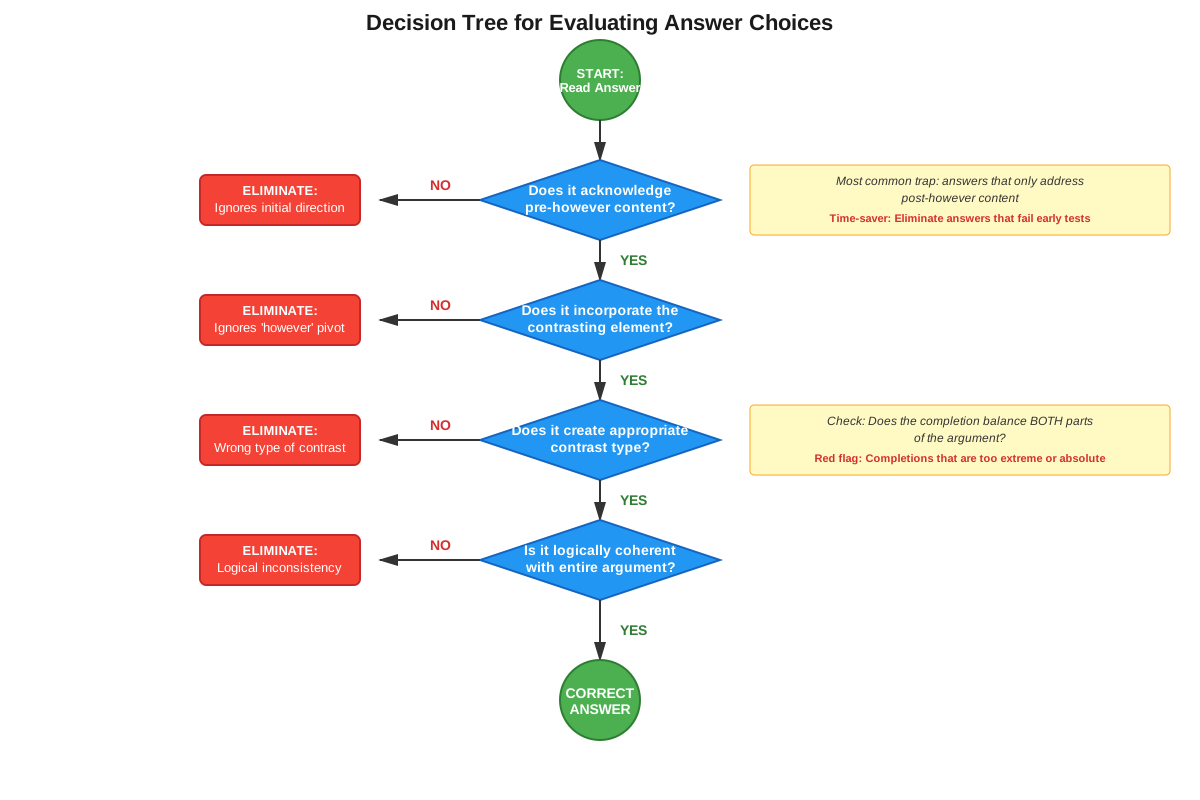
Systematically eliminate answers that:
- Ignore the "however" pivot: If an answer could work just as well without the "however" clause, it's wrong
- Completely negate the initial claim: Answers that treat the post-however information as entirely overriding the pre-however content typically overreach
- Introduce new topics: Completions should synthesize existing information, not bring in unmentioned considerations
- Fail the "both sides" test: Cover the blank and read the argument with the answer choice—does it acknowledge both pre- and post-however content?
- Are too extreme: Watch for answers that go beyond what the argument supports
Time Allocation
However-completion questions typically require 60-90 seconds:
- 20-30 seconds: Reading and analyzing the stimulus, identifying the logical relationship
- 10-15 seconds: Formulating a prediction
- 30-45 seconds: Evaluating answer choices and eliminating wrong answers
If a question exceeds 90 seconds, mark it and return later. These questions reward systematic analysis but can become time traps if you get stuck debating between two similar answers.
Memory Techniques
The BRIDGE Acronym
Remember that "however" creates a BRIDGE between contrasting ideas:
- Both sides must be acknowledged
- Relationship between pre- and post-however content determines completion
- Integration, not negation, is the goal
- Dual constraints (must fit both sides) guide answer selection
- General claims get qualified or limited
- Extreme answers usually overreach
The "Synthesis, Not Reversal" Principle
Visualize the argument structure as a balance scale: the pre-however content sits on one side, the post-however content on the other. The completion doesn't tip the scale entirely to one side—it finds the balance point that accounts for both weights. This mental image reinforces that correct answers synthesize rather than simply reverse the initial position.
The Three-Part Test
Before selecting an answer, apply this three-part test:
- Does it acknowledge the pre-however content? (If no, eliminate)
- Does it incorporate the post-however contrast? (If no, eliminate)
- Does it maintain logical coherence? (If no, eliminate)
Memorize this as "Acknowledge, Incorporate, Cohere" (AIC).
Summary
Completion with however questions test the ability to recognize and navigate logical pivots in arguments. The word "however" signals that contrasting, limiting, or complicating information is being introduced, creating a dual constraint: the completion must acknowledge both the initial claim and the contrasting information while maintaining overall argument coherence. Success requires identifying the specific type of logical relationship the "however" creates (evidence vs. counter-evidence, general rule vs. exception, advantage vs. disadvantage), predicting what type of statement must follow, and evaluating answer choices against both sides of the pivot. The most common errors involve either ignoring the "however" contrast entirely or overreacting by completely negating the initial claim. Correct answers typically present qualified or modified conclusions that synthesize both elements, often using qualifying language that reflects the nuanced nature of the integrated position. Mastering these questions strengthens broader logical reasoning skills essential throughout the LSAT, particularly the ability to evaluate argument structure and recognize how premises and conclusions interact.
Key Takeaways
- "However" creates a logical pivot requiring the completion to synthesize contrasting information, not simply continue or reverse the initial claim
- Correct answers must satisfy dual constraints: acknowledging pre-however content AND incorporating post-however contrast
- Predicting the type of completion needed before reading answer choices significantly improves accuracy and efficiency
- The most common trap answers either ignore the "however" pivot or completely negate the initial position rather than qualifying it
- Qualifying language in answer choices ("some," "may," "certain cases") often signals appropriate synthesis while absolute language ("all," "never," "must") often indicates overreach
- These questions test the same logical reasoning skills as assumption and inference questions but require active construction rather than recognition
- Systematic analysis using the BRIDGE framework and three-part test (Acknowledge, Incorporate, Cohere) provides a reliable approach to these questions
Related Topics
Assumption Questions: Understanding what unstated premises connect an argument's premises to its conclusion builds the foundation for recognizing what explicit statements are needed to complete arguments with logical pivots.
Strengthen/Weaken Questions: These questions test similar skills in reverse—identifying what information would support or undermine an argument helps develop the ability to predict what information an argument needs to maintain coherence.
Paradox/Resolve Questions: Like however-completion questions, paradox questions require synthesizing apparently contradictory information into a coherent explanation, strengthening the ability to integrate contrasting elements.
Inference Questions: The prediction skills developed for completion questions directly transfer to inference questions, where test-takers must identify what must follow from given information.
Argument Structure Questions: Mastering how "however" functions within argument structure deepens understanding of how arguments develop and how different components relate to each other.
Practice CTA
Now that you understand the principles behind completion with however questions, it's time to apply these concepts to actual LSAT-style problems. The practice questions and flashcards will reinforce your ability to identify logical relationships, predict completions, and evaluate answer choices systematically. Remember: these questions follow predictable patterns, and with focused practice, you'll develop the pattern recognition and analytical skills to handle them confidently and efficiently. Each practice question you complete strengthens your ability to navigate logical pivots—a skill that will serve you throughout the Logical Reasoning sections and beyond. Start practicing now to transform understanding into mastery!
Sign up free to keep reading
Create a free AnvayaPrep account to finish this LSAT guide on Completion with however — plus flashcards and practice questions.