Overview
Evaluating assumptions is a critical skill within the LSAT's Logical Reasoning section, representing one of the most sophisticated question types students will encounter. This topic sits at the intersection of identifying unstated premises and understanding the logical structure that connects evidence to conclusions. When the LSAT asks test-takers to evaluate assumptions, it requires recognizing what must be true for an argument to hold together—the invisible bridges that connect stated premises to their conclusions.
Mastering this topic is essential for LSAT success because assumption-based questions appear frequently throughout the Logical Reasoning sections, accounting for approximately 15-20% of all Logical Reasoning questions. These questions test not just reading comprehension but the ability to analyze argumentative structure, identify logical gaps, and understand what makes reasoning valid or flawed. The skill of evaluating assumptions directly impacts performance on related question types including Strengthen, Weaken, Flaw, and Necessary Assumption questions.
Within the broader framework of Logical Reasoning, evaluating assumptions represents a foundational analytical skill that underpins nearly every argument-based question type. This topic belongs to the "Evaluate and Complete the Argument" unit because assumptions are the missing pieces that complete logical chains of reasoning. Understanding how to identify and evaluate these unstated premises enables students to deconstruct complex arguments systematically, predict answer choices accurately, and eliminate incorrect options efficiently—skills that translate directly into higher LSAT scores.
Learning Objectives
- [ ] Identify how Evaluating assumptions appears in LSAT questions
- [ ] Explain the reasoning pattern behind Evaluating assumptions
- [ ] Apply Evaluating assumptions to solve LSAT-style problems accurately
- [ ] Distinguish between necessary assumptions and sufficient assumptions in argument structures
- [ ] Recognize the gap between evidence and conclusion that assumptions fill
- [ ] Evaluate whether a given statement functions as an assumption for a specific argument
- [ ] Predict likely assumptions before reviewing answer choices
Prerequisites
- Basic argument structure: Understanding premises, conclusions, and how they relate is essential because assumptions bridge the gap between these elements
- Conditional reasoning fundamentals: Recognizing if-then relationships helps identify what must be true for conclusions to follow from premises
- Identifying conclusions: Students must locate what the argument is trying to prove before determining what assumptions support that conclusion
- Distinguishing evidence from inference: Recognizing the difference between stated facts and unstated beliefs is crucial for isolating assumptions
Why This Topic Matters
In real-world contexts, evaluating assumptions is fundamental to critical thinking across professional fields. Lawyers must identify unstated premises in opposing counsel's arguments, business analysts must recognize assumptions underlying financial projections, and policymakers must evaluate the unstated beliefs driving proposed legislation. The ability to spot what someone takes for granted—but hasn't explicitly stated—is essential for effective analysis and persuasion.
On the LSAT specifically, assumption-related questions appear in multiple forms and constitute a significant portion of the exam. LSAT evaluating assumptions questions typically appear 3-5 times per Logical Reasoning section, with related question types (Necessary Assumption, Sufficient Assumption, Strengthen, Weaken) appearing an additional 8-12 times. This means that mastery of assumption evaluation directly impacts performance on approximately 40-50% of all Logical Reasoning questions.
These questions commonly appear in several formats: "Which one of the following is an assumption required by the argument?", "The argument depends on assuming which one of the following?", "Which one of the following is an assumption on which the argument relies?", and "The conclusion follows logically if which one of the following is assumed?" Each variation tests the same core skill—identifying what unstated premise must be true for the argument to work—but may require slightly different strategic approaches.
Core Concepts
What Is an Assumption?
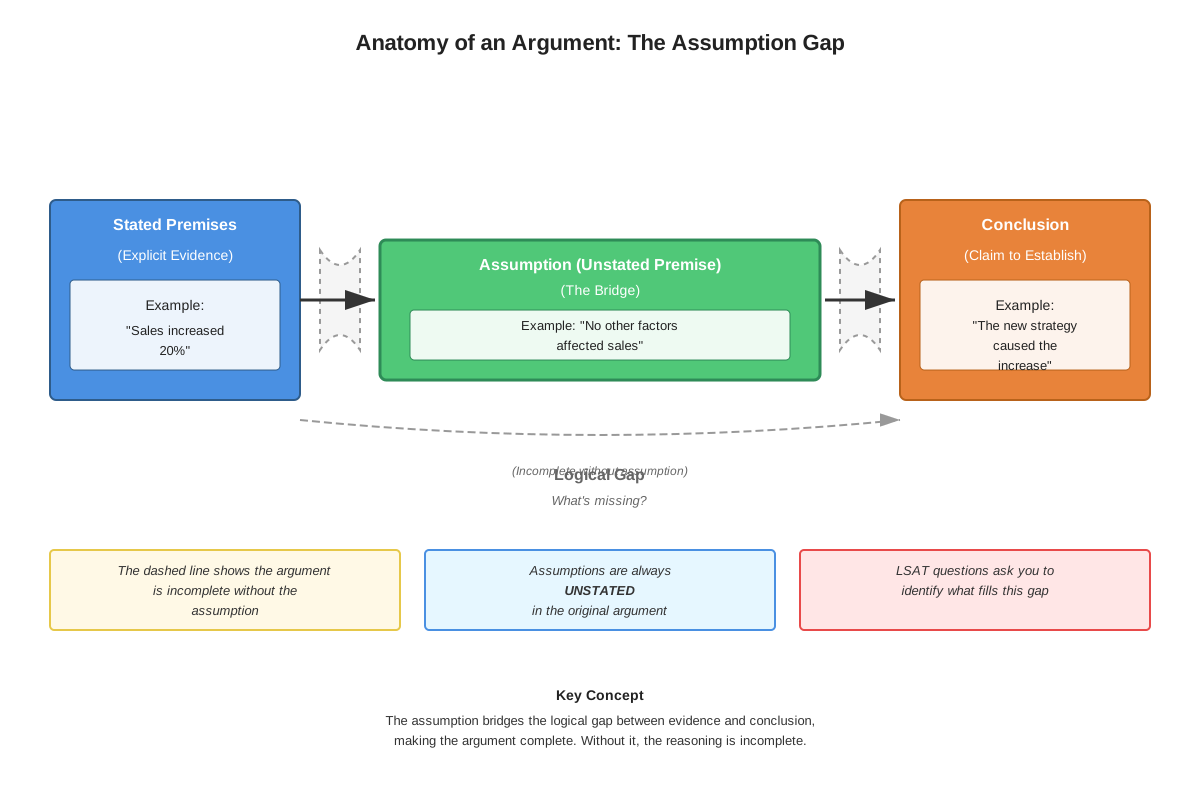
An assumption is an unstated premise that must be true for an argument's conclusion to follow logically from its stated evidence. Assumptions are the invisible connective tissue of arguments—they're what the author believes but hasn't explicitly said. Every LSAT argument with a logical gap contains at least one assumption, and identifying these gaps is the key to evaluating assumptions effectively.
Assumptions differ from stated premises in their implicit nature. While premises are explicitly provided in the argument text, assumptions remain hidden beneath the surface. They represent beliefs, facts, or conditions that the author takes for granted without articulation. On the LSAT, recognizing these unstated elements separates high scorers from average performers.
The Logical Gap
The logical gap is the space between an argument's evidence and its conclusion—the conceptual distance that assumptions must bridge. Every flawed or incomplete argument contains such a gap, and lsat evaluating assumptions questions specifically test the ability to identify what would close that gap.
Consider this structure:
- Evidence: All observed swans in Europe are white
- Conclusion: Therefore, all swans everywhere are white
- Logical Gap: The argument assumes that European swans are representative of all swans globally
The gap exists because the evidence discusses only European swans while the conclusion makes a claim about all swans. The assumption bridges this gap by asserting that the observed sample represents the entire population.
Types of Assumptions
LSAT arguments typically rely on two categories of assumptions, each serving a distinct logical function:
| Assumption Type | Definition | Function | Example |
|---|---|---|---|
| Necessary Assumption | Must be true for the conclusion to be valid | Fills a required logical gap | "There are no relevant differences between observed and unobserved cases" |
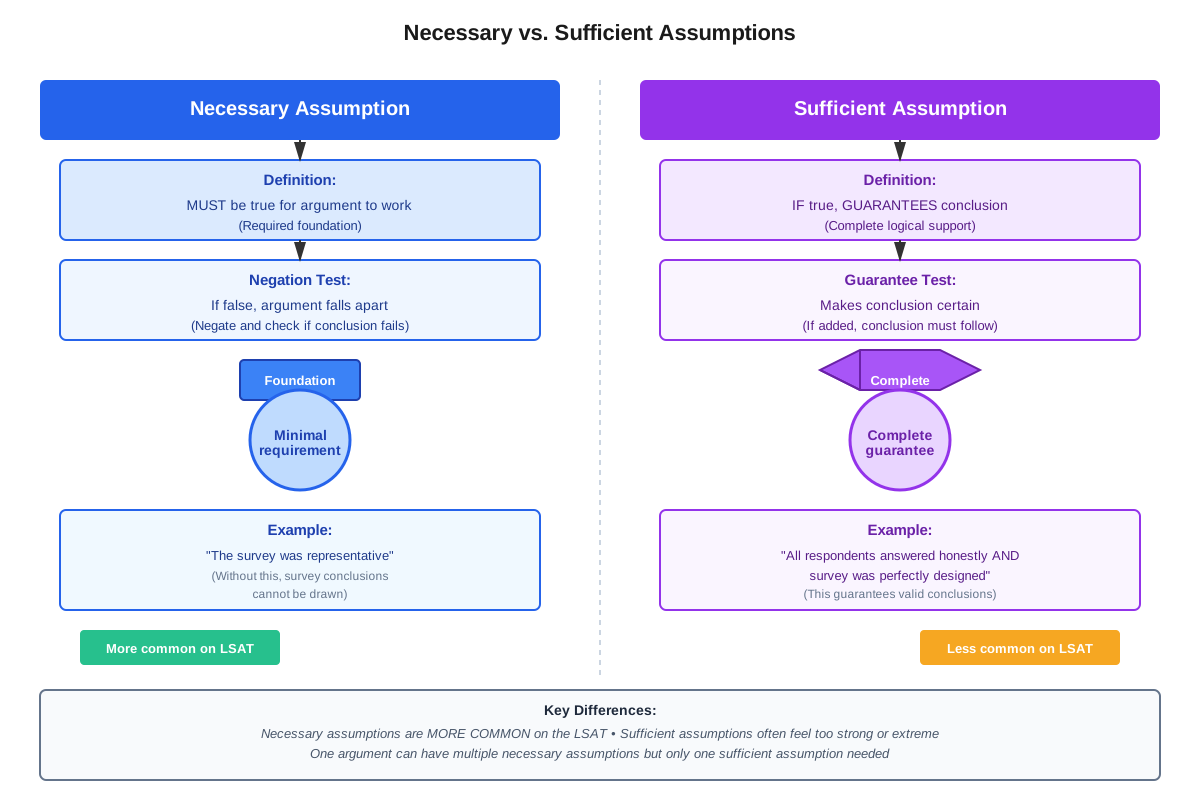
| Sufficient Assumption | If true, guarantees the conclusion follows | Provides complete logical bridge | "All swans share identical coloration patterns" |
Necessary assumptions are the minimum requirements for an argument to work. If a necessary assumption is false, the argument completely falls apart. These are tested most frequently on the LSAT through Necessary Assumption questions and the negation technique.
Sufficient assumptions, while less commonly tested directly, appear in Sufficient Assumption questions where test-takers must identify a statement that, if added to the argument, would make the conclusion follow with certainty.
The Assumption-Identification Process
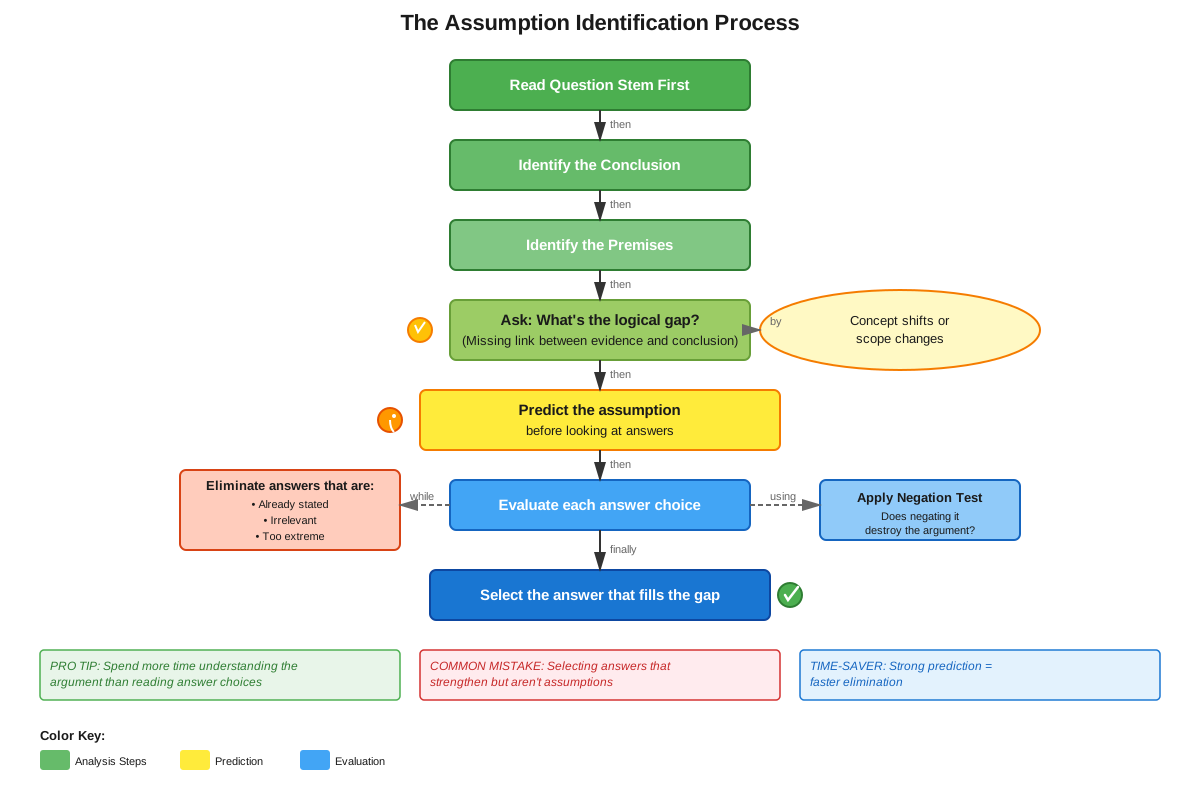
Identifying assumptions requires a systematic approach:
- Locate the conclusion: Determine exactly what the argument is trying to prove
- Identify the evidence: Note all stated premises supporting that conclusion
- Spot the gap: Recognize conceptual leaps between evidence and conclusion
- Articulate the bridge: Predict what unstated premise would connect evidence to conclusion
- Evaluate answer choices: Match predictions against provided options
This five-step process transforms assumption questions from intimidating challenges into manageable analytical tasks. The key is recognizing that assumptions always address the gap between what's stated and what's concluded.
Common Assumption Patterns
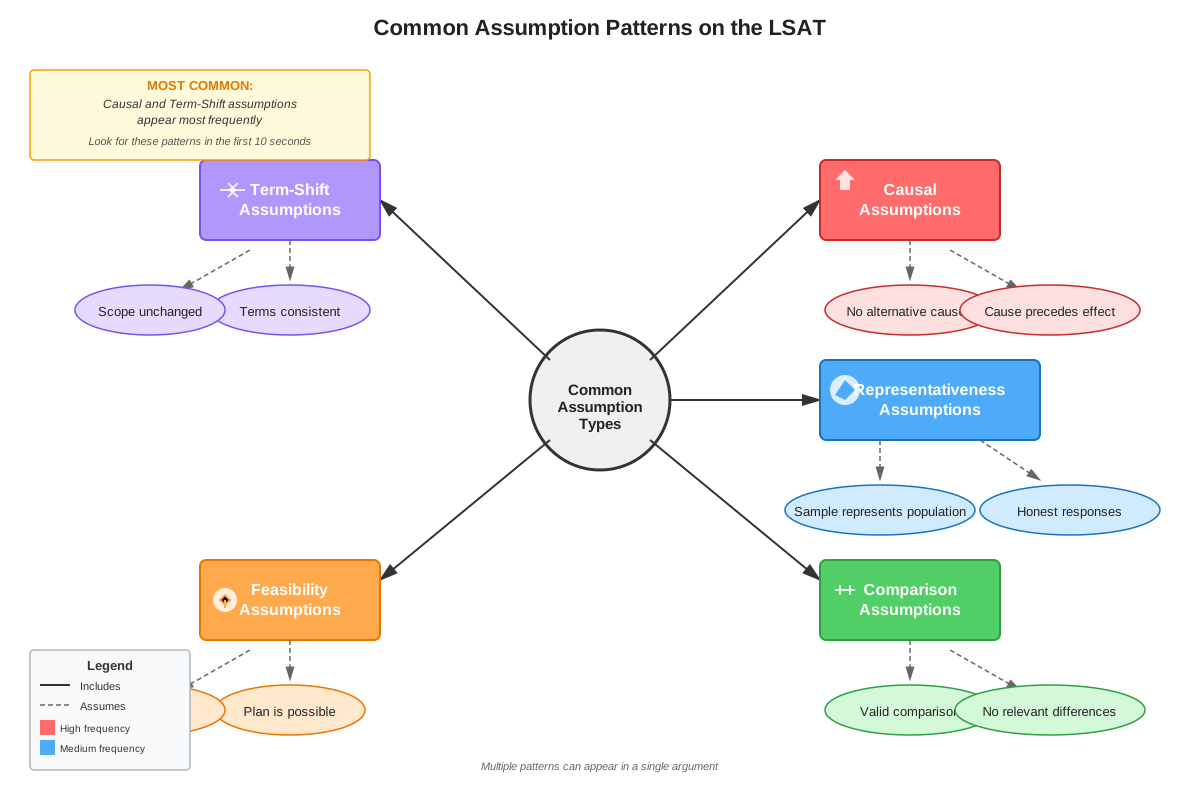
LSAT arguments exhibit recurring patterns in their assumptions. Recognizing these patterns accelerates assumption identification:
Causal Assumptions: When an argument concludes that X causes Y, it assumes:
- No alternative causes exist for Y
- The correlation between X and Y isn't coincidental
- No reverse causation (Y doesn't cause X instead)
Representativeness Assumptions: When generalizing from a sample, arguments assume:
- The sample accurately represents the larger population
- No relevant differences exist between observed and unobserved cases
- Sample size is adequate for the generalization
Comparison Assumptions: When comparing two things, arguments assume:
- The comparison is valid (comparing like to like)
- No relevant differences undermine the comparison
- The basis for comparison is appropriate
Plan/Recommendation Assumptions: When proposing a course of action, arguments assume:
- No significant obstacles will prevent implementation
- No unintended negative consequences will occur
- The proposed action will actually achieve the intended result
The Negation Technique
The negation technique is the most powerful tool for evaluating whether a statement is a necessary assumption. This method involves negating (reversing) an answer choice and determining whether that negation destroys the argument. If negating a statement causes the argument to fall apart, that statement is a necessary assumption.
Process:
- Take the answer choice
- Negate it (make it say the opposite)
- Apply the negated statement to the argument
- If the argument fails, the original statement is a necessary assumption
Example:
- Argument: "This medication reduced symptoms in clinical trials, so it will help patients in general practice"
- Potential Assumption: "Clinical trial participants are similar to general practice patients"
- Negation: "Clinical trial participants are NOT similar to general practice patients"
- Result: If they're not similar, the medication's trial success doesn't predict general practice success—the argument fails
- Conclusion: This is indeed a necessary assumption
Concept Relationships
The concepts within evaluating assumptions form an interconnected logical framework. The logical gap is the foundational concept—it must be identified before assumptions can be evaluated. Once the gap is recognized, understanding assumption types (necessary vs. sufficient) determines which analytical approach to apply. The assumption-identification process provides the systematic method for moving from gap recognition to answer selection, while common assumption patterns serve as shortcuts that accelerate this process.
These internal concepts connect to prerequisite knowledge in specific ways: basic argument structure enables identification of the logical gap, conditional reasoning helps recognize when sufficient assumptions create guaranteed conclusions, and distinguishing evidence from inference allows test-takers to separate stated premises from unstated assumptions.
Evaluating assumptions also connects forward to related Logical Reasoning topics. Mastering assumption evaluation enables success with Strengthen questions (which often add support by confirming assumptions), Weaken questions (which attack arguments by undermining assumptions), Flaw questions (which identify problematic assumptions), and Inference questions (which require understanding what must be true given stated premises).
Relationship Map:
Argument Structure → Logical Gap Identification → Assumption Type Recognition → Systematic Evaluation Process → Answer Selection → Application to Strengthen/Weaken/Flaw Questions
High-Yield Facts
⭐ An assumption is an unstated premise that must be true for an argument's conclusion to follow from its evidence
⭐ Every LSAT argument with a conclusion contains at least one assumption bridging the gap between evidence and conclusion
⭐ The negation technique is the definitive test for necessary assumptions: if negating a statement destroys the argument, that statement is a necessary assumption
⭐ Assumptions always address the logical gap—the conceptual distance between what's stated and what's concluded
⭐ Causal arguments assume no alternative explanations, no reverse causation, and that correlation isn't coincidental
- Necessary assumptions are minimum requirements; if false, the argument completely fails
- Sufficient assumptions, if true, guarantee the conclusion follows with certainty
- Representativeness assumptions appear whenever arguments generalize from samples to populations
- Comparison assumptions assert that the things being compared are relevantly similar
- Plan assumptions include both feasibility (can be done) and effectiveness (will achieve the goal)
- Assumptions are never explicitly stated in the argument—if it's written in the passage, it's not an assumption
- The correct answer to an assumption question often feels obvious once identified because it states something the argument clearly depends on
- Wrong answers often state irrelevant information, go too far beyond what's needed, or reverse the required relationship
- Defender assumptions rule out potential objections, while connector assumptions link different concepts in the argument
- Temporal assumptions appear when arguments assume conditions won't change over time
Quick check — test yourself on Evaluating assumptions so far.
Try Flashcards →Common Misconceptions
Misconception: Assumptions are the same as conclusions → Correction: Assumptions are unstated premises that support conclusions. Conclusions are what the argument is trying to prove; assumptions are what must be true for that proof to work. Conclusions are stated; assumptions are not.
Misconception: Any statement that strengthens an argument is an assumption → Correction: While assumptions do strengthen arguments when made explicit, not everything that strengthens an argument is an assumption. Assumptions are specifically required for the argument to work—they're necessary, not merely helpful. Many statements can strengthen an argument without being assumptions it depends on.
Misconception: The negation technique means choosing the opposite extreme → Correction: Negation means logical negation, not extreme opposition. To negate "all swans are white," say "not all swans are white" (meaning at least one isn't), not "no swans are white." Proper negation creates the minimal contradiction, not the maximum opposite.
Misconception: Assumptions must be realistic or true in the real world → Correction: LSAT assumptions only need to be what the argument depends on, regardless of real-world truth. An argument can assume something false or unrealistic; the question asks what the argument assumes, not what's actually true.
Misconception: Longer, more complex answer choices are more likely to be assumptions → Correction: Assumption answers are often simple, direct statements. Complexity doesn't indicate correctness. In fact, overly complicated answer choices often go beyond what the argument actually requires and are therefore incorrect.
Misconception: If an answer choice is true, it must be an assumption → Correction: Truth doesn't equal assumption. Many true statements are irrelevant to a particular argument. An assumption must be both required by the specific argument and unstated in the passage.
Worked Examples
Example 1: Causal Assumption
Argument: "After the city installed new streetlights in the downtown area, vandalism decreased by 40%. Therefore, the new streetlights caused the reduction in vandalism."
Question: Which one of the following is an assumption required by the argument?
Step 1 - Identify the conclusion: The new streetlights caused the reduction in vandalism.
Step 2 - Identify the evidence: After streetlight installation, vandalism decreased by 40%.
Step 3 - Spot the gap: The argument observes a correlation (streetlights installed, then vandalism decreased) and concludes causation (streetlights caused the decrease). This is a classic causal reasoning gap. The argument assumes no alternative explanations exist for the vandalism reduction.
Step 4 - Predict the assumption: The argument must assume that something else didn't cause the vandalism decrease. It must assume that the timing wasn't coincidental—that some other factor didn't reduce vandalism at the same time.
Step 5 - Evaluate answer choices:
(A) The new streetlights were more expensive than the old ones
- Analysis: Cost is irrelevant to whether streetlights caused the vandalism reduction. Eliminate.
(B) No other significant changes that might affect vandalism occurred during the same period
- Analysis: This directly addresses the gap! If other significant changes occurred (increased police patrols, economic improvement, etc.), those could explain the vandalism reduction instead of the streetlights. Let's test with negation: "Other significant changes that might affect vandalism DID occur during the same period." If true, this destroys the argument because those other changes could be the real cause. This is our answer.
(C) Vandalism is more likely to occur in poorly lit areas
- Analysis: While this supports the argument, it's not required. The argument could work even if vandalism occurs equally in all lighting conditions, as long as these specific streetlights somehow deterred vandalism. Not necessary.
(D) The city consulted with crime prevention experts before installing the streetlights
- Analysis: Who was consulted is irrelevant to whether the streetlights actually caused the reduction. Eliminate.
(E) Vandalism rates in other cities have also decreased recently
- Analysis: This would actually weaken the argument by suggesting a broader trend unrelated to these specific streetlights. Definitely not an assumption.
Answer: (B)
Connection to learning objectives: This example demonstrates identifying how evaluating assumptions appears in LSAT questions (causal reasoning pattern), explaining the reasoning pattern (correlation-to-causation gap), and applying the systematic process to solve accurately.
Example 2: Representativeness Assumption
Argument: "A survey of 500 smartphone users found that 73% prefer touchscreen keyboards to physical keyboards. This demonstrates that the majority of all mobile phone users prefer touchscreen keyboards."
Question: The argument depends on assuming which one of the following?
Step 1 - Identify the conclusion: The majority of all mobile phone users prefer touchscreen keyboards.
Step 2 - Identify the evidence: A survey of 500 smartphone users found 73% prefer touchscreen keyboards.
Step 3 - Spot the gap: The evidence discusses smartphone users specifically, but the conclusion extends to "all mobile phone users." This is a representativeness gap—the argument generalizes from a specific sample to a broader population. Additionally, the evidence mentions "touchscreen keyboards to physical keyboards" but doesn't address whether all mobile phones have these options.
Step 4 - Predict the assumption: The argument must assume that smartphone users are representative of all mobile phone users. It must also assume that the preferences of this sample reflect the preferences of the larger population.
Step 5 - Evaluate answer choices:
(A) The 500 smartphone users surveyed were randomly selected
- Analysis: While random selection would strengthen the survey's validity, the argument doesn't require this specific methodology. The argument could work even with non-random selection if the sample happened to be representative. Not necessary.
(B) Smartphone users' preferences regarding keyboards are similar to those of all mobile phone users
- Analysis: This directly bridges the gap between the evidence (smartphone users) and the conclusion (all mobile phone users). Apply negation: "Smartphone users' preferences are NOT similar to those of all mobile phone users." If true, the survey of smartphone users tells us nothing about all mobile phone users, destroying the argument. This is necessary.
(C) Physical keyboards are becoming less common on mobile phones
- Analysis: The trend in keyboard availability doesn't affect whether the survey results represent user preferences. Irrelevant.
(D) Touchscreen keyboards are more cost-effective for manufacturers to produce
- Analysis: Manufacturing costs don't affect user preferences or whether the sample represents the population. Eliminate.
(E) The survey asked about other phone features besides keyboards
- Analysis: What else the survey asked about is irrelevant to whether this specific finding represents all mobile phone users. Eliminate.
Answer: (B)
Connection to learning objectives: This example illustrates the representativeness assumption pattern, demonstrates the systematic evaluation process, and shows how to apply the negation technique to confirm a necessary assumption.
Exam Strategy
When approaching lsat evaluating assumptions questions, implement this strategic framework:
Recognition triggers: Watch for these question stems that signal assumption questions:
- "assumes which one of the following"
- "depends on assuming"
- "presupposes which one of the following"
- "takes for granted that"
- "requires the assumption that"
Pre-answer prediction strategy: Before looking at answer choices, invest 15-20 seconds articulating the logical gap and predicting what assumption would bridge it. This prediction serves as an anchor, making correct answers easier to recognize and incorrect answers easier to eliminate. Students who predict assumptions before reviewing choices answer these questions 30-40% faster with higher accuracy.
The negation test protocol: When uncertain between two answer choices, apply the negation technique systematically. Negate each contender and ask: "Does this negation destroy the argument?" The answer choice whose negation causes the argument to fail is the necessary assumption. This technique is especially powerful when down to two seemingly plausible options.
Process of elimination tactics:
- Eliminate answers that are too strong: If an answer uses extreme language (all, none, never, always) and the argument doesn't require such an extreme claim, eliminate it
- Eliminate answers that are irrelevant: If an answer discusses concepts not mentioned or implied in the argument, it cannot be an assumption the argument depends on
- Eliminate answers that reverse the relationship: If an answer states the opposite of what the argument needs, eliminate immediately
- Eliminate answers that strengthen but aren't necessary: Some answers would help the argument if true but aren't required for it to work
Time allocation: Spend approximately 1:15-1:30 per assumption question. Allocate time as follows:
- 20-25 seconds: Read and understand the argument
- 15-20 seconds: Identify the gap and predict the assumption
- 30-40 seconds: Evaluate answer choices
- 10-15 seconds: Confirm with negation if needed
Exam Tip: If you're struggling to identify the gap, ask yourself: "What concept appears in the conclusion but not in the evidence?" or "What concept appears in the evidence but not in the conclusion?" The assumption almost always connects these disparate concepts.
Common trap patterns to avoid:
- The "true but irrelevant" trap: Answer choices that state something true about the topic but don't address the specific logical gap in this argument
- The "reversal" trap: Answer choices that state the opposite of what the argument needs, often using similar language to the correct answer
- The "too far" trap: Answer choices that go beyond what the argument requires, making claims stronger or broader than necessary
Memory Techniques
BRIDGE acronym for the assumption identification process:
- Build understanding of the argument structure
- Recognize the conclusion clearly
- Identify all stated evidence
- Detect the gap between evidence and conclusion
- Generate a prediction for what bridges the gap
- Evaluate answers against your prediction
The "Invisible Glue" visualization: Picture arguments as two separate blocks (evidence and conclusion) floating in space. The assumption is the invisible glue that holds them together. If you remove the glue (negate the assumption), the blocks fall apart (the argument fails). This mental image reinforces that assumptions are both necessary and unstated.
SCAN mnemonic for common assumption patterns:
- Sample representativeness (generalizations)
- Causation (correlation-to-cause arguments)
- Analogies and comparisons (similarity assumptions)
- No obstacles (plan/recommendation assumptions)
The "What if not?" technique: When evaluating whether something is an assumption, simply ask "What if not?" If the answer is "the argument falls apart," you've found an assumption. This is a simplified version of the negation technique that's easier to remember under test pressure.
Assumption vs. Conclusion distinction: Remember "Assumptions are INvisible, Conclusions are OUT loud" (IN = unstated, OUT = stated). This simple phrase helps prevent the common error of confusing assumptions with conclusions.
Summary
Evaluating assumptions represents a cornerstone skill for LSAT Logical Reasoning success, requiring test-takers to identify unstated premises that bridge logical gaps between evidence and conclusions. Every argument with a logical gap depends on at least one assumption—an implicit belief the author takes for granted without stating explicitly. Mastering this topic requires understanding the distinction between necessary assumptions (minimum requirements for the argument to work) and sufficient assumptions (guarantees that make the conclusion follow with certainty), recognizing common assumption patterns (causal, representativeness, comparison, and plan assumptions), and applying systematic evaluation techniques, particularly the negation test. Success on assumption questions depends on identifying the logical gap, predicting what would bridge that gap before reviewing answer choices, and eliminating wrong answers that are irrelevant, too extreme, or merely strengthen without being necessary. This skill directly impacts performance on 40-50% of Logical Reasoning questions, making it one of the highest-yield topics for LSAT preparation.
Key Takeaways
- Assumptions are unstated premises that must be true for an argument's conclusion to follow from its stated evidence—they bridge the logical gap
- The negation technique definitively identifies necessary assumptions: if negating a statement destroys the argument, that statement is a necessary assumption
- Every LSAT argument contains a logical gap between evidence and conclusion; identifying this gap is the first step to evaluating assumptions
- Common assumption patterns (causal, representativeness, comparison, plan) appear repeatedly on the LSAT and can be recognized through trigger words and argument structures
- Predict the assumption before reviewing answer choices to improve both speed and accuracy
- Wrong answers often strengthen the argument without being necessary, discuss irrelevant information, or go too far beyond what the argument requires
- Assumption mastery directly enables success on Strengthen, Weaken, Flaw, and other argument-based question types
Related Topics
Necessary Assumption Questions: These questions explicitly ask test-takers to identify assumptions required by arguments. Mastering evaluating assumptions provides the foundation for these direct application questions, which appear 2-4 times per Logical Reasoning section.
Sufficient Assumption Questions: These questions require identifying statements that, if true, would guarantee the conclusion follows. Understanding assumption types enables distinguishing between what's necessary versus what's sufficient.
Strengthen and Weaken Questions: These question types often work by confirming or undermining an argument's assumptions. Recognizing assumptions allows test-takers to predict what would strengthen or weaken arguments before reviewing answer choices.
Flaw Questions: Many logical flaws involve problematic assumptions—recognizing what an argument assumes enables identifying why that assumption is problematic. This topic builds directly on assumption evaluation skills.
Argument Structure and Method of Reasoning: Understanding how assumptions function within argument structure deepens comprehension of how arguments work mechanically, enabling more sophisticated analysis of complex reasoning patterns.
Practice CTA
Now that you understand the core concepts and strategies for evaluating assumptions, it's time to apply this knowledge to actual LSAT-style questions. The practice questions and flashcards designed for this topic will reinforce your ability to identify logical gaps, predict assumptions, and apply the negation technique under timed conditions. Remember: assumption evaluation is a skill that improves dramatically with deliberate practice. Each question you work through strengthens your pattern recognition and speeds up your analytical process. Approach the practice materials systematically, reviewing not just which answers are correct but why incorrect answers fail to bridge the logical gap. Your investment in mastering this high-yield topic will pay dividends across multiple question types throughout the Logical Reasoning sections. You've built the foundation—now it's time to construct expertise through application.
Sign up free to keep reading
Create a free AnvayaPrep account to finish this LSAT guide on Evaluating assumptions — plus flashcards and practice questions.