Overview
Evaluating surveys is a critical skill within the LSAT's Logical Reasoning section, appearing frequently in questions that ask test-takers to assess the strength, validity, or reliability of survey-based arguments. Survey questions on the LSAT typically present an argument that relies on survey data to support a conclusion, then ask students to identify flaws, strengthen or weaken the argument, or determine what additional information would be most helpful in evaluating the conclusion. Understanding how to critically analyze surveys requires recognizing the methodological assumptions underlying survey research and identifying the specific vulnerabilities that can undermine survey-based reasoning.
The importance of this topic extends beyond isolated survey questions. LSAT evaluating surveys questions test fundamental critical thinking skills that appear throughout the Logical Reasoning section: the ability to identify unstated assumptions, recognize sampling issues, detect response bias, and understand how data collection methods affect the validity of conclusions. These questions frequently appear as Weaken, Strengthen, Flaw, and Evaluate and Complete the Argument question types, making survey evaluation one of the most versatile and high-yield topics for LSAT preparation.
Mastering survey evaluation connects directly to broader Logical Reasoning competencies, including causal reasoning, statistical arguments, and representativeness concerns. Students who excel at evaluating surveys develop a systematic approach to questioning evidence quality—a skill that proves invaluable across all argument-based questions on the LSAT. This topic serves as a bridge between understanding formal logical structures and applying practical reasoning to real-world evidence, making it essential for achieving a competitive score on the Logical Reasoning section.
Learning Objectives
- [ ] Identify how Evaluating surveys appears in LSAT questions
- [ ] Explain the reasoning pattern behind Evaluating surveys
- [ ] Apply Evaluating surveys to solve LSAT-style problems accurately
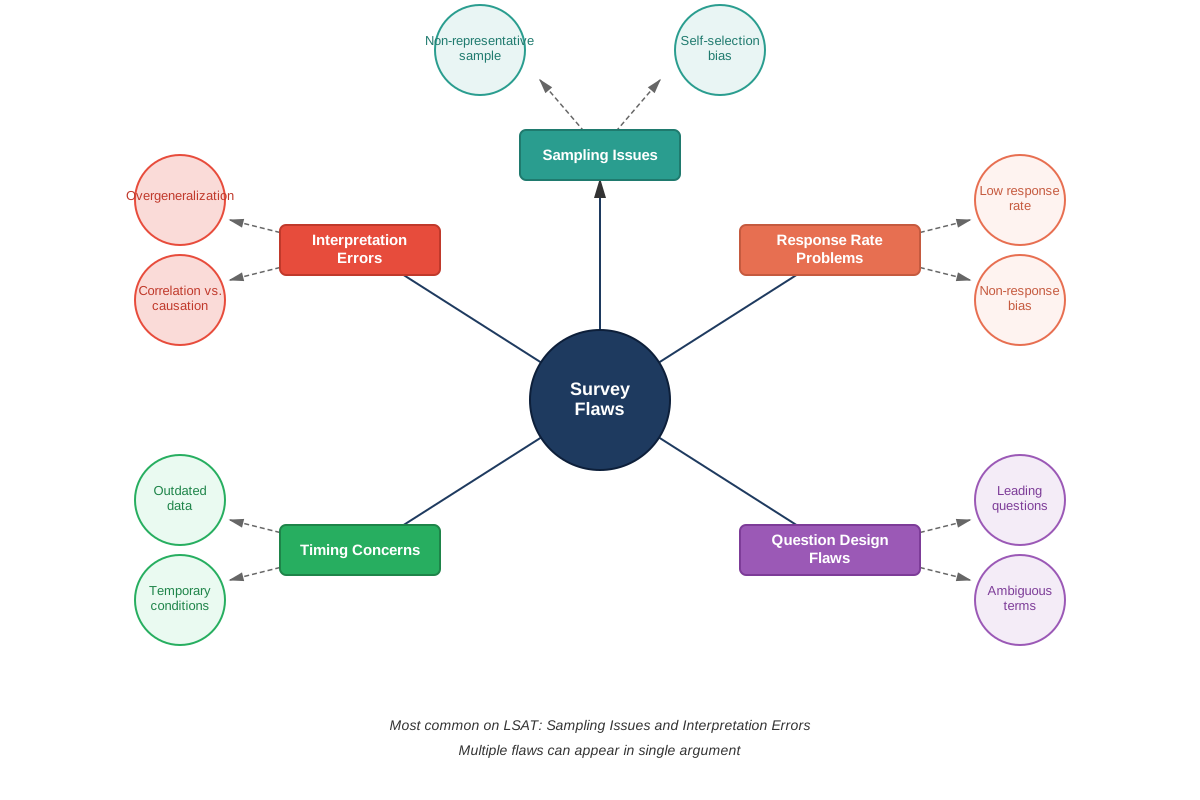
- [ ] Recognize the five major categories of survey flaws (sampling, response rate, question design, timing, and interpretation)
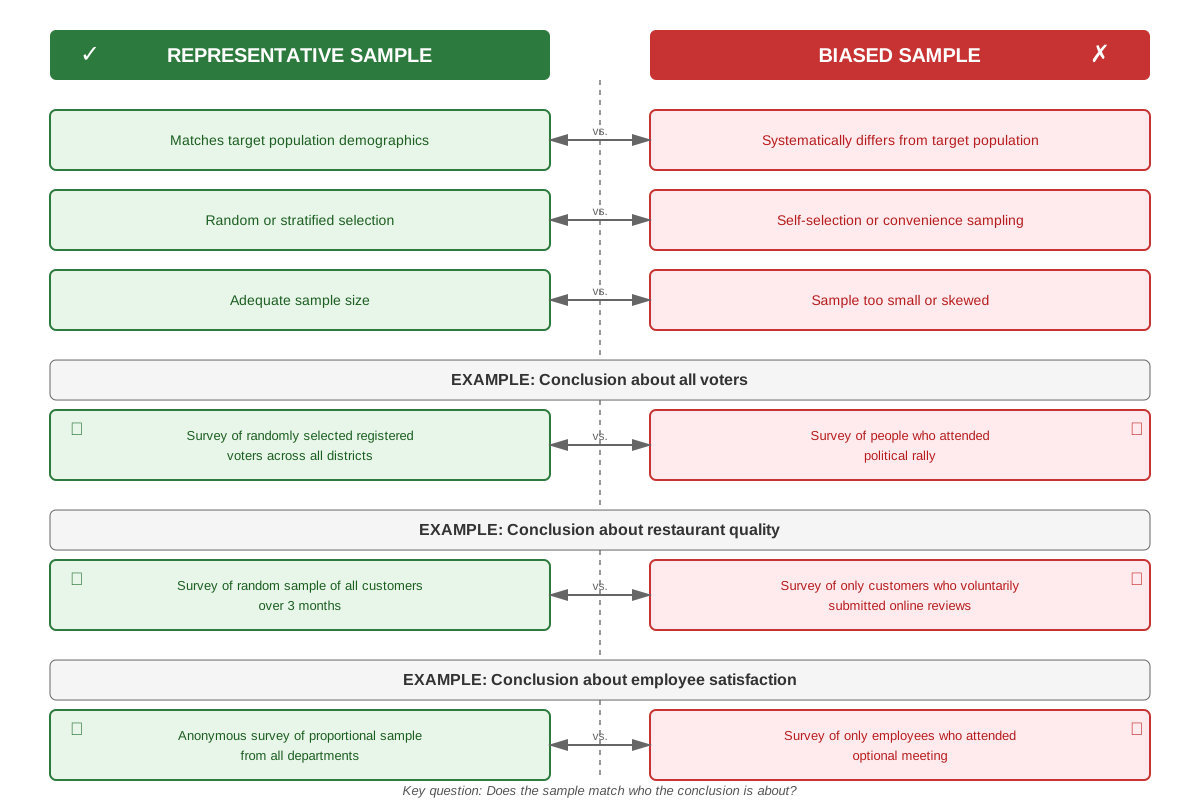
- [ ] Distinguish between representative and biased samples in survey-based arguments
- [ ] Evaluate whether survey conclusions are appropriately limited to the population actually surveyed
- [ ] Identify when answer choices introduce relevant versus irrelevant considerations for evaluating survey validity
Prerequisites
- Basic argument structure: Understanding premises, conclusions, and how evidence supports claims is essential because survey questions require identifying what the survey data actually establishes versus what the argument claims it establishes
- Assumption identification: Recognizing unstated assumptions is necessary because survey arguments depend on implicit assumptions about sample representativeness, respondent honesty, and question neutrality
- Strengthen and Weaken question types: Familiarity with these question formats is important because many survey questions ask how to strengthen or weaken survey-based arguments
- Causal reasoning fundamentals: Understanding correlation versus causation helps because surveys often measure correlations that arguments incorrectly interpret as causal relationships
Why This Topic Matters
Survey evaluation questions appear with remarkable frequency on the LSAT, typically comprising 2-4 questions per Logical Reasoning section. This translates to approximately 8-16% of all Logical Reasoning questions across a typical LSAT exam. The prevalence of survey questions reflects their effectiveness in testing multiple reasoning skills simultaneously: critical analysis of evidence, recognition of methodological flaws, and understanding of statistical representativeness.
In real-world applications, the ability to evaluate surveys critically is fundamental to legal practice. Attorneys regularly encounter survey evidence in cases involving trademark confusion, employment discrimination, consumer protection, and public opinion. Courts frequently admit survey evidence, and lawyers must be able to challenge or defend the methodology, sampling procedures, and interpretation of survey results. The LSAT tests this practical reasoning skill because it directly predicts success in legal analysis.
Survey questions commonly appear in several formats on the LSAT: Flaw questions that ask students to identify methodological problems; Weaken questions that require finding information that undermines survey validity; Strengthen questions that ask what would make the survey more reliable; and Evaluate questions that require determining what additional information is most relevant to assessing the argument's strength. Additionally, survey-based arguments frequently appear in Assumption questions, where the correct answer identifies a necessary assumption about the survey's methodology or the representativeness of its sample.
Core Concepts
Understanding Survey-Based Arguments
A survey-based argument uses data collected from a sample of individuals to draw conclusions about a larger population or to support a claim about preferences, behaviors, or beliefs. The fundamental logical structure involves three components: (1) a survey methodology that collects data from a specific group, (2) the survey results themselves, and (3) a conclusion that extends beyond the raw data. The gap between what the survey actually shows and what the argument concludes creates opportunities for logical vulnerabilities.
The strength of any survey-based argument depends on whether the survey methodology supports the specific conclusion drawn. LSAT questions exploit this relationship by presenting arguments where the conclusion overreaches the survey evidence, where the sample doesn't represent the target population, or where the survey design introduces bias that undermines the results' reliability.
The Five Major Categories of Survey Flaws
1. Sampling Problems
Sampling issues represent the most common category of survey flaws on the LSAT. A sample is the subset of a population that actually participates in the survey, while the population is the entire group about which the argument draws conclusions. For a survey to support valid conclusions, the sample must be representative of the target population—meaning it must reflect the relevant characteristics of that population in appropriate proportions.
Common sampling problems include:
- Self-selection bias: When survey participants choose whether to participate, those who respond may differ systematically from non-respondents in ways that affect the results
- Convenience sampling: Surveying only easily accessible individuals (e.g., people at a specific location or time) may exclude important segments of the population
- Sample size inadequacy: Too small a sample may not capture the diversity of the population
- Demographic mismatch: When the sample's characteristics (age, income, education, etc.) don't match the population about which conclusions are drawn
2. Response Rate and Non-Response Bias
The response rate is the percentage of surveyed individuals who actually complete the survey. Low response rates create vulnerability because non-respondents may differ systematically from respondents. If only 10% of surveyed individuals respond, the 90% who didn't respond might hold dramatically different views, making the results unrepresentative.
Non-response bias occurs when the characteristics that make someone likely to respond correlate with the survey topic. For example, if a survey about customer satisfaction only captures responses from highly satisfied or highly dissatisfied customers (while moderately satisfied customers ignore the survey), the results will misrepresent the true distribution of satisfaction levels.
3. Question Design and Wording
How survey questions are phrased dramatically affects responses. Leading questions suggest a desired answer, loaded questions contain emotionally charged language, and ambiguous questions allow different interpretations. The LSAT frequently tests whether students recognize that question wording could bias results.
Examples of problematic question design:
- Questions that assume facts not in evidence ("How much do you enjoy our excellent service?")
- Double-barreled questions that ask about multiple issues simultaneously
- Questions with limited response options that don't capture the full range of possible answers
- Questions whose interpretation depends on subjective terms without clear definitions
4. Timing and Context
When a survey is conducted can significantly affect results. Surveys conducted immediately after a specific event may capture temporary reactions rather than stable opinions. Temporal bias occurs when the timing of the survey systematically affects responses in ways that make them unrepresentative of typical conditions.
Context effects include:
- Surveying during atypical periods (holidays, crises, special events)
- Order effects where earlier questions influence responses to later questions
- Interviewer effects where the presence or characteristics of an interviewer affects responses
- Mode effects where the survey method (phone, online, in-person) influences who participates and how they respond
5. Interpretation and Scope
Even methodologically sound surveys can support flawed arguments if the conclusion misinterprets or overgeneralizes the results. Common interpretation problems include:
- Scope mismatch: Drawing conclusions about a different population than was surveyed
- Causal inference from correlation: Assuming survey correlations demonstrate causal relationships
- Ignoring alternative explanations: Failing to consider other factors that could explain survey results
- Temporal overgeneralization: Assuming survey results from one time period apply to different time periods
The Representativeness Principle
The representativeness principle is the foundational concept underlying survey evaluation: a sample can only support conclusions about populations it accurately represents. This principle has several important implications:
| Aspect | Requirement | LSAT Application |
|---|---|---|
| Population definition | The target population must be clearly defined | Arguments often blur who the conclusion is about |
| Sample characteristics | Sample demographics must match population demographics | Wrong answer choices often introduce irrelevant demographic information |
| Relevant characteristics | The sample must match the population on characteristics relevant to the survey topic | Students must identify which characteristics matter for the specific conclusion |
| Sampling method | The method of selecting participants must not systematically exclude segments | Random sampling is generally superior to convenience sampling |
Survey Validity vs. Argument Validity
A crucial distinction for LSAT success is recognizing that a survey can be methodologically sound while the argument using that survey remains flawed. Conversely, even a flawed survey might support a limited conclusion. Students must evaluate:
- Internal validity: Does the survey measure what it claims to measure?
- External validity: Can the results be generalized to the target population?
- Conclusion appropriateness: Does the argument's conclusion stay within the bounds of what the survey actually establishes?
Concept Relationships
The concepts within survey evaluation form an interconnected system where each element affects the others. Sampling problems directly impact representativeness, which determines whether conclusions can be validly extended from the sample to the population. Response rate issues compound sampling problems because non-response can transform an initially representative sample into a biased one. Question design flaws undermine internal validity, making even a perfectly representative sample produce unreliable data.
The relationship flows as follows: Survey Design (question wording, methodology) → Data Collection (sampling method, response rate) → Results (what the data actually shows) → Interpretation (what conclusions the data supports). LSAT questions can attack any point in this chain, and students must identify where the specific vulnerability lies.
Survey evaluation connects to prerequisite topics through shared logical principles. Assumption identification skills apply directly because survey arguments depend on unstated assumptions about methodology. Causal reasoning connects because surveys often measure correlations that arguments treat as causal. Strengthen and Weaken question strategies apply because survey questions frequently ask what would make the argument more or less convincing.
The relationship to broader Logical Reasoning concepts: Survey Evaluation → Statistical Reasoning → Evidence Quality Assessment → Argument Evaluation. Mastering survey evaluation develops the critical thinking skills needed for all evidence-based arguments, not just those explicitly involving surveys.
High-Yield Facts
⭐ The most common survey flaw on the LSAT is sample non-representativeness—the surveyed group differs systematically from the population about which conclusions are drawn.
⭐ Self-selection bias occurs when survey participants choose whether to respond, making respondents potentially unrepresentative of the broader population.
⭐ A low response rate creates vulnerability because non-respondents may differ systematically from respondents in ways relevant to the survey topic.
⭐ Question wording can bias results—leading questions, loaded language, and ambiguous terms all undermine survey validity.
⭐ Survey results about one population cannot automatically be generalized to a different population without additional justification.
- The timing of a survey can affect results if conducted during atypical circumstances or immediately after events that temporarily influence opinions.
- A large sample size does not compensate for a biased sampling method—a huge but unrepresentative sample remains unreliable.
- Survey questions with limited response options may fail to capture the full range of respondent views.
- The method of survey administration (phone, online, in-person) can affect both who participates and how they respond.
- Correlation found in survey data does not establish causation without additional evidence ruling out alternative explanations.
- Anonymous surveys may produce more honest responses than identified surveys, particularly on sensitive topics.
- Survey conclusions should be limited to the time period when the survey was conducted unless evidence supports temporal generalization.
Quick check — test yourself on Evaluating surveys so far.
Try Flashcards →Common Misconceptions
Misconception: A large sample size automatically makes a survey reliable and representative.
Correction: Sample size matters far less than sampling method. A massive sample drawn through biased methods (like surveying only people at a specific location) remains unrepresentative. A smaller random sample is superior to a larger biased sample.
Misconception: If a survey finds a correlation between two variables, this demonstrates that one causes the other.
Correction: Surveys can establish correlation but cannot alone prove causation. Alternative explanations, reverse causation, and confounding variables must be ruled out before inferring causal relationships from survey data.
Misconception: Survey results are invalid if any methodological imperfection exists.
Correction: The question is whether the specific flaw undermines the specific conclusion drawn. Minor imperfections may not affect the argument's validity, while major flaws in areas directly relevant to the conclusion do undermine it. LSAT questions test the ability to identify which flaws actually matter for the conclusion at hand.
Misconception: If survey respondents have no reason to lie, their responses can be taken at face value.
Correction: Even honest respondents may lack accurate self-knowledge, may misremember, may be influenced by question wording, or may interpret questions differently than intended. Additionally, social desirability bias can affect responses even when respondents intend to be truthful.
Misconception: Random sampling means surveying random people encountered in a random location.
Correction: True random sampling means every member of the target population has an equal probability of being selected. Surveying random people at a mall is still convenience sampling because it systematically excludes people who don't visit that mall, making it non-random with respect to the broader population.
Misconception: If a survey question seems clear to the survey designer, it will be clear to all respondents.
Correction: Question ambiguity is determined by how respondents interpret questions, not by the designer's intent. Terms that seem unambiguous may have different meanings to different demographic groups or in different contexts.
Worked Examples
Example 1: Identifying Sample Representativeness Issues
Question Stem: "Which of the following, if true, most weakens the argument?"
Argument: "A recent survey of subscribers to Gourmet Cooking Magazine found that 78% prefer gas stoves to electric stoves. This demonstrates that most home cooks prefer gas stoves for their cooking needs."
Analysis Process:
Step 1: Identify the survey methodology and sample.
- Sample: Subscribers to Gourmet Cooking Magazine
- Survey finding: 78% prefer gas stoves
Step 2: Identify the conclusion.
- Conclusion: Most home cooks prefer gas stoves
Step 3: Identify the logical gap.
- The argument assumes subscribers to Gourmet Cooking Magazine are representative of "home cooks" generally
- This is a scope mismatch—the sample is a specialized subset of the target population
Step 4: Determine what would weaken the argument.
- Information showing that magazine subscribers differ from typical home cooks in ways relevant to stove preference would weaken the argument
- The correct answer would likely indicate that subscribers are not representative of home cooks generally
Correct Answer Type: "Subscribers to Gourmet Cooking Magazine are more likely than typical home cooks to value the precise temperature control that gas stoves provide."
Why this weakens: This shows the sample is systematically different from the target population in a way directly relevant to the conclusion, undermining the representativeness assumption.
Connection to Learning Objectives: This example demonstrates how to identify survey flaws (sampling bias), explain the reasoning pattern (assumption of representativeness), and apply this knowledge to select the correct answer.
Example 2: Evaluating Response Rate Issues
Question Stem: "The argument is most vulnerable to criticism on the grounds that it fails to consider whether..."
Argument: "City officials mailed surveys to 10,000 residents asking whether they support the proposed park renovation. Of the 800 surveys returned, 650 indicated support for the renovation. Therefore, the majority of city residents support the proposed park renovation."
Analysis Process:
Step 1: Calculate the response rate.
- 800 returned out of 10,000 sent = 8% response rate
Step 2: Identify the conclusion.
- Conclusion: The majority of city residents support the renovation
Step 3: Identify the assumption.
- The argument assumes the 800 respondents are representative of all 10,000 surveyed residents (and by extension, all city residents)
- With only 8% responding, the 92% who didn't respond might have very different views
Step 4: Determine what the argument fails to consider.
- The argument doesn't consider whether non-respondents differ from respondents in their support for the renovation
- This is a non-response bias vulnerability
Correct Answer Type: "...those who did not return the survey are less likely to support the renovation than those who did return it."
Why this identifies the flaw: The argument treats the 8% who responded as representative of the entire population, but if non-respondents are systematically different (specifically, less supportive), then the conclusion is unwarranted. The low response rate creates vulnerability because the vast majority of surveyed individuals didn't respond, and their views could dramatically differ from respondents' views.
Alternative vulnerability: The argument also assumes the 10,000 surveyed residents represent all city residents, but the question stem would guide you to the most significant flaw.
Connection to Learning Objectives: This example shows how to identify response rate issues, explain why low response rates create logical vulnerabilities, and recognize how LSAT questions test this concept through "fails to consider" question formats.
Exam Strategy
Approaching Survey Questions Systematically
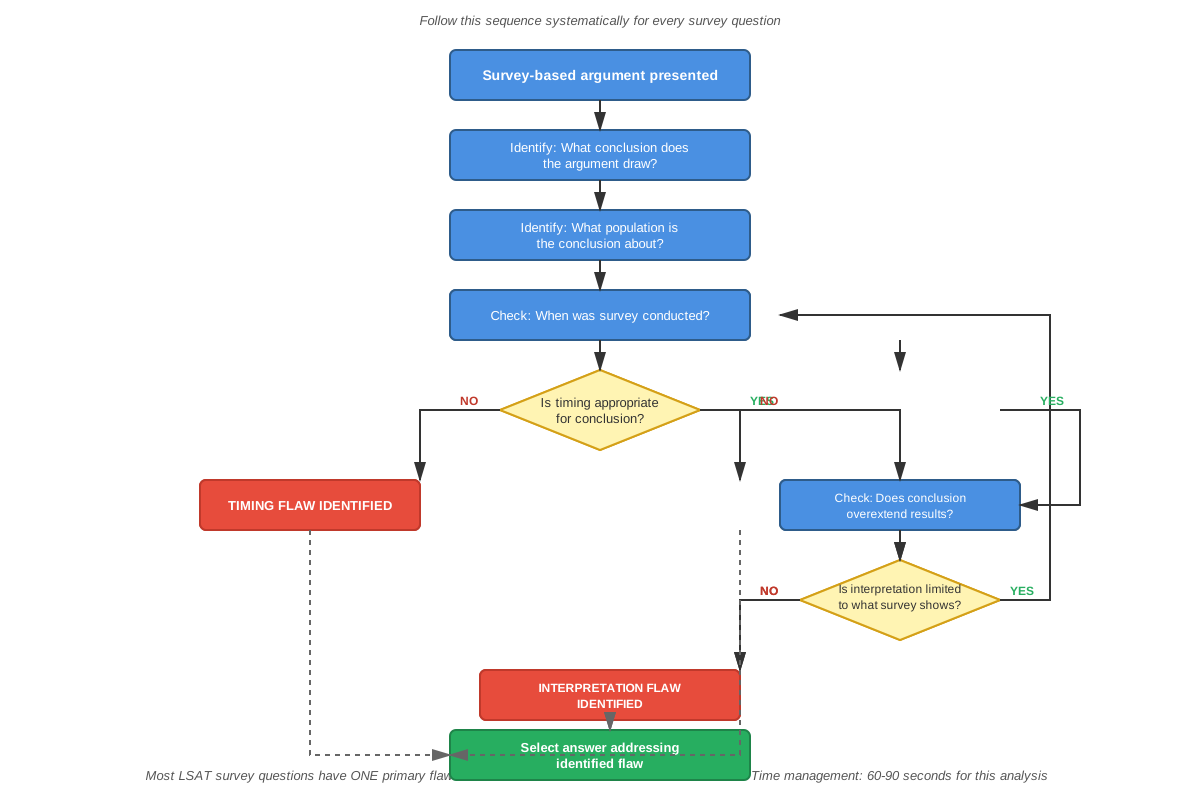
When encountering a survey-based argument on the LSAT, follow this systematic approach:
- Identify the three key elements: (a) Who was surveyed? (b) What did the survey find? (c) What conclusion does the argument draw?
- Look for scope mismatches: Does the conclusion extend beyond the surveyed population? If the survey asked college students but the conclusion is about "young people generally," that's a red flag.
- Check for sampling issues: How were survey participants selected? Self-selected samples, convenience samples, and samples from specialized populations all create vulnerabilities.
- Consider response rate: If mentioned, a low response rate signals potential non-response bias. If not mentioned, this might be what the argument "fails to consider."
- Evaluate question design: Could the question wording, structure, or response options bias results?
Trigger Words and Phrases
Watch for these phrases that signal survey-based arguments:
- "A survey of..." / "A poll found..." / "When asked..."
- "X percent of respondents..." / "The majority of those surveyed..."
- "According to a recent study..." (when the study is survey-based)
- "Subscribers to..." / "Members of..." / "Customers who..."
- "Those who responded..." / "Of those surveyed..."
These phrases often indicate sampling or response rate issues:
- "Subscribers" or "members" (specialized, potentially unrepresentative sample)
- "Those who responded" (signals potential non-response bias)
- "Randomly selected people at [location]" (convenience sampling disguised as random)
- "Volunteers" or "chose to participate" (self-selection bias)
Process of Elimination Tips
For Weaken questions:
- Eliminate answers that make the sample MORE representative
- Eliminate answers about issues unrelated to the survey methodology or the specific conclusion
- Keep answers that show the sample differs from the target population in relevant ways
- Keep answers that suggest question bias, low response rates, or timing issues
For Strengthen questions:
- Eliminate answers that introduce new flaws
- Keep answers that address potential sampling problems
- Keep answers that show the sample IS representative
- Keep answers that rule out alternative explanations for survey results
For Flaw questions:
- The correct answer will often use language like "takes for granted that the sample is representative" or "overlooks the possibility that non-respondents differ from respondents"
- Eliminate answers that describe flaws not present in the argument
- Focus on answers that identify assumptions about methodology or representativeness
For Assumption questions:
- The correct answer will often state that the sample is representative, that respondents answered honestly, or that the question was understood as intended
- Use the negation test: if negating the answer choice destroys the argument, it's a necessary assumption
Time Allocation
Survey questions typically require 1:15 to 1:30 to answer accurately. Spend:
- 20-30 seconds reading and identifying the survey structure
- 15-20 seconds identifying the logical gap
- 30-40 seconds evaluating answer choices
Don't rush these questions—they reward systematic analysis and often have tempting wrong answers that address irrelevant issues.
Memory Techniques
The SQRIP Mnemonic
Remember the five major categories of survey flaws with SQRIP:
- Sampling (Is the sample representative?)
- Question design (Is the wording biased or ambiguous?)
- Response rate (Did enough people respond? Do non-respondents differ?)
- Interpretation (Does the conclusion match what the survey shows?)
- Period/timing (When was the survey conducted? Does timing affect results?)
The Representativeness Checklist
Visualize a bridge connecting the sample to the population. The bridge holds only if:
- The sample is drawn from the target population (not a different group)
- The sampling method doesn't systematically exclude segments
- Respondents are similar to non-respondents
- The sample size is adequate
- Relevant characteristics match between sample and population
If any support beam is weak, the bridge collapses and the conclusion cannot be supported.
The Three Questions Technique
For any survey argument, ask:
- WHO? Who was surveyed vs. who is the conclusion about?
- HOW? How were participants selected and how were questions asked?
- WHAT? What does the data actually show vs. what does the argument claim?
Gaps between these elements reveal the argument's vulnerabilities.
Summary
Evaluating surveys on the LSAT requires systematic analysis of the relationship between survey methodology and the conclusions drawn from survey data. The fundamental principle is representativeness: a sample can only support conclusions about populations it accurately represents. The five major categories of survey flaws—sampling problems, response rate issues, question design bias, timing concerns, and interpretation errors—provide a framework for identifying vulnerabilities in survey-based arguments. LSAT questions exploit these vulnerabilities by presenting arguments where the surveyed sample doesn't represent the target population, where low response rates create non-response bias, where question wording could bias results, or where conclusions overgeneralize survey findings. Success requires identifying which specific flaw undermines the particular conclusion drawn, distinguishing between relevant and irrelevant considerations, and recognizing that even methodologically sound surveys can support flawed arguments if the conclusion extends beyond what the data establishes. Mastering survey evaluation develops critical thinking skills applicable throughout the Logical Reasoning section, making this high-yield topic essential for LSAT success.
Key Takeaways
- Sample representativeness is the most frequently tested concept—always check whether the surveyed group matches the population about which conclusions are drawn
- Self-selection and convenience sampling create systematic bias that large sample sizes cannot overcome
- Low response rates signal potential non-response bias—those who respond may differ from those who don't in ways relevant to the survey topic
- Question wording can bias results through leading language, ambiguous terms, or limited response options
- Scope mismatches between the sample and conclusion represent a common and easily identifiable flaw
- Survey timing and context affect results—surveys during atypical periods may not reflect typical conditions
- The SQRIP framework (Sampling, Question design, Response rate, Interpretation, Period/timing) provides a systematic approach to identifying survey flaws on the LSAT
Related Topics
Causal Reasoning: Survey evaluation connects directly to causal reasoning because surveys often establish correlations that arguments incorrectly interpret as causal relationships. Mastering survey evaluation provides the foundation for recognizing when correlation does and doesn't support causal conclusions.
Statistical Arguments: Beyond surveys, the LSAT tests reasoning about studies, experiments, and statistical data. The principles of sample representativeness and data interpretation learned through survey evaluation apply broadly to all statistical reasoning questions.
Strengthen and Weaken Questions: Survey-based arguments frequently appear in Strengthen and Weaken questions. The skills developed through survey evaluation—identifying assumptions, recognizing methodological flaws, and determining what information would affect argument strength—transfer directly to these question types.
Necessary Assumption Questions: Survey arguments depend on unstated assumptions about methodology, representativeness, and respondent honesty. Practicing survey evaluation sharpens the ability to identify necessary assumptions across all argument types.
Practice CTA
Now that you've mastered the core concepts of evaluating surveys, it's time to apply this knowledge to actual LSAT questions. The practice questions and flashcards will reinforce your understanding and develop the pattern recognition skills essential for quickly identifying survey flaws under timed conditions. Remember: survey questions reward systematic analysis using the SQRIP framework. Each practice question you complete strengthens your ability to spot sampling issues, response rate problems, and scope mismatches—skills that will serve you throughout the Logical Reasoning section. Approach the practice materials with confidence, knowing that survey evaluation is one of the most learnable and high-yield topics on the LSAT!
Sign up free to keep reading
Create a free AnvayaPrep account to finish this LSAT guide on Evaluating surveys — plus flashcards and practice questions.