Overview
Information relevance is a critical skill tested throughout the LSAT's Logical Reasoning section, particularly in questions that ask test-takers to evaluate arguments or complete them with the most appropriate conclusion or premise. At its core, information relevance requires the ability to distinguish between facts, claims, and evidence that genuinely strengthen, weaken, or bear upon an argument versus those that are tangential, irrelevant, or merely associated with the topic without logical connection. This skill goes beyond simple reading comprehension—it demands precise analytical thinking about what information actually matters to the logical structure of an argument.
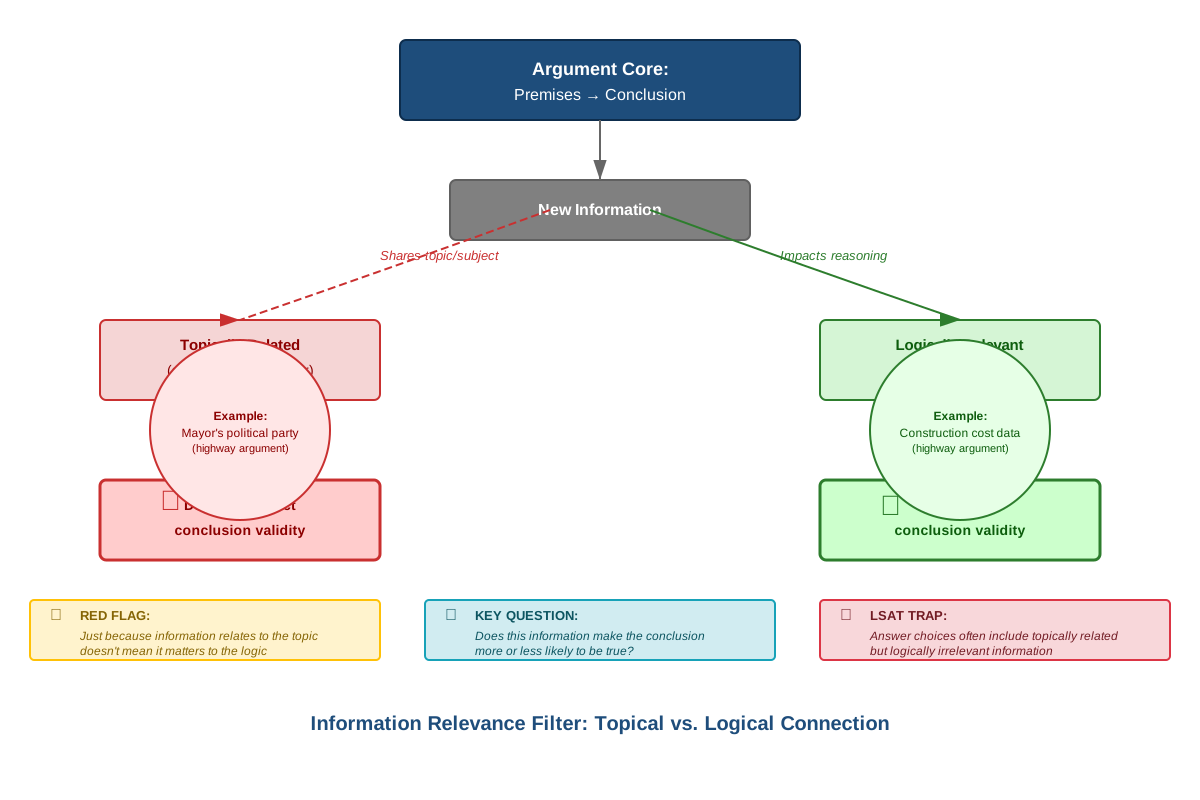
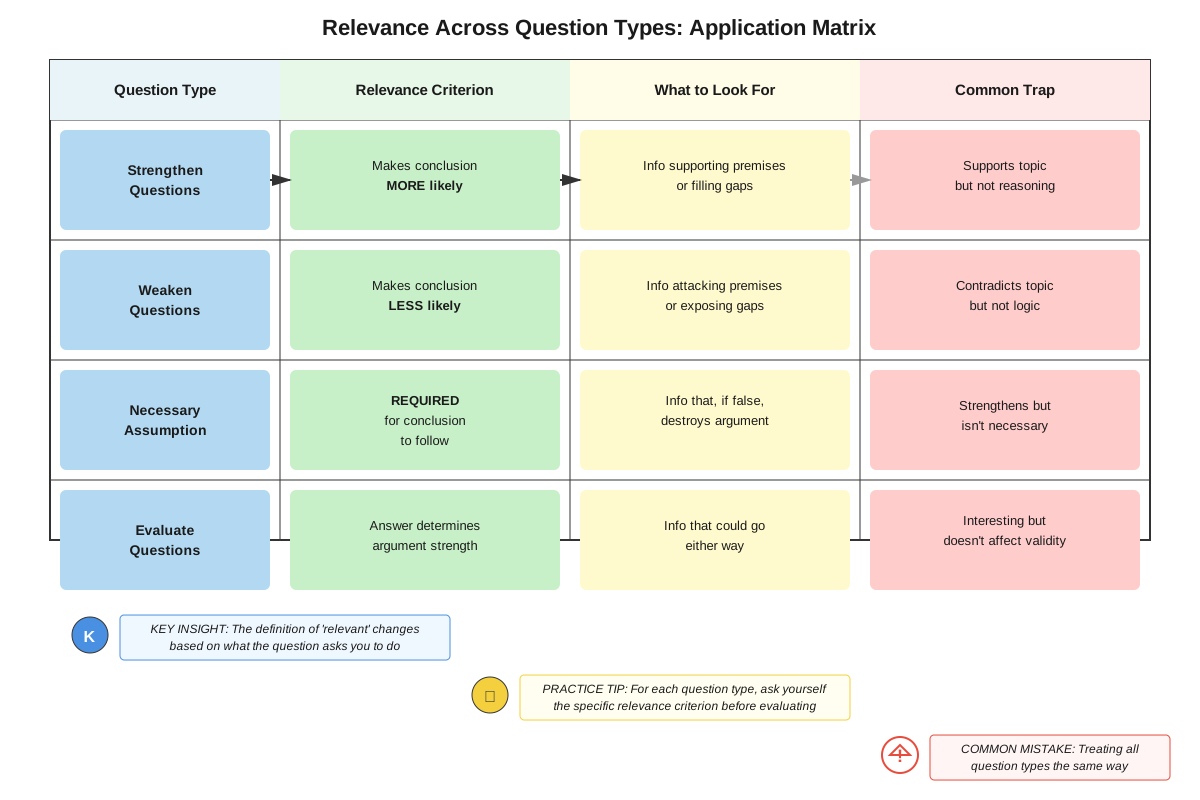
The LSAT tests information relevance across multiple question types, including Evaluate the Argument questions, Strengthen/Weaken questions, and Necessary Assumption questions. In each case, success depends on recognizing which pieces of information create genuine logical connections versus which merely seem related on the surface. For instance, an argument about whether a city should build a new highway might mention traffic congestion, environmental impact, and construction costs. A test-taker must determine whether information about the mayor's political affiliation is relevant to the argument's logic or merely contextual noise. This distinction separates high scorers from average performers.
Within the broader landscape of logical reasoning, information relevance serves as a foundational skill that supports nearly every other analytical task. Before one can identify assumptions, evaluate evidence, or recognize flaws, one must first determine what information actually connects to the argument's reasoning chain. This topic bridges basic argument structure (premises and conclusions) with more advanced skills like identifying sufficient and necessary conditions, recognizing causal reasoning patterns, and evaluating and completing arguments with precision. Mastering information relevance creates a mental filter that allows test-takers to process LSAT passages more efficiently and accurately.
Learning Objectives
- [ ] Identify how Information relevance appears in LSAT questions
- [ ] Explain the reasoning pattern behind Information relevance
- [ ] Apply Information relevance to solve LSAT-style problems accurately
- [ ] Distinguish between information that is topically related versus logically relevant to an argument's conclusion
- [ ] Evaluate whether new information creates a genuine logical connection or merely provides tangential context
- [ ] Predict what types of information would be most relevant to strengthening or weakening a specific argument structure
Prerequisites
- Basic argument structure: Understanding premises, conclusions, and how they connect is essential because information relevance requires identifying what supports or undermines these specific components.
- Conditional reasoning fundamentals: Recognizing if-then relationships helps determine when information about sufficient or necessary conditions is relevant to an argument's logic.
- Causal reasoning patterns: Many relevance questions involve determining whether information affects causal claims, requiring familiarity with cause-and-effect argument structures.
- Assumption identification: Recognizing gaps in reasoning helps predict what information would be relevant to fill those gaps or expose them.
Why This Topic Matters
In real-world contexts, the ability to assess information relevance is fundamental to critical thinking, decision-making, and persuasive communication. Professionals in law, business, medicine, and policy analysis constantly face situations where they must sift through abundant information to identify what actually matters to the decision at hand. A lawyer must determine which facts are legally relevant to a case; a business analyst must identify which market data genuinely affects a strategic recommendation; a physician must recognize which symptoms are diagnostically significant versus incidental. The LSAT tests this skill because it directly predicts success in legal reasoning, where distinguishing relevant from irrelevant evidence can determine case outcomes.
On the LSAT itself, information relevance appears with remarkable frequency. Approximately 15-20% of Logical Reasoning questions directly test this skill through Evaluate the Argument questions, while another 30-40% indirectly require it through Strengthen, Weaken, Necessary Assumption, and Sufficient Assumption questions. LSAT information relevance questions typically present an argument with a logical gap or questionable reasoning, then ask test-takers to identify what additional information would help evaluate the argument's strength. These questions often use stems like "Which of the following would be most useful to know in evaluating the argument?" or "The answer to which of the following questions would be most relevant to assessing the conclusion?"
Common manifestations in exam passages include arguments that make causal claims without ruling out alternative explanations (where information about those alternatives becomes relevant), arguments that generalize from limited samples (where information about sample representativeness matters), and arguments that rely on analogies (where information about the similarity of compared cases is crucial). The LSAT also frequently tests whether test-takers can recognize that emotionally charged or topically related information may be logically irrelevant—a sophisticated distinction that separates strong from weak performances.
Core Concepts
Defining Information Relevance
Information relevance refers to the logical connection between a piece of information and an argument's reasoning structure. Information is relevant when it genuinely affects the probability that the conclusion follows from the premises—either by strengthening the connection, weakening it, or helping to evaluate whether the reasoning is sound. Crucially, relevance is not the same as topical association. An argument about climate policy might mention carbon emissions, economic costs, and international agreements. Information about a politician's voting record on climate bills might be topically related but logically irrelevant if the argument concerns scientific predictions rather than political feasibility.
The key distinction lies in whether the information interacts with the argument's logical structure. Relevant information must connect to at least one of three elements: (1) the truth or accuracy of a premise, (2) the validity of the reasoning that connects premises to conclusion, or (3) the consideration of alternative explanations or counterexamples. Information that merely provides background context, emotional appeal, or tangential facts fails this test.
The Relevance Test Framework
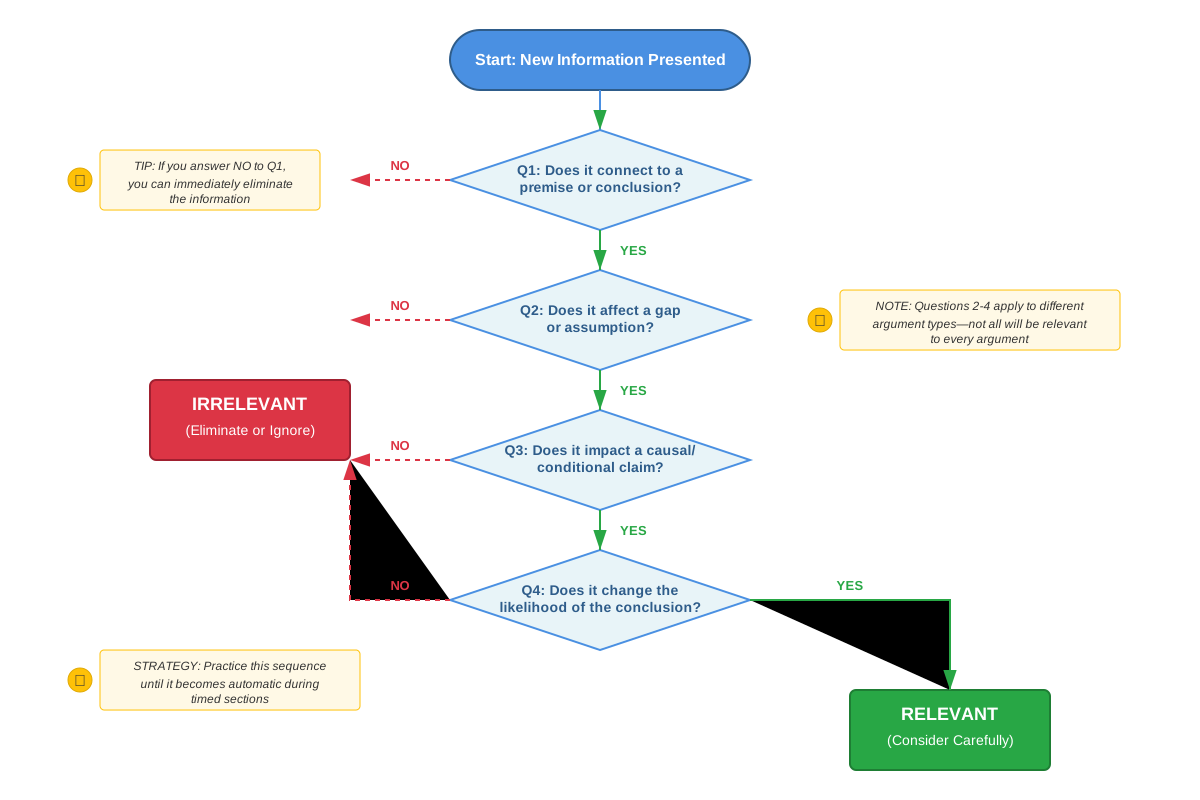
To systematically determine information relevance, apply this three-step framework:
- Identify the argument's conclusion and reasoning structure: What claim is being made, and what logical pathway supports it?
- Locate the logical gaps or assumptions: What must be true for the conclusion to follow? What alternative explanations exist?
- Assess whether the information addresses these gaps: Does it make the conclusion more or less likely by filling gaps, supporting assumptions, or ruling out alternatives?
Consider this example: "Company profits increased after implementing flexible work schedules. Therefore, flexible schedules caused the profit increase." The reasoning assumes no other factors caused the increase. Information about whether the company also launched a new product line during this period is highly relevant—it addresses an alternative explanation. Information about the CEO's management philosophy, while topically related, is likely irrelevant unless it directly connects to factors affecting profits.
Types of Relevant Information
Different argument structures make different types of information relevant:
| Argument Type | Relevant Information Concerns |
|---|---|
| Causal Claims | Alternative causes, correlation vs. causation, temporal sequence |
| Generalizations | Sample size, representativeness, diversity of cases |
| Analogies | Similarity of compared cases, relevant differences |
| Predictions | Past patterns, changed conditions, intervening factors |
| Recommendations | Feasibility, side effects, comparative alternatives |
For causal claims, information about alternative explanations, confounding variables, or the mechanism of causation is typically relevant. For generalizations, information about whether the sample accurately represents the population matters. For analogies, information about whether the compared situations share the characteristics that the argument assumes they share becomes crucial.
Relevance Versus Sufficiency
A critical distinction exists between information being relevant and information being sufficient to resolve an argument. Relevant information affects the argument's strength but may not definitively prove or disprove the conclusion. For instance, in evaluating whether a new drug is safe, information about side effects in clinical trials is relevant—it bears on the safety question. However, this information alone may not be sufficient to fully establish safety, as long-term effects, interactions with other medications, and effects on diverse populations might also matter.
LSAT questions often exploit this distinction by presenting answer choices that provide relevant information alongside choices that would definitively resolve the argument. Test-takers must recognize that Evaluate questions typically ask for relevant information (what would help assess the argument), not necessarily sufficient information (what would prove the conclusion true or false).
Irrelevance Patterns
Recognizing common patterns of irrelevance helps eliminate wrong answers efficiently:
- Temporal irrelevance: Information about events that occurred after the conclusion's timeframe or before the causal mechanism could operate
- Scope mismatch: Information about a different population, location, or context than the argument addresses
- Outcome irrelevance: Information about results or consequences that don't affect the logical connection between premises and conclusion
- Motivational irrelevance: Information about why someone made an argument or their intentions, when the argument concerns factual claims
- Definitional tangents: Information that clarifies terms without affecting the argument's logical structure
For example, if an argument claims that "reducing speed limits will decrease traffic fatalities," information about public opinion on speed limits is likely irrelevant—the argument makes a causal prediction, not a claim about popularity. However, information about whether drivers actually comply with speed limits would be highly relevant, as it affects whether the proposed cause can operate.
Conditional Relevance
Some information is conditionally relevant—its relevance depends on other facts. For instance, in an argument that "the new policy will succeed because it worked in Country A," information about Country A's economic system is only relevant if economic systems affect policy outcomes in the relevant domain. The LSAT occasionally tests whether test-takers recognize these conditional relationships, presenting information that seems relevant but only matters if certain unstated conditions hold.
Concept Relationships
Information relevance serves as the foundation for multiple higher-level logical reasoning skills. The relationship flows as follows:
Argument Structure Identification → Information Relevance → Assumption Identification → Argument Evaluation
Understanding argument structure (premises and conclusions) enables the identification of what information would be relevant to that structure. This relevance assessment, in turn, reveals the argument's assumptions—the unstated premises that must be true for the reasoning to work. These assumptions then become the basis for evaluating argument strength and identifying flaws.
Within the topic itself, the core concepts connect hierarchically. The Relevance Test Framework provides the systematic method for applying the definition of information relevance. Understanding types of relevant information helps predict what the framework will identify as relevant for specific argument structures. Recognizing irrelevance patterns accelerates the framework's application by enabling quick elimination of non-relevant options. The relevance versus sufficiency distinction refines the framework's output by clarifying what level of connection is required.
Information relevance also connects forward to evaluate and complete the argument questions, where test-takers must select information that helps assess an argument's strength or choose conclusions that follow from given premises. The skill of determining what information matters directly enables success on these question types. Additionally, information relevance underlies Strengthen and Weaken questions—one cannot effectively strengthen or weaken an argument without first identifying what information is relevant to its logical structure.
High-Yield Facts
⭐ Information is relevant only if it affects the logical connection between premises and conclusion, not merely if it relates to the topic.
⭐ For causal arguments, information about alternative causes or confounding variables is almost always relevant.
⭐ Information about sample representativeness is relevant to arguments that generalize from specific cases to broader populations.
⭐ Temporal information is relevant only if it concerns the timeframe during which the causal mechanism or reasoning applies.
⭐ In analogy-based arguments, information about relevant similarities or differences between compared cases is crucial.
- Information about motivations or intentions is typically irrelevant to arguments making factual or causal claims.
- Scope mismatches (different populations, locations, or contexts) usually indicate irrelevance.
- Information that would help distinguish between competing explanations is highly relevant to evaluating arguments.
- Emotional impact or dramatic details are often irrelevant to logical argument structure.
- Information about necessary conditions for a conclusion is more relevant than information about merely possible conditions.
- Background context that doesn't interact with the argument's reasoning chain is typically irrelevant.
- Information that addresses an argument's assumptions is always relevant to evaluating that argument.
- Definitional clarifications are relevant only when ambiguity affects the argument's logical structure.
- Information about implementation feasibility is relevant to recommendation arguments but not to purely descriptive or causal claims.
- Comparative information is relevant when the argument relies on relative rather than absolute claims.
Quick check — test yourself on Information relevance so far.
Try Flashcards →Common Misconceptions
Misconception: If information relates to the argument's topic, it must be relevant to the argument's logic.
Correction: Topical association does not equal logical relevance. Information must affect the reasoning structure—the connection between premises and conclusion—not merely discuss the same subject matter. An argument about whether a policy will reduce crime might mention police funding, but information about the police chief's salary is topically related yet logically irrelevant unless it affects crime reduction mechanisms.
Misconception: More information is always better for evaluating an argument.
Correction: Only information that addresses logical gaps, assumptions, or alternative explanations improves argument evaluation. Extraneous information, even if accurate and interesting, adds no evaluative value. The LSAT specifically tests whether test-takers can distinguish between information that genuinely helps assess an argument versus information that merely provides additional context.
Misconception: Information that would prove the conclusion true is always the most relevant.
Correction: Evaluate questions typically ask for information that would help assess the argument's reasoning, not necessarily prove the conclusion. Information that addresses the argument's assumptions or reasoning gaps is often more relevant than information that would independently establish the conclusion through entirely different reasoning.
Misconception: If information could affect the conclusion in some hypothetical scenario, it's relevant.
Correction: Relevance requires a direct connection to the argument's actual reasoning structure, not merely a conceivable indirect connection. The LSAT often includes answer choices describing information that could theoretically matter under elaborate chains of inference, but these are incorrect because they don't directly address the argument's logical pathway.
Misconception: Emotional or ethically significant information is automatically relevant to arguments about policy or recommendations.
Correction: Even in normative arguments about what should be done, information is relevant only if it connects to the argument's stated reasoning. If an argument recommends a policy based on economic efficiency, information about the policy's emotional impact is irrelevant unless the argument also claims to consider emotional factors. The LSAT tests whether test-takers can separate their personal judgment about what should matter from what actually matters to the argument's logic.
Misconception: Information about exceptions or unusual cases is irrelevant to general arguments.
Correction: Information about exceptions is highly relevant when it reveals that an argument's generalization is overstated or that assumed patterns don't hold universally. The frequency or typicality of exceptions matters, but their mere existence is relevant to evaluating the strength of generalizations.
Worked Examples
Example 1: Causal Argument Evaluation
Passage: "After the city installed brighter streetlights in the downtown area, vandalism decreased by 40%. Therefore, the brighter lighting caused the reduction in vandalism."
Question: Which of the following would be most useful to know in evaluating the argument?
Answer Choices:
(A) Whether the cost of the new streetlights exceeded the city's budget projections
(B) Whether the city also increased police patrols in the downtown area during the same period
(C) Whether residents approve of the brighter lighting
(D) Whether other cities have installed similar lighting systems
(E) Whether the streetlights use energy-efficient LED technology
Analysis:
First, identify the argument structure: The conclusion is that brighter lighting caused the vandalism reduction. The premise is that vandalism decreased after the lighting was installed. The reasoning assumes a causal connection based on temporal sequence.
Second, locate the logical gap: The argument assumes no other factors caused the vandalism reduction. This is a classic post hoc reasoning pattern where temporal sequence is taken as evidence of causation.
Third, assess each answer choice's relevance:
(A) Budget information is irrelevant—it doesn't affect whether the lighting caused the vandalism reduction, only whether the project was cost-effective.
(B) This is highly relevant. If police patrols increased simultaneously, this alternative explanation could account for the vandalism reduction, weakening the causal claim about lighting. This information directly addresses the argument's assumption that lighting was the cause.
(C) Resident approval is irrelevant to the causal claim. The argument concerns what caused the reduction, not whether people liked the lighting.
(D) Other cities' actions are irrelevant unless the argument makes a comparative claim. This information doesn't address whether lighting caused the reduction in this specific case.
(E) The technology type is irrelevant to causation. Whether LED or another technology, the question is whether brightness affected vandalism, not the technical specifications.
Correct Answer: (B)
Connection to Learning Objectives: This example demonstrates how to identify information relevance in LSAT questions (Objective 1), explains the reasoning pattern of distinguishing relevant from irrelevant information in causal arguments (Objective 2), and applies the relevance framework to solve the problem (Objective 3).
Example 2: Generalization Argument Evaluation
Passage: "A survey of 200 members of the National Physicians Association found that 75% support the proposed healthcare legislation. This shows that most doctors nationwide support the legislation."
Question: The argument's reasoning is most vulnerable to criticism on the grounds that it fails to consider whether:
Answer Choices:
(A) The legislation will actually improve healthcare outcomes
(B) The National Physicians Association's membership is representative of doctors nationwide
(C) Some doctors who support the legislation have reservations about specific provisions
(D) The survey methodology was scientifically rigorous
(E) Healthcare legislation typically receives support from medical professionals
Analysis:
The argument structure: Conclusion is that most doctors nationwide support the legislation. Premise is that 75% of surveyed association members support it. The reasoning generalizes from the sample to the broader population.
The logical gap: The argument assumes the sample (association members) accurately represents the target population (all doctors nationwide). This is a classic sampling assumption.
Assess relevance:
(A) Legislation effectiveness is irrelevant—the argument concerns what doctors believe, not whether their belief is correct or whether the legislation will work.
(B) This is highly relevant. If association members differ systematically from doctors generally (perhaps they're more politically active, from certain specialties, or have particular practice settings), the sample doesn't support the generalization. This directly addresses the argument's sampling assumption.
(C) Reservations about provisions are irrelevant—the argument only claims doctors support the legislation overall, not that they agree with every detail.
(D) While methodology matters, this choice is less directly relevant than (B). Even rigorous methodology can't overcome an unrepresentative sample. The more fundamental issue is representativeness.
(E) Historical patterns are irrelevant—the argument makes a claim about current support for specific legislation, not about typical patterns.
Correct Answer: (B)
Connection to Learning Objectives: This example shows how information relevance appears in flaw questions (Objective 1), explains the reasoning pattern for generalization arguments where sample representativeness is the key relevant factor (Objective 2), and demonstrates applying relevance analysis to distinguish the correct answer (Objective 3). It also illustrates distinguishing topically related information (methodology, effectiveness) from logically relevant information (representativeness).
Exam Strategy
When approaching LSAT information relevance questions, begin by investing 15-20 seconds in thoroughly understanding the argument's structure before reading answer choices. Identify the conclusion explicitly, then determine what type of reasoning connects premises to conclusion (causal, generalization, analogy, etc.). This upfront investment pays dividends by enabling rapid answer choice evaluation.
Trigger words and phrases that signal information relevance questions include:
- "Most useful to know in evaluating..."
- "Most relevant to assessing..."
- "Would be most important to determine..."
- "The answer to which question would most help..."
- "Most seriously weakens/strengthens if true..."
These stems indicate that you must identify what information matters to the argument's logical structure.
For process-of-elimination, systematically eliminate answer choices that exhibit irrelevance patterns:
- First pass: Eliminate choices with obvious scope mismatches (different populations, timeframes, or contexts than the argument addresses)
- Second pass: Eliminate choices providing background context or tangential information that doesn't interact with the reasoning structure
- Third pass: Between remaining choices, select the one that most directly addresses the argument's central assumption or logical gap
A powerful technique is the "if I knew this, would it change my assessment?" test. For each answer choice, imagine learning that information and ask whether it would make the conclusion more likely, less likely, or help you evaluate the reasoning. If the answer is "no change" or "unclear connection," the information is likely irrelevant.
Time allocation: Spend approximately 1:15-1:30 on information relevance questions. They typically require more careful analysis than some other question types but shouldn't consume excessive time. If you find yourself creating elaborate scenarios to make an answer choice seem relevant, you're likely overthinking—the correct answer should have a clear, direct connection to the argument's reasoning.
Watch for trap answers that exploit common mistakes:
- Choices that would prove the conclusion through entirely different reasoning (confusing relevance with sufficiency)
- Choices with emotional appeal or ethical significance that don't connect to the argument's stated reasoning
- Choices that address interesting questions about the topic without addressing the argument's logic
- Choices that would matter only if multiple unstated assumptions were true (conditional relevance without established conditions)
Memory Techniques
Use the acronym CAGAS to remember the five most common types of relevant information:
- Causal alternatives (for causal arguments)
- Assumptions addressed (for any argument type)
- Generalization representativeness (for sampling arguments)
- Analogy similarities (for comparison arguments)
- Scope matching (information must match the argument's domain)
For remembering irrelevance patterns, use TEMPO:
- Temporal mismatches (wrong timeframe)
- Emotional appeals (feelings vs. logic)
- Motivational information (why someone argues vs. whether the argument works)
- Popularity or opinion (what people think vs. what's true)
- Outcome information that doesn't affect the reasoning chain
Visualize information relevance as a bridge test: Does the information create a bridge between premises and conclusion, strengthen an existing bridge, or reveal that the bridge has gaps? If it doesn't interact with the bridge structure at all—if it's just scenery around the bridge—it's irrelevant.
For distinguishing topical association from logical relevance, remember: "Same topic ≠ Same logic." Just because information discusses the same subject doesn't mean it affects the reasoning. This simple reminder prevents the most common error on information relevance questions.
Summary
Information relevance is the skill of distinguishing between information that genuinely affects an argument's logical structure and information that merely relates to the topic without creating logical connections. On the LSAT, this skill appears across multiple question types but is most directly tested in Evaluate the Argument questions. The key principle is that relevant information must interact with the argument's reasoning—affecting the connection between premises and conclusion, addressing assumptions, or ruling out alternative explanations. Different argument types make different information relevant: causal arguments require information about alternative causes, generalizations need information about sample representativeness, and analogies depend on information about relevant similarities. Common irrelevance patterns include temporal mismatches, scope mismatches, emotional appeals, and motivational information. Success requires systematically applying the Relevance Test Framework: identify the argument structure, locate logical gaps, and assess whether information addresses those gaps. The distinction between topical association and logical relevance separates strong from weak performances on these questions.
Key Takeaways
- Information is relevant only when it affects the logical connection between premises and conclusion, not merely when it relates to the topic
- Apply the three-step Relevance Test Framework: identify structure, locate gaps, assess whether information addresses gaps
- For causal arguments, information about alternative explanations is almost always relevant
- For generalizations, sample representativeness information is key
- Temporal information must match the timeframe when the reasoning applies
- Eliminate answer choices with scope mismatches, emotional appeals, or motivational information that doesn't affect the logic
- Distinguish between information that helps evaluate an argument versus information that would prove the conclusion through different reasoning
Related Topics
Strengthen and Weaken Questions: Mastering information relevance directly enables success on these question types, as strengthening or weakening requires identifying what information is relevant to the argument's reasoning structure. The same relevance principles apply, with the additional task of determining whether relevant information supports or undermines the conclusion.
Necessary Assumption Questions: These questions ask for unstated premises that must be true for the argument to work. Information relevance skills help identify what assumptions matter by revealing what information would be relevant to evaluating the argument—those gaps indicate where necessary assumptions exist.
Sufficient Assumption Questions: Understanding information relevance helps predict what information would be sufficient to make an argument's conclusion follow with certainty, building on the foundation of knowing what information is relevant at all.
Flaw Questions: Many argument flaws involve treating irrelevant information as relevant or failing to consider relevant information. The ability to assess information relevance enables identification of these reasoning errors.
Practice CTA
Now that you understand the principles of information relevance, it's time to apply these concepts to actual LSAT questions. The practice questions and flashcards will reinforce your ability to quickly distinguish relevant from irrelevant information and apply the Relevance Test Framework under timed conditions. Each practice question you complete strengthens your mental filter for identifying what information truly matters to an argument's logic—a skill that will serve you throughout the Logical Reasoning section and beyond. Approach the practice with confidence, knowing that you now have a systematic framework for tackling these questions successfully.
Sign up free to keep reading
Create a free AnvayaPrep account to finish this LSAT guide on Information relevance — plus flashcards and practice questions.