Overview
Information that affects conclusion represents a critical category of LSAT Logical Reasoning questions that tests a student's ability to identify what additional facts, data, or evidence would strengthen, weaken, or otherwise impact an argument's conclusion. These questions require examinees to understand not just what an argument says, but what it assumes, what gaps exist in its reasoning, and what external information could make the conclusion more or less likely to be true. Unlike questions that ask students to identify flaws or assumptions directly, these questions demand a more dynamic analysis: students must evaluate how new information would interact with existing premises to affect the argument's persuasiveness.
This question type appears frequently on the LSAT and is essential for success in logical reasoning sections. The ability to evaluate and complete the argument by determining what information matters represents a sophisticated analytical skill that law schools value highly. Students must move beyond passive comprehension to active evaluation, considering multiple scenarios and their logical implications. This mirrors the type of reasoning attorneys perform daily when assessing case strength, evaluating evidence, or determining what additional discovery might change their legal strategy.
Understanding information that affects conclusions connects directly to several other Logical Reasoning concepts, including assumption identification, strengthening and weakening arguments, and sufficient versus necessary conditions. Mastery of this topic provides a foundation for tackling "Evaluate the Argument" questions, "Complete the Argument" questions, and even some "Strengthen/Weaken" variants. The analytical framework developed here—identifying gaps, recognizing relevant versus irrelevant information, and tracing logical connections—transfers across virtually all LSAT question types and represents core critical thinking skills essential for legal reasoning.
Learning Objectives
- [ ] Identify how Information that affects conclusion appears in LSAT questions
- [ ] Explain the reasoning pattern behind Information that affects conclusion
- [ ] Apply Information that affects conclusion to solve LSAT-style problems accurately
- [ ] Distinguish between information that strengthens, weakens, or is irrelevant to a conclusion
- [ ] Recognize the underlying assumptions that make certain information relevant to an argument
- [ ] Evaluate multiple pieces of potential information and rank their impact on a conclusion's validity
- [ ] Construct a systematic approach to "Evaluate the Argument" questions that maximizes accuracy under time pressure
Prerequisites
- Basic argument structure: Understanding premises, conclusions, and how they connect is essential because identifying information that affects conclusions requires recognizing what the argument already establishes versus what remains uncertain.
- Assumption identification: Recognizing unstated premises helps predict what information would matter, since relevant information typically addresses gaps between stated premises and conclusions.
- Conditional reasoning fundamentals: Understanding if-then relationships enables students to trace how new information would logically interact with existing argument components.
- Strengthen and weaken question types: Familiarity with these related question types provides context for understanding how information impacts argument quality.
Why This Topic Matters
In legal practice, attorneys constantly evaluate what information would affect their cases. Before trial, lawyers must determine what discovery requests to make, what witnesses to depose, and what evidence would most significantly impact their position. During negotiations, understanding what information would change the other party's position proves invaluable. This LSAT topic directly tests the analytical framework underlying these professional skills.
On the LSAT itself, questions involving information that affects conclusion appear with high frequency across both Logical Reasoning sections. Approximately 8-12% of all Logical Reasoning questions fall into the "Evaluate the Argument" category, with additional questions in "Complete the Argument" formats testing similar skills. These questions typically appear at medium to medium-high difficulty levels, making them crucial for students aiming to score above the 160 threshold. The LSAT tests this concept because it measures an examinee's ability to think dynamically about arguments rather than simply identifying static flaws.
These questions commonly appear in several formats: direct "Evaluate" questions asking what information would be most useful to know; "Complete the Argument" questions where the correct answer provides information that logically follows from or impacts the premises; and hybrid questions that combine evaluation with other reasoning tasks. Passages often involve causal claims, statistical arguments, analogies, or proposals for action—contexts where additional information could significantly alter the argument's strength. Understanding this topic enables students to approach these varied question formats with a unified analytical strategy.
Core Concepts
Understanding What Makes Information Relevant
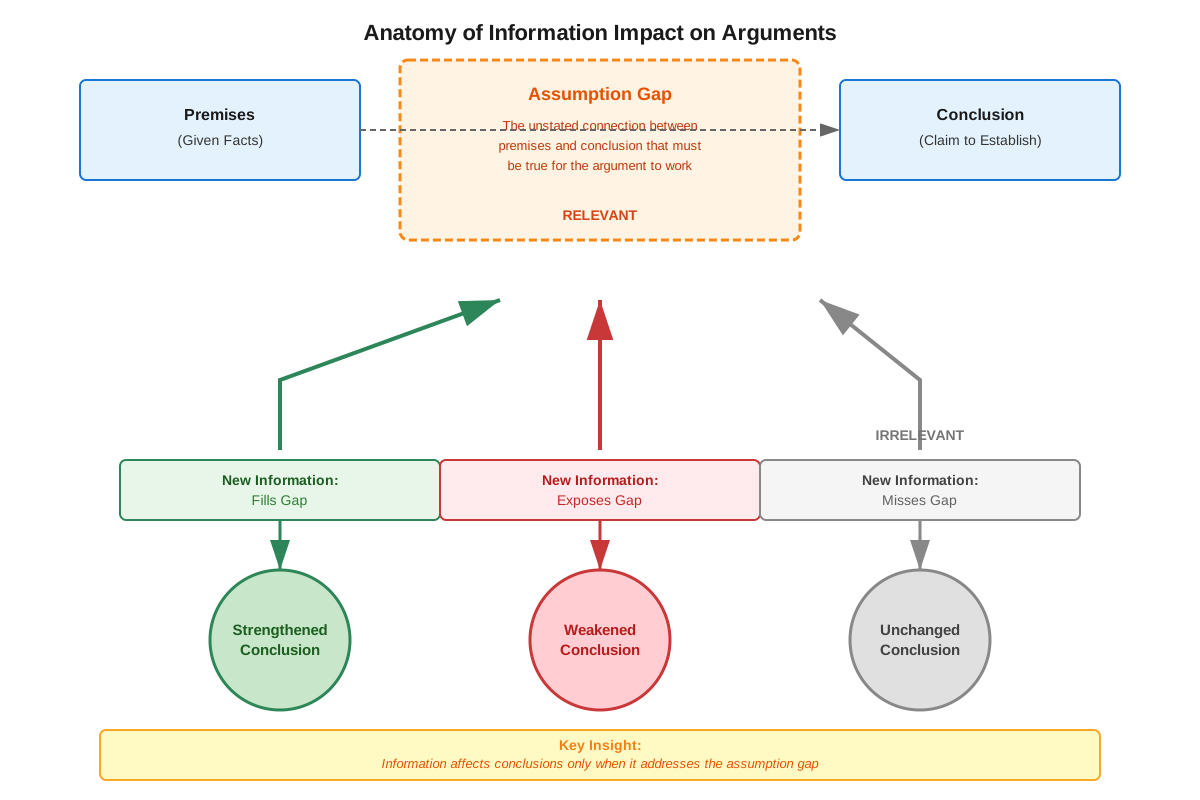
Information that affects conclusion refers to facts, data, or evidence that, if known, would make an argument's conclusion more or less likely to be true. Not all information is relevant—only information that addresses gaps, assumptions, or uncertainties in the argument's reasoning chain matters. The key to identifying relevant information lies in understanding the argument's structure: what does it claim, what evidence does it provide, and what must be true for the conclusion to follow from the premises?
Relevant information typically falls into several categories:
- Information that confirms or disconfirms an assumption
- Data that establishes or undermines a causal connection
- Evidence about alternative explanations for observed phenomena
- Facts about the scope or representativeness of cited evidence
- Information about relevant differences or similarities in comparisons
The Logical Gap Analysis Framework
To determine what information affects a conclusion, students must identify logical gaps—the space between what the argument establishes and what it claims. Every argument with a gap makes implicit assumptions about what fills that space. Information that addresses these assumptions directly impacts the conclusion's validity.
Consider this process:
- Identify the conclusion: What is the argument ultimately claiming?
- Map the premises: What evidence or reasons does the argument provide?
- Locate the gap: What must be true for the conclusion to follow from these specific premises?
- Determine relevant information: What facts would confirm or deny what must be true?
For example, if an argument concludes that "Policy X will reduce crime" based on the premise that "Policy X reduced crime in City A," the gap involves whether City A's experience generalizes to other contexts. Relevant information would address factors that might make City A's situation unique or representative.
Types of Information Impact
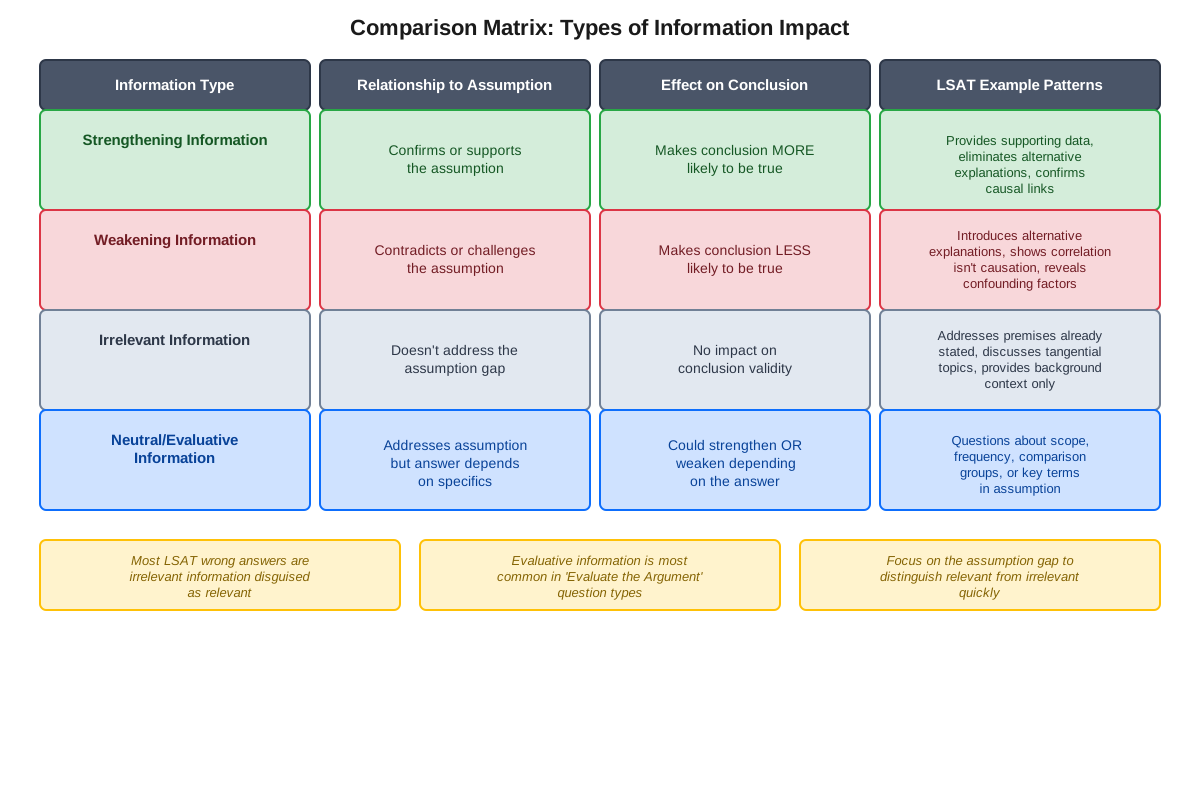
Information can affect conclusions in three primary ways:
| Impact Type | Effect on Conclusion | Example Context |
|---|---|---|
| Strengthening | Makes conclusion more likely true | Evidence confirming a key assumption |
| Weakening | Makes conclusion less likely true | Data suggesting an alternative explanation |
| Neutral | No effect on conclusion's likelihood | Information about irrelevant factors |
Understanding these categories helps students evaluate answer choices systematically. On "Evaluate" questions, correct answers typically present information that could either strengthen or weaken the argument depending on how the question is answered. On "Complete the Argument" questions, the correct answer provides information that logically follows from the premises and affects what conclusion can be drawn.
Assumption-Based Relevance
The connection between assumptions and relevant information is fundamental. Every assumption represents a potential vulnerability in an argument—a point where additional information could affect the conclusion's strength. LSAT information that affects conclusion questions essentially ask students to identify what assumptions matter most.
Consider assumption types and their corresponding relevant information:
- Causal assumptions: Information about alternative causes, correlation versus causation, or mechanism of effect
- Representativeness assumptions: Data about sample size, selection bias, or relevant differences
- Scope assumptions: Facts about whether premises apply to the conclusion's full scope
- Temporal assumptions: Information about whether past patterns continue or future conditions will match present ones
- Definitional assumptions: Clarification about how key terms are being used
The Relevance Test
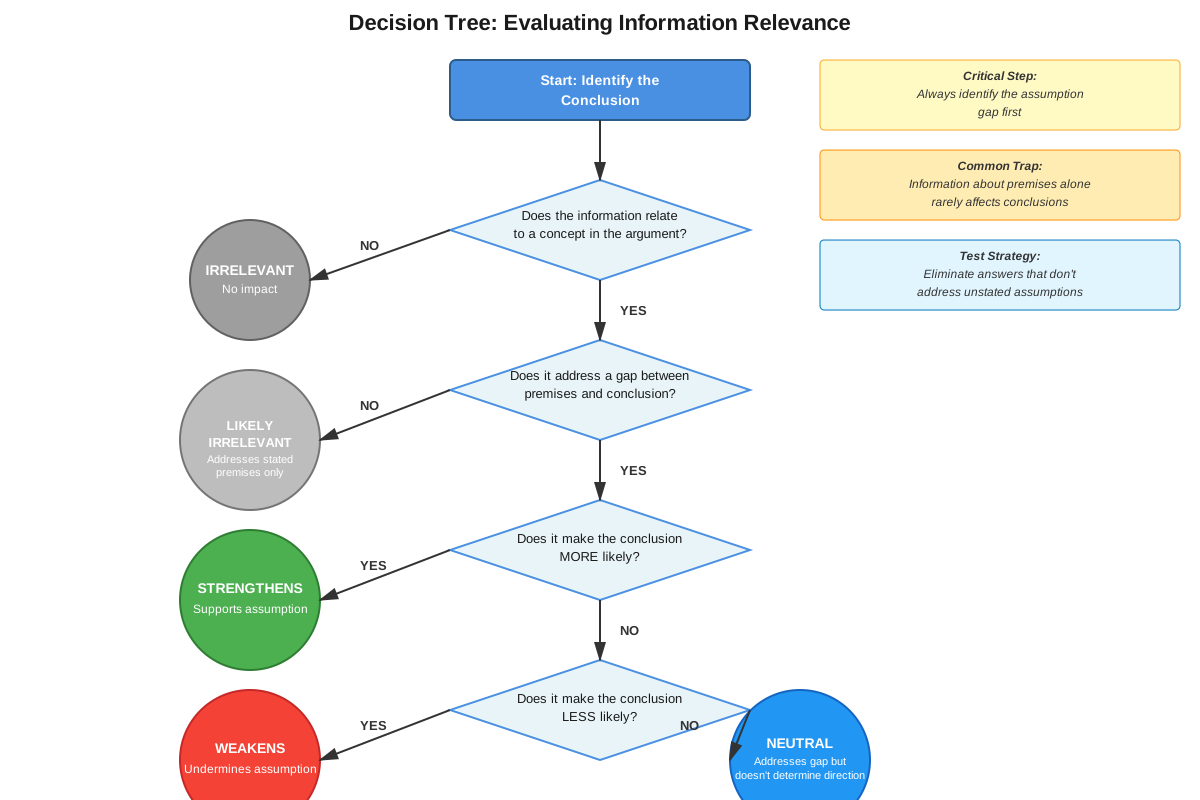
Not every piece of information that relates to an argument's topic affects its conclusion. Students must distinguish between topically related information and logically relevant information. The relevance test asks: "If I knew this information, would it change my assessment of whether the conclusion follows from the premises?"
Information fails the relevance test when it:
- Addresses a topic mentioned in the argument but doesn't connect to the reasoning chain
- Provides background context without affecting logical relationships
- Concerns consequences of the conclusion rather than its validity
- Relates to premises already established rather than gaps or assumptions
Information passes the relevance test when knowing it would:
- Confirm or disconfirm that premises actually support the conclusion
- Reveal whether an implicit assumption holds true
- Establish or undermine a causal or correlational claim
- Determine whether evidence is representative or exceptional
Evaluate Question Mechanics
"Evaluate the Argument" questions explicitly ask what information would be most useful to know in assessing an argument. These questions test whether students can identify the most significant gap or assumption. The correct answer typically presents a question or piece of information that, depending on the answer, would significantly strengthen or weaken the argument.
Key characteristics of correct answers:
- They address central rather than peripheral assumptions
- They create a clear dichotomy (if yes, strengthens; if no, weakens, or vice versa)
- They focus on gaps between premises and conclusion rather than on expanding premises
- They identify information that would affect the conclusion's likelihood, not just its implications
Complete the Argument Variations
Some questions ask students to complete an argument by selecting information that would logically follow or that the argument depends upon. These questions test similar skills but require students to recognize what information the argument's logic necessitates or implies. The correct answer provides information that:
- Fills a logical gap in a way that makes the conclusion follow
- States an assumption the argument requires
- Provides a conclusion that the premises support
Concept Relationships
The concepts within this topic form an interconnected analytical framework. Logical gap analysis serves as the foundation, enabling students to identify where arguments are vulnerable. This analysis directly reveals assumptions, which in turn determine what information is relevant. Understanding types of information impact allows students to evaluate how specific pieces of information would interact with identified assumptions. The relevance test acts as a filter, helping students distinguish between the many pieces of information that could relate to an argument and the specific information that would affect its conclusion.
These concepts connect to prerequisite knowledge in essential ways. Assumption identification skills enable logical gap analysis—students cannot identify what information matters without recognizing what the argument takes for granted. Basic argument structure understanding allows students to map premises and conclusions, which is necessary before gaps can be identified. Conditional reasoning helps students trace how new information would interact with existing premises through logical chains.
The relationship map flows as follows:
Argument Structure Recognition → Premise/Conclusion Identification → Logical Gap Analysis → Assumption Recognition → Relevant Information Identification → Impact Evaluation (Strengthen/Weaken/Neutral) → Answer Selection
This topic also connects forward to advanced Logical Reasoning skills. Mastering information that affects conclusions provides the foundation for tackling complex "Parallel Reasoning" questions, understanding "Principle" questions, and even approaching "Flaw" questions from a more sophisticated angle. The analytical framework developed here—systematically evaluating what matters and why—transfers across virtually all LSAT question types.
High-Yield Facts
⭐ Information affects a conclusion only if it addresses a gap or assumption in the argument's reasoning, not merely if it relates to the argument's topic.
⭐ The most relevant information typically addresses the argument's central assumption—the connection between its main premise and conclusion.
⭐ On "Evaluate" questions, correct answers usually present information that could either strengthen or weaken the argument depending on the answer.
⭐ Information about alternative explanations for observed phenomena is highly relevant to causal arguments.
⭐ Information about representativeness or sample characteristics is crucial for arguments that generalize from specific cases.
- Information that merely restates or expands upon premises already established does not affect the conclusion's validity.
- Relevant information must connect to the logical relationship between premises and conclusion, not just to the conclusion's implications or consequences.
- Arguments involving comparisons require information about relevant similarities and differences between the compared entities.
- Temporal arguments (past to future, or present to future) are vulnerable to information about changing conditions.
- Statistical arguments require information about sample size, selection methods, and relevant subgroups.
- Information about the mechanism or process by which a cause produces an effect is often relevant to causal claims.
- Scope mismatches between premises and conclusions create gaps that relevant information must address.
- Information that would affect subsidiary conclusions or intermediate steps in reasoning also affects the final conclusion.
Quick check — test yourself on Information that affects conclusion so far.
Try Flashcards →Common Misconceptions
Misconception: Any information related to the argument's topic affects its conclusion.
Correction: Only information that addresses logical gaps, assumptions, or the connection between premises and conclusion affects the argument's validity. Topical relevance does not equal logical relevance.
Misconception: Information that strengthens a premise automatically strengthens the conclusion.
Correction: Strengthening an already-established premise typically does not affect the conclusion. What matters is information that addresses whether the premises, as given, actually support the conclusion.
Misconception: The most complex or detailed answer choice is usually correct on "Evaluate" questions.
Correction: Correct answers identify the most significant gap or assumption, which may be stated quite simply. Complexity often indicates an answer that addresses peripheral rather than central issues.
Misconception: Information about the conclusion's consequences or implications affects whether the conclusion is true.
Correction: Whether a conclusion would have good or bad consequences if true does not affect whether it actually follows from the premises. Relevant information addresses the argument's logic, not its practical implications.
Misconception: On "Evaluate" questions, the correct answer must be information that weakens the argument.
Correction: Correct answers on "Evaluate" questions present information that could either strengthen or weaken the argument depending on what that information reveals. The question asks what would be useful to know, not what would necessarily undermine the argument.
Misconception: Background information or context always helps evaluate an argument.
Correction: Background information is relevant only if it affects the logical connection between premises and conclusion. Much contextual information, while interesting, does not impact whether the conclusion follows from the stated premises.
Misconception: If information would change what action should be taken, it affects the argument's conclusion.
Correction: Arguments conclude with claims about what is true, not recommendations for action (unless the conclusion itself is a recommendation). Information about practical considerations is relevant only if the conclusion itself concerns those considerations.
Worked Examples
Example 1: Causal Argument Evaluation
Argument: "City traffic congestion has decreased by 15% over the past year. The city implemented a new traffic light timing system one year ago. Therefore, the new traffic light timing system has successfully reduced traffic congestion."
Question: Which of the following would be most useful to know in evaluating the argument?
Analysis Process:
- Identify the conclusion: The new traffic light timing system reduced traffic congestion.
- Map the premises:
- Traffic congestion decreased 15% over the past year
- The new system was implemented one year ago
- Locate the gap: The argument assumes the timing system caused the decrease. But correlation doesn't prove causation. What if other factors caused the decrease?
- Determine relevant information: We need information that would confirm or disconfirm the causal connection. Alternative explanations would be highly relevant.
Evaluating answer choices:
(A) Whether the traffic light timing system was expensive to implement
- Analysis: Cost doesn't affect whether the system caused the reduction. This addresses implications, not validity. Irrelevant.
(B) Whether other significant changes affecting traffic occurred during the same period
- Analysis: This directly addresses the alternative explanation concern. If major road construction was completed, or gas prices spiked, or a large employer relocated, these could explain the decrease instead of (or in addition to) the timing system. This information would significantly affect whether we should attribute the decrease to the timing system. Highly relevant.
(C) Whether traffic congestion had been increasing before the system was implemented
- Analysis: While this provides context, it doesn't address whether the timing system caused the recent decrease. The decrease could still result from other factors regardless of the prior trend. Minimally relevant.
(D) Whether other cities have implemented similar traffic light timing systems
- Analysis: What happened in other cities doesn't tell us whether this system caused this decrease in this city. Irrelevant.
(E) Whether the 15% decrease represents a significant reduction in actual travel time
- Analysis: This addresses the magnitude or importance of the effect, not whether the timing system caused it. Irrelevant to the causal claim.
Correct Answer: (B)
Connection to Learning Objectives: This example demonstrates how to identify relevant information by locating the argument's central assumption (causal connection) and recognizing what information would address that assumption (alternative explanations).
Example 2: Generalization Argument Evaluation
Argument: "A study of 500 adults in Springfield found that 60% prefer shopping online to shopping in physical stores. This suggests that the majority of American adults prefer online shopping."
Question: The argument's reasoning is most vulnerable to criticism unless which of the following is true?
Analysis Process:
- Identify the conclusion: The majority of American adults prefer online shopping.
- Map the premises: 60% of 500 Springfield adults prefer online shopping.
- Locate the gap: The argument generalizes from Springfield to all American adults. This assumes Springfield residents are representative of all American adults regarding shopping preferences.
- Determine relevant information: We need information about whether Springfield is representative or whether factors might make it atypical.
Evaluating answer choices:
(A) The 500 adults surveyed were randomly selected from Springfield's population
- Analysis: Random selection within Springfield ensures the sample represents Springfield, but doesn't address whether Springfield represents America. This doesn't close the gap. Insufficient.
(B) Springfield's demographic characteristics closely match those of the United States as a whole
- Analysis: This directly addresses representativeness. If Springfield matches America demographically, and demographics correlate with shopping preferences, then the generalization is more justified. This information would significantly strengthen the argument by confirming the representativeness assumption. Highly relevant.
(C) The study was conducted by a reputable research organization
- Analysis: Credibility of the researchers doesn't address whether Springfield represents America. Irrelevant to the generalization issue.
(D) Online shopping has been increasing in popularity nationwide
- Analysis: A general trend doesn't tell us whether Springfield's specific percentage applies nationally. Springfield could still be atypical. Insufficient.
(E) The study defined "prefer" clearly and consistently
- Analysis: Clear definitions ensure we're measuring what we think we're measuring in Springfield, but don't address generalization to America. Irrelevant to the representativeness issue.
Correct Answer: (B)
Connection to Learning Objectives: This example illustrates how arguments that generalize from samples to populations require information about representativeness, and demonstrates the systematic approach to identifying what information would address the argument's central vulnerability.
Exam Strategy
Approaching "Evaluate" and "Complete" Questions
When encountering questions about information that affects conclusions, follow this systematic approach:
- Read the argument carefully and identify the conclusion first: Underline or mentally note the main claim. Everything else serves this claim.
- Map the evidence: What premises does the argument provide? What facts are established?
- Identify the gap: Ask yourself, "What must be true for this conclusion to follow from these specific premises?" The gap is often where the argument makes a logical leap.
- Predict what information would matter: Before looking at answer choices, formulate what type of information would address the gap. This prediction prevents you from being seduced by attractive but irrelevant choices.
- Apply the relevance test to each answer: For each choice, ask: "If I knew this, would it change my assessment of whether the conclusion follows from the premises?"
Trigger Words and Phrases
Watch for these question stems that signal information-that-affects-conclusion questions:
- "Which of the following would be most useful to know in evaluating the argument?"
- "The answer to which of the following questions would be most helpful in assessing the argument?"
- "Which of the following, if true, would most strengthen/weaken the argument?" (related skill)
- "The argument depends on assuming which of the following?" (closely related)
- "Which of the following most logically completes the argument?"
In the arguments themselves, these features often signal vulnerability to information-based questions:
- Causal language: "caused," "resulted in," "led to," "because of"
- Generalization indicators: "suggests that," "indicates that," "most," "typically"
- Comparison markers: "similarly," "likewise," "just as," "unlike"
- Temporal transitions: "will," "in the future," "previously," "historically"
- Statistical claims: percentages, "majority," "significant increase/decrease"
Process of Elimination Tips
Eliminate answers that:
- Address topics mentioned in the argument but don't connect to the reasoning chain
- Concern consequences or implications of the conclusion rather than its validity
- Merely restate or strengthen premises already established
- Introduce entirely new issues not connected to the argument's logic
- Would be relevant only if the conclusion were different from what it actually is
Favor answers that:
- Address the connection between the argument's main premise and its conclusion
- Speak to assumptions the argument must make
- Present information that could either strengthen or weaken the argument (on "Evaluate" questions)
- Focus on representativeness, alternative explanations, or scope issues
- Identify the most significant rather than peripheral gaps
Time Allocation
For medium-difficulty information-that-affects-conclusion questions, allocate approximately 1:20-1:30 (80-90 seconds). Spend:
- 30-40 seconds reading and analyzing the argument
- 10-15 seconds predicting what information would be relevant
- 30-40 seconds evaluating answer choices
If you find yourself spending more than 2 minutes on a single question, mark it and move on. These questions reward systematic analysis, but overthinking can lead to seeing relevance where none exists. Trust your initial gap analysis and relevance test.
Exam Tip: On "Evaluate" questions, the correct answer often addresses the argument's central assumption. If you're torn between two answers, ask which one addresses the biggest logical leap in the argument.
Memory Techniques
The GRACE Acronym for Identifying Relevant Information
Gap: What's the gap between premises and conclusion?
Relevance: Does this information address that gap?
Assumption: What assumption does this information test?
Connection: How does this connect premises to conclusion?
Effect: Would knowing this change the conclusion's likelihood?
The "Bridge Test" Visualization
Visualize the argument as two islands (premises and conclusion) with a bridge between them (the logical connection). The bridge has gaps or weak spots (assumptions). Relevant information either strengthens the bridge, reveals it's weaker than it appears, or shows there's actually no bridge at all. Irrelevant information is like describing the water around the islands—related to the scene but not affecting whether the bridge holds.
The Three R's of Relevance
Reasoning chain: Does it affect the logical connection?
Representativeness: Does it address whether evidence is typical or exceptional?
Rival explanations: Does it confirm or eliminate alternative causes?
Causal Argument Mnemonic: "CAME"
When evaluating causal arguments, remember CAME:
Correlation vs. causation
Alternative explanations
Mechanism (how does cause produce effect?)
Evidence of temporal relationship
Summary
Information that affects conclusion represents a sophisticated LSAT skill requiring students to identify what additional facts would strengthen, weaken, or otherwise impact an argument's validity. Success depends on systematic gap analysis: identifying the logical space between premises and conclusion, recognizing the assumptions that fill that space, and determining what information would confirm or disconfirm those assumptions. Not all information related to an argument's topic affects its conclusion—only information that addresses the logical connection between premises and conclusion matters. Students must distinguish between topical relevance and logical relevance, applying a rigorous relevance test to each potential piece of information. The most relevant information typically addresses the argument's central assumption, whether that involves causation, representativeness, scope, or comparison validity. Mastering this topic requires understanding various argument types and their characteristic vulnerabilities, then systematically evaluating what information would address those vulnerabilities. This analytical framework transfers across multiple LSAT question types and represents core critical thinking skills essential for legal reasoning.
Key Takeaways
- Information affects a conclusion only when it addresses gaps or assumptions in the argument's reasoning, not merely when it relates to the argument's topic
- Systematic gap analysis—identifying what must be true for the conclusion to follow from the premises—is the foundation for determining relevant information
- The relevance test asks whether knowing the information would change your assessment of whether the conclusion follows from the premises
- Causal arguments are vulnerable to information about alternative explanations; generalization arguments require information about representativeness
- On "Evaluate" questions, correct answers typically present information that could either strengthen or weaken the argument depending on what that information reveals
- Information that merely strengthens already-established premises or addresses the conclusion's implications rather than its validity is not relevant
- Predicting what type of information would matter before examining answer choices prevents being misled by attractive but irrelevant options
Related Topics
Assumption Questions: These questions directly ask students to identify what an argument assumes, which is closely related to determining what information would affect the conclusion. Mastering information-that-affects-conclusion questions strengthens assumption identification skills and vice versa.
Strengthen and Weaken Questions: These question types explicitly provide information and ask whether it strengthens or weakens an argument. Understanding information that affects conclusions provides the analytical framework for evaluating strengthening and weakening information.
Flaw Questions: Identifying flaws requires recognizing gaps in reasoning—the same skill needed to determine what information would affect a conclusion. Students who master this topic can approach flaw questions by asking what information would expose or address the flaw.
Sufficient Assumption Questions: These questions ask what information, if added, would make the conclusion follow logically from the premises. This directly applies the skill of identifying what information affects conclusions, specifically information that would guarantee the conclusion.
Principle Questions: Some principle questions require identifying what general rule would support or undermine an argument, which involves determining what information (in the form of a principle) would affect the conclusion's validity.
Practice CTA
Now that you've mastered the conceptual framework for identifying information that affects conclusions, it's time to apply these skills to actual LSAT questions. The practice questions and flashcards will reinforce your ability to quickly identify logical gaps, recognize relevant versus irrelevant information, and systematically evaluate answer choices. Remember that this skill improves dramatically with deliberate practice—each question you analyze strengthens your pattern recognition and analytical speed. Approach the practice materials with the systematic framework you've learned: identify the conclusion, map the premises, locate the gap, and apply the relevance test. Your investment in mastering this high-yield topic will pay dividends across multiple question types and significantly boost your Logical Reasoning score. You've built the foundation—now strengthen it through application!
Sign up free to keep reading
Create a free AnvayaPrep account to finish this LSAT guide on Information that affects conclusion — plus flashcards and practice questions.