Overview
Irrelevant evaluation choices represent one of the most strategically important concepts for mastering LSAT Logical Reasoning questions, particularly those that ask test-takers to evaluate and complete the argument. These are answer choices that, while potentially related to the general topic of the argument, provide no meaningful information that would help assess the strength or validity of the argument's conclusion. Understanding how to identify and eliminate irrelevant evaluation choices is crucial because they appear as wrong answer options in approximately 15-20% of Logical Reasoning questions, and recognizing them quickly can save valuable time during the exam while improving accuracy.
The ability to distinguish relevant from irrelevant evaluation criteria requires a sophisticated understanding of argument structure, logical relationships, and the specific gap between premises and conclusion. When the LSAT asks "Which of the following would be most useful to know in evaluating the argument?" or similar variations, the correct answer will always address information that could strengthen or weaken the argument's reasoning. Lsat irrelevant evaluation choices, by contrast, may discuss tangential issues, introduce new topics, or address aspects of the situation that have no bearing on whether the conclusion follows from the premises.
This topic sits at the intersection of several critical Logical Reasoning skills: identifying assumptions, recognizing argument structure, understanding necessary versus sufficient conditions, and evaluating causal reasoning. Mastery of irrelevant evaluation choices enhances performance not only on evaluation questions but also on strengthen/weaken questions, assumption questions, and flaw questions, as all these question types require precise identification of what matters to an argument's logical validity.
Learning Objectives
- [ ] Identify how Irrelevant evaluation choices appears in LSAT questions
- [ ] Explain the reasoning pattern behind Irrelevant evaluation choices
- [ ] Apply Irrelevant evaluation choices to solve LSAT-style problems accurately
- [ ] Distinguish between evaluation criteria that address the argument's core assumption versus those that address peripheral details
- [ ] Predict what information would be relevant before examining answer choices
- [ ] Recognize common patterns in how the LSAT constructs irrelevant evaluation distractors
Prerequisites
- Argument structure identification: Understanding premises, conclusions, and assumptions is essential because evaluation questions require identifying what information would affect the logical connection between these elements
- Strengthen and weaken question types: Familiarity with what makes arguments stronger or weaker provides the foundation for recognizing what information would be useful to evaluate
- Conditional reasoning basics: Many evaluation questions involve conditional relationships, and recognizing when information addresses necessary or sufficient conditions is crucial
- Scope recognition: Understanding the boundaries of an argument helps identify when answer choices introduce irrelevant new information
Why This Topic Matters
In real-world critical thinking, the ability to distinguish relevant from irrelevant evaluation criteria is fundamental to sound decision-making, policy analysis, and scientific reasoning. Professionals in law, medicine, business, and research must constantly assess which factors genuinely impact their conclusions and which are merely distracting noise. This skill prevents wasted resources investigating tangential issues and ensures focus remains on factors that actually matter to the decision at hand.
On the LSAT, evaluation questions appear in approximately 2-4 questions per Logical Reasoning section, making them a consistent presence on every exam. These questions typically appear in the format "Which of the following would be most useful to know in evaluating the argument?" or "The answer to which of the following questions would be most useful in determining whether the argument is sound?" The ability to quickly eliminate irrelevant evaluation choices can save 30-45 seconds per question, time that accumulates significantly across an exam section.
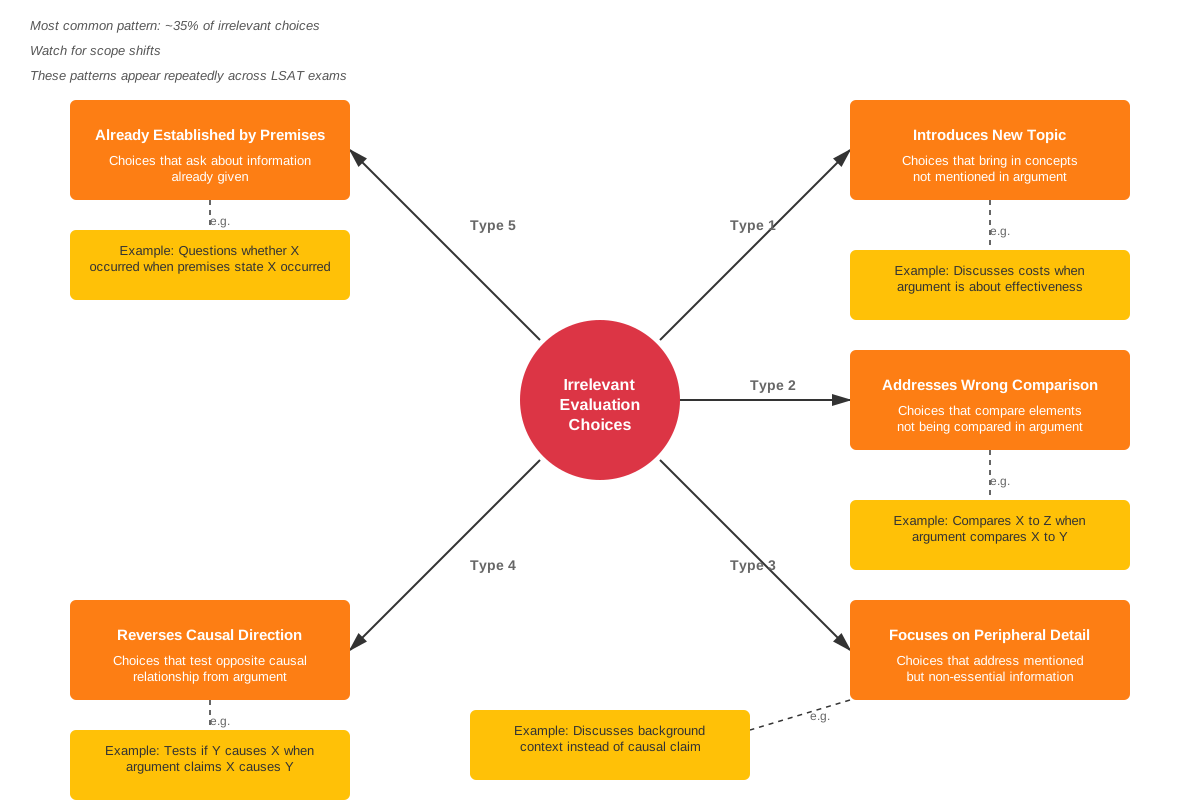
Irrelevant evaluation choices commonly appear in several patterns: they may address consequences of the conclusion rather than its validity, introduce comparison groups that don't affect the argument's logic, focus on implementation details when the argument concerns feasibility, or discuss historical background when the argument makes a forward-looking claim. Recognizing these patterns allows for rapid elimination and increased confidence in selecting the correct answer.
Core Concepts
Understanding Evaluation Questions
Evaluation questions ask test-takers to identify what additional information would help determine whether an argument's conclusion follows logically from its premises. The correct answer to an evaluation question will always present information that, depending on how it's answered, could either strengthen or weaken the argument. This is the fundamental test: if knowing the answer to a question or the truth of a statement would make the argument more or less convincing, that information is relevant to evaluation.
Irrelevant evaluation choices fail this test. They present information that, regardless of the answer, would not affect the logical strength of the argument. These choices often seem related to the argument's subject matter, making them tempting to test-takers who focus on topical relevance rather than logical relevance.
The Core Assumption Connection
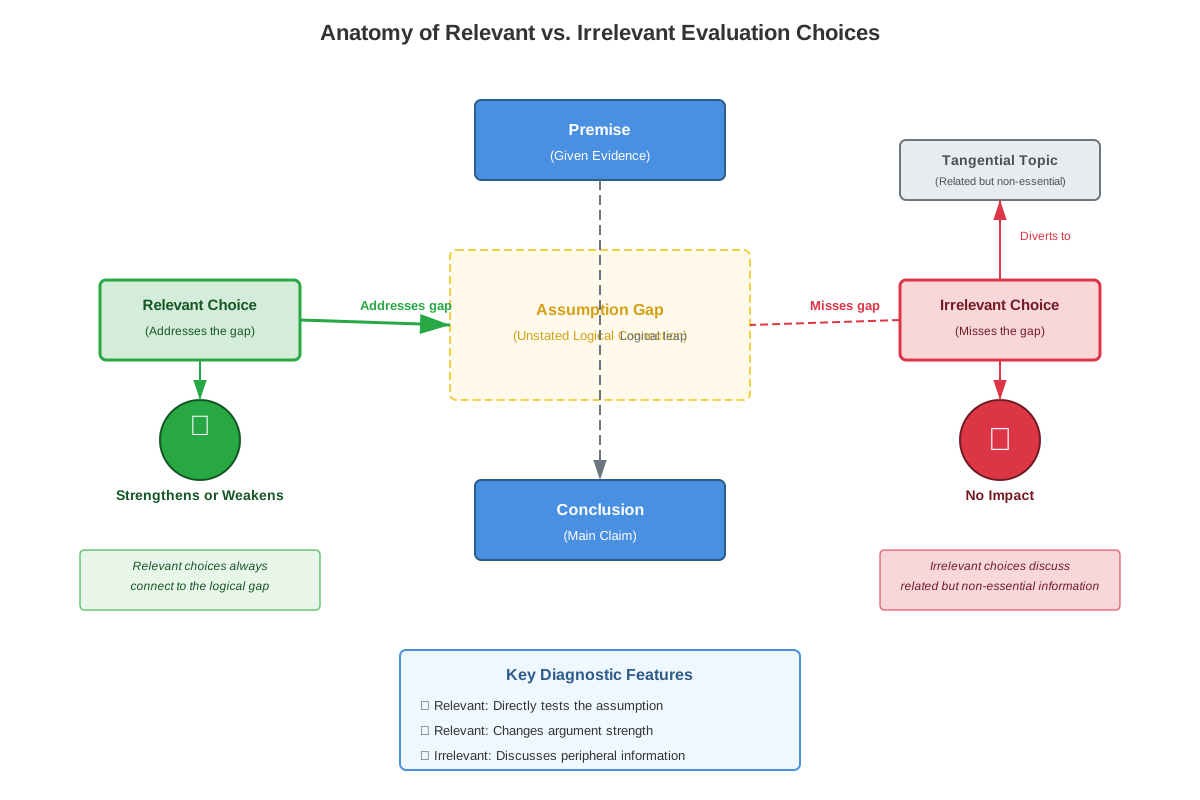
Every argument on the LSAT contains at least one assumption—an unstated premise necessary for the conclusion to follow from the stated premises. The most relevant evaluation criteria always address these assumptions directly or indirectly. To identify relevant evaluation information, test-takers must first identify the argument's core assumption, which represents the logical gap between premises and conclusion.
For example, if an argument concludes that "Policy X will reduce crime" based on the premise that "Policy X will increase police presence," the core assumption is that increased police presence leads to reduced crime. Relevant evaluation information would address whether this causal relationship holds true. Irrelevant evaluation choices might discuss the cost of Policy X, public opinion about police, or crime rates in other countries—none of which directly addresses whether the assumed causal mechanism is valid.
Categories of Irrelevant Evaluation Choices
| Category | Description | Example Context |
|---|---|---|
| Consequence Confusion | Addresses results of the conclusion being true rather than whether it is true | Argument about whether a policy will work; choice asks about effects if it's implemented |
| Scope Shift | Introduces elements outside the argument's defined boundaries | Argument about local effects; choice asks about national implications |
| Implementation Details | Focuses on practical execution when argument concerns theoretical validity | Argument about whether something should be done; choice asks about how to do it |
| Historical Tangents | Discusses past events that don't affect current logical relationships | Argument about future outcomes; choice asks about historical precedents that don't establish causation |
| Comparative Irrelevance | Introduces comparisons that don't affect the argument's internal logic | Argument about absolute effectiveness; choice asks about relative effectiveness compared to unmentioned alternatives |
The Relevance Test Framework
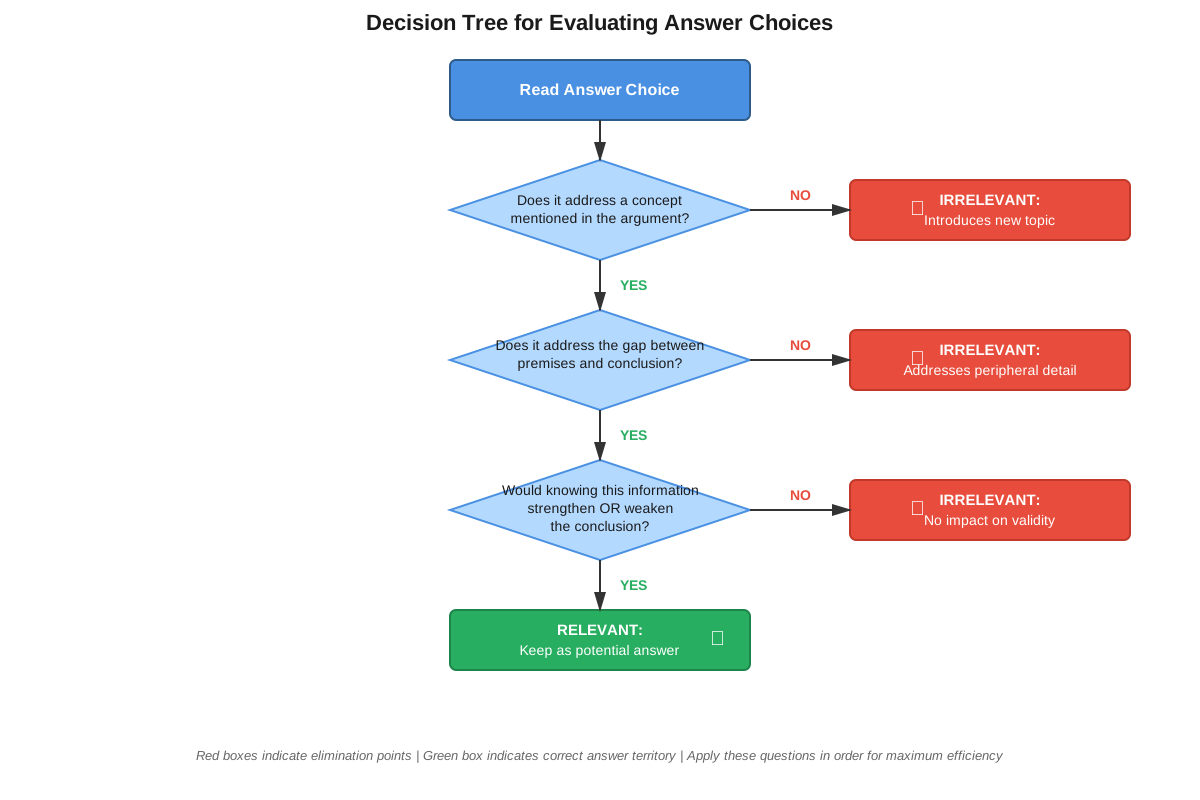
To systematically determine whether evaluation information is relevant, apply this three-step framework:
- Identify the conclusion and premises: What is the argument trying to prove, and what evidence does it offer?
- Locate the assumption: What unstated connection must be true for the conclusion to follow from the premises?
- Apply the "would it matter?" test: If the answer to the evaluation question were "yes" versus "no," would either answer make the argument stronger or weaker? If both answers leave the argument's strength unchanged, the evaluation criterion is irrelevant.
Common Logical Structures and Their Relevant Evaluations
Causal arguments (X causes Y) require evaluation of whether the causal mechanism is valid, whether alternative causes exist, and whether the correlation is genuine. Irrelevant evaluations often discuss the desirability of Y or the prevalence of X without addressing the causal connection.
Predictive arguments (X will happen) require evaluation of whether conditions necessary for X are present and whether factors that would prevent X are absent. Irrelevant evaluations often discuss what would happen after X occurs or compare X to unrelated events.
Prescriptive arguments (We should do X) require evaluation of whether X will achieve the stated goal and whether the goal is actually served by X. Irrelevant evaluations often discuss the popularity of X or the difficulty of implementing X without addressing effectiveness.
Analogical arguments (X is like Y, so what's true of Y is true of X) require evaluation of whether X and Y are similar in relevant respects. Irrelevant evaluations often discuss features of X or Y that aren't part of the analogy's logical structure.
The Scope Principle
One of the most powerful tools for identifying irrelevant evaluation choices is understanding scope. The scope of an argument includes the specific subjects, time frames, locations, and conditions explicitly or implicitly discussed. Evaluation criteria that fall outside this scope are almost always irrelevant unless they directly address an assumption that bridges the scope gap.
For instance, if an argument discusses "employees at Company X," evaluation criteria about "workers in the industry generally" are likely irrelevant unless the argument assumes that Company X employees are representative of industry workers. Similarly, if an argument concerns "current trends," historical information is irrelevant unless the argument assumes historical patterns will continue.
Concept Relationships
The concept of irrelevant evaluation choices connects directly to argument structure analysis, as identifying what's irrelevant requires first understanding what the argument actually claims and how it supports that claim. This foundational skill leads to assumption identification, which reveals the logical gaps that relevant evaluation criteria must address.
Assumption identification → determines → relevant evaluation criteria → enables elimination of → irrelevant evaluation choices
The relationship to strengthen and weaken questions is bidirectional: understanding what strengthens or weakens an argument helps identify relevant evaluation criteria, while practice with evaluation questions sharpens the ability to recognize what factors affect argument strength. Both question types require precise understanding of logical scope and the distinction between topical relevance and logical relevance.
Causal reasoning and conditional logic represent specific logical structures that frequently appear in evaluation questions. Mastery of these structures allows rapid identification of what information would be relevant—for causal arguments, information about alternative causes or the mechanism of causation; for conditional arguments, information about whether necessary or sufficient conditions are met.
The concept also connects forward to more advanced skills like flaw identification, as many irrelevant evaluation choices mirror common argument flaws (scope shifts, causal confusion, etc.). Recognizing these patterns in evaluation questions reinforces the ability to spot them in flaw questions.
High-Yield Facts
- ⭐ Relevant evaluation criteria must be capable of both strengthening and weakening the argument depending on the answer; if information can only affect the argument in one direction or not at all, it's irrelevant
- ⭐ The most common type of irrelevant evaluation choice discusses consequences of the conclusion rather than evidence for the conclusion's validity
- ⭐ Information outside the argument's scope is irrelevant unless the argument contains an assumption that bridges the scope gap
- Evaluation questions always have assumptions as their foundation; the correct answer addresses the core assumption directly or indirectly
- ⭐ Implementation details are irrelevant when the argument concerns whether something should be done, not how to do it
- Comparative information is irrelevant when the argument makes an absolute claim rather than a relative one
- ⭐ Historical information is irrelevant unless the argument explicitly assumes that past patterns predict future outcomes
- The popularity or desirability of a conclusion is irrelevant to whether the conclusion is logically supported by the premises
- Information about extreme or unusual cases is typically irrelevant when the argument concerns general patterns or typical situations
- ⭐ The correct answer to an evaluation question will always address the logical connection between premises and conclusion, not peripheral details
- Irrelevant choices often use keywords from the stimulus to create false topical relevance
- If you can't articulate how both a "yes" and "no" answer would affect the argument, the evaluation criterion is likely irrelevant
Quick check — test yourself on Irrelevant evaluation choices so far.
Try Flashcards →Common Misconceptions
Misconception: If an answer choice discusses the same topic as the argument, it must be relevant to evaluating the argument.
Correction: Topical relevance does not equal logical relevance. An evaluation criterion must address the logical connection between premises and conclusion, not merely discuss related subjects. The LSAT deliberately constructs wrong answers that are topically related but logically irrelevant.
Misconception: Information that would be interesting or useful to know in a real-world context is relevant for evaluation purposes.
Correction: Real-world usefulness differs from logical relevance. An evaluation question asks specifically what would help determine whether the conclusion follows from the premises, not what would be generally useful to know about the situation. Practical considerations like cost, popularity, or implementation difficulty are usually irrelevant to logical validity.
Misconception: If knowing something would change what action should be taken, it's relevant to evaluating the argument.
Correction: This confuses evaluating the argument with evaluating the situation. An evaluation question asks what would help assess the argument's logical strength, not what would affect decision-making more broadly. Information about consequences, side effects, or alternative options is typically irrelevant unless the argument explicitly claims something about these factors.
Misconception: Historical precedents are always relevant to evaluating arguments about future events.
Correction: Historical information is only relevant if the argument assumes that past patterns will continue or that historical conditions are analogous to current conditions. Many arguments about the future are based on current evidence or theoretical reasoning, making historical data irrelevant to evaluating the specific logical connection being made.
Misconception: If an answer choice addresses an assumption, it must be the correct answer.
Correction: Not all assumptions are equally central to an argument. Evaluation questions seek information that addresses the core assumption—the primary logical gap between premises and conclusion. Peripheral assumptions or background assumptions that don't affect the main logical connection are less relevant than the central assumption.
Worked Examples
Example 1: Causal Argument Evaluation
Stimulus: "City officials claim that the new traffic light system will reduce accidents at the intersection of Main and Oak Streets. They point out that since the system was installed three months ago, accidents at that intersection have decreased by 40%."
Question: "Which of the following would be most useful to know in evaluating the officials' claim?"
Answer Choices:
(A) Whether accidents at other intersections in the city have also decreased during the same period
(B) Whether the traffic light system was expensive to install
(C) Whether drivers generally approve of the new traffic light system
(D) Whether the intersection of Main and Oak Streets had more accidents than other intersections before the system was installed
(E) Whether the city plans to install similar systems at other intersections
Analysis:
First, identify the argument structure:
- Premise: Accidents decreased 40% since the system was installed
- Conclusion: The traffic light system caused the reduction
- Core Assumption: The decrease was caused by the traffic light system rather than other factors
Now apply the relevance test to each choice:
(A) Whether accidents at other intersections have also decreased: This is RELEVANT. If accidents decreased city-wide, it suggests a common cause (weather, enforcement campaign, etc.) rather than the traffic light system specifically. If accidents only decreased at Main and Oak, it strengthens the causal claim. This addresses the core assumption about causation.
(B) Whether the system was expensive: This is IRRELEVANT. Cost doesn't affect whether the system actually caused the reduction. This is a consequence/implementation detail that doesn't address the logical connection between the system and accident reduction.
(C) Whether drivers approve of the system: This is IRRELEVANT. Driver opinion doesn't determine whether the system actually reduced accidents. This confuses popularity with effectiveness.
(D) Whether Main and Oak had more accidents before: This is IRRELEVANT. The argument already tells us accidents decreased; knowing the absolute number before doesn't affect whether the system caused the decrease. This is a scope shift to comparative data that doesn't address causation.
(E) Whether the city plans to install more systems: This is IRRELEVANT. Future plans don't affect whether the current system worked. This discusses consequences of believing the conclusion rather than evidence for it.
Correct Answer: (A)
Connection to Learning Objectives: This example demonstrates how irrelevant evaluation choices often discuss implementation (B), popularity (C), comparative data that doesn't address the core logic (D), or consequences (E), while the relevant choice (A) directly addresses the causal assumption.
Example 2: Prescriptive Argument Evaluation
Stimulus: "The university should require all students to take a course in computer programming. In today's job market, employers increasingly seek candidates with programming skills, and students who graduate without these skills find themselves at a competitive disadvantage."
Question: "The answer to which of the following questions would be most helpful in determining whether the university should follow the recommendation?"
Answer Choices:
(A) Are there enough qualified instructors to teach programming courses to all students?
(B) Do students who take programming courses actually acquire skills that employers value?
(C) Have other universities implemented similar requirements?
(D) Would requiring programming courses delay graduation for some students?
(E) Are programming skills more important than other skills students might develop instead?
Analysis:
Argument structure:
- Premise: Employers want programming skills; students without them are disadvantaged
- Conclusion: The university should require programming courses
- Core Assumption: Taking programming courses will give students the programming skills that provide competitive advantage
Apply the relevance test:
(A) Enough qualified instructors: This is IRRELEVANT. This addresses implementation feasibility, not whether the requirement would achieve its stated goal. The argument concerns whether students should take programming, not whether it's logistically possible.
(B) Do students actually acquire valued skills: This is RELEVANT. If students take courses but don't acquire useful skills, the requirement won't achieve its goal. If they do acquire valued skills, it supports the recommendation. This directly addresses the assumption that courses lead to competitive advantage.
(C) Have other universities done this: This is IRRELEVANT. What other universities do doesn't determine whether this university should do it. This is a scope shift that doesn't address whether the requirement would work.
(D) Would it delay graduation: This is IRRELEVANT to the argument as stated. While this might be a practical concern, the argument doesn't claim anything about graduation timing. This introduces a new consideration rather than evaluating the stated reasoning.
(E) Are programming skills more important than alternatives: This is IRRELEVANT as the argument is structured. The argument doesn't claim programming is the most important skill, only that it provides competitive advantage. This introduces a comparison the argument doesn't make.
Correct Answer: (B)
Connection to Learning Objectives: This example shows how irrelevant choices often focus on implementation (A), appeal to what others do (C), introduce unstated considerations (D), or create false comparisons (E), while the relevant choice addresses whether the proposed action will achieve its stated purpose.
Exam Strategy
When approaching evaluation questions on the LSAT, follow this systematic process:
Step 1: Read the question stem first to confirm it's an evaluation question. Trigger phrases include "most useful to know in evaluating," "most helpful in determining whether," and "answer to which question would be most relevant."
Step 2: Identify the conclusion precisely. Underline or mentally note the exact claim being made. Pay attention to scope limitations (time, place, degree).
Step 3: Identify the premises and the gap. What evidence is offered? What must be assumed for the conclusion to follow? The gap represents what relevant evaluation criteria must address.
Step 4: Predict before looking at choices. Ask yourself: "What would I need to know to determine if this conclusion follows?" This prediction acts as a filter for wrong answers.
Step 5: Apply the "both directions" test to each answer choice. Ask: "If the answer were YES, would it affect the argument? If the answer were NO, would it affect the argument?" If either answer is "it wouldn't matter," eliminate that choice.
Step 6: Watch for scope shifts. Eliminate any choice that introduces new subjects, time frames, or comparisons not present in the original argument unless they directly address a stated assumption.
Step 7: Eliminate implementation and consequence distractors. If a choice discusses how to do something (when the argument is about whether to do it) or what will happen after the conclusion is true (rather than whether it is true), eliminate it.
Time Management Tip: Spend 10-15 seconds identifying the core assumption before reading answer choices. This upfront investment saves time by enabling rapid elimination of irrelevant choices.
Process of Elimination Tip: On evaluation questions, you can often eliminate 3-4 choices quickly by asking "Does this address the logical gap?" This leaves you comparing only 1-2 potentially correct answers.
Trigger words for irrelevant choices: "cost," "popular," "difficult to implement," "in the past," "other examples," "compared to alternatives" (when the argument makes no comparison), "consequences," "side effects."
Trigger words for relevant choices: "whether," "if," "the extent to which," "the degree to which"—these signal information that could vary and thus affect the argument differently depending on the answer.
Memory Techniques
SCOPE Acronym for identifying irrelevant evaluation choices:
- Scope shifts (introduces new subjects/boundaries)
- Consequences (discusses results of conclusion being true)
- Opinions (popularity/approval when argument concerns facts)
- Practical details (implementation when argument concerns validity)
- Extraneous comparisons (introduces comparisons not in original argument)
The "Both Directions" Visualization: Picture a scale with the argument on it. Relevant evaluation information tips the scale either toward "stronger" or "weaker" depending on the answer. Irrelevant information leaves the scale balanced regardless of the answer. Visualize each answer choice as a weight—does it tip the scale, or does it just sit there?
The "Bridge Test" Mnemonic: Imagine the premises and conclusion as two cliffs with a gap between them. The assumption is the bridge connecting them. Relevant evaluation criteria test whether the bridge is sturdy. Irrelevant criteria discuss the scenery, the cost of the bridge, or other bridges elsewhere—interesting but not relevant to whether this bridge holds.
CAP for Causal Arguments:
- Correlation genuine? (addresses whether the relationship exists)
- Alternative causes? (addresses whether other factors explain the effect)
- Proper mechanism? (addresses whether the proposed cause actually produces the effect)
Evaluation criteria that address any of these three elements are likely relevant for causal arguments.
Summary
Irrelevant evaluation choices represent answer options that fail to address the logical connection between an argument's premises and conclusion. Mastering this concept requires understanding that logical relevance differs from topical relevance—information can be related to an argument's subject matter without being relevant to evaluating its logical validity. The key to identifying irrelevant evaluation choices lies in first identifying the argument's core assumption, then testing whether each answer choice provides information that would strengthen or weaken the argument depending on how that information resolves. Irrelevant choices typically fall into predictable categories: they discuss consequences rather than validity, shift scope to introduce new elements, focus on implementation details when the argument concerns theoretical soundness, appeal to popularity or historical precedent without establishing logical connections, or introduce comparisons the argument doesn't make. By systematically applying the "both directions" test—asking whether both a "yes" and "no" answer would affect the argument's strength—test-takers can reliably distinguish relevant from irrelevant evaluation criteria and improve both accuracy and speed on these high-value LSAT questions.
Key Takeaways
- Relevant evaluation criteria must be capable of both strengthening and weakening an argument depending on the answer; if information only works in one direction or not at all, it's irrelevant
- Topical relevance does not equal logical relevance; the LSAT deliberately creates wrong answers that discuss the argument's subject matter without addressing its logical structure
- The core assumption is the key to identifying relevant evaluation criteria; information that addresses the gap between premises and conclusion is relevant, while information about peripheral issues is not
- Common categories of irrelevant choices include consequences, implementation details, scope shifts, popularity/opinion, and extraneous comparisons
- Apply the "both directions" test systematically: if you can't articulate how both a "yes" and "no" answer would affect the argument, the criterion is likely irrelevant
- Predict what would be relevant before examining answer choices to create a filter that enables rapid elimination of distractors
- Time efficiency comes from recognizing patterns: once you've identified common types of irrelevant choices, you can eliminate them in seconds rather than deliberating over each option
Related Topics
Assumption Questions: Mastering irrelevant evaluation choices directly enhances performance on assumption questions, as both require identifying the logical gap between premises and conclusion. Assumption questions ask what must be true, while evaluation questions ask what would be useful to know—two sides of the same analytical coin.
Strengthen and Weaken Questions: These question types share the fundamental skill of recognizing what information affects argument strength. Practice with evaluation questions sharpens the ability to distinguish factors that genuinely impact logical validity from those that merely seem relevant.
Flaw Questions: Many irrelevant evaluation choices mirror common argument flaws (scope shifts, causal confusion, etc.). Understanding why certain evaluation criteria are irrelevant reinforces the ability to identify these same patterns as flaws in other arguments.
Sufficient Assumption Questions: These advanced questions require identifying what information would guarantee the conclusion follows from the premises. Mastery of evaluation questions provides the foundation for this more demanding task by developing precision in identifying logical gaps.
Practice CTA
Now that you understand how to identify and eliminate irrelevant evaluation choices, it's time to apply these concepts to actual LSAT questions. The practice questions and flashcards will reinforce the patterns you've learned and build the speed and confidence necessary for test-day success. Remember: recognizing irrelevant evaluation choices is a skill that improves dramatically with deliberate practice. Each question you work through strengthens your ability to see through topical distractors and focus on logical relevance. Approach the practice materials systematically, applying the frameworks and tests outlined in this guide, and you'll find that what initially seemed challenging becomes second nature.
Sign up free to keep reading
Create a free AnvayaPrep account to finish this LSAT guide on Irrelevant evaluation choices — plus flashcards and practice questions.