Overview
Premise completion questions represent a distinctive and frequently tested question type within the LSAT's Logical Reasoning sections. These questions present an argument with a missing piece—typically a premise—and ask test-takers to identify which answer choice, when inserted into the argument, would best complete the logical structure. Unlike assumption questions that ask what must be true for an argument to work, premise completion questions explicitly indicate where information is missing and require selecting the statement that most logically fills that gap.
Understanding premise completion is essential for LSAT success because these questions test the fundamental skill of recognizing logical structure and identifying what information is necessary to bridge gaps between evidence and conclusion. This question type appears regularly on every LSAT administration, typically comprising 2-4 questions per test. Mastering premise completion develops critical analytical skills that transfer to other Logical Reasoning question types, including strengthen/weaken questions, assumption questions, and inference questions.
Within the broader framework of evaluate and complete the argument questions, premise completion occupies a central position. These questions require test-takers to actively participate in constructing valid arguments rather than merely evaluating pre-existing ones. This skill directly mirrors the analytical reasoning demanded in legal practice, where attorneys must construct complete, logically sound arguments from available evidence. The ability to identify missing premises and select appropriate completions demonstrates mastery of conditional reasoning, causal relationships, and logical necessity—all foundational concepts throughout the LSAT's logical reasoning sections.
Learning Objectives
- [ ] Identify how premise completion appears in LSAT questions
- [ ] Explain the reasoning pattern behind premise completion
- [ ] Apply premise completion to solve LSAT-style problems accurately
- [ ] Distinguish premise completion questions from assumption and strengthen questions
- [ ] Recognize the structural indicators that signal missing premises in arguments
- [ ] Evaluate answer choices based on logical fit and necessity within argument structure
- [ ] Predict the content and scope of missing premises before reviewing answer choices
Prerequisites
- Basic argument structure: Understanding the distinction between premises (evidence) and conclusions is fundamental to identifying what piece is missing from an incomplete argument.
- Conditional reasoning: Many premise completion questions involve conditional statements (if-then relationships), requiring facility with sufficient and necessary conditions.
- Causal reasoning: Recognizing causal claims and the evidence needed to support them is essential for completing arguments that establish cause-effect relationships.
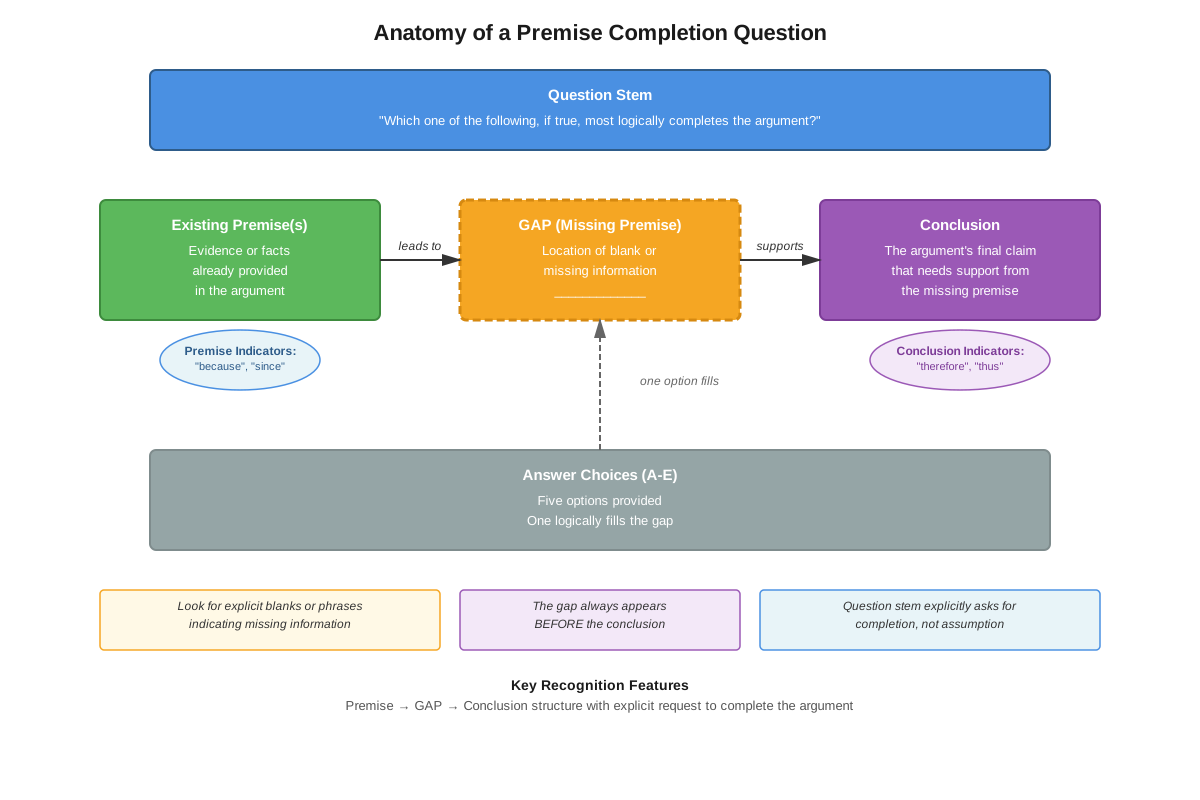
- Logical indicators: Familiarity with conclusion indicators (therefore, thus, hence) and premise indicators (because, since, for) helps identify where gaps exist in argument structure.
Why This Topic Matters
Premise completion questions assess a lawyer's core competency: constructing complete, logically valid arguments from incomplete information. In legal practice, attorneys regularly encounter situations where they must identify what additional evidence or reasoning would complete their case. This mirrors the exact skill tested in lsat premise completion questions—recognizing logical gaps and determining what information would bridge those gaps.
On the LSAT, premise completion questions appear with notable frequency, typically constituting 3-5% of all Logical Reasoning questions. This translates to approximately 2-4 questions per test administration. While this may seem modest, these questions are considered medium-to-high difficulty, making them significant differentiators between good and excellent scores. Test-takers who master premise completion often find that the analytical skills transfer directly to other question types, improving overall Logical Reasoning performance.
These questions commonly appear in several formats: explicit blank-filling exercises where the argument contains a literal blank line, questions asking "Which one of the following, if added as a premise, would make the argument valid?", and questions requesting the statement that "most logically completes the argument." The arguments themselves span diverse topics—scientific reasoning, policy debates, historical analysis, and everyday decision-making—ensuring that success depends on logical skill rather than content knowledge.
Core Concepts
The Structure of Premise Completion Questions
Premise completion questions present arguments with an explicitly identified gap in their logical structure. Unlike assumption questions where the gap is implicit, premise completion questions directly acknowledge the missing element, often through a blank line, ellipsis, or explicit question stem asking what would complete the argument. The test-taker's task is to select the answer choice that, when inserted into the designated location, creates the most logically coherent and complete argument.
The typical structure includes: (1) context or background information, (2) one or more stated premises, (3) an indicated gap (blank or explicit request for completion), and (4) a conclusion that follows from the complete set of premises. The missing premise serves as the crucial link connecting the stated evidence to the conclusion, making the argument's logical progression clear and valid.
Types of Missing Premises
Missing premises in LSAT questions fall into several categories, each requiring different analytical approaches:
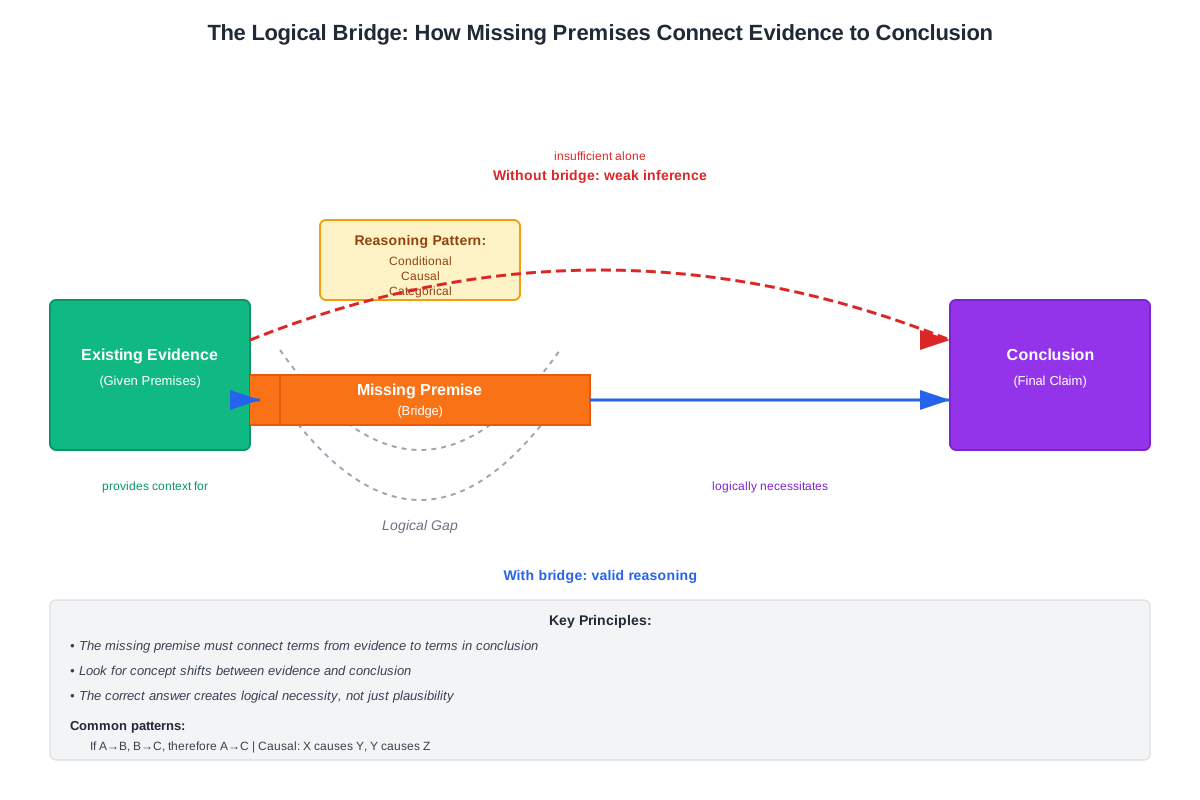
Bridging Premises: These connect two distinct concepts mentioned in the argument. For example, if premises discuss "economic growth" and the conclusion addresses "employment rates," the missing premise must establish a relationship between these concepts. Bridging premises are the most common type in premise completion questions.
Conditional Completions: When arguments involve conditional reasoning, the missing premise often completes a conditional chain. If the argument states "If A, then B" and concludes "Therefore C," the missing premise typically provides "If B, then C," completing the logical sequence.
Causal Links: Arguments establishing causal relationships frequently require premises that rule out alternative explanations or establish the mechanism by which the cause produces the effect. The missing premise might eliminate confounding variables or demonstrate temporal precedence.
Quantifier Specifications: Some arguments require premises that specify scope or quantity. An argument might move from discussing "some members of a group" to a conclusion about "the group as a whole," requiring a premise that bridges this quantitative gap.
The Logical Necessity Principle
The correct answer in premise completion questions must satisfy logical necessity—it must be the statement that, when added to the argument, makes the conclusion follow logically from the premises. This differs from sufficiency; the missing premise need not guarantee the conclusion's truth in all possible worlds, but it must complete the logical structure as presented in the argument.
To evaluate logical necessity, test-takers should:
- Identify the conclusion clearly
- List all stated premises
- Determine what logical gap exists between premises and conclusion
- Predict what type of statement would bridge this gap
- Evaluate each answer choice for its ability to complete the logical structure
Scope Matching in Premise Completion
A critical principle in lsat premise completion is scope matching—the correct answer must match the scope of both the stated premises and the conclusion. If premises discuss "most corporations" and the conclusion addresses "most corporations," the missing premise should maintain this scope rather than shifting to "all corporations" or "some corporations."
| Scope Element | Must Match Between |
|---|---|
| Subject matter | Premises, missing premise, conclusion |
| Quantifiers | Stated evidence and conclusion |
| Temporal frame | All components of the argument |
| Degree of certainty | Premises and conclusion |
The Pre-Phrase Strategy
Effective test-takers employ pre-phrasing—predicting the content and form of the missing premise before examining answer choices. This strategy involves:
- Reading the argument carefully, noting the conclusion
- Identifying stated premises and their relationship to the conclusion
- Articulating (mentally or in writing) what information would bridge the gap
- Formulating a prediction about the missing premise's content
- Comparing answer choices against this prediction
Pre-phrasing prevents test-takers from being swayed by attractive but incorrect answer choices and significantly improves accuracy and speed.
Common Argument Patterns
Certain argument patterns appear repeatedly in premise completion questions:
Categorical Syllogisms: Arguments following the pattern "All A are B; [missing]; Therefore, all A are C" require a premise establishing that "All B are C."
Analogical Arguments: When arguments reason by analogy, the missing premise often establishes relevant similarity between the compared situations or objects.
Elimination Arguments: Arguments that eliminate alternatives to reach a conclusion require premises that comprehensively account for all possibilities or that establish criteria for elimination.
Principle Application: Some arguments apply general principles to specific cases, requiring a missing premise that either states the principle or establishes that the specific case falls within the principle's scope.
Concept Relationships
Premise completion questions exist within a network of related Logical Reasoning concepts. Understanding these relationships enhances mastery and enables skill transfer across question types.
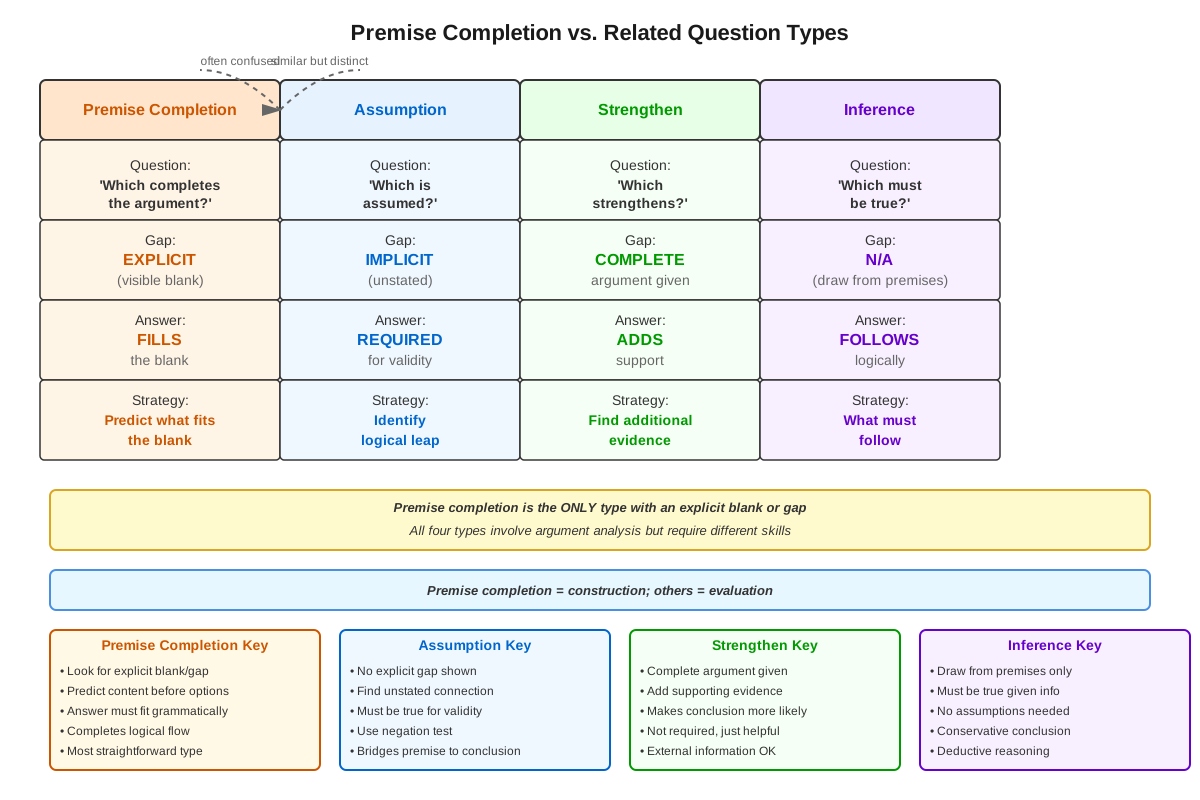
Premise Completion → Assumption Questions: Both question types involve identifying missing logical links, but assumption questions require recognizing implicit gaps while premise completion questions explicitly indicate where information is missing. Mastering premise completion builds the foundational skill of gap identification that transfers directly to assumption questions.
Conditional Reasoning → Premise Completion: Many premise completion questions involve conditional statements, requiring test-takers to complete conditional chains or establish necessary/sufficient conditions. The logical rules governing conditionals (contrapositive, transitive property) directly apply to predicting and evaluating missing premises.
Argument Structure → Premise Completion → Strengthen/Weaken Questions: Understanding argument structure enables identification of missing premises, which in turn illuminates what information would strengthen or weaken arguments. The same analytical process—identifying gaps between evidence and conclusion—underlies all three question types.
Scope Analysis → Premise Completion → Inference Questions: The scope-matching principle essential for premise completion also governs valid inferences. Both question types require careful attention to quantifiers, subject matter boundaries, and degrees of certainty.
The relationship map flows as follows: Basic Argument Structure → Gap Identification → Premise Completion → Advanced Argument Evaluation (Strengthen/Weaken/Evaluate) → Comprehensive Logical Reasoning Mastery.
High-Yield Facts
⭐ Premise completion questions explicitly indicate where information is missing, distinguishing them from assumption questions where gaps are implicit.
⭐ The correct answer must bridge the logical gap between stated premises and conclusion, creating a complete argument structure.
⭐ Scope matching is essential—the missing premise must align with the scope of both the evidence and conclusion in terms of subject matter, quantifiers, and certainty.
⭐ Pre-phrasing the missing premise before reviewing answer choices significantly improves accuracy and prevents distraction by attractive wrong answers.
⭐ The missing premise typically connects two distinct concepts mentioned in the argument, serving as a logical bridge.
- Premise completion questions appear 2-4 times per LSAT administration, making them a regular feature of the test.
- Wrong answers often introduce new information beyond the argument's scope or fail to complete the specific logical gap identified.
- The correct answer need not make the argument perfect or address all possible objections—it must simply complete the logical structure as presented.
- Many premise completion questions involve conditional reasoning, requiring completion of if-then chains.
- The missing premise should be the minimal addition necessary to complete the argument, not an elaborate or comprehensive statement.
- Temporal and causal relationships frequently require premise completion, particularly when arguments establish cause-effect claims.
- Answer choices that are true but irrelevant to the specific logical gap are common distractors.
Quick check — test yourself on Premise completion so far.
Try Flashcards →Common Misconceptions
Misconception: Premise completion questions are identical to assumption questions. → Correction: While both involve identifying missing logical links, premise completion questions explicitly indicate where information is missing (often with a blank line or direct question), whereas assumption questions require recognizing implicit gaps. Additionally, premise completion answers are typically more explicit and complete statements than assumption answers.
Misconception: The correct answer must make the argument's conclusion absolutely certain or true. → Correction: The correct answer must complete the logical structure as presented, making the conclusion follow from the premises. It need not guarantee the conclusion's truth in all possible scenarios or address every potential objection—it must simply bridge the specific logical gap identified in the argument.
Misconception: Longer, more detailed answer choices are more likely to be correct because they provide more complete information. → Correction: The correct answer is the minimal statement necessary to complete the logical structure. Overly elaborate answers often introduce information beyond the argument's scope. The best answer is typically focused and directly addresses the specific gap between premises and conclusion.
Misconception: If an answer choice is factually true or reasonable, it's likely correct. → Correction: The correct answer must specifically complete the logical structure of the given argument. Many wrong answers are true statements that simply don't bridge the particular gap in the argument. Logical fit within the argument's structure matters more than general truth or reasonableness.
Misconception: The missing premise can introduce entirely new concepts not mentioned in the argument. → Correction: The correct answer typically connects concepts already present in the argument, serving as a bridge between stated premises and conclusion. While it may introduce a relationship or connection not previously stated, it should work with the argument's existing elements rather than introducing wholly new subject matter.
Worked Examples
Example 1: Categorical Bridging
Argument:
"All successful entrepreneurs possess strong communication skills. Therefore, Maria, who recently launched a profitable startup, must possess strong communication skills."
Question: Which one of the following, if added as a premise, would make the argument logically valid?
Analysis:
Step 1: Identify the conclusion: "Maria must possess strong communication skills."
Step 2: Identify stated premises: "All successful entrepreneurs possess strong communication skills" and "Maria recently launched a profitable startup."
Step 3: Identify the logical gap: The premises discuss "successful entrepreneurs" and "strong communication skills," while also mentioning that Maria "launched a profitable startup." The conclusion claims Maria possesses strong communication skills. The gap is between "launching a profitable startup" and being a "successful entrepreneur."
Step 4: Pre-phrase the missing premise: We need a statement establishing that Maria is a successful entrepreneur, or that launching a profitable startup makes one a successful entrepreneur.
Step 5: Evaluate answer choices:
- (A) "Most people who launch startups possess strong communication skills." [Incorrect—introduces "most" when we need "all" to match the categorical structure; also doesn't establish Maria as a successful entrepreneur]
- (B) "Anyone who launches a profitable startup is a successful entrepreneur." [Correct—bridges the gap by establishing that Maria's action (launching a profitable startup) places her in the category of successful entrepreneurs, allowing the first premise to apply to her]
- (C) "Strong communication skills are essential for business success." [Incorrect—too general and doesn't connect Maria to the category of successful entrepreneurs]
- (D) "Maria has been recognized as an innovative business leader." [Incorrect—provides additional information about Maria but doesn't establish her as a successful entrepreneur]
Answer: (B) completes the logical structure by establishing the categorical relationship needed for the argument to work.
Example 2: Causal Completion
Argument:
"Studies show that countries with higher rates of educational attainment experience faster economic growth. Policymakers in Country X have noted that their economic growth has slowed in recent years. _____________. Therefore, Country X should invest heavily in expanding access to higher education."
Question: Which one of the following most logically completes the argument?
Analysis:
Step 1: Identify the conclusion: "Country X should invest heavily in expanding access to higher education."
Step 2: Identify stated premises: (1) Higher educational attainment correlates with faster economic growth, and (2) Country X's economic growth has slowed.
Step 3: Identify the logical gap: The argument moves from a correlation between education and growth, plus slowed growth in Country X, to a recommendation about education investment. The gap involves establishing that Country X specifically has an education problem and that addressing it would solve the growth problem.
Step 4: Pre-phrase the missing premise: We need a statement indicating that Country X has lower educational attainment or that improving education would address their specific growth problem.
Step 5: Evaluate answer choices:
- (A) "Educational attainment in Country X has declined over the same period." [Correct—establishes that Country X's problem aligns with the education-growth relationship, making the recommendation logical]
- (B) "Many factors contribute to economic growth beyond education." [Incorrect—weakens rather than completes the argument]
- (C) "Other countries have successfully improved economic growth through education investment." [Incorrect—provides supporting evidence but doesn't establish Country X's specific situation]
- (D) "Higher education is valuable for reasons beyond economic growth." [Incorrect—introduces new considerations outside the argument's scope]
Answer: (A) completes the causal reasoning by establishing that Country X's situation fits the pattern described in the first premise, making the recommended solution logical.
Exam Strategy
Identification Strategy
Premise completion questions can be identified through specific question stem language:
- "Which one of the following most logically completes the argument?"
- "Which one of the following, if added as a premise, would make the argument valid?"
- Arguments containing a blank line (______) with instructions to fill it
- "The conclusion follows logically if which one of the following is assumed?"
Exam Tip: When you see a blank line in an argument or a question asking what would "complete" the argument, you're dealing with premise completion, not assumption identification.
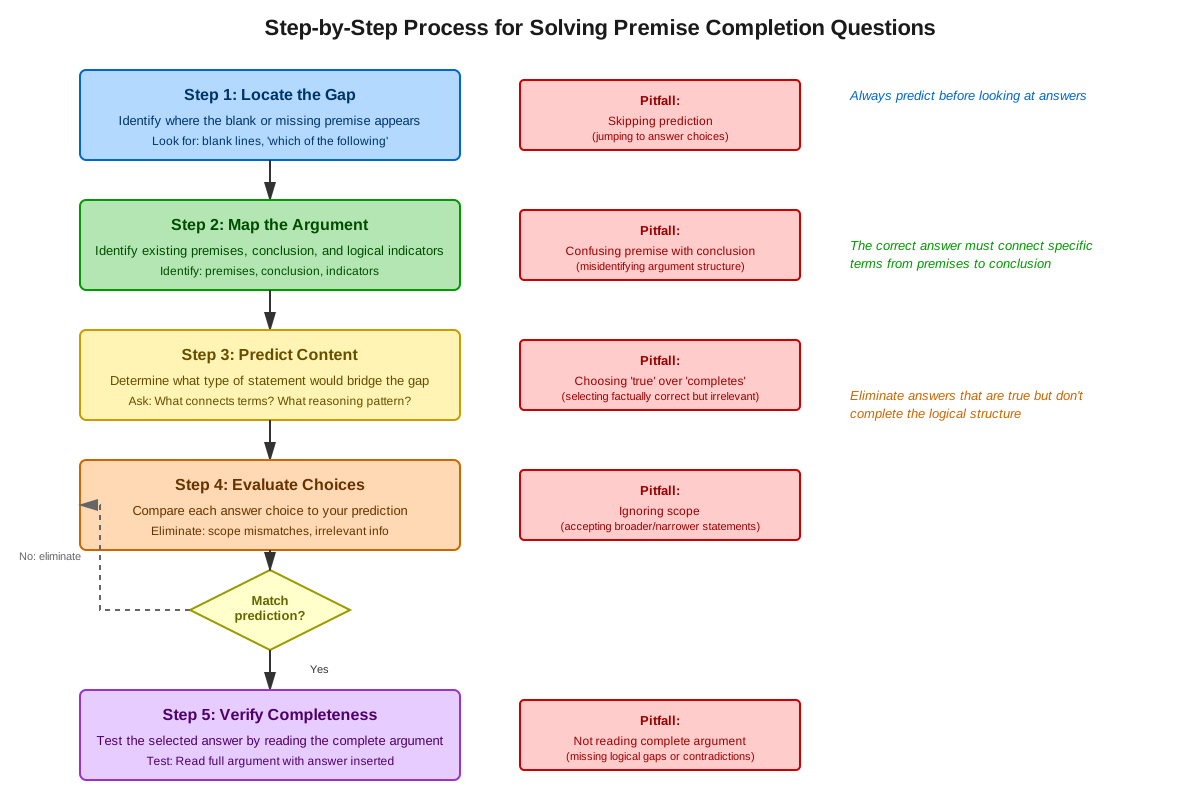
Systematic Approach
- Read the entire argument first: Understand the complete structure before focusing on the gap.
- Identify and underline the conclusion: Knowing where the argument is headed is essential for determining what's missing.
- List the stated premises: Write down or mentally note each piece of evidence provided.
- Articulate the gap: In your own words, describe what logical connection is missing between the premises and conclusion.
- Pre-phrase your answer: Predict what the missing premise should say before looking at answer choices.
- Evaluate systematically: Compare each answer choice against your prediction and the argument's structure.
Process of Elimination Tips
Eliminate answers that:
- Introduce concepts entirely outside the argument's scope
- Shift quantifiers inappropriately (e.g., from "some" to "all" or vice versa)
- Are true but irrelevant to the specific logical gap
- Weaken rather than complete the argument
- Are too broad or too narrow relative to the conclusion's scope
- Reverse the logical relationship needed
Favor answers that:
- Connect two concepts already mentioned in the argument
- Match the scope and certainty level of the conclusion
- Provide the minimal information necessary to bridge the gap
- Maintain consistency with the argument's logical structure
Time Management
Allocate approximately 1:15-1:30 per premise completion question. The time breakdown should be:
- 30 seconds: Reading and understanding the argument
- 15 seconds: Identifying the gap and pre-phrasing
- 30 seconds: Evaluating answer choices
- 15 seconds: Confirming your selection
If you find yourself spending more than 2 minutes on a premise completion question, mark it for review and move on. These questions should be relatively straightforward once you've identified the logical gap.
Memory Techniques
BRIDGE Acronym for evaluating premise completion answers:
- Bridges concepts in the argument
- Relevant to the specific gap
- In scope with premises and conclusion
- Direct connection (not tangential)
- Gap-filling (completes the structure)
- Essential to the logic (not just supporting)
The Missing Link Visualization: Picture the argument as a chain with one link missing. The stated premises are links on one side, the conclusion is the final link, and you need to identify which link connects them. This mental image helps focus on the bridging function of the missing premise.
Scope Matching Mantra: "Same subject, same scope, same certainty." Repeat this when evaluating answer choices to ensure the missing premise aligns with the argument's parameters.
The Completion Test: After selecting an answer, mentally insert it into the argument and read the complete version. If the argument now flows logically from premises to conclusion, you've likely found the correct answer.
Summary
Premise completion questions test the fundamental skill of identifying and filling logical gaps in arguments. These questions explicitly indicate where information is missing and require selecting the statement that most logically completes the argument's structure. Success depends on understanding argument structure, identifying the specific gap between stated premises and conclusion, and selecting an answer that bridges this gap while maintaining appropriate scope and logical necessity. The correct answer connects concepts already present in the argument, matches the scope of both premises and conclusion, and provides the minimal information necessary to make the conclusion follow logically. Unlike assumption questions where gaps are implicit, premise completion questions directly acknowledge the missing element, making gap identification more straightforward but requiring careful attention to logical fit and scope matching. Mastering premise completion develops analytical skills that transfer throughout Logical Reasoning, including assumption identification, argument strengthening and weakening, and inference drawing.
Key Takeaways
- Premise completion questions explicitly indicate missing information through blank lines or direct question stems, distinguishing them from assumption questions
- The correct answer must bridge the logical gap between stated premises and conclusion, creating a complete argument structure
- Pre-phrasing the missing premise before reviewing answer choices significantly improves accuracy and efficiency
- Scope matching is critical—the missing premise must align with the subject matter, quantifiers, and certainty level of both premises and conclusion
- The correct answer typically connects two concepts already mentioned in the argument rather than introducing entirely new subject matter
- Wrong answers often are true statements that simply don't complete the specific logical structure of the given argument
- Systematic approach: identify conclusion → list premises → articulate gap → pre-phrase → evaluate answer choices
Related Topics
Assumption Questions: After mastering premise completion, assumption questions represent the next logical progression. These questions require identifying implicit rather than explicit gaps in arguments, building on the gap-identification skills developed through premise completion practice.
Strengthen and Weaken Questions: Understanding what completes an argument illuminates what would strengthen or weaken it. The same analytical process—identifying gaps between evidence and conclusion—underlies both premise completion and strengthen/weaken questions.
Sufficient Assumption Questions: These represent an advanced form of premise completion, requiring identification of premises that would make conclusions follow with logical certainty. Mastering basic premise completion provides the foundation for this more demanding question type.
Conditional Reasoning: Many premise completion questions involve completing conditional chains or establishing necessary/sufficient conditions. Deepening conditional reasoning skills enhances premise completion performance.
Practice CTA
Now that you've mastered the core concepts of premise completion, it's time to apply these skills to actual LSAT-style questions. The practice questions and flashcards have been specifically designed to reinforce the strategies and principles covered in this guide. Focus on implementing the systematic approach: identify the conclusion, list the premises, articulate the gap, pre-phrase your answer, and then evaluate the choices. Remember, premise completion questions are high-yield opportunities to demonstrate your logical reasoning mastery—each question you practice strengthens the analytical skills that will serve you throughout the LSAT and beyond. Approach the practice with confidence, knowing that you now possess the framework for systematic success on these questions.
Sign up free to keep reading
Create a free AnvayaPrep account to finish this LSAT guide on Premise completion — plus flashcards and practice questions.