Overview
Principle completion is a critical question type within LSAT Logical Reasoning that tests a student's ability to identify and apply broad rules or standards that justify specific arguments or decisions. These questions present an argument or scenario and ask test-takers to select the principle that, when applied, best supports, justifies, or completes the reasoning presented. Unlike other question types that focus on identifying flaws or strengthening arguments with new evidence, principle completion questions require recognizing the underlying logical structure and matching it to an abstract rule that governs the reasoning.
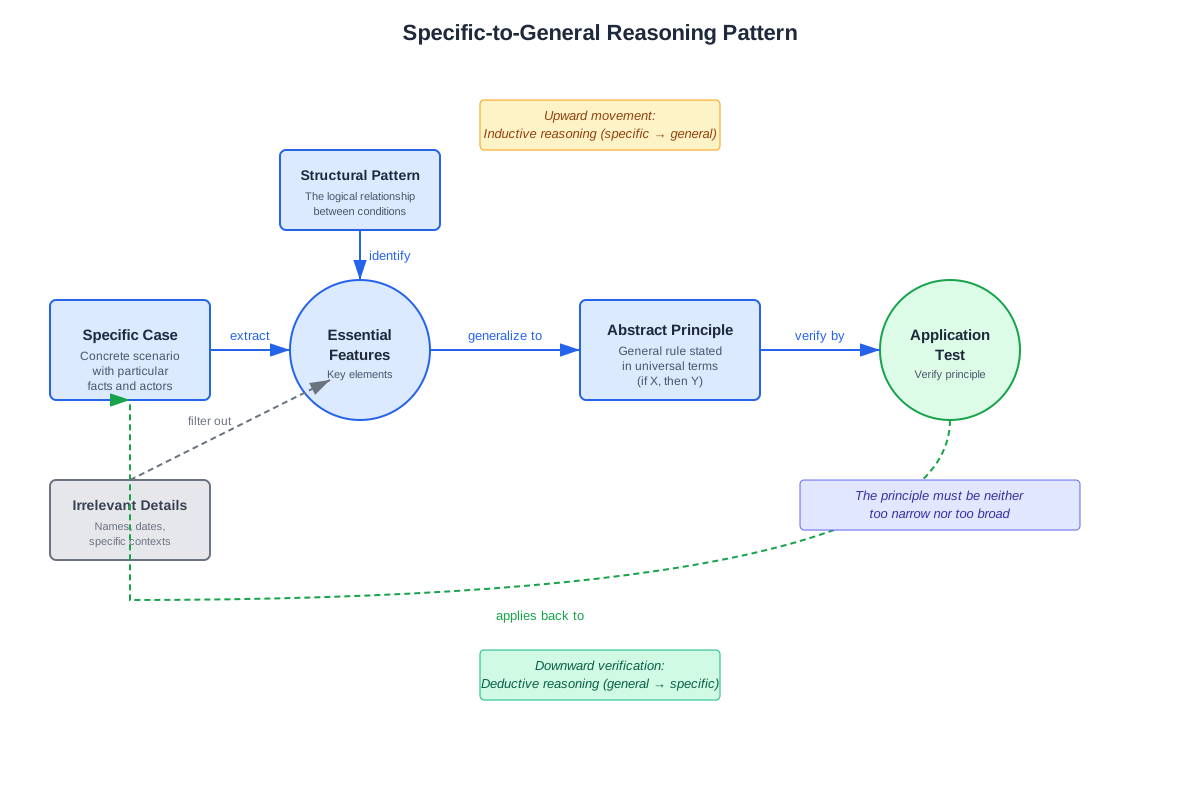
This topic represents a sophisticated intersection of abstract reasoning and practical application. Students must develop the ability to move fluidly between concrete examples and general principles, recognizing how specific cases instantiate broader rules. The LSAT tests this skill because legal reasoning fundamentally depends on applying general legal principles to particular factual situations—a core competency for law school and legal practice. Mastering principle completion questions demonstrates the capacity to think both inductively (from specific to general) and deductively (from general to specific), skills essential for legal analysis.
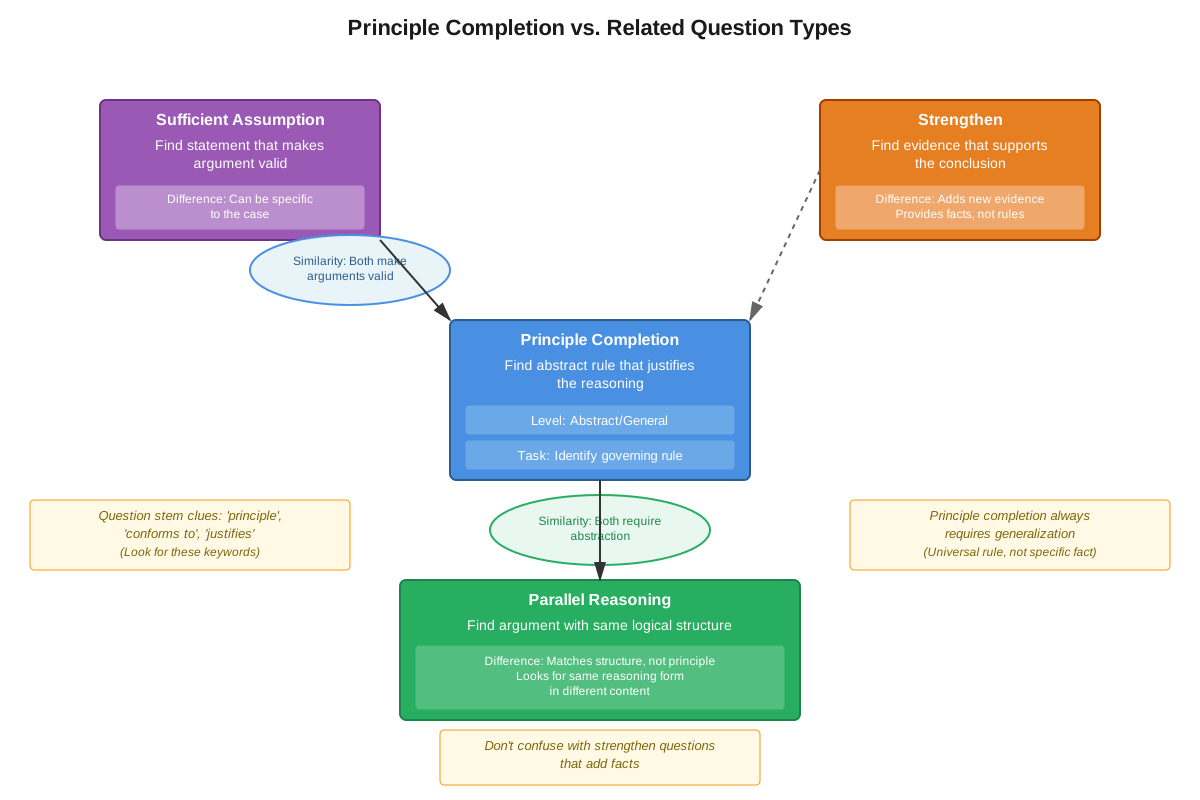
Within the broader Logical Reasoning section, principle completion questions connect to multiple reasoning patterns. They share characteristics with sufficient assumption questions (both require identifying what makes an argument valid) but differ in their level of abstraction. They also relate to parallel reasoning questions, as both require recognizing structural similarities across different contexts. Understanding principle completion enhances overall logical reasoning ability by developing pattern recognition skills and the capacity to abstract essential features from complex scenarios, making this a high-value topic for comprehensive LSAT preparation.
Learning Objectives
- [ ] Identify how Principle completion appears in LSAT questions
- [ ] Explain the reasoning pattern behind Principle completion
- [ ] Apply Principle completion to solve LSAT-style problems accurately
- [ ] Distinguish principle completion questions from other Logical Reasoning question types
- [ ] Evaluate answer choices by testing whether they properly generalize from specific cases
- [ ] Recognize common structural patterns in principle completion arguments
- [ ] Identify when answer choices are too narrow, too broad, or introduce irrelevant considerations
Prerequisites
- Basic argument structure: Understanding premises, conclusions, and how they connect is essential because principle completion requires identifying what rule would bridge the gap between evidence and conclusion
- Conditional reasoning: Familiarity with if-then statements and sufficient/necessary conditions helps recognize how principles establish logical relationships between conditions and outcomes
- Abstraction skills: The ability to identify essential features while ignoring irrelevant details enables students to match concrete scenarios with abstract principles
- Sufficient assumption questions: Experience with identifying what makes arguments valid provides a foundation for understanding how principles justify reasoning
Why This Topic Matters
Principle completion questions appear with significant frequency on the LSAT, typically comprising 2-4 questions per Logical Reasoning section. This translates to approximately 8-16% of all Logical Reasoning questions across a typical exam, making it a high-yield topic that directly impacts overall scores. These questions test skills that extend beyond test-taking into the fundamental competencies required for legal education and practice.
In real-world legal contexts, attorneys constantly apply general legal principles to specific factual situations. A lawyer might need to determine which statute or precedent governs a client's case, or how a constitutional principle applies to novel circumstances. Judges write opinions that articulate the principles underlying their decisions, ensuring consistency across cases. Legal scholars analyze how broad doctrines should be interpreted and applied. The cognitive skills tested by principle completion questions—abstracting general rules from specific instances and applying those rules to new situations—mirror the daily work of legal professionals.
On the LSAT, principle completion questions typically appear in several formats. The most common presents an argument or decision followed by a question stem asking which principle "most helps to justify" or "most closely conforms to" the reasoning. Another format describes a situation and asks which principle the scenario "illustrates" or "exemplifies." Some questions present multiple scenarios and ask which principle applies to all of them. Recognizing these formats quickly allows students to deploy appropriate strategies efficiently, maximizing accuracy while managing time constraints.
Core Concepts
Understanding Principle Completion Questions
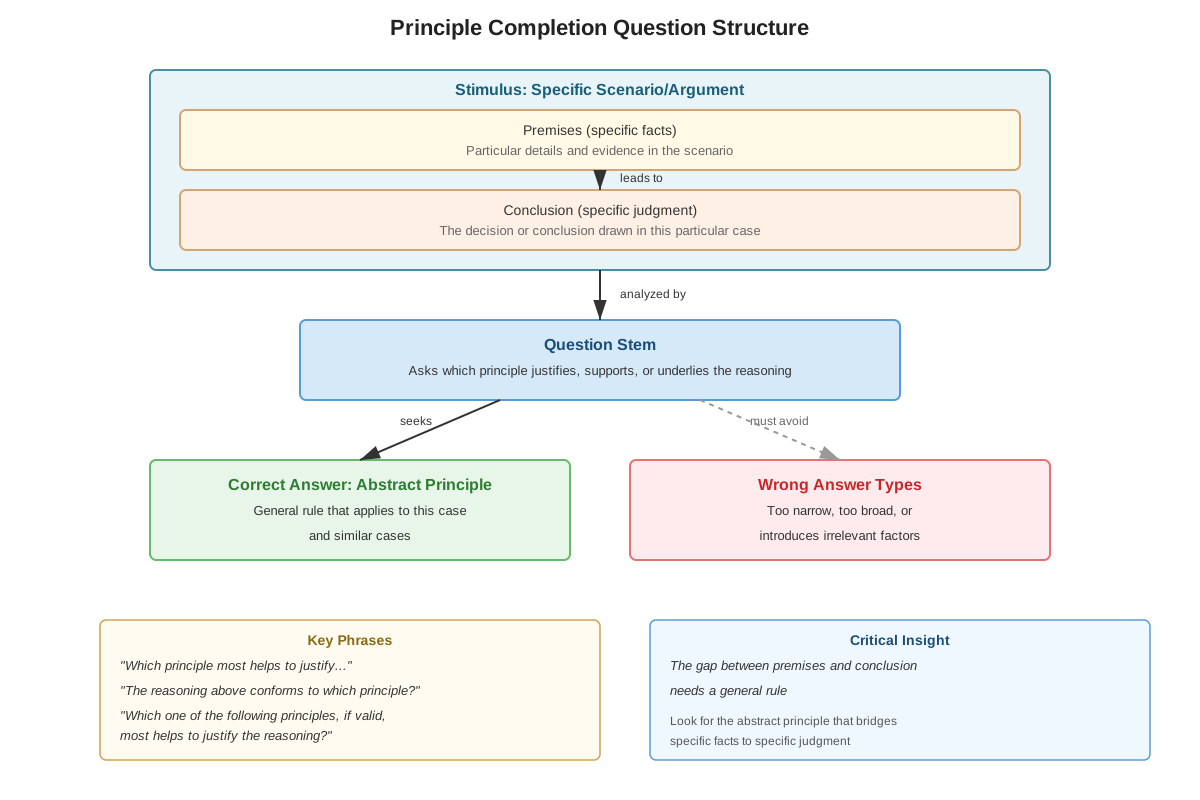
Principle completion questions ask test-takers to identify a general rule or standard that justifies, supports, or is exemplified by a specific argument or scenario. The principle serves as a bridge between the evidence presented and the conclusion drawn, making explicit the underlying reasoning that connects them. These questions test the ability to recognize logical patterns at an abstract level and match them to concrete applications.
The key distinction of principle completion lies in its level of abstraction. While a sufficient assumption might state "All X are Y," a principle typically takes the form of a normative or prescriptive rule: "One should do X when Y is the case" or "It is justified to conclude X whenever Y and Z are present." Principles often contain conditional structures, ethical standards, or decision-making criteria that can apply across multiple contexts.
The Anatomy of Principle Completion Arguments
LSAT principle completion arguments typically follow a predictable structure. The stimulus presents a specific situation, decision, or argument. This might be a person making a choice, an organization establishing a policy, or someone drawing a conclusion from evidence. The argument contains particular facts and reaches a specific conclusion. The correct answer provides a general principle that, when applied to these particular facts, validates or explains the conclusion.
Consider this structure:
Specific Facts → Specific Conclusion
The principle acts as a rule that covers this reasoning:
General Principle → (when applied to specific facts) → Validates the conclusion
Types of Principles
Principles on the LSAT generally fall into several categories:
Normative Principles: These establish what one should or ought to do under certain conditions. Example: "One should prioritize actions that benefit the greatest number of people when resources are limited."
Evaluative Principles: These provide criteria for judging or assessing something. Example: "A policy is justified only if its benefits outweigh its costs and it treats all affected parties fairly."
Conditional Principles: These specify that certain conditions lead to particular conclusions or actions. Example: "If an action violates no one's rights and increases overall welfare, then it is permissible."
Comparative Principles: These establish priorities or rankings among competing considerations. Example: "When individual liberty conflicts with collective security, liberty should take precedence unless the security threat is immediate and severe."
The Matching Process
Solving principle completion questions requires a systematic matching process between the specific argument and the abstract principle. This involves three key steps:
- Identify the essential features of the specific argument: What facts are presented? What conclusion is drawn? What implicit reasoning connects them?
- Abstract the pattern: What general rule would make this reasoning valid? What conditions are present, and what outcome follows?
- Test answer choices: Does each principle, when applied to the specific facts, validate the conclusion? Does it cover all relevant features without introducing irrelevant ones?
Scope Considerations
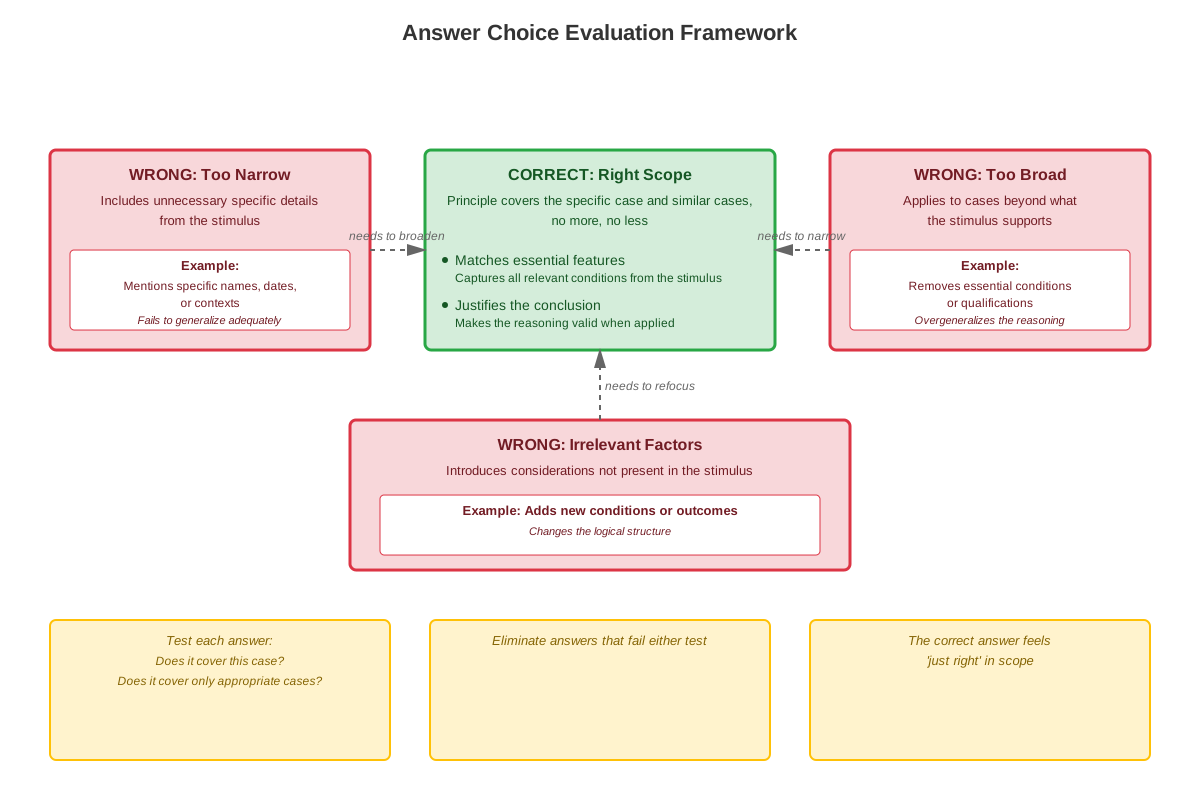
A critical aspect of evaluate and complete the argument questions involves scope matching. The correct principle must be neither too broad nor too narrow. A principle that's too broad applies to situations beyond what the argument addresses, potentially justifying conclusions the argument doesn't support. A principle that's too narrow fails to capture all the essential features of the argument, leaving gaps in the reasoning.
| Scope Issue | Problem | Example |
|---|---|---|
| Too Broad | Applies to cases beyond the argument's scope | Argument about hiring decisions; principle about all organizational decisions |
| Too Narrow | Fails to capture essential features | Argument involving cost and quality; principle addressing only cost |
| Irrelevant Factors | Introduces considerations not present in argument | Argument about efficiency; principle requiring consideration of tradition |
| Perfect Fit | Matches all and only the relevant features | Argument and principle align precisely in scope and content |
Common Structural Patterns
Certain reasoning patterns appear repeatedly in principle completion questions:
Cost-Benefit Pattern: Argument weighs advantages against disadvantages; principle establishes when benefits justify costs or actions.
Rights and Obligations Pattern: Argument involves what someone may or must do; principle specifies conditions under which rights or duties apply.
Means-Ends Pattern: Argument justifies an action as a means to a goal; principle establishes when means are appropriate for achieving ends.
Fairness and Equality Pattern: Argument involves treating people or situations similarly or differently; principle specifies when equal or differential treatment is justified.
Expertise and Authority Pattern: Argument defers to or questions expert judgment; principle establishes when expertise should guide decisions.
Concept Relationships
The concepts within principle completion form an interconnected system. Understanding the anatomy of principle completion arguments (specific facts leading to specific conclusions) enables recognition of the matching process required to identify appropriate principles. The matching process depends on understanding types of principles, as different argument structures call for different principle categories. Scope considerations inform every stage of the matching process, helping eliminate answers that are too broad, too narrow, or introduce irrelevant factors.
Principle completion connects to prerequisite topics in essential ways. Basic argument structure provides the foundation for identifying premises and conclusions in the specific argument. Conditional reasoning skills enable recognition of the if-then relationships that often structure principles. Sufficient assumption questions share the goal of identifying what makes arguments valid, but principle completion operates at a higher level of abstraction, requiring the assumption to be stated as a general rule rather than a specific claim.
The relationship map flows as follows:
Argument Structure → enables → Identifying Essential Features → leads to → Abstracting the Pattern → guides → Matching Process → constrained by → Scope Considerations → informed by → Understanding Principle Types → results in → Correct Answer Selection
This topic also connects forward to other advanced Logical Reasoning skills. Mastering principle completion enhances performance on parallel reasoning questions by developing pattern recognition abilities. It improves performance on application questions (where a principle is given and students must identify which scenario it applies to) by building bidirectional thinking between abstract and concrete. The abstraction skills developed here transfer to Reading Comprehension, particularly when identifying main points or understanding how examples support general claims.
High-Yield Facts
⭐ Principle completion questions ask for a general rule that justifies or is exemplified by a specific argument or scenario
⭐ The correct principle must match the scope of the argument—neither too broad nor too narrow
⭐ Principles typically take conditional or normative forms: "If X, then Y" or "One should do X when Y"
⭐ The correct answer will cover all essential features of the argument without introducing irrelevant considerations
⭐ Common wrong answers include principles that are too specific (merely restating the argument) or too general (applying to cases beyond the argument's scope)
- Principle completion questions typically comprise 8-16% of Logical Reasoning questions on the LSAT
- The matching process requires identifying essential features, abstracting the pattern, and testing answer choices systematically
- Normative principles establish what should be done; evaluative principles provide criteria for judgment
⭐ Wrong answers often introduce new considerations not present in the original argument
- Conditional principles specify that certain conditions lead to particular conclusions or actions
- The principle acts as a bridge between the specific facts and the specific conclusion
- Comparative principles establish priorities among competing considerations
- Scope errors are the most common reason for incorrect answer selection in principle completion questions
- The correct principle should make the argument's reasoning valid when applied to the specific facts presented
Quick check — test yourself on Principle completion so far.
Try Flashcards →Common Misconceptions
Misconception: The correct principle must use the same specific terms as the argument.
Correction: Principles operate at a higher level of abstraction. The correct answer will capture the logical structure and essential features but typically uses more general language. An argument about "hiring software engineers" might be justified by a principle about "selecting candidates for specialized positions."
Misconception: The broadest principle is always correct because it covers more situations.
Correction: Overly broad principles introduce considerations beyond the argument's scope and may justify conclusions the argument doesn't support. The correct principle should be general enough to function as a rule but specific enough to match the argument's essential features precisely.
Misconception: Principle completion questions are the same as sufficient assumption questions.
Correction: While both identify what makes arguments valid, principle completion requires the answer to be stated as a general, abstract rule that could apply to multiple situations. Sufficient assumptions can be specific claims tied to the particular argument. Principle completion operates at a higher level of abstraction.
Misconception: If a principle is true and relevant to the topic, it's the correct answer.
Correction: The correct principle must specifically justify the reasoning in the argument presented. A true principle about the general topic that doesn't match the argument's logical structure is incorrect. The principle must validate the specific connection between the premises and conclusion.
Misconception: The correct answer will introduce new information that strengthens the argument.
Correction: Unlike strengthen questions, principle completion doesn't add new evidence. Instead, it makes explicit the general rule that underlies the reasoning already present. The principle articulates the logical connection between existing premises and conclusion rather than providing additional support.
Misconception: Longer, more detailed principles are more likely to be correct.
Correction: Length doesn't determine correctness. Some correct principles are concise; some wrong answers are lengthy but introduce irrelevant details or fail to capture essential features. Focus on logical fit rather than length or complexity.
Worked Examples
Example 1: Policy Decision
Stimulus: The city council decided to implement a new recycling program despite its high initial costs. The council determined that the program would significantly reduce environmental harm over time and that this long-term benefit justified the immediate expense.
Question: Which principle most helps to justify the council's decision?
Answer Choices:
(A) Government bodies should implement any program that reduces environmental harm.
(B) When a policy's long-term environmental benefits outweigh its short-term costs, the policy should be adopted.
(C) Recycling programs should be implemented regardless of cost.
(D) Environmental considerations should always take priority over economic considerations.
(E) Policies with high initial costs should be avoided unless absolutely necessary.
Analysis:
First, identify the essential features of the argument:
- Premise 1: The program has high initial costs
- Premise 2: The program significantly reduces environmental harm over time
- Conclusion: The program should be implemented (the expense is justified)
The reasoning pattern: Long-term environmental benefit justifies short-term cost.
Now test each answer:
(A) Too broad—doesn't account for the cost consideration that's central to the argument. This would justify implementing programs regardless of cost, which isn't what the council decided.
(B) ⭐ CORRECT — This principle captures both essential features: long-term environmental benefits and short-term costs. It establishes that when benefits outweigh costs (as the council determined), implementation is justified. The scope matches perfectly.
(C) Too narrow and too extreme—ignores the weighing of costs against benefits that the council performed. This absolute principle doesn't match the council's reasoning.
(D) Too broad and introduces a consideration not in the argument—the council didn't say environmental considerations "always" take priority, just that in this case, the long-term benefits justified the costs.
(E) Contradicts the argument—this principle would argue against the council's decision rather than justify it.
Connection to Learning Objectives: This example demonstrates how to identify essential features (both cost and environmental benefit), abstract the pattern (weighing long-term benefits against short-term costs), and eliminate answers based on scope errors.
Example 2: Professional Decision
Stimulus: Dr. Martinez declined to recommend a particular medical treatment to her patient, even though the treatment had a high success rate. She explained that the treatment carried risks of serious side effects and that less risky alternatives, though slightly less effective, were available. Dr. Martinez concluded that recommending the safer alternatives was more appropriate given the circumstances.
Question: The principle that most helps to justify Dr. Martinez's reasoning is:
Answer Choices:
(A) Medical professionals should always recommend the treatment with the highest success rate.
(B) When safer alternatives exist, treatments with serious side effect risks should never be recommended.
(C) A medical professional should recommend a less risky treatment over a more effective one when the effectiveness difference is small and the risk difference is substantial.
(D) Patient safety is the only consideration relevant to treatment recommendations.
(E) Treatments should be evaluated solely on their success rates.
Analysis:
Essential features:
- Premise 1: Treatment has high success rate
- Premise 2: Treatment has serious side effect risks
- Premise 3: Alternatives are safer but slightly less effective
- Conclusion: Recommending safer alternatives is more appropriate
The reasoning pattern: When effectiveness difference is small but risk difference is large, choose the safer option.
Testing answers:
(A) Contradicts the argument—Dr. Martinez specifically didn't follow this principle.
(B) Too extreme—uses "never," which is too absolute. Dr. Martinez's reasoning was context-specific (alternatives available, small effectiveness difference), not an absolute rule.
(C) ⭐ CORRECT — Captures all essential features: acknowledges both effectiveness and risk, specifies the conditions (small effectiveness difference, substantial risk difference), and matches the conclusion (recommend less risky option). The scope is perfect.
(D) Too narrow—ignores the effectiveness consideration that Dr. Martinez explicitly weighed. She didn't ignore effectiveness; she balanced it against risk.
(E) Contradicts the argument—Dr. Martinez considered risks, not just success rates.
Connection to Learning Objectives: This example shows how the correct principle must account for multiple factors being weighed (effectiveness vs. risk) and specify the conditions under which one takes priority (when differences are of particular magnitudes). It also demonstrates how extreme language ("always," "never," "only") often signals wrong answers.
Exam Strategy
When approaching principle completion questions on the LSAT, begin by carefully reading the stimulus to identify the argument's structure. Mark or mentally note the premises and conclusion. Before looking at answer choices, articulate to yourself what general rule would justify this reasoning. This pre-phrasing strategy prevents answer choices from misleading you and provides a target to match against.
Trigger words and phrases that signal principle completion questions include:
- "Which principle most helps to justify..."
- "The reasoning above most closely conforms to which principle..."
- "Which principle, if valid, most helps to justify..."
- "The situation described above most closely conforms to which principle..."
- "Which principle is best illustrated by..."
Exam Tip: The phrase "most helps to justify" indicates you're looking for a principle that makes the argument's reasoning valid, not necessarily new evidence that strengthens it.
Process of elimination strategy: Systematically eliminate answers based on common errors:
- First pass: Eliminate answers that are clearly too broad (apply to situations beyond the argument) or too narrow (fail to capture essential features)
- Second pass: Eliminate answers that introduce considerations not present in the original argument
- Third pass: Between remaining choices, select the one that matches all essential features without adding irrelevant ones
Time allocation: Principle completion questions typically require 1:15 to 1:30 minutes. They demand careful reading but shouldn't consume excessive time. If you find yourself spending more than 1:45 on a principle completion question, mark it and return if time permits. The matching process should be systematic but efficient.
Common trap patterns to avoid:
- The restatement trap: An answer that merely repeats the specific argument in different words isn't a principle—it's too narrow
- The true-but-irrelevant trap: An answer that states a true principle about the general topic but doesn't match the argument's logical structure
- The extreme language trap: Answers with "always," "never," "only," or "all" are often too broad unless the argument itself uses such absolute language
Strategic approach for difficult questions: If you're struggling to identify the correct principle, try working backwards. For each answer choice, ask: "If this principle were true, would it justify the conclusion based on the premises given?" This application test can clarify which principle actually fits.
Memory Techniques
SCOPE Mnemonic for evaluating answer choices:
- Specific enough to match the argument's features
- Covers all essential elements
- Omits irrelevant considerations
- Pattern matches the reasoning structure
- Eliminates answers that are too extreme
The Bridge Visualization: Picture the principle as a bridge connecting the premises (one side) to the conclusion (other side). The bridge must be wide enough to cover all the premises but not so wide that it extends to unrelated areas. This mental image helps assess scope.
The Abstraction Ladder: Visualize moving up a ladder from specific to general. The argument sits at the bottom (specific case). The correct principle sits one or two rungs up (general enough to apply to similar cases but not at the top of the ladder where it's too abstract). Wrong answers are either at the same rung (too specific) or at the very top (too broad).
MATCH Acronym for the solving process:
- Mark the conclusion and premises
- Abstract the essential pattern
- Test each answer choice
- Check scope carefully
- Home in on the best fit
The "If-Then" Conversion: Many principles can be mentally converted to if-then form, making their logical structure clearer. Practice restating principles as: "If [conditions from premises], then [conclusion is justified]." This helps identify whether the principle actually connects the argument's components.
Summary
Principle completion questions test the ability to identify general rules that justify specific arguments or decisions, requiring movement between concrete examples and abstract principles. Success depends on systematically identifying essential features of arguments, abstracting the underlying reasoning pattern, and matching that pattern to principles that are neither too broad nor too narrow. The correct principle must cover all relevant features of the argument without introducing irrelevant considerations, functioning as a bridge that validates the connection between premises and conclusion. Common errors include selecting principles that are too specific (merely restating the argument), too general (applying beyond the argument's scope), or that introduce new factors not present in the original reasoning. Mastering this question type requires developing strong abstraction skills, understanding various principle types (normative, evaluative, conditional, comparative), and applying systematic elimination strategies that focus on scope matching. These skills directly translate to legal reasoning, where applying general rules to specific situations constitutes fundamental professional competency.
Key Takeaways
- Principle completion questions require identifying a general rule that justifies or is exemplified by a specific argument, operating at a higher level of abstraction than other question types
- The correct principle must match the argument's scope precisely—covering all essential features without being too broad or introducing irrelevant considerations
- Systematic approach involves identifying essential features, abstracting the reasoning pattern, and testing answer choices against the specific argument
- Common wrong answers include principles that are too specific (restatements), too broad (applying beyond scope), or that introduce new considerations not in the argument
- Scope matching is the most critical skill: the principle should be general enough to function as a rule but specific enough to capture the argument's essential features
- Pre-phrasing the principle before reading answer choices prevents being misled by attractive but incorrect options
- Extreme language ("always," "never," "only") in answer choices often signals overly broad principles unless the argument itself uses such absolute terms
Related Topics
Sufficient Assumption Questions: These questions also identify what makes arguments valid but at a more specific level. Mastering principle completion provides a foundation for recognizing the more abstract versions of sufficient assumptions.
Application Questions: The inverse of principle completion—these provide a principle and ask which scenario it applies to. Understanding principle completion enables bidirectional thinking between abstract rules and concrete applications.
Parallel Reasoning: Both question types require recognizing logical structures across different contexts. The pattern recognition skills developed through principle completion directly enhance parallel reasoning performance.
Necessary Assumption Questions: While these identify what must be true for an argument to work, principle completion identifies the general rule that justifies the reasoning. Understanding the distinction clarifies different types of logical relationships.
Strengthen and Weaken Questions: These add or remove support for arguments, while principle completion makes explicit the underlying rule. Recognizing this distinction prevents confusion between adding evidence and articulating principles.
Practice CTA
Now that you've mastered the core concepts of principle completion, it's time to apply these skills to actual LSAT questions. The practice questions and flashcards will reinforce your ability to identify essential features, abstract reasoning patterns, and match principles to arguments with precision. Each practice question you complete strengthens your pattern recognition abilities and builds the confidence needed for test day. Remember: principle completion is a high-yield topic that appears consistently on the LSAT, making your practice time here a direct investment in score improvement. Approach each practice question systematically, using the MATCH process and SCOPE evaluation techniques you've learned. You're developing skills that extend beyond the LSAT into the core competencies of legal reasoning itself.
Sign up free to keep reading
Create a free AnvayaPrep account to finish this LSAT guide on Principle completion — plus flashcards and practice questions.