Overview
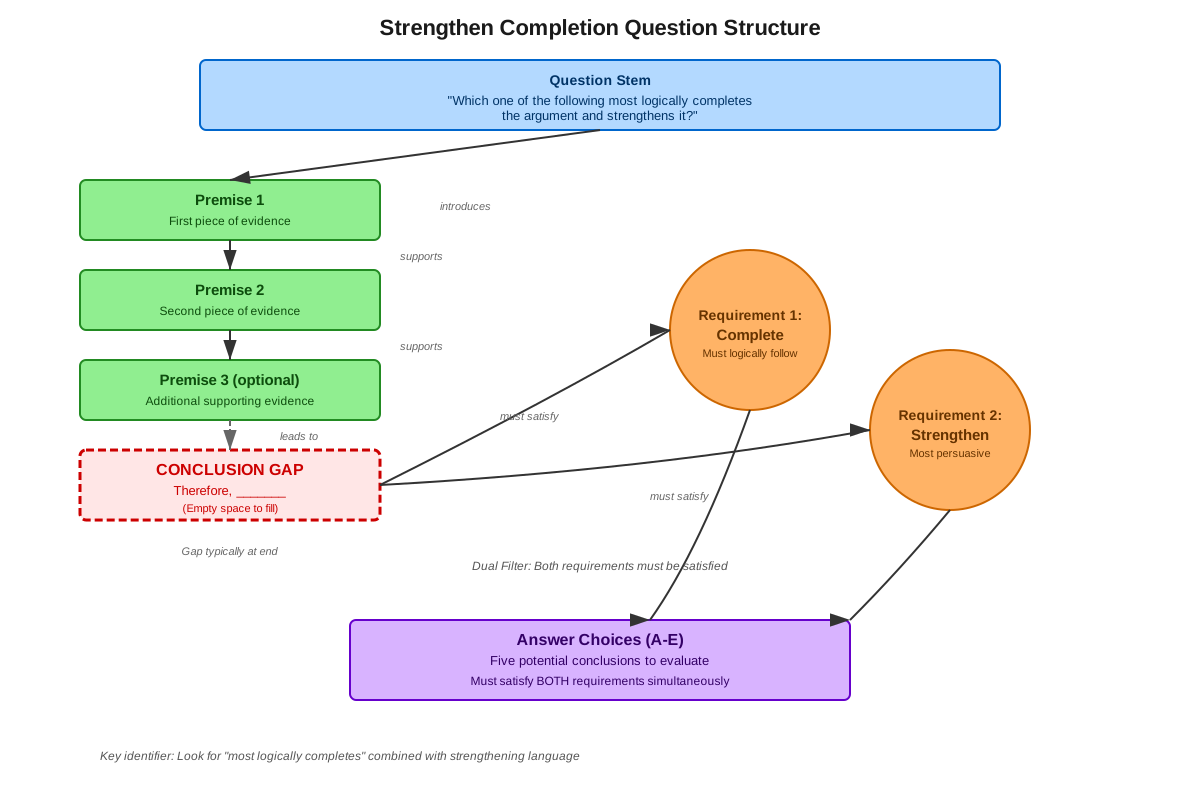
Strengthen completion questions represent a sophisticated hybrid question type on the LSAT that combines elements of both argument completion and strengthening tasks. In these questions, test-takers encounter an incomplete argument—typically missing its conclusion—and must select the answer choice that both completes the argument logically and strengthens the reasoning presented in the premises. This question type appears regularly in the Logical Reasoning sections and demands that students simultaneously understand argument structure, identify logical gaps, and recognize which conclusion would make the argument most persuasive.
The challenge of lsat strengthen completion questions lies in their dual requirement: the correct answer must not only follow logically from the premises but must also create the strongest possible argument. Unlike simple argument completion questions where any logical conclusion might suffice, strengthen completion questions require selecting the conclusion that makes the argument most resistant to criticism and most compelling. This means students must evaluate multiple potential conclusions and determine which one creates the tightest logical connection between premises and conclusion while minimizing vulnerabilities.
Within the broader landscape of Logical Reasoning, strengthen completion questions bridge several critical skills. They require understanding of argument structure (identifying premises, conclusions, and assumptions), facility with strengthening techniques (recognizing what makes arguments more persuasive), and the ability to evaluate and complete the argument by selecting conclusions that maximize logical force. Mastering this question type builds foundational skills that transfer to pure strengthening questions, assumption questions, and even flaw identification, making it a high-leverage topic for overall LSAT performance improvement.
Learning Objectives
- [ ] Identify how Strengthen completion appears in LSAT questions
- [ ] Explain the reasoning pattern behind Strengthen completion
- [ ] Apply Strengthen completion to solve LSAT-style problems accurately
- [ ] Distinguish between answer choices that merely complete an argument versus those that both complete and strengthen it
- [ ] Recognize common argument structures that appear in strengthen completion questions
- [ ] Evaluate the relative strength of multiple potential conclusions for the same set of premises
- [ ] Identify the assumptions that connect premises to conclusions in strengthen completion contexts
Prerequisites
- Basic argument structure: Understanding premises, conclusions, and how they relate is essential because strengthen completion requires identifying where the conclusion should fit and what it should accomplish
- Strengthening question fundamentals: Familiarity with what makes arguments stronger (additional evidence, closing gaps, eliminating alternatives) provides the foundation for selecting conclusions that maximize argument strength
- Conditional reasoning: Many strengthen completion questions involve conditional statements, so recognizing sufficient and necessary conditions helps identify which conclusions follow most powerfully
- Assumption identification: Since the strongest conclusions often make the fewest or most reasonable assumptions, recognizing what an argument assumes is crucial for this question type
Why This Topic Matters
Strengthen completion questions appear with notable frequency on the LSAT, typically comprising 2-4 questions per test across both Logical Reasoning sections. This represents approximately 5-8% of all Logical Reasoning questions, making it a high-yield topic that can directly impact overall scores. The question type tests multiple competencies simultaneously, meaning that mastering strengthen completion builds skills that transfer to numerous other question types, creating a multiplier effect on performance.
In real-world applications, the skills tested by strengthen completion questions mirror critical thinking demands in legal practice and beyond. Attorneys regularly construct arguments from available evidence, selecting conclusions that are both logically sound and maximally persuasive to judges or juries. The ability to recognize which conclusion creates the strongest case from a given set of facts is fundamental to legal advocacy, contract negotiation, and policy argumentation.
On the LSAT, strengthen completion questions typically appear with stem language such as "Which one of the following most logically completes the argument?" or "The conclusion of the argument is most strongly supported if which one of the following completes the passage?" These questions present an argument with a blank line or explicit gap, usually at the end but occasionally mid-argument. The passage provides premises and context, then signals that a conclusion should follow. Test-takers must evaluate five potential conclusions, selecting the one that both fits logically and creates the most robust argument. This question type frequently appears in passages discussing causal relationships, policy recommendations, scientific hypotheses, or comparative evaluations.
Core Concepts
The Dual Nature of Strengthen Completion
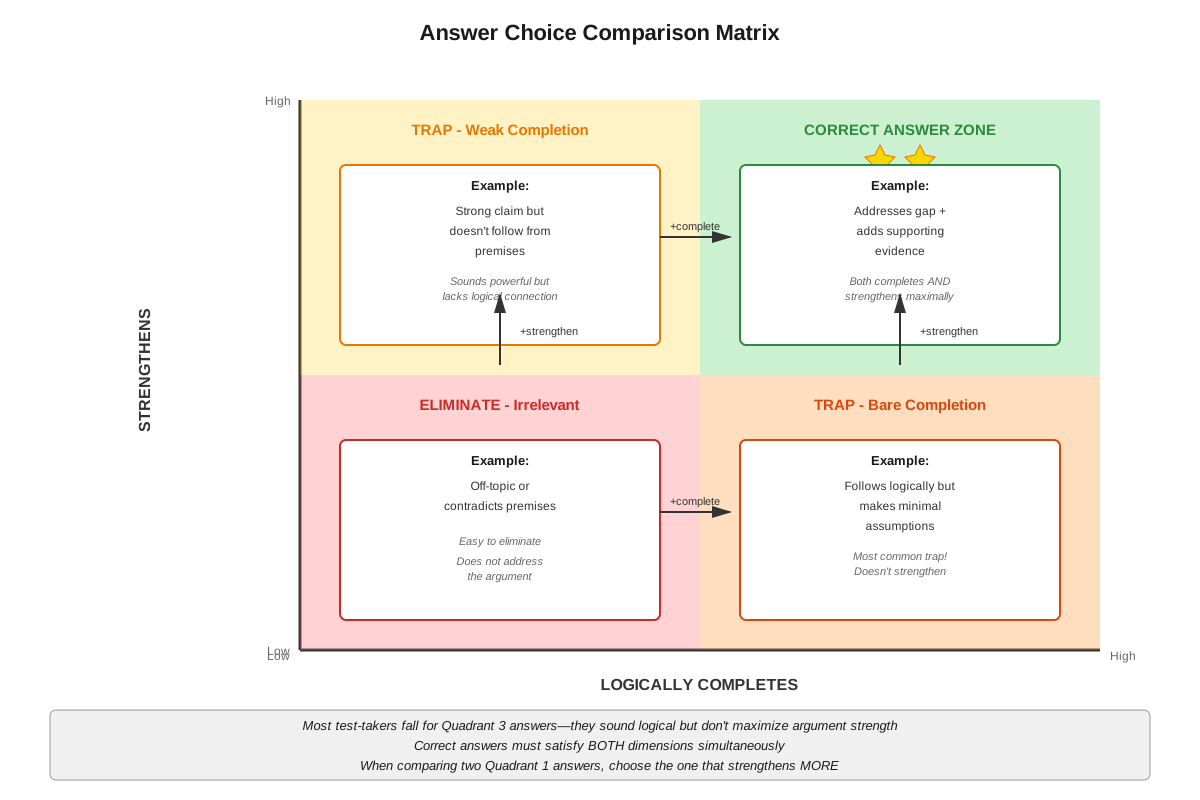
Strengthen completion questions require satisfying two distinct criteria simultaneously. First, the selected answer must complete the argument—it must fit logically as a conclusion that follows from the stated premises. Second, among all logically possible conclusions, it must be the one that creates the strongest argument. This dual requirement distinguishes strengthen completion from simpler completion questions where any logical conclusion suffices.
The "completion" aspect demands that the answer choice functions as a proper conclusion. It should be supported by the premises rather than introducing entirely new information that the premises don't address. The conclusion should represent the point the argument is building toward, not a tangential observation or an additional premise.
The "strengthen" aspect requires evaluating which conclusion makes the argument most persuasive and resistant to objections. A stronger conclusion typically: (1) makes fewer or more reasonable assumptions, (2) has more direct support from the premises, (3) is more modest in scope, avoiding overreach, or (4) addresses potential counterarguments. The correct answer creates the tightest logical connection between what's stated and what's concluded.
Identifying Strengthen Completion Questions
These questions appear with distinctive stem language that signals both the completion and strengthening requirements. Common formulations include:
- "Which one of the following most logically completes the argument?"
- "The conclusion of the argument is most strongly supported if which one of the following completes the passage?"
- "Which one of the following, if true, would most reasonably complete the argument?"
- "The argument's conclusion is most justified if which one of the following is assumed to complete it?"
The key indicators are phrases like "most logically," "most strongly supported," or "most reasonably," which signal that multiple answers might complete the argument but only one creates the strongest version. The passage itself will contain a blank line (often indicated by underlining or explicit statement that something follows) where the conclusion should appear.
The Reasoning Pattern
The typical structure of strengthen completion arguments follows this pattern:
- Context/Background: Initial sentences establish the topic and relevant facts
- Premises: Evidence, observations, or established facts that will support the conclusion
- Intermediate reasoning: Sometimes explicit logical steps connecting evidence to conclusion
- Gap: The missing conclusion, often signaled by "therefore," "thus," "consequently," or similar transition words
- Answer choices: Five potential conclusions of varying logical strength
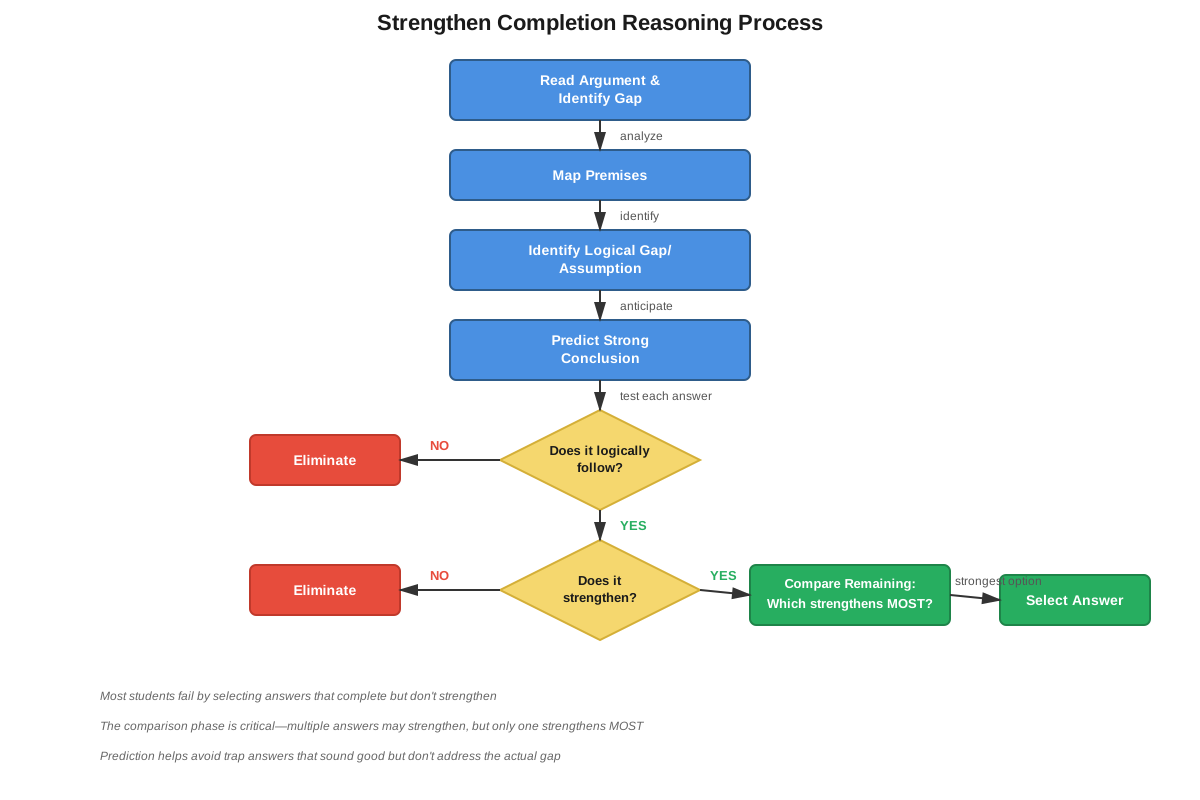
The reasoning pattern requires working backward from potential conclusions to evaluate which one the premises best support. Strong test-takers develop a prediction of what the conclusion should accomplish before examining answer choices, then evaluate each option against both logical fit and argumentative strength.
Evaluating Conclusion Strength
When multiple answer choices could logically complete an argument, strength differentiation becomes crucial. Consider these factors when evaluating relative strength:
| Strength Factor | Stronger Conclusion | Weaker Conclusion |
|---|---|---|
| Scope | Matches premise scope precisely | Overgeneralizes or introduces new scope |
| Assumptions | Requires minimal, reasonable assumptions | Requires multiple or questionable assumptions |
| Evidence alignment | Directly addresses all key premises | Ignores some premises or adds unsupported elements |
| Moderation | Uses qualified language when appropriate | Makes absolute claims beyond evidence |
| Vulnerability | Resistant to obvious objections | Easily challenged or refuted |
Common Argument Structures in Strengthen Completion
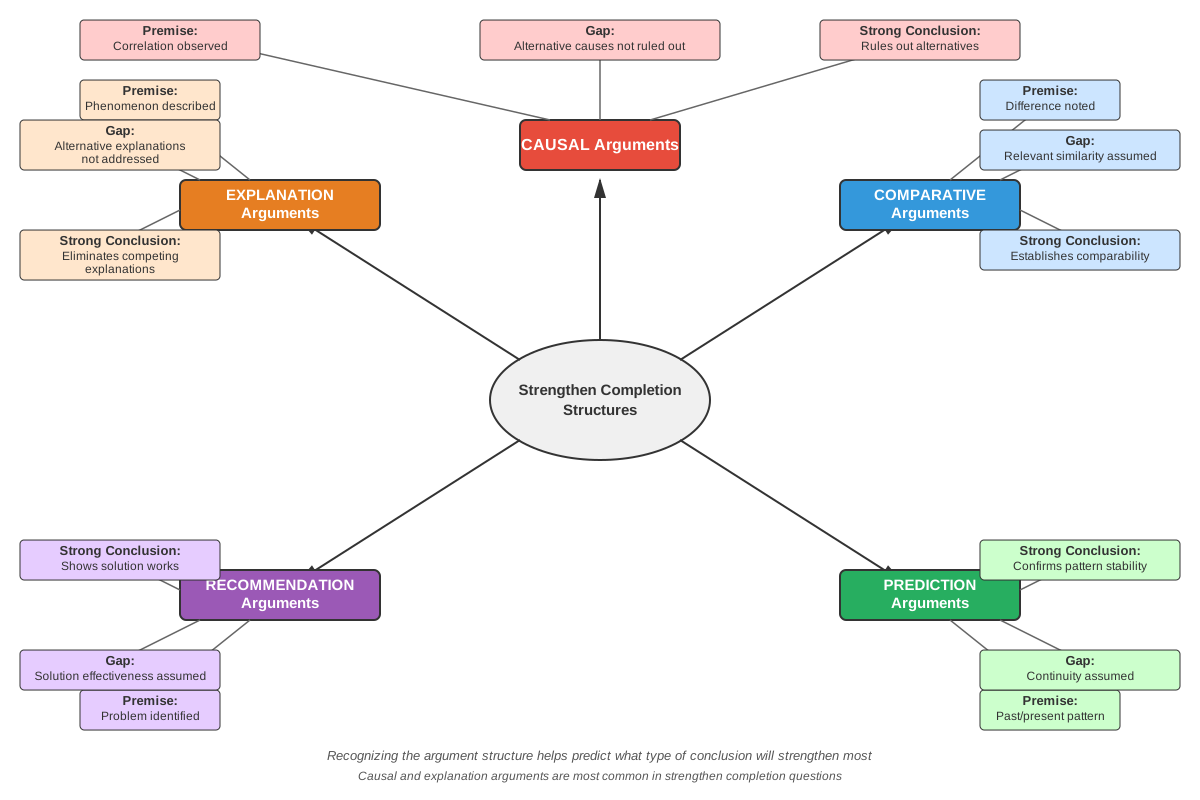
Several argument patterns appear frequently in strengthen completion questions:
Causal Arguments: Premises establish correlation or temporal sequence; the conclusion should assert causation in the most defensible way. Stronger conclusions often include qualifiers or acknowledge the specific conditions under which causation operates.
Comparative Arguments: Premises compare two or more options; the conclusion should recommend or evaluate based on the comparison. Stronger conclusions align with all comparison points mentioned rather than cherry-picking favorable evidence.
Problem-Solution Arguments: Premises identify a problem and describe a proposed solution; the conclusion should evaluate the solution's effectiveness. Stronger conclusions account for both the solution's benefits and its limitations as described in the premises.
Evidence-Hypothesis Arguments: Premises present observations or data; the conclusion should state which hypothesis best explains the evidence. Stronger conclusions are those most directly supported by the specific evidence provided rather than requiring additional assumptions.
The Role of Assumptions
Every argument makes assumptions—unstated premises necessary for the conclusion to follow. In strengthen completion questions, the strongest conclusion is often the one requiring the fewest or most reasonable assumptions. When evaluating answer choices, identify what each potential conclusion would require the reader to assume. The conclusion requiring the most defensible assumptions creates the strongest argument.
For example, if premises establish that "Company X increased advertising spending by 50% and sales increased by 30%," a conclusion stating "The advertising increase caused the sales increase" requires assuming no other factors influenced sales. A stronger conclusion might be "The advertising increase likely contributed to the sales increase," which makes a more modest claim requiring fewer assumptions about other causal factors.
Concept Relationships
The concepts within strengthen completion form an interconnected system. Identifying strengthen completion questions through stem language → enables → recognizing the dual nature of the task → which guides → evaluating conclusion strength using specific criteria → while → understanding common argument structures provides templates for prediction → and → analyzing assumptions helps differentiate between stronger and weaker potential conclusions.
Strengthen completion connects to prerequisite topics through multiple pathways. Basic argument structure provides the foundation for understanding where conclusions fit and how they relate to premises. Strengthening question fundamentals supply the criteria for evaluating which conclusion creates the most robust argument. Conditional reasoning often appears in the premises, making recognition of sufficient and necessary conditions crucial for selecting conclusions that follow most powerfully. Assumption identification enables recognizing which conclusions require the most defensible logical leaps.
This topic also connects forward to related Logical Reasoning question types. Mastering strengthen completion builds skills directly applicable to pure strengthening questions (where the conclusion is given and support must be added), assumption questions (which test the same gap-identification skills), and sufficient assumption questions (which require identifying what would guarantee a conclusion follows). The evaluation skills developed here transfer to weakening questions (by understanding what makes arguments vulnerable) and flaw questions (by recognizing when conclusions overreach their premises).
High-Yield Facts
⭐ Strengthen completion questions require both logical fit and maximum argumentative strength—not just any conclusion that follows from premises
⭐ The correct answer typically makes fewer or more reasonable assumptions than incorrect options
⭐ Stem language containing "most logically," "most strongly supported," or "most reasonably" signals strengthen completion rather than simple completion
⭐ Stronger conclusions match the scope of the premises precisely without overgeneralizing or introducing new elements
⭐ The conclusion should address all major premises rather than cherry-picking some while ignoring others
- Strengthen completion questions typically appear 2-4 times per LSAT, representing approximately 5-8% of Logical Reasoning questions
- The missing conclusion usually appears at the end of the passage but occasionally appears mid-argument
- Qualified conclusions (using "likely," "probably," "may") are often stronger than absolute claims when evidence is limited
- Causal conclusions require stronger evidence than correlational conclusions; the strongest answer often reflects this distinction
⭐ Wrong answers often complete the argument logically but introduce unnecessary assumptions or overreach the evidence
- Predictions made before reading answer choices improve accuracy by establishing clear criteria for evaluation
- The correct answer rarely introduces entirely new concepts not mentioned or implied in the premises
- Comparative arguments require conclusions that account for all comparison points, not just favorable ones
- Time-efficient test-takers eliminate answers that fail the "completion" test before evaluating relative strength
- Strengthen completion skills transfer directly to assumption, sufficient assumption, and pure strengthening questions
Quick check — test yourself on Strengthen completion so far.
Try Flashcards →Common Misconceptions
Misconception: Any answer choice that could logically follow from the premises is equally correct → Correction: Strengthen completion requires selecting the conclusion that creates the strongest argument, not just any logical conclusion. Multiple answers may complete the argument, but only one maximizes argumentative force by making the fewest assumptions and aligning most closely with premise scope.
Misconception: The longest or most detailed answer choice is usually correct because it provides more information → Correction: Length and detail don't correlate with strength. Often, more concise conclusions that avoid overreach and unnecessary claims create stronger arguments than verbose options that introduce multiple assumptions or extend beyond premise support.
Misconception: Strengthen completion questions are just regular strengthening questions with a blank to fill → Correction: While related, these question types differ fundamentally. Regular strengthening questions provide a complete argument and ask what additional information would support it. Strengthen completion questions require selecting the conclusion itself, which demands different skills including scope-matching and assumption-minimization.
Misconception: The correct answer should always be a bold, definitive conclusion rather than a qualified statement → Correction: Conclusion strength depends on evidence strength. When premises provide limited or correlational evidence, qualified conclusions (using "likely," "suggests," "may") often create stronger arguments than absolute claims that overreach the evidence and require additional assumptions.
Misconception: If an answer choice introduces a new concept not explicitly mentioned in the premises, it must be wrong → Correction: While the conclusion should be supported by the premises, it can introduce new concepts if those concepts represent logical implications or reasonable inferences from what's stated. The key is whether the new concept requires defensible assumptions given the premises, not whether it uses identical terminology.
Misconception: The correct answer will always address every single premise mentioned in the passage → Correction: While strong conclusions typically account for major premises, not every detail must be explicitly addressed in the conclusion. Some premises provide context or background rather than direct support. The conclusion should address the argument's main logical thrust, which may not require referencing every stated fact.
Misconception: Strengthen completion questions test reading comprehension rather than logical reasoning → Correction: These questions fundamentally test logical reasoning skills: evaluating argument structure, identifying assumptions, assessing evidential support, and recognizing scope limitations. While reading comprehension is necessary to understand the passage, the core skill being tested is logical evaluation of which conclusion creates the strongest argument.
Worked Examples
Example 1: Causal Argument Structure
Passage: "A recent study found that students who ate breakfast before taking standardized tests scored an average of 12% higher than students who did not eat breakfast. The study controlled for variables including prior academic performance, socioeconomic status, and sleep duration. Researchers noted that breakfast eaters reported feeling more alert during testing. Therefore, _____________."
Answer Choices:
(A) eating breakfast causes improved test performance in all academic contexts
(B) students should always eat breakfast regardless of their testing schedule
(C) the correlation between breakfast consumption and test scores suggests breakfast may improve test performance
(D) breakfast is the most important factor in determining test performance
(E) students who skip breakfast will inevitably perform poorly on standardized tests
Analysis:
First, identify this as a strengthen completion question through the "Therefore" signal and the need to complete the argument. The premises establish: (1) correlation between breakfast and higher scores, (2) control for confounding variables, and (3) reported increased alertness.
Evaluate each option:
(A) "causes improved test performance in all academic contexts" - This overreaches the evidence in two ways: it makes a definitive causal claim when the study shows correlation (even with controls), and it extends to "all academic contexts" when the study only examined standardized tests. This requires assuming the results generalize universally. Too strong.
(B) "students should always eat breakfast regardless of their testing schedule" - This extends beyond the scope by recommending breakfast even when no test is scheduled, which the premises don't address. Scope mismatch.
(C) "the correlation between breakfast consumption and test scores suggests breakfast may improve test performance" - This conclusion matches the evidence precisely: it acknowledges the correlational nature, uses qualified language ("suggests," "may"), and limits scope to test performance. It makes minimal assumptions. Strong candidate.
(D) "breakfast is the most important factor in determining test performance" - This requires assuming breakfast matters more than all other factors, which the study doesn't establish. The 12% improvement doesn't mean breakfast is the most important factor. Unsupported comparison.
(E) "students who skip breakfast will inevitably perform poorly" - "Inevitably" and "poorly" are too absolute. The study shows average differences, not universal outcomes, and "12% lower" doesn't necessarily mean "poorly." Overgeneralization.
Correct Answer: (C)
This conclusion creates the strongest argument because it: (1) matches the scope of the evidence (test performance specifically), (2) uses appropriately qualified language given the correlational nature of the data, (3) acknowledges what the controlled variables accomplish without claiming definitive causation, and (4) makes minimal assumptions. It resists obvious objections while following logically from the premises.
Example 2: Problem-Solution Argument Structure
Passage: "City planners propose reducing downtown traffic congestion by implementing a congestion pricing system that charges vehicles entering the central district during peak hours. Similar systems in London and Singapore reduced traffic volume by 20-30% within the first year. However, critics note that the city's public transportation system currently operates at 95% capacity during peak hours and cannot accommodate significant increases in ridership. The proposal will likely _____________."
Answer Choices:
(A) completely solve the city's traffic congestion problems
(B) succeed in reducing traffic volume but may create overcrowding problems in public transportation
(C) fail because congestion pricing has never worked in cities with limited public transportation
(D) reduce traffic by exactly 20-30% based on the London and Singapore examples
(E) be unnecessary since the public transportation system is already efficient
Analysis:
The premises establish: (1) a proposed solution (congestion pricing), (2) evidence of success elsewhere (20-30% reduction), and (3) a potential limitation (public transit at capacity). The conclusion should evaluate the proposal accounting for both its potential benefits and identified constraints.
(A) "completely solve the city's traffic congestion problems" - This ignores the public transportation capacity issue entirely and makes an absolute claim ("completely solve") that the evidence doesn't support. Even successful examples showed 20-30% reduction, not complete elimination. Ignores key premise and overstates.
(B) "succeed in reducing traffic volume but may create overcrowding problems in public transportation" - This conclusion addresses both major premise threads: it acknowledges the evidence from successful implementations while recognizing the constraint identified by critics. The qualified language ("may create") is appropriate given the premises. Strong candidate.
(C) "fail because congestion pricing has never worked in cities with limited public transportation" - This makes an absolute prediction ("fail") and introduces an unsupported claim about congestion pricing's track record in cities with limited transit. The premises don't establish this pattern. Introduces unsupported information.
(D) "reduce traffic by exactly 20-30% based on the London and Singapore examples" - "Exactly" is too strong; those examples show what happened in different cities, not what will definitely happen here. This also ignores the public transportation capacity issue. Overconfident prediction ignoring constraints.
(E) "be unnecessary since the public transportation system is already efficient" - This misinterprets the premise. Operating at 95% capacity indicates the system is heavily used, not that congestion pricing is unnecessary. The proposal addresses traffic congestion, which the premises establish as a problem. Misreads premises.
Correct Answer: (B)
This conclusion creates the strongest argument because it: (1) acknowledges the evidence supporting the proposal's potential effectiveness, (2) recognizes the legitimate constraint identified in the premises, (3) uses appropriately qualified language ("may") for the predicted problem, and (4) addresses all major premise components rather than cherry-picking. It presents a balanced evaluation that follows from the complete set of premises while making minimal additional assumptions.
Exam Strategy
When approaching strengthen completion questions on the LSAT, implement this systematic process:
Step 1: Identify the question type through stem language. Look for "most logically completes," "most strongly supported if," or similar phrases indicating both completion and strengthening requirements. This identification shapes your entire approach.
Step 2: Read the passage actively, noting: (a) what evidence or premises are provided, (b) what scope limitations exist (specific contexts, qualified language, limited data), (c) what the argument seems to be building toward, and (d) any potential gaps or assumptions in the reasoning.
Step 3: Make a prediction before reading answer choices. Ask yourself: "What conclusion would these premises best support?" and "What conclusion would require the fewest additional assumptions?" Your prediction doesn't need to be perfect, but it establishes evaluation criteria.
Step 4: Eliminate answers that fail the completion test. Before evaluating strength, remove options that: (a) don't follow logically from the premises, (b) introduce entirely new topics the premises don't address, or (c) contradict information in the passage.
Step 5: Among remaining options, evaluate relative strength using these criteria:
- Which makes fewer or more reasonable assumptions?
- Which matches premise scope most precisely?
- Which addresses all major premises rather than ignoring some?
- Which uses language appropriate to the evidence strength?
Exam Tip: When two answers both seem to complete the argument logically, the stronger one typically uses more qualified language if the evidence is limited, or addresses a potential objection that the weaker answer ignores.
Trigger words and phrases to watch for:
- Causal language ("causes," "results in," "leads to") in answer choices often signals overreach when premises only establish correlation
- Absolute terms ("always," "never," "all," "none," "must") typically create weaker conclusions than qualified terms ("likely," "probably," "may," "suggests")
- Scope expansions (premises discuss "this city" but answer says "all cities") indicate potential overreach
- Comparative superlatives ("most important," "best," "only") require strong evidence that premises often don't provide
Process-of-elimination tips specific to strengthen completion:
- Eliminate answers with scope mismatches first—these are often easiest to identify and eliminate quickly
- Remove answers making definitive causal claims when premises only show correlation
- Eliminate options introducing new concepts that require multiple additional assumptions
- Remove answers that ignore major premises mentioned in the passage
- Between final contenders, choose the more modest, qualified conclusion when evidence is limited
Time allocation advice: Strengthen completion questions merit slightly more time than average Logical Reasoning questions (aim for 1:30-1:45 rather than 1:20) because they require evaluating multiple dimensions. However, if you find yourself spending over 2 minutes, make your best judgment and move forward. The systematic elimination process should narrow options efficiently even when the correct answer isn't immediately obvious.
Memory Techniques
SCOPE Mnemonic for evaluating conclusion strength:
- Scope: Does the conclusion match premise scope, or does it overgeneralize?
- Causation: Does it claim causation when only correlation is established?
- Omissions: Does it ignore any major premises?
- Presumptions: What assumptions does it require?
- Evidence: Is the language qualified appropriately for the evidence strength?
The "Goldilocks Principle": Think of strengthen completion like Goldilocks finding the right porridge. Some conclusions are "too hot" (too strong, overreaching the evidence), some are "too cold" (too weak, not really concluding anything), and one is "just right" (appropriately strong given the premises). This visualization helps remember that the correct answer balances ambition with evidence.
Visualization Strategy: Picture the premises as puzzle pieces and potential conclusions as different frames. The strongest conclusion is the frame that fits all the pieces without leaving gaps (ignored premises) or requiring pieces you don't have (additional assumptions). This mental image reinforces the concept of comprehensive support with minimal assumptions.
The "Assumption Count" Technique: For each answer choice, mentally count how many additional assumptions it requires. The conclusion requiring the fewest reasonable assumptions typically creates the strongest argument. This converts an abstract concept (argument strength) into a concrete, countable metric.
CAP Acronym for common wrong answer patterns:
- Causation claimed without support (correlation ≠ causation)
- Absolute language when evidence is limited
- Premises ignored or contradicted
When you eliminate an answer for one of these reasons, mentally note "CAP" to reinforce the pattern recognition.
Summary
Strengthen completion questions require selecting the conclusion that both logically completes an argument and creates the strongest possible reasoning from the given premises. These questions appear regularly on the LSAT and test multiple competencies simultaneously: understanding argument structure, evaluating evidential support, identifying assumptions, and recognizing scope limitations. The correct answer distinguishes itself not by being the only logical conclusion, but by being the conclusion that makes the fewest or most reasonable assumptions, matches premise scope precisely, addresses all major evidence, and uses language appropriately qualified for the evidence strength. Success requires systematic evaluation: first eliminating options that fail to complete the argument logically, then comparing remaining options for relative strength using consistent criteria. Common wrong answers overreach the evidence through causal claims unsupported by correlational data, extend beyond premise scope through overgeneralization, ignore key premises, or make absolute claims when qualified language would be more defensible. Mastering strengthen completion builds foundational skills that transfer to numerous other Logical Reasoning question types, making it a high-leverage topic for overall LSAT performance improvement.
Key Takeaways
- Strengthen completion questions require both logical fit AND maximum argumentative strength—multiple answers may complete the argument, but only one creates the strongest version
- The correct answer typically makes fewer or more reasonable assumptions than incorrect options while matching premise scope precisely
- Systematic elimination improves efficiency: first remove answers that don't complete the argument logically, then evaluate remaining options for relative strength
- Qualified language ("likely," "may," "suggests") often creates stronger conclusions than absolute claims when evidence is limited or correlational
- Common wrong answer patterns include claiming causation without support, using absolute language inappropriately, extending beyond premise scope, and ignoring major premises
- The SCOPE mnemonic (Scope, Causation, Omissions, Presumptions, Evidence) provides a systematic framework for evaluating conclusion strength
- Skills developed through strengthen completion practice transfer directly to assumption, sufficient assumption, strengthening, and flaw questions, creating multiplier effects on overall performance
Related Topics
Pure Strengthening Questions: After mastering strengthen completion, pure strengthening questions become more accessible. These provide a complete argument and ask what additional information would support it. The evaluation skills developed in strengthen completion—recognizing what makes arguments more robust—apply directly to identifying effective strengthening evidence.
Assumption Questions: Strengthen completion builds assumption identification skills because the strongest conclusions require the fewest or most reasonable assumptions. Assumption questions explicitly test this skill by asking what must be true for a conclusion to follow, making them a natural progression from strengthen completion mastery.
Sufficient Assumption Questions: These questions ask what, if assumed, would guarantee a conclusion follows. The gap-identification skills developed through strengthen completion—recognizing what's missing between premises and conclusion—transfer directly to sufficient assumption questions, which formalize this gap-closing process.
Flaw Questions: Understanding what makes conclusions strong (as required for strengthen completion) illuminates what makes them weak. Flaw questions test recognition of reasoning errors, many of which involve the same issues strengthen completion addresses: scope mismatches, unsupported causal claims, and excessive assumptions.
Argument Structure Questions: Mastering strengthen completion deepens understanding of how arguments function—how premises support conclusions, where assumptions enter, and how scope affects validity. This foundation enables more sophisticated analysis of argument structure in questions asking about argument organization or the role of specific statements.
Practice CTA
Now that you've mastered the core concepts of strengthen completion, it's time to apply these skills to actual LSAT-style questions. The practice questions and flashcards will reinforce your understanding of the dual completion-strengthening requirement, help you internalize the SCOPE evaluation framework, and build pattern recognition for common wrong answer types. Each practice question you work through strengthens your ability to identify assumptions, evaluate scope, and select conclusions that create maximally robust arguments—skills that will serve you across multiple Logical Reasoning question types. Approach the practice systematically, using the strategies outlined in this guide, and you'll see measurable improvement in both accuracy and efficiency. Your investment in mastering this high-yield topic will pay dividends throughout the Logical Reasoning sections and contribute significantly to your overall LSAT success.
Sign up free to keep reading
Create a free AnvayaPrep account to finish this LSAT guide on Strengthen completion — plus flashcards and practice questions.