Overview
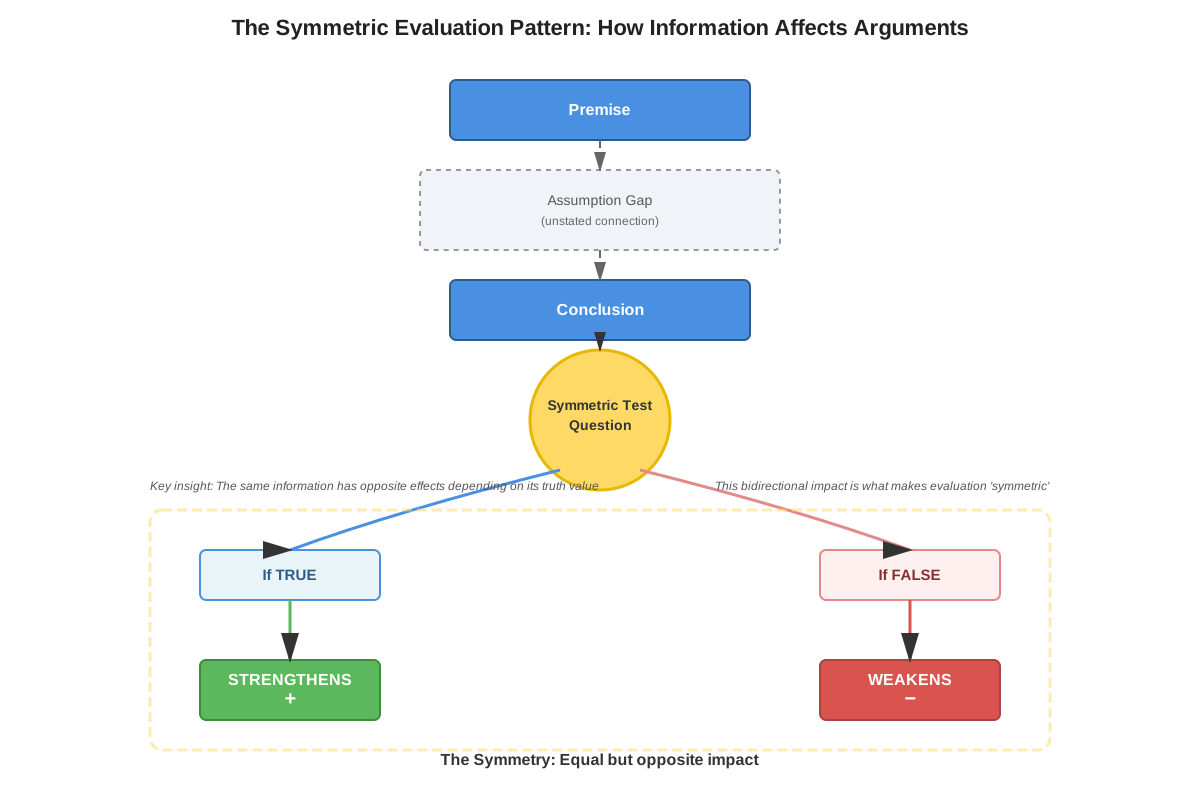
Symmetric evaluation is a sophisticated reasoning pattern that appears frequently in LSAT Logical Reasoning sections, particularly in "Evaluate the Argument" and "Complete the Argument" question types. This pattern involves identifying information that would strengthen an argument if true and weaken it if false—or vice versa. The symmetry lies in the fact that the same piece of information has equal but opposite impact depending on whether it holds true or not.
Understanding symmetric evaluation is essential for LSAT success because it represents one of the most efficient ways to identify correct answers in evaluation questions. When a question asks "Which of the following would be most useful to know in evaluating the argument?" the correct answer will almost always exhibit this symmetric property. Recognizing this pattern allows test-takers to eliminate answer choices that only work in one direction or that are irrelevant regardless of their truth value.
Within the broader landscape of logical reasoning, symmetric evaluation connects directly to argument structure analysis, assumption identification, and conditional reasoning. It requires students to understand not just what an argument claims, but what unstated assumptions bridge the gap between premises and conclusion. This topic builds upon foundational skills in identifying conclusions, recognizing evidence, and understanding how different types of information affect argument strength. Mastery of symmetric evaluation significantly improves performance on approximately 15-20% of Logical Reasoning questions and provides a powerful framework for approaching the most challenging argument-based questions on the exam.
Learning Objectives
- [ ] Identify how Symmetric evaluation appears in LSAT questions
- [ ] Explain the reasoning pattern behind Symmetric evaluation
- [ ] Apply Symmetric evaluation to solve LSAT-style problems accurately
- [ ] Distinguish between symmetric and asymmetric answer choices in evaluation questions
- [ ] Construct symmetric evaluation tests for any given argument structure
- [ ] Recognize the relationship between symmetric evaluation and argument assumptions
Prerequisites
- Argument structure identification: Understanding premises, conclusions, and the relationship between them is essential because symmetric evaluation requires analyzing how new information affects the connection between evidence and claim.
- Conditional reasoning basics: Familiarity with if-then relationships helps recognize how symmetric evaluation often tests whether a necessary condition is met.
- Assumption identification: Recognizing unstated assumptions is crucial because symmetric evaluation typically tests information directly related to an argument's core assumptions.
- Strengthen and weaken question types: Experience with these question types provides the foundation for understanding how information can affect arguments in opposite directions.
Why This Topic Matters
Symmetric evaluation represents a high-yield concept that appears in multiple question types across every LSAT administration. Beyond "Evaluate the Argument" questions (which appear 2-4 times per test), this reasoning pattern also surfaces in "Most Strongly Supported" questions, "Complete the Argument" questions, and even some "Necessary Assumption" questions. Understanding this pattern provides a reliable decision-making framework that can save precious seconds during the exam.
In real-world applications, symmetric evaluation mirrors the critical thinking skills required in legal practice. Attorneys must constantly evaluate which facts would be most relevant to investigate, which pieces of evidence would most significantly impact a case, and which questions would yield the most useful information during discovery or cross-examination. The ability to identify information that could decisively swing an argument in either direction is fundamental to legal reasoning.
On the LSAT, symmetric evaluation questions typically appear as: "Which of the following would be most useful to know in order to evaluate the argument?" or "The answer to which of the following questions would be most helpful in evaluating the conclusion?" These questions test whether students can identify the critical gap in an argument—the unstated assumption that, if confirmed, strengthens the reasoning, but if contradicted, undermines it. Approximately 8-12% of all Logical Reasoning questions directly test this skill, making it one of the most frequently tested advanced reasoning patterns on the exam.
Core Concepts
The Fundamental Pattern of Symmetric Evaluation
Symmetric evaluation refers to a reasoning pattern where a single piece of information has equal but opposite effects on an argument depending on its truth value. If the information is true, it strengthens the argument; if false, it weakens it—or vice versa. This symmetry distinguishes truly relevant evaluation criteria from information that only matters in one direction or doesn't matter at all.
The pattern emerges from the logical structure of arguments themselves. Every argument contains explicit premises and a conclusion, but also relies on unstated assumptions that bridge the gap between evidence and claim. LSAT symmetric evaluation questions specifically target these assumptions by asking what information would be most useful to know. The correct answer will always be information that directly tests whether a critical assumption holds true.
Consider the basic structure:
- Premise: X is true
- Unstated Assumption: Y is also true
- Conclusion: Therefore, Z follows
A symmetric evaluation question would ask about Y. If Y is true, the argument is strengthened; if Y is false, the argument is weakened. This creates perfect symmetry.
The Four-Quadrant Test for Symmetry
To determine whether an answer choice exhibits symmetric evaluation, apply the four-quadrant test:
- Assume the information is TRUE: Does this strengthen the argument?
- Assume the information is FALSE: Does this weaken the argument?
- Check for equal impact: Is the strengthening/weakening effect roughly equivalent in magnitude?
- Verify relevance: Does the information directly address the logical gap between premises and conclusion?
| Truth Value | Effect on Argument | Requirement for Symmetry |
|---|---|---|
| True | Strengthens | Must have clear positive impact |
| False | Weakens | Must have clear negative impact |
| Either | Relevant | Must directly address core assumption |
| Neither | Irrelevant | Eliminates the answer choice |
Asymmetric Answer Choices: Common Traps
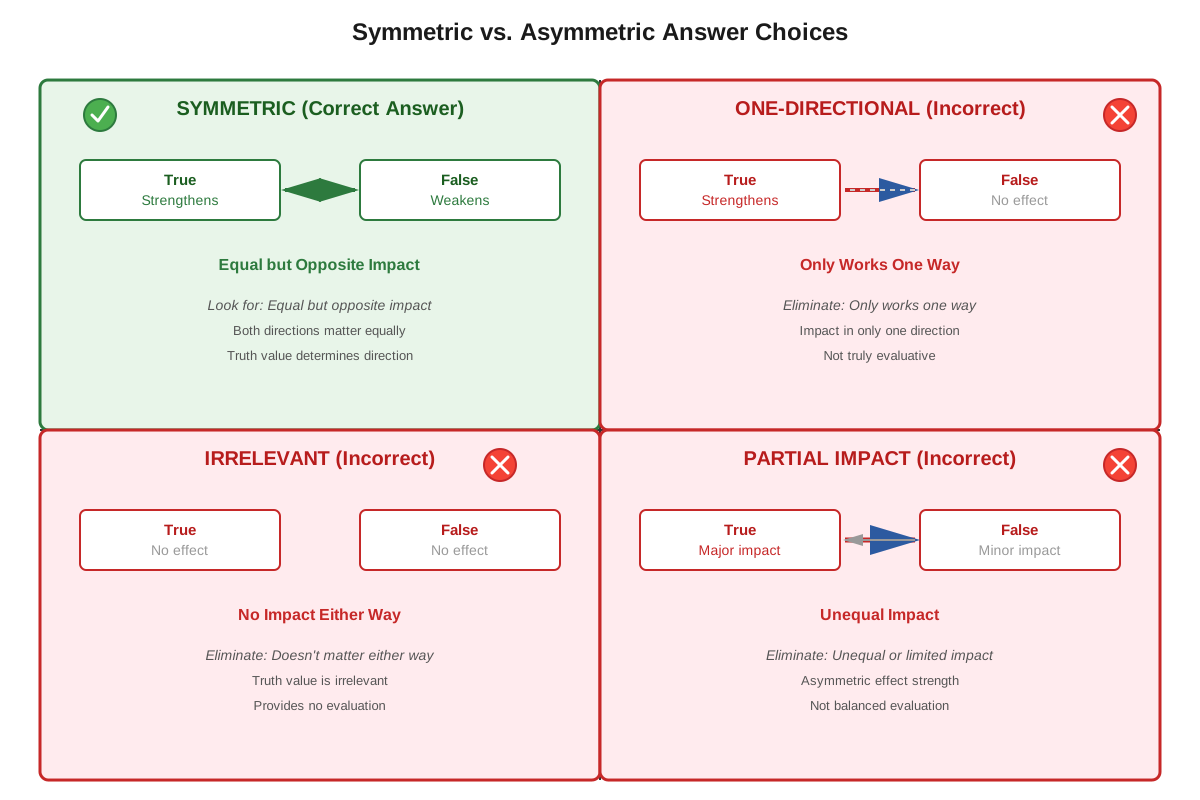
Many incorrect answer choices in evaluate and complete the argument questions appear relevant but fail the symmetry test. These asymmetric choices fall into several categories:
One-directional information: This type of answer choice only affects the argument if true (or only if false), but has no impact in the opposite direction. For example, if an argument concludes that a policy will succeed, an answer choice stating "whether similar policies have succeeded elsewhere" might strengthen the argument if true, but wouldn't necessarily weaken it if false (absence of similar successes doesn't prove failure).
Irrelevant in both directions: Some answer choices seem related to the topic but don't actually affect the logical connection between premises and conclusion. These choices fail the relevance test regardless of their truth value.
Unequal impact: Certain answer choices might technically affect the argument in both directions but with vastly different magnitudes—strongly strengthening if true but only slightly weakening if false, or vice versa. True symmetric evaluation requires roughly equivalent impact.
The Assumption-Evaluation Connection
The relationship between assumptions and symmetric evaluation is fundamental to understanding this reasoning pattern. Every argument's unstated assumptions represent potential points of evaluation. The most critical assumption—the one that, if false, would most severely damage the argument—typically corresponds to the correct answer in a symmetric evaluation question.
To identify this critical assumption, examine the logical gap between premises and conclusion. What must be true for the conclusion to follow from the evidence? What alternative explanations or complicating factors has the argument ignored? The information that would confirm or deny these assumptions exhibits perfect symmetry.
Recognizing Symmetric Evaluation in Question Stems
Logical reasoning questions signal symmetric evaluation through specific phrasings:
- "Which of the following would be most useful to know in evaluating the argument?"
- "The answer to which of the following questions would be most helpful in assessing the conclusion?"
- "In order to evaluate the argument, it would be most important to determine whether..."
- "Which of the following would it be most relevant to investigate?"
These question stems explicitly ask for information that would help evaluate—not information that definitely strengthens or weakens, but information whose truth value matters to the argument's validity.
The Scope Principle in Symmetric Evaluation
Correct answers in symmetric evaluation questions must match the scope of the argument's conclusion. If the conclusion makes a claim about "most" cases, the evaluation must test whether "most" is accurate. If the conclusion predicts a specific outcome, the evaluation must test factors that would determine that outcome. Scope mismatches—where an answer choice addresses a broader or narrower claim than the conclusion actually makes—indicate incorrect answers.
Concept Relationships
The concepts within symmetric evaluation form an interconnected system. The fundamental pattern (information affecting arguments in opposite directions based on truth value) provides the foundation for understanding why the four-quadrant test works as a decision-making tool. This test, in turn, helps identify asymmetric answer choices that fail one or more criteria for true symmetry.
The assumption-evaluation connection explains why symmetric evaluation works: assumptions represent the logical gaps that evaluation must test. This connects directly back to prerequisite knowledge of argument structure and assumption identification. Understanding this relationship enables students to predict what information would exhibit symmetry before even reading the answer choices.
The scope principle acts as a filter that works alongside the symmetry test, eliminating answer choices that might technically exhibit symmetry but don't match the specific claim being evaluated.
Relationship map:
Argument Structure → Identifies Assumptions → Reveals Evaluation Points → Tested by Symmetric Information → Verified by Four-Quadrant Test → Filtered by Scope Principle → Correct Answer
This topic also connects forward to more advanced logical reasoning skills. Mastering symmetric evaluation improves performance on necessary assumption questions (which ask for assumptions that must be true) and sufficient assumption questions (which ask for assumptions that guarantee the conclusion). Both question types benefit from understanding which information would most significantly affect an argument.
High-Yield Facts
⭐ Symmetric evaluation requires information that strengthens an argument if true and weakens it if false (or vice versa) with roughly equal impact.
⭐ The correct answer in evaluation questions almost always tests the argument's most critical unstated assumption.
⭐ If an answer choice only matters in one direction (only if true OR only if false), it fails the symmetry test and is incorrect.
⭐ Symmetric evaluation questions appear 2-4 times per LSAT, making them one of the most frequent advanced reasoning patterns tested.
⭐ The scope of the evaluation must match the scope of the conclusion—no broader, no narrower.
- Answer choices that introduce entirely new topics, even if interesting, typically fail the relevance test for symmetric evaluation.
- Information about the arguer's credibility or motives rarely exhibits true symmetry because it doesn't directly test logical connections.
- Comparative information (comparing the situation to other cases) only exhibits symmetry if the comparison directly tests an assumption about similarity or difference.
- Quantitative precision matters: if a conclusion claims "most," evaluation must test whether "most" is accurate, not whether "some" or "all" is accurate.
- Background information that's true regardless of the argument's validity cannot exhibit symmetry because it doesn't vary with the argument's strength.
- The phrase "would be most useful to know" indicates that multiple answer choices might be somewhat relevant, but only one exhibits true symmetry.
- Temporal information (about past or future) only exhibits symmetry if the argument assumes temporal consistency or change.
Quick check — test yourself on Symmetric evaluation so far.
Try Flashcards →Common Misconceptions
Misconception: Any information related to the argument's topic will exhibit symmetric evaluation. → Correction: Relevance to the topic is necessary but not sufficient. The information must specifically test the logical connection between premises and conclusion, not just relate to the subject matter. Many wrong answers discuss the same topic but don't affect whether the conclusion follows from the evidence.
Misconception: If information would strengthen the argument when true, it automatically exhibits symmetry. → Correction: True symmetry requires that the information also weakens the argument when false, with roughly equivalent impact. Many answer choices only work in one direction—they strengthen if true but have no effect if false, or they're irrelevant in both directions.
Misconception: The correct answer must provide information that definitively proves or disproves the conclusion. → Correction: Symmetric evaluation asks what would be useful to know, not what would conclusively settle the matter. The correct answer identifies information that would significantly affect the argument's strength in either direction, even if it wouldn't provide absolute certainty.
Misconception: Longer, more complex answer choices are more likely to be correct in evaluation questions. → Correction: Complexity doesn't correlate with correctness. In fact, the correct answer often states a relatively simple question or piece of information that directly tests a core assumption. Test-makers frequently use complex language in wrong answers to make them appear sophisticated and relevant.
Misconception: If an answer choice mentions something the argument failed to consider, it must be the correct evaluation. → Correction: Arguments omit countless pieces of information. The question is whether the omitted information matters to the logical connection between premises and conclusion. Many wrong answers point out omissions that are interesting but don't exhibit symmetry because they don't test critical assumptions.
Misconception: Evaluation questions and necessary assumption questions are essentially the same. → Correction: While related, these question types differ importantly. Necessary assumption questions ask for something that must be true for the argument to work. Evaluation questions ask for information whose truth value would matter—the information could be true or false, and either way would significantly affect the argument. A necessary assumption, if false, would destroy the argument, but if true, might only maintain the argument's current strength rather than strengthening it further.
Worked Examples
Example 1: The Restaurant Expansion
Argument: "The downtown restaurant has been profitable for three consecutive years. The owners are considering opening a second location in the suburbs. Since the restaurant's success downtown demonstrates the quality of its food and service, the suburban location should also be profitable."
Question: Which of the following would be most useful to know in evaluating the argument?
Answer Choices:
A) Whether the restaurant has won any culinary awards
B) Whether suburban residents have dining preferences similar to those of downtown customers
C) Whether the owners have experience managing multiple locations
D) Whether other restaurants in the downtown area are also profitable
E) Whether the restaurant's profitability has increased each year or remained stable
Analysis:
Let's apply the four-quadrant test to each answer choice:
Choice A: If true (the restaurant has won awards), this might slightly strengthen the claim about quality, but the argument already assumes quality based on profitability. If false (no awards), this doesn't weaken the argument because profitability already demonstrates success. This fails the symmetry test—it's either irrelevant or only works in one direction weakly.
Choice B: If true (suburban residents have similar preferences), this significantly strengthens the argument because it confirms that the factors driving downtown success will apply in the suburbs. If false (suburban residents have different preferences), this significantly weakens the argument because the downtown success might not translate to a different customer base. This exhibits clear symmetry with equivalent impact in both directions. This tests the unstated assumption that what works downtown will work in the suburbs.
Choice C: If true (they have experience), this might strengthen confidence in execution, but the argument is about whether the location will be profitable based on the restaurant's quality, not about management capability. If false (no experience), this introduces a new concern but doesn't directly address the logical gap between downtown success and suburban potential. This is somewhat relevant but doesn't exhibit strong symmetry because it addresses a different issue than the argument's core reasoning.
Choice D: Whether other downtown restaurants are profitable is irrelevant to whether this specific restaurant's qualities will translate to the suburbs. This fails the relevance test in both directions.
Choice E: Whether profitability increased or remained stable doesn't affect whether the success will translate to a different location. This is about the trend of existing success, not about the transferability of that success. Fails the symmetry test.
Correct Answer: B
This example demonstrates how the correct answer tests the critical assumption (that downtown success predicts suburban success) by asking whether the customer bases are similar—information that clearly strengthens the argument if true and weakens it if false.
Example 2: The Archaeological Dating
Argument: "Archaeologists discovered pottery fragments at a site previously thought to be uninhabited during the Bronze Age. The pottery style matches styles known from Bronze Age settlements in the region. Therefore, the site was inhabited during the Bronze Age."
Question: The answer to which of the following questions would be most helpful in evaluating the conclusion?
Answer Choices:
A) Were the pottery fragments found in the deepest layer of excavation?
B) Did Bronze Age pottery styles vary significantly across different regions?
C) Could the pottery fragments have been transported to the site after the Bronze Age?
D) Were other artifacts besides pottery found at the site?
E) How many pottery fragments were discovered?
Analysis:
Choice A: The depth of excavation relates to the age of the artifacts but doesn't directly test whether the site was inhabited during the Bronze Age versus whether Bronze Age pottery arrived there by other means. This is somewhat relevant but doesn't exhibit strong symmetry.
Choice B: Regional variation in styles doesn't affect whether this particular pottery indicates Bronze Age habitation at this site. The argument already establishes that the style matches regional Bronze Age pottery. This fails the relevance test.
Choice C: If true (pottery could have been transported later), this severely weakens the argument because it provides an alternative explanation for Bronze Age pottery being at the site without Bronze Age habitation. If false (pottery could not have been transported later), this strengthens the argument by eliminating alternative explanations and confirming that the pottery's presence indicates habitation. This exhibits perfect symmetry and tests the critical assumption that the pottery's presence indicates habitation rather than later transport.
Choice D: Other artifacts might provide additional evidence, but their presence or absence doesn't test the logical connection between pottery presence and habitation. If true (other artifacts exist), this might strengthen the conclusion through additional evidence, but if false (no other artifacts), this doesn't necessarily weaken the pottery-based reasoning. Asymmetric impact.
Choice E: The quantity of fragments might affect confidence levels but doesn't test whether the pottery indicates habitation versus transport. Whether there are five fragments or fifty, the logical question remains the same. Fails the symmetry test.
Correct Answer: C
This example illustrates how symmetric evaluation often tests alternative explanations. The argument assumes that pottery presence indicates habitation, but this assumption only holds if the pottery couldn't have arrived by other means. Choice C directly tests this assumption with perfect symmetry.
Exam Strategy
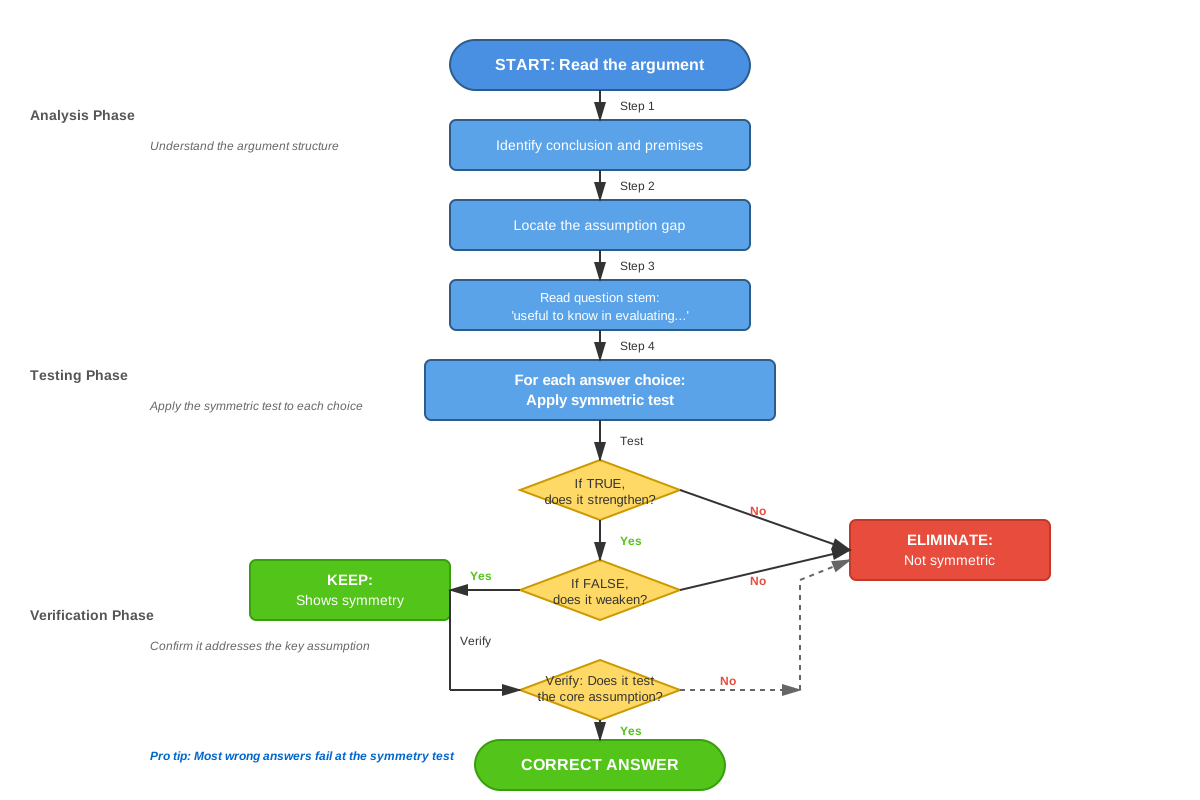
When approaching lsat symmetric evaluation questions, follow this systematic process:
Step 1: Identify the conclusion precisely. Underline or mentally note the exact claim being made. Pay attention to scope qualifiers like "most," "some," "will," or "should."
Step 2: Map the logical gap. Ask yourself: "What must the arguer be assuming for this conclusion to follow from these premises?" The unstated assumption represents the most likely target for symmetric evaluation.
Step 3: Predict before reading choices. Based on the assumption you identified, predict what information would test it. Ask: "What question, if answered, would tell me whether this assumption holds?"
Step 4: Apply the four-quadrant test to each choice. Systematically test each answer by asking: "If this is true, what happens to the argument? If this is false, what happens?" Eliminate any choice that only works in one direction or doesn't work in either direction.
Step 5: Verify scope matching. Ensure your selected answer tests the same scope as the conclusion. If the conclusion claims "most," the evaluation should test "most," not "all" or "some."
Exam Tip: Trigger phrases that signal symmetric evaluation questions include "useful to know," "helpful in evaluating," "most relevant to investigate," and "important to determine." These phrases indicate you should look for information that matters regardless of its truth value.
Time allocation: Spend 1:15-1:30 on these questions. They require careful analysis but shouldn't consume excessive time. If you've correctly identified the assumption (15-20 seconds), predicting the answer (10-15 seconds), and testing choices (30-45 seconds) should proceed efficiently.
Process of elimination tips specific to symmetric evaluation:
- Immediately eliminate choices that introduce entirely new topics not connected to the logical gap
- Eliminate choices about the arguer's credibility, motives, or expertise unless the argument explicitly relies on authority
- Eliminate choices that only provide additional examples or evidence without testing assumptions
- Be suspicious of choices that seem to strengthen the argument but wouldn't weaken it if false—these often fail the symmetry test
- Watch for scope mismatches where the choice addresses a broader or narrower claim than the conclusion makes
Common trap patterns: Test-makers often include wrong answers that would strengthen the argument if true but are irrelevant if false. These appear attractive because they seem helpful, but they fail the symmetry requirement. Another common trap is information that would be interesting to know but doesn't affect the logical connection between premises and conclusion.
Memory Techniques
SYMMETRIC Acronym:
- Strengthens if true
- Yields opposite effect if false
- Matches conclusion scope
- Must test assumptions
- Equal impact both directions
- Tests logical gaps
- Relevant to reasoning
- Ignores new topics
- Confirms or contradicts
Visualization Strategy: Picture a balanced scale. The argument sits in the middle. The information you're testing is a weight that could be placed on either side. If it's true, the scale tips toward "stronger argument." If it's false, the scale tips toward "weaker argument." If the scale doesn't tip, or only tips in one direction, the information doesn't exhibit symmetry.
The "Both Directions" Mantra: Before selecting an answer, mentally repeat: "True helps, false hurts" or "True hurts, false helps." If you can't complete both parts of this statement for an answer choice, it's not symmetric.
The Assumption Bridge: Visualize the argument as two islands (premises and conclusion) with a bridge between them (the assumption). Symmetric evaluation asks: "What information would tell us whether this bridge is sturdy?" Information about the islands themselves (additional premises or restating the conclusion) doesn't test the bridge. Information about unrelated bridges doesn't help. Only information about this specific bridge exhibits symmetry.
Summary
Symmetric evaluation represents a critical reasoning pattern for LSAT success, appearing in multiple question types across every exam administration. The core principle is straightforward: information exhibits symmetry when it strengthens an argument if true and weakens it if false (or vice versa) with roughly equivalent impact. This pattern emerges because arguments rely on unstated assumptions that bridge the gap between premises and conclusions. The most useful information for evaluating an argument directly tests whether these critical assumptions hold true. Mastering symmetric evaluation requires understanding the four-quadrant test (checking impact if true, impact if false, equivalence of impact, and relevance to the logical gap), recognizing asymmetric answer choices that fail one or more criteria, and connecting evaluation to assumption identification. Success on these questions depends on precisely identifying the conclusion's scope, mapping the logical gap between evidence and claim, predicting what information would test the core assumption, and systematically applying the symmetry test to eliminate incorrect answers. This skill not only improves performance on explicit evaluation questions but also enhances overall logical reasoning ability by developing a deeper understanding of argument structure and the relationship between evidence, assumptions, and conclusions.
Key Takeaways
- Symmetric evaluation requires information that affects an argument in opposite directions depending on its truth value, with roughly equal impact in both directions
- The correct answer in evaluation questions almost always tests the argument's most critical unstated assumption—the logical gap between premises and conclusion
- Apply the four-quadrant test systematically: check if the information strengthens when true, weakens when false, has equivalent impact, and directly addresses the reasoning
- Eliminate answer choices that only work in one direction, introduce irrelevant new topics, or mismatch the conclusion's scope
- Predict the answer before reading choices by identifying the argument's core assumption and asking what information would test whether that assumption holds
- Symmetric evaluation connects directly to assumption identification, argument structure analysis, and strengthen/weaken reasoning patterns
- Time efficiency comes from systematic application of the symmetry test rather than intuitive judgment about what "seems relevant"
Related Topics
Necessary Assumption Questions: These questions ask for assumptions that must be true for the argument to work. Mastering symmetric evaluation provides excellent preparation because necessary assumptions, when negated, weaken arguments—exhibiting one direction of the symmetric pattern. Understanding evaluation helps identify which assumptions are truly necessary versus merely helpful.
Sufficient Assumption Questions: These questions ask for information that, if true, would guarantee the conclusion. While these don't require symmetry (they only need to work if true), understanding symmetric evaluation helps distinguish between sufficient assumptions and mere strengtheners.
Strengthen and Weaken Questions: These question types explicitly ask for information that affects the argument in one direction. Symmetric evaluation mastery improves performance on these questions by developing the skill of analyzing how information affects logical connections.
Flaw Questions: Identifying flaws requires recognizing unstated assumptions that don't hold. Since symmetric evaluation focuses on testing assumptions, this skill directly supports flaw identification by highlighting which assumptions are most questionable.
Parallel Reasoning: Advanced parallel reasoning questions sometimes require recognizing symmetric evaluation patterns in abstract form, making this topic valuable for the most challenging logical reasoning questions.
Practice CTA
Now that you understand the principles of symmetric evaluation, it's time to apply this knowledge to actual LSAT questions. The practice questions and flashcards will help solidify your ability to recognize symmetric patterns, apply the four-quadrant test efficiently, and distinguish correct answers from attractive traps. Remember that mastery comes through deliberate practice—work through each question systematically, checking your reasoning against the principles outlined in this guide. Pay special attention to questions where you're torn between two answer choices, as these situations often reveal opportunities to refine your understanding of symmetry. With consistent practice, identifying symmetric evaluation will become second nature, giving you a significant advantage on test day. You've built the foundation—now strengthen it through application!
Sign up free to keep reading
Create a free AnvayaPrep account to finish this LSAT guide on Symmetric evaluation — plus flashcards and practice questions.