Overview
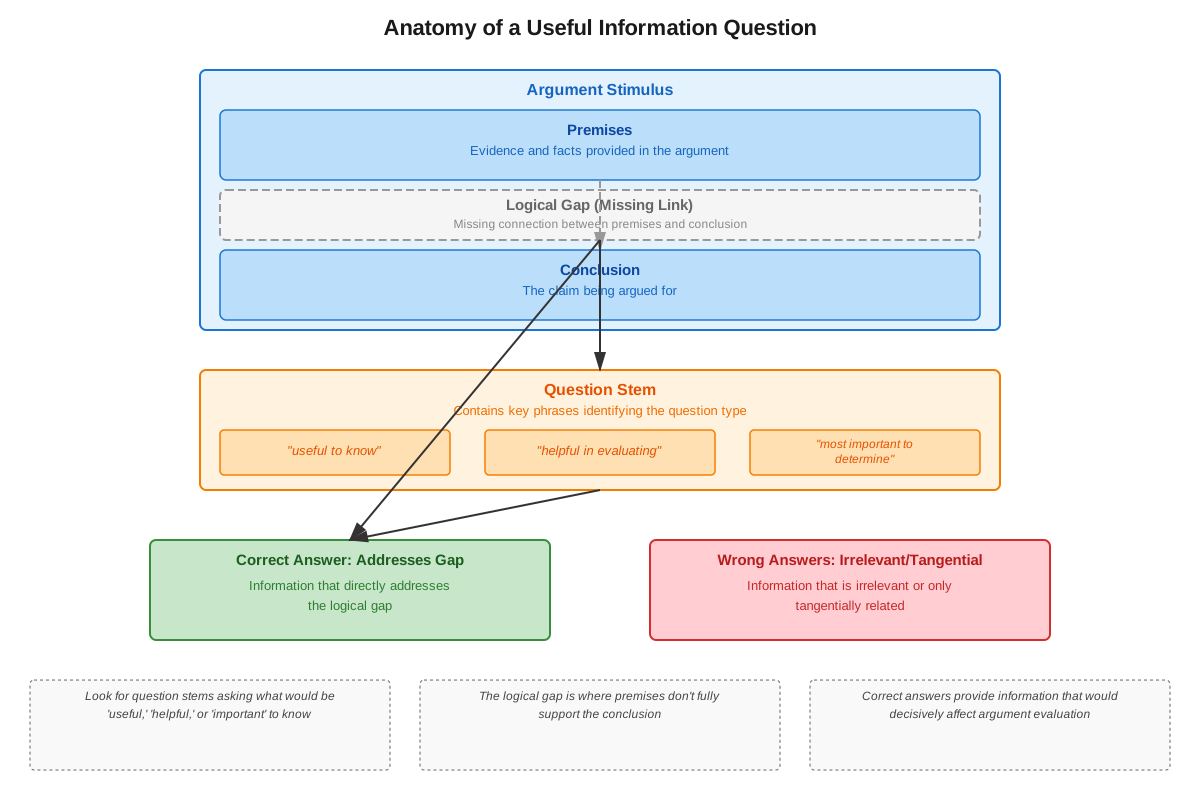
Useful information questions represent a distinctive and challenging question type within the LSAT's Logical Reasoning section. These questions ask test-takers to identify what additional piece of information would be most helpful in evaluating an argument's strength or in completing an incomplete argument. Unlike questions that ask you to strengthen or weaken an argument directly, useful information questions require you to recognize what's missing—what critical piece of evidence or data would allow you to properly assess whether the conclusion follows from the premises. This question type tests your ability to identify gaps in reasoning and understand what information would be decisive in determining an argument's validity.
These questions are essential for LSAT success because they assess multiple reasoning skills simultaneously: recognizing assumptions, identifying logical gaps, understanding what makes evidence relevant, and evaluating the relationship between premises and conclusions. Mastering lsat useful information questions requires developing a sophisticated understanding of argument structure and the ability to think conditionally about how different pieces of information would affect an argument's persuasiveness. This skill directly translates to the analytical thinking required in law school and legal practice, where attorneys must constantly evaluate what additional information they need to build or assess a case.
Within the broader context of Logical Reasoning, useful information questions bridge several question families. They share characteristics with Assumption questions (identifying what's unstated), Strengthen/Weaken questions (understanding what affects argument validity), and Evaluate questions (determining what matters for assessment). The ability to evaluate and complete the argument by identifying useful information represents an advanced synthesis of fundamental logical reasoning skills, making this topic a high-yield area for score improvement.
Learning Objectives
- [ ] Identify how Useful information questions appears in LSAT questions
- [ ] Explain the reasoning pattern behind Useful information questions
- [ ] Apply Useful information questions to solve LSAT-style problems accurately
- [ ] Distinguish between information that is merely relevant and information that is decisively useful for evaluation
- [ ] Recognize the specific logical gaps that different types of useful information would address
- [ ] Predict what type of useful information an argument requires based on its structure and reasoning pattern
Prerequisites
- Argument structure identification: Understanding premises, conclusions, and how they relate is essential because useful information questions require recognizing what's missing from the argument's logical chain.
- Assumption recognition: Identifying unstated assumptions helps determine what information would be most useful, as useful information often tests or confirms key assumptions.
- Conditional reasoning: Understanding if-then relationships enables recognition of what information would be decisive in determining whether conditions are met.
- Strengthen and Weaken question types: Familiarity with how information affects argument strength provides the foundation for identifying what information would be useful for evaluation.
Why This Topic Matters
Useful information questions appear regularly on the LSAT, typically comprising 2-4 questions per Logical Reasoning section. This translates to approximately 4-8 questions per test, making them a significant component of your overall score. These questions are particularly high-yield because students who master them often see dramatic score improvements—the skills required transfer directly to other question types, creating a multiplier effect on performance.
In legal practice, attorneys constantly face situations where they must determine what additional information they need before making decisions, advising clients, or proceeding with cases. The ability to identify what information would be most useful in evaluating a situation is fundamental to legal analysis, discovery processes, and strategic decision-making. This makes useful information questions among the most practically relevant question types on the LSAT.
On the exam, these questions commonly appear with stems like "Which of the following would be most useful to know in evaluating the argument?" or "The answer to which of the following questions would be most helpful in determining whether the plan will succeed?" They frequently test arguments involving causal claims, predictions, comparisons, plans or proposals, and statistical or survey-based reasoning. Recognizing these common argument patterns helps you anticipate what type of information will be most useful.
Core Concepts
Understanding Useful Information Questions
Useful information questions ask you to identify what additional piece of information would most help in evaluating whether an argument's conclusion is justified by its premises. The key distinction is that you're not being asked to strengthen or weaken the argument directly—instead, you're identifying what you'd need to know to make that determination. The correct answer typically presents information that, depending on how it turns out, could either support or undermine the argument significantly.
These questions test your ability to recognize logical gaps—the unstated connections between premises and conclusions that the argument assumes but doesn't establish. The most useful information directly addresses these gaps, allowing you to assess whether the assumption is warranted. This requires thinking conditionally: "If the answer to this question is X, the argument is stronger; if the answer is Y, the argument is weaker."
The Reasoning Pattern
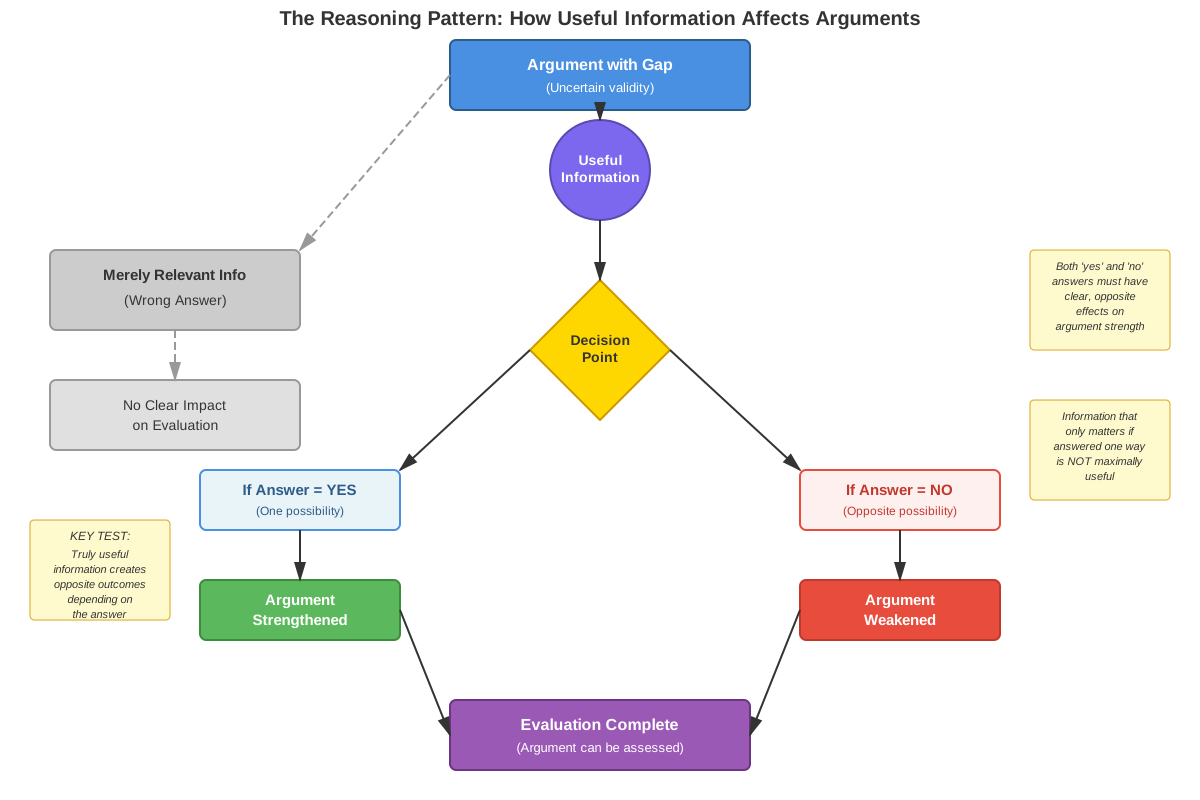
The fundamental reasoning pattern behind useful information questions involves three steps:
- Identify the argument's conclusion and premises: Determine exactly what the argument is trying to prove and what evidence it offers.
- Recognize the logical gap or assumption: Identify what unstated connection the argument relies upon—what must be true for the conclusion to follow from the premises.
- Determine what information would test that assumption: The most useful information directly addresses whether the assumption holds, such that different answers would significantly affect the argument's strength.
The correct answer to a useful information question typically has a binary quality—knowing the answer one way would strengthen the argument, while knowing it the other way would weaken it. This bidirectional impact is what makes the information truly useful for evaluation rather than merely relevant.
Types of Arguments and Corresponding Useful Information
Different argument structures require different types of useful information:
| Argument Type | Common Gap | Useful Information Needed |
|---|---|---|
| Causal Claims | Alternative causes; correlation vs. causation | Whether other factors could explain the effect; whether the cause precedes the effect |
| Predictions | Changed circumstances; relevant differences | Whether conditions will remain similar; whether new factors will intervene |
| Comparisons | Relevant differences between compared items | Whether the items are comparable in relevant respects |
| Plans/Proposals | Unintended consequences; feasibility | Whether implementation is practical; whether side effects will occur |
| Statistical/Survey Arguments | Sample representativeness; response bias | Whether the sample reflects the population; whether responses are reliable |
Identifying Useful vs. Merely Relevant Information
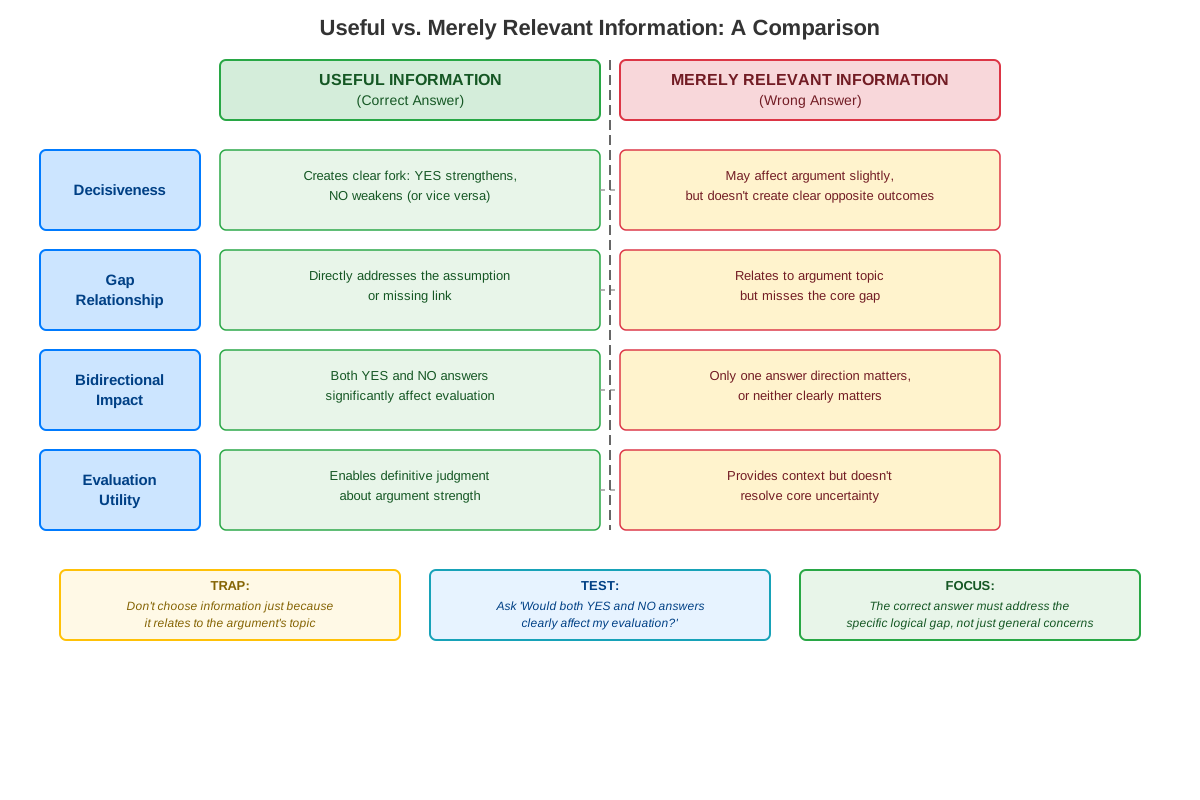
A critical skill is distinguishing between information that is decisively useful and information that is only tangentially relevant. Decisively useful information:
- Directly addresses a key assumption in the argument
- Would significantly affect the argument's strength depending on the answer
- Fills a logical gap between premises and conclusion
- Has clear implications for whether the conclusion follows
Merely relevant information might relate to the topic but doesn't directly test the argument's logical structure. For example, in an argument about whether a new traffic light will reduce accidents at an intersection, knowing the color of the traffic light would be relevant to the topic but not useful for evaluation. However, knowing whether the intersection's accidents are caused by factors a traffic light would address (like cars running through the intersection) versus factors it wouldn't address (like poor road conditions) would be decisively useful.
The Evaluation Framework
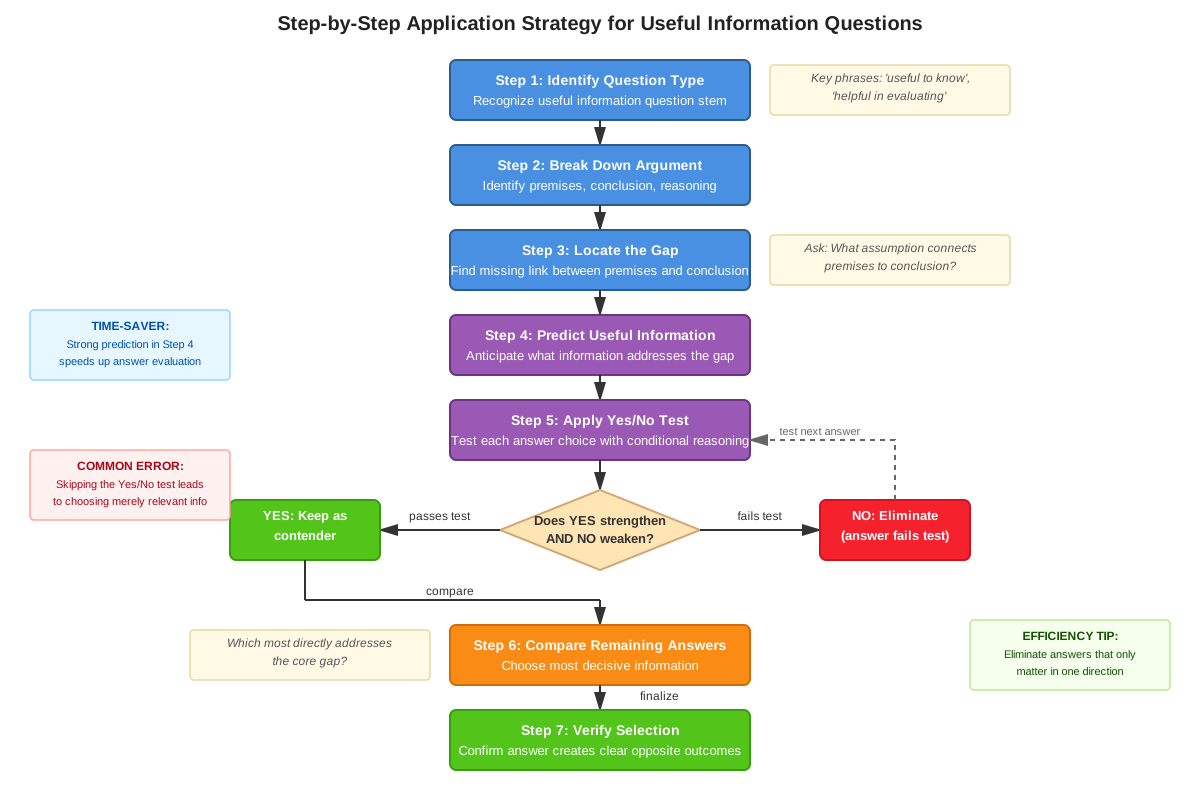
When approaching useful information questions, apply this systematic framework:
- Isolate the conclusion: What is the argument ultimately trying to prove?
- Map the evidence: What premises support this conclusion?
- Identify the assumption: What must be true for this evidence to support this conclusion?
- Predict useful information: What would you need to know to determine if the assumption holds?
- Evaluate answer choices: Which choice most directly tests the key assumption?
The most common error is selecting information that would strengthen or weaken the argument in only one direction, rather than information that would be useful for evaluation regardless of how it turns out. Remember: useful information helps you evaluate; it doesn't predetermine the evaluation's outcome.
Common Argument Patterns Requiring Useful Information
Causal arguments frequently appear in useful information questions. These arguments claim that X causes Y based on correlation or temporal sequence. The useful information typically addresses whether alternative explanations exist, whether the causal mechanism is plausible, or whether the correlation might be coincidental.
Comparative arguments make claims based on similarities or differences between two situations. Useful information for these arguments typically addresses whether the comparison is apt—whether relevant similarities exist and whether relevant differences have been overlooked.
Predictive arguments extrapolate from past or present conditions to future outcomes. The most useful information addresses whether conditions will remain stable, whether new factors will emerge, or whether the past is representative of the future.
Concept Relationships
The concepts within useful information questions form an interconnected web of logical reasoning skills. Argument structure identification serves as the foundation, enabling you to recognize the logical gaps that useful information must address. These gaps are essentially unstated assumptions, connecting useful information questions directly to assumption-family questions.
The evaluation framework synthesizes these elements, providing a systematic approach that incorporates conditional reasoning (thinking about how different answers would affect the argument) and relevance assessment (distinguishing decisively useful from merely relevant information). This framework applies differently depending on the argument type, with each type having characteristic gaps and corresponding useful information needs.
The relationship map flows as follows:
Argument Structure → reveals → Logical Gaps/Assumptions → require → Useful Information → which is identified through → Evaluation Framework → applied according to → Argument Type → resulting in → Conditional Assessment (if answer is X, then argument is stronger/weaker)
This topic connects to prerequisite knowledge by building on assumption recognition (useful information tests assumptions), strengthen/weaken questions (useful information would strengthen or weaken depending on the answer), and conditional reasoning (evaluating how different answers would affect the argument). It also connects forward to evaluate the argument questions, which are essentially a variant of useful information questions with slightly different phrasing.
High-Yield Facts
⭐ Useful information questions ask what you'd need to know to evaluate an argument, not what would strengthen or weaken it directly
⭐ The correct answer typically has bidirectional impact—different answers would affect the argument in opposite ways
⭐ Useful information directly addresses the logical gap or key assumption in the argument
⭐ Common question stems include "most useful to know," "most helpful in determining," and "answer to which question would be most relevant"
⭐ The most useful information is that which, depending on the answer, would most significantly affect the argument's strength
- Merely relevant information relates to the topic but doesn't test the argument's logical structure
- Causal arguments typically require information about alternative explanations or the causal mechanism
- Comparative arguments need information about whether the comparison is apt in relevant respects
- Predictive arguments require information about whether conditions will remain stable or change
- Statistical arguments need information about sample representativeness and data reliability
- Wrong answers often provide information that would only strengthen or only weaken, not help evaluate
- The correct answer addresses what the argument assumes but doesn't establish
- Useful information questions test multiple reasoning skills simultaneously, making them high-yield for score improvement
Quick check — test yourself on Useful information questions so far.
Try Flashcards →Common Misconceptions
Misconception: Useful information questions are the same as strengthen or weaken questions. → Correction: Useful information questions ask what you'd need to know to evaluate the argument, not what would directly strengthen or weaken it. The correct answer should be information that could go either way—if the answer is X, the argument is stronger; if Y, it's weaker.
Misconception: Any information related to the argument's topic is useful for evaluation. → Correction: Information must directly address a logical gap or key assumption to be truly useful. Topical relevance is insufficient; the information must test whether the conclusion follows from the premises.
Misconception: The correct answer will always be information that, if known, would definitively prove or disprove the conclusion. → Correction: Useful information helps evaluate the argument's strength, not necessarily prove or disprove the conclusion absolutely. It addresses whether the reasoning is sound, not whether the conclusion is ultimately true or false.
Misconception: If information would strengthen the argument, it's not useful because it's biased toward one side. → Correction: Information can be useful even if, when answered one way, it only strengthens (or only weakens). What matters is that knowing the answer would significantly help in evaluation. However, the most useful information typically has bidirectional potential.
Misconception: Longer, more detailed answer choices are more likely to be correct because they provide more information. → Correction: The length or complexity of an answer choice doesn't determine its usefulness. Often, the correct answer is concise and directly addresses the key assumption, while longer answers may include irrelevant details.
Misconception: You need to determine whether the argument is actually strong or weak before selecting useful information. → Correction: Useful information questions don't require you to evaluate the argument's actual strength—only to identify what information would help you make that evaluation. Your job is to find the gap, not to fill it.
Worked Examples
Example 1: Causal Argument
Argument: "City officials report that traffic accidents at the intersection of Main and Elm Streets have decreased by 40% since new streetlights were installed six months ago. Therefore, the new streetlights have made the intersection safer."
Question: Which of the following would be most useful to know in evaluating the argument?
Analysis:
Step 1 - Identify conclusion: The new streetlights have made the intersection safer (caused the decrease in accidents).
Step 2 - Map evidence: Accidents decreased 40% after streetlight installation.
Step 3 - Identify assumption: The argument assumes the streetlights caused the decrease, not some other factor. It also assumes correlation indicates causation and that no other changes occurred simultaneously.
Step 4 - Predict useful information: We'd need to know whether other factors could explain the decrease, whether the decrease is part of a broader trend, or whether other changes occurred at the same time.
Step 5 - Evaluate choices:
(A) Whether accidents at other intersections in the city also decreased during the same period
- This is the correct answer. If accidents decreased citywide, the streetlights might not be the cause. If only this intersection saw decreases, the streetlights are more likely responsible. This directly tests the causal assumption.
(B) What type of streetlights were installed
- This is merely relevant, not useful for evaluation. The type doesn't address whether they caused the decrease.
(C) How much the streetlights cost
- Irrelevant to whether they caused the safety improvement.
(D) Whether drivers have complained about the streetlights
- Tangentially relevant but doesn't address the causal relationship between lights and accident reduction.
Key Takeaway: For causal arguments, the most useful information typically addresses alternative explanations or whether the correlation might be coincidental.
Example 2: Predictive Argument
Argument: "The new online learning platform increased student test scores by 15% in pilot schools last year. Therefore, implementing this platform district-wide will improve overall student performance."
Question: The answer to which of the following questions would be most helpful in determining whether the plan will succeed?
Analysis:
Step 1 - Identify conclusion: District-wide implementation will improve overall student performance.
Step 2 - Map evidence: The platform increased scores by 15% in pilot schools.
Step 3 - Identify assumption: The argument assumes pilot schools are representative of all district schools, that conditions will remain similar during district-wide implementation, and that the platform itself (not other factors) caused the improvement.
Step 4 - Predict useful information: We need to know whether pilot schools differ from other schools in relevant ways, whether the pilot conditions can be replicated district-wide, or whether other factors contributed to the pilot success.
Step 5 - Evaluate choices:
(A) Whether the pilot schools received additional teacher training that won't be provided district-wide
- This is the correct answer. If pilot schools had extra support that won't be replicated, the platform alone might not produce similar results district-wide. If the platform alone was responsible, district-wide success is more likely. This directly tests whether the pilot results are replicable.
(B) How many students participated in the pilot program
- The size of the pilot might be relevant but doesn't address whether the results are replicable or representative.
(C) Whether students enjoyed using the platform
- Student satisfaction doesn't directly address whether performance will improve district-wide.
(D) What subjects the platform covers
- This is background information but doesn't test the key assumption about replicability.
Key Takeaway: For predictive arguments, the most useful information addresses whether conditions will remain similar and whether the past results are representative and replicable.
Exam Strategy
When you encounter useful information questions on the LSAT, follow this strategic approach:
Trigger words to watch for: "most useful to know," "most helpful in determining," "most relevant to evaluating," "answer to which question," "most important to establish," and "most useful in assessing." These phrases signal that you're looking for information that aids evaluation, not information that directly strengthens or weakens.
Step-by-step approach:
- Read the question stem first to confirm it's a useful information question
- Identify the conclusion clearly before reading answer choices
- Spot the logical gap between premises and conclusion
- Predict what type of information would address this gap before looking at choices
- Apply the bidirectional test to answer choices: Would different answers affect the argument in different ways?
Process of elimination tips:
- Eliminate choices that would only strengthen or only weaken without helping evaluation
- Eliminate information that's merely topically relevant but doesn't address the logical structure
- Eliminate information about implementation details that don't affect whether the reasoning is sound
- Eliminate information that's too narrow or specific to address the main assumption
- Keep choices that directly test whether a key assumption holds
Exam Tip: If you're stuck between two answers, ask yourself: "Which piece of information, if I knew it, would most change my assessment of whether this argument's conclusion follows from its premises?" The answer that would most significantly affect your evaluation is correct.
Time allocation: Spend 1:15-1:30 on these questions. They require careful analysis but shouldn't consume excessive time. If you've correctly identified the assumption, the right answer should be relatively clear. If you're spending more than 1:45, make your best guess and move on.
Common traps to avoid:
- Don't select information that seems important to the topic but doesn't test the argument's logic
- Don't choose information that would only help if you already knew other information
- Don't pick answers that address minor points while ignoring the main assumption
- Don't select information about the conclusion itself rather than the reasoning supporting it
Memory Techniques
BRIDGE mnemonic for identifying useful information:
- Bidirectional impact (different answers affect argument differently)
- Relevant to the logical gap (not just the topic)
- Identifies what's assumed (tests unstated connections)
- Decisive for evaluation (significantly affects assessment)
- Gap-filling potential (addresses what's missing)
- Evaluative power (helps determine if conclusion follows)
The "Two-Way Street" visualization: Picture useful information as a fork in the road. One path leads to "argument stronger," the other to "argument weaker." The correct answer is the signpost that tells you which path you're on. If the information only leads one direction, it's not the most useful for evaluation.
The "Missing Link" technique: Visualize the argument as a chain with premises on one end and conclusion on the other. The useful information is the missing link that, once you know it, tells you whether the chain holds together or breaks apart.
CAUSE acronym for causal arguments:
- Correlation vs. causation
- Alternative explanations
- Underlying mechanisms
- Sequence (does cause precede effect?)
- Elimination of confounding factors
Summary
Useful information questions represent a sophisticated LSAT question type that tests your ability to identify logical gaps and determine what additional information would most help evaluate an argument's strength. These questions require you to recognize unstated assumptions and think conditionally about how different pieces of information would affect the relationship between premises and conclusion. The key distinction is that you're not directly strengthening or weakening the argument—you're identifying what you'd need to know to make that assessment. The correct answer typically has bidirectional potential, meaning different answers would affect the argument in opposite ways. Success requires mastering argument structure identification, recognizing common argument patterns (causal, comparative, predictive, statistical), and distinguishing decisively useful information from merely relevant details. These questions appear regularly on the LSAT and test multiple reasoning skills simultaneously, making them high-yield for score improvement. The systematic evaluation framework—isolating the conclusion, mapping evidence, identifying assumptions, predicting useful information, and evaluating choices—provides a reliable approach for consistently selecting correct answers.
Key Takeaways
- Useful information questions ask what you'd need to know to evaluate an argument, not what would directly strengthen or weaken it
- The correct answer typically addresses the argument's key assumption or logical gap and has bidirectional impact
- Different argument types (causal, comparative, predictive, statistical) require different types of useful information
- Decisively useful information directly tests whether the conclusion follows from the premises, while merely relevant information relates to the topic without addressing logical structure
- Apply the systematic evaluation framework: identify conclusion → map evidence → spot assumption → predict useful information → evaluate choices
- The bidirectional test is crucial: would different answers to this question affect the argument in different ways?
- These questions test multiple reasoning skills simultaneously and appear 4-8 times per test, making them high-yield for score improvement
Related Topics
Evaluate the Argument Questions: These questions are closely related to useful information questions, often asking you to evaluate arguments by identifying what information would be most relevant. Mastering useful information questions provides direct preparation for evaluate questions.
Assumption Questions: Understanding how to identify unstated assumptions is fundamental to recognizing what information would be useful, as useful information typically tests key assumptions. Success with useful information questions strengthens assumption question performance.
Strengthen and Weaken Questions: These question types share the underlying skill of understanding what affects argument strength. Useful information questions require you to identify what could strengthen or weaken depending on the answer, making them an advanced synthesis of strengthen/weaken skills.
Flaw Questions: Recognizing logical flaws helps identify what information would be useful, as useful information often addresses the argument's weaknesses. The gap-identification skills transfer directly between these question types.
Sufficient Assumption Questions: These questions ask what would guarantee the conclusion follows, while useful information questions ask what would help evaluate whether it follows. Understanding the relationship between premises and conclusions is essential for both.
Practice CTA
Now that you've mastered the core concepts of useful information questions, it's time to put your knowledge into practice. Work through the practice questions to reinforce your understanding of how to identify logical gaps, distinguish decisively useful from merely relevant information, and apply the evaluation framework systematically. Use the flashcards to internalize the key distinctions and common argument patterns. Remember: these questions test sophisticated reasoning skills that improve with deliberate practice. Each question you work through strengthens your ability to analyze arguments and identify what matters most for evaluation—skills that will serve you throughout the LSAT and in legal reasoning. You've built a strong foundation; now apply it with confidence!
Sign up free to keep reading
Create a free AnvayaPrep account to finish this LSAT guide on Useful information questions — plus flashcards and practice questions.