Overview
Circular reasoning is one of the most frequently tested logical flaws on the LSAT Logical Reasoning section. This fallacy occurs when an argument's conclusion is used as one of its premises, creating a loop where the reasoning depends on the very claim it attempts to prove. Rather than providing independent support for a conclusion, circular arguments merely restate the conclusion in different words within the premise, offering no actual justification. Understanding this flaw is critical because it appears in approximately 10-15% of flaw questions across LSAT administrations, making it a high-yield topic that directly impacts test performance.
The LSAT tests circular reasoning in subtle ways that challenge test-takers to distinguish between legitimate reasoning patterns and fallacious ones. Unlike more obvious logical errors, lsat circular reasoning often disguises itself through varied language, making the premise and conclusion appear different when they actually express the same idea. Recognizing this pattern requires careful analysis of argument structure and the ability to identify when premises provide genuine independent support versus when they simply assume what needs to be proven.
Within the broader landscape of logical reasoning, circular reasoning represents a fundamental failure of argumentation. It connects to other flaw types such as assumption-based reasoning and insufficient evidence, but maintains its distinct character through its self-referential structure. Mastering circular reasoning enhances overall critical thinking skills needed for the LSAT, particularly the ability to evaluate whether arguments provide legitimate justification or merely create the illusion of proof through linguistic variation.
Learning Objectives
- [ ] Identify how Circular reasoning appears in LSAT questions
- [ ] Explain the reasoning pattern behind Circular reasoning
- [ ] Apply Circular reasoning to solve LSAT-style problems accurately
- [ ] Distinguish circular reasoning from superficially similar valid argument structures
- [ ] Recognize linguistic variations that disguise circular reasoning in LSAT passages
- [ ] Evaluate whether premises provide independent support or merely restate conclusions
- [ ] Predict correct answer choices that accurately describe circular reasoning flaws
Prerequisites
- Basic argument structure: Understanding premises and conclusions is essential because identifying circular reasoning requires recognizing when these elements improperly overlap
- Assumption identification: Recognizing unstated assumptions helps distinguish between arguments that rely on hidden premises versus those that circularly assume their conclusions
- Flaw question format: Familiarity with how the LSAT asks about argumentative flaws enables efficient application of circular reasoning concepts to actual test questions
- Paraphrasing skills: The ability to recognize when different phrasings express identical ideas is crucial for detecting circular reasoning disguised through linguistic variation
Why This Topic Matters
Circular reasoning appears throughout everyday discourse, from political debates to advertising claims to academic arguments. Recognizing this flaw enables critical evaluation of arguments in professional, academic, and personal contexts. Lawyers must identify circular reasoning in opposing counsel's arguments, making this skill directly relevant to legal practice. The ability to spot when someone merely restates a claim rather than supporting it represents a fundamental critical thinking competency applicable across disciplines.
On the LSAT, circular reasoning appears in approximately 3-5 questions per test administration, primarily within flaw questions but occasionally in other question types including Method of Reasoning and Parallel Reasoning questions. This frequency, combined with the topic's medium difficulty level, makes it a high-value target for focused study. Questions testing circular reasoning typically appear in positions 8-20 within Logical Reasoning sections, meaning they contribute significantly to overall section performance.
The LSAT presents circular reasoning through various formats: explicit arguments where the circularity is relatively apparent, subtle arguments where extensive paraphrasing obscures the circular structure, and complex arguments where circular reasoning combines with other flaws. Test-makers frequently use technical or abstract subject matter to make the circular structure less obvious, requiring students to focus on logical form rather than content. Common contexts include scientific reasoning, policy arguments, and definitional claims where the circularity hides within specialized terminology.
Core Concepts
Definition and Structure of Circular Reasoning
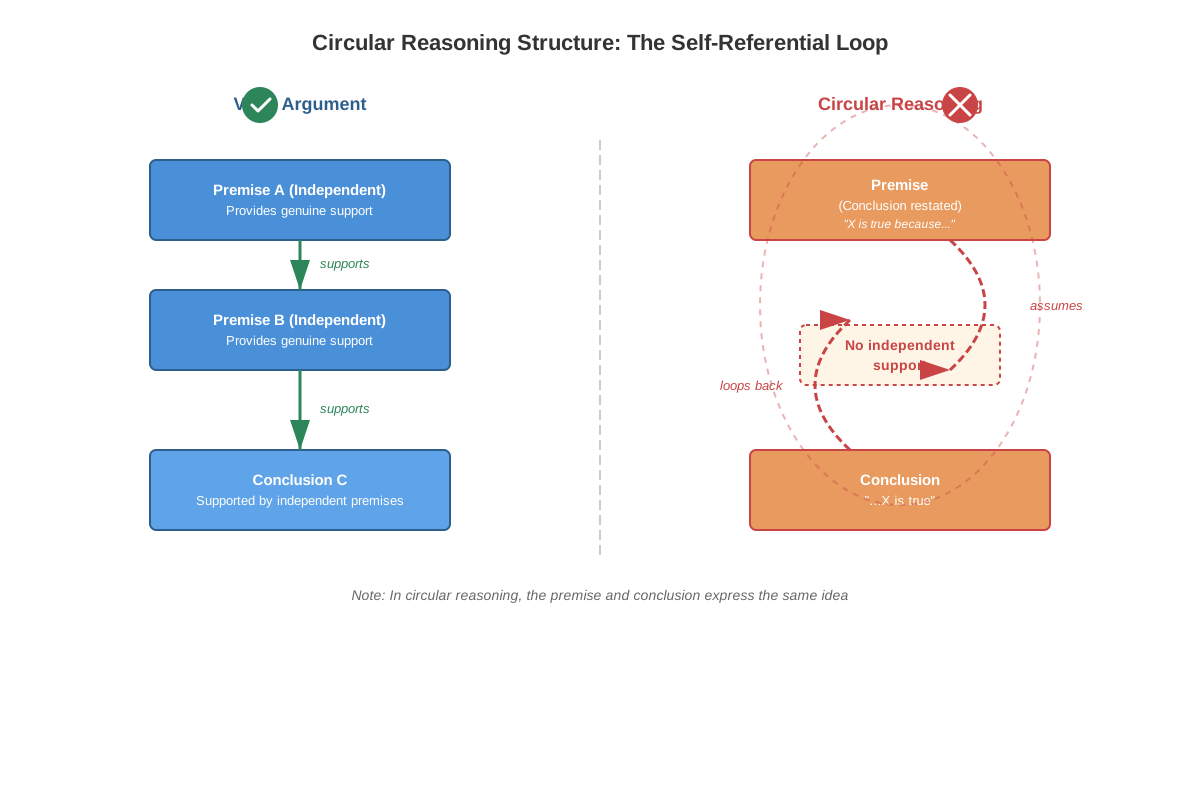
Circular reasoning, also called "begging the question" (petitio principii), occurs when an argument assumes the truth of its conclusion within its premises. The logical structure creates a closed loop: Premise P supports Conclusion C, but Premise P is actually identical to or directly dependent upon Conclusion C. This violates the fundamental requirement that premises must provide independent grounds for accepting a conclusion.
The basic structure follows this pattern:
- Conclusion: Statement X is true
- Premise: Statement Y is true (where Y is logically equivalent to X)
- The argument fails because Y doesn't provide independent support for X
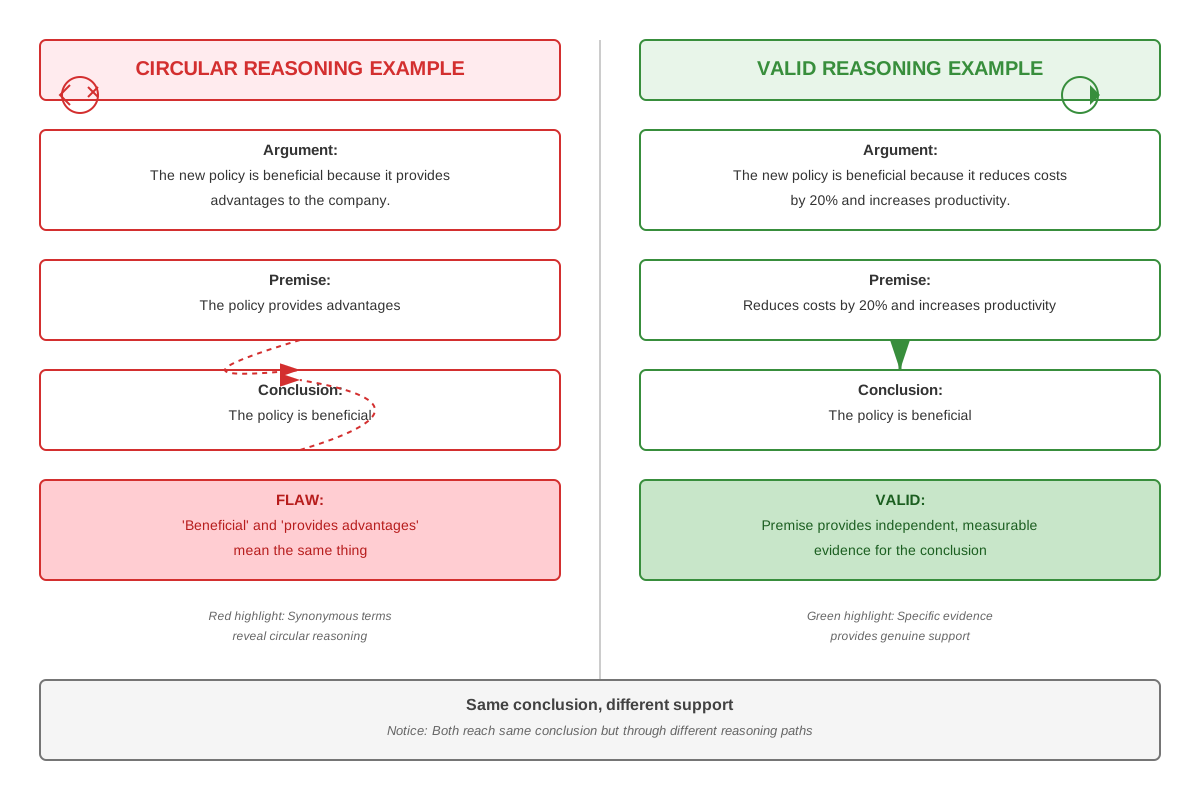
Consider this simple example: "Reading is beneficial because it's good for you." The premise ("it's good for you") and conclusion ("reading is beneficial") express the same idea using different words. No independent reason supports why reading is beneficial—the argument simply restates the claim.
How Circular Reasoning Differs from Valid Arguments
Valid arguments provide premises that are logically independent from their conclusions. Even when premises and conclusions relate closely, valid arguments maintain a crucial distinction: the premises could theoretically be true while the conclusion is false (in invalid arguments) or the premises genuinely support the conclusion through independent evidence (in valid arguments).
| Valid Argument | Circular Argument |
|---|---|
| Premises provide independent evidence | Premises restate the conclusion |
| Conclusion follows from distinct grounds | Conclusion assumed within premises |
| Can evaluate premise truth separately | Cannot separate premise from conclusion |
| Advances understanding | Creates illusion of proof |
For example, "Reading improves vocabulary because it exposes people to new words" is valid because the premise (exposure to new words) provides independent support distinct from the conclusion (vocabulary improvement). The premise explains how reading benefits vocabulary rather than merely restating that it does.
Linguistic Disguises in LSAT Circular Reasoning
The LSAT rarely presents circular reasoning in obvious forms. Instead, test-makers employ several techniques to obscure the circularity:
Synonym substitution: Using different words for the same concept makes premises and conclusions appear distinct. "The policy is effective because it achieves its intended results" uses "effective" and "achieves its intended results" as synonyms.
Definitional circularity: Arguments that define terms using the concept being defined. "A just law is one that promotes justice" provides no independent criterion for justice.
Expanded restatement: Adding descriptive details while maintaining logical equivalence. "This medication works because it successfully treats the condition it's designed to address" elaborates without providing independent support.
Technical terminology: Using specialized vocabulary to mask the circular structure. "The compound exhibits catalytic properties because it demonstrates the capacity to accelerate reactions without being consumed" may sound sophisticated but remains circular.
Identifying Circular Reasoning: The Independence Test
To identify circular reasoning, apply the independence test: Can the premise be understood and evaluated without already accepting the conclusion? If understanding or accepting the premise requires first accepting the conclusion, the reasoning is circular.
Follow these steps:
- Identify the conclusion clearly
- Identify each premise
- For each premise, ask: "Does this give me a reason to believe the conclusion that doesn't already assume the conclusion is true?"
- If the answer is no, the reasoning is circular
Common LSAT Circular Reasoning Patterns
Pattern 1: Direct Restatement
- Conclusion: X is true
- Premise: X is true (stated differently)
- Example: "The defendant is guilty because he committed the crime"
Pattern 2: Definitional Circle
- Conclusion: Y has property P
- Premise: Things with property P have characteristic C, and Y has characteristic C (where C is definitionally equivalent to P)
- Example: "This artwork is beautiful because it possesses aesthetic qualities that make it pleasing to view"
Pattern 3: Causal Circle
- Conclusion: A causes B
- Premise: B occurs because of A (without independent evidence)
- Example: "Exercise improves health because physical activity makes people healthier"
Pattern 4: Authority Circle
- Conclusion: Source S is reliable
- Premise: S says it's reliable (or S's claims are true because S is reliable)
- Example: "This study is trustworthy because the researchers are credible, and we know they're credible because their studies are trustworthy"
Why Circular Reasoning Fails Logically
Circular reasoning commits a fundamental logical error: it provides no epistemic advancement. If someone doubts the conclusion, the circular premise gives them no new reason to change their mind because accepting the premise requires the same leap of faith as accepting the conclusion. The argument cannot convince a skeptic or provide justification to someone who doesn't already believe the conclusion.
Logically, circular arguments are valid (if the premise is true, the conclusion must be true—because they're the same thing) but completely unsound as persuasive reasoning. They fail their communicative purpose: to provide reasons for belief. This distinguishes circular reasoning from other logical flaws that involve invalid inference patterns.
Concept Relationships
Circular reasoning connects to several other logical reasoning concepts tested on the LSAT. It represents a specific type of insufficient evidence flaw where the insufficiency stems from complete dependence between premise and conclusion. While other insufficient evidence flaws involve premises that are weak, irrelevant, or incomplete, circular reasoning involves premises that are logically identical to the conclusion.
The relationship to assumption-based reasoning is particularly important. Valid arguments often rely on unstated assumptions that bridge premises to conclusions. Circular reasoning, however, doesn't bridge anything—it assumes the conclusion itself. Understanding this distinction helps differentiate between "the argument assumes X" (where X is an unstated premise) and "the argument assumes its conclusion" (circular reasoning).
Concept map:
- Argument Structure → Premises must support conclusion → Independence requirement → Violation creates Circular Reasoning
- Circular Reasoning → Special case of → Insufficient Evidence
- Circular Reasoning ← Distinguished from → Valid arguments with assumptions
- Identifying Circular Reasoning → Requires → Paraphrasing skills + Logical analysis
- Circular Reasoning → Often combined with → Other flaws (scope shifts, causal errors)
Circular reasoning also relates to question stem recognition. Flaw questions asking what the argument "does" or how it "proceeds" may have circular reasoning as the correct answer, typically phrased as "takes for granted the truth of the conclusion," "presupposes what it seeks to establish," or "assumes what it attempts to prove."
High-Yield Facts
⭐ Circular reasoning occurs when an argument's premise is logically equivalent to its conclusion, providing no independent support
⭐ The LSAT typically disguises circular reasoning through synonym substitution, expanded restatement, or technical terminology
⭐ Correct answer choices for circular reasoning flaws often include phrases like "presupposes what it seeks to establish" or "takes for granted the truth of the conclusion"
⭐ To identify circular reasoning, apply the independence test: Can the premise be evaluated without already accepting the conclusion?
⭐ Circular reasoning appears in approximately 3-5 questions per LSAT, primarily in flaw questions
- Circular reasoning is logically valid but epistemically useless—it cannot convince anyone who doubts the conclusion
- The flaw is also called "begging the question," though this term is often misused in everyday language
- Circular reasoning differs from repetition; an argument can repeat ideas for emphasis while still providing independent support
- LSAT wrong answers for circular reasoning questions often describe other flaws like hasty generalization or false dichotomy
- Recognizing circular reasoning requires focusing on logical structure rather than content or subject matter
- Arguments can contain both circular reasoning and other flaws simultaneously
- The more technical or abstract the subject matter, the harder it is to spot circular reasoning
- Definitional circularity is particularly common in LSAT questions involving legal, scientific, or philosophical concepts
- Circular reasoning questions often appear in the middle difficulty range (questions 8-20) of Logical Reasoning sections
- Understanding circular reasoning improves performance on Method of Reasoning and Parallel Reasoning questions, not just Flaw questions
Quick check — test yourself on Circular reasoning so far.
Try Flashcards →Common Misconceptions
Misconception: Any argument that mentions its conclusion in the premises is circular reasoning → Correction: Circular reasoning requires that the premise be logically equivalent to or dependent upon the conclusion. Arguments can reference their conclusions while still providing independent support. For example, "Because reading exposes people to new words, reading improves vocabulary" mentions both reading and vocabulary improvement but provides independent support through the mechanism (exposure to new words).
Misconception: Circular reasoning and repetition are the same thing → Correction: Repetition involves stating the same idea multiple times, while circular reasoning specifically involves using the conclusion as support for itself. An argument can repeat its conclusion for emphasis while still providing genuine independent premises. Conversely, circular reasoning may never explicitly repeat the conclusion if it's sufficiently disguised through paraphrasing.
Misconception: All arguments with closely related premises and conclusions are circular → Correction: Valid arguments often have premises and conclusions that are closely related—that's how support works. The key distinction is independence: valid arguments provide premises that could be true even if the conclusion were false, or that explain why the conclusion is true through distinct evidence. Circular reasoning merely restates that the conclusion is true.
Misconception: "Begging the question" means "raising the question" → Correction: In logic, "begging the question" is the traditional term for circular reasoning, meaning to assume what needs to be proven. The colloquial usage ("this begs the question of whether...") is technically incorrect, though common in everyday speech. On the LSAT, understanding the logical meaning is essential.
Misconception: Circular reasoning is always easy to spot → Correction: The LSAT deliberately obscures circular reasoning through sophisticated paraphrasing, technical terminology, and complex sentence structures. Identifying it requires careful analysis of logical relationships, not just surface-level reading. Many test-takers miss circular reasoning because the varied language makes premises and conclusions appear distinct.
Misconception: If an argument has other flaws, it can't also be circular → Correction: Arguments can commit multiple logical errors simultaneously. An argument might be both circular and contain a scope shift, or be circular while also making an unwarranted causal claim. When answering flaw questions, identify the most significant or most directly described flaw in the answer choices.
Worked Examples
Example 1: Identifying Circular Reasoning in a Policy Argument
Argument: "The new traffic regulation should be implemented because it represents sound policy. After all, any regulation that improves public safety is sound policy, and this regulation will improve public safety by reducing accidents. We know it will reduce accidents because it's an effective safety measure."
Analysis:
Step 1: Identify the conclusion
- Main conclusion: "The new traffic regulation should be implemented"
- Subsidiary conclusion: "This regulation will improve public safety"
Step 2: Identify the premises
- Premise 1: "Any regulation that improves public safety is sound policy"
- Premise 2: "This regulation will improve public safety by reducing accidents"
- Premise 3: "It will reduce accidents because it's an effective safety measure"
Step 3: Apply the independence test
- Premise 1 is conditional and potentially valid
- Premise 2 claims the regulation improves safety by reducing accidents
- Premise 3 states it reduces accidents because it's "an effective safety measure"
Step 4: Identify the circularity
The circular reasoning appears in Premise 3. Saying the regulation "will reduce accidents because it's an effective safety measure" is circular because "effective safety measure" means something that reduces accidents. The premise assumes what it needs to prove: that the regulation actually works.
Connection to learning objectives: This example demonstrates how circular reasoning appears in LSAT questions (Learning Objective 1) through definitional equivalence. The reasoning pattern (Learning Objective 2) involves using a term ("effective safety measure") that presupposes the conclusion (accident reduction) rather than providing independent evidence for it.
Example 2: Distinguishing Circular from Valid Reasoning
Argument A (Circular): "Dr. Martinez is a trustworthy expert on climate science because her research conclusions are reliable, and we know her conclusions are reliable because she's a trustworthy expert."
Argument B (Valid): "Dr. Martinez is a trustworthy expert on climate science because her research has been peer-reviewed by leading scientists, replicated by independent laboratories, and published in top-tier journals."
Analysis:
Argument A commits circular reasoning:
- Conclusion: Dr. Martinez is trustworthy
- Premise: Her conclusions are reliable
- Supporting premise: She's trustworthy (circular!)
- The argument creates a loop: trustworthy → reliable conclusions → trustworthy
Argument B provides valid support:
- Conclusion: Dr. Martinez is trustworthy
- Premises: Peer review, replication, publication in top journals
- These premises are independent criteria for trustworthiness
- Someone could evaluate these premises without already believing the conclusion
LSAT Application: On the test, you might see a question asking "The argument is most vulnerable to criticism on the grounds that it..." The correct answer for Argument A would be something like: "presupposes the reliability of the expert whose reliability it attempts to establish" or "takes for granted what it seeks to demonstrate."
Connection to learning objectives: This example helps students apply circular reasoning concepts to solve LSAT-style problems (Learning Objective 3) by contrasting flawed and valid argument structures. It demonstrates the reasoning pattern (Learning Objective 2) where circular arguments create self-referential loops while valid arguments provide independent evidentiary chains.
Exam Strategy
Approaching Circular Reasoning Questions
When encountering a potential circular reasoning question on the LSAT, follow this systematic approach:
- Read the question stem first: Flaw questions will ask what the argument "does," how it "proceeds," or what makes it "vulnerable to criticism"
- Identify the conclusion clearly: Underline or mentally note the main claim the argument attempts to establish
- Map the premises: Identify each piece of evidence offered in support
- Check for logical equivalence: Ask whether any premise is just the conclusion restated in different words
- Apply the skeptic test: If someone doubted the conclusion, would the premises give them new reasons to believe it?
Trigger Words and Phrases
In the argument stimulus, watch for:
- Definitional language: "by definition," "what it means to be," "the nature of"
- Circular indicators: "obviously," "clearly," "it follows that" (without actual evidence)
- Synonyms and paraphrases that restate rather than support
- Abstract or technical terms that may hide logical equivalence
In answer choices, circular reasoning is typically described as:
- "presupposes what it seeks to establish"
- "takes for granted the truth of the conclusion"
- "assumes what it attempts to prove"
- "treats the claim to be established as though it were already proven"
- "uses the conclusion as a premise"
- "argues in a circle"
- "begs the question"
Process of Elimination Tips
Eliminate answers that describe other flaws:
- Hasty generalization (small sample size)
- False dichotomy (only two options presented)
- Ad hominem (attacking the person)
- Correlation/causation confusion
- Scope shifts (conclusion broader than premises)
Keep answers that indicate self-reference:
- Any description suggesting the argument assumes its conclusion
- Language about presupposition or taking for granted
- References to circular structure or lack of independent support
Be cautious with:
- Answers about "insufficient evidence" (too vague—need specificity about why it's insufficient)
- Answers about "assumptions" (distinguish between unstated premises and assuming the conclusion)
Time Allocation
Circular reasoning questions typically require 60-90 seconds:
- 20-30 seconds: Read and understand the argument
- 15-20 seconds: Identify the flaw
- 25-40 seconds: Evaluate answer choices
- 5-10 seconds: Confirm and move on
If you're spending more than 90 seconds, you may be overthinking. Trust your analysis of whether the premise provides independent support. If it doesn't, and the premise seems to restate the conclusion, you've likely found circular reasoning.
Memory Techniques
The CIRCLE Acronym
Conclusion restated
Independence lacking
Reasoning loops back
Claim assumed, not proven
Logical equivalence present
Evidence is the conclusion itself
Visualization Strategy
Picture circular reasoning as a snake eating its own tail (ouroboros). The argument starts with a premise, moves toward the conclusion, but the conclusion curves back and becomes the premise. There's no external support—just an endless loop. When analyzing arguments, visualize whether the reasoning moves forward (valid) or curves back on itself (circular).
The "Skeptic's Challenge" Mnemonic
Remember: "Would a doubter be convinced?"
If someone skeptical of the conclusion would respond, "But you just restated what I'm doubting!" then the reasoning is circular. Valid arguments give skeptics new information to consider; circular arguments just repeat the disputed claim in different words.
Synonym Alert System
Train yourself to recognize when different words express the same idea:
- "Effective" = "achieves its purpose" = "works" = "successful"
- "Beneficial" = "good for you" = "helpful" = "advantageous"
- "Reliable" = "trustworthy" = "dependable" = "credible"
When you see these synonym pairs in premise-conclusion relationships without independent evidence, suspect circular reasoning.
Summary
Circular reasoning represents a fundamental logical flaw where arguments use their conclusions as premises, creating self-referential loops that provide no genuine justification. This flaw appears frequently on the LSAT, particularly in flaw questions, where test-makers disguise the circularity through paraphrasing, technical terminology, and complex sentence structures. Identifying circular reasoning requires applying the independence test: determining whether premises can be evaluated without already accepting the conclusion. The LSAT typically describes this flaw using phrases like "presupposes what it seeks to establish" or "takes for granted the truth of the conclusion." Mastering circular reasoning involves recognizing when different phrasings express logically equivalent ideas and distinguishing between arguments that provide independent support and those that merely restate claims. Success requires focusing on logical structure rather than content, applying systematic analysis to identify when premises fail to advance beyond the conclusion they purport to support, and efficiently eliminating answer choices that describe other logical flaws.
Key Takeaways
- Circular reasoning occurs when premises are logically equivalent to the conclusion, providing no independent support for the claim
- The independence test is crucial: Can the premise be evaluated without already accepting the conclusion?
- LSAT circular reasoning typically hides behind synonym substitution, expanded restatement, and technical terminology
- Correct answer choices use specific language like "presupposes what it seeks to establish" rather than vague descriptions
- Focus on logical structure, not content—circular reasoning can appear in any subject matter
- Distinguish circular reasoning from valid arguments with unstated assumptions; the former assumes the conclusion itself, while the latter assumes bridging premises
- Apply the skeptic test: Would someone doubting the conclusion find new reasons to believe it, or just the same claim restated?
Related Topics
Sufficient Assumption Questions: Understanding circular reasoning helps identify when arguments need additional premises versus when they're fundamentally flawed by assuming their conclusions. Mastering circular reasoning enables better evaluation of what assumptions would make arguments valid.
Necessary Assumption Questions: Distinguishing between assumptions that support arguments and circular reasoning that undermines them is crucial for necessary assumption questions, where the correct answer must be something the argument depends on without being the conclusion itself.
Parallel Reasoning Questions: Recognizing circular reasoning patterns helps identify structurally similar arguments, including those that share the same circular flaw, improving accuracy on parallel reasoning questions.
Strengthen/Weaken Questions: Understanding why circular reasoning fails helps identify what would genuinely strengthen an argument (independent evidence) versus what would merely restate the conclusion, and what would weaken circular arguments by exposing their lack of independent support.
Practice CTA
Now that you understand circular reasoning's structure, patterns, and LSAT applications, it's time to cement your mastery through practice. Attempt the practice questions to apply these concepts to realistic LSAT scenarios, and use the flashcards to reinforce key definitions and trigger phrases. Remember: recognizing circular reasoning is a skill that improves with deliberate practice. Each question you analyze strengthens your ability to spot this high-yield flaw quickly and accurately on test day. Your investment in mastering this topic will pay dividends across multiple Logical Reasoning questions on every LSAT section you encounter.
Sign up free to keep reading
Create a free AnvayaPrep account to finish this LSAT guide on Circular reasoning — plus flashcards and practice questions.