Overview
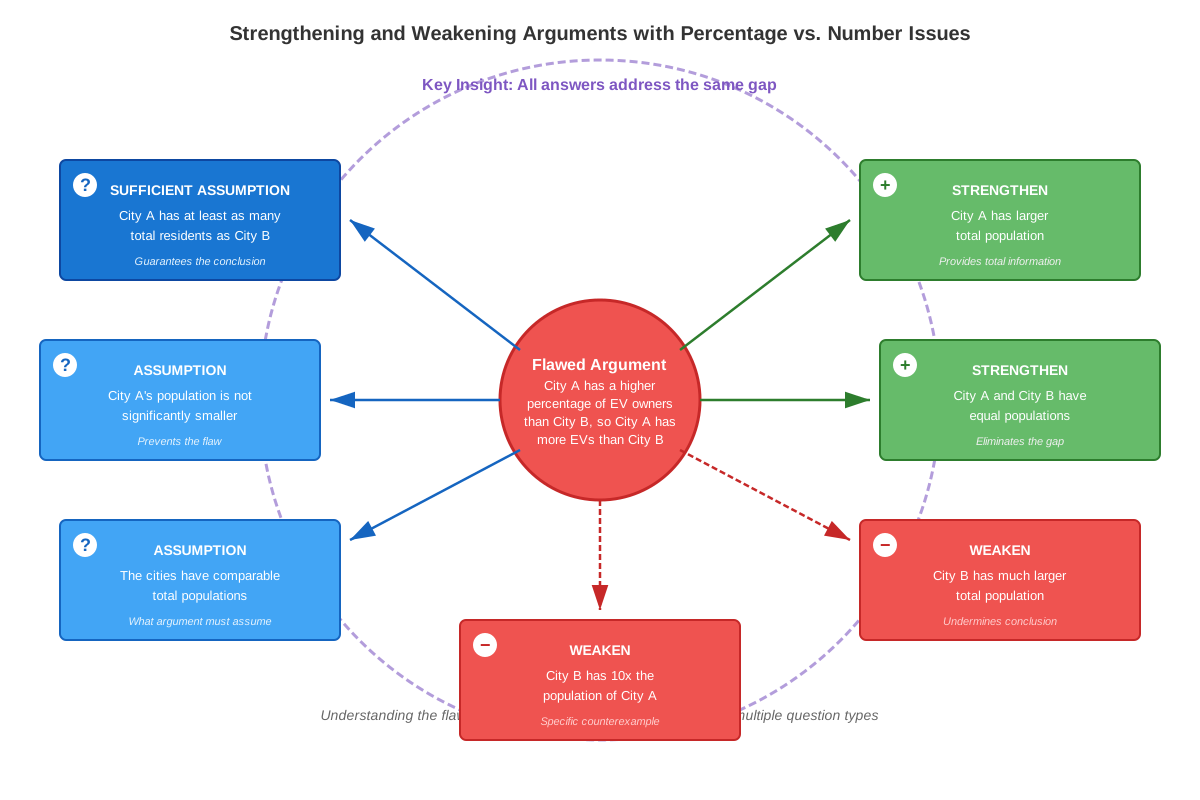
The percentage versus number flaw represents one of the most frequently tested reasoning errors in LSAT Logical Reasoning sections. This flaw occurs when an argument confuses relative proportions (percentages, rates, or ratios) with absolute quantities (raw numbers or totals), or vice versa. For instance, an argument might conclude that because a higher percentage of Group A experiences an outcome compared to Group B, more members of Group A must experience that outcome—ignoring that Group B might be substantially larger. This type of flawed reasoning appears across multiple question types, including flaw questions, assumption questions, strengthen/weaken questions, and parallel reasoning questions.
Understanding this flaw is essential for LSAT success because it tests a fundamental aspect of quantitative reasoning that appears in legal, policy, and analytical contexts. The LSAT frequently presents arguments that manipulate statistical information in misleading ways, and recognizing the percentage versus number distinction allows test-takers to identify logical gaps quickly and accurately. This flaw often appears in arguments about demographics, business statistics, health outcomes, educational performance, and social trends—contexts where both percentages and absolute numbers carry significance but cannot be used interchangeably.
Within the broader landscape of Logical Reasoning, the lsat percentage versus number flaw connects to other quantitative reasoning errors, including sampling flaws, survey methodology issues, and causal reasoning problems. Mastering this concept strengthens overall analytical skills and provides a framework for evaluating any argument that relies on numerical or statistical evidence. The ability to distinguish between relative and absolute measures is foundational to legal reasoning, where precise interpretation of data often determines case outcomes.
Learning Objectives
- [ ] Identify how Percentage versus number flaw appears in LSAT questions
- [ ] Explain the reasoning pattern behind Percentage versus number flaw
- [ ] Apply Percentage versus number flaw to solve LSAT-style problems accurately
- [ ] Distinguish between arguments that validly use percentages versus those that commit the flaw
- [ ] Recognize variations of this flaw across different question types (flaw, assumption, strengthen/weaken)
- [ ] Construct counterexamples that expose the percentage versus number confusion
- [ ] Predict what additional information would be needed to make a flawed argument valid
Prerequisites
- Basic understanding of percentages and proportions: Necessary to recognize when an argument shifts between relative and absolute measures
- Familiarity with LSAT argument structure: Required to identify premises, conclusions, and logical gaps in reasoning
- Knowledge of what constitutes a logical flaw: Essential foundation for recognizing this specific type of reasoning error
- Experience with flaw question stems: Helps in quickly identifying when to look for this particular flaw pattern
Why This Topic Matters
The percentage versus number flaw appears with remarkable frequency on the LSAT, making it one of the highest-yield topics for test preparation. Research of recent LSAT administrations suggests this flaw appears in approximately 10-15% of Logical Reasoning questions, either as the primary flaw or as a component of the reasoning structure. This frequency makes it more common than many other specific flaw types, and its appearance spans multiple question formats beyond traditional flaw questions.
In real-world contexts, this reasoning error underlies many misleading claims in media, politics, business, and public health. A company might boast that it has the highest percentage of satisfied customers while serving far fewer customers than competitors. A politician might claim that a policy reduced crime rates (percentage) while total crimes (numbers) actually increased due to population growth. Medical studies might show that a treatment increases survival rates (percentage) while the absolute number of lives saved remains minimal. Legal professionals must regularly evaluate statistical evidence, expert testimony, and policy arguments where this distinction proves critical.
On the LSAT specifically, this flaw commonly appears in arguments about:
- Comparative statistics between groups of different sizes
- Business performance metrics (market share versus total revenue)
- Educational outcomes (graduation rates versus total graduates)
- Health and safety data (infection rates versus total cases)
- Survey results and polling data
- Demographic trends and population studies
The LSAT tests this concept because it reflects genuine analytical challenges lawyers face when interpreting evidence, evaluating expert testimony, and constructing or deconstructing arguments in legal practice.
Core Concepts
The Fundamental Distinction
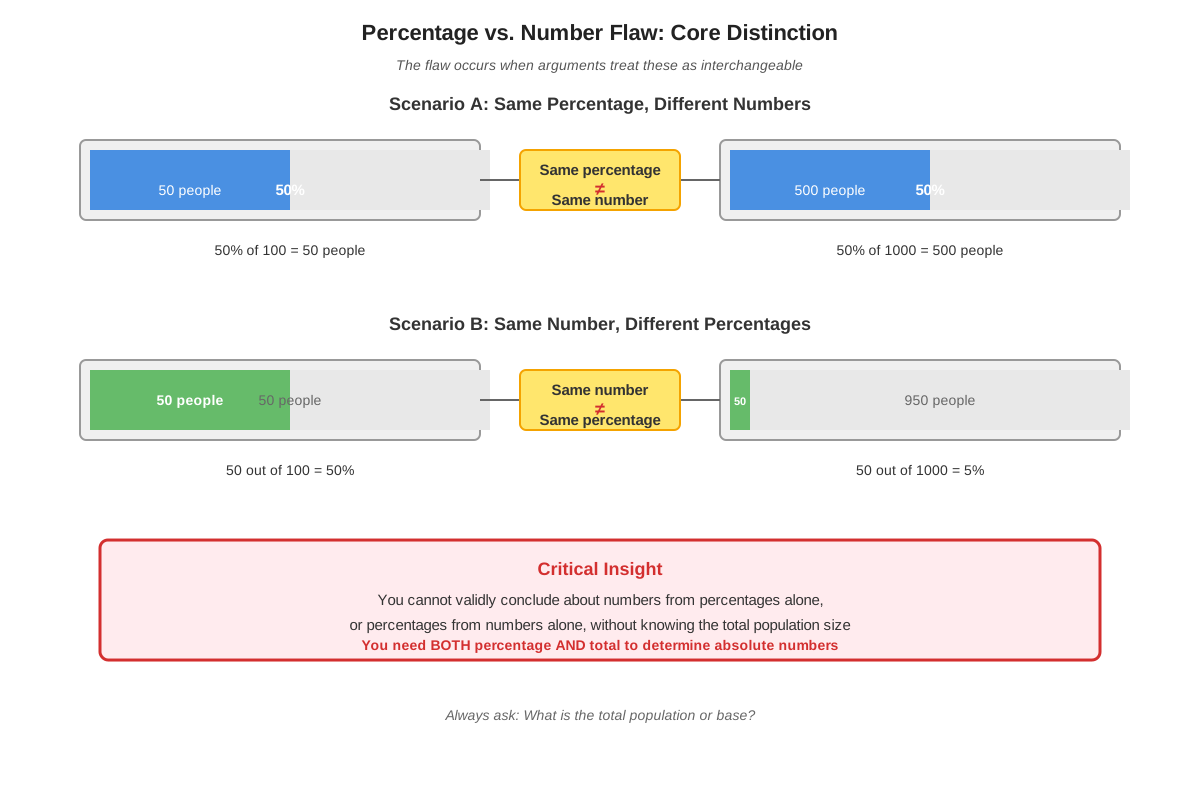
The percentage versus number flaw occurs when an argument treats percentages (or other relative measures like rates, ratios, or proportions) as if they were interchangeable with absolute numbers (raw counts or totals), or vice versa. These two types of measurements convey fundamentally different information:
- Percentages/Rates/Proportions: Relative measures that express a part-to-whole relationship, independent of absolute size
- Numbers/Totals/Counts: Absolute measures that express actual quantities
The flaw emerges when an argument uses evidence about one type of measure to draw a conclusion about the other type without providing information about the relationship between them.
The Classic Pattern
The most common manifestation follows this structure:
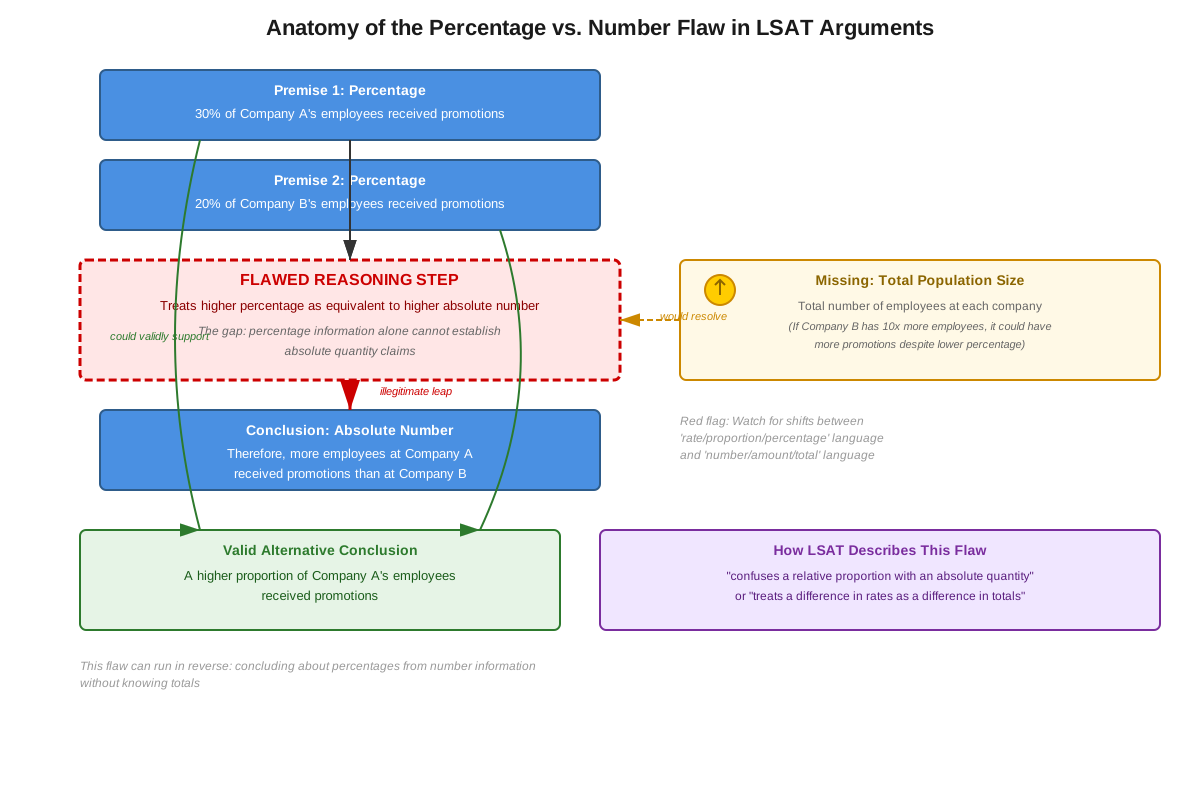
- Premise: Group A has a higher percentage/rate than Group B
- Conclusion: Group A has a higher number/total than Group B (or vice versa)
- Gap: No information provided about the relative sizes of Group A and Group B
This reasoning fails because a smaller group with a higher percentage can easily have fewer total instances than a larger group with a lower percentage.
Mathematical Illustration
Consider this concrete example:
| Group | Total Size | Percentage with Trait | Actual Number with Trait |
|---|---|---|---|
| A | 100 | 80% | 80 |
| B | 1,000 | 20% | 200 |
Group A has a higher percentage (80% > 20%), but Group B has a higher absolute number (200 > 80). An argument concluding that Group A has more instances based solely on the higher percentage commits the flaw.
Directional Variations
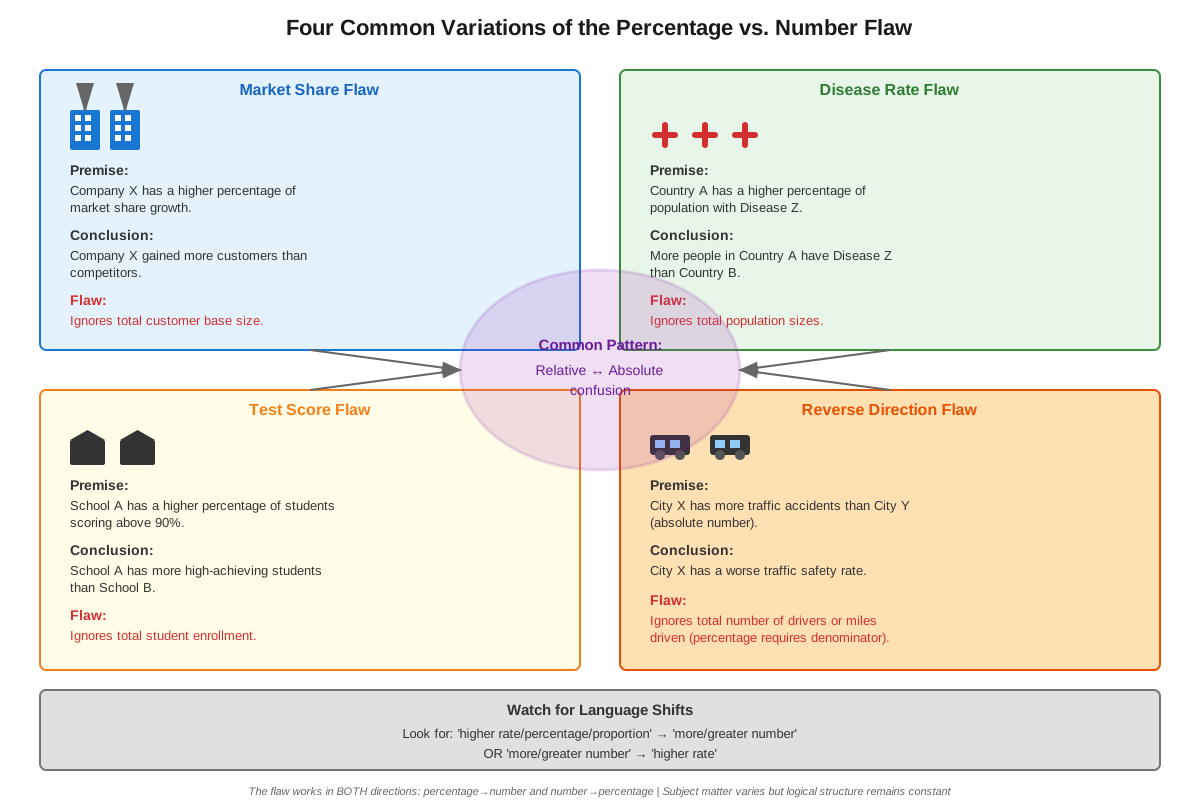
The flaw works in both directions:
Percentage to Number: Concluding that a higher percentage means a higher absolute number
- Flawed: "Company X has a higher percentage of employees with advanced degrees than Company Y, so Company X employs more people with advanced degrees."
- Problem: Company Y might be much larger
Number to Percentage: Concluding that a higher absolute number means a higher percentage
- Flawed: "More accidents occur on Highway 1 than Highway 2, so Highway 1 has a higher accident rate."
- Problem: Highway 1 might have far more traffic volume
The Missing Information
To validly move from percentage to number (or vice versa), an argument needs information about the base or total population being measured. Specifically:
- To conclude about numbers from percentages: Need the total size of each group
- To conclude about percentages from numbers: Need the total size of each group
- The formula connecting them: Number = Percentage × Total
Without this connecting information, the argument contains a logical gap that constitutes the flaw.
Context-Specific Manifestations
The LSAT presents this flaw across various contexts:
Temporal Comparisons: "Crime rates decreased this year, so fewer crimes occurred" (ignores population changes)
Comparative Advantage: "Country A exports a higher percentage of its production than Country B, so Country A exports more goods" (ignores total production volume)
Success Metrics: "Program X has a higher success rate than Program Y, so Program X produces more successful outcomes" (ignores program size)
Risk Assessment: "More people die from Disease A than Disease B, so Disease A is more dangerous" (ignores prevalence/exposure rates)
Why This Flaw Is Persuasive
This reasoning error appears convincing because:
- Percentages and numbers both represent "more" or "less" in everyday language
- People naturally focus on the measure presented without considering what's missing
- The flaw exploits the cognitive tendency to assume similar-sized comparison groups
- In some contexts, percentages and numbers do correlate, making the confusion seem reasonable
Concept Relationships
The percentage versus number flaw connects to several other Logical Reasoning concepts in important ways:
Within Quantitative Reasoning Flaws: This flaw represents one category within the broader family of statistical and numerical reasoning errors. It relates closely to sampling flaws (where sample percentages are used to conclude about population numbers without knowing sample size) and survey methodology issues (where response rates affect the validity of conclusions).
Relationship to Necessary Assumptions: When this flaw appears, the argument makes an unstated assumption that the groups being compared are similar in size, or that the relationship between percentage and number holds in a particular way. Assumption questions may ask test-takers to identify this missing link.
Connection to Sufficient Assumptions: A sufficient assumption that would fix this flaw would provide the missing information about group sizes or explicitly state that the groups are comparable in size such that the percentage relationship translates to the number relationship.
Link to Strengthen/Weaken Questions: Information about the relative sizes of groups being compared will strengthen or weaken arguments that commit this flaw. Evidence that groups are similar in size strengthens the argument; evidence of substantial size differences weakens it.
Relationship Map:
Percentage/Rate Evidence → [Missing: Group Size Information] → Number/Total Conclusion
↓
Creates Logical Gap
↓
Requires Assumption about Comparable Sizes
↓
Can be Strengthened (by showing similar sizes) or Weakened (by showing different sizes)
High-Yield Facts
⭐ The percentage versus number flaw occurs when an argument confuses relative measures (percentages, rates, ratios) with absolute measures (numbers, totals, counts) without providing information connecting them.
⭐ A smaller group with a higher percentage can have fewer total instances than a larger group with a lower percentage.
⭐ To validly conclude about numbers from percentages, an argument must provide information about the total size of the groups being compared.
⭐ The flaw works bidirectionally: percentage-to-number and number-to-percentage conclusions both require information about group sizes.
⭐ Temporal comparisons often commit this flaw by comparing rates across time periods without accounting for population changes.
- The formula connecting percentages and numbers is: Absolute Number = Percentage × Total Population
- This flaw appears in approximately 10-15% of Logical Reasoning questions across various question types
- Common trigger phrases include "higher rate," "more likely," "greater percentage," "increased proportion," and "more instances"
- The flaw is particularly common in arguments about comparative statistics, business metrics, and demographic trends
- Recognizing this flaw requires distinguishing between what the evidence actually shows versus what the conclusion claims
Quick check — test yourself on Percentage versus number flaw so far.
Try Flashcards →Common Misconceptions
Misconception: If an argument mentions both percentages and numbers, it cannot commit the percentage versus number flaw.
Correction: The flaw occurs when the argument uses one type of measure as evidence for a conclusion about the other type without providing the connecting information (group sizes). Simply mentioning both types doesn't establish the necessary logical connection.
Misconception: The percentage versus number flaw only appears in flaw questions.
Correction: This reasoning pattern appears across multiple question types including assumption questions (asking what's assumed), strengthen/weaken questions (asking what information would affect the argument), and parallel reasoning questions (asking for structurally similar arguments).
Misconception: If two groups have the same percentage, they must have the same number of instances.
Correction: Groups of different sizes can have identical percentages but vastly different absolute numbers. For example, 50% of 100 (50) differs dramatically from 50% of 10,000 (5,000).
Misconception: The flaw only matters when comparing two different groups.
Correction: The flaw also appears in temporal comparisons (same group at different times) when population size changes, or in single-group arguments that shift between percentage and number without justification.
Misconception: If an argument provides any numerical information, it has addressed the percentage versus number issue.
Correction: The argument must provide specifically the information that connects percentages to numbers—namely, the total size or base population. Other numerical details don't resolve the flaw.
Worked Examples
Example 1: Classic Flaw Question
Argument: "Last year, 15% of Acme Corporation's employees received promotions, while only 10% of Beta Industries' employees received promotions. Therefore, Acme Corporation promoted more employees than Beta Industries last year."
Question: Which of the following describes a flaw in the reasoning above?
Analysis:
- Identify the evidence type: The premises provide percentages (15% and 10%)
- Identify the conclusion type: The conclusion claims something about absolute numbers ("more employees")
- Spot the gap: No information about the total number of employees at each company
- Recognize the flaw: The argument moves from percentage evidence to a number conclusion without providing the connecting information
Why it's flawed: Beta Industries could employ 10,000 people (10% = 1,000 promotions) while Acme employs only 1,000 people (15% = 150 promotions). Beta would have promoted more employees despite the lower percentage.
Correct answer would state: "The argument fails to consider that Beta Industries might employ significantly more people than Acme Corporation, such that a smaller percentage could represent a larger absolute number of promotions."
Connection to learning objectives: This example demonstrates how to identify the flaw (Objective 1), explains the reasoning pattern of moving from percentage to number without justification (Objective 2), and shows how to analyze the argument structure to solve the problem (Objective 3).
Example 2: Assumption Question Variation
Argument: "The new traffic safety campaign has been successful. Before the campaign, there were 500 traffic accidents per month in the city. After the campaign, the accident rate dropped to 3 accidents per 1,000 drivers per month. Clearly, the campaign reduced the number of accidents."
Question: The argument assumes which of the following?
Analysis:
- Identify the shift: The argument compares a raw number (500 accidents) with a rate (3 per 1,000 drivers)
- Recognize the conclusion: Claims the number of accidents decreased
- Identify what's missing: Information about how many drivers there were before versus after
- Determine the assumption: The argument assumes the number of drivers didn't increase so much that 3 per 1,000 drivers actually represents more than 500 total accidents
Why this matters: If the city now has 200,000 drivers, the rate of 3 per 1,000 means 600 total accidents—an increase, not a decrease. The argument assumes this isn't the case.
Correct answer would state: "The number of drivers in the city did not increase substantially enough that the lower rate represents a higher absolute number of accidents."
Alternative calculation: For the conclusion to hold, the current number of drivers must be less than approximately 167,000 (since 500 accidents ÷ 3 accidents per 1,000 = 166,667 drivers). The argument assumes this is true.
Connection to learning objectives: This example shows how the flaw appears in assumption questions (Objective 1), demonstrates the reasoning pattern with temporal comparisons (Objective 2), and illustrates how to construct the logical connection needed to solve the problem (Objectives 3 and 7).
Exam Strategy
Recognition Triggers
Watch for these phrases that signal potential percentage versus number flaws:
Percentage/Rate indicators: "higher rate," "greater proportion," "more likely," "increased percentage," "larger share," "per capita," "per 1,000," "ratio of"
Number/Total indicators: "more instances," "greater number," "most cases," "total amount," "absolute increase," "additional cases"
Comparison words: "than," "compared to," "relative to," "versus," "more than," "less than"
When you see evidence using one type of indicator and a conclusion using the other type, immediately check whether the argument provides information about group sizes or totals.
Systematic Approach
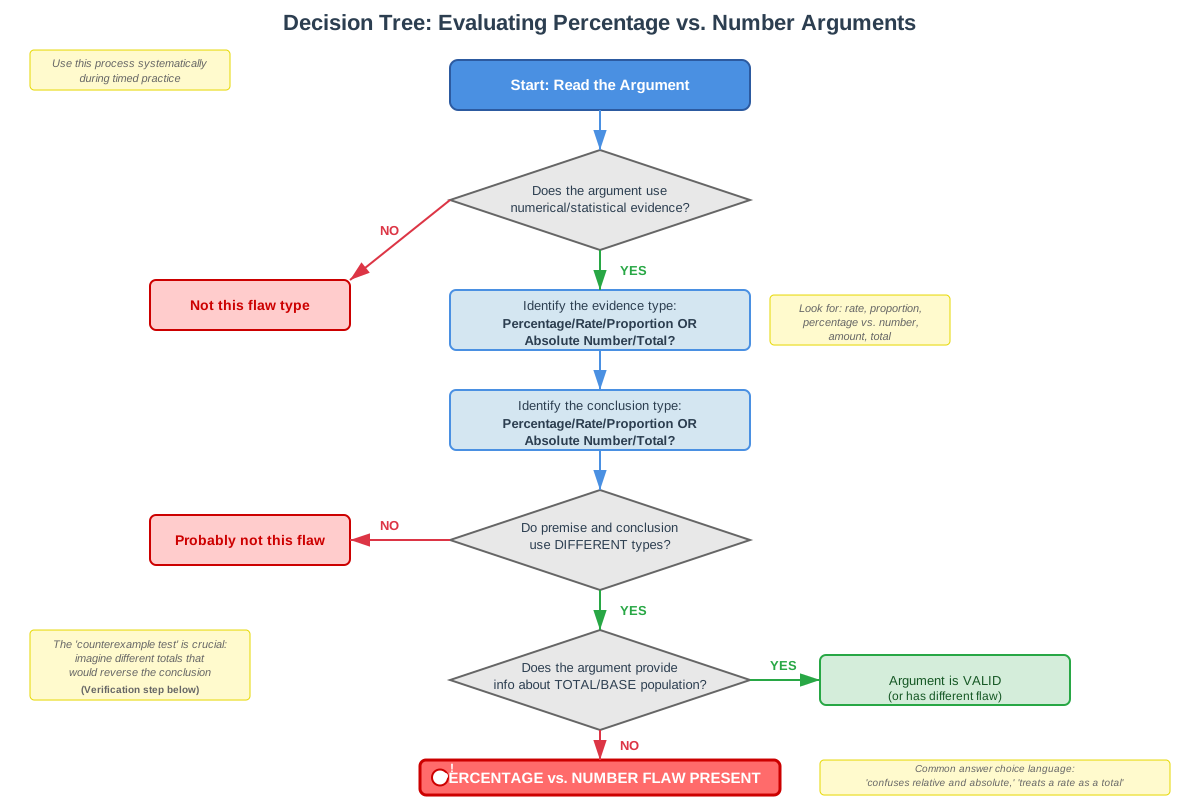
- Identify the evidence type: Is the premise about percentages/rates or numbers/totals?
- Identify the conclusion type: Is the conclusion about percentages/rates or numbers/totals?
- Check for mismatch: If they differ, look for connecting information
- Verify the gap: Confirm that no information about group sizes or bases is provided
- Construct a counterexample: Mentally create a scenario where the premise is true but the conclusion is false
Process of Elimination
For flaw questions, eliminate answers that:
- Describe flaws the argument doesn't commit
- Focus on irrelevant aspects of the reasoning
- Accurately describe the argument's structure without identifying a flaw
Keep answers that:
- Mention the distinction between rates/percentages and numbers/totals
- Point out missing information about group sizes or populations
- Note that a higher percentage doesn't necessarily mean a higher number (or vice versa)
Time Management
This flaw is typically quick to identify once you recognize the pattern:
- Spend 10-15 seconds identifying evidence and conclusion types
- Spend 5-10 seconds checking for connecting information
- Spend 20-30 seconds evaluating answer choices
- Total time: 35-55 seconds for recognition and elimination
If you're unsure, construct a quick numerical counterexample—this usually takes only 10-15 seconds and definitively confirms the flaw.
Common Trap Answers
Trap: "The argument assumes that percentages and numbers are the same thing."
Why it's wrong: Too simplistic; the argument doesn't confuse the definitions but rather fails to provide connecting information.
Trap: "The argument relies on statistical data that may be inaccurate."
Why it's wrong: This addresses data reliability, not the logical relationship between percentages and numbers.
Better answer: "The argument overlooks the possibility that the groups being compared differ substantially in size, such that a higher percentage in one group could represent a lower absolute number."
Memory Techniques
The "Small Slice, Big Pie" Mnemonic
Remember: "A small slice of a big pie beats a big slice of a small pie."
This captures the essence of the flaw: a small percentage (small slice) of a large group (big pie) can exceed a large percentage (big slice) of a small group (small pie) in absolute terms.
The P→N Formula
P→N requires T: To go from Percentage to Number, you need the Total.
Visualize this as a bridge: Percentage [missing bridge: Total] Number. Without the bridge (total/group size), you can't cross from one to the other.
The "Rate vs. Raw" Distinction
Rate = Relative (percentages, proportions, per capita)
Raw = Real numbers (totals, counts, absolute quantities)
Both start with "R" but represent different things. When an argument mixes Rate and Raw without connecting them, it commits the flaw.
The Counterexample Template
Memorize this quick template for constructing counterexamples:
- Group A: Small total × High percentage = Small number
- Group B: Large total × Low percentage = Large number
- Result: Higher percentage doesn't mean higher number
Example: 90% of 100 (90) < 20% of 1,000 (200)
Summary
The percentage versus number flaw represents a critical reasoning error where arguments confuse relative measures (percentages, rates, proportions) with absolute measures (numbers, totals, counts) without providing the necessary connecting information. This flaw appears frequently on the LSAT across multiple question types and requires test-takers to recognize when evidence about one type of measure is used to support a conclusion about another type without justification. The fundamental issue is that groups of different sizes can have inverse relationships between their percentages and their absolute numbers—a smaller group with a higher percentage can have fewer total instances than a larger group with a lower percentage. To validly move from percentage to number or vice versa, an argument must provide information about the total size or base population of the groups being compared. Recognizing this flaw requires careful attention to whether premises and conclusions discuss the same type of measure, and whether the argument supplies the information needed to connect them. Mastery of this concept enables quick identification of flawed reasoning and accurate prediction of what assumptions, strengtheners, or weakeners would be relevant to arguments involving statistical or numerical evidence.
Key Takeaways
- The percentage versus number flaw occurs when arguments treat percentages and absolute numbers as interchangeable without providing information about group sizes
- A higher percentage does not necessarily mean a higher absolute number, and vice versa—the relationship depends on the total size of the groups being compared
- This flaw appears in approximately 10-15% of Logical Reasoning questions across multiple question types including flaw, assumption, and strengthen/weaken questions
- To identify this flaw, check whether the evidence type (percentage or number) matches the conclusion type, and whether connecting information about totals is provided
- The formula connecting these measures is: Absolute Number = Percentage × Total Population; without information about the total, the connection cannot be made
- Quick counterexamples (like 90% of 100 versus 20% of 1,000) can confirm the flaw and help eliminate wrong answers
- Trigger phrases include "higher rate," "more likely," "greater percentage" (for rates) and "more instances," "greater number," "most cases" (for totals)
Related Topics
Sampling Flaws: Understanding how sample characteristics relate to population characteristics builds on the percentage versus number distinction, as sample percentages must be properly weighted by sample size to draw valid population conclusions.
Causal Reasoning Errors: Many causal arguments rely on statistical evidence where the percentage versus number distinction matters, particularly when evaluating whether correlation data supports causal claims.
Necessary vs. Sufficient Conditions: The information needed to connect percentages and numbers (group sizes) represents a necessary condition for the argument's validity, deepening understanding of conditional logic.
Quantitative Comparison Flaws: This broader category includes other ways arguments misuse numerical data, such as confusing averages with totals or rates with absolute changes.
Survey and Study Methodology: Understanding how data is collected and reported helps identify when percentage versus number issues arise from methodological choices rather than explicit reasoning errors.
Practice CTA
Now that you understand the percentage versus number flaw, you're ready to apply this knowledge to actual LSAT questions. The practice questions and flashcards will help solidify your ability to spot this flaw quickly and accurately under timed conditions. Remember, this is one of the highest-yield topics in Logical Reasoning—mastering it will directly improve your score. Each practice question you work through strengthens your pattern recognition and builds the confidence you need to tackle this flaw type efficiently on test day. Start practicing now to transform this knowledge into automatic recognition and consistent points!
Sign up free to keep reading
Create a free AnvayaPrep account to finish this LSAT guide on Percentage versus number flaw — plus flashcards and practice questions.