Overview
The prescriptive-descriptive flaw represents one of the most frequently tested reasoning errors in LSAT Logical Reasoning sections. This flaw occurs when an argument improperly moves from a descriptive claim (what is the case) to a prescriptive claim (what ought to be the case), or vice versa, without providing adequate justification for the transition. In philosophical terms, this is known as the "is-ought" problem, first articulated by David Hume, who observed that one cannot logically derive normative conclusions from purely factual premises without additional moral or evaluative principles.
On the LSAT, this flaw appears with remarkable consistency in flaw questions, where test-takers must identify the logical weakness in an argument. The prescriptive-descriptive error is particularly insidious because it often seems intuitively reasonable in everyday discourse, making it an ideal testing ground for the LSAT's mission to assess critical thinking skills. Arguments committing this flaw typically present evidence about how things currently are, how people actually behave, or what has historically occurred, then leap to conclusions about how things should be, what people ought to do, or what policies should be implemented—all without establishing the normative bridge necessary to justify such conclusions.
Understanding the prescriptive-descriptive flaw is essential not only for identifying it in isolation but also for recognizing how it relates to broader patterns of flawed reasoning on the LSAT. This flaw connects to assumption questions (where the missing normative principle might be the necessary assumption), strengthen/weaken questions (where adding or removing normative justification affects argument strength), and principle questions (where the correct answer often supplies the missing evaluative standard). Mastering this concept enhances overall performance across multiple Logical Reasoning question types and sharpens the analytical skills necessary for legal reasoning.
Learning Objectives
- [ ] Identify how prescriptive-descriptive flaw appears in LSAT questions
- [ ] Explain the reasoning pattern behind prescriptive-descriptive flaw
- [ ] Apply prescriptive-descriptive flaw to solve LSAT-style problems accurately
- [ ] Distinguish between descriptive and prescriptive statements in complex argument structures
- [ ] Recognize the missing normative principles that would be required to bridge descriptive premises to prescriptive conclusions
- [ ] Evaluate answer choices that correctly characterize the prescriptive-descriptive flaw using various phrasings and terminology
Prerequisites
- Basic argument structure: Understanding premises, conclusions, and how they relate is essential because identifying the prescriptive-descriptive flaw requires recognizing when the conclusion type differs from the premise type.
- Conditional reasoning fundamentals: Many prescriptive-descriptive flaws involve conditional statements about what should happen given certain conditions, requiring comfort with if-then logic.
- Flaw question format: Familiarity with how flaw questions are asked and structured allows focus on content rather than format when identifying this specific error type.
- Distinction between facts and values: Basic awareness that factual claims differ from value judgments provides the conceptual foundation for recognizing when arguments cross this boundary improperly.
Why This Topic Matters
The lsat prescriptive-descriptive flaw appears in approximately 10-15% of all flaw questions across recent LSAT administrations, making it one of the highest-yield flaw types to master. Beyond its frequency, this flaw type is particularly valuable because it tests a fundamental skill required in legal reasoning: the ability to distinguish between what the law is and what the law should be, between factual findings and policy recommendations, between describing precedent and arguing for its application or modification.
In real-world legal contexts, attorneys must constantly navigate the boundary between descriptive and prescriptive claims. A lawyer might describe how courts have historically ruled on certain matters (descriptive) while arguing how a court should rule in the present case (prescriptive). Confusing these categories or failing to provide adequate justification when moving between them represents a critical reasoning failure that can undermine legal arguments. The LSAT tests this skill because it directly relates to the analytical demands of law school and legal practice.
This topic commonly appears in LSAT passages involving policy recommendations, ethical arguments, behavioral studies applied to normative conclusions, and historical precedent used to justify future actions. Test-makers favor contexts involving social science research, business practices, government regulations, and moral philosophy—areas where the temptation to move from "is" to "ought" without justification is particularly strong. Recognizing this flaw requires not just pattern recognition but genuine understanding of the logical gap being exploited.
Core Concepts
The Fundamental Distinction: Descriptive vs. Prescriptive Claims
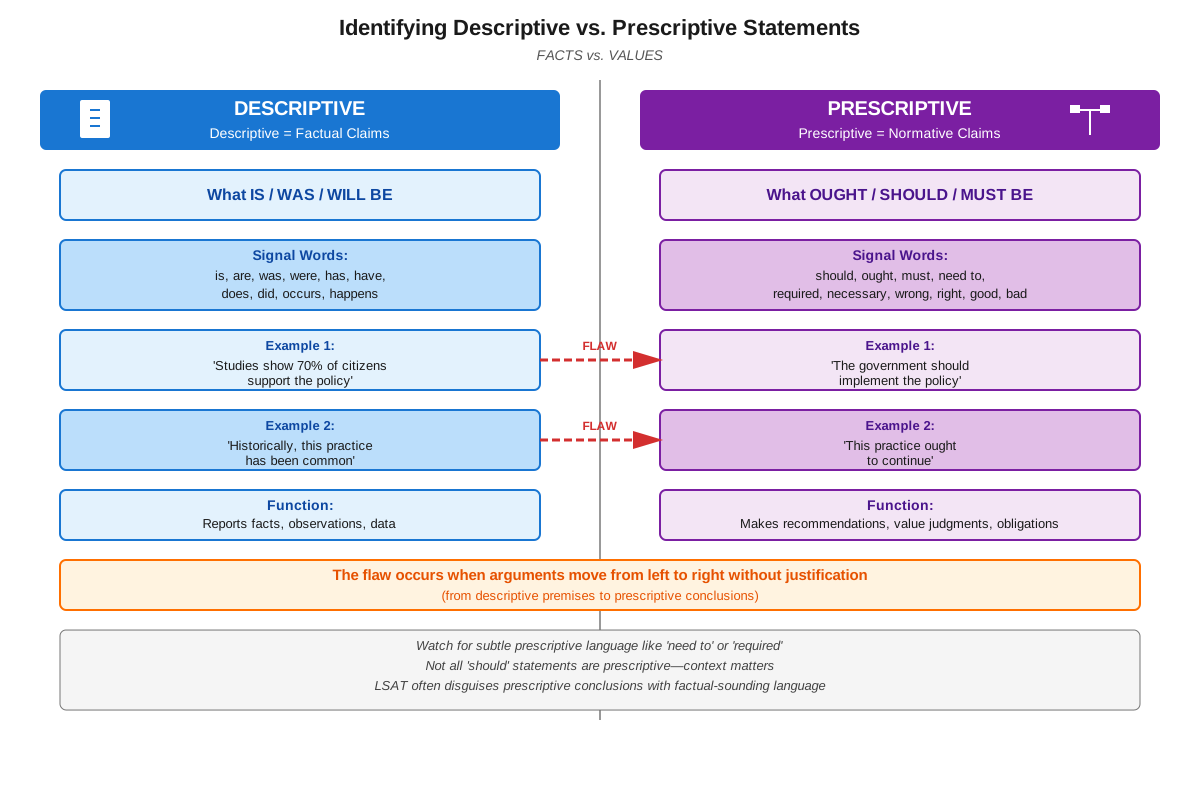
Descriptive claims (also called factual, empirical, or positive claims) describe how things are, were, or will be in the world. They make assertions about reality that can, in principle, be verified or falsified through observation or evidence. Examples include: "Most people recycle when convenient bins are available," "The policy has been in effect for ten years," or "Studies show that exercise improves cardiovascular health."
Prescriptive claims (also called normative, evaluative, or ought claims) express judgments about how things should be, what people ought to do, or what would be good, right, or desirable. They involve values, obligations, recommendations, or evaluations. Examples include: "People should recycle whenever possible," "The policy ought to be continued," or "Everyone must exercise regularly."
The critical distinction lies in their logical character: descriptive claims can be true or false based on empirical evidence, while prescriptive claims require additional evaluative standards or moral principles to be justified. No amount of purely factual information can, by itself, logically compel a normative conclusion without some evaluative bridge principle.
The Structure of the Prescriptive-Descriptive Flaw
The prescriptive-descriptive flaw occurs when an argument exhibits one of these patterns:
- Descriptive premises → Prescriptive conclusion (most common): The argument presents only factual information but concludes with a recommendation, obligation, or value judgment
- Prescriptive premises → Descriptive conclusion (less common): The argument presents only normative claims but concludes with a factual prediction or description
The overwhelming majority of LSAT questions feature the first pattern. Here's the logical structure:
Premise 1: [Descriptive claim about what is]
Premise 2: [Descriptive claim about what is]
Conclusion: [Prescriptive claim about what ought to be]
The flaw lies in the missing normative principle—an unstated evaluative standard that would be necessary to justify the transition from facts to values. Without this principle, the argument commits a logical leap.
Why This Constitutes a Flaw
The prescriptive-descriptive flaw represents a genuine logical error, not merely a weak argument. Consider this example:
Flawed Argument: "Studies show that 80% of successful executives wake up before 6 AM. Therefore, you should wake up before 6 AM if you want to be successful."
The premises describe what successful executives actually do (descriptive), but the conclusion tells you what you ought to do (prescriptive). The argument assumes without justification that:
- What successful people do is what causes their success
- What causes success for others will cause success for you
- Success is something you should pursue
- Mimicking behaviors of successful people is advisable
None of these evaluative principles are stated, yet all are necessary to bridge the logical gap. The argument treats correlation as prescription without justification.
Common Contexts for This Flaw
| Context | Descriptive Element | Prescriptive Leap | Missing Principle |
|---|---|---|---|
| Historical precedent | "This has always been done this way" | "We should continue doing it this way" | Past practice justifies future policy |
| Majority behavior | "Most people do X" | "You should do X" | Popular behavior is correct behavior |
| Natural occurrence | "X occurs naturally" | "X is good/acceptable" | Natural equals desirable |
| Current policy | "The law currently requires X" | "The law should require X" | Existing policy is justified policy |
| Ability/capacity | "People can do X" | "People should do X" | Capability creates obligation |
Recognizing Prescriptive Language
Identifying this flaw requires recognizing prescriptive indicators in conclusions:
Strong prescriptive markers:
- Should, ought, must, need to
- It is necessary/essential/imperative that
- Has an obligation/duty/responsibility to
- Would be right/wrong/good/bad to
- Deserves, merits, warrants
- It is advisable/recommended that
Subtle prescriptive markers:
- Policy recommendations ("The government should implement...")
- Evaluative judgments ("This is the best approach...")
- Advice or guidance ("Companies would do well to...")
- Moral assessments ("It is unfair that...")
The Normative Bridge
To repair an argument with a prescriptive-descriptive flaw, one must supply a normative bridge principle—an evaluative standard that connects the factual premises to the value-laden conclusion. For example:
Flawed: "Meditation reduces stress in 70% of practitioners. Therefore, everyone should meditate."
Normative bridge needed: "People should engage in activities that effectively reduce stress" or "What benefits most people is what everyone should do."
With the bridge: "Meditation reduces stress in 70% of practitioners. People should engage in activities that effectively reduce stress. Therefore, everyone should meditate."
The argument is now logically valid (though the bridge principle itself might be questionable). The LSAT tests whether students recognize when such bridges are missing.
Concept Relationships
The prescriptive-descriptive flaw connects intimately with several other Logical Reasoning concepts. It represents a specific type of gap in reasoning where the conclusion goes beyond what the premises establish—similar to scope shifts, but specifically involving the fact-value distinction.
Relationship to Assumption Questions: The missing normative principle in a prescriptive-descriptive flaw is often precisely what assumption questions ask students to identify. If a flaw question asks what's wrong with an argument committing this error, the corresponding assumption question would ask what principle must be assumed to make the argument work.
Relationship to Strengthen/Weaken Questions: Adding a normative bridge principle strengthens an argument with this flaw; pointing out the absence of such a principle or providing evidence that the implicit normative assumption is false weakens the argument.
Relationship to Principle Questions: Many principle questions present arguments with prescriptive-descriptive gaps and ask which principle, if valid, would justify the reasoning. The correct answer supplies the missing normative bridge.
Conceptual flow: Descriptive premises → [Missing normative principle] → Prescriptive conclusion. Recognizing the gap → Identifying it as a flaw → Understanding what would fill the gap → Applying this knowledge across question types.
High-Yield Facts
⭐ The prescriptive-descriptive flaw occurs when an argument moves from factual premises to normative conclusions without providing evaluative justification.
⭐ Approximately 10-15% of flaw questions on recent LSATs involve prescriptive-descriptive reasoning errors.
⭐ The most common pattern is descriptive premises leading to prescriptive conclusions, not the reverse.
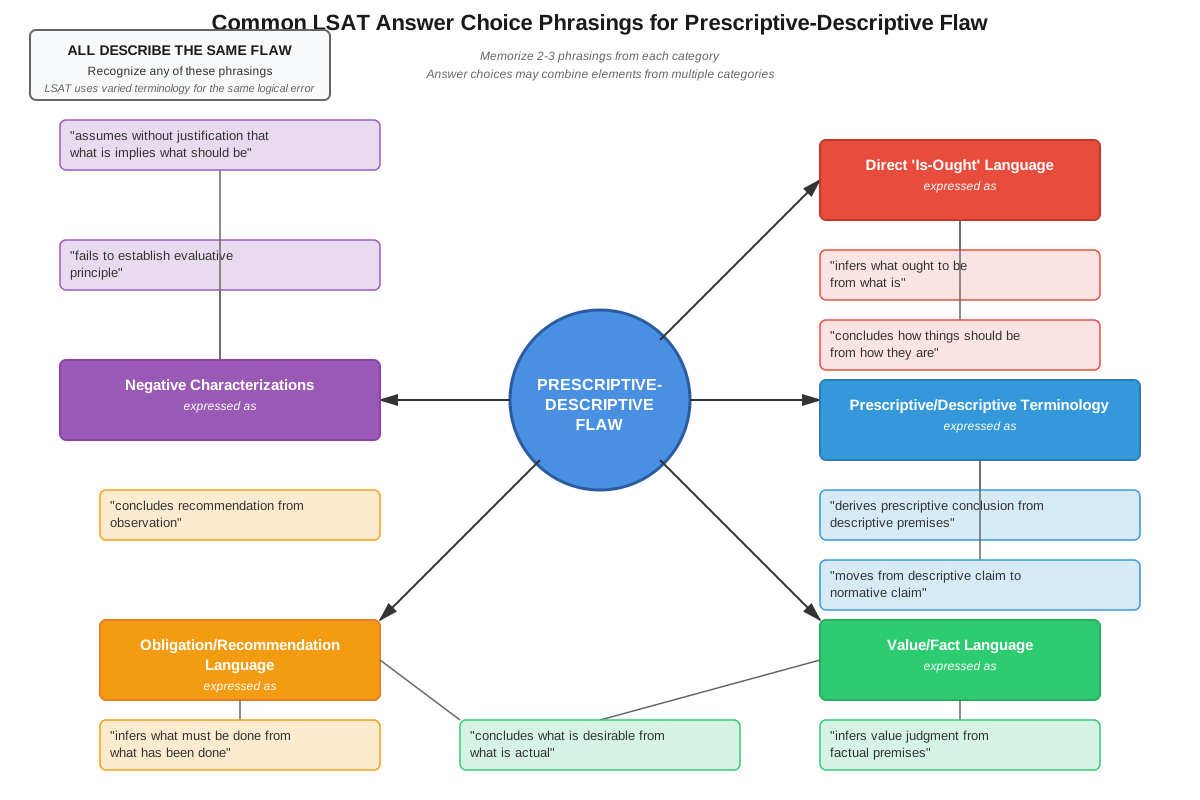
⭐ Answer choices describing this flaw often use phrases like "infers what ought to be the case from what is the case" or "takes a claim about what is done as evidence for a claim about what should be done."
⭐ Historical precedent, majority behavior, and natural occurrence are the three most common descriptive premises used in arguments with this flaw.
- Prescriptive claims contain value judgments, recommendations, or obligations that cannot be derived from facts alone.
- The flaw is also known as the "is-ought problem," "fact-value gap," or "naturalistic fallacy" in philosophical contexts.
- Recognizing prescriptive language markers (should, ought, must, need to) in conclusions is essential for quickly identifying potential instances of this flaw.
- The missing element in these arguments is always a normative or evaluative principle that would bridge the logical gap.
- This flaw can appear in reverse (prescriptive to descriptive), though this is rare on the LSAT, typically involving arguments that assume moral obligations predict actual behavior.
- Arguments about what is "natural" or "traditional" concluding what is "good" or "right" almost always commit this flaw.
- The flaw remains present even when the prescriptive conclusion might be correct; the issue is logical structure, not truth.
Quick check — test yourself on Prescriptive-descriptive flaw so far.
Try Flashcards →Common Misconceptions
Misconception: If the prescriptive conclusion seems reasonable or true, the argument doesn't commit the flaw.
→ Correction: The prescriptive-descriptive flaw is a structural logical error independent of whether the conclusion happens to be correct. An argument can reach a true conclusion through flawed reasoning. The LSAT tests logical validity, not truth of conclusions.
Misconception: Any argument with both descriptive and prescriptive elements commits this flaw.
→ Correction: The flaw only occurs when the argument moves from descriptive premises to prescriptive conclusions without providing normative justification. If the argument includes a normative principle that bridges the gap, no flaw exists. The presence of both types of claims isn't itself problematic—the problem is the unjustified transition.
Misconception: The prescriptive-descriptive flaw is the same as a correlation-causation error.
→ Correction: While these flaws can co-occur, they're distinct. Correlation-causation confuses statistical association with causal relationship (both descriptive claims). The prescriptive-descriptive flaw involves moving between different logical categories (fact vs. value), not misinterpreting relationships within the factual domain.
Misconception: Arguments from authority or tradition automatically commit the prescriptive-descriptive flaw.
→ Correction: These arguments commit the flaw only when they move from "this is what authorities say/what tradition holds" (descriptive) to "therefore this is what should be done" (prescriptive) without establishing why authority or tradition should be followed. An argument that includes "we should follow expert recommendations" as a premise doesn't commit the flaw.
Misconception: The flaw only appears in arguments about ethics or morality.
→ Correction: While ethical arguments frequently involve prescriptive claims, this flaw appears in any context involving recommendations, policies, advice, or evaluations—including business strategy, personal decisions, government policy, and scientific applications. Any "should" conclusion based solely on "is" premises potentially commits this flaw.
Misconception: Identifying this flaw requires philosophical expertise about meta-ethics.
→ Correction: While the philosophical background is interesting, LSAT success requires only recognizing the structural pattern: factual premises + normative conclusion without a bridging principle = flaw. No specialized philosophical knowledge is necessary.
Worked Examples
Example 1: Policy Recommendation
Argument: "A recent survey found that 75% of employees at companies with flexible work schedules report higher job satisfaction than those at companies with rigid schedules. Additionally, companies with flexible schedules show 15% lower turnover rates. Therefore, all companies should implement flexible work schedules."
Analysis:
Step 1: Identify the conclusion
The conclusion is prescriptive: "all companies should implement flexible work schedules." The word "should" signals a normative claim about what ought to be done.
Step 2: Identify the premises
- Premise 1: 75% of employees at flexible-schedule companies report higher satisfaction (descriptive)
- Premise 2: Flexible-schedule companies have 15% lower turnover (descriptive)
Both premises present factual claims about what is the case—survey results and statistical correlations.
Step 3: Identify the gap
The argument moves from descriptive facts (what correlates with flexible schedules) to a prescriptive conclusion (what all companies should do) without providing any normative principle.
Step 4: Articulate the missing principle
The argument assumes without justification that:
- Companies should adopt policies that increase employee satisfaction
- Companies should adopt policies that reduce turnover
- What works for some companies should be implemented by all companies
- The benefits outweigh any potential costs or drawbacks
Step 5: Recognize the flaw
This is a clear prescriptive-descriptive flaw. The argument treats empirical evidence about outcomes as sufficient justification for a policy recommendation without establishing why those outcomes are desirable or why the policy should be universally adopted.
How this might appear in an answer choice: "The argument improperly infers from evidence about the effects of a policy that the policy ought to be adopted."
Example 2: Natural Behavior Argument
Argument: "Anthropological studies demonstrate that in virtually all human societies throughout history, people have formed family units and shown preferential treatment toward their relatives. This pattern of kin favoritism appears across diverse cultures and time periods. It follows that showing preference to one's family members is morally acceptable behavior."
Analysis:
Step 1: Identify the conclusion
The conclusion is prescriptive/evaluative: "showing preference to one's family members is morally acceptable behavior." This makes a moral judgment about what is acceptable (a normative claim).
Step 2: Identify the premises
- Premise 1: All human societies have formed family units (descriptive)
- Premise 2: People show preferential treatment toward relatives (descriptive)
- Premise 3: This pattern appears across cultures and time periods (descriptive)
All premises describe what humans actually do—empirical observations about behavior.
Step 3: Identify the gap
The argument moves from universal human behavior (descriptive) to moral acceptability (prescriptive) without justification. This is sometimes called the "naturalistic fallacy"—assuming that what is natural is therefore good or right.
Step 4: Articulate the missing principle
The argument assumes:
- What humans universally do is morally acceptable
- Historical prevalence establishes moral legitimacy
- Natural human tendencies are ethically justified
Step 5: Recognize the flaw
This commits the prescriptive-descriptive flaw by treating widespread practice as evidence for moral acceptability. The argument confuses "is" (people do show kin favoritism) with "ought" (people should or may acceptably show kin favoritism).
How this might appear in an answer choice: "The argument takes evidence that a behavior is widely practiced as sufficient to establish that the behavior is morally permissible."
Exam Strategy
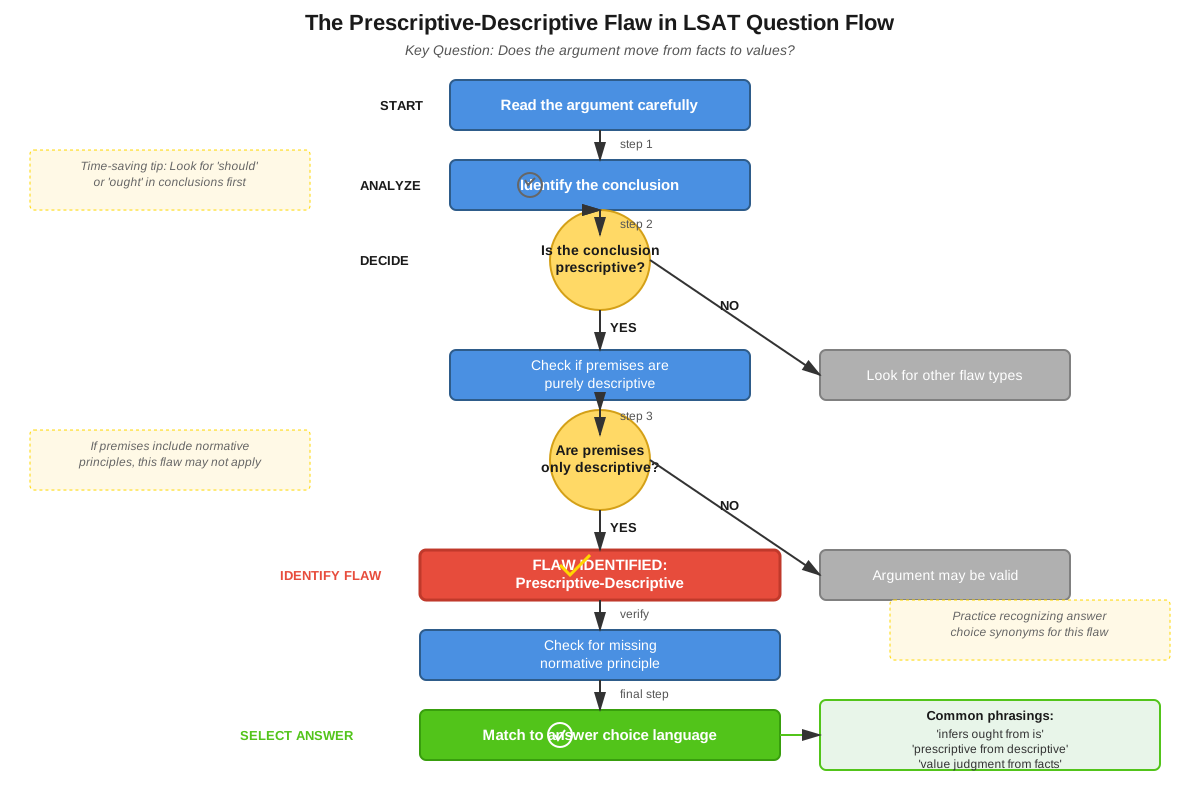
When approaching flaw questions on the LSAT, use this systematic process to identify prescriptive-descriptive flaws:
Step 1: Read the conclusion first (or identify it quickly while reading). Scan for prescriptive language: should, ought, must, recommended, advisable, right, wrong, good, bad, necessary, essential. If the conclusion contains these markers, flag it as potentially prescriptive.
Step 2: Analyze the premises. Ask: Are these purely factual claims? Do they describe what is, was, or will be the case? Are they reporting data, studies, historical facts, or current practices? If yes, and the conclusion is prescriptive, you likely have this flaw.
Step 3: Look for the missing bridge. Ask: Has the argument provided any reason why the facts should lead to this recommendation? Is there any evaluative principle stated? If not, the prescriptive-descriptive flaw is present.
Step 4: Predict the answer. Before looking at choices, articulate the flaw: "The argument moves from what is the case to what should be the case without justification."
Step 5: Match to answer choices. Look for these common phrasings:
- "infers what ought to be from what is"
- "takes a claim about what is done as evidence for what should be done"
- "concludes that something should be the case merely because it is the case"
- "treats a descriptive claim as if it were a prescriptive claim"
- "assumes without justification that what is natural/common/traditional is therefore desirable/right/good"
Exam Tip: Approximately 60% of prescriptive-descriptive flaw answer choices use the explicit language "ought" and "is" or "should" and "does." The remaining 40% use more varied language but maintain the same conceptual distinction.
Time allocation: These questions should take 60-90 seconds once you've mastered the pattern. The flaw itself is straightforward to identify; the challenge lies in matching your understanding to the answer choice phrasing, which can vary considerably.
Elimination strategy:
- Eliminate answers describing flaws that aren't present (e.g., if there's no causal reasoning, eliminate causal flaw answers)
- Eliminate answers that describe the argument's structure accurately without identifying a flaw
- Eliminate answers that reverse the direction (descriptive to prescriptive vs. prescriptive to descriptive)
- Keep answers that capture the fact-value gap, even if the wording differs from what you expected
Trigger contexts: Be especially alert for this flaw when arguments discuss:
- Policy recommendations based on studies or data
- Moral conclusions based on natural behavior or evolution
- Business advice based on what successful companies do
- Legal arguments based on historical precedent alone
- Ethical claims based on cultural practices
Memory Techniques
Primary Mnemonic: "IS ≠ OUGHT"
The simplest way to remember this flaw is the formula: You cannot get from IS to OUGHT without a bridge. When you see an argument, ask "IS or OUGHT?" for both premises and conclusion. If they differ, check for the bridge.
The Bridge Visualization: Picture the argument as two islands—Fact Island (descriptive) and Value Island (prescriptive). The premises are on Fact Island, the conclusion on Value Island. To get from one to the other, you need a bridge (the normative principle). If there's no bridge, the argument commits the flaw—it's trying to jump the gap.
The "Should" Signal: Train yourself to have an automatic response when you see "should," "ought," or "must" in a conclusion. Think: "Show me the evaluative principle!" If the argument hasn't provided one, you've found the flaw.
The Three-Question Check:
- What do the premises describe? (The "IS")
- What does the conclusion prescribe? (The "OUGHT")
- What principle connects them? (The "BRIDGE")
If you can't answer question 3, the flaw is present.
Acronym: FIND the flaw
- Factual premises only?
- Is the conclusion normative?
- No evaluative principle stated?
- Descriptive-prescriptive flaw identified!
Summary
The prescriptive-descriptive flaw represents a fundamental logical error where arguments attempt to derive normative conclusions (what should be, what ought to be done, what is right or good) from purely descriptive premises (what is, what people do, what has occurred) without providing the necessary evaluative principles to justify the transition. This flaw, rooted in the philosophical "is-ought problem," appears frequently on the LSAT because it tests a critical skill for legal reasoning: distinguishing between factual claims and value judgments. To identify this flaw, students must recognize prescriptive language in conclusions, verify that premises are purely descriptive, and determine whether any normative bridge principle has been provided. The flaw is most commonly seen in arguments involving policy recommendations based on empirical data, moral conclusions based on natural or traditional behavior, and advice based on what successful people or organizations do. Mastering this concept requires understanding both the logical structure of the flaw and the various ways LSAT answer choices describe it, from explicit "is-ought" language to more subtle phrasings about inferring prescriptive claims from descriptive evidence.
Key Takeaways
- The prescriptive-descriptive flaw occurs when arguments move from factual premises to normative conclusions without providing evaluative justification—you cannot derive "ought" from "is" alone.
- This flaw appears in 10-15% of flaw questions, making it one of the highest-yield patterns to master for LSAT Logical Reasoning sections.
- Identify this flaw by checking whether the conclusion contains prescriptive language (should, ought, must, right, wrong) while premises contain only descriptive claims (facts, data, observations).
- The missing element is always a normative bridge principle—an evaluative standard that would connect the factual premises to the value-laden conclusion.
- Common contexts include policy recommendations from studies, moral conclusions from natural behavior, and advice based on what successful people do—all moving from description to prescription without justification.
- Answer choices use varied language but consistently capture the core error: treating what is the case as sufficient evidence for what should be the case.
- This flaw connects to multiple question types: it appears directly in flaw questions, the missing principle appears in assumption questions, and supplying or undermining the principle appears in strengthen/weaken questions.
Related Topics
Necessary Assumption Questions: Understanding the prescriptive-descriptive flaw directly enhances performance on necessary assumption questions, where the missing normative principle often constitutes the required assumption. Mastering this flaw teaches students to identify what evaluative standards arguments depend upon.
Sufficient Assumption Questions: These questions frequently ask for principles that would make arguments valid. When the argument commits a prescriptive-descriptive flaw, the correct answer typically provides the normative bridge principle needed to connect descriptive premises to prescriptive conclusions.
Principle Questions (Apply and Identify): Both types of principle questions heavily feature prescriptive-descriptive reasoning. Apply questions ask which principle justifies a given argument (often one with this flaw), while identify questions ask which argument follows from a given principle (often a normative bridge).
Strengthen and Weaken Questions: Arguments with prescriptive-descriptive gaps can be strengthened by adding normative principles or weakened by undermining implicit evaluative assumptions. Recognizing this flaw helps identify which answer choices will have these effects.
Parallel Reasoning and Parallel Flaw: Questions asking for parallel flawed reasoning often feature prescriptive-descriptive errors. Mastering this flaw enables quick identification of structurally similar arguments across different content domains.
Practice CTA
Now that you understand the prescriptive-descriptive flaw—its structure, identification markers, and strategic importance—it's time to cement this knowledge through active practice. Attempt the practice questions designed for this topic, focusing on applying the systematic identification process outlined above. As you work through problems, consciously articulate the "IS-OUGHT-BRIDGE" analysis for each argument. Create flashcards for the various ways answer choices phrase this flaw, as recognizing these different formulations is crucial for test-day success. Remember: this single flaw type appears in roughly one out of every seven to ten flaw questions you'll encounter on test day. The time invested in mastering it now will yield significant score improvements. You've built the conceptual foundation—now build the pattern recognition and speed through deliberate practice.
Sign up free to keep reading
Create a free AnvayaPrep account to finish this LSAT guide on Prescriptive-descriptive flaw — plus flashcards and practice questions.