Overview
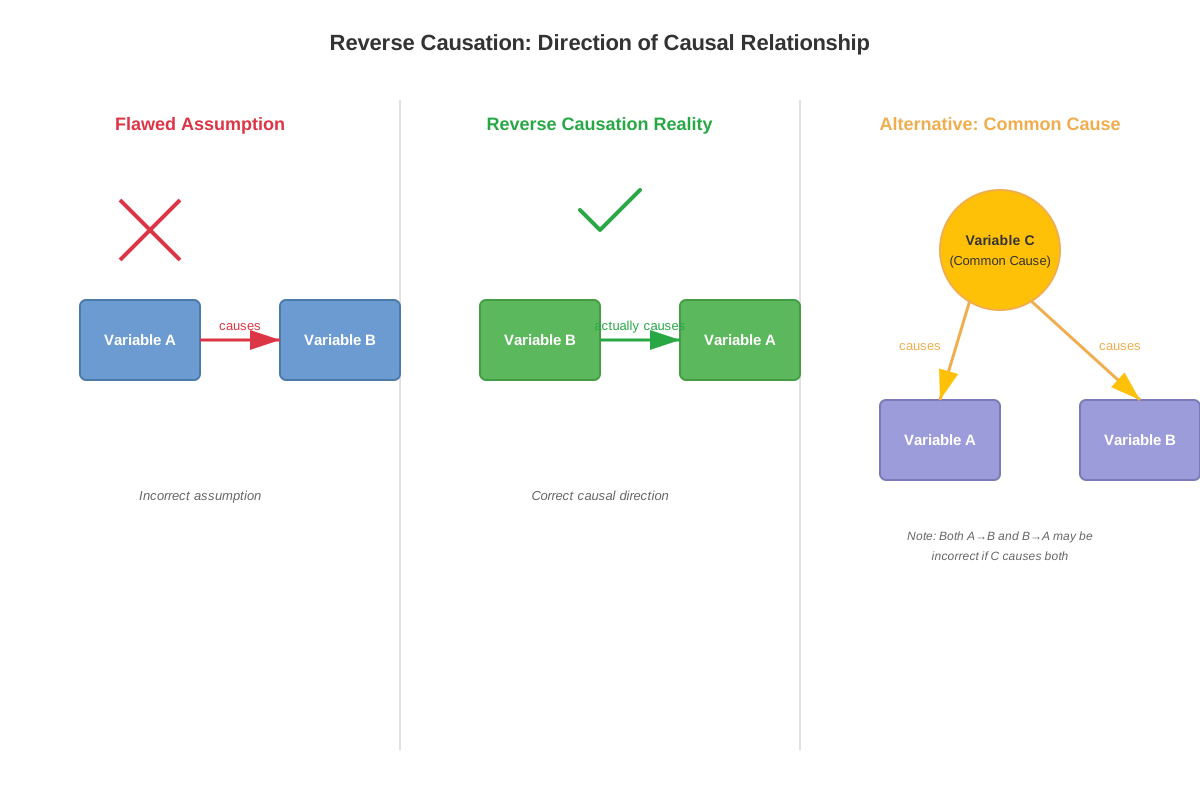
Reverse causation is one of the most frequently tested logical flaws on the LSAT Logical Reasoning section, appearing in approximately 10-15% of flaw questions. This reasoning error occurs when an argument mistakes the direction of a causal relationship—assuming that A causes B when, in reality, B causes A, or when both variables are caused by a third factor. Understanding reverse causation is essential not only for identifying flawed reasoning but also for strengthening arguments, evaluating assumptions, and resolving paradoxes across multiple question types.
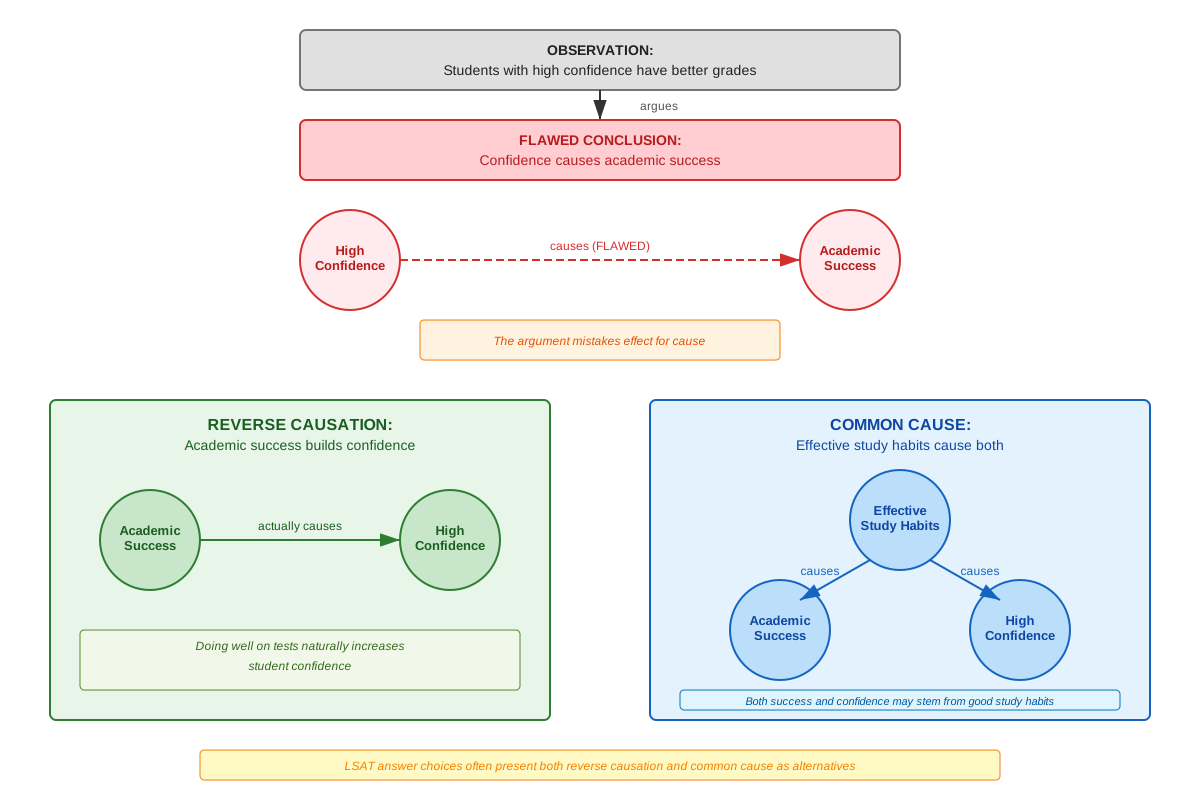
The concept sits at the heart of causal reasoning, which permeates the LSAT. Test-makers frequently construct arguments that observe a correlation between two phenomena and then leap to a causal conclusion without adequately establishing the direction of causation. For instance, an argument might note that successful students tend to have high confidence levels and conclude that confidence causes academic success—when it may actually be that academic success builds confidence, or that both stem from effective study habits. Recognizing this flaw requires careful attention to the logical structure of arguments and the ability to distinguish between correlation and properly established causation.
Within the broader landscape of Logical Reasoning, reverse causation connects intimately with other causal reasoning errors, including confusing correlation with causation, overlooking alternative causes, and failing to consider common cause scenarios. Mastering lsat reverse causation strengthens overall analytical skills and provides a framework for evaluating the validity of causal claims—a skill that extends beyond the exam into legal reasoning, policy analysis, and everyday critical thinking.
Learning Objectives
- [ ] Identify how reverse causation appears in LSAT questions
- [ ] Explain the reasoning pattern behind reverse causation
- [ ] Apply reverse causation to solve LSAT-style problems accurately
- [ ] Distinguish reverse causation from other causal reasoning flaws
- [ ] Construct counterexamples that expose reverse causation errors
- [ ] Predict answer choice patterns in flaw questions involving reverse causation
- [ ] Recognize trigger language that signals potential reverse causation scenarios
Prerequisites
- Basic understanding of causal relationships: Necessary to distinguish between causes and effects in argument structures
- Familiarity with correlation versus causation: Essential foundation for understanding why observing two phenomena together doesn't establish which causes which
- Knowledge of argument structure: Required to identify premises, conclusions, and logical gaps in LSAT arguments
- Experience with flaw question formats: Helps recognize how reverse causation appears among answer choices and question stems
Why This Topic Matters
Reverse causation represents a fundamental error in human reasoning that appears constantly in real-world contexts. Policy debates, medical research, business decisions, and legal arguments all hinge on correctly identifying causal relationships. When legislators observe that communities with more police officers have higher crime rates and conclude that police presence causes crime (rather than crime rates prompting increased police deployment), they commit the reverse causation fallacy. Legal professionals must regularly evaluate whether evidence demonstrates that a defendant's action caused harm or whether other factors better explain observed outcomes.
On the LSAT specifically, reverse causation appears in multiple question types beyond standard flaw questions. It surfaces in Strengthen/Weaken questions (where answer choices might address the direction of causation), Assumption questions (where the argument depends on the causal direction being correct), and Method of Reasoning questions (where describing the flaw requires understanding the reversal). Statistical analysis suggests that reverse causation appears in 3-5 questions per LSAT administration, making it a high-yield topic that directly impacts scores.
The LSAT tests reverse causation through several common patterns: arguments about behaviors and outcomes (does exercise cause health or health enable exercise?), temporal sequences (does A preceding B mean A caused B?), and correlational studies (when two variables move together, which influences which?). Test-makers deliberately craft arguments where both causal directions seem plausible, requiring careful analysis to identify the logical flaw.
Core Concepts
The Basic Structure of Reverse Causation
Reverse causation occurs when an argument observes a relationship between two variables and incorrectly identifies which variable causes the other. The fundamental pattern involves:
- Observation: Variables A and B are correlated (they occur together)
- Causal claim: The argument asserts that A causes B
- Flaw: The evidence equally supports (or better supports) that B causes A
The error lies not in recognizing a relationship but in establishing its direction without adequate justification. Consider this structure:
Premise: People who drink coffee regularly tend to feel tired in the morning.
Conclusion: Therefore, drinking coffee causes morning tiredness.
Flaw: The reverse is more plausible—people who naturally feel tired in the morning drink coffee to combat that tiredness.
Distinguishing Features of Reverse Causation
What separates reverse causation from other causal reasoning errors is the bidirectional plausibility. Unlike arguments that simply confuse correlation with causation (where no causal relationship may exist), reverse causation scenarios involve genuine causal relationships—just in the opposite direction from what the argument claims.
| Feature | Reverse Causation | Simple Correlation/Causation Error | Common Cause Error |
|---|---|---|---|
| Relationship exists | Yes, causal | Maybe none | Yes, but indirect |
| Direction matters | Critical—reversed | Not applicable | Both affected by third factor |
| Plausibility | Both directions seem reasonable | Causation may not exist at all | Neither causes the other |
| LSAT frequency | High | Very high | High |
Temporal Sequence and Causation
A particularly tricky variant of reverse causation involves temporal relationships. Arguments sometimes assume that because A precedes B chronologically, A must cause B. However, reverse causation can still occur when:
- B's eventual occurrence influences A earlier (anticipatory behavior)
- Both A and B are part of a cyclical process
- The observation of A actually occurs after B has already begun influencing behavior
Example: "Students who attend review sessions the week before exams perform better on those exams. Therefore, attending review sessions causes improved exam performance." The flaw? Students who are already better prepared (and thus likely to perform well) are more motivated to attend review sessions. Their preparation level causes both review session attendance and good performance.
The Mechanism of Misidentification
Understanding why reverse causation errors occur helps identify them on the LSAT. The human mind naturally seeks causal explanations for observed patterns, and several cognitive shortcuts lead to directional errors:
- Salience bias: The more noticeable or recent phenomenon is assumed to be the cause
- Narrative preference: We prefer stories where actions lead to outcomes rather than outcomes prompting actions
- Temporal proximity: Events closer in time seem more causally connected
- Confirmation bias: Once we hypothesize a causal direction, we notice supporting evidence more readily
Identifying Reverse Causation in LSAT Arguments
LSAT arguments containing reverse causation typically follow these patterns:
Pattern 1: Behavioral Correlation
- Observation: People with characteristic X tend to engage in behavior Y
- Claim: Characteristic X causes behavior Y
- Likely flaw: Behavior Y actually produces characteristic X
Pattern 2: Success Indicators
- Observation: Successful people/organizations exhibit trait A
- Claim: Trait A causes success
- Likely flaw: Success enables or produces trait A
Pattern 3: Problem-Solution Confusion
- Observation: Presence of intervention Z correlates with problem W
- Claim: Intervention Z causes or worsens problem W
- Likely flaw: Problem W prompts intervention Z
Pattern 4: Cyclical Relationships
- Observation: A and B rise and fall together
- Claim: A drives changes in B
- Likely flaw: B drives changes in A, or they mutually influence each other
The Role of Evidence Strength
Not all reverse causation flaws are equally obvious. The strength of evidence provided affects how clearly the flaw appears:
- Weak evidence: Mere correlation with no mechanism → both directions equally unsupported
- Moderate evidence: Temporal sequence or plausible mechanism → one direction may seem more likely
- Strong evidence: Controlled studies or clear mechanisms → reverse causation less likely but still possible
LSAT arguments typically provide weak to moderate evidence, making the reverse causation flaw more pronounced and testable.
Concept Relationships
Reverse causation exists within a network of related logical reasoning concepts. At its foundation, it builds upon the correlation versus causation distinction—the recognition that two phenomena occurring together doesn't establish that one causes the other. Reverse causation represents a more sophisticated error: accepting that causation exists but misidentifying its direction.
The concept connects directly to alternative explanations in causal reasoning. When evaluating whether A causes B, three primary alternatives exist: (1) B causes A (reverse causation), (2) C causes both A and B (common cause), or (3) the correlation is coincidental (no causation). These alternatives form a decision tree for evaluating causal claims.
Relationship map:
Correlation observation → Causal claim → Direction assessment → [Reverse causation OR Common cause OR Correct causation OR No causation]
Reverse causation also relates to necessary versus sufficient conditions. Arguments sometimes confuse a necessary condition (B must be present for A) with a sufficient condition (A guarantees B), leading to directional confusion. If B is necessary for A, then A's presence indicates B exists—but this doesn't mean B causes A.
Within flaw questions specifically, reverse causation connects to overlooking alternative explanations and unwarranted assumptions. The argument assumes the causal direction without justification, overlooking the alternative that causation runs in reverse. This assumption often appears in Assumption question types as well.
High-Yield Facts
⭐ Reverse causation occurs when an argument mistakes the direction of a causal relationship, claiming A causes B when B actually causes A or when the direction is uncertain.
⭐ Temporal sequence alone never proves causal direction—just because A precedes B doesn't mean A causes B.
⭐ LSAT reverse causation flaws typically involve correlations where both causal directions seem initially plausible.
⭐ Answer choices describing reverse causation often use phrases like "reverses cause and effect," "takes the effect to be the cause," or "mistakes a consequence for a cause."
⭐ The most common LSAT pattern involves behavioral traits and outcomes where success/outcomes actually produce the observed traits rather than vice versa.
- Reverse causation differs from common cause errors—reverse causation involves actual causation in the opposite direction, while common cause involves a third factor causing both observed phenomena.
- Arguments vulnerable to reverse causation criticism typically provide only correlational evidence without mechanistic explanation.
- Cyclical relationships (where A and B mutually influence each other) represent a special case where both causal directions may be partially correct.
- Reverse causation can appear in Strengthen questions where correct answers provide evidence for the claimed causal direction.
- In Weaken questions, pointing out the possibility of reverse causation undermines arguments that assume a particular causal direction.
- Necessary/sufficient condition confusion often accompanies reverse causation errors in complex arguments.
- The phrase "correlation does not imply causation" is related but distinct—reverse causation accepts causation exists but questions its direction.
Quick check — test yourself on Reverse causation so far.
Try Flashcards →Common Misconceptions
Misconception: Reverse causation only occurs when the causation definitely runs in the opposite direction.
Correction: On the LSAT, reverse causation is a flaw even when the evidence merely fails to establish the claimed direction—the argument doesn't need to prove the reverse direction, just fail to rule it out as equally or more plausible.
Misconception: If A happens before B chronologically, reverse causation cannot apply.
Correction: Temporal precedence doesn't eliminate reverse causation because anticipatory behavior, cyclical processes, and measurement timing can create situations where the later phenomenon actually influences the earlier one. For example, students' existing knowledge level (which will cause good exam performance) influences their decision to attend review sessions beforehand.
Misconception: Reverse causation and common cause are the same flaw.
Correction: These are distinct errors. Reverse causation involves A and B where one causes the other (but the argument gets the direction wrong). Common cause involves C causing both A and B, with neither A nor B causing the other. The correct answer choice language differs significantly between these flaws.
Misconception: Every correlation-to-causation argument involves reverse causation.
Correction: Some arguments jump from correlation to causation without any causal relationship existing at all, or with a third factor causing both. Reverse causation specifically requires that a genuine causal relationship exists but runs opposite to the claimed direction.
Misconception: Pointing out reverse causation means proving the opposite causal direction is correct.
Correction: Identifying the flaw only requires showing that the argument hasn't adequately ruled out the reverse direction as a possibility. The evidence might be insufficient to establish causation in either direction, but the argument's flaw is assuming one direction without justification.
Misconception: If an argument provides a mechanism for how A causes B, reverse causation cannot be a flaw.
Correction: Even with a plausible mechanism, if an equally or more plausible mechanism exists for B causing A, the argument commits the reverse causation error. The flaw lies in not considering or ruling out the alternative direction.
Worked Examples
Example 1: The Confidence-Success Scenario
Argument:
"A recent study found that students who express high confidence in their academic abilities tend to achieve higher grades than students who express lower confidence. This demonstrates that building student confidence is an effective strategy for improving academic performance. Therefore, schools should implement programs designed to boost student confidence."
Analysis:
Step 1: Identify the conclusion
The conclusion is that schools should implement confidence-boosting programs because confidence causes improved academic performance.
Step 2: Identify the evidence
The evidence is a correlation: high confidence and high grades occur together.
Step 3: Identify the causal claim
The argument claims confidence → academic performance (confidence causes better grades).
Step 4: Evaluate the causal direction
Is the reverse direction plausible? Could academic performance → confidence? Yes—students who understand material well and perform successfully on assignments naturally develop confidence in their abilities. Their actual competence and resulting good performance cause their confidence, not the other way around.
Step 5: Assess the flaw
The argument observes a correlation and assumes a causal direction without ruling out the reverse. The evidence equally supports (or better supports) that academic success builds confidence rather than confidence causing success.
Correct answer choice language: "The argument takes a consequence of academic success to be a cause of that success" or "The argument reverses the causal relationship between confidence and academic performance."
Connection to learning objectives: This example demonstrates how reverse causation appears in LSAT questions (behavioral trait + outcome pattern) and shows the reasoning pattern (correlation → unjustified causal direction).
Example 2: The Exercise-Health Relationship
Argument:
"Health researchers have noted that people who exercise regularly have lower rates of depression than people who do not exercise regularly. Additionally, people who begin exercise programs often report improved mood within weeks. These findings indicate that exercise causes improvements in mental health. Consequently, doctors should prescribe exercise as a treatment for depression."
Analysis:
Step 1: Identify the conclusion
Exercise causes mental health improvements and should be prescribed for depression.
Step 2: Identify the evidence
- Correlation: regular exercisers have lower depression rates
- Temporal observation: people starting exercise programs report mood improvements
Step 3: Identify the causal claim
Exercise → improved mental health (exercise causes better mental health)
Step 4: Evaluate the causal direction
Is reverse causation plausible? Could mental health status → exercise behavior? Yes—people experiencing depression often lack the motivation and energy to exercise. Those with better mental health are more capable of initiating and maintaining exercise routines. The correlation might exist because mental health enables exercise, not because exercise causes mental health improvements.
Step 5: Consider the temporal evidence
The argument provides stronger evidence than simple correlation by noting mood improvements after starting exercise. However, this doesn't eliminate reverse causation because: (1) people who successfully start and maintain exercise programs may already be experiencing mental health improvements that enabled them to begin exercising, and (2) the selection bias means we're only observing people whose mental health was sufficient to start and continue the program.
Step 6: Assess the flaw
Despite the temporal component, the argument hasn't adequately established causal direction. The reverse remains plausible: better mental health → ability to exercise regularly.
Correct answer choice language: "The argument fails to consider that the mental health status of individuals might affect their likelihood of exercising regularly" or "The argument overlooks the possibility that the correlation between exercise and mental health is explained by mental health affecting exercise behavior rather than the reverse."
Connection to learning objectives: This example shows a more sophisticated reverse causation scenario with temporal evidence, demonstrating why temporal sequence alone doesn't eliminate the flaw and how to apply reverse causation analysis to complex arguments.
Exam Strategy
Recognition Triggers
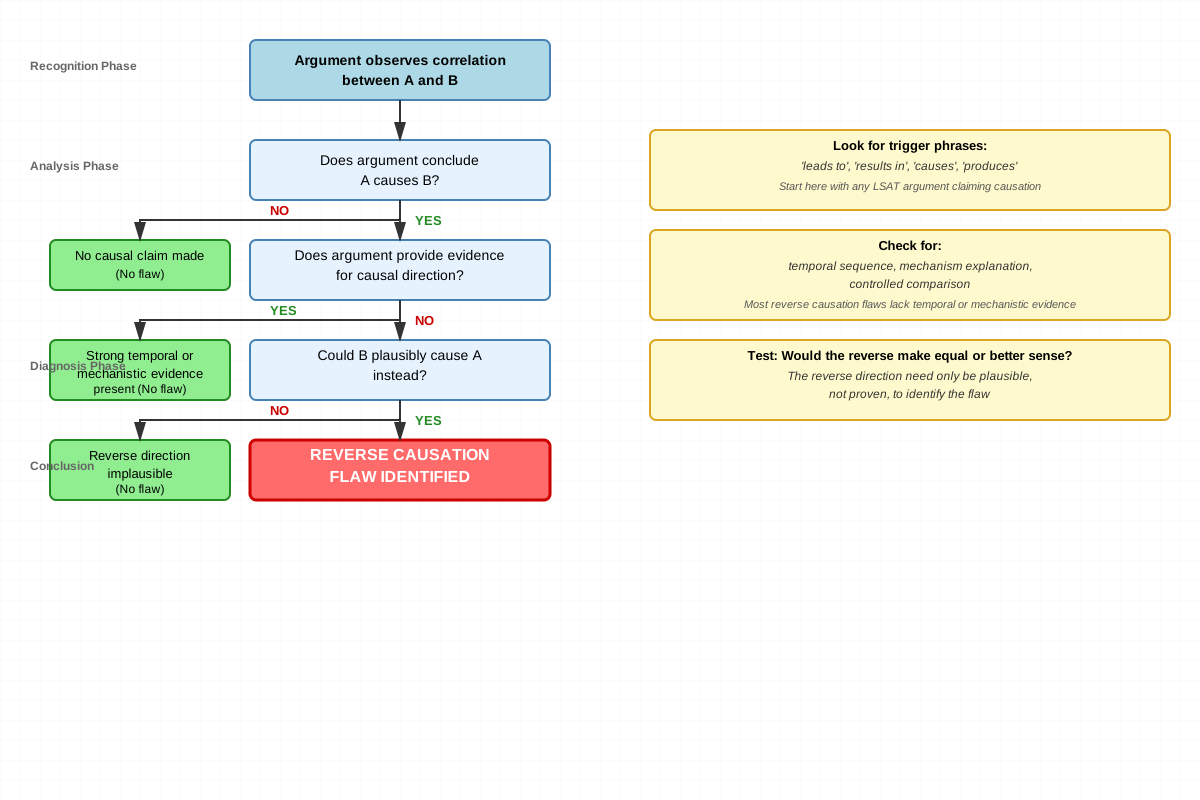
Watch for these linguistic patterns that signal potential reverse causation flaws:
- "This shows that..." or "This demonstrates that..." followed by a causal claim based on correlational evidence
- "Therefore, to achieve B, we should increase A" (policy recommendations based on correlations)
- "People who have X tend to do Y" followed by claims about X causing Y
- "Successful [entities] exhibit trait Z" followed by claims that Z causes success
- Phrases like "leads to," "results in," "causes," "produces," or "brings about" when the evidence only shows correlation
Systematic Approach
When encountering a potential reverse causation question, follow this process:
- Identify the correlation (2-3 seconds): What two things occur together?
- Identify the claimed direction (2-3 seconds): Which does the argument say causes which?
- Test the reverse (5-10 seconds): Is the opposite direction equally or more plausible?
- Check for ruling-out language (3-5 seconds): Does the argument address the alternative direction?
- Predict answer choice language (3-5 seconds): Formulate how the correct answer will describe the flaw
Exam Tip: If you can create a plausible story for causation running in the opposite direction, reverse causation is likely the flaw—even if the argument's direction also seems plausible.
Answer Choice Elimination
Eliminate choices that:
- Describe common cause errors when the question involves reverse causation
- Claim the argument confuses correlation with causation without specifying the directional error
- Focus on sample size, representativeness, or other statistical issues when the core flaw is directional
- Describe circular reasoning or other structural flaws unrelated to causal direction
Select choices that:
- Explicitly mention reversing cause and effect
- State the argument "takes the effect to be the cause" or similar language
- Describe the argument as "failing to consider that [B might cause A]"
- Use phrases like "mistakes a consequence for a cause"
Time Management
Allocate approximately:
- 15-20 seconds: Reading and understanding the argument
- 10-15 seconds: Identifying the flaw (testing reverse causation)
- 20-30 seconds: Evaluating answer choices
- Total: 45-65 seconds for a reverse causation flaw question
Reverse causation questions typically fall in the medium difficulty range, so don't spend excessive time if you've identified the flaw clearly. Trust your analysis and move forward.
Common Trap Answers
Test-makers frequently include these trap answers in reverse causation questions:
- "The argument confuses correlation with causation": Too vague—doesn't specify the directional error
- "The argument fails to consider alternative causes": Describes common cause, not reverse causation
- "The argument's conclusion goes beyond what the evidence supports": Too general—doesn't identify the specific flaw
- "The argument relies on a small or unrepresentative sample": Addresses evidence quality, not causal direction
Memory Techniques
The Arrow Flip Mnemonic
Remember "FLIP" for reverse causation:
- Flaw in direction
- Logic assumes A→B
- Ignores B→A possibility
- Plausibility of reverse
Visualization Strategy
When reading an argument, physically draw arrows between correlated variables:
- Draw A ← ? → B (showing correlation)
- Note which direction the argument claims: A → B
- Ask: "Could it be B → A instead?"
- If yes, you've found reverse causation
The "Success Story" Pattern
Many reverse causation questions follow the "Success Story" pattern:
- Successful people/entities have trait X
- Therefore, trait X causes success
- Overlooks that success enables/produces trait X
- Reverse is more plausible
- You should pick the answer about reversed causation
The Question Stem Acronym: TRACE
When you see potential reverse causation, TRACE the logic:
- Two variables correlated
- Relationship claimed (which causes which)
- Alternative direction plausible?
- Consider if argument rules out reverse
- Evaluate answer choices for directional language
Summary
Reverse causation represents a critical logical flaw where arguments observe correlations between two variables and incorrectly identify which variable causes the other. Unlike simple correlation-causation errors, reverse causation involves genuine causal relationships but in the opposite direction from what the argument claims. The LSAT tests this concept extensively in flaw questions and related question types, making it essential for achieving high scores. Successful identification requires recognizing that temporal sequence alone doesn't establish causation, that both causal directions must be evaluated for plausibility, and that arguments often fail to rule out the reverse direction despite assuming one direction is correct. The most common patterns involve behavioral traits and outcomes, success indicators, and problem-solution relationships where the claimed cause is actually the effect. Mastering reverse causation requires systematic analysis: identify the correlation, determine the claimed causal direction, test whether the reverse is equally or more plausible, and select answer choices that explicitly describe the directional error rather than more general causal reasoning flaws.
Key Takeaways
- Reverse causation occurs when arguments mistake which variable causes which, claiming A causes B when B actually causes A or when the direction remains uncertain
- Temporal precedence (A before B) never proves causal direction—anticipatory behavior and cyclical processes allow later phenomena to influence earlier ones
- The most testable pattern involves success/outcomes producing observed traits rather than traits causing success
- Correct answer choices use specific language about "reversing cause and effect" or "taking the effect to be the cause" rather than general correlation-causation language
- Testing the reverse direction for plausibility is the key analytical step—if B causing A seems equally reasonable, the argument commits the flaw
- Reverse causation differs from common cause errors (third factor causing both) and requires different answer choice language
- Systematic analysis following the TRACE method (Two variables, Relationship claimed, Alternative direction, Consider ruling-out, Evaluate answers) ensures accurate identification
Related Topics
Common Cause Fallacy: Understanding how third variables can cause both observed phenomena helps distinguish this flaw from reverse causation. Mastering reverse causation provides the foundation for recognizing when neither observed variable causes the other.
Necessary vs. Sufficient Conditions: Causal relationships often involve necessary or sufficient conditions, and confusion between these can compound reverse causation errors. This topic builds on causal reasoning skills developed through reverse causation.
Correlation and Causation: The broader category of causal reasoning errors encompasses reverse causation as a specific type. Mastering reverse causation deepens understanding of the general correlation-causation distinction.
Strengthen and Weaken Questions: Reverse causation appears frequently in these question types where answer choices either support the claimed causal direction or suggest the reverse. Skills developed here transfer directly to these question types.
Assumption Questions: Arguments with reverse causation flaws depend on assumptions about causal direction. Understanding reverse causation enables identification of these underlying assumptions.
Practice CTA
Now that you understand the mechanics and patterns of reverse causation, you're ready to apply these concepts to actual LSAT questions. The practice questions and flashcards will reinforce your ability to quickly identify reverse causation flaws, distinguish them from related errors, and select correct answer choices with confidence. Each practice question you complete strengthens your pattern recognition and builds the automaticity needed for test-day success. Remember: reverse causation appears in 3-5 questions per test, making your investment in mastering this topic directly translatable to points on your score. Approach the practice materials systematically, and you'll develop the expertise to handle any reverse causation question the LSAT presents.
Sign up free to keep reading
Create a free AnvayaPrep account to finish this LSAT guide on Reverse causation — plus flashcards and practice questions.