Overview
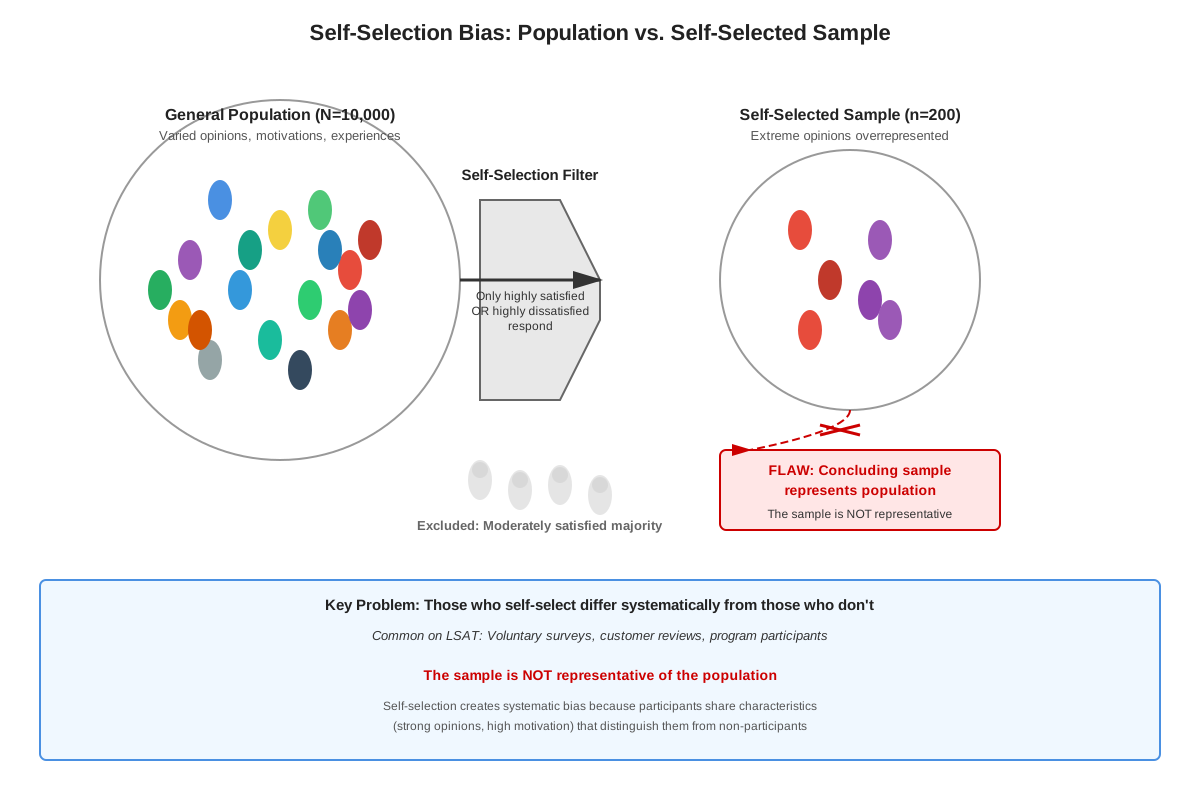
Self-selection bias is a critical reasoning flaw that appears frequently on the LSAT, particularly in flaw questions within the Logical Reasoning section. This bias occurs when the sample or group being studied is not representative of the broader population because individuals have chosen themselves to participate, rather than being randomly selected. The resulting data becomes skewed because those who self-select often share characteristics that distinguish them from the general population in ways that directly affect the study's conclusions.
Understanding LSAT self-selection bias is essential for success on the exam because it represents one of the most commonly tested reasoning errors in arguments. Test-makers frequently construct arguments that draw broad conclusions from self-selected samples—such as voluntary surveys, customer reviews, or people who choose to participate in programs—without acknowledging that these participants may differ systematically from those who did not participate. Recognizing this flaw allows test-takers to quickly identify vulnerable reasoning and select correct answer choices that point out this methodological weakness.
Within the broader landscape of Logical Reasoning concepts, self-selection bias falls under the category of sampling and generalization errors. It connects closely to other statistical reasoning flaws, such as unrepresentative samples, hasty generalizations, and correlation-causation errors. Mastering self-selection bias strengthens overall analytical skills and provides a framework for evaluating the validity of evidence-based arguments—a skill tested across multiple question types including Flaw, Weaken, Strengthen, and Assumption questions.
Learning Objectives
- [ ] Identify how Self-selection bias appears in LSAT questions
- [ ] Explain the reasoning pattern behind Self-selection bias
- [ ] Apply Self-selection bias to solve LSAT-style problems accurately
- [ ] Distinguish self-selection bias from other sampling errors and reasoning flaws
- [ ] Predict when an argument's conclusion will be vulnerable to self-selection bias criticism
- [ ] Construct answer choices that correctly identify self-selection bias in flawed arguments
- [ ] Evaluate whether a given sample is likely to be representative based on selection methodology
Prerequisites
- Basic understanding of arguments: Ability to identify premises and conclusions is essential because self-selection bias involves evaluating whether premises provide adequate support for conclusions.
- Familiarity with generalization: Understanding how specific examples relate to broader claims helps recognize when a self-selected sample is being inappropriately generalized.
- Knowledge of evidence evaluation: Recognizing what constitutes strong versus weak evidence enables identification of when self-selection undermines an argument's evidential foundation.
- Introduction to flaw question types: Understanding the basic structure and task of flaw questions provides the framework for recognizing self-selection bias as a specific type of reasoning error.
Why This Topic Matters
Self-selection bias appears in real-world contexts constantly, making it both practically valuable and frequently tested. Voluntary online reviews, political polls of motivated respondents, testimonials from satisfied customers, and studies using volunteer participants all potentially suffer from this bias. Professionals in law, business, medicine, and public policy must regularly evaluate whether conclusions drawn from self-selected samples are reliable—making this a fundamental critical thinking skill.
On the LSAT, self-selection bias appears in approximately 10-15% of Logical Reasoning questions across various question types. It most commonly appears in Flaw questions (where test-takers must identify the reasoning error), but also surfaces in Weaken questions (where the correct answer points out the self-selection problem), Strengthen questions (where the correct answer addresses the self-selection concern), and Assumption questions (where the argument depends on the sample being representative). The LSAT particularly favors scenarios involving surveys, customer feedback, program evaluations, and voluntary participation studies.
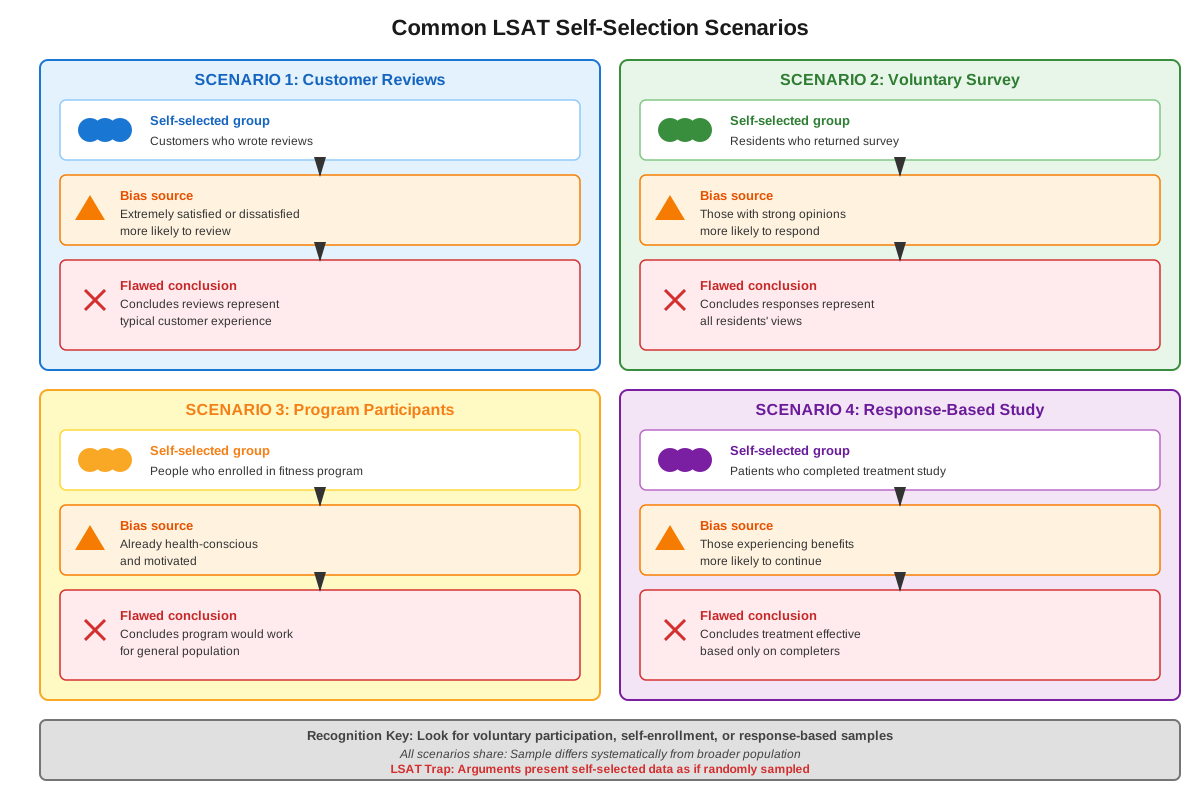
Common manifestations include: arguments concluding that a product is excellent based on customer reviews (ignoring that dissatisfied customers may not leave reviews); claims about program effectiveness based on testimonials from participants who completed the program (ignoring that those who dropped out may have had different experiences); and generalizations about public opinion based on voluntary surveys (ignoring that those with strong opinions are more likely to respond). Recognizing these patterns enables rapid identification of the flaw and efficient elimination of incorrect answer choices.
Core Concepts
Definition and Mechanism
Self-selection bias occurs when individuals choose whether to participate in a study, survey, or program, and this choice correlates with characteristics relevant to the study's conclusions. The fundamental problem is that people who self-select into a sample often differ systematically from those who do not, making the sample unrepresentative of the broader population about which conclusions are drawn.
The mechanism operates through correlation between the decision to participate and the attribute being measured. For example, if a restaurant asks diners to complete voluntary feedback cards, those with extremely positive or negative experiences are more likely to respond than those with neutral experiences. This creates a bimodal distribution in the sample that does not reflect the true distribution of customer satisfaction. The restaurant owner who concludes "most customers either love or hate our food" based on these cards commits the self-selection bias error.
The Reasoning Pattern
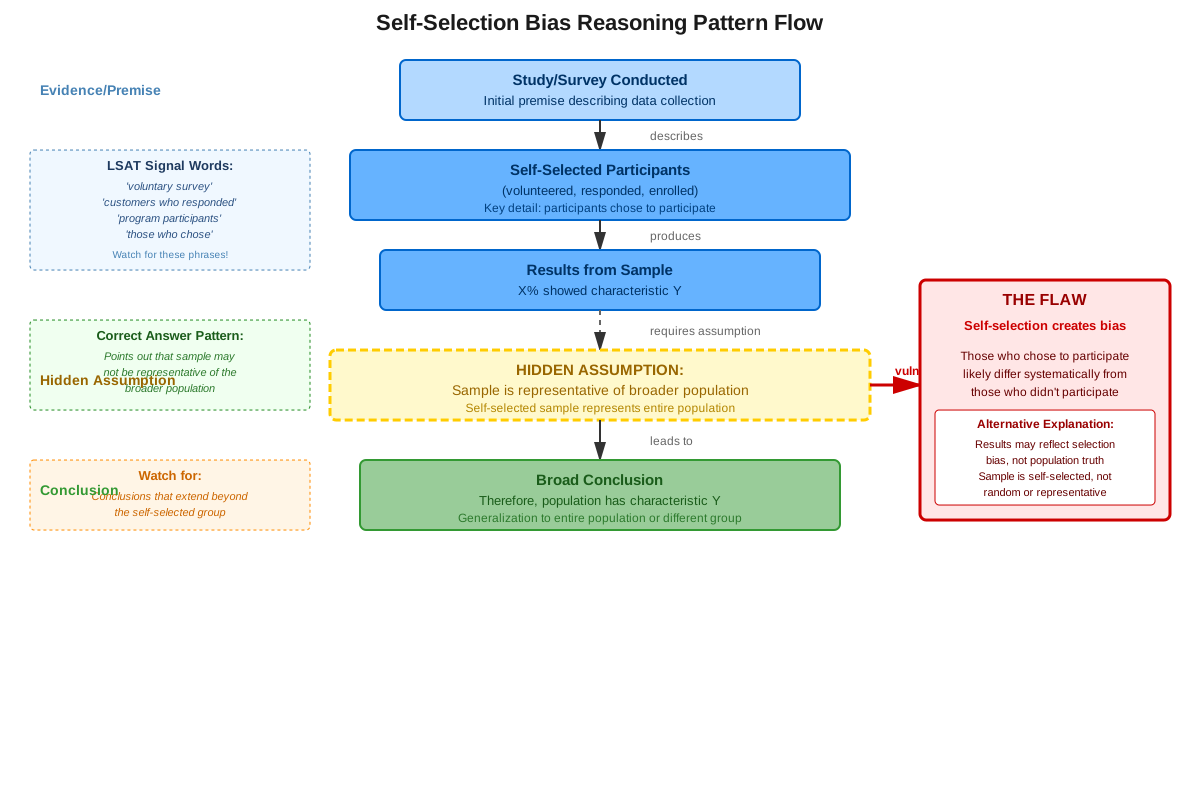
Arguments containing self-selection bias follow a predictable structure:
- Evidence: Data or testimony from a self-selected group (volunteers, respondents, participants who completed a program)
- Conclusion: A generalization about a broader population or an evaluation of effectiveness/quality
- Hidden assumption: The self-selected sample is representative of the broader group
- Flaw: The assumption is unwarranted because the act of self-selection may correlate with the measured outcome
The critical insight is that the very act of choosing to participate can be the factor that makes participants unrepresentative. Someone who voluntarily enrolls in a challenging fitness program may already be more motivated than the average person; someone who completes a lengthy survey about a product may care more intensely about that product than non-respondents.
Types of Self-Selection Scenarios
| Scenario Type | Example | Why Bias Occurs |
|---|---|---|
| Voluntary surveys | Online poll about political issue | Those with strong opinions more likely to respond |
| Customer reviews | Product ratings on website | Extremely satisfied/dissatisfied more likely to review |
| Program completers | Testimonials from graduates | Those who struggled may have dropped out |
| Opt-in studies | Volunteers for medical research | Volunteers may be healthier or more health-conscious |
| Complaint-based data | Customer service feedback | Only those with problems contact support |
Distinguishing Representative from Unrepresentative Samples
A representative sample accurately reflects the characteristics of the population being studied. Random selection is the gold standard for achieving representativeness because it eliminates systematic bias in who gets included. In contrast, self-selection introduces systematic bias because the decision to participate is not random—it correlates with personal characteristics, opinions, or experiences.
Key indicators that a sample may suffer from self-selection bias:
- Use of volunteers rather than random selection
- Reliance on those who respond to optional surveys
- Data from only those who completed a program (survivorship bias variant)
- Feedback from customers who chose to provide it
- Participants who sought out the opportunity rather than being recruited randomly
The Generalization Problem
The core logical error in self-selection bias is an unwarranted generalization. The argument moves from "X is true of this self-selected group" to "X is true of the broader population" without justification for treating the sample as representative. This violates a fundamental principle of inductive reasoning: the strength of a generalization depends on the sample's representativeness.
For LSAT purposes, recognizing this pattern means identifying when an argument:
- Draws a conclusion about "most people," "the general public," or "typical customers" based on self-selected respondents
- Evaluates a program's effectiveness using only data from those who completed it
- Makes claims about product quality based on voluntary reviews or testimonials
- Generalizes from volunteers to the broader population
Why Self-Selection Creates Bias
The bias emerges because the factors that influence someone's decision to participate often correlate with the outcome being measured. Consider these examples:
- A gym advertising "95% of our members achieve their fitness goals" based on member surveys—but people who fail to achieve goals are more likely to quit the gym and thus not be surveyed
- A university claiming "our alumni are highly successful" based on responses to alumni surveys—but successful alumni are more likely to respond and share their achievements
- A political candidate claiming "most voters support my position" based on rally attendance—but those who attend rallies are already supporters
In each case, the selection mechanism (remaining a member, responding to surveys, attending rallies) correlates with the measured outcome (achieving goals, being successful, supporting the candidate), making the sample unrepresentative.
Concept Relationships
Self-selection bias connects to several related logical reasoning concepts through a web of relationships:
Self-selection bias → Unrepresentative sample: Self-selection is a specific mechanism that produces unrepresentative samples. All self-selection bias involves unrepresentative samples, but not all unrepresentative samples result from self-selection (some result from other sampling errors).
Unrepresentative sample → Hasty generalization: When an argument generalizes from an unrepresentative sample, it commits a hasty generalization. Self-selection bias is thus a specific type of hasty generalization where the representativeness problem stems from self-selection.
Self-selection bias ↔ Survivorship bias: These concepts overlap significantly. Survivorship bias occurs when analysis focuses only on entities that "survived" some selection process, ignoring those that didn't. This is a form of self-selection where the "selection" is surviving/persisting rather than volunteering.
Self-selection bias → Correlation-causation confusion: Arguments with self-selection bias sometimes also confuse correlation with causation. For example, concluding that a program causes success based on successful completers ignores that motivated people both complete programs AND achieve success independently.
Random sampling → Eliminates self-selection bias: Random selection is the methodological solution to self-selection bias. When the LSAT presents an argument that uses random sampling, self-selection bias is not applicable.
The relationship map: Voluntary participation → Self-selected sample → Unrepresentative sample → Unwarranted generalization → Flawed conclusion
Quick check — test yourself on Self-selection bias so far.
Try Flashcards →High-Yield Facts
⭐ Self-selection bias occurs when participants choose themselves rather than being randomly selected, and this choice correlates with the measured outcome.
⭐ Arguments concluding about a general population based on voluntary survey respondents are vulnerable to self-selection bias.
⭐ Customer reviews and testimonials are classic examples of self-selected samples because only certain customers choose to provide feedback.
⭐ Program effectiveness cannot be reliably determined by surveying only those who completed the program, as dropouts may have had different experiences.
⭐ The key question to ask: "Might those who chose to participate differ systematically from those who didn't in ways relevant to the conclusion?"
- Self-selection bias is distinct from random sampling error; it involves systematic rather than random differences between sample and population.
- Correct answer choices identifying self-selection bias often use phrases like "overlooks the possibility that," "fails to consider that," or "ignores that" followed by a description of how participants might differ from non-participants.
- The bias can operate in either direction: self-selected samples can be either more positive or more negative than the general population, depending on who chooses to participate.
- Large sample size does not eliminate self-selection bias; even millions of voluntary responses can be unrepresentative if the selection mechanism is biased.
- Arguments that acknowledge the self-selection problem (e.g., "among those who responded") and limit their conclusions accordingly do not commit this flaw.
Common Misconceptions
Misconception: Self-selection bias only occurs with small samples.
Correction: Sample size is irrelevant to self-selection bias. Even very large self-selected samples can be unrepresentative. A million voluntary online survey responses can be more biased than a hundred randomly selected responses.
Misconception: If the argument mentions that "many people" participated, the sample must be representative.
Correction: The number of participants doesn't determine representativeness; the selection method does. "Many people" who self-selected can still be systematically different from those who didn't participate.
Misconception: Self-selection bias and survivorship bias are completely different concepts.
Correction: Survivorship bias is actually a specific type of self-selection bias where the "selection" involves persisting or surviving rather than initially volunteering. Both involve analyzing only a subset that differs systematically from the whole.
Misconception: If an argument acknowledges that the data comes from volunteers, it has addressed the self-selection problem.
Correction: Merely acknowledging that participants are volunteers doesn't fix the flaw if the argument still generalizes to non-volunteers. The argument must either limit its conclusion to volunteers or provide evidence that volunteers are representative.
Misconception: Self-selection bias only affects surveys and polls.
Correction: Self-selection bias appears in many contexts: program evaluations using only completers, product quality claims based on reviews, effectiveness studies using volunteers, and any situation where participation is optional and may correlate with the outcome.
Misconception: Random sampling is just one of many equally valid sampling methods.
Correction: For LSAT purposes, random sampling is the gold standard that eliminates self-selection bias. When an argument uses random sampling, self-selection bias criticisms don't apply. Other methods may introduce bias.
Worked Examples
Example 1: Restaurant Review Argument
Argument: "Bella's Restaurant must serve excellent food. Of the customers who posted reviews on the restaurant's website, 90% gave the food five stars."
Analysis:
Step 1: Identify the conclusion
The conclusion is that Bella's Restaurant serves excellent food.
Step 2: Identify the evidence
The evidence is that 90% of customers who posted reviews gave five stars.
Step 3: Identify the reasoning gap
The argument assumes that customers who posted reviews are representative of all customers. This is where self-selection bias enters.
Step 4: Explain the flaw
Customers who choose to post reviews on a restaurant's website are self-selected. They may differ systematically from customers who don't post reviews. Specifically, extremely satisfied customers might be more motivated to post positive reviews, while moderately satisfied customers might not bother. Additionally, the restaurant's own website might attract more positive reviews than neutral platforms. The 90% figure from this self-selected sample cannot reliably support a conclusion about the restaurant's food quality in general.
Step 5: Connect to learning objectives
This example demonstrates how self-selection bias appears in LSAT questions (Learning Objective 1) through a common scenario involving voluntary feedback. The reasoning pattern (Learning Objective 2) follows the structure: self-selected evidence → generalized conclusion about quality. To solve this problem (Learning Objective 3), recognize the trigger phrase "customers who posted reviews" and identify that these customers chose themselves, making them potentially unrepresentative.
Example 2: Fitness Program Argument
Argument: "The FitLife program is highly effective at helping people lose weight. A survey of people who completed the six-month program found that 85% lost at least 15 pounds."
Analysis:
Step 1: Identify the conclusion
The FitLife program is highly effective at helping people lose weight.
Step 2: Identify the evidence
85% of people who completed the program lost at least 15 pounds.
Step 3: Identify the reasoning gap
The argument only considers people who completed the program, not those who started it. This is a self-selection issue because completing the program was optional—people could drop out.
Step 4: Explain the flaw
This argument suffers from self-selection bias in the form of survivorship bias. The sample consists only of program completers, who self-selected by choosing to continue rather than drop out. People who weren't losing weight might have been more likely to quit the program, meaning they wouldn't be included in the survey. The 85% success rate among completers doesn't tell us about the program's effectiveness for all who started it. If 100 people started and only 20 completed (with 17 of those losing weight), the program would be far less effective than the argument suggests, even though 85% of completers succeeded.
Step 5: Connect to learning objectives
This example shows self-selection bias in program evaluation contexts (Learning Objective 1). The reasoning pattern (Learning Objective 2) involves drawing conclusions about program effectiveness from a self-selected subset of participants. The solution strategy (Learning Objective 3) requires recognizing "people who completed" as a red flag indicating potential self-selection bias, then identifying that dropouts might have had different outcomes.
Exam Strategy
Recognition Triggers
Watch for these phrases that signal potential self-selection bias:
- "Customers who left reviews"
- "Respondents to the survey"
- "Volunteers in the study"
- "People who completed the program"
- "Those who chose to participate"
- "Members who responded"
- "Alumni who replied"
Exam Tip: When you see any phrase indicating that participation was voluntary or that data comes only from a subset who took some action, immediately consider whether self-selection bias might be present.
Question Approach Process
- Identify if the sample is self-selected: Look for voluntary participation, optional surveys, or data from only those who persisted/completed something.
- Ask the critical question: "Could those who participated differ from those who didn't in ways relevant to the conclusion?"
- Check the scope of the conclusion: Is the argument generalizing beyond the self-selected sample? If the conclusion is limited to the sample itself, self-selection bias may not apply.
- Evaluate answer choices: Correct answers identifying self-selection bias typically point out that participants might differ from non-participants, that the sample might not be representative, or that those who didn't participate might have different characteristics.
Process of Elimination Tips
Eliminate answer choices that:
- Criticize the argument for having a small sample size (size isn't the issue with self-selection bias)
- Point out that the argument doesn't prove its conclusion with certainty (this is too vague and applies to most arguments)
- Identify irrelevant flaws that don't address the representativeness problem
- Suggest the argument needs more evidence without specifying why the current evidence is problematic
Keep answer choices that:
- Point out that participants might differ from non-participants
- Note that the sample might not be representative
- Identify that those who didn't respond/participate/complete might have different characteristics
- Suggest that the selection method could correlate with the measured outcome
Time Allocation
Self-selection bias questions should take approximately 1:00-1:30 minutes once you recognize the pattern. The recognition phase should be quick (10-15 seconds) once you spot trigger phrases. Spend most of your time carefully reading answer choices to find the one that precisely identifies the representativeness problem without introducing irrelevant issues.
Memory Techniques
Primary Mnemonic: VOLUNTEER
Voluntary participation signals bias
Only some choose to respond
Likely to differ from non-participants
Unrepresentative sample results
Not randomly selected
Those who participate may be special
Evidence doesn't support generalization
Representativeness cannot be assumed
Visualization Strategy
Picture a restaurant with 100 diners. Only 10 write reviews (the self-selected sample). Visualize that these 10 are either extremely happy (smiling, enthusiastic) or extremely unhappy (frowning, angry), while the other 90 are neutral (blank expressions). This image captures how self-selection creates unrepresentative samples—the reviewers don't look like the general dining population.
The "Who's Missing?" Question
Train yourself to automatically ask "Who's missing from this sample?" whenever you see voluntary participation. This simple question triggers analysis of self-selection bias. Who didn't respond to the survey? Who dropped out of the program? Who didn't leave a review? The missing people are often systematically different from those included.
Acronym for Answer Choice Evaluation: DIFFER
Do participants differ from non-participants?
Is the sample representative?
Factors influencing participation
Fails to consider who's excluded
Evidence from self-selected group
Representativeness assumed without justification
Summary
Self-selection bias is a critical reasoning flaw that occurs when arguments draw conclusions about a general population based on data from individuals who chose to participate, without justifying that these self-selected participants are representative. This bias emerges because the decision to participate often correlates with the very characteristics being measured—satisfied customers are more likely to leave reviews, motivated individuals are more likely to complete programs, and those with strong opinions are more likely to respond to surveys. On the LSAT, self-selection bias appears frequently in Logical Reasoning questions, particularly in Flaw questions, but also in Weaken, Strengthen, and Assumption questions. Recognizing this flaw requires identifying voluntary participation or self-selected samples, then evaluating whether the argument inappropriately generalizes from this potentially unrepresentative sample to a broader population. The key insight is that sample size doesn't matter—even large self-selected samples can be systematically biased. Mastering self-selection bias enables rapid identification of a common reasoning error and efficient elimination of incorrect answer choices.
Key Takeaways
- Self-selection bias occurs when voluntary participants differ systematically from non-participants in ways relevant to the conclusion
- Trigger phrases include "respondents," "volunteers," "those who completed," and "customers who reviewed"
- The critical question is always: "Could those who participated differ from those who didn't?"
- Sample size is irrelevant—even millions of self-selected responses can be unrepresentative
- Random sampling eliminates self-selection bias; voluntary participation introduces it
- Correct answer choices typically point out that participants might not be representative of the broader group
- Self-selection bias represents an unwarranted generalization from a potentially unrepresentative sample
Related Topics
Survivorship Bias: A specific form of self-selection bias where analysis focuses only on entities that survived some selection process. Mastering self-selection bias provides the foundation for understanding survivorship bias in contexts like business success studies or historical analyses.
Hasty Generalization: The broader category of reasoning errors involving insufficient evidence for a generalization. Self-selection bias is a specific mechanism that produces hasty generalizations, so understanding this topic deepens comprehension of generalization flaws overall.
Sampling Errors: Various ways that samples can fail to represent populations, including non-random sampling, biased sampling frames, and response bias. Self-selection bias is one type of sampling error, and mastering it facilitates understanding of sampling methodology more broadly.
Correlation vs. Causation: Arguments with self-selection bias sometimes also confuse correlation with causation, particularly in program evaluation contexts. Understanding self-selection bias helps identify when apparent causal relationships might be explained by selection effects.
Necessary vs. Sufficient Assumptions: Self-selection bias arguments depend on the assumption that the sample is representative. Analyzing these assumptions connects to broader work on identifying and evaluating argument assumptions.
Practice CTA
Now that you understand self-selection bias, it's time to cement your mastery through practice. Attempt the practice questions to test your ability to identify this flaw in various contexts and under time pressure. Use the flashcards to reinforce key concepts and trigger phrases. Remember: recognizing self-selection bias quickly and accurately can earn you valuable points on test day. Each practice question you complete strengthens your pattern recognition and builds the confidence you need to excel on the LSAT. You've learned the concept—now prove you can apply it!
Sign up free to keep reading
Create a free AnvayaPrep account to finish this LSAT guide on Self-selection bias — plus flashcards and practice questions.