Overview
The value judgment flaw is a critical reasoning error that appears frequently on the LSAT Logical Reasoning section. This flaw occurs when an argument improperly moves from purely factual or descriptive premises to a normative conclusion about what should be done, what is morally right or wrong, or what has value—without providing any principle or premise that bridges this logical gap. In philosophical terms, this represents a violation of the is-ought distinction: the argument attempts to derive an "ought" statement from purely "is" statements. Understanding this flaw is essential because it tests a fundamental principle of logical reasoning: conclusions must be supported by premises that are relevant to the type of claim being made.
On the LSAT, flaw questions constitute approximately 15-20% of all Logical Reasoning questions, making them one of the most important question types to master. Within this category, value judgment flaws appear regularly, often disguised within arguments about policy recommendations, ethical decisions, or evaluative claims. The LSAT tests whether students can recognize when an argument has failed to establish the normative foundation necessary for its prescriptive or evaluative conclusion. This skill extends beyond test-taking: it reflects the type of analytical thinking essential for legal reasoning, where distinguishing between factual claims and value-based conclusions is fundamental to constructing sound arguments.
The value judgment flaw connects to broader concepts in logical reasoning, particularly the relationship between premises and conclusions, the sufficiency of evidence, and the types of assumptions that arguments make. It shares characteristics with other common LAWS flaws, such as unwarranted assumptions and gaps in reasoning, but has a distinctive feature: the specific mismatch between descriptive evidence and normative conclusions. Mastering this flaw type enhances overall performance on the LSAT because it sharpens the ability to identify subtle logical gaps—a skill tested across multiple question types including Assumption, Strengthen/Weaken, and Necessary Assumption questions.
Learning Objectives
- [ ] Identify how Value judgment flaw appears in LSAT questions
- [ ] Explain the reasoning pattern behind Value judgment flaw
- [ ] Apply Value judgment flaw to solve LSAT-style problems accurately
- [ ] Distinguish value judgment flaws from other common reasoning errors
- [ ] Recognize the specific language patterns that signal value judgment flaws in arguments
- [ ] Predict correct answer choices for flaw questions involving value judgments
- [ ] Construct valid critiques of arguments containing value judgment flaws
Prerequisites
- Basic argument structure: Understanding premises, conclusions, and how they relate is essential because identifying the value judgment flaw requires recognizing when a conclusion makes a different type of claim than the premises support.
- Descriptive vs. normative statements: Familiarity with the difference between statements of fact (what is) and statements of value or prescription (what ought to be) provides the conceptual foundation for recognizing this flaw.
- Common LSAT flaw types: General knowledge of how flaws function in LSAT arguments helps contextualize the value judgment flaw within the broader category of reasoning errors.
- Conditional reasoning basics: Many value judgment flaws involve misunderstanding the relationship between factual conditions and value-based conclusions.
Why This Topic Matters
The value judgment flaw represents a fundamental principle in logic and philosophy that has profound real-world applications. In legal reasoning, attorneys must distinguish between factual determinations (what happened) and legal or ethical judgments (what should be done about it). Courts regularly confront arguments that attempt to derive legal obligations from factual circumstances without adequate normative principles. Similarly, policy debates often contain this flaw when advocates move from empirical data directly to policy recommendations without articulating the values or principles that justify the leap.
On the LSAT specifically, value judgment flaws appear in approximately 5-8% of all Logical Reasoning questions, making them a high-yield topic for focused study. They most commonly appear in Flaw questions (where students must identify the reasoning error) but also surface in Assumption questions (where the missing normative premise must be identified) and Strengthen/Weaken questions (where adding or removing value-based premises affects argument strength). The LSAT particularly favors arguments about policy decisions, ethical obligations, aesthetic judgments, and recommendations for action—all contexts where value judgment flaws naturally arise.
Test-makers design these questions to assess whether students can recognize that factual information alone cannot establish what is good, bad, right, wrong, beautiful, ugly, or what should or should not be done. This skill is tested because it reflects the analytical precision required in legal practice, where distinguishing between factual findings and normative conclusions is essential for sound legal reasoning. Students who master this flaw type gain a significant advantage because they can quickly eliminate incorrect answer choices and identify the precise logical gap in arguments.
Core Concepts
The Structure of Value Judgment Flaws
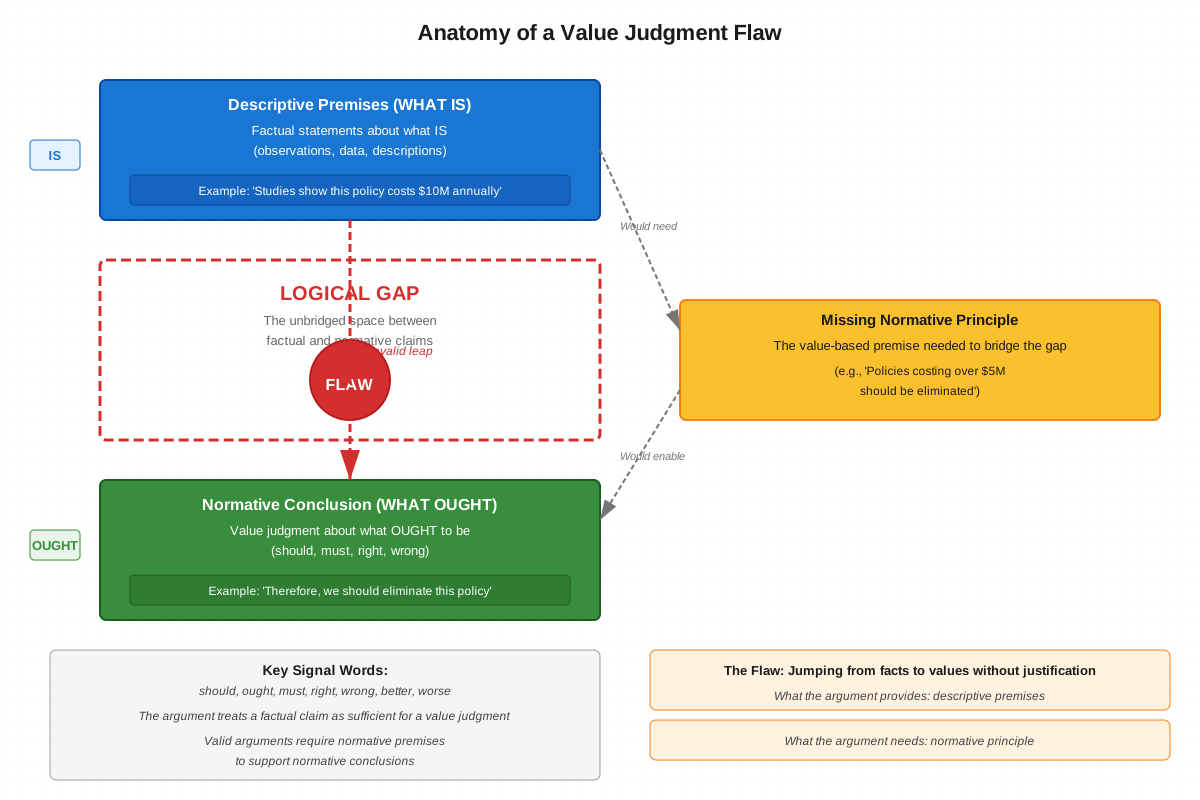
A value judgment flaw (also called an is-ought fallacy or fact-value gap) occurs when an argument presents only factual, descriptive, or empirical premises but reaches a conclusion that makes a normative, evaluative, or prescriptive claim. The fundamental problem is that no amount of purely factual information can, by itself, establish what should be the case or what has value without an additional premise that provides the normative standard or principle.
The basic structure follows this pattern:
Premises: Factual statements (X is the case, Y has property Z, etc.)
Conclusion: Normative statement (Therefore, we should do A, B is good/bad, C is right/wrong)
Flaw: No premise establishes the value system or normative principle that would justify the conclusion
For example: "Studies show that meditation reduces stress hormones. Therefore, everyone should meditate daily." The premise is purely descriptive (a factual claim about biological effects), while the conclusion is prescriptive (a recommendation about what people ought to do). The argument fails to establish why reducing stress hormones is valuable or why this particular benefit justifies the universal recommendation.
Types of Normative Conclusions
Understanding the various forms that normative conclusions take helps identify value judgment flaws more reliably. These conclusions typically fall into several categories:
| Type | Characteristics | Example Language |
|---|---|---|
| Prescriptive | Recommendations or commands about what should be done | "should," "must," "ought to," "needs to" |
| Evaluative | Judgments about quality, worth, or desirability | "good," "bad," "better," "worse," "valuable" |
| Moral/Ethical | Claims about right and wrong, justice, or obligations | "right," "wrong," "just," "unjust," "obligated" |
| Aesthetic | Judgments about beauty, taste, or artistic merit | "beautiful," "ugly," "elegant," "tasteless" |
| Prudential | Claims about what is wise or in one's interest | "advisable," "prudent," "foolish," "wise" |
The Is-Ought Distinction
The philosophical foundation of the value judgment flaw rests on the is-ought distinction, articulated by philosopher David Hume. This principle holds that statements about what is the case (descriptive statements) belong to a fundamentally different logical category than statements about what ought to be the case (normative statements). No valid logical inference can move from purely descriptive premises to a normative conclusion without at least one normative premise.
Consider the logical structure:
- Premise: Eating vegetables provides essential nutrients (descriptive)
- Premise: Most people don't eat enough vegetables (descriptive)
- Conclusion: People should eat more vegetables (normative)
The argument commits a value judgment flaw because it lacks a normative premise such as "People should do things that provide essential nutrients" or "People ought to address nutritional deficiencies." Without such a principle, the factual premises cannot support the prescriptive conclusion.
Distinguishing Value Judgment Flaws from Valid Arguments
Not every argument with a normative conclusion commits a value judgment flaw. Valid arguments include at least one normative premise that establishes the relevant value system or principle. Understanding what makes an argument valid helps identify when the flaw is present:
Flawed Argument:
- Premise: This policy would increase tax revenue (factual)
- Conclusion: We should implement this policy (normative)
- Problem: No premise establishes that increasing tax revenue is desirable
Valid Argument:
- Premise: This policy would increase tax revenue (factual)
- Premise: We should implement policies that increase tax revenue (normative)
- Conclusion: We should implement this policy (normative)
- Success: The normative premise bridges the gap
Common Contexts for Value Judgment Flaws
The LSAT presents value judgment flaws in predictable contexts that test-takers should recognize:
Policy Arguments: Arguments recommending government action based solely on empirical outcomes without establishing that those outcomes are desirable. Example: "This regulation would reduce industry profits by 15%. Therefore, we should not implement it." (Assumes profit reduction is bad without stating this value.)
Ethical Decisions: Arguments about what is morally right or wrong based only on consequences or facts without moral principles. Example: "Most people approve of this practice. Therefore, it is ethically acceptable." (Assumes majority approval determines ethical status.)
Aesthetic Judgments: Arguments about artistic or aesthetic value based solely on technical or factual properties. Example: "This painting uses complex techniques and rare materials. Therefore, it is beautiful." (Assumes technical complexity determines beauty.)
Personal Recommendations: Arguments about what individuals should do based only on factual information about outcomes. Example: "Changing careers would increase your income. Therefore, you should change careers." (Assumes income maximization should guide career decisions.)
The Role of Implicit Assumptions
Value judgment flaws often involve implicit assumptions—unstated normative premises that the argument requires but fails to provide. On Assumption questions, the correct answer supplies the missing normative principle. On Flaw questions, the correct answer identifies the absence of this principle as the reasoning error. Recognizing that these arguments assume a value system without establishing it is key to mastering this flaw type.
Concept Relationships
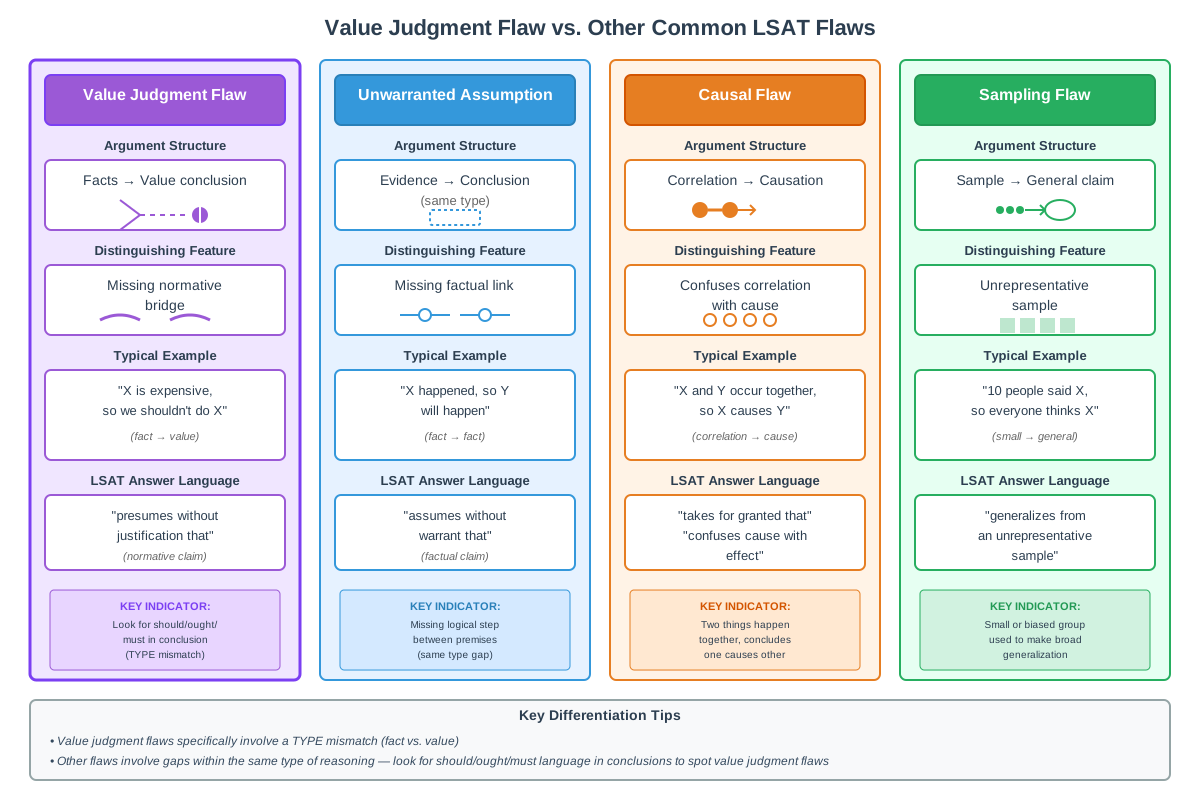
The value judgment flaw connects to several other logical reasoning concepts in important ways. First, it represents a specific type of gap between premises and conclusion—the most fundamental category of reasoning errors. While many flaws involve insufficient evidence or irrelevant premises, the value judgment flaw specifically involves a categorical mismatch between descriptive evidence and normative conclusions.
This flaw relates closely to unwarranted assumptions because arguments with value judgment flaws assume (without stating) that certain outcomes are desirable or that certain principles apply. The difference is that value judgment flaws specifically involve assumptions about values, norms, or prescriptions rather than factual assumptions. Understanding this distinction helps students choose between answer choices that describe different types of assumptions.
The concept also connects to appeal to popularity and appeal to tradition fallacies. These fallacies often contain value judgment flaws because they move from descriptive facts (many people believe X, or X has been done for a long time) to normative conclusions (therefore X is right or should be done) without establishing why popularity or tradition determines value.
Relationship map: Descriptive premises → [Missing normative principle] → Normative conclusion. The value judgment flaw occurs in the gap where the normative principle should appear. This gap can be filled (making the argument valid) by adding a premise that establishes the relevant value system, or it can be exploited (in Weaken questions) by challenging the assumed values.
The flaw also relates to necessary assumptions: the missing normative premise is necessary for the argument's validity. If the normative principle is false, the argument fails. This connection explains why value judgment flaws appear not only in Flaw questions but also in Necessary Assumption and Sufficient Assumption questions.
Quick check — test yourself on Value judgment flaw so far.
Try Flashcards →High-Yield Facts
⭐ The value judgment flaw occurs when an argument moves from purely descriptive premises to a normative conclusion without providing a normative principle to bridge the gap.
⭐ Key indicator words for normative conclusions include: "should," "ought," "must," "right," "wrong," "good," "bad," "better," "worse," and "advisable."
⭐ No amount of factual information alone can establish what has value or what should be done—a value-based premise is always required.
⭐ The flaw is also known as the is-ought fallacy, fact-value gap, or naturalistic fallacy in philosophical contexts.
⭐ On Flaw questions, correct answers often state that the argument "fails to establish that the outcome described is desirable" or "takes for granted that what is the case determines what ought to be the case."
- Arguments can have normative conclusions without committing this flaw if they include at least one normative premise.
- The value judgment flaw is distinct from insufficient evidence flaws—the problem is not quantity of evidence but the type of evidence relative to the conclusion.
- Policy recommendation arguments are particularly prone to value judgment flaws on the LSAT.
- The flaw can appear in reverse: moving from normative premises to purely factual conclusions (though this is less common on the LSAT).
- Recognizing the categorical difference between "is" and "ought" statements is the fundamental skill for identifying this flaw.
- Value judgment flaws often overlap with other flaws, particularly unwarranted assumptions and gaps in reasoning.
- The missing normative premise in a value judgment flaw represents a necessary assumption of the argument.
- Test-makers often disguise the flaw by using complex language or embedding the normative conclusion within a longer argument.
Common Misconceptions
Misconception: Any argument with a normative conclusion commits a value judgment flaw.
Correction: Arguments with normative conclusions are valid if they include at least one normative premise that establishes the relevant value system or principle. The flaw only occurs when ALL premises are purely descriptive.
Misconception: If most people agree with a value judgment, then the argument doesn't need to state it explicitly.
Correction: The logical validity of an argument depends on its stated premises, not on whether its assumptions are widely shared. Even if a value is nearly universal, the argument commits a flaw if it doesn't include a premise establishing that value.
Misconception: Statistical or scientific evidence can establish what should be done.
Correction: Empirical evidence can inform decisions by showing what outcomes will result from actions, but it cannot by itself establish that those outcomes are desirable or that the actions should be taken. A normative premise is always required.
Misconception: The value judgment flaw is the same as an appeal to emotion.
Correction: While both involve values, they are distinct. Appeal to emotion uses emotional language to bypass logical reasoning, while value judgment flaw involves a logical gap between descriptive premises and normative conclusions. An argument can commit a value judgment flaw without any emotional language.
Misconception: Pointing out consequences of an action is sufficient to recommend or oppose that action.
Correction: Identifying consequences is only the first step. To recommend or oppose an action based on its consequences requires an additional premise establishing that those consequences are good or bad, desirable or undesirable.
Misconception: If an argument's conclusion uses "would" instead of "should," it avoids the value judgment flaw.
Correction: The flaw depends on the logical function of the conclusion, not just its grammatical form. A conclusion stating "this policy would be beneficial" makes an evaluative claim (beneficial = good) and thus requires normative support, even though it doesn't use "should."
Worked Examples
Example 1: Policy Recommendation
Argument: "Recent studies demonstrate that implementing a four-day work week increases employee productivity by an average of 12% while reducing overhead costs for employers by 8%. Additionally, employees report higher job satisfaction and better work-life balance. Therefore, all companies should adopt a four-day work week."
Analysis:
Step 1: Identify the conclusion. The conclusion is normative: "all companies should adopt a four-day work week." The word "should" signals a prescriptive claim about what ought to be done.
Step 2: Examine the premises. All premises are purely descriptive/factual:
- Productivity increases by 12% (empirical fact)
- Overhead costs reduce by 8% (empirical fact)
- Employees report higher satisfaction (empirical fact about reported experiences)
- Employees report better work-life balance (empirical fact about reported experiences)
Step 3: Identify the gap. The argument moves from facts about outcomes to a recommendation about what should be done. It assumes, without stating, that these outcomes (increased productivity, reduced costs, higher satisfaction, better work-life balance) are desirable and that companies should pursue policies that produce these outcomes.
Step 4: Articulate the flaw. The argument commits a value judgment flaw by failing to establish that the described outcomes are valuable or that companies have an obligation to pursue them. The missing normative premise might be: "Companies should adopt policies that increase productivity and employee satisfaction" or "Companies ought to prioritize employee well-being and efficiency."
Step 5: Connect to answer choices. On a Flaw question, the correct answer might state: "takes for granted that the outcomes described are desirable without establishing why companies should prioritize these particular outcomes" or "fails to provide a principle establishing that companies ought to adopt policies with these effects."
Example 2: Ethical Judgment
Argument: "Archaeological evidence shows that ancient civilizations across multiple continents practiced ritual sacrifice. Anthropological studies indicate that these practices were central to social cohesion and cultural identity in these societies. Historical records demonstrate that these practices persisted for thousands of years. Therefore, ritual sacrifice was morally acceptable in those cultural contexts."
Analysis:
Step 1: Identify the conclusion. The conclusion is normative/evaluative: "ritual sacrifice was morally acceptable." This makes a moral judgment about the ethical status of a practice.
Step 2: Examine the premises. All premises are descriptive:
- Archaeological evidence shows the practice occurred (historical fact)
- The practices were central to social cohesion (sociological fact)
- The practices persisted for millennia (historical fact)
Step 3: Identify the gap. The argument moves from facts about what was practiced and its social functions to a moral conclusion about acceptability. It assumes that prevalence, social function, or historical persistence determines moral status.
Step 4: Articulate the flaw. The argument commits a value judgment flaw by failing to establish the moral principle that would justify the conclusion. It assumes without stating that practices are morally acceptable if they serve social functions or persist historically. The missing normative premise might be: "Practices that promote social cohesion are morally acceptable" or "Long-standing cultural practices are morally acceptable within their contexts."
Step 5: Connect to answer choices. The correct answer might state: "confuses a description of what was practiced with a judgment about what was morally right" or "fails to establish that historical prevalence or social function determines moral acceptability."
Learning Objective Connection: This example demonstrates how to identify value judgment flaws (Objective 1), explains the reasoning pattern of moving from descriptive to normative claims (Objective 2), and shows how to apply this knowledge to analyze LSAT-style arguments (Objective 3).
Exam Strategy
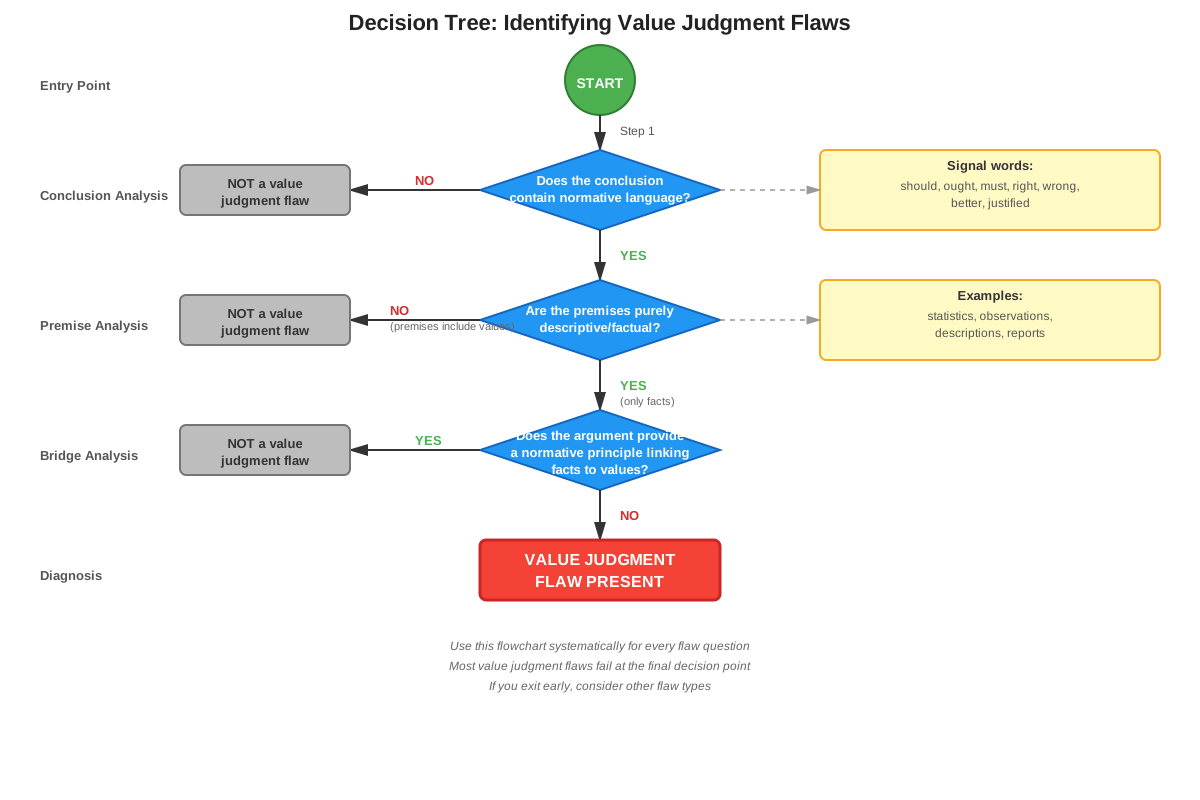
When approaching flaw questions that may involve value judgment flaws, use this systematic process:
Step 1: Identify the conclusion quickly. Look for conclusion indicators ("therefore," "thus," "so") and determine whether the conclusion is normative (contains should/ought/good/bad/right/wrong) or descriptive (states facts).
Step 2: If the conclusion is normative, scan premises for normative content. Ask: "Do any premises establish values, principles, or what ought to be?" If all premises are purely factual, you've likely found a value judgment flaw.
Step 3: Articulate the gap to yourself. Before looking at answer choices, mentally state: "The argument assumes that [factual situation] means we should [normative conclusion], but doesn't establish why."
Trigger words to watch for in conclusions:
- Prescriptive: should, ought, must, needs to, has to, required
- Evaluative: good, bad, better, worse, best, worst, valuable, worthless
- Moral: right, wrong, ethical, unethical, just, unjust, fair, unfair
- Prudential: advisable, wise, foolish, prudent, recommended
Trigger phrases in answer choices that indicate value judgment flaws:
- "fails to establish that the outcome is desirable"
- "takes for granted that what is the case determines what ought to be"
- "presumes without justification that the described situation is good/bad"
- "confuses a factual claim with a value judgment"
- "assumes without warrant that the goal mentioned should be pursued"
Process of elimination tips:
- Eliminate answers describing factual errors if the premises are factually accurate
- Eliminate answers about insufficient sample size or statistical problems if the flaw is about the type of evidence, not its quantity
- Eliminate answers about causal reasoning if the argument doesn't make causal claims
- Keep answers that mention assumptions about values, desirability, or what should be done
Time allocation: Value judgment flaws are often among the quicker flaws to identify once you recognize the pattern. Spend 15-20 seconds identifying the conclusion type, 10-15 seconds checking premise types, and 30-40 seconds on answer choices. If you've correctly identified the flaw, the right answer should be clear.
Exam Tip: If you see a policy recommendation or ethical judgment conclusion, immediately check whether any premise establishes why that policy is good or that ethical standard applies. The absence of such a premise is your signal.
Memory Techniques
Mnemonic for identifying value judgment flaws: "FIND"
- Factual premises only?
- Is there an ought/should conclusion?
- No normative principle stated?
- Descriptive-to-normative gap = flaw!
Visualization strategy: Picture a bridge between two islands. One island is labeled "FACTS" (what is), the other "VALUES" (what ought to be). The argument tries to get from Facts island to Values island, but there's no bridge (no normative premise). The argument commits a value judgment flaw by attempting to cross without a bridge.
Acronym for normative conclusion indicators: "SOBER"
- Should
- Ought
- Better/worse
- Ethical/right/wrong
- Recommended/required
Memory phrase: "You can't get an ought from an is"—this captures the essence of the is-ought distinction and the value judgment flaw.
Pattern recognition: Train yourself to automatically think "Where's the value premise?" whenever you see a normative conclusion. Make this an automatic response, like checking for necessary and sufficient conditions in conditional reasoning.
Summary
The value judgment flaw represents a fundamental logical error where arguments attempt to derive normative conclusions—claims about what should be done, what is good or bad, or what is right or wrong—from purely descriptive premises about facts or empirical observations. This flaw violates the is-ought distinction: the principle that factual statements alone cannot establish value-based conclusions without at least one premise that provides the relevant normative principle or value system. On the LSAT, this flaw appears frequently in arguments about policy recommendations, ethical judgments, and prescriptive claims. Identifying the flaw requires recognizing when a conclusion makes a different type of claim (normative) than the premises support (descriptive). The key skill is distinguishing between arguments that validly include normative premises and those that commit the flaw by assuming values without establishing them. Mastering this concept requires understanding the structure of the flaw, recognizing trigger words that signal normative conclusions, and systematically checking whether arguments bridge the gap between facts and values. Success on these questions depends on the ability to articulate precisely what normative premise is missing and to recognize answer choices that correctly identify this gap.
Key Takeaways
- The value judgment flaw occurs when arguments move from purely factual premises to normative conclusions without providing a value-based principle to justify the leap.
- Normative conclusions use indicator words like "should," "ought," "good," "bad," "right," "wrong," and "must"—these trigger immediate scrutiny of whether premises establish values.
- The is-ought distinction is fundamental: no amount of factual information alone can establish what has value or what should be done.
- Valid arguments with normative conclusions must include at least one normative premise; the flaw occurs only when all premises are descriptive.
- On Flaw questions, correct answers often state that the argument "fails to establish that the outcome is desirable" or "takes for granted that what is determines what ought to be."
- Policy recommendations and ethical judgments are the most common contexts for value judgment flaws on the LSAT.
- The missing normative premise represents a necessary assumption—without it, the argument cannot validly reach its conclusion.
Related Topics
Necessary Assumption Questions: Understanding value judgment flaws directly prepares students for Necessary Assumption questions where the correct answer supplies the missing normative premise that the argument requires. Mastering the identification of what's missing in value judgment flaws makes finding necessary assumptions more systematic.
Sufficient Assumption Questions: These questions often require adding a normative premise to make an argument valid. The skills developed in recognizing value judgment flaws transfer directly to identifying what principle would bridge the gap between descriptive premises and normative conclusions.
Strengthen and Weaken Questions: Arguments with value judgment flaws can be strengthened by adding support for the assumed values or weakened by challenging those values. Understanding the flaw helps predict what would affect argument strength.
Principle Questions: Many Principle questions involve identifying or applying normative principles. The ability to recognize when arguments lack normative support is essential for these question types.
Parallel Reasoning: Recognizing the abstract structure of value judgment flaws (descriptive premises → normative conclusion without normative premise) helps identify parallel flawed reasoning in different contexts.
Practice CTA
Now that you understand the value judgment flaw—its structure, how to identify it, and how it appears on the LSAT—it's time to cement this knowledge through practice. Work through the practice questions to test your ability to spot this flaw in various contexts and under timed conditions. Use the flashcards to reinforce the key concepts, trigger words, and answer choice patterns. Remember: recognizing value judgment flaws becomes faster and more intuitive with deliberate practice. Each question you analyze strengthens your pattern recognition and builds the confidence you need to excel on test day. You've built a strong conceptual foundation—now apply it!
Sign up free to keep reading
Create a free AnvayaPrep account to finish this LSAT guide on Value judgment flaw — plus flashcards and practice questions.