Overview
At least statements represent a critical category of quantified claims in formal logic and quantifiers that appear frequently throughout LSAT logical reasoning sections. These statements establish minimum thresholds or boundaries, asserting that a quantity, frequency, or degree meets or exceeds a specified value. Understanding how to interpret, manipulate, and apply at least statements is essential for success on the LSAT, as they appear in various question types including Must Be True, Sufficient Assumption, Necessary Assumption, and Parallel Reasoning questions.
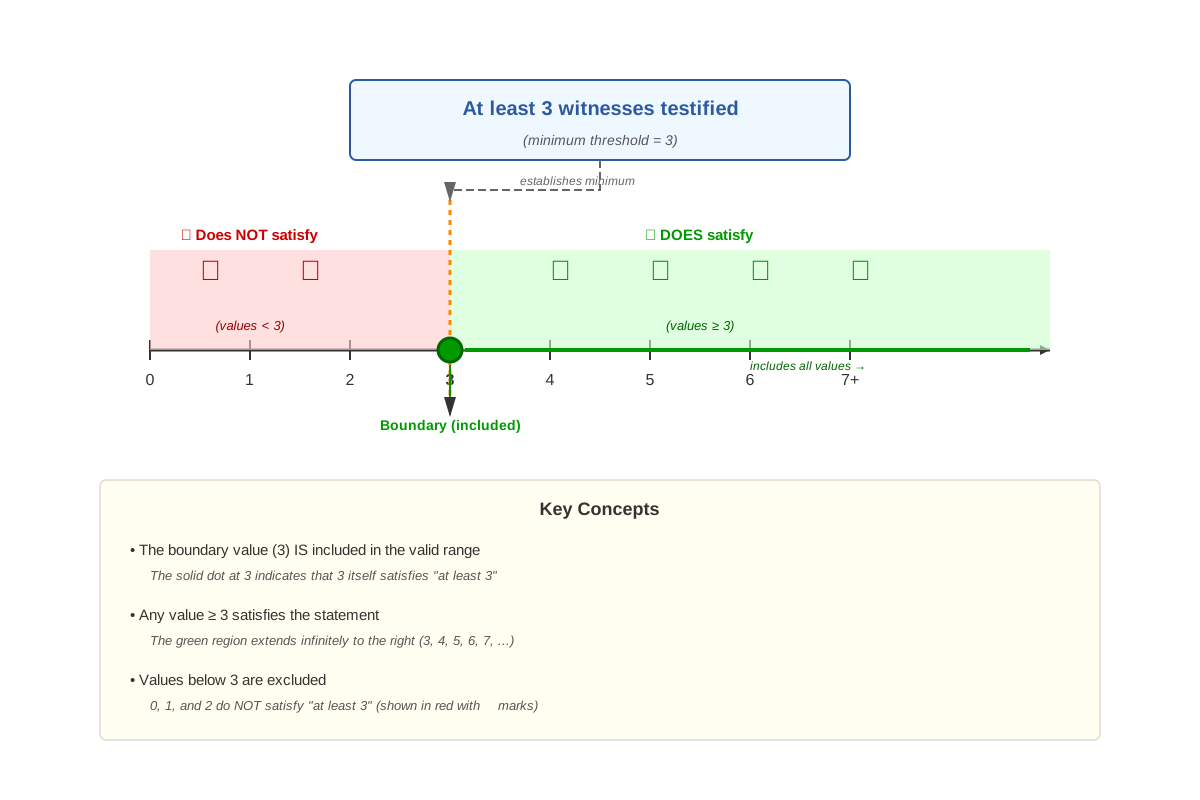
The logical structure of lsat at least statements differs fundamentally from "at most" statements, "exactly" statements, and other quantified expressions. When a statement claims "at least three witnesses testified," it means three or more witnesses testified—the actual number could be three, four, ten, or any higher value. This inclusive lower-bound nature creates specific logical implications that test-makers exploit to construct challenging questions. Mastering at least statements requires understanding not only what they assert directly but also what they allow, what they exclude, and how they interact with other logical operators like negation, conjunction, and disjunction.
Within the broader landscape of LSAT logical reasoning, at least statements connect intimately with conditional logic, quantifier relationships, and numerical reasoning. They often appear embedded within complex argument structures where recognizing the precise logical force of the quantifier becomes crucial for identifying valid inferences. The ability to translate at least statements into formal logical notation, recognize their contrapositives, and understand their relationship to other quantified statements represents a high-yield skill that directly impacts performance on multiple question types throughout the exam.
Learning Objectives
- [ ] Identify how at least statements appear in LSAT questions across different question types
- [ ] Explain the reasoning pattern behind at least statements and their logical structure
- [ ] Apply at least statements to solve LSAT-style problems accurately
- [ ] Translate at least statements into formal logical notation and symbolic representations
- [ ] Distinguish between at least statements and other quantified expressions (at most, exactly, some, all)
- [ ] Recognize valid and invalid inferences that can be drawn from at least statements
- [ ] Combine at least statements with conditional logic to solve complex reasoning problems
Prerequisites
- Basic quantifier logic: Understanding terms like "all," "some," "none," and "most" provides the foundation for grasping how at least statements function as numerical quantifiers
- Conditional reasoning fundamentals: Knowledge of if-then statements and their contrapositives enables recognition of how at least statements interact with conditional structures
- Set theory basics: Familiarity with set membership, subsets, and overlapping categories helps visualize the scope of at least statements
- Numerical comparison operators: Understanding greater than, less than, and equal to relationships clarifies the boundary conditions that at least statements establish
Why This Topic Matters
At least statements appear in approximately 15-20% of LSAT logical reasoning questions, making them one of the most frequently tested quantifier types on the exam. Their prevalence stems from their versatility—test-makers can embed them in argument structures, use them to create subtle logical traps, and combine them with other logical operators to test sophisticated reasoning skills. Questions involving at least statements typically appear in Must Be True questions (where students must identify what necessarily follows), Sufficient Assumption questions (where the correct answer bridges a gap involving quantities), and Parallel Reasoning questions (where matching quantifier structures is essential).
In real-world contexts, at least statements pervade legal reasoning, policy analysis, and scientific discourse—all domains that the LSAT seeks to assess. Legal standards often specify minimum requirements ("at least two witnesses must corroborate"), regulatory frameworks establish threshold conditions ("at least 60% approval required"), and scientific claims frequently involve minimum frequencies ("at least half of the participants showed improvement"). The ability to reason precisely about these minimum thresholds translates directly to the analytical skills required in law school and legal practice.
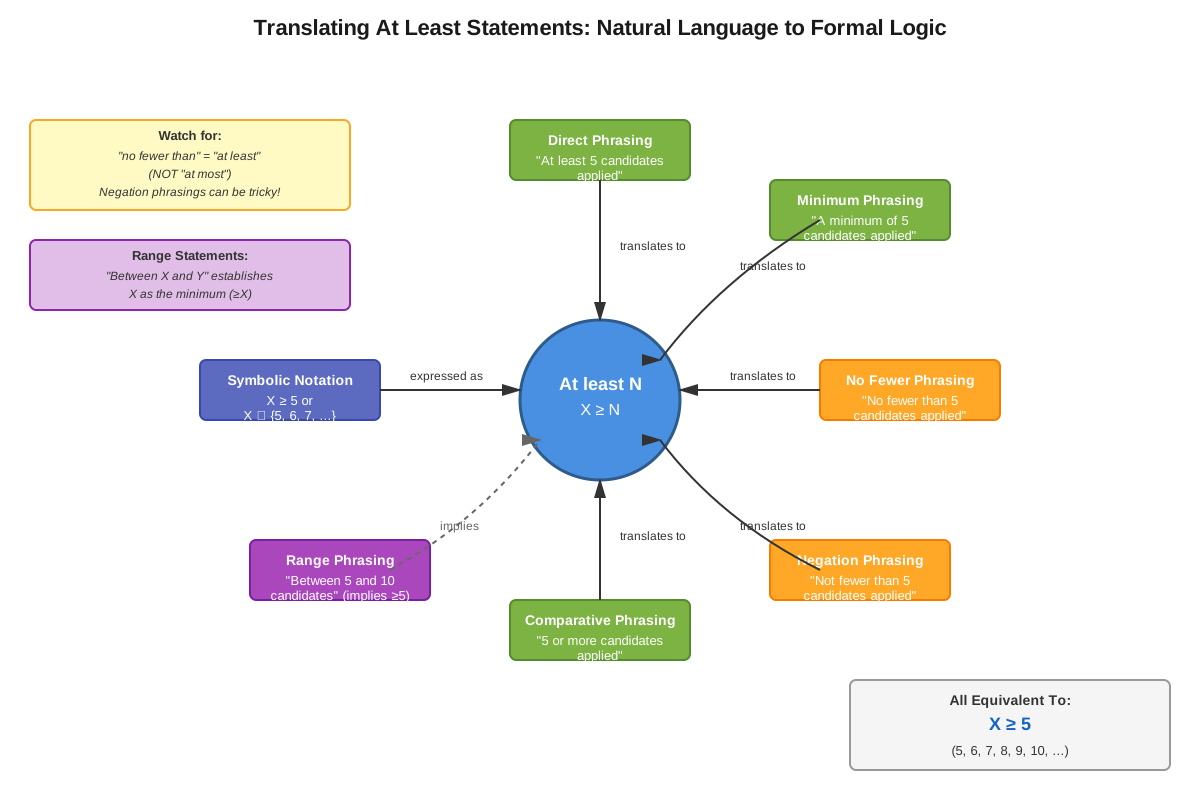
Common manifestations of at least statements in LSAT passages include explicit numerical claims ("at least five board members voted against"), comparative assertions ("at least as many supporters as opponents"), temporal frequencies ("occurs at least twice annually"), and probabilistic thresholds ("at least 70% likelihood"). Test-makers often disguise at least statements using equivalent phrasings like "no fewer than," "a minimum of," or "three or more," requiring students to recognize the underlying logical structure regardless of surface-level wording variations.
Core Concepts
Logical Structure of At Least Statements
An at least statement establishes a lower bound on a quantity, asserting that the actual value equals or exceeds the specified minimum. The formal structure can be represented as: "At least n instances of X" means "n or more instances of X," which translates symbolically to X ≥ n. This inclusive boundary is crucial—the statement remains true whether exactly n instances exist or any greater number exists.
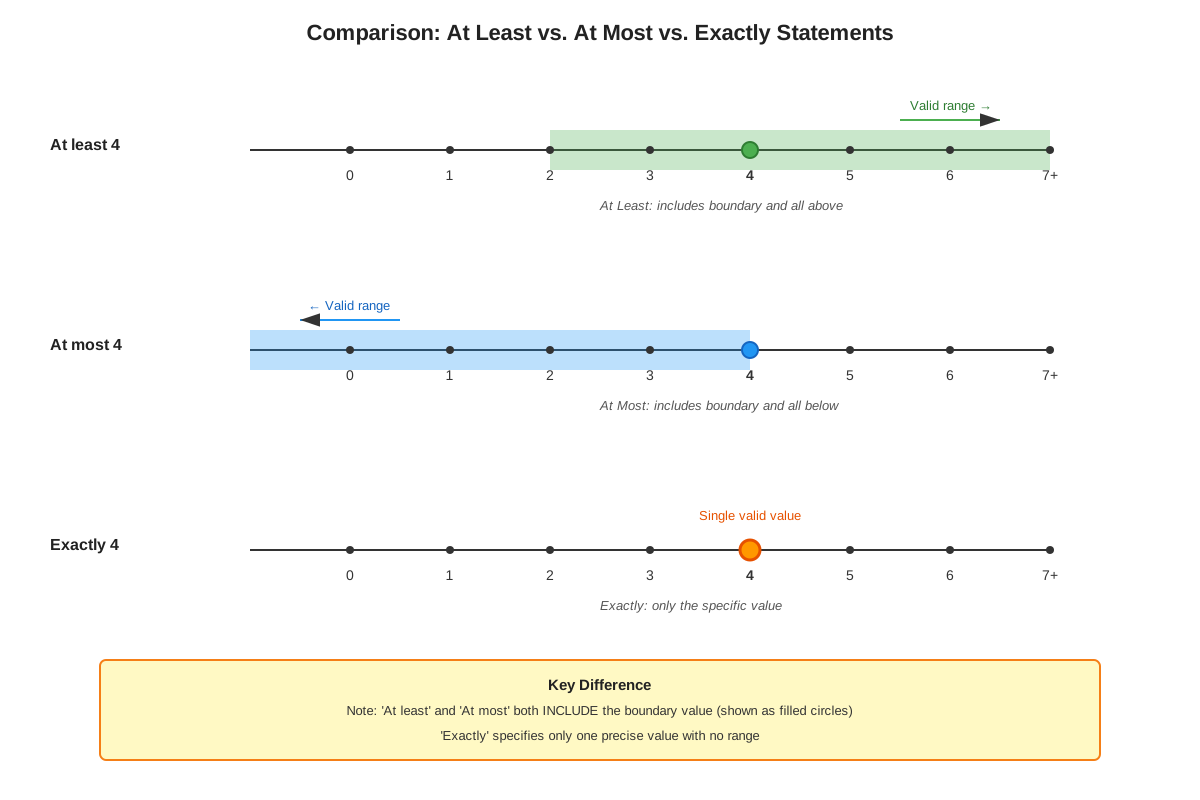
The truth conditions for at least statements differ fundamentally from other quantifiers. While "all" requires universal satisfaction and "some" requires merely one or more instances, at least statements occupy a middle ground by specifying a precise numerical threshold. Consider these distinctions:
| Statement Type | Minimum Required | Maximum Allowed | Example |
|---|---|---|---|
| At least 3 | 3 | Unlimited | "At least 3 witnesses" = 3, 4, 5, ... witnesses |
| Exactly 3 | 3 | 3 | "Exactly 3 witnesses" = only 3 witnesses |
| At most 3 | 0 | 3 | "At most 3 witnesses" = 0, 1, 2, or 3 witnesses |
| Some | 1 | Unlimited | "Some witnesses" = 1 or more witnesses |
| All | Total population | Total population | "All witnesses" = every single witness |
Negation of At Least Statements
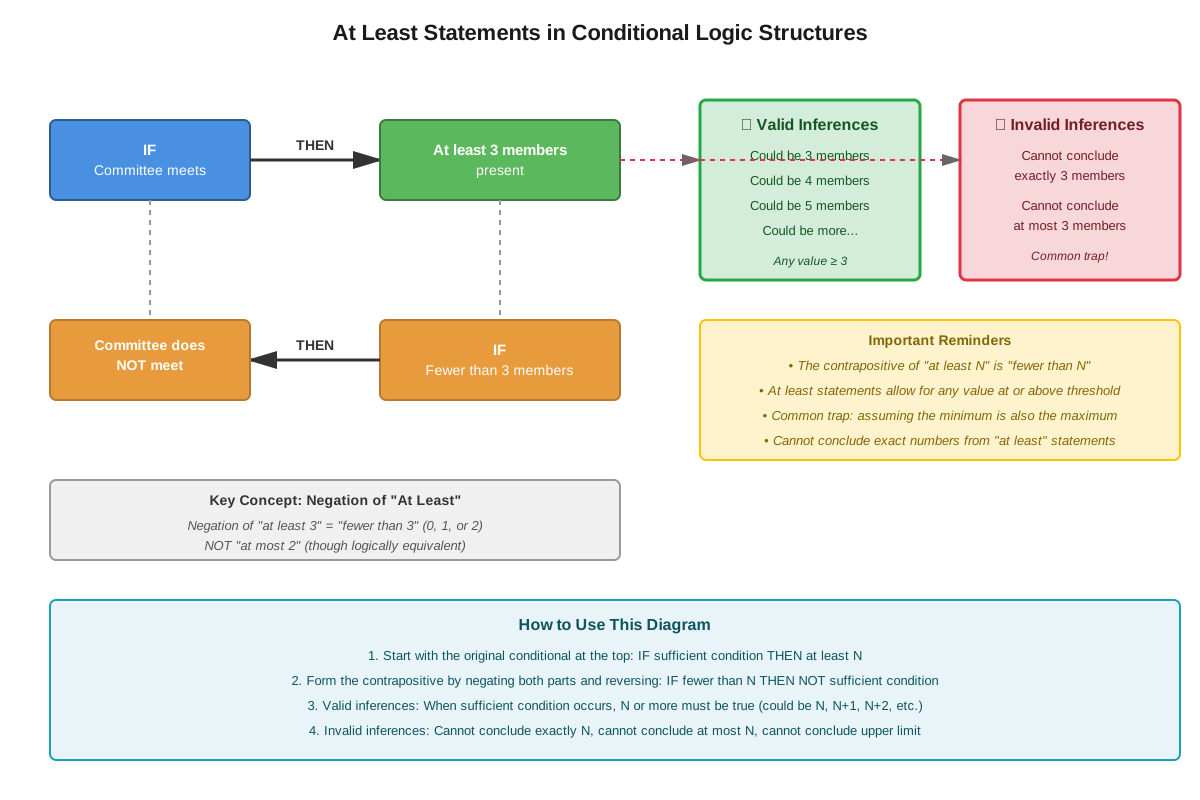
Understanding how to negate at least statements correctly is essential for contrapositive reasoning and identifying logical opposites. The negation of "at least n" is "fewer than n," which equivalently means "at most (n-1)." For example:
- Statement: "At least 4 committee members approved"
- Negation: "Fewer than 4 committee members approved" OR "At most 3 committee members approved"
This negation pattern creates a complementary relationship where exactly one of the pair must be true. If it's false that at least 4 members approved, then necessarily fewer than 4 approved. Test-makers frequently exploit confusion about this negation relationship by offering answer choices that incorrectly negate at least statements as "none" or "at most n" (rather than "at most n-1").
Combining At Least Statements with Conditional Logic
At least statements frequently appear as components of conditional relationships, either in the sufficient condition, the necessary condition, or both. Consider the structure: "If at least 3 board members object → the proposal fails." This creates a threshold-triggered conditional where meeting the numerical minimum activates the consequent.
When at least statements appear in necessary conditions, they establish minimum requirements: "The proposal passes → at least 5 members voted for it." Taking the contrapositive yields: "Fewer than 5 members voted for it → the proposal does not pass." Recognizing these patterns enables students to chain inferences and identify what must be true given certain conditions.
Comparative At Least Statements
A sophisticated variant involves comparative at least statements: "at least as many X as Y." This structure asserts X ≥ Y, meaning the quantity of X equals or exceeds the quantity of Y. For example, "The company hired at least as many engineers as accountants" means engineers ≥ accountants. If 10 accountants were hired, then 10 or more engineers were hired.
These comparative statements create transitive relationships that enable chaining:
- At least as many A as B (A ≥ B)
- At least as many B as C (B ≥ C)
- Therefore: At least as many A as C (A ≥ C)
Interaction with Other Quantifiers
At least statements interact with other quantifiers in predictable ways that test-makers exploit. Understanding these relationships enables rapid elimination of incorrect answer choices:
- "At least some" is redundant—"at least one" already means "some"
- "At least all" is contradictory—"all" already represents the maximum
- "At least most" means "most or all"—the quantity exceeds 50% and could reach 100%
- "At least half" means "50% or more"—establishing a precise numerical threshold
Temporal and Frequency Applications
At least statements frequently specify temporal frequencies or recurring events: "The audit occurs at least quarterly" means four or more times per year. "The medication must be taken at least twice daily" means two or more times per day. These temporal applications require careful attention to the time frame specified and the minimum frequency established within that frame.
Concept Relationships
The logical architecture of at least statements connects to multiple domains within LSAT reasoning. At the foundational level, basic quantifier logic (all, some, none) provides the conceptual framework, with at least statements representing a more precise numerical specification than the general "some" quantifier. This precision enables formal logic and quantifiers to express exact threshold conditions that appear throughout legal and analytical reasoning.
At least statements directly interact with conditional logic through threshold-triggered conditionals, where meeting a numerical minimum activates a consequent condition. This relationship flows bidirectionally: conditionals can have at least statements in either the sufficient or necessary condition, and understanding both configurations is essential for valid inference-making.
The relationship map follows this structure:
Basic Quantifiers → Numerical Quantifiers (At Least) → Threshold Conditionals → Complex Inference Chains
Additionally, at least statements connect to negation and opposition through their complementary relationship with "at most" statements. Understanding this opposition enables recognition of logical contradictions and supports process-of-elimination strategies.
Finally, at least statements relate to comparative reasoning when expressed in relative terms ("at least as many as"), creating connections to inequality reasoning and transitive relationships that appear in logic games and complex logical reasoning questions.
High-Yield Facts
⭐ "At least n" means "n or more"—the actual quantity can equal n or exceed it by any amount
⭐ The negation of "at least n" is "fewer than n," which equals "at most (n-1)"
⭐ "At least as many X as Y" means X ≥ Y, allowing X to equal or exceed Y
⭐ At least statements establish inclusive lower bounds—they specify what must be true at minimum but allow for more
⭐ When an at least statement appears in a sufficient condition, meeting the threshold triggers the consequent
- "At least some" is logically equivalent to "some"—both mean one or more
- "At least most" means "most or all"—the majority threshold is met and could reach totality
- At least statements can be chained transitively: if A ≥ B and B ≥ C, then A ≥ C
- Temporal at least statements specify minimum frequencies within defined time periods
- "No fewer than n" is synonymous with "at least n"—both establish the same lower bound
- At least statements remain true across all scenarios meeting or exceeding the threshold
- Combining "at least n" with "at most m" creates a bounded range: n ≤ X ≤ m
- The contrapositive of a conditional with an at least statement in the necessary condition uses "fewer than" in the sufficient condition
- At least statements can modify percentages, creating proportional thresholds: "at least 60%" means 60% or more
- When two at least statements conflict (e.g., "at least 5" and "at least 8"), the higher threshold supersedes the lower
Quick check — test yourself on At least statements so far.
Try Flashcards →Common Misconceptions
Misconception: "At least 3" means "exactly 3" → Correction: "At least 3" means "3 or more"—it establishes a minimum but allows for any higher quantity. The statement remains true whether there are 3, 4, 10, or 100 instances.
Misconception: The negation of "at least 5" is "at most 5" → Correction: The negation of "at least 5" is "fewer than 5," which equals "at most 4." These are complementary opposites—if one is true, the other must be false, with no overlap at the boundary value.
Misconception: "At least as many X as Y" means X > Y (strictly greater than) → Correction: "At least as many X as Y" means X ≥ Y, allowing X to equal Y. The phrase includes the possibility of equality, not just strict inequality.
Misconception: "At least some" is stronger than "some" → Correction: "At least some" and "some" are logically equivalent—both mean "one or more." The phrase "at least" is redundant when modifying "some" since "some" already establishes a minimum of one.
Misconception: If "at least 4 members voted yes" is true, then "at least 6 members voted yes" must also be true → Correction: "At least 4" allows for 4, 5, 6, or more, but doesn't guarantee 6 or more. If exactly 5 members voted yes, "at least 4" is true but "at least 6" is false.
Misconception: At least statements in necessary conditions can be satisfied by fewer instances → Correction: When a conditional states "X → at least n instances of Y," the necessary condition requires n or more instances. Fewer than n instances would make the necessary condition false, triggering the contrapositive.
Misconception: "At least half" means "more than half" → Correction: "At least half" means "50% or more," including exactly 50%. "More than half" would require exceeding 50%, excluding the boundary value itself.
Worked Examples
Example 1: Must Be True Question
Stimulus: A university committee consists of 12 members. The proposal to change graduation requirements will pass only if at least 8 members vote in favor. At yesterday's meeting, at least 5 members voted against the proposal.
Question: Which of the following must be true?
Answer Choices:
(A) The proposal passed
(B) The proposal did not pass
(C) Fewer than 8 members voted in favor
(D) At least 7 members voted in favor
(E) Exactly 5 members voted against
Solution Process:
Step 1: Identify the at least statements and translate them into formal logic.
- Proposal passes → at least 8 vote in favor (necessary condition)
- At least 5 voted against (given fact)
Step 2: Determine what we know with certainty.
- Total members: 12
- Members voting against: ≥ 5 (could be 5, 6, 7, 8, 9, 10, 11, or 12)
- Members voting in favor: ≤ 7 (since at least 5 voted against, at most 7 voted in favor)
Step 3: Apply the contrapositive of the conditional.
- Proposal passes → at least 8 in favor
- Contrapositive: Fewer than 8 in favor → proposal does not pass
Step 4: Evaluate what must be true.
Since at most 7 members could have voted in favor (12 total - at least 5 against = at most 7 in favor), we know fewer than 8 voted in favor. By the contrapositive, the proposal did not pass.
Correct Answer: (B) The proposal did not pass
Connection to Learning Objectives: This example demonstrates how to identify at least statements in stimulus text, apply the reasoning pattern (including contrapositive), and use the logical structure to determine what must be true.
Example 2: Sufficient Assumption Question
Stimulus: The city council will approve the new zoning ordinance only if at least three-quarters of the council members support it. Currently, at least 60% of council members support the ordinance.
Question: Which of the following, if assumed, would allow the conclusion that the city council will approve the new zoning ordinance?
Answer Choices:
(A) All council members who currently support the ordinance will vote for it
(B) At least 15% more council members will come to support the ordinance
(C) Most council members believe the ordinance is necessary
(D) The council members who support the ordinance are more influential than those who oppose it
(E) No council member will change their position before the vote
Solution Process:
Step 1: Identify the logical structure and gap.
- Necessary condition for approval: at least 75% support
- Current situation: at least 60% support
- Gap: Need to bridge from 60% to 75%
Step 2: Calculate what's needed.
- Current: ≥ 60%
- Required: ≥ 75%
- Minimum additional support needed: 15%
Step 3: Evaluate answer choices for sufficiency.
- (A) Doesn't add support, just maintains current 60%
- (B) At least 15% more → 60% + 15% = 75% minimum → sufficient!
- (C) "Most" means >50%, which we already exceed—doesn't guarantee 75%
- (D) Influence doesn't affect the numerical threshold
- (E) Maintaining current position keeps us at 60%, below the 75% threshold
Correct Answer: (B) At least 15% more council members will come to support the ordinance
Connection to Learning Objectives: This example shows how at least statements create numerical gaps in arguments and how to identify the precise quantitative assumption needed to bridge that gap, demonstrating application of at least statements to solve LSAT problems accurately.
Exam Strategy
When approaching LSAT questions involving at least statements, begin by identifying and underlining all quantified expressions in the stimulus. Pay particular attention to phrases like "at least," "no fewer than," "minimum of," and "or more," as these signal the presence of lower-bound quantifiers. Translate these immediately into symbolic notation (X ≥ n) to clarify the logical structure.
Trigger words and phrases to watch for include:
- "At least" (direct indicator)
- "No fewer than" (equivalent expression)
- "Minimum of" (threshold language)
- "Or more" (inclusive upper range)
- "As many as" or "at least as many as" (comparative forms)
- "Not less than" (double negative form)
For Must Be True questions, focus on what the at least statement guarantees versus what it merely allows. The statement "at least 5" guarantees 5 or more but doesn't guarantee any specific number above 5. Eliminate answer choices that claim certainty about quantities exceeding the stated minimum without additional support.
For Sufficient Assumption questions, calculate the numerical gap between what's given and what's required. If the conclusion requires "at least 75%" and the premise establishes "at least 60%," the correct answer must bridge that 15% gap. Look for answer choices that provide exactly the additional quantity needed.
Process-of-elimination strategies:
- Eliminate answers that confuse "at least n" with "exactly n"
- Eliminate answers that incorrectly negate at least statements (watch for "at most n" instead of "at most n-1")
- Eliminate answers that claim certainty about quantities above the minimum without justification
- Eliminate answers that treat comparative at least statements as strict inequalities
Time allocation: Spend 15-20 seconds identifying and translating all quantifiers before attempting to solve the question. This upfront investment prevents costly errors and often reveals the logical structure immediately. For questions combining at least statements with conditional logic, allocate an additional 10-15 seconds to map out the contrapositive and identify valid inference chains.
Exam Tip: When you see "at least" in a necessary condition, immediately think about the contrapositive using "fewer than." This pattern appears frequently in Must Be True and Parallel Reasoning questions.
Memory Techniques
Mnemonic for At Least vs. At Most: "At LEAST means LEAVE room for more; At MOST means MAXIMUM ceiling." The shared "L" and "M" sounds create an auditory link between the quantifier and its meaning.
Visualization Strategy: Picture at least statements as a number line with a solid dot at the threshold value and an arrow extending rightward to infinity. The solid dot indicates inclusion of the boundary value, and the rightward arrow shows unlimited upward possibility. For "at least 5," visualize: ●—————→ at position 5.
Negation Acronym - FLAB: "Fewer than, Less than, At most (n-1), Below n" all represent equivalent negations of "at least n." The acronym FLAB helps recall that these four phrasings express the same logical opposite.
Comparative Statement Memory Device: "At least as many X as Y" = "X ≥ Y" = "X is Y's equal or better." The phrase "equal or better" captures both the equality and greater-than possibilities in a memorable way.
Boundary Inclusion Reminder: "At least is INCLUSIVE at the bottom, EXCLUSIVE at the top (no top!)." This phrase emphasizes that at least statements include the stated value but have no upper limit.
Summary
At least statements establish inclusive lower bounds on quantities, asserting that a value equals or exceeds a specified minimum. These quantified expressions appear throughout LSAT logical reasoning questions, requiring precise understanding of their logical structure, negation patterns, and interaction with conditional logic. The fundamental principle—"at least n" means "n or more"—creates specific truth conditions that differ from other quantifiers like "exactly," "at most," and "some." Mastering at least statements requires recognizing their various phrasings, correctly negating them as "fewer than n" or "at most (n-1)," and understanding how they function within conditional relationships. When at least statements appear in necessary conditions, they establish minimum thresholds that must be met; when they appear in sufficient conditions, meeting the threshold triggers the consequent. Comparative forms like "at least as many X as Y" create inequality relationships (X ≥ Y) that enable transitive reasoning chains. Success on LSAT questions involving at least statements depends on translating these expressions into formal notation, identifying valid inferences, avoiding common misconceptions about boundary values, and recognizing how numerical gaps create logical vulnerabilities in arguments.
Key Takeaways
- At least statements establish inclusive lower bounds: "at least n" means "n or more," allowing any quantity equal to or exceeding the threshold
- Negation uses "fewer than": The logical opposite of "at least n" is "fewer than n," equivalent to "at most (n-1)"
- Comparative forms create inequalities: "At least as many X as Y" translates to X ≥ Y, permitting equality or X exceeding Y
- Contrapositive reasoning applies: When at least statements appear in conditionals, their negations appear in contrapositives using "fewer than"
- Boundary values are included: Unlike "more than," at least statements include the specified value itself as a valid instance
- Numerical gaps signal assumptions: When conclusions require higher thresholds than premises provide, the gap indicates the needed assumption
- Multiple phrasings express the same logic: "At least," "no fewer than," "minimum of," and "or more" all establish equivalent lower bounds
Related Topics
At Most Statements: The complementary quantifier to at least statements, establishing upper bounds rather than lower bounds. Mastering at least statements provides the foundation for understanding at most statements and recognizing their opposition relationship.
Exactly Statements: Precise quantifiers that establish both lower and upper bounds simultaneously. Understanding at least statements helps distinguish between minimum thresholds and exact specifications.
Most and Some Quantifiers: General quantifiers that relate to at least statements through numerical thresholds. "Most" means "more than half," which can be expressed as "at least 50% + 1."
Conditional Logic with Quantifiers: Advanced integration of at least statements within if-then structures, building on the foundational understanding developed in this topic.
Numerical Reasoning in Logic Games: Application of at least statements to sequencing and grouping games, where minimum and maximum constraints create deductive inferences.
Practice CTA
Now that you've mastered the logical structure and application of at least statements, it's time to solidify your understanding through active practice. Attempt the practice questions designed specifically for this topic, focusing on identifying at least statements in various phrasings, correctly negating them, and applying them within complex argument structures. Use the flashcards to reinforce the key distinctions between at least, at most, and exactly statements until recognition becomes automatic. Remember: at least statements appear in 15-20% of logical reasoning questions, making this one of the highest-yield topics for score improvement. Your investment in mastering this concept will pay dividends across multiple question types throughout the exam. Approach each practice question methodically, translating quantifiers into formal notation and checking your reasoning against the worked examples provided. You've built the foundation—now strengthen it through deliberate practice!
Sign up free to keep reading
Create a free AnvayaPrep account to finish this LSAT guide on At least statements — plus flashcards and practice questions.