Overview
Formal logic answer traps represent one of the most sophisticated and frequently tested elements within LSAT Logical Reasoning sections. These traps are deliberately constructed incorrect answer choices that exploit common misunderstandings of conditional reasoning, quantifier relationships, and logical inference patterns. The test makers design these distractors to appear correct to students who make predictable errors in translating, diagramming, or applying formal logic principles. Understanding these traps is not merely about avoiding wrong answers—it's about developing the precise analytical thinking that distinguishes top LSAT performers from average test-takers.
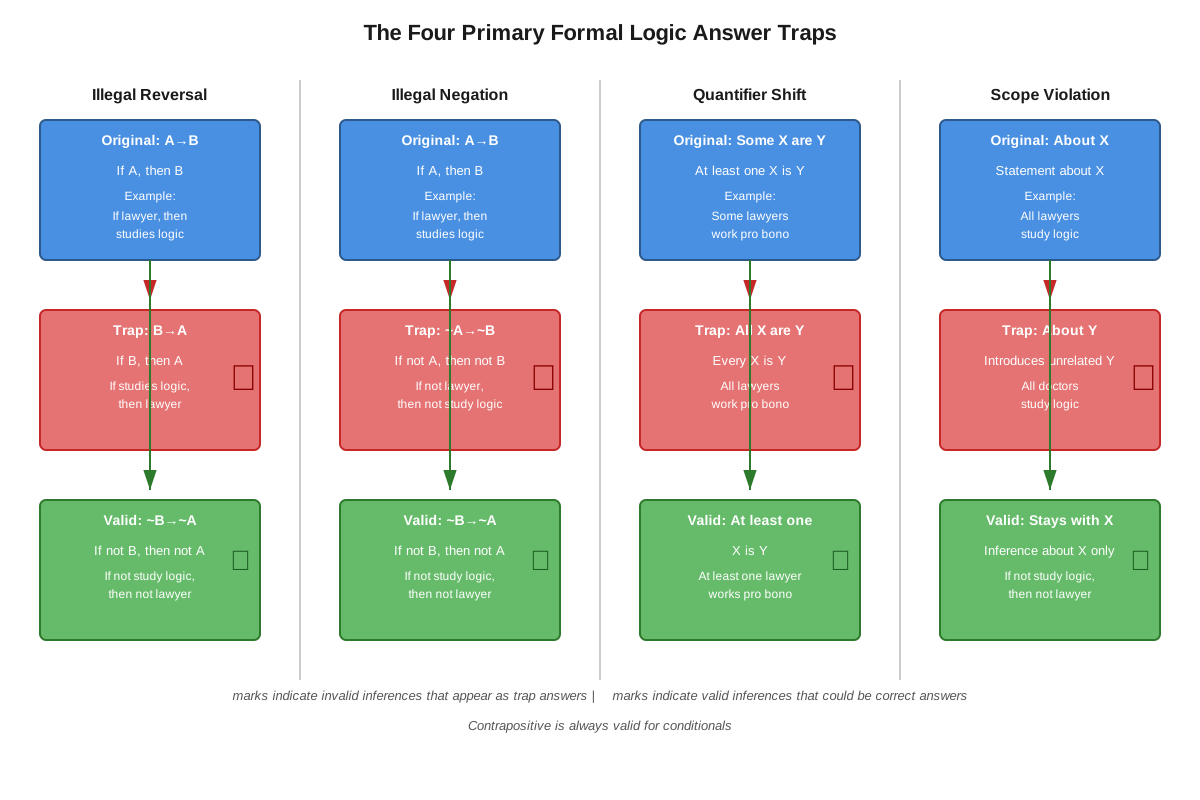
The LSAT consistently tests formal logic through Must Be True questions, Sufficient Assumption questions, and Parallel Reasoning questions, among others. Within these question types, lsat formal logic answer traps appear with remarkable consistency, targeting specific vulnerabilities in logical reasoning. Students who can recognize these traps gain a significant competitive advantage, as they can eliminate wrong answers quickly and confidently identify correct responses even when the logic becomes complex. These traps often involve illegal reversals, illegal negations, quantifier shifts, and scope violations—each representing a distinct pattern of flawed reasoning that the LSAT exploits repeatedly.
Mastering formal logic answer traps connects directly to broader logical reasoning competencies tested throughout the LSAT. The ability to spot these traps requires fluency with conditional statements, contrapositive formation, formal logic and quantifiers, and the precise relationships between sufficient and necessary conditions. This topic sits at the intersection of pure logical analysis and strategic test-taking, making it essential for students aiming to maximize their Logical Reasoning scores. The patterns learned here transfer directly to Reading Comprehension inference questions and even to Analytical Reasoning (Logic Games), where formal relationships govern correct deductions.
Learning Objectives
- [ ] Identify how formal logic answer traps appears in LSAT questions
- [ ] Explain the reasoning pattern behind formal logic answer traps
- [ ] Apply formal logic answer traps to solve LSAT-style problems accurately
- [ ] Distinguish between illegal reversals and illegal negations in answer choices
- [ ] Recognize quantifier shifts that create invalid inferences
- [ ] Evaluate answer choices for scope violations and unwarranted assumptions
- [ ] Construct valid contrapositives to eliminate trap answers efficiently
Prerequisites
- Conditional statement structure (if-then relationships): Understanding sufficient and necessary conditions is fundamental to recognizing when answer choices violate logical rules
- Contrapositive formation: The ability to correctly form contrapositives enables identification of illegal reversals and negations
- Basic quantifier logic (all, some, most, none): Quantifier relationships determine valid inferences and reveal quantifier shift traps
- Logical operators (and, or, not): Proper understanding of logical connectives prevents misinterpretation of compound statements
- Valid inference patterns: Knowing what can and cannot be validly concluded from premises is essential for trap recognition
Why This Topic Matters
Formal logic answer traps appear in approximately 40-50% of Logical Reasoning questions on any given LSAT, making this one of the highest-yield topics for score improvement. These traps are not randomly distributed—they appear most frequently in Must Be True questions (where illegal inferences are common), Sufficient Assumption questions (where scope violations predominate), and Parallel Reasoning questions (where structural mismatches trap unwary test-takers). Understanding these patterns can directly improve accuracy on 8-12 questions per test, translating to several points on the scaled score.
In real-world applications, the analytical skills developed through mastering formal logic traps transfer directly to legal reasoning, contract interpretation, and statutory analysis—core competencies for law school and legal practice. Attorneys must constantly evaluate whether conclusions follow necessarily from premises, identify flawed reasoning in opposing arguments, and construct airtight logical chains. The LSAT tests these skills precisely because they predict success in legal education and practice.
Common manifestations of this topic include answer choices that reverse conditional relationships ("If A then B" becoming "If B then A"), negate conditions incorrectly ("If A then B" becoming "If not A then not B"), shift quantifiers inappropriately ("All X are Y" becoming "All Y are X"), or introduce concepts beyond the scope of the stimulus. The LSAT also frequently presents trap answers that are possibly true or likely true but not necessarily true—a distinction that separates correct from incorrect responses in Must Be True questions. Recognizing these patterns allows students to work more efficiently, eliminating wrong answers in seconds rather than laboriously evaluating each choice.
Core Concepts
The Illegal Reversal Trap
The illegal reversal represents the most common formal logic answer trap on the LSAT. This trap occurs when an answer choice reverses the direction of a conditional relationship without proper justification. Given a conditional statement "If A, then B" (symbolized as A → B), an illegal reversal incorrectly concludes "If B, then A" (B → A). This error is tempting because the reversed statement uses the same terms and appears logically related to the original, but it commits a fundamental logical fallacy.
Consider the statement: "All lawyers are college graduates." This translates to: Lawyer → College Graduate. An illegal reversal would claim: "All college graduates are lawyers" (College Graduate → Lawyer), which is obviously false. However, on the LSAT, illegal reversals are disguised within complex language and multiple conditional chains, making them harder to spot. The test makers know that under time pressure, students often confuse the direction of conditional relationships, especially when the sufficient and necessary conditions are presented in non-standard order.
The only valid inference from A → B (besides the statement itself) is the contrapositive: ~B → ~A (If not B, then not A). Any other directional inference constitutes an illegal reversal. Answer choices containing illegal reversals often use language like "therefore," "thus," or "must be true" to suggest logical necessity where none exists.
The Illegal Negation Trap
The illegal negation trap involves incorrectly negating both terms of a conditional without reversing their order. From "If A, then B" (A → B), an illegal negation incorrectly concludes "If not A, then not B" (~A → ~B). This error stems from confusion about how negation operates in conditional logic and represents a fundamental misunderstanding of necessary versus sufficient conditions.
Using our previous example: "All lawyers are college graduates" (Lawyer → College Graduate), an illegal negation would claim: "If someone is not a lawyer, then they are not a college graduate" (~Lawyer → ~College Graduate). This is clearly invalid—many non-lawyers hold college degrees. The illegal negation trap is particularly insidious because it feels intuitively correct to many test-takers, who reason that negating the condition should negate the result.
The correct contrapositive requires both negation AND reversal: from A → B, we can validly conclude ~B → ~A. Answer choices presenting illegal negations often appear in Must Be True questions and Inference questions, where they exploit the common misconception that negating the sufficient condition tells us anything definite about the necessary condition.
Quantifier Shift Traps
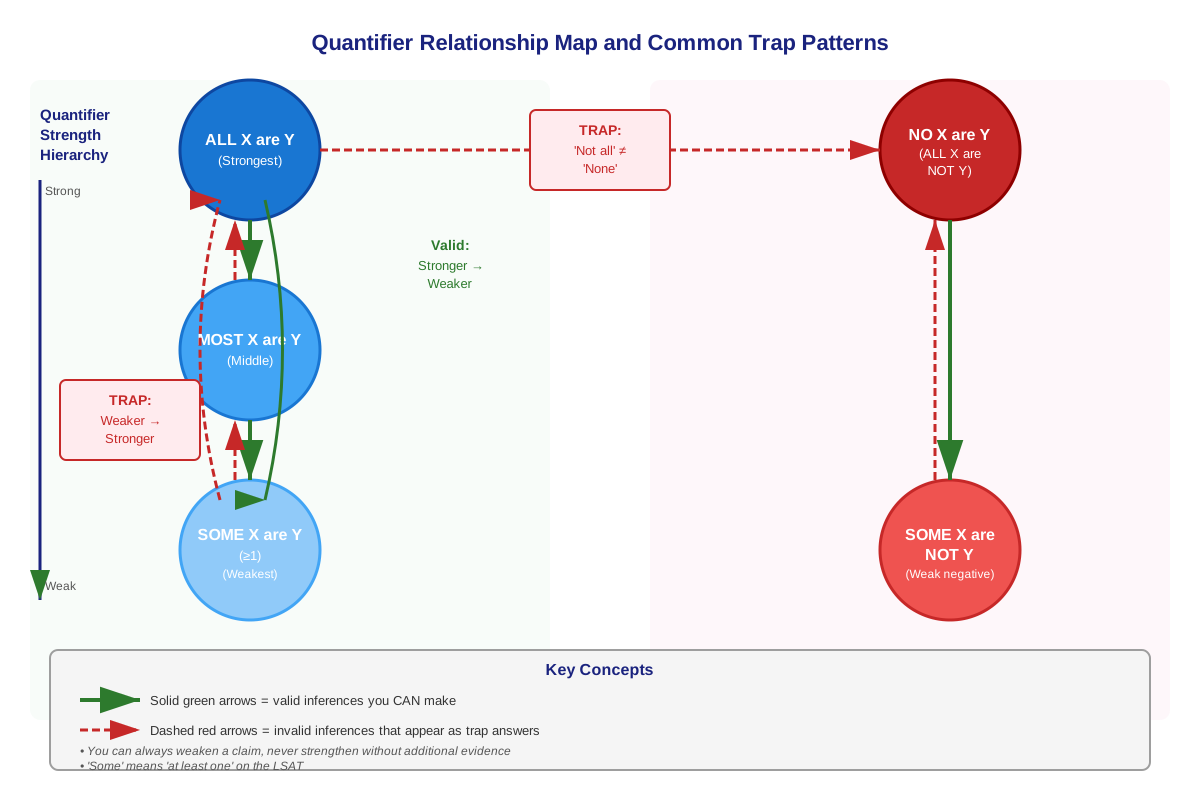
Quantifier shifts occur when answer choices change the quantifier from the stimulus, creating invalid inferences. The LSAT tests understanding of four primary quantifiers: all (universal affirmative), no/none (universal negative), some (particular affirmative), and some...not (particular negative). Each quantifier permits specific valid inferences, and shifting between them without justification creates logical errors.
| Original Statement | Valid Inferences | Invalid Quantifier Shifts |
|---|---|---|
| All A are B | Some A are B (if A exists); No A are non-B | All B are A; Most A are B |
| No A are B | No B are A; All A are non-B | Some A are not B (if A exists) |
| Some A are B | Some B are A; Not all A are non-B | All A are B; Most A are B |
| Most A are B | Some A are B; Not all A are non-B | All A are B; Most B are A |
A common quantifier shift trap involves moving from "some" to "all" or "most." For example, if the stimulus states "Some politicians are dishonest," a trap answer might claim "Most politicians are dishonest" or "All dishonest people are politicians." These shifts are particularly dangerous because they seem like reasonable extensions of the original claim, but they introduce information not present in the stimulus.
Another frequent quantifier trap involves the "most" quantifier. "Most A are B" does NOT allow us to conclude "Most B are A." If most students are hardworking, we cannot infer that most hardworking people are students—the relative sizes of the groups matter. The LSAT exploits this confusion regularly, especially in Must Be True questions.
Scope Violations
Scope violations occur when answer choices introduce concepts, terms, or relationships not present in the stimulus. These traps are particularly common in Sufficient Assumption and Must Be True questions, where the correct answer must be fully supported by or directly connected to the stimulus content. Scope violations come in several varieties:
- New term introduction: The answer choice mentions a concept never discussed in the stimulus
- Relationship expansion: The answer claims a relationship between elements that were discussed separately but never connected
- Temporal or modal shifts: The answer changes the timeframe (past to future) or modality (possible to necessary) without justification
- Comparative claims: The answer makes comparisons not supported by the stimulus
For example, if a stimulus discusses "economic growth" and "employment rates," a scope violation might introduce "inflation," "consumer confidence," or "stock market performance"—related economic concepts but not mentioned in the passage. Even if the answer seems economically plausible or true in the real world, it violates the logical scope of the argument.
Possibility vs. Necessity Confusion
A sophisticated trap involves confusing what could be true with what must be true. In Must Be True questions, the correct answer follows necessarily from the stimulus—it cannot be false if the stimulus is true. Trap answers often present scenarios that are possible or even likely but not logically required.
Consider a stimulus stating: "Every member of the committee voted for the proposal." A trap answer might say: "The proposal was popular among committee members." While this seems reasonable, "popular" suggests widespread approval beyond mere voting behavior and introduces a psychological element (approval) not necessarily implied by voting. The votes could have been strategic, coerced, or reluctant. The answer is possibly true but not necessarily true.
This trap is especially prevalent in questions involving conditional logic. From "If elected, she will lower taxes" (Elected → Lower Taxes), we cannot conclude "She wants to lower taxes" or "Lowering taxes is good policy." These might be true, but they don't follow necessarily from the conditional statement, which only establishes what will happen if the condition is met.
Compound Condition Traps
When stimuli present compound conditions using "and" or "or," trap answers often mishandle the logical relationships. A statement like "If A and B, then C" (A ∧ B → C) requires BOTH A and B to guarantee C. A trap answer might suggest that A alone is sufficient for C, or that B alone is sufficient for C, neither of which follows from the original statement.
Similarly, "If A or B, then C" (A ∨ B → C) means that EITHER condition is sufficient for C. Trap answers might claim that both are necessary, or that one is necessary and the other sufficient, misrepresenting the disjunctive relationship.
The contrapositive of compound conditions also creates traps. The contrapositive of "A ∧ B → C" is "~C → ~A ∨ ~B" (if not C, then not A or not B). Trap answers often present "~C → ~A ∧ ~B" (if not C, then not A and not B), which is stronger than what the logic permits.
Concept Relationships
The various formal logic answer traps interconnect through their shared foundation in conditional reasoning and valid inference patterns. Illegal reversals and illegal negations both stem from misunderstanding the asymmetric nature of conditional relationships—the sufficient condition guarantees the necessary condition, but not vice versa. These two traps represent the two most common ways students incorrectly manipulate conditionals, and recognizing one helps identify the other.
Quantifier shift traps connect to illegal reversals through the concept of conversion. "All A are B" does not convert to "All B are A," just as "A → B" does not reverse to "B → A." Both errors involve assuming a symmetric relationship where only an asymmetric one exists. Understanding quantifier logic deepens comprehension of conditional logic, as universal quantifiers can be expressed as conditionals (All A are B = A → B).
Scope violations interact with all other trap types by adding an additional layer of error. An answer choice might commit both an illegal reversal AND a scope violation, making it doubly wrong. Recognizing scope issues first can eliminate answers quickly, before even analyzing their logical structure. The relationship flows: First check scope (are all terms from the stimulus?), then check logical structure (are the relationships valid?), then check modality (is the claim necessarily true?).
Possibility versus necessity confusion represents the ultimate test of whether a student has mastered all other concepts. An answer might have perfect scope, valid logical structure, and correct quantifiers, yet still be wrong because it's merely possible rather than necessary. This trap sits at the apex of the logical hierarchy: Scope → Structure → Modality → Necessity.
The progression of mastery follows this path: Basic conditional logic → Contrapositive formation → Illegal reversal/negation recognition → Quantifier logic → Compound conditions → Scope analysis → Necessity evaluation. Each concept builds on previous ones, creating a comprehensive framework for evaluating answer choices systematically.
Quick check — test yourself on Formal logic answer traps so far.
Try Flashcards →High-Yield Facts
⭐ The only valid inference from "If A, then B" is the contrapositive "If not B, then not A"—any other directional inference is an illegal reversal or illegal negation
⭐ "Most A are B" does NOT allow the inference "Most B are A"—quantifier relationships are not automatically reversible
⭐ In Must Be True questions, the correct answer must be true if the stimulus is true; "could be true" or "likely true" answers are traps
⭐ Scope violations are the most common wrong answer type in Sufficient Assumption questions—the correct answer connects only terms already present in the stimulus
⭐ "If A and B, then C" requires BOTH conditions; the contrapositive is "If not C, then not A OR not B" (not "and")
- The contrapositive of a conditional is logically equivalent to the original; if one is true, the other must be true
- "Some A are B" is logically equivalent to "Some B are A"—this is the only quantifier relationship that converts validly
- "All A are B" allows the inference "Some A are B" only if at least one A exists
- Negating "all" yields "some...not," and negating "some" yields "none"—these are logical opposites
- Answer choices using extreme language ("always," "never," "only," "must") in Must Be True questions are often traps unless the stimulus uses equally strong language
- Temporal shifts (present to future, past to present) without explicit support in the stimulus create scope violations
- Comparative claims ("more than," "better than," "faster than") require explicit comparative information in the stimulus
- Modal shifts from "can" or "may" to "will" or "must" represent unwarranted strengthening of claims
Common Misconceptions
Misconception: If "All A are B" is true, then "All B are A" must also be true.
Correction: This is an illegal reversal. "All A are B" only tells us that the set of A is contained within the set of B, not that they are identical sets. B could contain many elements that are not A. The only valid reversal involves the contrapositive: "All A are B" means "All non-B are non-A."
Misconception: If the sufficient condition doesn't occur, the necessary condition won't occur either.
Correction: This is an illegal negation. From "If A, then B," we cannot conclude "If not A, then not B." The necessary condition (B) might occur for reasons other than the sufficient condition (A). The sufficient condition guarantees the necessary condition, but other factors might also produce the necessary condition.
Misconception: "Most A are B" and "Most B are A" are logically equivalent statements.
Correction: These statements are independent and neither implies the other. "Most" is not a reversible quantifier. If most students are hardworking (>50% of students), this tells us nothing definite about what percentage of hardworking people are students. The relative sizes of the two groups determine whether the reverse statement is true.
Misconception: In Must Be True questions, any answer that seems reasonable or likely is correct.
Correction: Must Be True questions require logical necessity, not plausibility. The correct answer must be true if the stimulus is true; it cannot possibly be false given the stimulus. Many trap answers are probably true or possibly true but not necessarily true. Real-world knowledge and common sense can actually lead students astray on these questions.
Misconception: If an answer choice uses different words than the stimulus, it's introducing new scope and must be wrong.
Correction: Paraphrasing and using synonyms is acceptable and often necessary. The issue is introducing new concepts or relationships, not new vocabulary. An answer that says "physicians" when the stimulus said "doctors" is fine. An answer that introduces "nurses" when only "doctors" were discussed commits a scope violation.
Misconception: The contrapositive of "If A and B, then C" is "If not C, then not A and not B."
Correction: The correct contrapositive is "If not C, then not A OR not B." When negating a compound sufficient condition joined by "and," the negation distributes as "or" (De Morgan's Law). If C doesn't occur, we know at least one of the conditions (A or B) didn't occur, but we don't know that both failed to occur.
Worked Examples
Example 1: Illegal Reversal and Quantifier Shift
Stimulus: "All successful entrepreneurs are risk-takers. Some risk-takers are wealthy individuals."
Question: Which of the following must be true?
Answer Choices:
(A) All risk-takers are successful entrepreneurs.
(B) Some wealthy individuals are successful entrepreneurs.
(C) All wealthy individuals are risk-takers.
(D) Some successful entrepreneurs are risk-takers.
(E) Most risk-takers are wealthy.
Analysis:
First, diagram the stimulus:
- Successful Entrepreneur → Risk-Taker
- Some Risk-Takers are Wealthy
Now evaluate each answer:
(A) "All risk-takers are successful entrepreneurs" reverses the first conditional (Risk-Taker → Successful Entrepreneur). This is an illegal reversal. The original statement tells us all entrepreneurs are risk-takers, not that all risk-takers are entrepreneurs. ELIMINATE.
(B) "Some wealthy individuals are successful entrepreneurs" attempts to connect wealthy individuals to successful entrepreneurs. However, the stimulus only tells us some risk-takers are wealthy and all entrepreneurs are risk-takers. We cannot determine whether any wealthy individuals are entrepreneurs—they might all be risk-takers who are not entrepreneurs. This commits a scope violation by claiming a relationship not established in the stimulus. ELIMINATE.
(C) "All wealthy individuals are risk-takers" commits a quantifier shift from "some" to "all." The stimulus says some risk-takers are wealthy, which is equivalent to saying some wealthy individuals are risk-takers, but this doesn't mean all wealthy individuals are risk-takers. ELIMINATE.
(D) "Some successful entrepreneurs are risk-takers" is valid. Since all successful entrepreneurs are risk-takers (assuming at least one successful entrepreneur exists), it follows that some successful entrepreneurs are risk-takers. This is a valid weakening of the universal quantifier. CORRECT.
(E) "Most risk-takers are wealthy" commits a quantifier shift from "some" to "most." The stimulus provides no information about the proportion of risk-takers who are wealthy. ELIMINATE.
Key Takeaway: This example demonstrates how multiple trap types can appear in a single question. The correct answer (D) is actually a weaker claim than what the stimulus states, which is often the case in Must Be True questions—the LSAT tests whether you can recognize what must follow, even if it's less informative than the original statement.
Example 2: Compound Conditions and Illegal Negation
Stimulus: "The committee will approve the proposal only if both the budget is balanced and the timeline is realistic. The timeline is not realistic."
Question: Which of the following can be properly concluded?
Answer Choices:
(A) The budget is not balanced.
(B) The committee will not approve the proposal.
(C) If the budget is balanced, the committee will approve the proposal.
(D) The committee will approve the proposal if the budget is not balanced.
(E) If the timeline were realistic, the committee would approve the proposal.
Analysis:
First, translate the stimulus into formal logic:
- "Only if" introduces a necessary condition: Approve → (Balanced ∧ Realistic)
- We're told: ~Realistic
The contrapositive of the first statement is: ~(Balanced ∧ Realistic) → ~Approve
This simplifies to: (~Balanced ∨ ~Realistic) → ~Approve
Since we know ~Realistic is true, we know (~Balanced ∨ ~Realistic) is true, which triggers the contrapositive.
(A) "The budget is not balanced" cannot be concluded. We know at least one of the conditions failed (budget not balanced OR timeline not realistic), and we know the timeline is not realistic, but this doesn't tell us anything definite about the budget. The budget might or might not be balanced. ELIMINATE.
(B) "The committee will not approve the proposal" is correct. Since the timeline is not realistic, the compound necessary condition (Balanced ∧ Realistic) is not met. When a necessary condition fails, the sufficient condition cannot occur. Therefore, the committee will not approve the proposal. CORRECT.
(C) "If the budget is balanced, the committee will approve the proposal" commits an illegal reversal and misunderstands compound conditions. Even if the budget is balanced, we need BOTH conditions (balanced AND realistic timeline) for approval. Since the timeline is not realistic, approval won't happen regardless of the budget. ELIMINATE.
(D) "The committee will approve the proposal if the budget is not balanced" is illogical and commits multiple errors. It suggests that NOT meeting one of the necessary conditions would lead to approval, which contradicts the logic entirely. ELIMINATE.
(E) "If the timeline were realistic, the committee would approve the proposal" commits the same error as (C)—assuming one condition is sufficient when both are necessary. Even with a realistic timeline, we'd still need a balanced budget for approval. ELIMINATE.
Key Takeaway: Compound necessary conditions require ALL elements to be present for the sufficient condition to occur. If any element of a compound necessary condition fails, the sufficient condition cannot occur. This example also shows how the LSAT tests understanding of "only if" (which introduces necessary, not sufficient, conditions) and how to properly apply the contrapositive with compound conditions.
Exam Strategy
When approaching LSAT questions involving formal logic, implement a systematic process to avoid answer traps:
Step 1: Identify and diagram all conditional relationships in the stimulus. Look for indicator words: "if," "when," "whenever" (sufficient conditions); "then," "only if," "requires," "necessary" (necessary conditions). Write out the relationships using arrows or your preferred notation system.
Step 2: Form contrapositives immediately for all conditional statements. Having both the original and contrapositive visible prevents illegal reversals and negations. Many correct answers are simply contrapositives of stimulus statements.
Step 3: Note all quantifiers precisely. Distinguish between "all," "most," "some," and "none." These are not interchangeable, and shifting between them creates invalid inferences. Circle or underline quantifiers to keep them prominent.
Step 4: Identify the question type to determine what the correct answer must do. Must Be True questions require necessity; Sufficient Assumption questions require scope-matching; Parallel Reasoning questions require structural identity. Different question types have different trap patterns.
Step 5: Pre-phrase the correct answer when possible. Before looking at answer choices, determine what must be true or what assumption is needed. This prevents trap answers from seeming attractive.
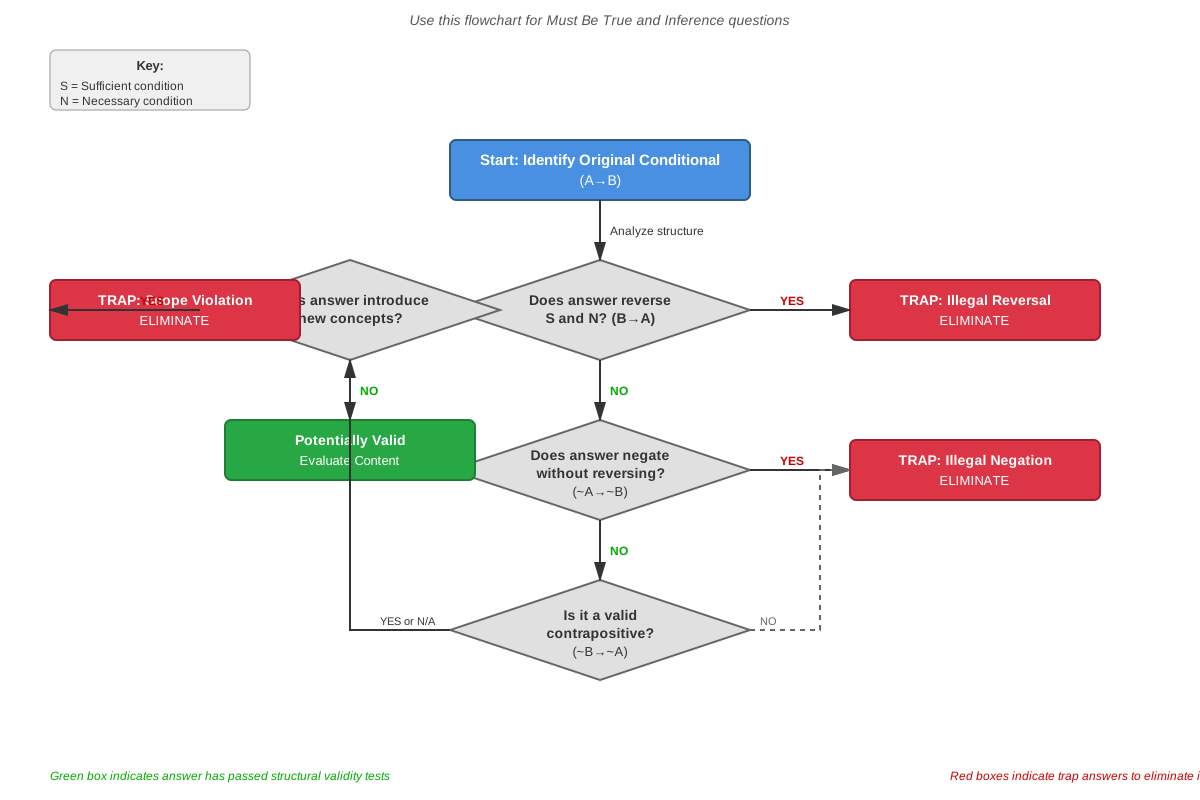
Step 6: Evaluate answer choices systematically using the elimination hierarchy:
- Scope check: Does the answer introduce new terms or concepts?
- Direction check: Does it reverse or illegally negate a conditional?
- Quantifier check: Does it shift quantifiers without justification?
- Necessity check: Must this be true, or could it merely be true?
Exam Tip: In Must Be True questions, extreme answer choices ("always," "never," "only," "all") are usually wrong unless the stimulus uses equally extreme language. The correct answer is often more moderate or qualified.
Trigger words for illegal reversals: "therefore," "thus," "consequently" followed by a reversal of the stimulus conditional. Watch for answers that flip the order of terms while maintaining the conditional structure.
Trigger words for scope violations: "probably," "likely," "suggests," "indicates"—these often signal that the answer is making claims beyond what the stimulus logically establishes.
Time allocation: Spend 15-20 seconds diagramming complex formal logic stimuli. This upfront investment saves time by making answer evaluation faster and more accurate. Don't rush the setup phase.
Process of elimination: In formal logic questions, you can often eliminate 3-4 answers quickly by checking for obvious reversals, negations, or scope violations. This leaves you comparing only 1-2 plausible answers, where careful logical analysis determines the correct choice.
Memory Techniques
Mnemonic for valid inferences from conditionals: "ONLY CONTRA"
- Original statement
- No other directional inferences
- Logically equivalent
- Yields the contrapositive
Acronym for answer evaluation: "SDQN" (Scope, Direction, Quantifier, Necessity)
- Scope: Are all terms from the stimulus?
- Direction: Is the conditional direction preserved?
- Quantifier: Is the quantifier unchanged?
- Necessity: Must this be true?
Visualization for illegal reversals: Picture a one-way street. "If A, then B" is like a street going from A to B. You can't drive backward (B to A) just because the street exists. The contrapositive is like finding an alternate route: if you can't reach B, you must not have started from A.
Mnemonic for compound condition contrapositives: "AND becomes OR"
When negating "If A and B, then C," remember: the contrapositive negates and reverses, and "and" becomes "or": "If not C, then not A or not B."
Quantifier relationship memory device: "ALL-SOME-NONE triangle"
- ALL → SOME (valid weakening)
- NONE → NOT ALL (logical opposites)
- SOME and SOME...NOT are contradictories
- Only SOME converts validly (Some A are B = Some B are A)
Scope violation check: "New Terms = Wrong"
If an answer choice introduces a term not in the stimulus, it's almost always wrong in Must Be True and Sufficient Assumption questions. Mentally highlight every noun and concept in the stimulus, then check that answer choices don't add to this list.
Summary
Formal logic answer traps represent systematic patterns of incorrect reasoning that the LSAT uses to test precise logical thinking. The most common traps—illegal reversals, illegal negations, quantifier shifts, and scope violations—exploit predictable errors in conditional reasoning and inference formation. Mastering these traps requires understanding that conditional relationships are asymmetric (A → B does not imply B → A), that the only valid inference from a conditional is its contrapositive (~B → ~A), and that quantifiers cannot be shifted without explicit justification. Compound conditions require special attention, as their contrapositives involve distributing negation according to De Morgan's Laws. The distinction between what must be true versus what could be true separates correct answers from attractive traps in Must Be True questions. Systematic evaluation using scope, direction, quantifier, and necessity checks enables efficient elimination of trap answers. These skills transfer across Logical Reasoning question types and form the foundation for advanced LSAT performance, as formal logic underlies not only explicit conditional reasoning questions but also argument structure, assumption identification, and inference evaluation throughout the test.
Key Takeaways
- The only valid inference from "If A, then B" is the contrapositive "If not B, then not A"—all other directional inferences are traps
- Illegal reversals (B → A) and illegal negations (~A → ~B) are the most common formal logic traps on the LSAT
- Quantifier shifts, especially from "some" to "all" or "most," create invalid inferences that appear in wrong answer choices
- Scope violations introduce new terms or relationships not present in the stimulus and are particularly common in Sufficient Assumption questions
- Must Be True questions require logical necessity, not plausibility—"could be true" answers are traps regardless of how reasonable they seem
- Compound conditions joined by "and" require all elements for the sufficient condition to occur; their contrapositives use "or"
- Systematic answer evaluation using SDQN (Scope, Direction, Quantifier, Necessity) prevents falling for trap answers under time pressure
Related Topics
Conditional Logic Chains: Building on formal logic answer traps, this topic explores how multiple conditional statements link together to create extended inference chains, where recognizing traps becomes more complex across multiple logical steps.
Quantifier Logic and Venn Diagrams: Deepens understanding of quantifier relationships through visual representation, making quantifier shift traps easier to identify and avoid.
Sufficient vs. Necessary Assumptions: Applies formal logic trap recognition to assumption questions, where understanding the precise logical requirements prevents selecting assumptions that are too strong, too weak, or outside the argument's scope.
Formal Logic in Parallel Reasoning: Extends trap recognition to questions requiring structural matching, where illegal reversals and negations appear as structural mismatches between stimulus and answer choice arguments.
Advanced Contrapositive Applications: Explores complex scenarios involving multiple conditionals, compound conditions, and nested logic where contrapositive formation becomes essential for efficient problem-solving.
Practice CTA
Now that you understand the systematic patterns behind formal logic answer traps, you're ready to apply these concepts to actual LSAT questions. The practice questions and flashcards will reinforce your ability to spot illegal reversals, illegal negations, quantifier shifts, and scope violations under timed conditions. Each practice problem you complete strengthens your pattern recognition and builds the automaticity needed for test-day success. Remember: these traps appear in 40-50% of Logical Reasoning questions, making this practice among the highest-yield activities for score improvement. Approach each practice question systematically using the SDQN framework, and you'll develop the precision and confidence that distinguish top LSAT performers. Your investment in mastering these concepts will pay dividends across every section of the test!
Sign up free to keep reading
Create a free AnvayaPrep account to finish this LSAT guide on Formal logic answer traps — plus flashcards and practice questions.