Overview
Quantifier inference is a fundamental reasoning skill tested extensively throughout the LSAT Logical Reasoning sections. This topic involves understanding how statements containing quantifiers—words like "all," "some," "most," "none," and "many"—relate to one another and what logical conclusions can be validly drawn from them. Mastering quantifier inference enables test-takers to navigate complex argument structures, identify valid and invalid inferences, and recognize subtle logical relationships that distinguish correct answers from attractive distractors.
The LSAT frequently presents arguments that hinge on the proper interpretation of quantified statements. A test-taker who understands formal logic and quantifiers can quickly identify when an argument commits a quantifier shift error, when a conclusion legitimately follows from quantified premises, or when additional information would be needed to support a claim. This skill appears across multiple question types, including Must Be True, Sufficient Assumption, Necessary Assumption, Flaw, and Parallel Reasoning questions. The ability to work fluently with quantifiers separates high scorers from average performers because it enables precise logical analysis rather than intuitive but unreliable reasoning.
Within the broader framework of logical reasoning, quantifier inference connects directly to conditional logic, formal logic structures, and argument evaluation. While conditional statements deal with "if-then" relationships, quantified statements express relationships between groups or categories. Understanding both systems and how they interact provides a comprehensive toolkit for dissecting LSAT arguments. Many complex LSAT questions combine quantifiers with conditional logic, requiring test-takers to translate between different logical forms and track multiple relationships simultaneously.
Learning Objectives
- [ ] Identify how Quantifier inference appears in LSAT questions
- [ ] Explain the reasoning pattern behind Quantifier inference
- [ ] Apply Quantifier inference to solve LSAT-style problems accurately
- [ ] Distinguish between valid and invalid quantifier inferences in argument structures
- [ ] Translate natural language statements into formal quantifier notation
- [ ] Recognize common quantifier shift fallacies and explain why they are invalid
- [ ] Combine quantifier reasoning with conditional logic to solve complex problems
Prerequisites
- Basic conditional logic: Understanding "if-then" statements is essential because quantifiers often interact with conditional relationships in LSAT arguments
- Argument structure identification: Recognizing premises and conclusions allows proper application of quantifier rules to evaluate argument validity
- Categorical relationships: Familiarity with how groups and categories relate helps in understanding what quantified statements actually claim
- Negation principles: Knowing how to properly negate statements is crucial for working with quantifier oppositions and contrapositives
Why This Topic Matters
Quantifier inference appears in approximately 15-25% of all Logical Reasoning questions on the LSAT, making it one of the highest-yield topics for score improvement. Questions involving quantifiers span virtually every question type, though they appear most frequently in Must Be True, Flaw, Sufficient Assumption, and Parallel Reasoning questions. The LSAT tests quantifier reasoning both explicitly—with formal logic structures clearly visible—and implicitly, where quantifier relationships are embedded in natural language arguments.
In real-world applications, quantifier reasoning underlies legal interpretation, policy analysis, and contractual language. Attorneys must distinguish between "all parties must consent" versus "some parties must consent" when interpreting agreements. Judges evaluate whether evidence proves "beyond reasonable doubt" (a quantifier concept) versus "more likely than not." The precision required for legal reasoning makes quantifier inference an authentic preview of law school and legal practice demands.
On the LSAT, quantifier inference commonly appears when arguments make claims about groups, categories, or populations. A stimulus might state that "most lawyers work long hours" and conclude something about "all lawyers" or "some specific lawyer"—requiring test-takers to evaluate whether the inference is valid. Alternatively, questions might present statistical information using quantifiers and ask what must be true, could be true, or cannot be true based on that information. Recognizing these patterns and applying systematic quantifier rules enables rapid, accurate question analysis.
Core Concepts
The Basic Quantifiers
Lsat quantifier inference begins with understanding the four fundamental quantifiers and their logical properties. Each quantifier makes a specific claim about the relationship between two categories or groups:
All (Universal Affirmative): States that every member of one category belongs to another category. "All dogs are mammals" means if something is a dog, it is definitely a mammal. This is the strongest affirmative quantifier and can be represented as: All A are B.
No/None (Universal Negative): States that no member of one category belongs to another category. "No reptiles are mammals" means if something is a reptile, it is definitely not a mammal. This is the strongest negative quantifier: No A are B.
Some (Particular Affirmative): States that at least one member of one category belongs to another category. "Some lawyers are judges" means at least one lawyer is a judge, but makes no claim about how many. Critically, "some" in formal logic means "at least one" and could include "all." This is represented as: Some A are B.
Most (Majority Quantifier): States that more than half of one category belongs to another category. "Most students study hard" means more than 50% of students study hard. This quantifier is particularly important on the LSAT because it enables certain inferences that "some" does not.
Valid Quantifier Inferences
Understanding what can and cannot be validly inferred from quantified statements is the core of quantifier inference:
| Original Statement | Valid Inferences | Invalid Inferences |
|---|---|---|
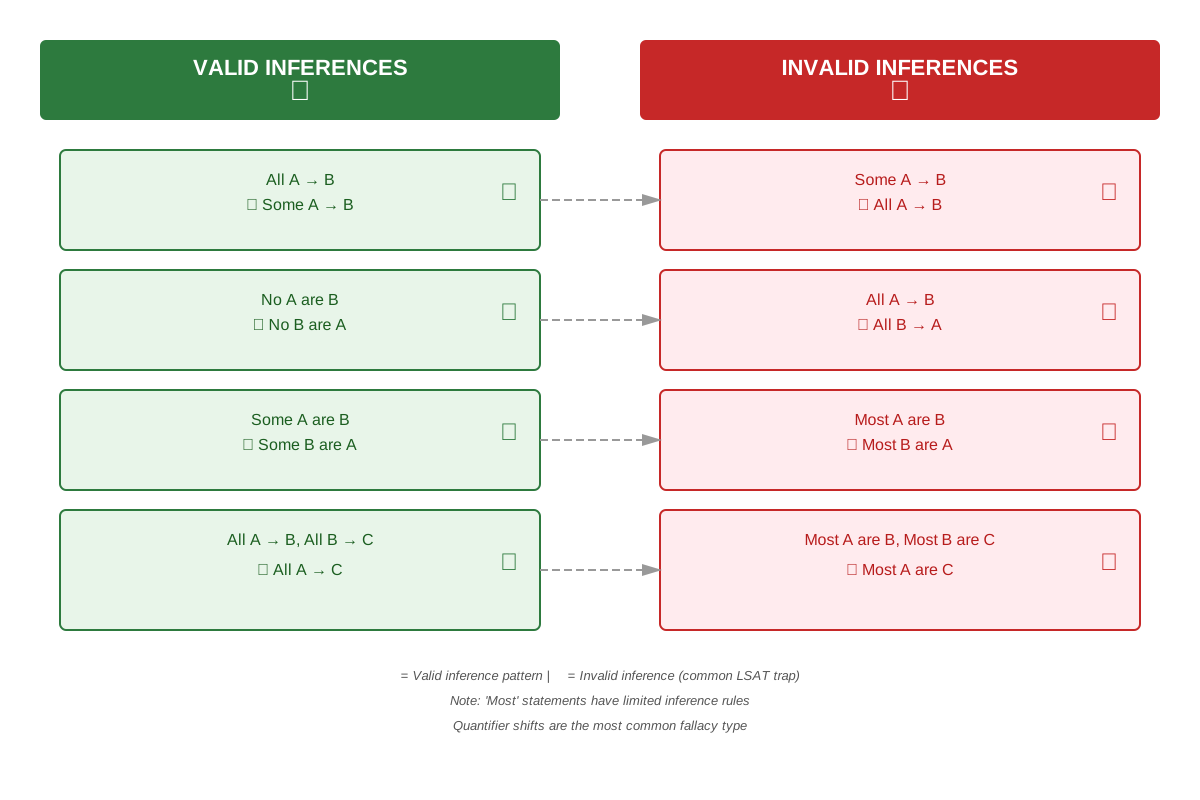
| All A are B | Some A are B (if A exists); Some B are A (if A exists) | All B are A; Most A are B |
| No A are B | No B are A; Some A are not B (if A exists) | All A are not-B (if A might not exist) |
| Some A are B | Some B are A; At least one A exists; At least one B exists | Most A are B; All A are B |
| Most A are B | Some A are B; At least one A exists | All A are B; Most B are A |
The conversion rules are particularly important: "All A are B" does NOT convert to "All B are A," but "No A are B" DOES convert to "No B are A." This asymmetry causes many test-taker errors. Similarly, "Some A are B" converts perfectly to "Some B are A," but "Most A are B" does NOT convert to "Most B are A."
Quantifier Negations
Properly negating quantified statements is essential for evaluating arguments and finding necessary assumptions:
- The negation of "All A are B" is "Some A are not B" (NOT "No A are B")
- The negation of "No A are B" is "Some A are B"
- The negation of "Some A are B" is "No A are B"
- The negation of "Most A are B" is "Most A are not B" or "Half or fewer A are B"
These negation relationships form what logicians call the "Square of Opposition." Understanding these relationships prevents common errors where test-takers incorrectly assume that the opposite of "all" is "none" rather than "some...not."
Combining Quantifiers: Syllogistic Reasoning
The LSAT frequently tests the ability to combine multiple quantified statements to reach valid conclusions:
Valid Combination Patterns:
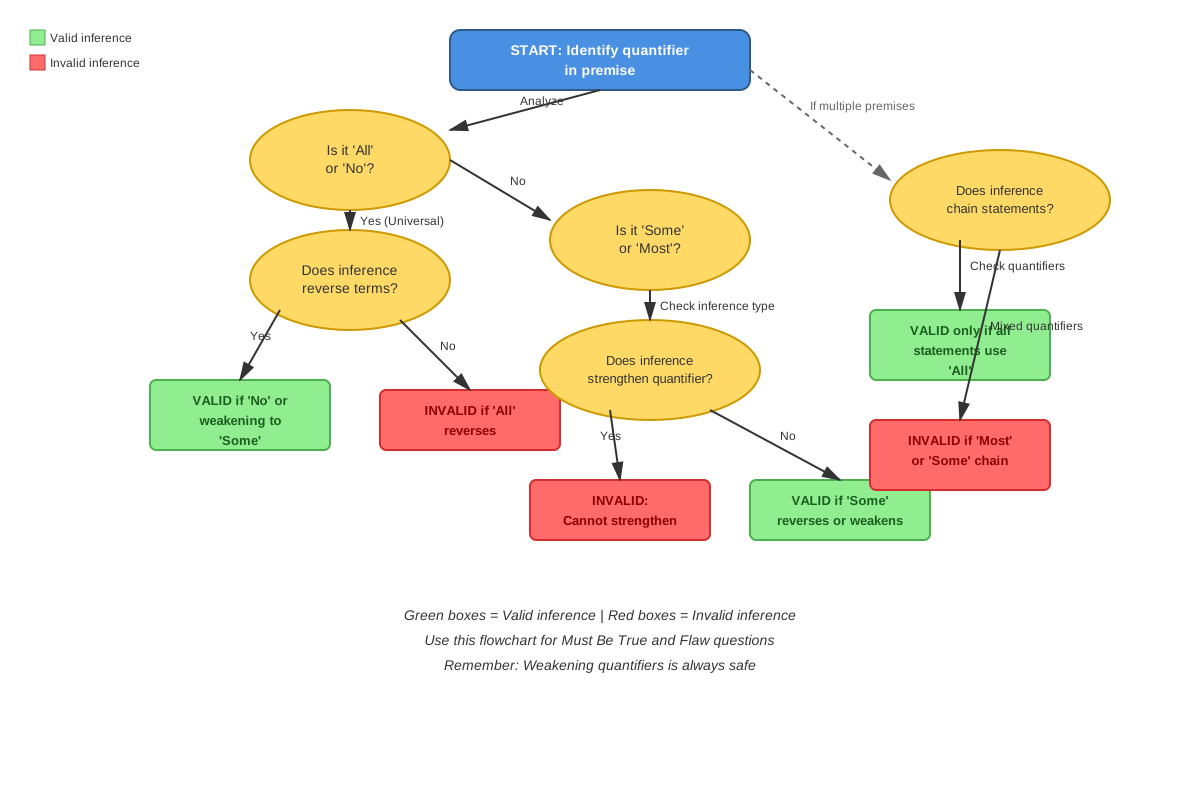
- All-All Chain: All A are B + All B are C → All A are C
- Most-Most Chain: Most A are B + Most B are C → Some A are C (but NOT necessarily most)
- Most-All Chain: Most A are B + All B are C → Most A are C
- Some-All Chain: Some A are B + All B are C → Some A are C
Invalid Combination Patterns:
- All A are B + All C are B → Cannot conclude anything definite about A and C
- Most A are B + Some B are C → Cannot conclude anything definite about A and C
- Some A are B + Some B are C → Cannot conclude anything definite about A and C
The key principle is that quantifiers can only chain together when the second term of one statement matches the first term of the next statement, and even then, only certain combinations yield valid conclusions.
Quantifier Shift Fallacies
A quantifier shift occurs when an argument illegitimately moves from one quantifier to another. Common patterns include:
Hasty Generalization: Moving from "some" to "all" without justification. Example: "Some politicians are corrupt, therefore all politicians are corrupt."
Unwarranted Weakening: Moving from "all" to "most" or "some" when the conclusion requires "all." Example: "We need all team members to agree, but most have agreed, so we can proceed."
Reverse Majority Inference: Assuming that "Most A are B" means "Most B are A." Example: "Most professional athletes are wealthy, so most wealthy people are professional athletes."
Existential Import
Statements beginning with "all" or "no" do not guarantee that the category being discussed actually has any members. "All unicorns are magical" is technically true because there are no unicorns to contradict it. However, "Some unicorns are magical" would be false because "some" requires at least one actual member.
This concept matters on the LSAT when evaluating what must be true: from "All A are B" alone, you cannot conclude "Some A are B" unless you know that at least one A exists. The LSAT occasionally exploits this technicality, though more commonly it assumes categories discussed have members unless otherwise indicated.
Concept Relationships
The concepts within quantifier inference form an interconnected logical system. Basic quantifiers (all, some, most, none) serve as the foundation → these enable valid quantifier inferences through conversion and immediate inference rules → understanding these inferences requires mastery of quantifier negations to identify logical opposites → these elements combine in syllogistic reasoning where multiple quantified premises yield conclusions → throughout this system, quantifier shift fallacies represent the invalid moves that arguments must avoid.
Quantifier inference connects to prerequisite topics in several ways. Conditional logic often combines with quantifiers: "All A are B" can be expressed as "If A, then B," creating a bridge between quantifier and conditional reasoning systems. Argument structure knowledge enables identification of where quantifiers appear in premises versus conclusions, which is essential for evaluating validity. Negation principles from basic logic extend directly into quantifier negations, where understanding logical opposites becomes crucial.
Looking forward, quantifier inference enables progression to more advanced topics like formal logic translation, where complex natural language arguments are converted into symbolic form, and advanced assumption questions, where recognizing subtle quantifier shifts helps identify necessary and sufficient assumptions. The relationship map flows: Basic Logic → Quantifier Inference → Complex Formal Logic → Advanced Argument Analysis.
Quick check — test yourself on Quantifier inference so far.
Try Flashcards →High-Yield Facts
⭐ "All A are B" does NOT convert to "All B are A" – this is the single most common quantifier error on the LSAT
⭐ "Some" in formal logic means "at least one" and could include "all" – never eliminate an answer choice because it seems too strong if "some" is in the premise
⭐ The negation of "all" is "some...not," NOT "none" – this appears frequently in Necessary Assumption and Weaken questions
⭐ "Most A are B" does NOT convert to "Most B are A" – the LSAT exploits this asymmetry repeatedly
⭐ Two "most" statements about the same category guarantee overlap – if Most A are B and Most A are C, then Some B are C
- "No A are B" perfectly converts to "No B are A" – this is the only universal quantifier that converts symmetrically
- Combining "All A are B" with "All B are C" yields "All A are C" – this is the only guaranteed transitive chain
- "Some A are B" converts perfectly to "Some B are A" – particular affirmatives are symmetric
- From "Most A are B" and "All B are C," you can validly conclude "Most A are C" – most-all chains preserve the majority
- Quantifier scope matters: "All lawyers are not wealthy" is ambiguous between "No lawyers are wealthy" and "Not all lawyers are wealthy"
Common Misconceptions
Misconception: The opposite of "all" is "none."
Correction: The logical negation of "all" is "some...not." If it's not true that all dogs are friendly, that means at least one dog is not friendly—not that no dogs are friendly. The LSAT exploits this in Necessary Assumption questions where test-takers incorrectly select extreme negations.
Misconception: "Most A are B" means the same thing as "Most B are A."
Correction: These are completely different claims. Most professional athletes are male, but it's not true that most males are professional athletes. Quantifiers only convert symmetrically for "some" and "none/no," never for "all" or "most."
Misconception: If some A are B and some B are C, then some A are C.
Correction: This inference is invalid. Some dogs are brown, and some brown things are tables, but no dogs are tables. The LSAT frequently includes this invalid inference pattern as a trap answer in Must Be True and Parallel Reasoning questions.
Misconception: "All A are B" means that A and B are the same group.
Correction: "All A are B" means every A is included in B, but B might contain many other things. All dogs are mammals, but mammals include cats, whales, and humans. This confusion leads to invalid conversion errors.
Misconception: You can't conclude anything from two "some" statements.
Correction: While you generally cannot conclude anything definite, if both "some" statements are about the same specific individual or entity, you can draw conclusions. "Some politicians are lawyers" and "Some lawyers are judges" tells you nothing definite about politicians and judges, but if you know "John is a politician" and "John is a lawyer," you can conclude John is both.
Misconception: "Most" means "almost all" or "the vast majority."
Correction: In formal logic, "most" means strictly "more than half" (>50%). It could mean 51% or 99%. The LSAT uses this precise definition, so "most" is much weaker than test-takers intuitively assume.
Worked Examples
Example 1: Must Be True Question
Stimulus: "Most of the students in Professor Chen's class are philosophy majors. All philosophy majors at this university are required to take a logic course. Therefore, most students in Professor Chen's class have taken a logic course."
Question: Which of the following, if assumed, allows the conclusion to be properly drawn?
Analysis:
Step 1: Identify the quantified statements and translate them:
- Premise 1: Most (Chen's students) are (philosophy majors)
- Premise 2: All (philosophy majors at this university) are (required to take logic)
- Conclusion: Most (Chen's students) have (taken logic)
Step 2: Evaluate the logical chain:
We have a Most-All combination: Most A are B, and All B are C. This validly yields "Most A are C" IF the philosophy majors in Chen's class are the same philosophy majors covered by the "all" statement.
Step 3: Identify the gap:
The argument assumes that the philosophy majors in Chen's class are at "this university" (so they're covered by the requirement). If Chen's class included visiting students from other universities who are philosophy majors, they wouldn't be required to take logic at this university.
Step 4: Required assumption:
The argument needs to assume that the philosophy majors in Chen's class are philosophy majors at this university, not elsewhere.
Correct Answer Pattern: "All philosophy majors in Professor Chen's class are philosophy majors at this university" or equivalent.
Connection to Learning Objectives: This example demonstrates how quantifier inference appears in Assumption questions (Objective 1), shows the Most-All reasoning pattern (Objective 2), and requires applying quantifier rules to identify logical gaps (Objective 3).
Example 2: Flaw Question
Stimulus: "A recent survey found that some doctors recommend herbal supplements to their patients. Furthermore, most herbal supplements have not been rigorously tested for safety. Therefore, some doctors recommend products to their patients that have not been rigorously tested for safety."
Question: The reasoning in the argument is flawed because it:
Analysis:
Step 1: Map the quantifier structure:
- Premise 1: Some (doctors) recommend (herbal supplements)
- Premise 2: Most (herbal supplements) have not been (rigorously tested)
- Conclusion: Some (doctors) recommend (untested products)
Step 2: Evaluate the inference:
The argument tries to combine "Some A are B" with "Most B are C" to conclude "Some A are C." This is an invalid inference pattern. We know some doctors recommend herbal supplements, and we know most herbal supplements are untested, but we don't know whether the specific supplements recommended by doctors are among the tested or untested ones.
Step 3: Identify the flaw type:
This is a quantifier combination error. The argument fails to establish that the "some" doctors and the "most" untested supplements overlap. Perhaps the doctors only recommend the minority of supplements that have been tested.
Step 4: Predict the answer:
The correct answer will identify that the argument improperly assumes overlap between the supplements doctors recommend and the supplements that haven't been tested.
Correct Answer Pattern: "Fails to establish that the herbal supplements recommended by doctors are among those that have not been rigorously tested" or "Assumes without justification that the herbal supplements recommended by doctors are representative of herbal supplements generally."
Connection to Learning Objectives: This example shows quantifier inference in Flaw questions (Objective 1), explains the invalid Some-Most reasoning pattern (Objective 2), demonstrates a quantifier shift fallacy (Objective 6), and applies systematic analysis to identify the error (Objective 3).
Exam Strategy
When approaching LSAT questions involving quantifier inference, follow this systematic process:
Step 1: Identify and translate quantifiers – Circle or underline every quantifier word (all, some, most, none, many, few) and translate the statement into formal structure. Write "All A → B" or "Most A are B" in the margin to clarify relationships.
Step 2: Check for conversion errors – Whenever an argument moves from "All A are B" to a claim about B, immediately check whether it's illegitimately converting to "All B are A." This is the highest-yield error pattern to spot.
Step 3: Track quantifier chains – If multiple quantified statements appear, determine whether they can validly combine. Look for matching terms (the B in "All A are B" and "All B are C") and verify the combination pattern is valid.
Step 4: Watch for quantifier shifts – Compare the quantifier strength in premises versus conclusions. If premises use "some" or "most" but the conclusion uses "all," you've likely found the flaw or identified what assumption is needed.
Exam Tip: The words "many," "several," and "numerous" are logically equivalent to "some" (at least one). Don't be fooled by natural language variations—translate them all to "some" for analysis.
Trigger words and phrases to watch for:
- "All," "every," "each," "any" → Universal affirmative
- "No," "none," "not any" → Universal negative
- "Some," "a few," "several," "at least one" → Particular affirmative
- "Most," "majority," "more than half" → Majority quantifier
- "Not all," "some...not" → Negation of universal affirmative
Process-of-elimination tips:
In Must Be True questions, eliminate any answer that requires converting "all" or "most" statements. In Flaw questions, prioritize answers mentioning "assumes," "takes for granted," or "fails to establish" combined with quantifier language. In Sufficient Assumption questions, look for answers that bridge quantifier gaps by providing the missing link in a chain.
Time allocation: Spend 10-15 seconds identifying and translating quantifiers before reading answer choices. This upfront investment prevents re-reading and confusion. If a question involves three or more quantified statements, it's likely testing combination rules—budget an extra 15-20 seconds for careful analysis.
Memory Techniques
SCAN Mnemonic for Quantifier Negations:
- Some → None (and vice versa)
- Convert None freely (No A are B = No B are A)
- All → Some...not (NOT none!)
- Never convert All or Most
Visualization Strategy for Quantifier Relationships:
Picture quantifiers as nested circles (Venn diagrams). "All A are B" means the A circle is completely inside the B circle. "Some A are B" means the circles overlap. "No A are B" means the circles don't touch. "Most A are B" means more than half of the A circle overlaps with B. This mental image prevents conversion errors because you can see that even if all of A is inside B, B might be much larger.
The "MOST" Rule Acronym:
- More than half (>50%)
- Overlap guaranteed with two "most" statements about same category
- Some is always true if most is true
- Transitive with "all" (Most A→B + All B→C = Most A→C)
Conversion Memory Aid: "NONE and SOME play fair; ALL and MOST don't share." Only "none" and "some" convert symmetrically; "all" and "most" do not.
Summary
Quantifier inference is a high-yield LSAT topic requiring precise understanding of how statements containing "all," "some," "most," and "none" relate logically. The core skill involves recognizing valid versus invalid inferences: "all" statements do not convert (All A are B ≠ All B are A), but "none" and "some" statements do convert symmetrically. Proper negation is critical—the opposite of "all" is "some...not," not "none." When combining quantified statements, only certain patterns yield valid conclusions: All-All chains work transitively, Most-All chains preserve the majority, but Some-Some combinations prove nothing definite. The LSAT exploits quantifier reasoning across question types, particularly in Must Be True, Flaw, and Assumption questions. Success requires systematic translation of natural language into formal quantifier structures, careful tracking of quantifier strength through arguments, and recognition of common fallacies like hasty generalization and improper conversion. Mastering these patterns enables rapid identification of logical gaps and valid inferences, directly improving accuracy and speed on test day.
Key Takeaways
- All A are B does not convert to All B are A—this is the single most tested quantifier error on the LSAT
- The negation of "all" is "some...not," and the negation of "some" is "none"—never confuse opposites with negations
- Most A are B combined with All B are C validly yields Most A are C—this is the most reliable quantifier chain
- Two "most" statements about the same category guarantee overlap: if Most A are B and Most A are C, then Some B are C
- "Some" in formal logic means "at least one" and could include "all"—don't eliminate answers for being too strong
- Quantifier shift fallacies (moving from some/most to all, or vice versa) appear in approximately 20% of Flaw questions
- Systematic translation of quantifiers into formal notation prevents errors and saves time on complex questions
Related Topics
Conditional Logic and Contraposition: Quantifier inference connects directly to conditional reasoning because "All A are B" can be expressed as "If A, then B." Mastering both systems enables handling complex arguments that combine quantifiers with conditional structures.
Formal Logic Translation: Advanced application of quantifier inference involves translating complex natural language arguments into symbolic logic notation, enabling precise evaluation of validity.
Necessary vs. Sufficient Assumptions: Understanding quantifier relationships is essential for identifying what assumptions arguments require (necessary) versus what would guarantee their conclusions (sufficient), particularly when arguments involve quantifier shifts.
Statistical Reasoning: Quantifiers like "most" connect to statistical concepts tested on the LSAT, including sampling, generalization, and the relationship between parts and wholes.
Argument Diagramming: Visual representation of argument structure benefits from quantifier notation, helping test-takers track complex relationships across multiple premises.
Practice CTA
Now that you understand the core principles of quantifier inference, it's time to cement your mastery through active practice. Attempt the practice questions associated with this topic, focusing on identifying quantifier patterns before looking at answer choices. Create flashcards for the valid and invalid inference patterns, and quiz yourself on quantifier negations until they become automatic. Remember: quantifier inference appears in roughly one out of every four Logical Reasoning questions, making this one of the highest-return investments of your study time. Every minute spent mastering these patterns translates directly into points on test day. You've built the foundation—now apply it systematically to real LSAT questions and watch your accuracy soar.
Sign up free to keep reading
Create a free AnvayaPrep account to finish this LSAT guide on Quantifier inference — plus flashcards and practice questions.