Overview
Some statements represent one of the most fundamental building blocks of formal logic and quantifiers tested on the LSAT. These statements express partial existence claims—assertions that at least one member of a category possesses a particular property. While they may appear deceptively simple at first glance, LSAT some statements carry precise logical meanings that differ significantly from everyday conversational usage. Understanding these statements is essential for success in Logical Reasoning sections, where they appear frequently in argument analysis, inference questions, and formal logic puzzles.
The LSAT tests some statements in multiple contexts: as premises in arguments, as conclusions to be drawn from given information, and as components of complex conditional chains. Mastering some statements enables students to navigate Must Be True questions, Inference questions, and Parallel Reasoning questions with confidence. The precision required to work with these statements develops the analytical rigor necessary for legal reasoning, making this topic both practically important for test performance and conceptually foundational for law school success.
Some statements interact intimately with other quantifier types (all, most, none) and form the basis for understanding logical relationships, contrapositives, and valid inference patterns. They serve as the gateway to more complex formal logic operations, including syllogistic reasoning and quantifier negation. Students who master some statements gain a significant advantage in quickly eliminating incorrect answer choices and identifying logically valid conclusions—skills that directly translate to higher LSAT scores.
Learning Objectives
- [ ] Identify how Some statements appears in LSAT questions
- [ ] Explain the reasoning pattern behind Some statements
- [ ] Apply Some statements to solve LSAT-style problems accurately
- [ ] Distinguish between "some," "most," and "all" statements and their logical implications
- [ ] Correctly negate some statements and understand their contrapositives
- [ ] Combine multiple some statements to derive valid inferences
- [ ] Recognize invalid inference patterns involving some statements
Prerequisites
- Basic categorical logic: Understanding of categories, classes, and set membership is essential because some statements describe relationships between groups
- Conditional reasoning fundamentals: Familiarity with if-then statements helps distinguish between conditional claims and quantified claims
- Logical operators: Knowledge of AND, OR, and NOT operations provides the foundation for understanding how some statements combine and negate
- Argument structure: Ability to identify premises and conclusions enables recognition of how some statements function within arguments
Why This Topic Matters
Some statements appear in approximately 15-20% of all Logical Reasoning questions on the LSAT, making them one of the highest-yield topics for focused study. They surface most frequently in Must Be True/Inference questions, where test-takers must identify what necessarily follows from given premises. Some statements also appear prominently in Parallel Reasoning questions, where recognizing the logical structure of quantified claims is essential for matching argument patterns.
Beyond direct testing, understanding some statements is crucial for evaluating argument validity across all question types. Many Strengthen, Weaken, and Assumption questions involve reasoning about partial relationships between categories. Students who misinterpret some statements often select answer choices that commit scope errors—claiming too much or too little based on the evidence provided.
In real-world legal reasoning, some statements correspond to existential claims that attorneys must prove or disprove. A prosecutor asserting "some of the defendant's statements were false" makes a fundamentally different claim than "all of the defendant's statements were false." The precision required to work with these distinctions on the LSAT directly prepares students for the analytical demands of legal practice, where subtle logical differences can determine case outcomes.
Core Concepts
Definition and Logical Meaning
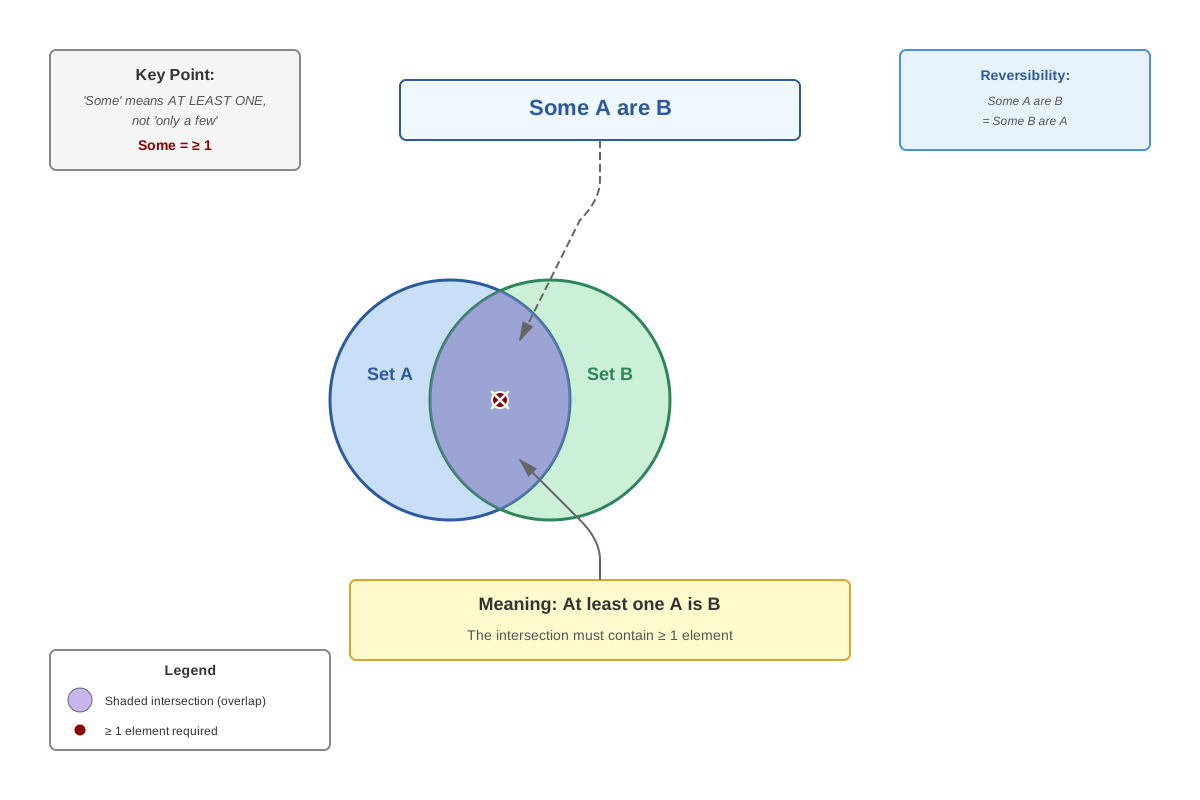
A some statement is a quantified claim asserting that at least one member of a category possesses a particular property or stands in a particular relationship to another category. In formal logic notation, some statements take the form "Some A are B," which translates to "At least one A is B" or "There exists at least one thing that is both A and B."
The critical feature of some statements is their minimum commitment: they assert existence of at least one instance but remain silent about how many instances exist beyond that minimum. "Some lawyers are vegetarians" is true whether exactly one lawyer is vegetarian, whether half of all lawyers are vegetarians, or whether 99% of lawyers are vegetarians. This minimal commitment makes some statements logically weaker than "most" or "all" statements but also makes them easier to prove true and harder to prove false.
Logical Properties of Some Statements
Some statements possess several distinctive logical properties that distinguish them from other quantifier types:
Reversibility: Some statements are reversible without changing their truth value. If "Some A are B" is true, then "Some B are A" must also be true. This property is unique to some statements—it does not hold for "all" or "most" statements. For example, if some doctors are marathon runners, then some marathon runners are doctors. This reversibility stems from the symmetric nature of the existential claim: asserting overlap between two categories works equally well from either direction.
Non-negation: Some statements do not tell us anything definitive about what is NOT the case. "Some lawyers are tall" does not tell us whether some lawyers are not tall, whether all lawyers are tall, or whether most lawyers are tall. This property frequently appears in wrong answer choices that attempt to draw unwarranted negative conclusions from positive some statements.
Existential import: Some statements carry existential commitment—they assert that at least one thing actually exists. "Some unicorns are white" would be false not because unicorns aren't white, but because unicorns don't exist at all. This matters for LSAT questions involving hypothetical or conditional scenarios.
Negation of Some Statements
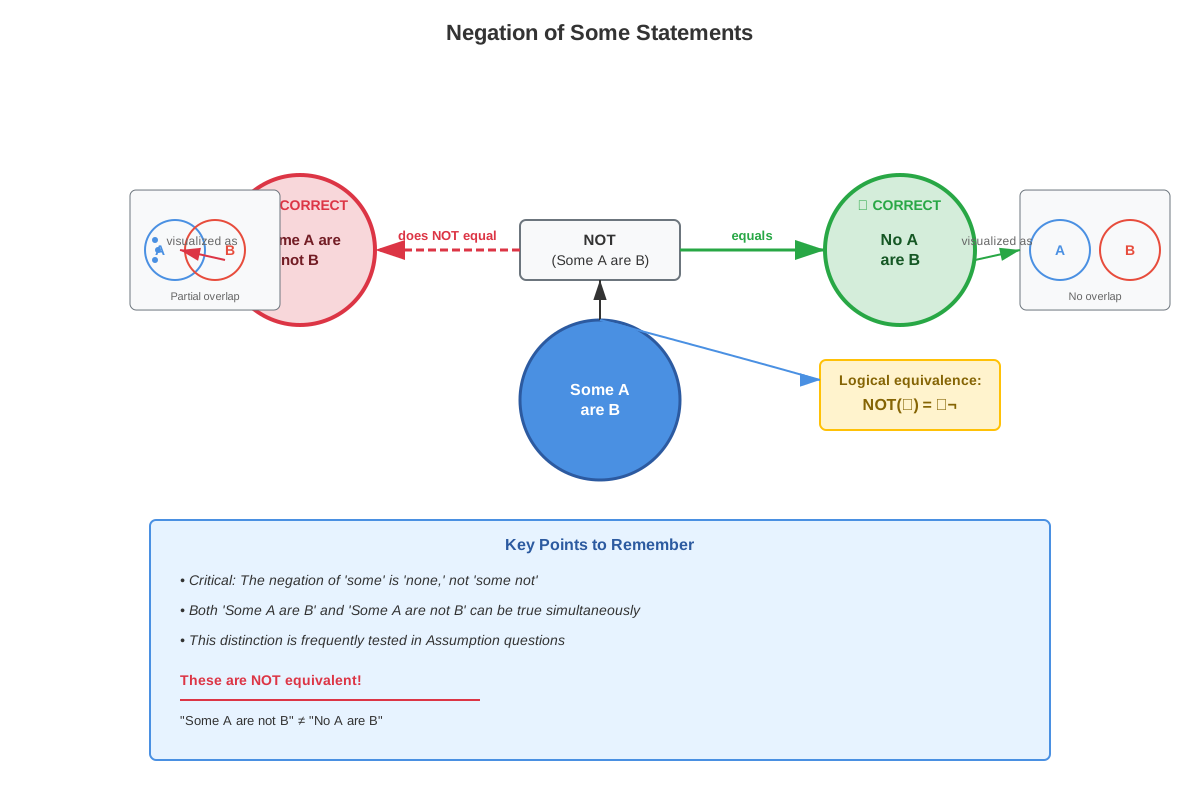
Understanding how to negate some statements correctly is essential for contrapositive reasoning and for evaluating argument validity. The negation of "Some A are B" is "No A are B" (equivalently, "All A are not B"). This follows from the logical principle that if it's false that at least one A is B, then zero A are B.
Common errors in negation include:
- Incorrectly negating "Some A are B" as "Some A are not B" (these statements can both be true simultaneously)
- Incorrectly negating "Some A are B" as "Most A are not B" (this is too strong)
- Confusing negation with reversal
The negation relationship creates a logical dichotomy: exactly one of "Some A are B" or "No A are B" must be true. This principle enables elimination of answer choices in Must Be True questions.
Combining Some Statements
The LSAT frequently tests the ability to derive valid inferences by combining multiple some statements. However, the rules for combining some statements are more restrictive than many test-takers initially assume.
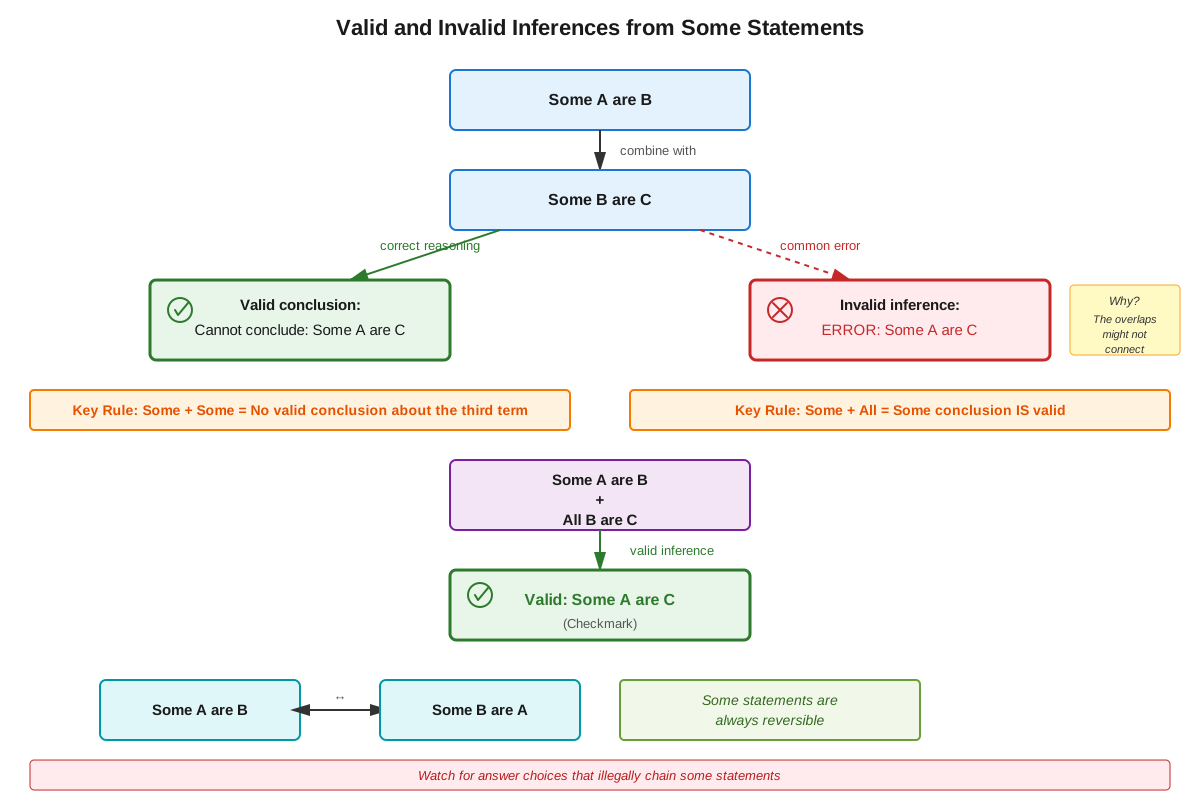
Valid combination pattern: When some statements share a common middle term in a specific configuration, a valid inference can be drawn. If "Some A are B" and "Some B are C," we CANNOT validly conclude "Some A are C." The overlap between A and B might involve entirely different members of B than the overlap between B and C.
The overlapping chain rule: To validly infer "Some A are C" from two some statements, we need "Some A are B" and "ALL B are C" (or equivalently, "ALL A are B" and "Some B are C"). The universal quantifier ensures that the overlap extends through the chain.
This limitation is heavily tested because it contradicts intuitive reasoning patterns. Test-takers often incorrectly assume that some statements chain together like conditional statements, leading to selection of invalid inference answer choices.
Some vs. Most vs. All
Understanding the logical relationships among different quantifiers is crucial for accurate reasoning:
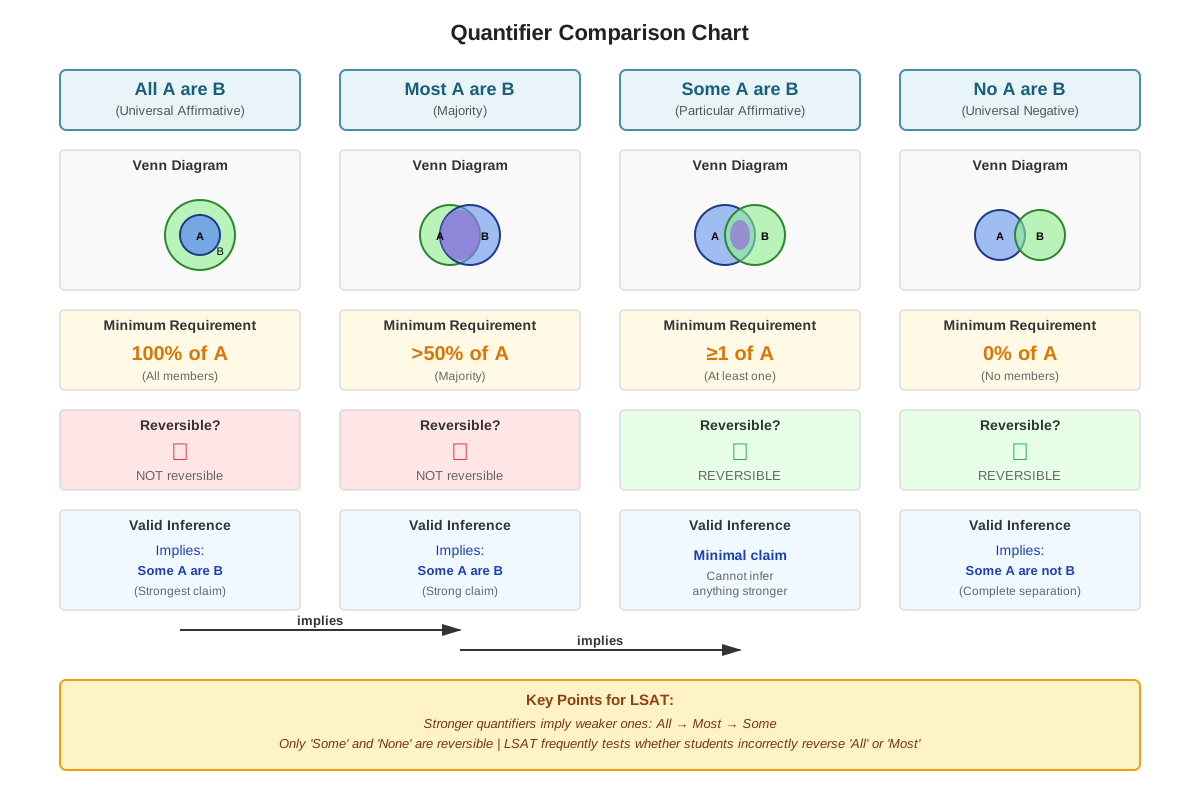
| Quantifier | Minimum Commitment | Reversible? | Negation |
|---|---|---|---|
| Some | At least one | Yes | None/No |
| Most | More than half | No | Not most (≤50%) |
| All | Every single one | No | Some...not |
Logical strength hierarchy: All statements are stronger than most statements, which are stronger than some statements. This means:
- If "All A are B" is true, then "Most A are B" is true, and "Some A are B" is true
- If "Some A are B" is false, then "Most A are B" is false, and "All A are B" is false
- The reverse implications do not hold
This hierarchy matters for Strengthen/Weaken questions, where upgrading from "some" to "most" or "all" strengthens an argument, while downgrading weakens it.
Some Statements in Conditional Contexts
Some statements interact with conditional statements in specific ways that the LSAT tests regularly. Consider the difference between:
- "Some lawyers are wealthy" (a categorical some statement)
- "If someone is a lawyer, then sometimes they are wealthy" (a conditional with modal qualification)
The first asserts definite overlap between two categories. The second makes a conditional claim about possibilities. The LSAT tests whether students can distinguish these structures and avoid conflating them.
When a some statement appears as the consequent of a conditional, special care is required: "If X, then some Y are Z" means that X's occurrence guarantees at least one Y is Z, but it doesn't tell us which Y or how many.
Concept Relationships
Some statements form the foundation of the quantifier hierarchy in formal logic. They represent the weakest positive existential claim, sitting below "most" and "all" statements in logical strength. This hierarchical relationship means that any statement establishing "all" or "most" automatically establishes "some," but not vice versa.
The relationship between some statements and their negations (none/no statements) creates a logical dichotomy that enables proof by contradiction. When evaluating arguments, recognizing that "some" and "none" are logical opposites helps eliminate answer choices that attempt to maintain both simultaneously.
Some statements connect to conditional reasoning through the concept of sufficient and necessary conditions. While "All A are B" translates to "If A, then B," some statements do not translate into simple conditionals. This distinction prevents students from incorrectly applying conditional reasoning rules (like contrapositive formation) to some statements.
The reversibility property of some statements links them to symmetric relationships in logic. This property distinguishes them from asymmetric relationships expressed by "all" and "most" statements, creating a unique logical signature that appears in Parallel Reasoning questions.
Conceptual flow: Basic quantifier understanding → Some statement definition → Negation rules → Combination rules → Integration with conditional logic → Application to complex arguments
Quick check — test yourself on Some statements so far.
Try Flashcards →High-Yield Facts
⭐ Some means "at least one"—it is the minimum existential claim and remains true even if only one instance exists
⭐ Some statements are reversible: "Some A are B" logically equals "Some B are A" without exception
⭐ The negation of "Some A are B" is "No A are B" (not "Some A are not B")
⭐ Two some statements cannot be chained: "Some A are B" and "Some B are C" do NOT allow you to conclude "Some A are C"
⭐ If "All A are B" is true, then "Some A are B" must be true—all statements entail some statements
- "Some A are B" and "Some A are not B" can both be true simultaneously—they are not contradictory
- Some statements carry existential commitment—they assert that at least one thing actually exists
- "Some" in LSAT logic is inclusive of "all"—if all members of a category have a property, then some members have that property
- Some statements do not support negative inferences—"Some are" doesn't tell you about "some are not"
- The LSAT uses "some" consistently to mean "at least one," never "exactly some but not all"
- Some statements combined with universal statements can yield valid inferences: "Some A are B" + "All B are C" → "Some A are C"
- Most statements entail some statements: if most A are B, then some A are B must be true
- Some statements appear in correct answers to Must Be True questions more frequently than "all" or "most" statements because they make weaker, safer claims
- Recognizing that an answer choice claims "some" when the stimulus supports "all" indicates a scope error—the answer is too weak
- Some statements cannot be contrapositives because they lack the conditional structure necessary for contrapositive formation
Common Misconceptions
Misconception: "Some" means "some but not all" or excludes the possibility that all members have the property.
Correction: In formal logic and on the LSAT, "some" means "at least one" and is fully compatible with "all." If all lawyers are ethical, then "some lawyers are ethical" is true. The LSAT uses "some" inclusively unless explicitly stated otherwise.
Misconception: You can chain some statements together like conditional statements to derive new conclusions.
Correction: Unlike conditionals, some statements do not chain. "Some A are B" and "Some B are C" do not allow you to conclude "Some A are C" because the overlaps might involve completely different members of B. Valid chaining requires at least one universal quantifier.
Misconception: "Some A are B" means "Some A are not B" must also be true.
Correction: These statements are independent. "Some A are B" tells you nothing definitive about whether some A are not B. Both could be true, or only the first could be true (if all A are B).
Misconception: The negation of "Some A are B" is "Some A are not B."
Correction: The correct negation of "Some A are B" is "No A are B" (or "All A are not B"). The negation must make the original statement false, which requires asserting that zero instances exist, not just that some instances don't have the property.
Misconception: Some statements can be converted to conditional statements for easier manipulation.
Correction: Some statements and conditional statements have fundamentally different logical structures. "Some A are B" cannot be rewritten as "If A, then B" or any other conditional form. Attempting this conversion leads to invalid reasoning patterns.
Misconception: If "Some A are B" is true, then "Most A are B" might be true.
Correction: While this is technically possible, the some statement provides no evidence whatsoever for the most statement. On Must Be True questions, you cannot infer "most" from "some." The logical relationship only works in the opposite direction: "most" entails "some."
Misconception: Some statements in the stimulus must appear as some statements in the correct answer.
Correction: Valid inferences from some statements might be expressed using different quantifiers or logical structures. For example, from "Some A are B" and "All B are C," the valid inference "Some A are C" might be expressed as "At least one A is C" or "There exists an A that is C."
Worked Examples
Example 1: Basic Inference Question
Stimulus: "Some philosophy professors are published authors. All published authors have literary agents."
Question: Which one of the following must be true?
Answer Choices:
(A) Some philosophy professors have literary agents
(B) Most philosophy professors have literary agents
(C) All philosophy professors have literary agents
(D) Some literary agents represent philosophy professors
(E) Most literary agents represent philosophy professors
Solution:
Step 1: Identify the logical structure of each statement.
- Statement 1: "Some philosophy professors are published authors" = Some PP are PA
- Statement 2: "All published authors have literary agents" = All PA are LA
Step 2: Determine what can be validly inferred.
We have a some statement (Some PP are PA) combined with an all statement (All PA are LA). This is the valid combination pattern: the some statement establishes that at least one PP is PA, and the all statement guarantees that this PP (being a PA) must be LA.
Therefore: Some PP are LA (Some philosophy professors have literary agents)
Step 3: Evaluate answer choices.
- (A) Correctly states our valid inference. ✓
- (B) Claims "most"—too strong; we only know "some." ✗
- (C) Claims "all"—far too strong; we only know about the some who are published authors. ✗
- (D) This is the reversal of (A). Since some statements are reversible, this is also true! However, checking if (A) is available first...
- (E) Claims "most"—too strong and unsupported. ✗
Answer: (A)
Key takeaway: This example demonstrates the valid combination pattern (some + all = some) and illustrates why upgrading to "most" or "all" creates invalid inferences.
Example 2: Negation and Contradiction
Stimulus: "It is not the case that some of the committee members voted against the proposal."
Question: If the statement above is true, which one of the following must be true?
Answer Choices:
(A) Some committee members voted for the proposal
(B) Most committee members voted for the proposal
(C) No committee members voted against the proposal
(D) Some committee members did not vote against the proposal
(E) At least one committee member abstained from voting
Solution:
Step 1: Translate the stimulus into formal logic.
"It is not the case that some of the committee members voted against the proposal"
= NOT (Some CM voted against)
= No CM voted against (by the negation rule for some statements)
= All CM did not vote against
Step 2: Determine what must be true.
If no committee members voted against the proposal, then it is impossible for any committee member to have voted against it. This is precisely what choice (C) states.
Step 3: Evaluate other choices.
- (A) Might be true, but not required—they could have all abstained. ✗
- (B) Too strong—we have no information about how many voted for. ✗
- (C) Directly states our conclusion. ✓
- (D) This is actually weaker than what we know—we know ALL did not vote against, so certainly some did not, but this doesn't capture the full force of our conclusion. ✗
- (E) Possible but not required—all could have voted for. ✗
Answer: (C)
Key takeaway: This example demonstrates proper negation of some statements and shows why understanding the logical equivalence between "No A are B" and "All A are not B" is essential.
Exam Strategy
When approaching LSAT questions involving some statements, implement this systematic process:
Recognition phase: Identify trigger words that signal some statements: "some," "at least one," "there exists," "a few," "several," "certain," and "a number of." All of these translate to the logical "some" (at least one). Also watch for implicit some statements like "not all A are B," which logically means "some A are not B."
Translation phase: Convert natural language into formal logic notation. Write "Some A are B" in the margin to clarify the logical structure. This prevents misreading complex sentence structures and helps identify the categories being related.
Combination analysis: When multiple some statements appear, check whether they can be validly combined. Look for the presence of universal quantifiers (all, every, each) that enable valid chaining. Be immediately suspicious of answer choices that chain two some statements without an intervening universal quantifier.
Scope checking: Some statements make minimal claims. In Must Be True questions, answers that upgrade "some" to "most" or "all" are almost always incorrect. Conversely, in Sufficient Assumption questions, upgrading from "some" to "all" might be exactly what's needed to make an argument valid.
Exam Tip: In Must Be True questions, some statements appear in correct answers more frequently than stronger quantifiers because they make safer, more defensible claims. When stuck between two answers, the one with "some" is often correct.
Time allocation: Some statement questions should be answered relatively quickly (60-90 seconds) because the logical operations are mechanical once mastered. If spending more than two minutes on a some statement question, flag it and move on—you're likely overthinking or missing a simple logical relationship.
Process of elimination: Eliminate answers that:
- Upgrade quantifiers without justification (some → most → all)
- Chain some statements invalidly
- Confuse negation with contradiction
- Reverse non-reversible quantifiers (all, most)
- Make claims about what is NOT the case based solely on positive some statements
Memory Techniques
SALO Mnemonic for quantifier strength hierarchy:
- Some (weakest)
- Almost all / Most
- Literally all / All
- Only all (strongest - adds necessity)
Reversibility Rule: Remember "SOME SWIM BOTH WAYS"—some statements are like swimmers who can go in either direction. If some A are B, then some B are A.
Negation Mnemonic: "SOME becomes NONE"—the negation of some is no/none, not "some...not."
Chaining Visualization: Picture some statements as partial Venn diagram overlaps. Two partial overlaps (some A-B, some B-C) don't guarantee a third overlap (some A-C) because the overlaps might involve different parts of B. You need a complete circle (all) to guarantee the chain continues.
The "At Least One" Test: Whenever you see "some," mentally replace it with "at least one" to maintain logical precision. This prevents the colloquial interpretation of "some but not all."
Combination Rule Acronym - SAC:
- Some + All = Conclusion (valid)
- Some + Some = Nothing (invalid)
Summary
Some statements represent the fundamental existential quantifier in formal logic, asserting that at least one member of a category possesses a particular property. On the LSAT, these statements appear frequently in Logical Reasoning questions, particularly in Must Be True and Inference questions where precise logical reasoning is essential. The key properties of some statements—reversibility, minimal existential commitment, and specific combination rules—distinguish them from other quantifiers and create predictable patterns that test-takers must master. Understanding that "some" means "at least one" (inclusive of "all"), that some statements reverse without changing truth value, and that they cannot be chained without universal quantifiers enables accurate analysis of arguments and valid inference derivation. The negation of some statements (producing "none/no" statements) and their position in the quantifier strength hierarchy (below "most" and "all") complete the essential knowledge framework. Mastery of some statements provides the foundation for more complex formal logic operations and directly translates to improved performance on 15-20% of Logical Reasoning questions.
Key Takeaways
- Some means "at least one" and is inclusive of "all"—never interpret it as "some but not all" on the LSAT
- Some statements are uniquely reversible: "Some A are B" always equals "Some B are A"
- Valid combination requires a universal quantifier: Some + All = Some (valid), but Some + Some = Nothing (invalid)
- Negation produces "none": The opposite of "Some A are B" is "No A are B," not "Some A are not B"
- Quantifier hierarchy matters: All → Most → Some in logical strength; inferences flow downward only
- Some statements make minimal claims, making them frequent correct answers in Must Be True questions but insufficient for most Sufficient Assumption questions
- Recognition and translation are critical first steps—identify some statements quickly and convert them to formal notation to avoid errors
Related Topics
Universal Quantifiers (All Statements): Understanding all statements and their relationship to some statements enables mastery of the complete quantifier system. All statements are stronger than some statements and enable valid chaining inferences.
Most Statements: Most statements occupy the middle ground between some and all, requiring more than 50% of a category to possess a property. They entail some statements but not vice versa.
Conditional Logic: While distinct from quantified statements, conditionals interact with some statements in complex arguments. Mastering both enables analysis of sophisticated LSAT arguments.
Formal Logic Translations: Converting natural language into formal logical notation builds on some statement mastery and enables systematic analysis of complex argument structures.
Syllogistic Reasoning: Classical syllogisms combine quantified statements (including some statements) to derive valid conclusions, representing the next level of formal logic complexity.
Practice CTA
Now that you understand the logical structure and properties of some statements, it's time to cement your mastery through active practice. Attempt the practice questions associated with this topic, focusing on identifying some statements quickly, applying combination rules accurately, and avoiding common negation errors. Use flashcards to drill the key properties—reversibility, negation rules, and combination patterns—until they become automatic. Remember that some statements appear in approximately one out of every five Logical Reasoning questions, making this practice time one of your highest-yield investments for LSAT success. Each practice question you complete builds the pattern recognition and logical precision that separates good LSAT scores from great ones. You've built the foundation—now apply it!
Sign up free to keep reading
Create a free AnvayaPrep account to finish this LSAT guide on Some statements — plus flashcards and practice questions.