Overview
Fact set reasoning is a foundational skill in LSAT Logical Reasoning that requires test-takers to draw valid conclusions from a collection of given statements. Unlike argument-based questions where you evaluate someone's reasoning, fact set questions present you with a series of factual statements and ask what must be true, could be true, or is most strongly supported based solely on those facts. This question type appears frequently in the inference questions category and demands precise logical thinking without introducing outside assumptions or knowledge.
Mastering LSAT fact set reasoning is essential because these questions test your ability to synthesize information and recognize what logically follows from given premises. The LSAT presents fact sets as neutral collections of information—there's no conclusion to evaluate, no flaw to identify, and no assumption to uncover. Instead, you must combine the facts systematically to determine what new information can be validly derived. This skill directly mirrors the analytical thinking required in legal practice, where attorneys must draw conclusions from statutes, case facts, and precedents without overstepping what the evidence actually supports.
Within the broader landscape of logical reasoning, fact set questions represent a pure test of deductive and inferential skills. They connect closely to conditional reasoning, formal logic, and the principle of staying within the scope of given information. While other Logical Reasoning question types ask you to critique or strengthen arguments, fact set reasoning asks you to construct valid inferences—making it both a distinct skill and a foundation for understanding how conclusions properly follow from premises throughout the LSAT.
Learning Objectives
- [ ] Identify how Fact set reasoning appears in LSAT questions
- [ ] Explain the reasoning pattern behind Fact set reasoning
- [ ] Apply Fact set reasoning to solve LSAT-style problems accurately
- [ ] Distinguish between what must be true versus what could be true from a fact set
- [ ] Recognize and avoid common inference errors such as unwarranted assumptions and scope violations
- [ ] Combine multiple facts systematically to derive valid compound inferences
- [ ] Evaluate answer choices using the "proof standard" appropriate for different inference question stems
Prerequisites
- Basic conditional logic: Understanding "if-then" statements is essential because fact sets often contain conditional relationships that must be combined to reach valid conclusions.
- Formal logic notation: Familiarity with symbolic representation helps track relationships between multiple facts efficiently.
- Argument structure fundamentals: Recognizing premises and conclusions provides the foundation for understanding how inferences differ from arguments.
- Scope awareness: The ability to identify what information is and isn't addressed in a passage prevents introducing outside knowledge into fact set reasoning.
Why This Topic Matters
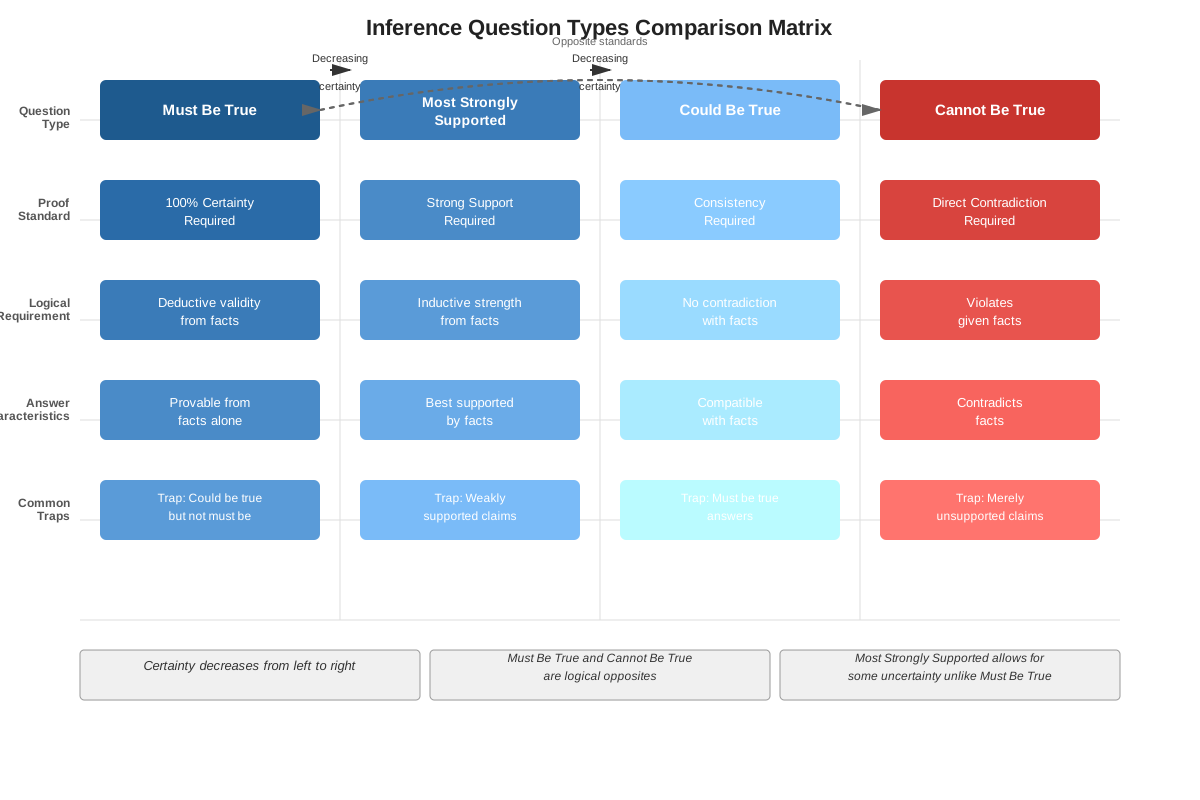
Fact set reasoning appears in approximately 15-20% of Logical Reasoning questions across both LR sections, making it one of the most frequently tested question types on the LSAT. These questions typically appear as "Must Be True," "Most Strongly Supported," "Could Be True," or "Cannot Be True" questions. The skill translates directly to legal reasoning: attorneys constantly must determine what conclusions are warranted by statutes, contracts, and case facts without making unsupported logical leaps.
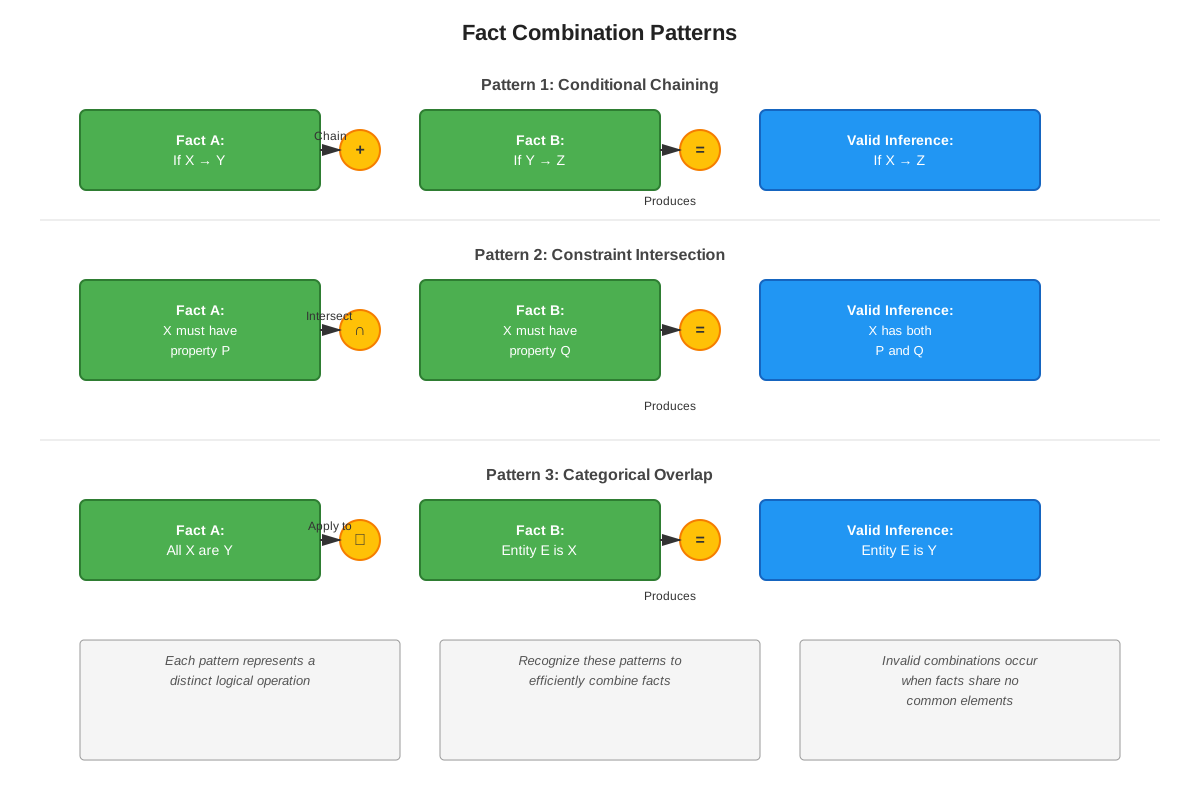
In real-world legal practice, fact set reasoning underpins case analysis, statutory interpretation, and contract review. When a lawyer reads a statute stating "All corporations must file annual reports" and "Entity X is a corporation," the lawyer must validly conclude that Entity X must file annual reports—exactly the type of inference tested in LSAT fact set questions. Misapplying this reasoning in legal practice can lead to malpractice, making it a critical competency the LSAT appropriately emphasizes.
On the exam, fact set questions commonly appear in several formats: short passages presenting 3-5 factual statements followed by an inference question; longer passages describing scenarios, surveys, or studies; and occasionally as principle application questions where facts must be matched to rules. The key distinguishing feature is always the absence of an argument structure—you're given only facts and must determine what follows logically.
Core Concepts
What Constitutes a Fact Set
A fact set is a collection of statements presented as true without argument or persuasion. Unlike argument-based passages where a conclusion is drawn and supported by premises, fact sets simply present information. The LSAT signals fact set questions through stems like "If the statements above are true, which one of the following must also be true?" or "The information above most strongly supports which one of the following?" The critical recognition point is that you're not evaluating whether the reasoning is sound—you're accepting all statements as true and determining what logically follows.
Fact sets typically contain three types of information: categorical statements (all, some, none), conditional statements (if-then relationships), and specific facts about individuals or situations. For example, a fact set might state: "All members of the committee are lawyers. Some lawyers specialize in tax law. Chen is a member of the committee." From these facts, you can validly infer that Chen is a lawyer (must be true), but you cannot infer that Chen specializes in tax law (could be true, but not must be true).
The Inference Standard: Must Be True vs. Strongly Supported
Understanding the proof standard required by different question stems is crucial for fact set reasoning. "Must be true" questions demand absolute logical certainty—the correct answer must be true in every possible scenario consistent with the facts. "Most strongly supported" questions allow for high probability rather than certainty—the correct answer should be the most reasonable conclusion even if not logically guaranteed.
Consider this distinction: If told "Most doctors recommend exercise" and "Dr. Smith is a doctor," you cannot conclude that Dr. Smith must recommend exercise (she might be in the minority), but it is strongly supported that she does (since most doctors do). The LSAT carefully calibrates answer choices to test whether you recognize this difference. Must-be-true questions typically involve combining categorical or conditional statements where the conclusion follows necessarily, while strongly-supported questions often involve statistical or probabilistic information.
Combining Facts Systematically
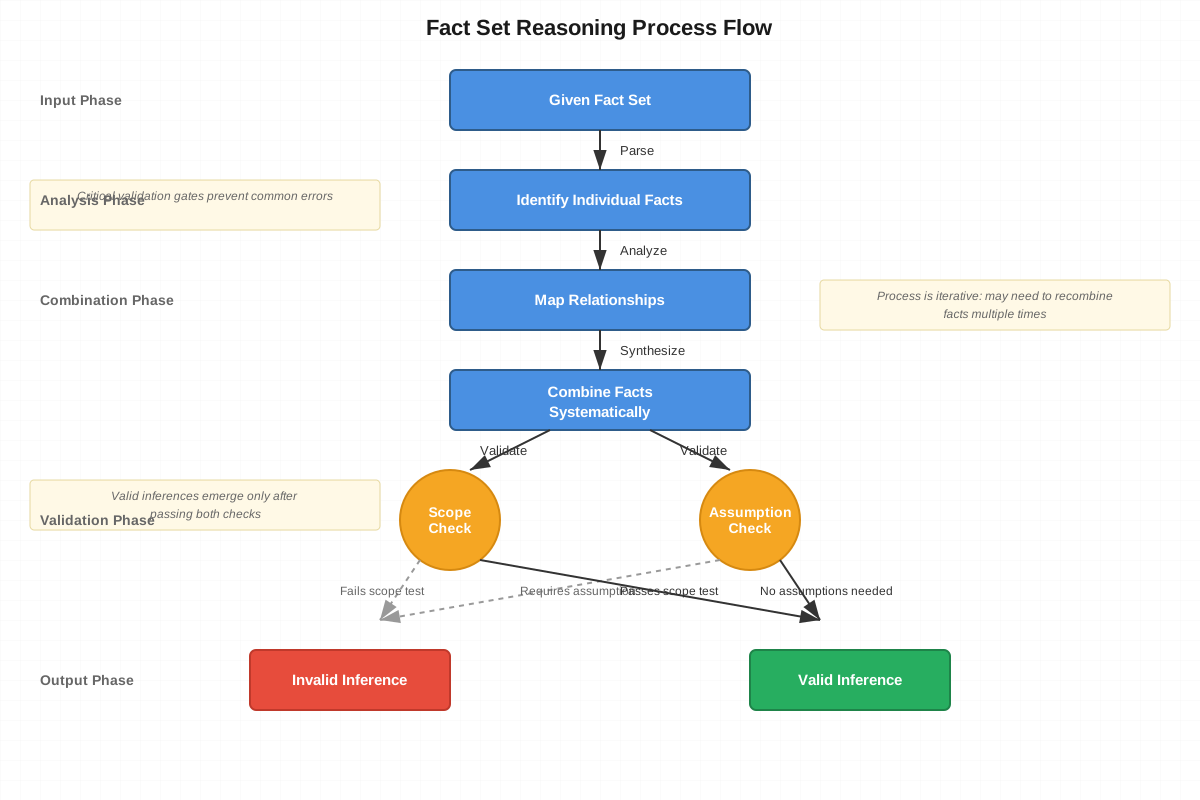
The core skill in LSAT fact set reasoning involves linking multiple facts to derive new information. This process follows formal logic principles, particularly the transitive property and conditional chaining. When Fact A tells you "All X are Y" and Fact B tells you "All Y are Z," you can validly conclude "All X are Z." The LSAT tests this skill with increasing complexity, requiring you to track multiple relationships simultaneously.
A systematic approach involves:
- Cataloging each fact: Write down or mentally note each distinct piece of information
- Identifying relationships: Determine which facts share common terms or concepts
- Linking facts: Combine facts that share elements to derive new conclusions
- Testing necessity: Verify that your inference must be true given the facts, not just possibly true
For example, given: "Everyone at the party wore either red or blue. No one wearing red danced. Maria danced." You can systematically conclude: Maria didn't wear red (from facts 2 and 3), therefore Maria wore blue (from fact 1 and the previous inference). This multi-step process is typical of medium-to-difficult fact set questions.
Scope Limitations and Valid Inference
A critical aspect of fact set reasoning is recognizing scope limitations—what the facts do and don't tell you. The LSAT frequently includes wrong answer choices that introduce information beyond the scope of the fact set or make unwarranted assumptions. Valid inferences stay strictly within the boundaries of what's stated or logically entailed.
Common scope violations include:
- Causal assumptions: Facts state correlation, answer assumes causation
- Temporal assumptions: Facts describe one time period, answer assumes continuation or change
- Quantifier shifts: Facts say "some," answer says "most" or "all"
- Introducing new concepts: Answer brings in ideas not mentioned or implied by the facts
For instance, if a fact set states "Sales increased after the new marketing campaign launched," you cannot validly infer that the marketing campaign caused the sales increase—correlation doesn't establish causation. The correct inference might be simply that both events occurred, or that the increase happened during or after the campaign period.
Conditional Reasoning in Fact Sets
Many fact sets contain conditional statements that must be properly understood and combined. A conditional "If A, then B" tells you that whenever A occurs, B must occur, but it doesn't tell you what happens when A doesn't occur. Combining conditionals follows the chain rule: If A→B and B→C, then A→C.
The LSAT tests whether you can:
- Apply conditionals correctly (when the sufficient condition is met, the necessary condition follows)
- Recognize valid contrapositives (If A→B, then not-B→not-A)
- Avoid invalid reversal (If A→B does NOT mean if B→A)
- Combine conditional chains to reach distant conclusions
For example: "If elected, the mayor will appoint Chen. If Chen is appointed, the policy will change. The mayor was elected." From these facts, you can validly conclude both that Chen will be appointed and that the policy will change, by applying the conditionals in sequence.
Quantified Statements and Logical Relationships
Fact sets frequently include quantified statements using terms like all, some, most, none, and few. Understanding the logical relationships between these quantifiers is essential for valid inference:
| Quantifier | Meaning | Valid Inference |
|---|---|---|
| All X are Y | Every member of X is in Y | If something is X, it's Y |
| Some X are Y | At least one X is Y | There exists overlap between X and Y |
| Most X are Y | More than half of X are Y | Probability > 50% that a given X is Y |
| No X are Y | Zero overlap | If something is X, it's not Y |
The LSAT tests whether you understand that "some" means "at least one" (possibly all), that "most" can be combined with another "most" to guarantee overlap, and that "all" statements can be chained but "some" statements generally cannot. For instance, "All A are B" and "All B are C" yields "All A are C," but "Some A are B" and "Some B are C" doesn't tell you whether any A are C.
Concept Relationships
Fact set reasoning serves as the foundation for all inference-based questions on the LSAT. The core skill—determining what must or likely follows from given information—connects directly to conditional reasoning (applying if-then relationships), formal logic (using quantifiers and logical operators), and argument analysis (distinguishing premises from conclusions).
The relationship flows as follows: Basic logical operators (and, or, not, if-then) → Quantified statements (all, some, none) → Fact set reasoning (combining multiple facts) → Complex inference questions (multi-step reasoning with constraints). Mastering fact set reasoning also enables progression to more advanced topics like sufficient assumption questions (where you must identify what fact would complete an argument) and parallel reasoning questions (where you must match logical structures).
Within fact set reasoning itself, the concepts build hierarchically: Understanding individual fact types → Recognizing valid single-step inferences → Combining multiple facts systematically → Distinguishing between must-be-true and strongly-supported conclusions → Avoiding scope violations and unwarranted assumptions. Each level depends on mastery of the previous level, making systematic practice essential.
High-Yield Facts
⭐ Fact set questions present only facts, never arguments—there is no conclusion to evaluate or assumption to identify
⭐ "Must be true" requires absolute logical certainty; "most strongly supported" allows for high probability without certainty
⭐ Valid inferences stay strictly within the scope of given facts—introducing outside information or assumptions is the most common error
⭐ Conditional statements can be chained (if A→B and B→C, then A→C) and contraposed (if A→B, then not-B→not-A) but never reversed
⭐ "Some" means "at least one, possibly all"—it establishes existence but not quantity beyond one
- "All" statements can be chained indefinitely to create valid inferences across multiple steps
- "Most" statements can be combined: if most X are Y and most Y are Z, then some X must be Z
- Correlation stated in facts does not establish causation unless explicitly stated
- Temporal facts describe specific time periods—don't assume continuation, change, or patterns beyond what's stated
- Quantifier shifts (some→most, most→all) in answer choices signal likely wrong answers
Quick check — test yourself on Fact set reasoning so far.
Try Flashcards →Common Misconceptions
Misconception: If the fact set doesn't explicitly contradict an answer choice, that answer could be correct.
Correction: For "must be true" questions, the correct answer must be provable from the facts, not merely consistent with them. Many wrong answers are possible but not provable.
Misconception: "Some X are Y" means "only some X are Y" (i.e., not all X are Y).
Correction: "Some" means "at least one," which is compatible with "all." If all X are Y, then some X are Y is also true. "Some" establishes a minimum, not a maximum.
Misconception: You can combine two "some" statements to reach a conclusion (e.g., "Some A are B" and "Some B are C" means "Some A are C").
Correction: Two "some" statements cannot be validly combined. The A's that are B might be completely different from the B's that are C, so no overlap between A and C is guaranteed.
Misconception: If a fact set describes a correlation or temporal sequence, causation can be inferred.
Correction: Causation requires explicit statement or logical necessity. "X happened, then Y happened" doesn't mean X caused Y—both could be caused by Z, or the timing could be coincidental.
Misconception: "Most strongly supported" means "could possibly be true based on the facts."
Correction: "Most strongly supported" requires the answer to be highly probable or the most reasonable conclusion from the facts, not merely possible. The correct answer should be significantly better supported than alternatives.
Misconception: Background knowledge or real-world facts can be used to evaluate answer choices.
Correction: Fact set reasoning requires treating the given facts as the complete universe of information. Even if an answer choice is true in reality, it's wrong if it can't be derived from the stated facts.
Worked Examples
Example 1: Multi-Step Conditional Reasoning
Fact Set:
- All participants in the study were given either Treatment A or Treatment B.
- No participant given Treatment A experienced side effects.
- Every participant who completed the study received a follow-up survey.
- Marcus experienced side effects and completed the study.
Question: If the statements above are true, which one of the following must also be true?
Answer Choices:
(A) Marcus received Treatment B
(B) Marcus received a follow-up survey
(C) Some participants who received Treatment B experienced side effects
(D) Most participants completed the study
(E) Marcus received Treatment B and a follow-up survey
Solution Process:
Step 1: Catalog the facts and identify what we know about Marcus specifically.
- Marcus experienced side effects (given)
- Marcus completed the study (given)
Step 2: Apply Fact 2 to Marcus.
- No participant given Treatment A experienced side effects
- Marcus experienced side effects
- Therefore, Marcus was NOT given Treatment A (contrapositive application)
Step 3: Apply Fact 1 to Marcus.
- All participants received either Treatment A or Treatment B
- Marcus did not receive Treatment A (from Step 2)
- Therefore, Marcus received Treatment B
Step 4: Apply Fact 3 to Marcus.
- Every participant who completed the study received a follow-up survey
- Marcus completed the study (given)
- Therefore, Marcus received a follow-up survey
Step 5: Evaluate answer choices.
- (A) Must be true (proven in Step 3) ✓
- (B) Must be true (proven in Step 4) ✓
- (C) Could be true but not must be true—we only know Marcus experienced side effects
- (D) Not supported—we have no information about what proportion completed the study
- (E) Must be true (combines Steps 3 and 4) ✓
Correct Answer: (E) is the most complete answer, though (A) and (B) are also necessarily true. On the actual LSAT, only one answer would be structured to be the best choice, but this example demonstrates how multiple valid inferences can be drawn from a single fact set.
Learning Objective Connection: This example demonstrates applying fact set reasoning through systematic combination of conditional statements and categorical facts to reach valid conclusions.
Example 2: Quantifier Reasoning and Scope Limitations
Fact Set:
- Most of the company's engineers have advanced degrees.
- Some employees with advanced degrees work in management.
- All managers receive performance bonuses.
- Keisha is an engineer at the company.
Question: The information above most strongly supports which one of the following?
Answer Choices:
(A) Keisha has an advanced degree
(B) Keisha probably has an advanced degree
(C) If Keisha has an advanced degree, she works in management
(D) Some engineers receive performance bonuses
(E) Most engineers receive performance bonuses
Solution Process:
Step 1: Identify what we can and cannot conclude about Keisha.
- Keisha is an engineer (given)
- Most engineers have advanced degrees (given)
- Therefore, it's probable (>50% chance) that Keisha has an advanced degree
- But we cannot be certain—she could be in the minority without advanced degrees
Step 2: Evaluate (A) vs. (B).
- (A) states certainty ("has") which we cannot establish—WRONG
- (B) states probability ("probably") which matches "most"—POTENTIALLY CORRECT
Step 3: Evaluate (C).
- This reverses the conditional relationship
- We know some with advanced degrees work in management, not that all do—WRONG
Step 4: Evaluate (D).
- We know: Some employees with advanced degrees work in management (Fact 2)
- We know: All managers receive bonuses (Fact 3)
- We know: Most engineers have advanced degrees (Fact 1)
- Can we connect these? Some engineers have advanced degrees (from "most"), and some people with advanced degrees are managers, but we can't establish that any engineers are managers
- However, we CAN establish: Some people with advanced degrees are managers, and all managers get bonuses, so some people with advanced degrees get bonuses
- But we cannot establish that any of these are engineers—WRONG
Step 5: Evaluate (E).
- We have no information about what proportion of engineers receive bonuses—WRONG
Correct Answer: (B) "Keisha probably has an advanced degree"
Key Insight: "Most strongly supported" questions allow probabilistic reasoning. Since most engineers have advanced degrees and Keisha is an engineer, it's more likely than not (thus "probably") that she has an advanced degree. This is the strongest inference we can make from the facts.
Learning Objective Connection: This example demonstrates distinguishing between must-be-true and strongly-supported inferences, and recognizing scope limitations when combining quantified statements.
Exam Strategy
Identifying Fact Set Questions
Fact set questions are signaled by specific question stems. Watch for:
- "If the statements above are true, which one of the following must also be true?"
- "The information above most strongly supports which one of the following?"
- "Which one of the following can be properly inferred from the passage?"
- "If all the statements above are true, which one of the following must be false?"
The key trigger is the absence of argumentative language. If the passage doesn't present someone's reasoning or conclusion, you're likely dealing with a fact set.
Systematic Approach to Fact Set Questions
- Read actively: As you read each fact, note its type (categorical, conditional, specific) and mentally catalog the information
- Identify connections: Look for common terms or concepts that appear in multiple facts—these are your linking points
- Predict before reading choices: Based on the facts, anticipate what kinds of inferences are possible
- Apply the appropriate standard: For "must be true," demand proof; for "strongly supported," accept high probability
- Eliminate aggressively: Wrong answers often introduce new scope, reverse conditionals, or shift quantifiers
Process of Elimination Strategies
Red flags in answer choices:
- Scope creep: Introduces concepts not mentioned in the facts
- Quantifier shifts: Facts say "some," answer says "most" or "all"
- Causal language: Answer claims causation when facts only show correlation
- Temporal assumptions: Answer assumes change or continuation beyond stated timeframe
- Reversed conditionals: Answer reverses an if-then relationship from the facts
- Extreme language: Words like "always," "never," "only," "must" (unless provable)
Green flags in answer choices:
- Paraphrases facts: Restates given information in different words
- Combines facts validly: Links two or more facts using proper logic
- Hedged language: For "strongly supported" questions, words like "probably," "likely," "suggests"
- Stays in scope: Uses only concepts and terms from the fact set
Time Management
Fact set questions typically require 60-90 seconds. Allocate time as follows:
- 30-40 seconds: Reading and understanding the fact set
- 10-15 seconds: Predicting possible inferences
- 25-35 seconds: Evaluating answer choices
If you find yourself spending more than 90 seconds, you may be overcomplicating the inference or introducing assumptions. Return to the facts and look for the simplest valid connection.
Memory Techniques
SCOPE Acronym for Avoiding Wrong Answers:
- Stay within stated facts
- Causation requires explicit statement
- Outside knowledge is forbidden
- Proof required for "must be true"
- Extreme language needs justification
Quantifier Hierarchy Visualization:
Picture a pyramid with "ALL" at the top (strongest claim), "MOST" in the middle, "SOME" near the bottom (weakest claim), and "NONE" as the inverse at the base. Valid inferences move down the pyramid (all→most→some) but never up without additional facts.
Conditional Chain Mnemonic: "Sufficient Triggers Necessary" (STN)
When you see "If A, then B," remember A is Sufficient to Trigger B which is Necessary. This helps you remember that the sufficient condition (A) activates the necessary condition (B), not the reverse.
The "Prove It" Test:
For must-be-true questions, imagine a skeptical judge demanding you prove your answer using only the facts. If you can't point to specific facts that establish your conclusion with certainty, eliminate that answer.
Summary
Fact set reasoning is a core LSAT skill requiring test-takers to draw valid conclusions from given statements without introducing assumptions or outside knowledge. Unlike argument-based questions, fact sets present only factual information and ask what must be true, could be true, or is most strongly supported. Success requires understanding the difference between absolute logical certainty (must be true) and high probability (strongly supported), systematically combining facts through proper application of conditional logic and quantifiers, and rigorously staying within the scope of stated information. The most common errors involve introducing causal assumptions, shifting quantifiers, reversing conditionals, and bringing in outside knowledge. Mastery comes from practicing systematic fact cataloging, identifying linking terms between facts, applying formal logic rules precisely, and aggressively eliminating answers that violate scope or logical principles. These questions appear frequently on the LSAT and directly test the analytical reasoning skills essential for legal practice.
Key Takeaways
- Fact set questions present only facts without argument structure—accept all statements as true and determine what logically follows
- "Must be true" requires absolute proof from the facts; "most strongly supported" allows probabilistic reasoning
- Valid inferences stay strictly within the scope of given facts—the most common error is introducing outside assumptions
- Conditional statements can be chained and contraposed but never reversed without additional justification
- Quantifiers have specific meanings: "some" = at least one, "most" = more than half, "all" = every single one
- Systematically catalog facts, identify common terms, and link facts to derive valid conclusions
- Wrong answers typically introduce scope violations, shift quantifiers, assume causation, or reverse conditionals
Related Topics
Sufficient Assumption Questions: Building on fact set reasoning, these questions ask you to identify what additional fact would make an argument's conclusion follow logically. Mastering fact set reasoning provides the foundation for recognizing what's missing from an incomplete argument.
Conditional Logic and Formal Logic: These topics provide the technical framework underlying fact set reasoning. Deeper study of conditional chains, contrapositives, and logical operators enhances your ability to combine facts systematically.
Must Be True vs. Most Strongly Supported Questions: A specialized subset of inference questions that requires distinguishing between absolute logical necessity and strong probabilistic support. This distinction is crucial for selecting correct answers in fact set questions.
Principle Application Questions: These questions present general rules (principles) and ask you to apply them to specific fact patterns, combining fact set reasoning with rule-based analysis.
Practice CTA
Now that you understand the core principles of fact set reasoning, it's time to apply these concepts to actual LSAT questions. Work through the practice questions systematically, using the strategies outlined in this guide. Pay special attention to identifying question stems, cataloging facts, and eliminating answers that violate scope or logical principles. Review the flashcards to reinforce the key distinctions between quantifiers and the rules for combining conditional statements. Remember: fact set reasoning is a skill that improves dramatically with deliberate practice. Each question you work through strengthens your ability to recognize valid inferences and avoid common traps. You're building the analytical foundation that will serve you throughout the LSAT and in legal practice.
Sign up free to keep reading
Create a free AnvayaPrep account to finish this LSAT guide on Fact set reasoning — plus flashcards and practice questions.