Overview
Inference from causal claims represents one of the most frequently tested reasoning patterns on the LSAT Logical Reasoning section. This topic requires students to understand how causal relationships work, what can be legitimately concluded from causal statements, and what cannot be inferred without additional evidence. When the LSAT presents a causal claim—such as "X causes Y"—the test systematically evaluates whether students can distinguish between valid inferences and tempting but logically unsupported conclusions.
Mastering this topic is essential because causal reasoning appears across multiple question types, including Must Be True questions, Most Strongly Supported questions, and even some Strengthen/Weaken questions where understanding the logical structure of causation becomes critical. The LSAT frequently tests whether students recognize that correlation does not equal causation, whether they understand the difference between necessary and sufficient conditions in causal relationships, and whether they can identify what must follow from a given causal claim versus what merely might follow.
Within the broader Logical Reasoning framework, inference questions involving causal claims connect directly to conditional reasoning, argument structure analysis, and formal logic. Understanding causal inference patterns strengthens performance across the entire Logical Reasoning section because causal relationships underpin many arguments, and the ability to parse these relationships accurately separates high scorers from average performers. This topic builds upon foundational skills in identifying premises and conclusions while preparing students for more complex tasks like evaluating argument validity and identifying logical flaws.
Learning Objectives
- [ ] Identify how Inference from causal claims appears in LSAT questions
- [ ] Explain the reasoning pattern behind Inference from causal claims
- [ ] Apply Inference from causal claims to solve LSAT-style problems accurately
- [ ] Distinguish between valid and invalid inferences from causal statements
- [ ] Recognize common causal reasoning traps and avoid them under time pressure
- [ ] Evaluate whether correlation evidence supports causal conclusions
- [ ] Identify the direction of causation and alternative causal explanations
Prerequisites
- Basic conditional logic: Understanding if-then relationships is essential because causal claims often function similarly to conditional statements, though with important distinctions.
- Argument structure identification: Recognizing premises and conclusions allows students to isolate causal claims within complex passages and determine what the argument actually asserts.
- Correlation versus causation distinction: Familiarity with this fundamental concept provides the foundation for understanding why certain inferences from causal claims are valid while others are not.
- Necessary and sufficient conditions: These logical concepts help clarify what causal claims do and do not guarantee about the relationship between cause and effect.
Why This Topic Matters
Causal reasoning pervades everyday decision-making, scientific inquiry, legal argumentation, and policy debates. Understanding how to properly infer conclusions from causal claims enables critical evaluation of medical studies, economic policies, legal causation arguments, and social science research. This skill extends far beyond test preparation into professional and personal contexts where distinguishing genuine causal relationships from mere associations can have significant consequences.
On the LSAT, causal reasoning appears in approximately 15-20% of Logical Reasoning questions, making it one of the highest-yield topics for focused study. Questions involving lsat inference from causal claims appear most frequently as Must Be True questions, where students must identify what necessarily follows from a causal statement, and as Most Strongly Supported questions, where students select the answer most justified by causal evidence. Additionally, many Flaw questions test whether students recognize improper causal inferences, and Strengthen/Weaken questions often require understanding what would support or undermine a causal claim.
Common manifestations in exam passages include: arguments concluding that X causes Y based on correlation data; passages presenting causal mechanisms and asking what can be inferred about related phenomena; stimuli describing interventions and their effects; and arguments that confuse causal direction or overlook alternative explanations. The LSAT particularly favors testing whether students recognize that a causal claim allows certain inferences while prohibiting others, even when wrong answers seem intuitively appealing.
Core Concepts
Understanding Causal Claims
A causal claim asserts that one phenomenon (the cause) brings about, produces, or is responsible for another phenomenon (the effect). When the LSAT states "X causes Y," this establishes a specific relationship: the presence or occurrence of X makes Y happen or increases the likelihood of Y occurring. Importantly, causal claims are directional—they specify which element is the cause and which is the effect.
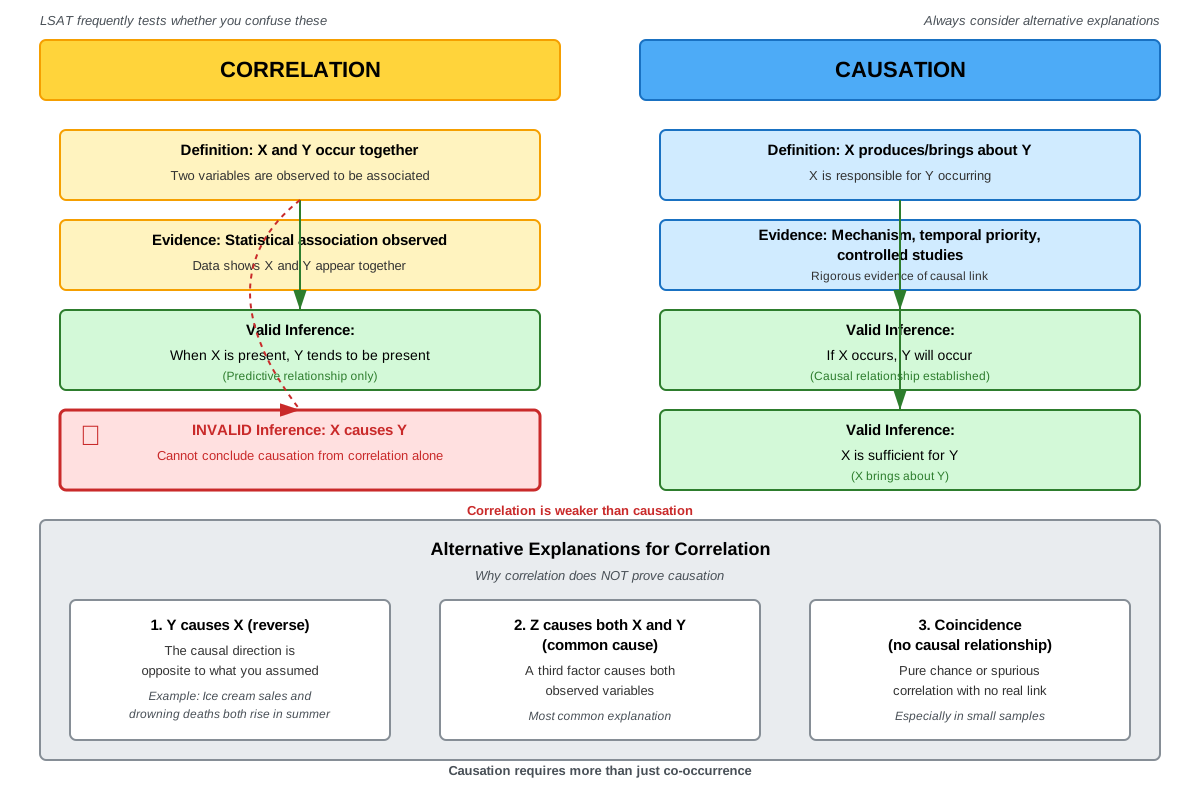
The logical structure of causal claims differs from mere correlation. While correlation indicates that two phenomena occur together or vary together, causation asserts that one actually produces the other. The LSAT exploits this distinction relentlessly, presenting answer choices that confuse these concepts or that assume causation from correlational evidence without justification.
Valid Inferences from Causal Claims
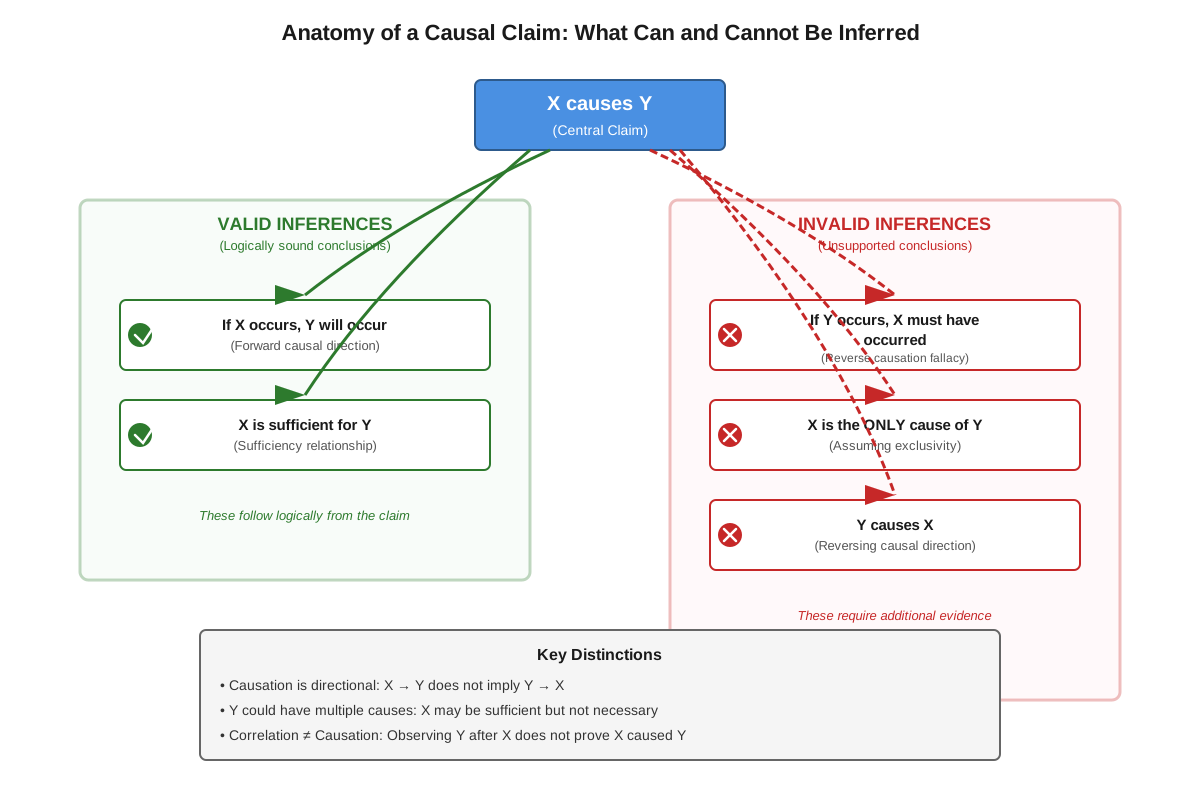
When presented with a genuine causal claim "X causes Y," several inferences are logically valid:
- Presence of cause suggests presence of effect: If X is present (and all necessary background conditions are met), Y will occur or is more likely to occur.
- Absence of all causes suggests absence of effect: If X is the only cause of Y and X is absent, then Y will not occur. However, this inference requires knowing that X is the sole cause.
- Effect presence suggests cause presence: If Y has occurred and X is the only known cause of Y, then X likely occurred. This inference strengthens when X is established as the exclusive cause.
- Mechanism implications: If the causal mechanism is described, inferences about intermediate steps or related phenomena may be valid.
Invalid Inferences and Common Traps
The LSAT frequently tests recognition of invalid inferences that students might mistakenly accept:
Reverse causation assumption: From "X causes Y," one cannot infer that Y causes X. Causation is directional. The fact that smoking causes lung cancer does not mean lung cancer causes smoking.
Confusing correlation with causation: Observing that X and Y occur together does not establish that X causes Y. Both might be caused by a third factor Z, or the correlation might be coincidental.
Assuming exclusivity: From "X causes Y," one cannot infer that X is the only cause of Y unless explicitly stated. Multiple factors might produce the same effect.
Necessity confusion: A causal claim does not automatically mean the cause is necessary for the effect. X might cause Y, but Y might also occur through other causal pathways.
Sufficiency confusion: Similarly, a cause might not be sufficient by itself. X might cause Y only in the presence of additional factors or conditions.
Causal Chains and Mechanisms
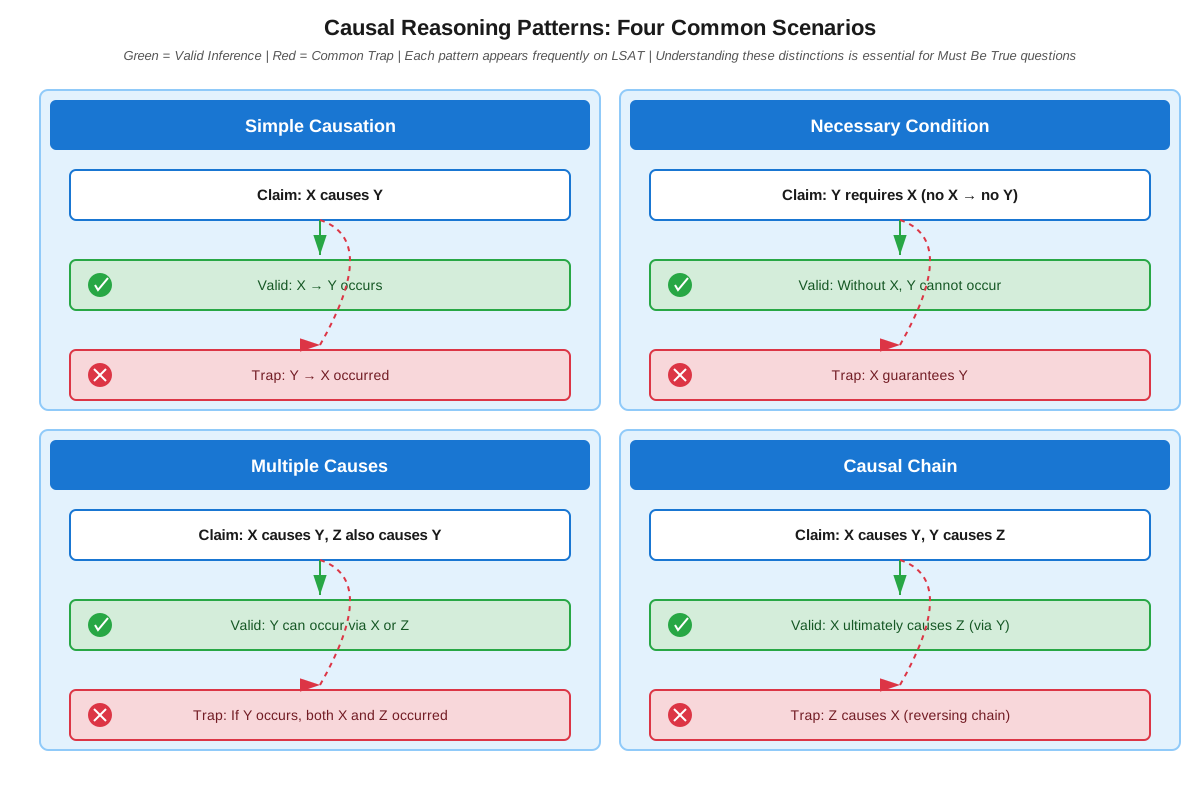
The LSAT often presents causal chains where X causes Y, and Y causes Z. From such chains, valid inferences include that X ultimately causes Z (through the intermediate step Y). Understanding these chains allows students to trace effects back to root causes or predict downstream consequences of initial causes.
When causal mechanisms are described—explaining how X brings about Y—additional inferences become possible about what must occur during the causal process, what conditions must be present, or what would interrupt the causal chain.
Alternative Explanations
A critical skill involves recognizing that observed correlations might have multiple explanations:
| Observation | Possible Explanation 1 | Possible Explanation 2 | Possible Explanation 3 |
|---|---|---|---|
| X and Y correlate | X causes Y | Y causes X | Z causes both X and Y |
| X precedes Y | X causes Y | Both caused by earlier factor | Coincidental timing |
| X and Y increase together | X causes Y | Y causes X | Common cause or confounding variable |
The LSAT rewards students who recognize that correlation evidence alone cannot determine which explanation is correct without additional information about temporal sequence, mechanism, or controlled conditions.
Temporal Sequence and Causation
Causes must precede their effects in time. If Y occurred before X, then X cannot have caused Y. The LSAT uses temporal information to test whether students properly apply this principle. However, temporal precedence alone does not establish causation—X occurring before Y does not prove X caused Y, as both might be effects of an earlier cause, or the sequence might be coincidental.
Strength of Causal Claims
Causal claims vary in strength from deterministic ("X always causes Y") to probabilistic ("X increases the likelihood of Y"). The LSAT tests whether students recognize what can be inferred from each type. A deterministic claim allows stronger inferences about individual cases, while probabilistic claims support inferences about populations or likelihoods but not certainties about specific instances.
Concept Relationships
The concepts within causal inference form an interconnected logical framework. Understanding causal claims as directional relationships provides the foundation for recognizing valid inferences (what must or likely follows) and distinguishing these from invalid inferences (tempting but unsupported conclusions). The distinction between valid and invalid inferences directly depends on understanding correlation versus causation, as many invalid inferences stem from treating correlational evidence as if it established causation.
Alternative explanations connect to invalid inferences by showing why certain conclusions are unwarranted—when multiple explanations could account for observed data, inferring one specific causal relationship is unjustified. Temporal sequence serves as a necessary but insufficient condition for causation, connecting to the broader framework by providing one criterion that must be met for valid causal inference while not guaranteeing causation alone.
Causal chains extend basic causal claims into more complex structures, building upon the foundational understanding of single cause-effect relationships. The concepts of necessity and sufficiency from conditional logic map onto causal reasoning, helping clarify what causal claims do and do not guarantee.
Relationship map: Basic causal claim structure → Valid inference patterns → Recognition of invalid inference traps → Alternative explanation consideration → Temporal sequence evaluation → Causal chain analysis → Integration with necessity/sufficiency concepts → Application to LSAT question types.
High-Yield Facts
⭐ A causal claim "X causes Y" does not mean X is the only cause of Y unless explicitly stated.
⭐ Correlation between X and Y does not establish that X causes Y; alternative explanations include reverse causation, common cause, or coincidence.
⭐ From "X causes Y," one cannot validly infer that Y causes X—causation is directional.
⭐ Temporal precedence is necessary for causation (causes must precede effects) but not sufficient to establish causation.
⭐ If X is stated to be the sole cause of Y and X is absent, then Y will not occur.
- A causal claim allows inference from cause to effect but requires additional information to infer from effect to cause.
- Multiple causes can produce the same effect; observing the effect does not determine which cause operated.
- Causal mechanisms, when described, allow inferences about intermediate steps in the causal process.
- Probabilistic causal claims ("X increases risk of Y") support inferences about populations but not certainties about individuals.
- Controlled conditions or experimental manipulation provide stronger evidence for causation than mere observational correlation.
- The absence of a correlation generally undermines (though does not definitively disprove) a causal claim.
- Causal chains allow transitive inference: if X causes Y and Y causes Z, then X ultimately causes Z.
Quick check — test yourself on Inference from causal claims so far.
Try Flashcards →Common Misconceptions
Misconception: If X and Y occur together frequently, X must cause Y.
Correction: Correlation does not establish causation. The co-occurrence might result from Y causing X, a third factor causing both, or coincidence. Additional evidence about temporal sequence, mechanism, or controlled conditions is needed to establish causation.
Misconception: From "X causes Y," one can infer that without X, Y cannot occur.
Correction: This inference is valid only if X is the sole cause of Y. Unless the stimulus explicitly states X is the only cause, Y might occur through alternative causal pathways.
Misconception: If X causes Y, then Y causes X (bidirectional causation is assumed).
Correction: Causal relationships are directional unless explicitly stated otherwise. The fact that smoking causes health problems does not mean health problems cause smoking.
Misconception: Temporal precedence alone establishes causation.
Correction: While causes must precede effects, X occurring before Y does not prove X caused Y. Both might be effects of an earlier common cause, or the temporal sequence might be coincidental.
Misconception: A causal claim means the cause is both necessary and sufficient for the effect.
Correction: A basic causal claim establishes that X can produce Y but does not automatically mean X is necessary (Y might have other causes) or sufficient alone (X might require additional conditions to produce Y).
Misconception: If removing X eliminates Y, this proves X was the cause of Y.
Correction: While this provides strong evidence for causation, it does not definitively prove it. The removal of X might coincide with other changes, or X might be part of a necessary causal pathway without being the direct cause.
Misconception: Stronger correlation means stronger causation.
Correction: Correlation strength indicates how closely two variables track together but does not indicate causal strength or even whether causation exists. A weak correlation might reflect genuine weak causation, or a strong correlation might reflect no causation at all (coincidence or common cause).
Worked Examples
Example 1: Basic Causal Inference
Stimulus: "Studies show that regular exercise causes improved cardiovascular health. Additionally, improved cardiovascular health is associated with increased longevity."
Question: Which of the following can be properly inferred from the statements above?
Answer Choices:
(A) Regular exercise is the only way to improve cardiovascular health.
(B) Anyone who exercises regularly will live longer than those who do not.
(C) Regular exercise contributes to increased longevity through its effect on cardiovascular health.
(D) Increased longevity causes improved cardiovascular health.
(E) People with good cardiovascular health must exercise regularly.
Analysis:
The stimulus establishes two relationships: (1) exercise causes improved cardiovascular health, and (2) improved cardiovascular health is associated with increased longevity. The second relationship is described as an "association," not explicitly as causation, though the context suggests cardiovascular health contributes to longevity.
(A) is invalid because the stimulus states exercise causes improved cardiovascular health but does not claim it is the only cause. Other factors might also improve cardiovascular health.
(B) is too strong. The stimulus supports that exercise contributes to longevity through cardiovascular health, but "will live longer" implies certainty and ignores other factors affecting longevity (accidents, genetics, other health conditions).
(C) is valid. The stimulus establishes that exercise causes improved cardiovascular health (first causal link) and that cardiovascular health is associated with longevity (second link). Following the causal chain, exercise contributes to longevity through the intermediate mechanism of cardiovascular health. This inference properly follows from the given information.
(D) reverses causation. The stimulus suggests cardiovascular health contributes to longevity, not that longevity causes cardiovascular health.
(E) commits the invalid inference of assuming that because exercise causes improved cardiovascular health, improved cardiovascular health must result from exercise. This ignores alternative causes of good cardiovascular health (genetics, diet, etc.).
Correct Answer: (C)
Learning Objective Connection: This example demonstrates identifying valid inferences from causal claims (following causal chains) while avoiding invalid inferences (assuming exclusivity, reversing causation, or confusing sufficient with necessary conditions).
Example 2: Correlation and Alternative Explanations
Stimulus: "A recent study found that children who attend preschool score higher on reading tests in third grade than children who do not attend preschool. The researchers concluded that preschool attendance causes improved reading ability."
Question: Which of the following, if true, most weakens the researchers' causal conclusion?
Answer Choices:
(A) Some children who did not attend preschool scored as high as children who did attend.
(B) The preschools in the study used different teaching methods.
(C) Families who send children to preschool tend to have higher incomes and more books at home than families who do not.
(D) Reading ability in third grade predicts academic success in later years.
(E) Preschool attendance has increased over the past decade.
Analysis:
The stimulus presents correlational evidence (preschool attendance correlates with higher reading scores) and concludes causation (preschool causes improved reading). To weaken this causal inference, we need information suggesting an alternative explanation for the correlation.
(A) shows variation within groups but does not challenge the causal claim. Even if some non-preschool children score high, preschool might still cause improvement on average.
(B) is irrelevant to whether preschool causes improvement. Different methods might all be effective, or this variation might explain differences among preschool attendees but does not address the causal claim.
(C) provides a strong alternative explanation. If families who send children to preschool differ systematically (higher income, more books), these factors might cause the improved reading scores rather than preschool itself. This suggests a common cause (family resources/education emphasis) producing both preschool attendance and better reading scores, undermining the inference that preschool causes the improvement.
(D) addresses consequences of reading ability but does not challenge whether preschool causes that ability.
(E) provides temporal information about trends but does not address the causal relationship between preschool and reading scores.
Correct Answer: (C)
Learning Objective Connection: This example illustrates recognizing that correlation does not establish causation and identifying alternative explanations (common cause) that undermine causal inferences. It demonstrates the reasoning pattern behind evaluating causal claims and applying this understanding to LSAT-style problems.
Exam Strategy
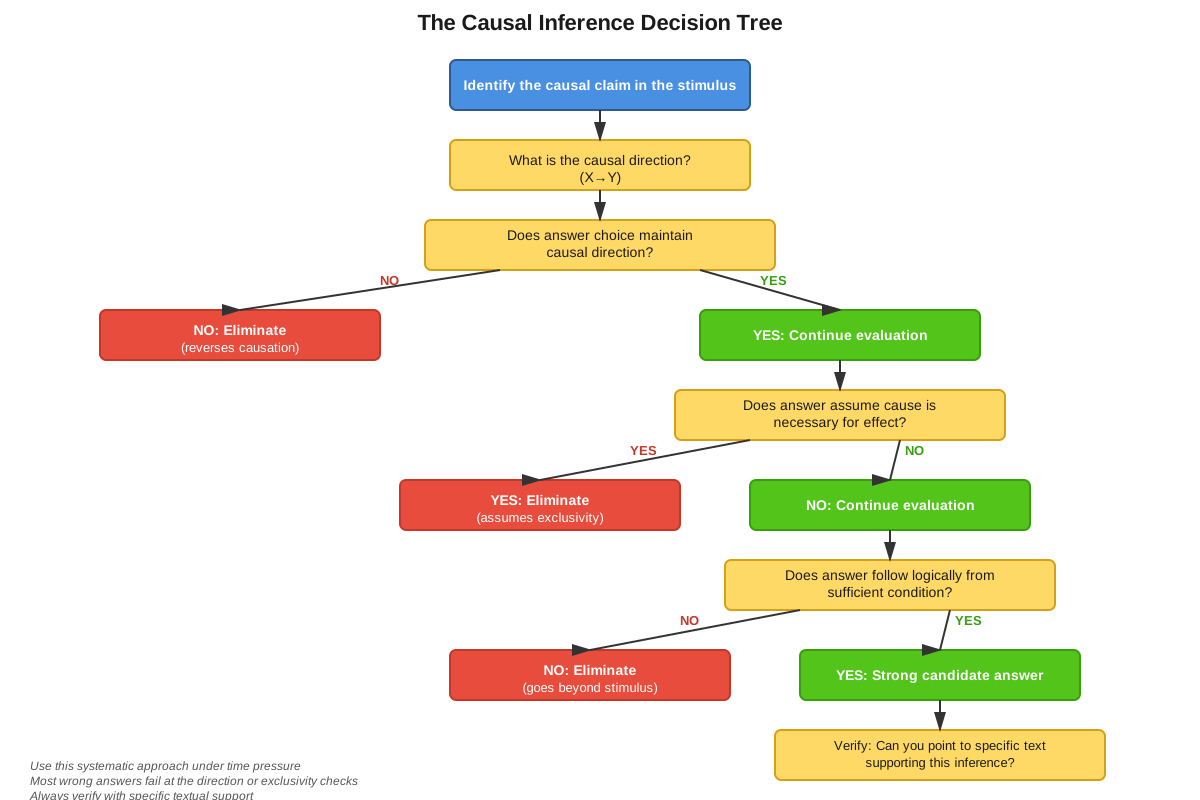
When approaching inference questions involving causal claims on the LSAT, follow this systematic process:
Step 1: Identify the causal claim explicitly. Look for language indicating causation: "causes," "produces," "brings about," "leads to," "results in," "is responsible for," or "contributes to." Distinguish these from mere correlation words like "associated with," "correlated with," or "occurs together with."
Step 2: Note the direction of causation. Clearly identify which element is the cause and which is the effect. The LSAT frequently includes wrong answers that reverse this direction.
Step 3: Determine whether the cause is stated as exclusive. Does the stimulus say or imply that X is the only cause of Y, or might other causes exist? Most LSAT stimuli do not establish exclusivity, making answers that assume it incorrect.
Step 4: Watch for temporal information. If the stimulus provides timing details, use these to eliminate answers that violate temporal sequence (effects preceding causes) or that assume causation from temporal precedence alone.
Step 5: Eliminate answers that commit common errors:
- Reversing causation
- Assuming exclusivity when not stated
- Confusing correlation with causation
- Treating probabilistic claims as certainties
- Ignoring alternative explanations
Exam Tip: Wrong answers on causal inference questions often feel intuitively correct because they describe relationships that might exist in the real world. Resist this temptation—focus only on what the stimulus actually establishes, not on outside knowledge or assumptions.
Trigger phrases for causal claims: "X causes Y," "X produces Y," "X brings about Y," "X is responsible for Y," "X leads to Y," "X results in Y," "due to X," "because of X," "X accounts for Y."
Trigger phrases for correlation (not causation): "X is associated with Y," "X correlates with Y," "X and Y occur together," "X accompanies Y," "X is linked to Y" (without explicit causal language).
Time allocation: Spend 15-20 seconds identifying the causal structure before evaluating answer choices. This upfront investment prevents wasting time on attractive wrong answers. For Must Be True questions with causal claims, expect to spend 60-90 seconds total, as these questions reward careful analysis over speed.
Process of elimination: Start by eliminating answers that clearly reverse causation or assume facts not in evidence. Then evaluate remaining answers for whether they follow validly from the established causal relationship, checking each against the specific wording of the stimulus.
Memory Techniques
Mnemonic for valid causal inferences - "PACE":
- Presence of cause suggests presence of effect
- Absence of sole cause suggests absence of effect
- Chain following (if X→Y and Y→Z, then X→Z)
- Effect presence suggests cause presence (when cause is exclusive)
Mnemonic for invalid inference traps - "RENT":
- Reversing causation (Y causes X from X causes Y)
- Exclusivity assumption (X is the only cause)
- Necessity confusion (X is necessary for Y)
- Temporal precedence alone (X before Y means X caused Y)
Visualization strategy: Picture causal relationships as arrows. "X causes Y" becomes X → Y. This visual representation makes it immediately clear that Y → X (reverse) is not established, and helps track causal chains (X → Y → Z).
Acronym for alternative explanations - "RCC":
- Reverse causation (Y actually causes X)
- Common cause (Z causes both X and Y)
- Coincidence (no causal relationship)
When evaluating correlation evidence, mentally run through RCC to remember that multiple explanations exist beyond the stated causal claim.
Summary
Inference from causal claims represents a high-yield LSAT topic requiring precise understanding of what follows logically from causal statements and what does not. Valid inferences include following causal chains, inferring effects from causes (when conditions are met), and inferring causes from effects (when exclusivity is established). Invalid inferences that the LSAT exploits include reversing causation, assuming exclusivity without justification, confusing correlation with causation, and treating temporal precedence as sufficient for causation. Success requires recognizing that causal claims are directional, that multiple causes can produce the same effect, and that correlation evidence alone cannot establish causation without ruling out alternative explanations like reverse causation or common causes. Students must distinguish between what a causal claim actually establishes versus what seems intuitively plausible but lacks logical support. Mastering this topic involves systematic analysis of causal structure, careful attention to stimulus wording, and disciplined elimination of answers that commit predictable logical errors.
Key Takeaways
- Causal claims are directional: "X causes Y" does not mean "Y causes X"—always note which element is the cause and which is the effect.
- Correlation ≠ causation: Co-occurrence of two phenomena does not establish that one causes the other without additional evidence ruling out alternative explanations.
- Exclusivity must be stated: Unless the stimulus explicitly says X is the only cause of Y, do not infer that Y cannot occur without X.
- Temporal precedence is necessary but not sufficient: Causes must precede effects, but X occurring before Y does not prove X caused Y.
- Valid inferences follow causal chains: If X causes Y and Y causes Z, then X ultimately causes Z through the intermediate mechanism.
- Alternative explanations undermine causal conclusions: Reverse causation, common causes, and coincidence represent competing explanations for observed correlations.
- Watch for strength qualifiers: Distinguish between deterministic causal claims (X always causes Y) and probabilistic claims (X increases likelihood of Y), as these support different inferences.
Related Topics
Necessary and Sufficient Conditions: Understanding the logical structure of necessary and sufficient conditions deepens comprehension of causal relationships, as causes can be necessary, sufficient, both, or neither for their effects. Mastering causal inference provides a foundation for analyzing these more formal logical relationships.
Flaw Questions - Causal Reasoning Errors: Many Flaw questions test recognition of improper causal inferences, including confusing correlation with causation, reversing causal direction, or overlooking alternative explanations. Mastery of causal inference directly improves performance on these questions.
Strengthen and Weaken Questions: These question types frequently involve causal arguments, asking what would support or undermine a causal claim. Understanding valid causal inference patterns enables identification of relevant strengtheners and weakeners.
Conditional Logic and Formal Logic: Causal relationships share structural similarities with conditional statements, and understanding both enhances overall logical reasoning ability. The skills developed in causal inference transfer to analyzing conditional chains and contrapositive reasoning.
Practice CTA
Now that you have mastered the core concepts of inference from causal claims, reinforce your understanding by attempting the practice questions designed specifically for this topic. These questions will challenge you to apply the reasoning patterns, identify valid and invalid inferences, and avoid common traps under timed conditions. Additionally, use the flashcards to drill high-yield facts and ensure rapid recognition of causal structures on test day. Consistent practice with these materials will transform your understanding into the automatic, confident performance that produces top LSAT scores. You have built a strong foundation—now apply it to achieve mastery.
Sign up free to keep reading
Create a free AnvayaPrep account to finish this LSAT guide on Inference from causal claims — plus flashcards and practice questions.