Overview
Inference from comparisons is a critical reasoning pattern that appears frequently on the LSAT Logical Reasoning section. This question type requires test-takers to draw valid conclusions from statements that compare two or more entities, concepts, or situations. When the LSAT presents comparative statements—such as "X is more likely than Y" or "A requires less effort than B"—students must understand the logical relationships these comparisons establish and recognize what can and cannot be validly inferred from them. Mastering this skill is essential because comparison-based reasoning appears not only in dedicated inference questions but also permeates assumption, strengthen/weaken, and flaw questions throughout the exam.
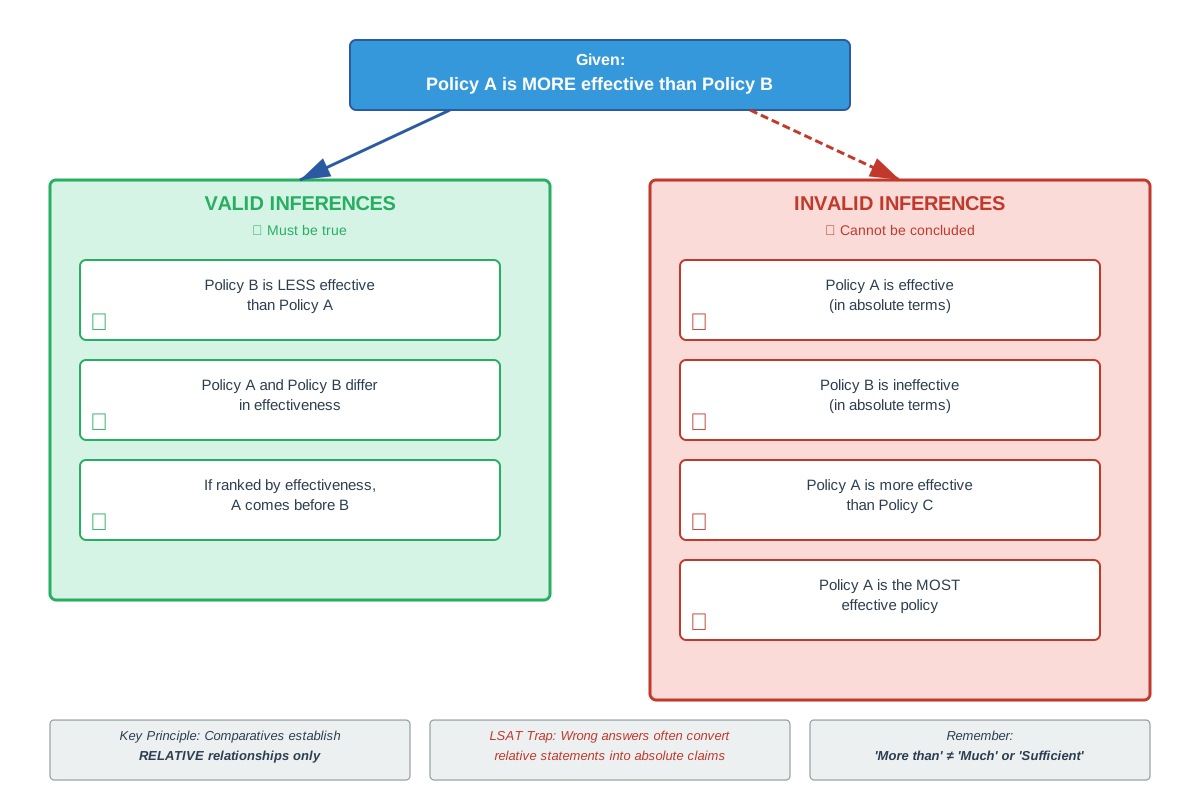
The fundamental challenge of LSAT inference from comparisons lies in distinguishing between what the comparison explicitly establishes versus what test-takers might assume based on real-world knowledge or intuition. The LSAT deliberately constructs comparison statements that invite overreach—students often infer absolute qualities when only relative relationships are established, or they reverse the direction of comparisons incorrectly. For example, knowing that "Policy A is more effective than Policy B" tells us nothing definitive about whether either policy is actually effective in an absolute sense; it only establishes a relative relationship between the two.
Within the broader landscape of logical reasoning, inference from comparisons connects directly to conditional reasoning, quantitative relationships, and formal logic. These questions test the same fundamental skill that underlies all LSAT success: the ability to recognize precisely what information has been provided and to draw only those conclusions that must be true based on that information. Students who excel at comparison-based inferences demonstrate disciplined thinking that resists the temptation to import outside assumptions or to extend conclusions beyond what the premises warrant.
Learning Objectives
- [ ] Identify how Inference from comparisons appears in LSAT questions
- [ ] Explain the reasoning pattern behind Inference from comparisons
- [ ] Apply Inference from comparisons to solve LSAT-style problems accurately
- [ ] Distinguish between valid and invalid inferences drawn from comparative statements
- [ ] Recognize common trap answers that exploit misunderstandings of comparative logic
- [ ] Translate complex comparative statements into clear logical relationships
- [ ] Combine multiple comparative statements to derive compound inferences
Prerequisites
- Basic formal logic: Understanding of necessary and sufficient conditions provides the foundation for recognizing what comparisons do and do not establish
- Conditional reasoning: Familiarity with "if-then" statements helps students avoid confusing comparative relationships with conditional ones
- Quantifier logic: Knowledge of "all," "some," and "none" enables proper interpretation of comparative scope
- Inference question structure: General understanding of how LSAT inference questions work and what "must be true" means in this context
Why This Topic Matters
Inference from comparisons represents one of the most practical reasoning skills tested on the LSAT because comparative thinking pervades legal reasoning, policy analysis, and everyday decision-making. Lawyers constantly evaluate which precedent is more applicable, which interpretation is stronger, or which evidence is more probative. The ability to reason precisely about relative relationships without overstepping into unsupported absolute claims is fundamental to legal analysis.
On the LSAT itself, comparison-based reasoning appears in approximately 15-20% of Logical Reasoning questions across both sections. While dedicated inference questions may explicitly ask what "must be true" based on comparative statements, this reasoning pattern also appears in:
- Assumption questions where the argument relies on unstated comparative relationships
- Strengthen/Weaken questions where answer choices introduce new comparisons or challenge existing ones
- Flaw questions where arguments improperly infer absolute qualities from relative comparisons
- Parallel reasoning questions where matching comparative structures is essential
The LSAT frequently embeds comparisons within complex stimulus passages involving multiple entities, temporal comparisons (before/after), or nested relationships (A compared to B, which is compared to C). Test-makers exploit predictable errors in comparative reasoning, making this a high-yield area for score improvement. Students who master this topic gain points not only on direct inference questions but across multiple question types throughout both Logical Reasoning sections.
Core Concepts
The Logic of Comparative Statements
A comparative statement establishes a relationship between two or more entities along some dimension or property. The most fundamental principle is that comparisons are inherently relative rather than absolute. When the LSAT states "X is larger than Y," this tells us only about the relationship between X and Y—it provides no information about whether X is large in any absolute sense, whether Y is small, or how either compares to any third entity not mentioned.
Comparative statements typically take several forms:
| Comparison Type | Example | What It Establishes | What It Does NOT Establish |
|---|---|---|---|
| Simple comparative | "A is faster than B" | A's speed > B's speed | Whether A is fast; whether B is slow |
| Superlative | "C is the tallest" | C's height > all others | C's actual height; how much taller |
| Equality | "D equals E in weight" | D's weight = E's weight | The actual weight value |
| Negative comparative | "F is less reliable than G" | F's reliability < G's reliability | Whether either is reliable |
Valid Inferences from Single Comparisons
From a single comparative statement, only certain inferences are logically valid. Consider the statement: "The new medication is more effective than the standard treatment."
Valid inferences include:
- The standard treatment is less effective than the new medication (reversal with adjustment)
- The two treatments differ in effectiveness (non-identity)
- If we rank treatments by effectiveness, the new medication ranks higher than the standard treatment
Invalid inferences include:
- The new medication is effective (absolute quality not established)
- The standard treatment is ineffective (absolute quality not established)
- The new medication is the most effective available (no comparison to other options provided)
- The difference in effectiveness is significant (magnitude not specified)
Transitive Properties in Comparative Chains
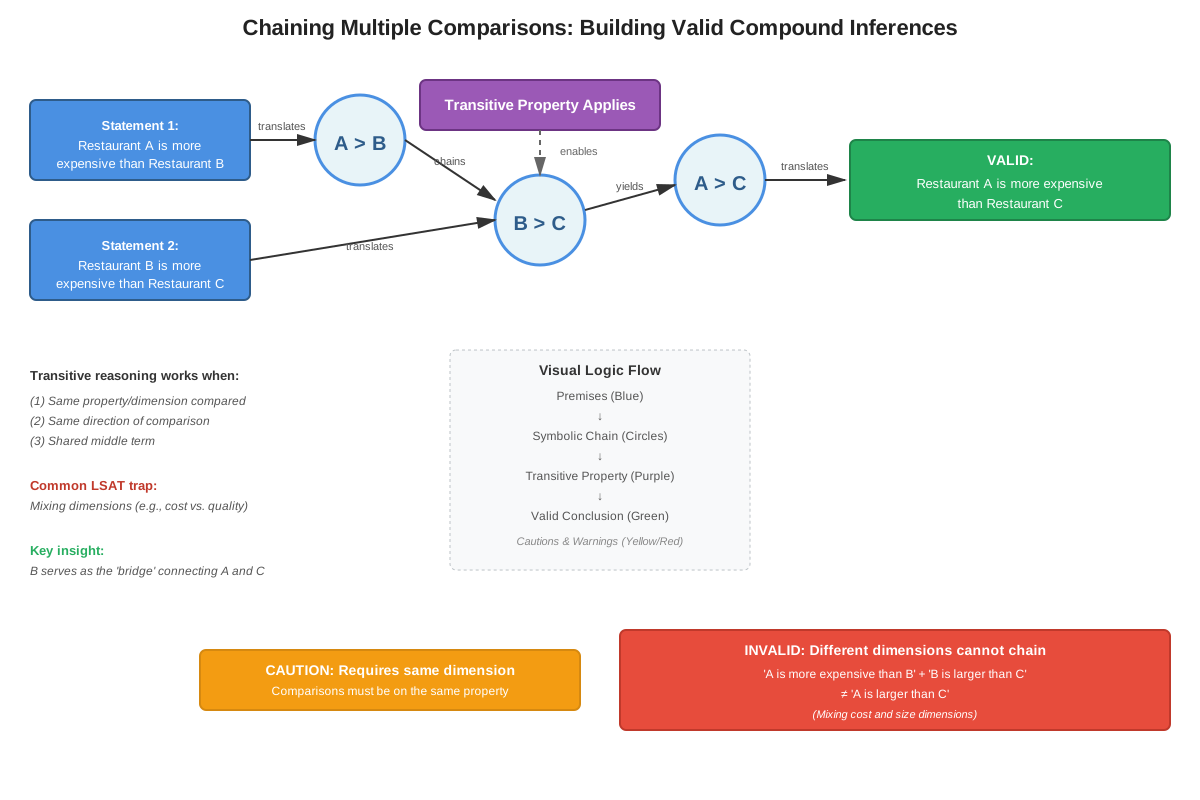
When multiple comparative statements are provided, transitivity often allows for compound inferences. If "A is greater than B" and "B is greater than C," then "A is greater than C" must be true. However, transitivity applies only to certain types of comparisons and requires careful attention to the dimension being compared.
Transitive comparisons:
- Quantitative relationships (more/less, greater/fewer, higher/lower)
- Temporal sequences (before/after, earlier/later)
- Hierarchical rankings (superior/inferior, better/worse)
Non-transitive or conditionally transitive:
- Preferences (if John prefers A to B and B to C, John must prefer A to C—but this doesn't extend across different people)
- Causal relationships (A causes B, B causes C does not always mean A causes C directly)
Scope Limitations in Comparative Reasoning
The scope of a comparison defines its boundaries—what entities are included and what dimension is being measured. LSAT questions frequently test whether students recognize scope limitations. Consider: "Among the proposed solutions, Plan X is the most cost-effective."
This comparison's scope is limited to:
- Only the proposed solutions (not all possible solutions)
- Cost-effectiveness specifically (not other measures like speed or thoroughness)
Students cannot validly infer that Plan X is cost-effective in absolute terms, that it's the best plan overall, or that it's more cost-effective than any non-proposed solution.
Quantitative vs. Qualitative Comparisons
Quantitative comparisons involve measurable dimensions where precise relationships can be established: "Product A costs $50 more than Product B" provides specific information that enables mathematical inferences.
Qualitative comparisons involve subjective or non-numerical dimensions: "Candidate X is more charismatic than Candidate Y" establishes a relationship but without the precision that enables numerical calculations.
The LSAT tests whether students recognize that qualitative comparisons, while establishing valid relative relationships, do not support the same types of inferences as quantitative ones. From "A is more charismatic than B," we cannot infer "A is twice as charismatic as B" or make any numerical calculation.
Comparative Modifiers and Their Implications
Certain words modify comparisons in ways that affect valid inferences:
- "Slightly/marginally more": Establishes the direction of comparison and indicates small magnitude
- "Significantly/substantially more": Establishes direction and indicates large magnitude (though "large" remains relative)
- "At least as much": Establishes minimum relationship (equal or greater)
- "No more than": Establishes maximum relationship (equal or less)
These modifiers matter because they affect what can be inferred. "A is at least as effective as B" allows for the possibility that A and B are equally effective, while "A is more effective than B" excludes this possibility.
Temporal Comparisons
Temporal comparisons establish relationships in time: before/after, earlier/later, first/last. These function similarly to other comparisons but with specific logical properties:
- Temporal order is transitive: if Event A occurred before Event B, and Event B occurred before Event C, then Event A occurred before Event C
- Temporal comparisons do not establish causation: "A occurred before B" does not mean "A caused B"
- Temporal comparisons may be relative or absolute: "earlier" is relative, while "at 3:00 PM" is absolute
The LSAT frequently tests whether students confuse temporal sequence with causal relationships or whether they properly track multiple temporal comparisons through complex passages.
Concept Relationships
The concepts within inference from comparisons build upon each other in a logical progression. Understanding the logic of comparative statements (that comparisons are relative, not absolute) forms the foundation for all other concepts. This fundamental principle directly enables recognition of valid versus invalid inferences from single comparisons—students must first understand the relative nature of comparisons before they can determine what follows from them.
Transitive properties in comparative chains extends single-comparison logic to multiple statements, requiring students to combine the foundational understanding with rules about when and how comparisons can be chained together. This concept connects back to prerequisite knowledge of conditional reasoning, as transitivity in comparisons parallels (but differs from) transitivity in conditional statements.
Scope limitations and quantitative versus qualitative comparisons both refine the foundational understanding by adding nuance—they specify the boundaries and types of comparative relationships. These concepts work together: scope defines what entities and dimensions are included, while the quantitative/qualitative distinction determines what types of inferences are possible within that scope.
Comparative modifiers and temporal comparisons represent specialized applications of the core principles. Modifiers affect the strength and nature of comparative relationships, while temporal comparisons apply comparative logic to the specific dimension of time.
The relationship map flows as follows:
Basic comparative logic → Valid/invalid inferences → Transitive chains (horizontal expansion) and Scope/type distinctions (vertical refinement) → Specialized applications (modifiers and temporal)
These concepts connect to broader logical reasoning skills by exemplifying the LSAT's core demand: precise interpretation of what statements do and do not establish. They relate to prerequisite formal logic by applying logical principles to a specific type of statement structure, and they connect forward to more complex reasoning tasks where comparative relationships form part of larger arguments.
High-Yield Facts
⭐ Comparative statements establish only relative relationships, never absolute qualities—"X is better than Y" does not tell us whether X is good
⭐ Reversing a comparison requires adjusting the comparative term—if "A is more than B," then "B is less than A" (not "B is more than A")
⭐ Transitive inferences are valid only when all comparisons measure the same dimension—you cannot chain "A is heavier than B" with "B is faster than C"
⭐ Superlatives establish relationships with all other members of the specified group—"X is the tallest" means X is taller than every other member
⭐ The scope of a comparison is limited to explicitly mentioned entities and dimensions—comparisons to unmentioned entities cannot be inferred
- Equality statements ("A equals B") allow bidirectional substitution in further comparisons
- "At least as much" includes the possibility of equality; "more than" excludes equality
- Temporal sequence (before/after) does not establish causation without additional support
- Quantitative comparisons support mathematical operations; qualitative comparisons do not
- Comparative statements with different subjects cannot be combined unless a linking comparison is provided
- Negative comparisons ("less than") follow the same logical rules as positive comparisons ("more than")
- The magnitude of difference in a comparison cannot be inferred unless explicitly stated
- Multiple comparisons involving the same entity can be combined to generate new inferences about relationships between other entities
Quick check — test yourself on Inference from comparisons so far.
Try Flashcards →Common Misconceptions
Misconception: If A is more effective than B, then A must be effective in an absolute sense.
Correction: Comparative statements establish only relative relationships. A could be more effective than B while both are ineffective, or while only A is effective, or while both are effective. The comparison alone does not determine absolute qualities.
Misconception: If A is better than B, and C is better than D, then A must be better than D.
Correction: Transitive inferences require a chain of comparisons involving the same entities. Without a comparison linking A or B to C or D, no inference about the relationship between A and D can be drawn. These are two separate, unconnected comparisons.
Misconception: "A is more likely than B" means "A is likely."
Correction: Probability comparisons are relative. A could be more likely than B even if A has only a 2% probability and B has a 1% probability—neither would be "likely" in absolute terms. The comparison establishes only which has higher probability, not whether either probability is high.
Misconception: If the passage compares A and B, then any answer choice comparing A and B must be inferable.
Correction: The specific content and direction of the comparison matters. If the passage states "A is larger than B," this does not support an inference that "A is more expensive than B" or "A is better than B"—only size has been compared, and only in one direction.
Misconception: Temporal sequence implies causation—if A happened before B, then A caused B.
Correction: Temporal order is logically independent of causal relationships. While causes must precede effects, precedence alone does not establish causation. The LSAT frequently includes temporally ordered events that are not causally related, and assuming causation from sequence is a common trap.
Misconception: If A is "significantly more" than B, then the difference must be large in absolute terms.
Correction: "Significantly" modifies the comparison but remains relative to context. A could be significantly more than B even if both values are small. For example, 2 is significantly more than 1 (100% more), but both numbers are small in absolute terms.
Misconception: Comparative statements can be reversed without changing the comparative term—if "A is superior to B," then "B is superior to A."
Correction: Reversing a comparison requires inverting the comparative relationship. If "A is superior to B," then "B is inferior to A" (not "B is superior to A"). The direction of the comparison must be adjusted when the order of entities is reversed.
Worked Examples
Example 1: Single Comparison with Scope Limitations
Stimulus: "Among the five candidates interviewed for the position, Martinez demonstrated more relevant experience than any other candidate. Chen, one of the five candidates, has worked in the industry for fifteen years."
Question: Which of the following must be true based on the information above?
Answer Choices:
(A) Martinez has worked in the industry for more than fifteen years
(B) Martinez has more total work experience than Chen
(C) Martinez demonstrated more relevant experience than Chen
(D) Martinez is the most qualified candidate for the position
(E) Chen demonstrated less relevant experience than all other candidates except Martinez
Analysis:
First, identify the comparative statements:
- Martinez demonstrated more relevant experience than any other candidate (among the five interviewed)
- Chen has worked in the industry for fifteen years (absolute statement, not comparative)
Now evaluate each answer choice:
(A) Martinez has worked in the industry for more than fifteen years
This confuses "relevant experience" with "industry experience" and attempts to infer absolute duration from a relative comparison. The comparison tells us only that Martinez demonstrated more relevant experience than Chen, not that Martinez has more industry experience or that relevant experience equals industry experience. Invalid.
(B) Martinez has more total work experience than Chen
This confuses "relevant experience" (the dimension compared) with "total work experience" (a different dimension). The stimulus compares only relevant experience, so no inference about total experience is possible. Invalid.
(C) Martinez demonstrated more relevant experience than Chen
Chen is "one of the five candidates," and Martinez demonstrated more relevant experience than "any other candidate" among the five. This means Martinez demonstrated more relevant experience than each of the other four candidates individually, including Chen. This is a valid application of the universal comparison ("any other") to a specific member of the group. Valid—this is the correct answer.
(D) Martinez is the most qualified candidate for the position
"Most qualified" is broader than "most relevant experience." Qualification might depend on factors beyond relevant experience (education, personality, salary requirements, etc.). The comparison establishes only one dimension of evaluation. Invalid.
(E) Chen demonstrated less relevant experience than all other candidates except Martinez
This would require Chen to rank second among the five candidates. However, the stimulus tells us only that Martinez ranks first—it provides no information about the relative ranking of the other four candidates. Chen could rank second, third, fourth, or fifth. Invalid.
Key Takeaway: This example demonstrates how scope limitations (the comparison applies only to relevant experience, only among the five candidates) and the distinction between dimensions (relevant vs. total vs. industry experience) restrict valid inferences.
Example 2: Transitive Chain with Multiple Comparisons
Stimulus: "The new environmental regulation will be more costly to implement than the current policy. However, the proposed alternative regulation would be less costly to implement than the new regulation. The current policy is more costly to implement than taking no regulatory action at all."
Question: If the statements above are true, which of the following must also be true?
Answer Choices:
(A) The proposed alternative regulation is less costly than the current policy
(B) The proposed alternative regulation is more costly than taking no action
(C) The new regulation is the most costly option mentioned
(D) Taking no action is less costly than all regulatory options mentioned
(E) The current policy and the proposed alternative regulation are equally costly
Analysis:
First, translate the comparative statements into a clear relationship, using "cost to implement" as the dimension and arranging from most to least costly:
- New regulation > Current policy (new is MORE costly)
- New regulation > Proposed alternative (proposed alternative is LESS costly than new)
- Current policy > No action (current is MORE costly)
Now construct the transitive chain. We can establish:
- New regulation > Current policy > No action (from statements 1 and 3)
- New regulation > Proposed alternative (from statement 2)
The question is: where does "Proposed alternative" fit relative to "Current policy" and "No action"?
From the given information:
- We know: New regulation > Proposed alternative
- We know: New regulation > Current policy > No action
- We do NOT know how Proposed alternative compares to Current policy or No action
Now evaluate the answer choices:
(A) The proposed alternative regulation is less costly than the current policy
This would require: Current policy > Proposed alternative. But we only know that New regulation > Proposed alternative and New regulation > Current policy. The proposed alternative could be more costly than, less costly than, or equally costly to the current policy. Invalid.
(B) The proposed alternative regulation is more costly than taking no action
This would require: Proposed alternative > No action. We know New regulation > Proposed alternative and Current policy > No action, but we don't know how Proposed alternative compares to Current policy or No action. If Proposed alternative is less costly than Current policy, and Current policy is more costly than No action, then Proposed alternative could still be either more or less costly than No action. Invalid.
(C) The new regulation is the most costly option mentioned
We know: New regulation > Current policy and New regulation > Proposed alternative. We also know Current policy > No action. By transitivity, New regulation > No action. Therefore, New regulation is more costly than all other options mentioned (Current policy, Proposed alternative, and No action). Valid—this is the correct answer.
(D) Taking no action is less costly than all regulatory options mentioned
We know No action < Current policy and No action < New regulation (by transitivity). However, we don't know how No action compares to Proposed alternative. Proposed alternative could potentially be less costly than No action. Invalid.
(E) The current policy and the proposed alternative regulation are equally costly
Nothing in the stimulus suggests equality. We know both are less costly than the new regulation, but their relationship to each other is not established. Invalid.
Key Takeaway: This example demonstrates how transitive reasoning allows combining multiple comparisons to generate new inferences, but only when the comparisons form a connected chain. Unconnected comparisons (like Proposed alternative vs. Current policy) cannot be resolved without additional information.
Exam Strategy
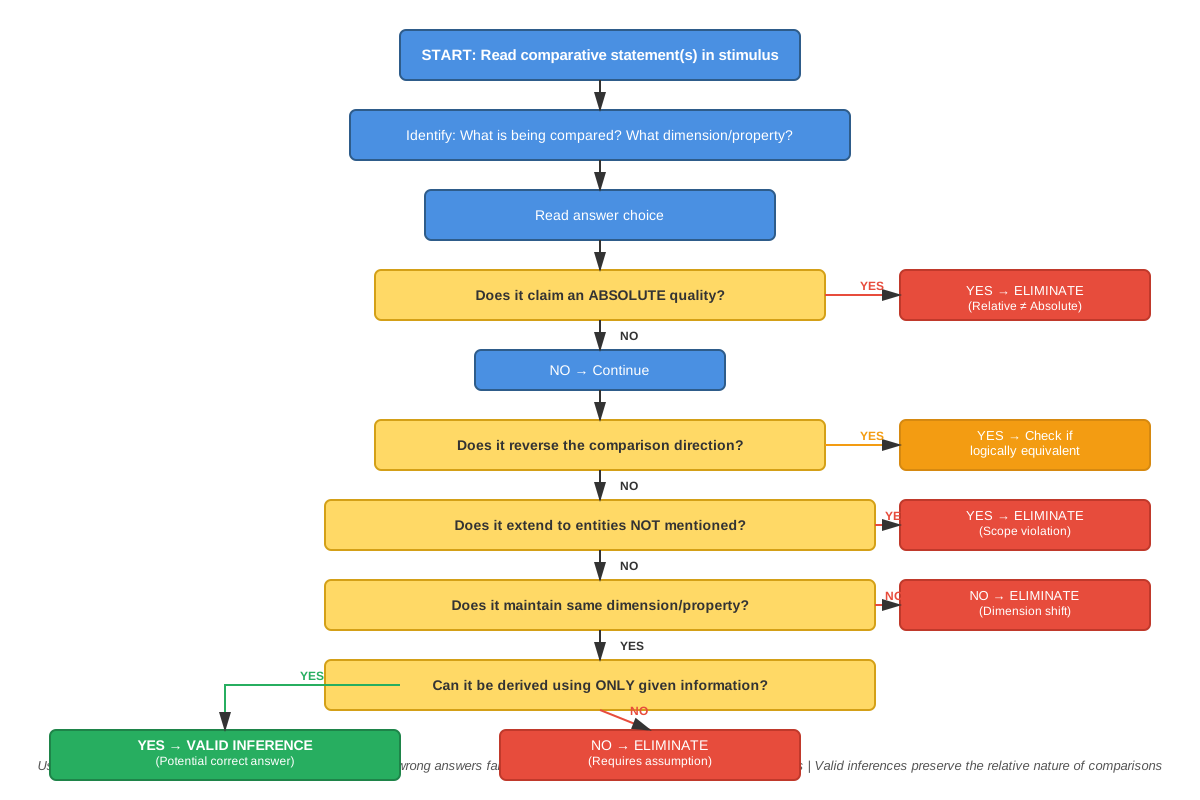
When approaching LSAT questions involving inference from comparisons, implement this systematic process:
Step 1: Identify all comparative statements in the stimulus. Underline or note each comparison, paying attention to:
- What entities are being compared
- What dimension or property is being compared (cost, effectiveness, likelihood, etc.)
- The direction of the comparison (more/less, better/worse, etc.)
- Any modifiers (significantly, slightly, at least, etc.)
Step 2: Map the relationships using symbols or a simple diagram. For example:
- A > B (A is more than B)
- B > C (B is more than C)
- Therefore: A > B > C
Step 3: Note scope limitations explicitly. Ask:
- What group or set do these entities belong to?
- What dimension is being compared?
- What time frame applies?
Step 4: Before looking at answer choices, predict what types of inferences are valid:
- Reversals (if A > B, then B < A)
- Transitive conclusions (if A > B > C, then A > C)
- Superlative implications (if A is the most, then A > all others)
Trigger words and phrases to watch for:
- "More/less," "greater/fewer," "higher/lower": Quantitative comparisons
- "Better/worse," "superior/inferior": Qualitative comparisons
- "Most," "least," "-est" endings: Superlatives indicating comparison to all others
- "At least as," "no more than": Boundary comparisons that include equality
- "Among," "of those," "in the group": Scope limiters
- "Before/after," "earlier/later": Temporal comparisons
Process-of-elimination tips:
- Eliminate answer choices that introduce new dimensions: If the stimulus compares cost, eliminate answers about effectiveness unless a connection is established
- Eliminate absolute claims: If an answer states "X is expensive" rather than "X is more expensive than Y," it likely oversteps the relative comparison
- Eliminate reversed comparisons: If the stimulus states A > B, eliminate answers suggesting B > A
- Eliminate scope violations: If the comparison applies to "the three proposed plans," eliminate answers about plans not mentioned or about all possible plans
- Eliminate magnitude claims: If the stimulus doesn't specify how much more/less, eliminate answers that assume large or small differences
Time allocation advice:
Comparison-based inference questions typically require 60-90 seconds. Allocate:
- 20-30 seconds: Reading and mapping the stimulus
- 10-15 seconds: Predicting valid inferences
- 30-45 seconds: Evaluating answer choices
If a question involves complex transitive chains with 3+ comparisons, allow up to 2 minutes. The time investment in carefully mapping relationships pays off by making answer evaluation faster and more accurate.
Exam Tip: When stuck between two answer choices, return to the exact wording of the comparison in the stimulus. The LSAT rewards precision—often the difference between correct and incorrect answers hinges on a single word like "more" vs. "most" or "likely" vs. "more likely."
Memory Techniques
The "R.A.N.G.E." Acronym for Comparison Analysis:
- Relative, not absolute (comparisons establish relationships, not qualities)
- Adjust when reversing (if A > B, then B < A, not B > A)
- No new dimensions (can't infer about properties not compared)
- Group scope matters (comparisons apply only to mentioned entities)
- Equality excluded by "more" (but included by "at least as")
Visualization Strategy: The Comparison Ladder
Imagine each comparison as placing entities on rungs of a ladder. Higher rungs represent "more" of the compared property:
[New Regulation]  ← Top rung (most costly)
[Current Policy]  ← Middle rung
[No Action]       ← Bottom rung (least costly)
When a new entity is introduced with a comparison, place it on the appropriate rung. If its position relative to existing entities is unclear, note it to the side with a question mark. This visual prevents invalid transitive inferences.
The "Same Dimension" Mantra
Before combining comparisons, repeat: "Same dimension, same dimension." This prevents the common error of chaining "A is heavier than B" with "B is faster than C." Only comparisons measuring the same property can be combined transitively.
Temporal Sequence Reminder: "Before ≠ Because"
For temporal comparisons, remember that chronological order does not establish causation. Visualize a timeline with events marked, but no arrows connecting them unless causation is explicitly stated.
Summary
Inference from comparisons is a high-yield LSAT topic that tests the ability to draw valid conclusions from statements establishing relative relationships between entities. The fundamental principle is that comparisons are inherently relative—they establish how entities relate to each other along a specific dimension but do not determine absolute qualities. Valid inferences from comparisons include reversals (with adjusted comparative terms), transitive conclusions when comparisons form connected chains along the same dimension, and implications of superlatives. Invalid inferences typically involve assuming absolute qualities from relative comparisons, combining comparisons across different dimensions, extending comparisons beyond their stated scope, or confusing temporal sequence with causation. Success on comparison-based questions requires careful attention to what dimension is being compared, what entities are included in the comparison's scope, and whether the comparison establishes equality or strict inequality. Students must resist the temptation to import real-world assumptions or to extend conclusions beyond what the comparative statements strictly establish.
Key Takeaways
- Comparative statements establish only relative relationships between entities, never absolute qualities or values
- Valid inferences require maintaining the same dimension of comparison and respecting scope limitations to explicitly mentioned entities
- Transitive reasoning applies when comparisons form connected chains (A > B, B > C allows inferring A > C), but only along the same dimension
- Reversing a comparison requires inverting the comparative term: if "A is more than B," then "B is less than A"
- Superlatives ("most," "least," "-est") establish that one entity exceeds all others in the specified group on the compared dimension
- Temporal comparisons establish chronological order but do not, by themselves, establish causal relationships
- The LSAT exploits predictable errors: assuming absolute qualities, combining incompatible dimensions, and extending beyond stated scope
Related Topics
Conditional Reasoning and Sufficient/Necessary Conditions: Mastering comparisons provides a foundation for understanding conditional statements, as both involve precise relationships between entities. Conditional reasoning adds the dimension of logical dependency (if-then relationships) to the relative relationships established by comparisons.
Quantitative Reasoning and Proportional Relationships: Building on comparison skills, quantitative reasoning involves numerical relationships and calculations. Understanding that comparisons establish order but not magnitude prepares students for questions requiring mathematical precision.
Causal Reasoning: Comparison skills directly support causal analysis because causal arguments often involve comparing outcomes under different conditions. Recognizing that correlation (including temporal sequence) differs from causation extends the principle that comparisons establish limited relationships.
Formal Logic and Diagramming: The symbolic representation of comparisons (A > B) connects to broader formal logic skills. Students who master comparison notation can more easily learn complex logical diagramming techniques.
Practice CTA
Now that you understand the logical structure of inference from comparisons, it's time to apply these principles to actual LSAT questions. The practice questions and flashcards will reinforce your ability to identify comparative statements, map relationships accurately, and distinguish valid from invalid inferences. Remember: precision in interpretation is the key to success. Each practice question you work through strengthens your pattern recognition and builds the disciplined thinking that separates top scorers from the rest. Approach each question systematically, map the comparisons before evaluating answers, and review both correct and incorrect choices to understand why each answer succeeds or fails. Your investment in mastering this high-yield topic will pay dividends across multiple question types throughout the LSAT.
Sign up free to keep reading
Create a free AnvayaPrep account to finish this LSAT guide on Inference from comparisons — plus flashcards and practice questions.