Overview
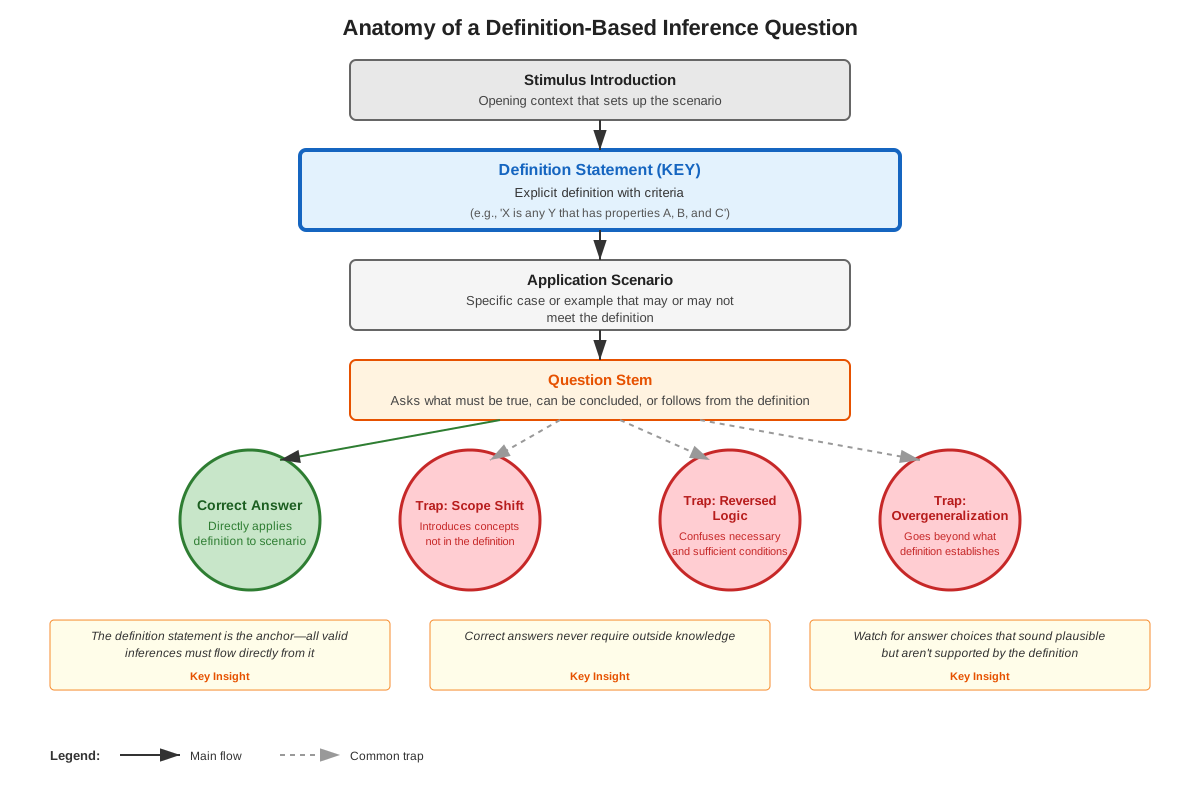
Inference from definitions is a critical reasoning pattern that appears frequently on the LSAT Logical Reasoning section. This question type requires test-takers to draw valid conclusions based on how terms are explicitly defined within a stimulus. Unlike other inference questions that rely on implicit relationships or causal reasoning, these questions hinge on the precise application of stated definitions to specific cases or scenarios. The LSAT tests whether students can recognize when something meets or fails to meet a given definition, and whether they can correctly apply definitional criteria to novel situations.
Understanding lsat inference from definitions is essential because these questions reward careful reading and logical precision—two skills that underpin success across all LSAT question types. When a stimulus provides a definition (such as "A democracy is any system where citizens directly elect their leaders"), the correct answer will necessarily follow from applying that definition correctly. These questions often appear deceptively simple, but they punish hasty reasoning and reward students who can distinguish between what must be true based on a definition versus what might be true or seems plausible.
Within the broader landscape of logical reasoning, inference from definitions represents a foundational skill that connects to conditional reasoning, formal logic, and argument analysis. Mastering this topic strengthens a student's ability to work with precise language, recognize sufficient and necessary conditions embedded in definitions, and avoid common traps involving scope shifts or unwarranted assumptions. This skill set directly transfers to Must Be True questions, Some/Most/All questions, and even strengthening/weakening questions where definitional boundaries matter.
Learning Objectives
- [ ] Identify how Inference from definitions appears in LSAT questions
- [ ] Explain the reasoning pattern behind Inference from definitions
- [ ] Apply Inference from definitions to solve LSAT-style problems accurately
- [ ] Distinguish between valid inferences from definitions and unsupported extrapolations
- [ ] Recognize when answer choices introduce concepts outside the scope of the given definition
- [ ] Evaluate whether specific examples satisfy or violate stated definitional criteria
- [ ] Identify common trap answers that confuse necessary and sufficient conditions in definitions
Prerequisites
- Basic conditional logic: Understanding "if-then" relationships is essential because definitions often establish conditions that must be met for something to qualify as an instance of the defined term.
- Formal logic notation: Familiarity with translating statements into logical form helps parse complex definitions and track their application accurately.
- Reading comprehension fundamentals: The ability to identify main claims and supporting details ensures students can locate and properly interpret definitional statements within stimuli.
- Scope recognition: Understanding what is and isn't addressed in an argument prevents students from importing outside knowledge when working with definitions.
Why This Topic Matters
In legal reasoning and professional contexts, precise application of definitions determines outcomes in contracts, statutes, regulations, and case law. Attorneys must constantly determine whether specific situations fall within or outside defined categories—exactly the skill tested in inference from definitions questions. This reasoning pattern appears throughout legal education and practice, making it a legitimate predictor of law school success.
On the LSAT, inference questions constitute approximately 25-30% of all Logical Reasoning questions, and inference from definitions represents a significant subset of this category. These questions appear in both Logical Reasoning sections, typically 2-4 times per test. They're considered "high-yield" because they follow predictable patterns and reward systematic analysis, making them excellent opportunities for score improvement.
Inference from definitions questions commonly appear in several formats: stimuli may define a technical term and then ask what must be true about something that fits the definition; they may present multiple definitions and ask which scenario satisfies specific criteria; or they may define a category and ask which example necessarily belongs to or is excluded from that category. The LSAT also tests this skill indirectly in Parallel Reasoning questions where definitional structures must be matched, and in Principle questions where general rules function similarly to definitions.
Core Concepts
Understanding Definitional Structure
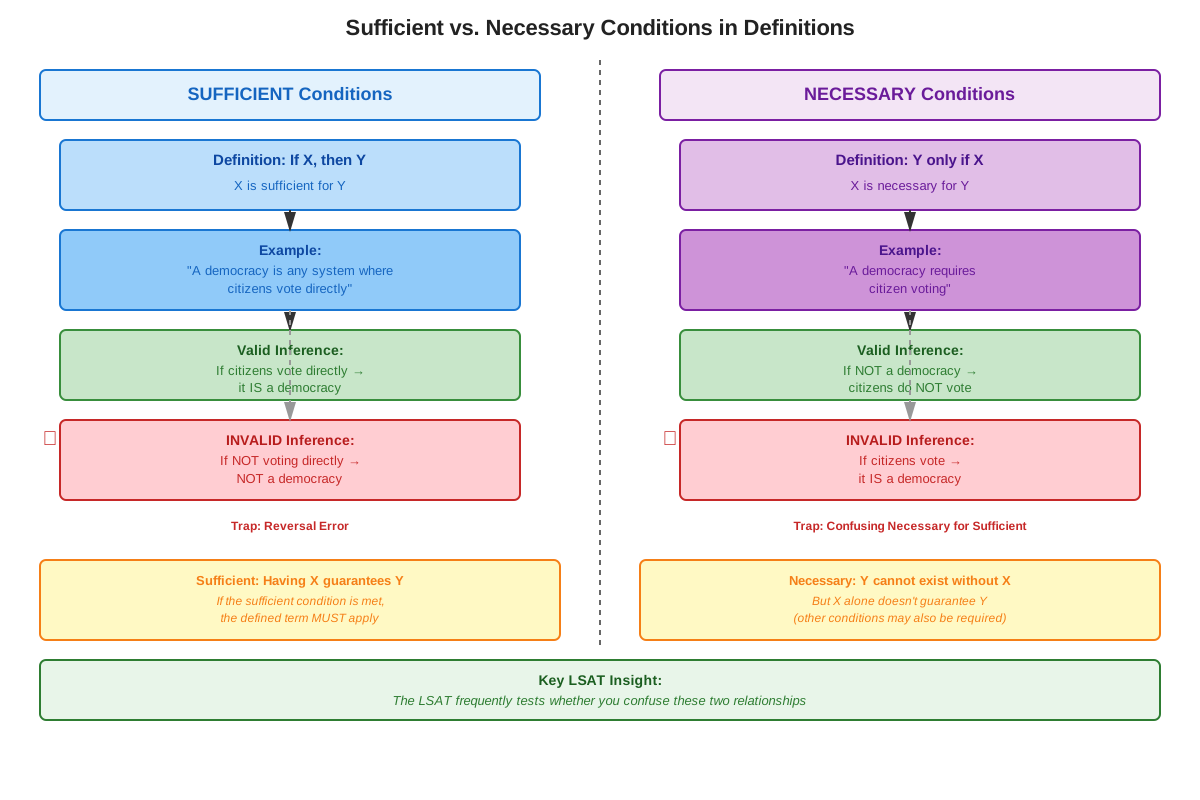
A definition establishes the criteria that something must meet to be classified as an instance of a particular category or concept. On the LSAT, definitions typically follow one of two structures: necessary and sufficient conditions (where meeting all stated criteria guarantees membership in the category) or necessary but not sufficient conditions (where stated criteria must be met but additional unstated criteria might also be required).
When a stimulus states "X is any Y that has properties A, B, and C," this creates a sufficient condition: anything with properties A, B, and C qualifies as X. Conversely, it also establishes necessary conditions: anything that is X must have properties A, B, and C. Understanding this bidirectional relationship is crucial for avoiding trap answers.
Consider this example: "A planet is any celestial body that orbits a star, has sufficient mass to be rounded by its own gravity, and has cleared its orbital path of debris." This definition establishes three necessary conditions for planet status. If something lacks any one of these properties, it cannot be a planet. If something possesses all three, it must be a planet (according to this definition).
Applying Definitions to Specific Cases
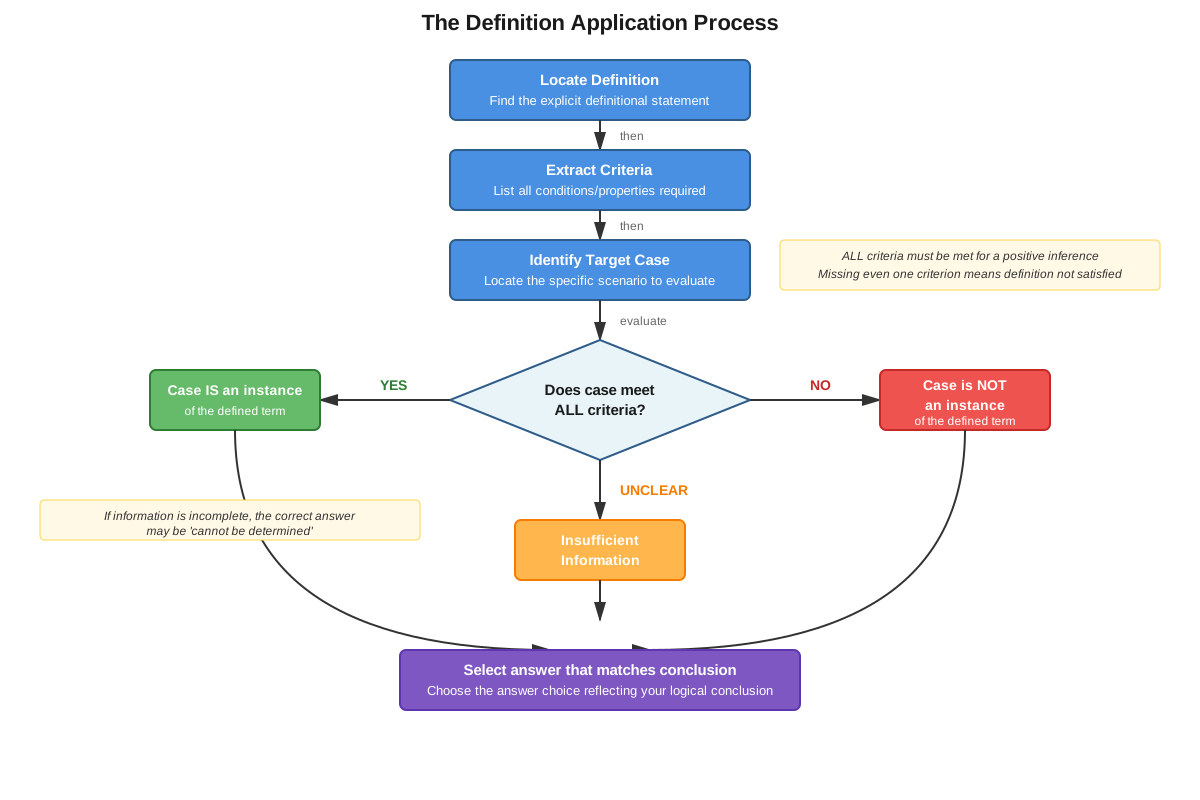
The core reasoning pattern involves a two-step process:
- Identify the definitional criteria: Extract the specific conditions or properties that the definition establishes
- Match the case to the criteria: Determine whether a given scenario, example, or situation satisfies all, some, or none of the stated conditions
This matching process requires careful attention to detail. Test-takers must resist the temptation to rely on real-world knowledge or common usage of terms. The LSAT frequently uses familiar words with stipulated definitions that differ from everyday usage. What matters is not what "planet" or "democracy" or "art" means in the real world, but what the stimulus explicitly defines it to mean.
Scope Limitations in Definitional Inference
A critical concept in inference from definitions is scope limitation—recognizing what can and cannot be inferred from a given definition. A definition tells us about membership in a specific category, but it doesn't necessarily tell us about:
- Other properties members of that category might have
- Relationships between this category and other categories
- Causal relationships or explanations for why something has the defining properties
- Comparative judgments (better, worse, more important) unless explicitly stated
For example, if "modern art" is defined as "art created after 1860," we can infer that a painting from 1875 is modern art, but we cannot infer that it's better than earlier art, that it uses different techniques, or that it's more valuable—none of these follow from the definition alone.
Definitional Boundaries and Edge Cases
The LSAT often tests understanding of definitional boundaries by presenting edge cases—scenarios that meet some but not all criteria, or that meet criteria in unexpected ways. These questions assess whether students can apply definitions mechanically rather than intuitively.
| Scenario Type | Definitional Status | Common Trap |
|---|---|---|
| Meets all stated criteria | Must be included in category | Assuming additional unstated requirements |
| Meets some but not all criteria | Must be excluded from category | Thinking "close enough" counts |
| Meets all criteria in unusual way | Must be included in category | Rejecting counterintuitive applications |
| Outside scope of definition | Cannot determine status | Assuming definition covers all cases |
Negative Inferences from Definitions
Students must also master negative inferences—what must NOT be true based on a definition. If something is defined as requiring properties X, Y, and Z, then anything lacking even one of these properties cannot be an instance of the defined category. This seems straightforward, but trap answers often present scenarios that seem like they should qualify based on similarity or common sense, even though they technically fail to meet the stated definition.
Multiple Definitions and Comparative Analysis
Some LSAT questions present multiple related definitions and require students to determine which definition applies to a given case, or how the definitions relate to each other. This tests the ability to:
- Track multiple sets of criteria simultaneously
- Recognize when definitions overlap (something can satisfy both)
- Identify when definitions are mutually exclusive
- Determine which definition is more specific or general
For instance, a stimulus might define both "felony" and "misdemeanor" with distinct criteria, then present a scenario and ask which category applies. Success requires systematically checking the scenario against each definition's criteria.
Concept Relationships
The concepts within inference from definitions build hierarchically. Understanding definitional structure (necessary and sufficient conditions) provides the foundation for applying definitions to specific cases. This application skill must be constrained by scope limitations—knowing what cannot be inferred is as important as knowing what can be inferred. Definitional boundaries represent the practical application of scope limitations to edge cases, while negative inferences apply the contrapositive logic inherent in definitional structures. Finally, multiple definitions integrate all previous concepts by requiring simultaneous application of multiple definitional frameworks.
This topic connects directly to prerequisite knowledge of conditional logic: definitions create conditional relationships where meeting criteria is sufficient for category membership, and category membership necessitates meeting criteria. The formal logic skills students bring to this topic enable them to translate definitions into logical notation, making the inference process more systematic.
Inference from definitions also relates closely to other Logical Reasoning topics. It shares structural similarities with Principle questions (where general rules function like definitions), Parallel Reasoning (where definitional structures must be matched), and Flaw questions (where misapplication of definitions constitutes a reasoning error). Mastering this topic strengthens performance across these related question types.
Relationship map: Conditional Logic → Definitional Structure → Application to Cases → Scope Limitations → Boundary Cases → Negative Inferences → Multiple Definitions → Broader Logical Reasoning Skills
High-Yield Facts
- ⭐ A valid inference from a definition must follow necessarily from the stated criteria without adding unstated requirements or assumptions
- ⭐ When something meets all criteria in a definition, it must be an instance of the defined category, regardless of whether it seems like a typical example
- ⭐ When something fails to meet even one criterion in a definition, it cannot be an instance of the defined category
- ⭐ Definitions on the LSAT override real-world usage—apply only what the stimulus explicitly states
- ⭐ Scope limitations prevent inferring properties not mentioned in the definition, even if they seem related or plausible
- The contrapositive of a definition is always valid: if something is NOT an instance of the category, it must lack at least one defining criterion
- Definitions establish both sufficient conditions (meeting criteria → category membership) and necessary conditions (category membership → must meet criteria)
- Edge cases that meet definitional criteria in unexpected ways still qualify as instances of the category
- Multiple definitions can overlap—something may satisfy criteria for more than one defined category simultaneously
- Comparative or evaluative judgments cannot be inferred from purely descriptive definitions unless explicitly stated
- Causal relationships are not established by definitions unless causation is explicitly part of the definitional criteria
- Temporal or sequential information in definitions must be applied precisely—"after" means after, not "during" or "before"
Quick check — test yourself on Inference from definitions so far.
Try Flashcards →Common Misconceptions
Misconception: If something seems like a typical example of a category, it must satisfy the definition given in the stimulus.
Correction: The LSAT frequently uses stipulated definitions that differ from common usage. Only the stated criteria matter, not intuitive or prototypical examples. A stimulus might define "bird" in a way that excludes penguins or includes bats—apply only what's stated.
Misconception: Meeting most of the criteria in a definition is sufficient for category membership.
Correction: Unless the definition explicitly uses language like "at least two of the following" or "most of these criteria," all stated criteria must be met. Partial satisfaction of definitional criteria means the item does NOT qualify as an instance of the category.
Misconception: Definitions allow for reasonable inferences about related properties not explicitly mentioned.
Correction: Inference from definitions questions test mechanical application of stated criteria only. Even highly plausible additional properties cannot be inferred unless they follow necessarily from the stated definition. If "X is any Y with property Z" is the definition, we cannot infer that X has property W, even if all real-world instances of Y with property Z also have property W.
Misconception: When a definition seems to have an obvious exception or limitation, the correct answer will account for this real-world nuance.
Correction: The LSAT tests whether students can apply definitions as stated, not whether they can identify practical limitations. If a definition seems overly broad or narrow, apply it exactly as written. The test rewards logical precision, not real-world reasonableness.
Misconception: Negative definitions (defining what something is NOT) work differently from positive definitions.
Correction: Negative definitions follow the same logical structure as positive definitions. If "X is any Y that does NOT have property Z," then anything that is X must lack property Z, and anything with property Z cannot be X. The inference pattern remains identical.
Misconception: Complex definitions with multiple clauses allow for more interpretive flexibility.
Correction: Complex definitions require more careful analysis but follow the same strict logical rules. Each clause or criterion must be satisfied. Complexity increases the opportunity for error but doesn't change the fundamental reasoning pattern.
Worked Examples
Example 1: Basic Definitional Application
Stimulus: "A heritage site is any location that has been continuously inhabited for at least 500 years and contains structures built using traditional methods that have been maintained without modern materials. The village of Thornbury has been inhabited for 600 years and contains a church built in 1450 using traditional stone masonry. However, the church's roof was replaced with modern synthetic tiles in 1990."
Question: Based on the definition provided, which of the following must be true?
Answer Choices:
(A) Thornbury is a heritage site
(B) Thornbury is not a heritage site
(C) The church in Thornbury was built using traditional methods
(D) Heritage sites are more historically valuable than non-heritage sites
(E) Thornbury would be a heritage site if the roof were replaced with traditional materials
Analysis:
Step 1: Extract definitional criteria
- Criterion 1: Continuously inhabited for at least 500 years
- Criterion 2: Contains structures built using traditional methods
- Criterion 3: Structures maintained without modern materials
Step 2: Apply to Thornbury
- Criterion 1: ✓ (600 years of continuous inhabitation)
- Criterion 2: ✓ (church built with traditional stone masonry)
- Criterion 3: ✗ (modern synthetic tiles used in maintenance)
Step 3: Evaluate answer choices
(A) Incorrect—Thornbury fails to meet all criteria (Criterion 3 violated)
(B) Correct—Since Thornbury fails to meet Criterion 3 (structures must be maintained without modern materials), it cannot be a heritage site according to the definition. This must be true.
(C) Incorrect—While this is stated in the stimulus, it's not an inference from the definition; it's directly stated information. More importantly, the question asks what must be true based on the definition, and this doesn't address Thornbury's status as a heritage site.
(D) Incorrect—The definition provides no comparative or evaluative information. This imports outside assumptions about value.
(E) Incorrect—This is likely true in the real world, but the question asks what "must be true" based on the given information. We don't know if replacing the roof would satisfy Criterion 3, as we don't know if that's the only modern material used.
Key Takeaway: This example demonstrates that failing even one criterion disqualifies something from category membership, regardless of how well it satisfies other criteria.
Example 2: Multiple Definitions and Scope
Stimulus: "Legal scholars distinguish between two types of precedent. Binding precedent is any prior court decision that must be followed by lower courts in the same jurisdiction. Persuasive precedent is any prior court decision from another jurisdiction or from a court at the same level that may be considered but need not be followed. A recent decision by the State Supreme Court of California addressed contract law. Judge Martinez in Nevada, a state trial court judge, is now considering a similar contract dispute."
Question: Based on the definitions provided, which of the following must be true?
Answer Choices:
(A) The California decision is binding precedent for Judge Martinez
(B) The California decision is persuasive precedent for Judge Martinez
(C) Judge Martinez must consider the California decision
(D) The California decision is not binding precedent for Judge Martinez
(E) Binding precedent is more important than persuasive precedent
Analysis:
Step 1: Extract definitional criteria
Binding precedent requires:
- Prior court decision
- Must be followed by lower courts
- Same jurisdiction
Persuasive precedent requires:
- Prior court decision
- From another jurisdiction OR from court at same level
- May be considered but need not be followed
Step 2: Apply to the California decision relative to Judge Martinez
For binding precedent:
- ✓ Prior court decision
- ? Must be followed by lower courts (Judge Martinez is a trial court judge)
- ✗ Same jurisdiction (California vs. Nevada—different jurisdictions)
For persuasive precedent:
- ✓ Prior court decision
- ✓ From another jurisdiction (California vs. Nevada)
- (The "may be considered but need not be followed" is a consequence, not a criterion)
Step 3: Evaluate answer choices
(A) Incorrect—The California decision is from a different jurisdiction, so it cannot be binding precedent for a Nevada judge.
(B) Tempting but not necessarily true—While the California decision meets the criteria for persuasive precedent (it's from another jurisdiction), we cannot be certain it "is" persuasive precedent without knowing whether Judge Martinez's court system recognizes it as such. The definition tells us what qualifies as persuasive precedent, but doesn't tell us that all decisions from other jurisdictions automatically become persuasive precedent.
(C) Incorrect—Persuasive precedent "may be considered but need not be followed," which means there's no requirement to consider it.
(D) Correct—This must be true. The California decision fails to meet the "same jurisdiction" criterion for binding precedent. Since it's from a different jurisdiction, it cannot be binding precedent for Judge Martinez. This is a valid negative inference.
(E) Incorrect—The definitions provide no comparative evaluation of importance.
Key Takeaway: This example illustrates the importance of negative inferences (what must NOT be true) and the distinction between meeting definitional criteria versus making positive claims about category membership. Answer choice (D) is correct because it makes a negative claim that necessarily follows from the definition, while (B) makes a positive claim that, while plausible, doesn't necessarily follow.
Exam Strategy
When approaching inference from definitions questions on the LSAT, follow this systematic process:
Step 1: Identify the definition (15-20 seconds)
Look for explicit definitional language: "X is any Y that...", "X is defined as...", "For purposes of this argument, X means...", "X requires...", "X consists of..." These phrases signal that a formal definition is being provided.
Step 2: Extract and list criteria (20-30 seconds)
Write down or mentally catalog each distinct criterion. Use shorthand notation if helpful. For complex definitions, number the criteria (1, 2, 3) to ensure you check each one systematically.
Step 3: Identify the case or scenario (10-15 seconds)
Determine what specific situation, example, or entity the question asks about. This might be stated in the stimulus or introduced in the question stem.
Step 4: Match systematically (30-40 seconds)
Check the case against each criterion. Mark each as satisfied (✓) or not satisfied (✗). Be precise—"almost" or "mostly" satisfied means not satisfied.
Step 5: Apply logical rules (20-30 seconds)
- All criteria met → must be instance of category
- Any criterion not met → cannot be instance of category
- Insufficient information about a criterion → cannot determine status
Exam Tip: The correct answer to an inference from definitions question will be the most conservative, mechanical application of the stated definition. Avoid answers that seem reasonable but require assumptions beyond the stated criteria.
Trigger words and phrases to watch for:
- "Based on the definition provided..." (signals that only stated criteria matter)
- "Must be true" (requires necessary inference, not just possible inference)
- "According to the passage..." (limits scope to what's explicitly stated)
- "If the above definition is used..." (emphasizes applying the stipulated definition)
Process-of-elimination tips:
- Eliminate answers that add unstated criteria: If an answer choice requires meeting conditions not mentioned in the definition, eliminate it immediately.
- Eliminate answers that ignore stated criteria: If an answer treats something as an instance of the category despite failing to meet a stated criterion, eliminate it.
- Eliminate comparative or evaluative claims: Unless the definition itself includes comparative language, answers making "better," "more important," or "superior" claims can be eliminated.
- Eliminate answers that confuse necessary and sufficient: If the definition establishes sufficient conditions (meeting criteria guarantees membership), an answer claiming something might not be a member despite meeting all criteria is wrong.
Time allocation advice:
Inference from definitions questions should take 60-90 seconds total. They're typically faster than causal reasoning or flaw questions because the reasoning pattern is more mechanical. If you find yourself spending more than 90 seconds, you're likely overcomplicating the analysis. Return to the basic matching process: does the case meet all stated criteria? That's usually all you need to determine.
Memory Techniques
MATCH Acronym for the systematic process:
- Mark the definition clearly
- Analyze each criterion separately
- Test the case against each criterion
- Check for completeness (all criteria addressed)
- Heed only stated requirements (no additions)
Visualization Strategy: Picture a checklist with boxes next to each criterion. As you evaluate a case, mentally check or X each box. The pattern of checks and X's determines the answer. All checks = must be instance; any X = cannot be instance.
The "Robot Rule": Apply definitions like a robot following programming—no interpretation, no flexibility, no common sense adjustments. If the definition says "exactly three properties," then 2.9 properties or 3.1 properties both fail. This mindset prevents the most common error: importing reasonable but unstated assumptions.
Scope Boundary Mnemonic: "Definitions Only State Specific Criteria" (DOSSC). When tempted to infer something beyond the stated definition, remember: Definitions Only State Specific Criteria—nothing more.
Summary
Inference from definitions represents a high-yield LSAT question type that rewards systematic, precise application of stated criteria to specific cases. The core skill involves extracting definitional criteria, matching cases against those criteria mechanically, and drawing only those conclusions that necessarily follow from the definition as stated. Success requires resisting the temptation to import real-world knowledge, common usage, or plausible assumptions. Instead, students must apply definitions like formal logical rules: when all criteria are met, category membership is established; when any criterion fails, category membership is impossible. The LSAT tests this skill through various formats, including determining whether specific examples satisfy definitions, drawing negative inferences about what cannot be true, and working with multiple related definitions simultaneously. Mastering this topic strengthens broader logical reasoning skills, particularly conditional logic, scope recognition, and precise textual analysis. The mechanical nature of these questions makes them excellent opportunities for score improvement through systematic practice and disciplined application of the matching process.
Key Takeaways
- Inference from definitions questions require mechanical application of stated criteria without adding assumptions or importing outside knowledge
- All definitional criteria must be satisfied for something to qualify as an instance of the defined category—partial satisfaction is insufficient
- Negative inferences (what must NOT be true) are as important as positive inferences and often appear in correct answers
- Scope limitations prevent inferring properties, relationships, or evaluations not explicitly stated in the definition
- The LSAT uses stipulated definitions that may differ from real-world usage—apply only what the stimulus states
- Edge cases that meet criteria in unexpected ways still qualify as instances of the category
- Systematic checking of each criterion against the case prevents errors and saves time
Related Topics
Conditional Logic and Formal Logic: Mastering inference from definitions provides direct preparation for more complex conditional reasoning questions, where multiple conditional statements interact. The skills of identifying sufficient and necessary conditions transfer directly.
Principle Questions: General principles function similarly to definitions—they establish criteria that determine whether specific actions or situations fall within their scope. The same matching process applies.
Parallel Reasoning: These questions often require matching definitional structures across different contexts, testing whether students can recognize when two definitions have the same logical form.
Flaw Questions - Definitional Errors: Understanding correct application of definitions enables recognition of common flaws, such as applying definitions too broadly, ignoring stated criteria, or confusing necessary and sufficient conditions.
Must Be True Questions: While inference from definitions is a subset of Must Be True questions, mastering this specific pattern strengthens performance on all Must Be True variants by developing precision in drawing necessary conclusions.
Practice CTA
Now that you've mastered the core concepts of inference from definitions, it's time to cement your understanding through active practice. The systematic approach outlined in this guide becomes automatic only through repeated application to actual LSAT questions. Challenge yourself with the practice questions and flashcards designed for this topic—each one provides an opportunity to refine your matching process and build the confidence that comes from consistent accuracy. Remember: inference from definitions questions are high-yield opportunities where systematic preparation directly translates to points on test day. Your investment in mastering this topic will pay dividends across multiple question types throughout the Logical Reasoning section.
Sign up free to keep reading
Create a free AnvayaPrep account to finish this LSAT guide on Inference from definitions — plus flashcards and practice questions.