Overview
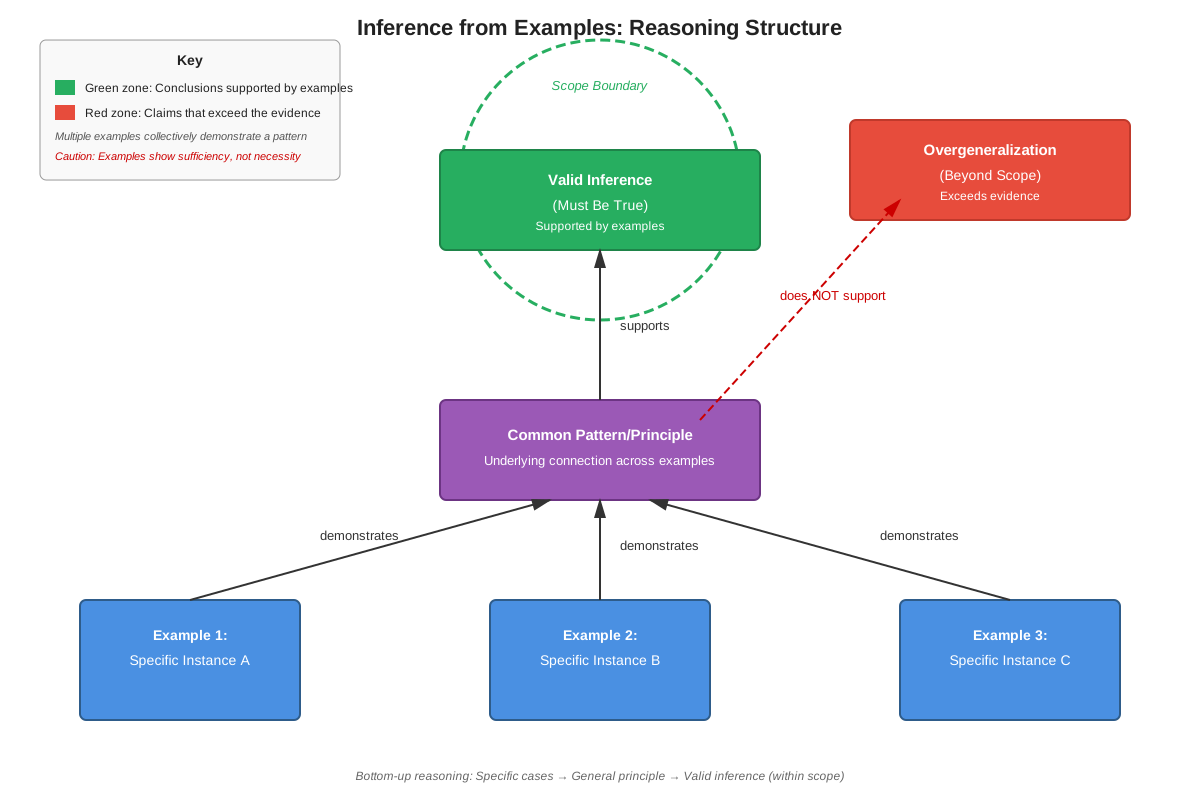
Inference from examples is a fundamental reasoning pattern that appears frequently throughout the LSAT Logical Reasoning section. This pattern involves drawing broader conclusions or identifying underlying principles based on specific instances or cases presented in the stimulus. When the LSAT presents multiple examples or a series of specific situations, test-makers often expect students to recognize the common thread connecting these examples and make a valid inference about what they collectively demonstrate. This reasoning skill is essential because it mirrors the type of analytical thinking required in legal practice, where attorneys must identify patterns across case law and extract applicable principles from specific precedents.
Understanding how to properly draw inferences from examples is critical for LSAT success because it appears in multiple question types within Logical Reasoning, including Must Be True questions, Main Point questions, and Principle questions. The LSAT tests whether students can distinguish between inferences that are strongly supported by the examples provided versus those that go beyond what the evidence warrants. This topic requires careful attention to the scope and strength of conclusions—a hallmark of sound legal reasoning. Students who master this skill gain a significant advantage because they can quickly identify what the examples collectively prove without falling into traps that involve overgeneralization or unsupported assumptions.
Within the broader landscape of inference questions, inference from examples represents a specific pattern where the evidence takes the form of particular cases, instances, or illustrations rather than general statements or statistical data. This topic connects closely to other Logical Reasoning concepts such as argument structure, sufficient and necessary conditions, and the distinction between what must be true versus what could be true. Mastering inference from examples builds the foundation for understanding how specific evidence supports general conclusions—a skill that extends to evaluating arguments, identifying assumptions, and recognizing flaws throughout the LSAT.
Learning Objectives
By the end of this study guide, students should be able to:
- [ ] Identify how Inference from examples appears in LSAT questions
- [ ] Explain the reasoning pattern behind Inference from examples
- [ ] Apply Inference from examples to solve LSAT-style problems accurately
- [ ] Distinguish between valid inferences and overgeneralizations when presented with multiple examples
- [ ] Recognize the common structural patterns in stimuli that present examples as evidence
- [ ] Evaluate answer choices by determining which conclusions are most strongly supported by the given examples
- [ ] Identify the scope limitations inherent in reasoning from specific examples to broader conclusions
Prerequisites
Students should have foundational knowledge of the following concepts before studying this topic:
- Basic argument structure: Understanding premises and conclusions is essential because inference from examples involves identifying what the examples (premises) support—relevant because students must distinguish evidence from inference.
- Sufficient and necessary conditions: Familiarity with conditional logic helps students avoid confusing "what the examples show" with "what must always be true"—relevant because examples demonstrate sufficiency but rarely necessity.
- Scope and degree: Understanding how to assess the breadth and strength of claims is crucial—relevant because the most common errors involve drawing conclusions that are too broad or too strong for the examples provided.
- Must Be True vs. Could Be True distinctions: Recognizing the difference between what is proven versus what is possible—relevant because LSAT inference from examples questions typically ask what must be true based on the examples given.
Why This Topic Matters
Inference from examples is not merely an academic exercise—it reflects the core reasoning process attorneys use daily when analyzing case law, identifying legal precedents, and arguing by analogy. When lawyers examine multiple court decisions to determine how a principle applies to a new case, they are engaging in precisely the type of reasoning the LSAT tests through inference from examples questions. This reasoning pattern also appears in policy analysis, scientific reasoning, and everyday decision-making, making it a universally valuable critical thinking skill.
On the LSAT, inference from examples appears with remarkable frequency. Approximately 15-20% of Logical Reasoning questions involve drawing inferences from specific cases or examples, making this one of the highest-yield topics for test preparation. These questions appear most commonly as Must Be True questions, where the correct answer must be supported by the examples in the stimulus, and as Principle questions, where students must identify the general rule that the examples illustrate. Additionally, this reasoning pattern appears in Main Point questions when the author uses examples to support a broader conclusion, and in Parallel Reasoning questions where students must match the pattern of reasoning from examples.
The LSAT presents inference from examples in several characteristic ways: multiple brief examples that share a common feature, a detailed case study followed by a question about what it demonstrates, comparative examples that highlight contrasts, or a series of situations that collectively support a principle. Recognizing these patterns allows students to quickly identify the question type and apply the appropriate analytical framework, significantly improving both accuracy and speed.
Core Concepts
The Basic Structure of Inference from Examples
Inference from examples is a reasoning pattern where specific instances, cases, or illustrations serve as evidence from which a conclusion is drawn. The fundamental structure involves presenting one or more particular examples and then either explicitly stating or implicitly suggesting what these examples demonstrate, prove, or support. In LSAT questions, the stimulus typically provides the examples, and the correct answer identifies what can be validly inferred from them.
The logical structure follows this pattern:
- Example 1 exhibits characteristic X
- Example 2 exhibits characteristic X
- Example 3 exhibits characteristic X
- Therefore, [inference about X or about the examples]
The strength of an inference from examples depends on several factors: the number of examples provided, the representativeness of those examples, the consistency of the pattern across examples, and the scope of the conclusion drawn. The LSAT tests whether students can identify conclusions that stay within the bounds of what the examples actually demonstrate.
Types of Examples in LSAT Stimuli
The LSAT presents examples in various formats, each requiring slightly different analytical approaches:
| Example Type | Characteristics | What to Look For |
|---|---|---|
| Multiple parallel cases | 2-4 brief examples with similar features | The common thread connecting all examples |
| Contrasting examples | Examples that differ in one key respect | What the difference reveals about causation or correlation |
| Single detailed case | One extended example with multiple features | Which feature is most relevant to the inference |
| Hypothetical scenarios | "If X, then Y" examples | Whether the examples establish sufficiency, necessity, or correlation |
| Historical or empirical examples | Real-world cases cited as evidence | The scope limitation of the specific examples given |
Understanding which type of example structure appears in a stimulus helps students quickly identify what kind of inference the question will likely test. Multiple parallel cases typically support inferences about common features, while contrasting examples usually support inferences about causal relationships or necessary conditions.
Valid vs. Invalid Inferences from Examples
The critical skill in logical reasoning involving examples is distinguishing between inferences that are strongly supported and those that go beyond what the evidence warrants. Valid inferences from examples must satisfy several criteria:
Valid inferences:
- Stay within the scope of the examples provided
- Acknowledge limitations (e.g., "at least some," "can," "possible")
- Focus on features common to all examples
- Avoid introducing new concepts not present in the examples
- Maintain appropriate strength (not claiming certainty when examples show possibility)
Invalid inferences (common traps):
- Overgeneralize from limited examples ("all" or "always" when examples show "some")
- Assume causation from correlation in the examples
- Introduce factors not mentioned in any example
- Reverse the logic (confusing sufficient and necessary conditions)
- Extend beyond the category represented by the examples
For instance, if three examples show that "some successful entrepreneurs dropped out of college," a valid inference would be "college completion is not necessary for entrepreneurial success," while an invalid inference would be "dropping out of college causes entrepreneurial success" or "most successful entrepreneurs dropped out of college."
The Principle Behind the Examples
Many LSAT questions ask students to identify the principle or general rule that the examples illustrate. This requires abstracting from the specific details to find the underlying pattern. The principle should be:
- General enough to cover all examples provided
- Specific enough to exclude situations not represented by the examples
- Accurate in capturing what the examples actually demonstrate
- Complete in accounting for all relevant features of the examples
When identifying principles from examples, students should ask: "What must be true for all these examples to make sense?" or "What rule would explain why all these examples turned out this way?" The correct principle will make each example an instance of the broader rule without requiring additional assumptions.
Scope Management in Inference Questions
Perhaps the most tested aspect of inference from examples is scope management—ensuring that conclusions don't exceed what the examples support. The LSAT frequently includes wrong answers that are too broad, too narrow, or that shift the scope in subtle ways.
Scope considerations:
- Quantifier scope: Examples showing "some" don't support conclusions about "most" or "all"
- Category scope: Examples about "professional athletes" don't support conclusions about "all athletes"
- Temporal scope: Examples from "the past decade" don't necessarily support conclusions about "throughout history"
- Modal scope: Examples showing something "can happen" don't prove it "must happen" or "usually happens"
The LSAT tests scope management by presenting answer choices that are factually consistent with the examples but go slightly beyond what they prove. Students must develop sensitivity to these subtle scope shifts to avoid attractive wrong answers.
Inference from Examples vs. Argument from Examples
It's important to distinguish between inference questions that present examples and argument questions that use examples as premises. In inference from examples questions, the stimulus typically presents examples without explicitly stating a conclusion—the student must identify what the examples support. In argument questions, the author uses examples to support a stated conclusion, and the question asks about the argument's structure, assumptions, or flaws.
This distinction matters because the analytical approach differs. For inference questions, students should focus on what must be true given the examples. For argument questions, students should evaluate whether the examples adequately support the author's conclusion and identify any gaps in reasoning.
Concept Relationships
The concepts within inference from examples form an interconnected framework. The basic structure of inference from examples provides the foundation for understanding all other aspects of this topic. This structure directly determines what constitutes valid vs. invalid inferences, as validity depends on whether the inference respects the logical boundaries established by the example structure.
Scope management emerges as a critical application of understanding valid inferences—it represents the practical skill of ensuring conclusions don't exceed what examples warrant. The types of examples presented in stimuli influence what kinds of inferences are possible; for instance, contrasting examples support different inferences than parallel examples do. Finally, identifying principles from examples represents the highest level of abstraction, requiring students to synthesize all other concepts to extract the general rule that examples illustrate.
The relationship map flows as follows:
Basic Structure → determines → Types of Examples → influences → Valid Inferences → requires → Scope Management → enables → Principle Identification
This topic connects to prerequisite knowledge of argument structure because examples function as premises supporting inferences (conclusions). It relates to conditional logic because students must avoid confusing examples that show sufficiency (X can lead to Y) with necessity (X must lead to Y). The topic also connects forward to more advanced Logical Reasoning concepts like Parallel Reasoning, where students must match the pattern of reasoning from examples, and Strengthen/Weaken questions, where additional examples can support or undermine arguments.
High-Yield Facts
⭐ Inference from examples questions most commonly appear as Must Be True questions, requiring answers that are fully supported by the examples provided.
⭐ The most common trap in inference from examples questions is overgeneralization—answer choices that extend beyond the scope of the examples.
⭐ When multiple examples are presented, the correct inference typically focuses on what all examples have in common, not unique features of individual examples.
⭐ Examples showing that something "can" happen or "sometimes" occurs do not support conclusions using "must," "always," or "cannot."
⭐ The correct answer in inference from examples questions often uses qualifying language like "at least some," "possible," or "not necessary" rather than absolute terms.
- Contrasting examples (where cases differ in one key respect) typically support inferences about what causes the difference or what is necessary for a particular outcome.
- When a stimulus presents a single detailed example, the correct inference usually relates to the most emphasized feature of that example.
- Inference from examples questions rarely require outside knowledge—the examples contain all information needed to support the correct answer.
- Wrong answers frequently introduce new concepts or factors not mentioned in any of the examples provided.
- The principle that examples illustrate should be abstract enough to cover all examples but specific enough to exclude situations not represented.
- Examples demonstrating correlation (X and Y occur together) do not support inferences about causation (X causes Y) without additional evidence.
- When examples span different categories or contexts, the correct inference typically addresses what they share despite their differences.
Quick check — test yourself on Inference from examples so far.
Try Flashcards →Common Misconceptions
Misconception: If three examples show a pattern, the pattern must apply to all similar cases.
Correction: Examples demonstrate what is possible or what can occur, but they don't prove universality. Three examples of successful college dropouts don't prove that dropping out leads to success generally—only that college completion isn't necessary for success.
Misconception: The correct answer must mention specific details from the examples.
Correction: Valid inferences often abstract from specific details to identify broader patterns. If examples mention "physicians," "engineers," and "teachers," the correct answer might refer to "professionals" without mentioning specific professions.
Misconception: More examples always make an inference stronger.
Correction: The strength of an inference depends on representativeness and consistency, not just quantity. Two highly representative examples can support stronger inferences than five unrepresentative ones. The LSAT tests logical support, not statistical significance.
Misconception: If an answer choice is consistent with the examples, it must be correct.
Correction: In Must Be True questions, the correct answer must be proven by the examples, not merely consistent with them. Many wrong answers could be true but aren't necessarily true based on the examples given.
Misconception: Inference from examples questions require identifying the author's intended conclusion.
Correction: Many inference from examples stimuli don't contain an explicit conclusion—they simply present examples. The question asks what can be inferred, not what the author concluded. Students should focus on what the examples logically support, regardless of authorial intent.
Misconception: Contrasting examples always indicate causation.
Correction: While contrasting examples can suggest causal relationships, they might instead reveal necessary conditions, sufficient conditions, or mere correlation. If examples show "all successful cases had feature X, while unsuccessful cases lacked it," this suggests X is necessary, not that X causes success.
Misconception: The correct answer will be the most interesting or surprising inference.
Correction: The LSAT rewards logical validity, not novelty. The correct answer is often straightforward and might seem obvious—it's simply what the examples definitively support. Wrong answers are frequently more interesting but go beyond what's proven.
Worked Examples
Example 1: Multiple Parallel Cases
Stimulus: "Three recent studies examined the effectiveness of different teaching methods. The first study found that students who learned mathematics through project-based activities retained concepts longer than those who learned through lectures. The second study showed that students learning history through primary source analysis demonstrated better critical thinking than those using textbooks alone. The third study revealed that science students conducting hands-on experiments understood principles more deeply than those watching demonstrations."
Question: Which one of the following can be properly inferred from the information above?
Answer Choices:
(A) Active learning methods are always superior to passive learning methods.
(B) Lectures and textbooks are ineffective teaching tools.
(C) In at least some academic subjects, student engagement with material improves learning outcomes.
(D) Most students prefer hands-on learning to traditional instruction.
(E) Teachers should eliminate lectures from their teaching practices.
Analysis:
Step 1: Identify the example structure. This stimulus presents three parallel examples, each comparing an active learning method with a more passive method across different subjects (mathematics, history, science).
Step 2: Identify the common thread. All three examples show active engagement (project-based activities, primary source analysis, hands-on experiments) producing better outcomes than passive approaches (lectures, textbooks alone, watching demonstrations).
Step 3: Evaluate scope. The examples cover three subjects but not all subjects. They show better outcomes in these cases but don't prove universal superiority or that passive methods are completely ineffective.
Step 4: Evaluate each answer:
(A) Too broad: "Always" exceeds what three examples can prove. The examples show active methods worked better in these cases, not in all cases.
(B) Too extreme: The examples show active methods produced better results, but this doesn't mean passive methods are "ineffective"—only that they were less effective in these comparisons.
(C) Correct: This answer appropriately qualifies the inference with "at least some" (scope-appropriate) and "improves" (comparative, not absolute). The three subjects represent "at least some academic subjects," and engagement clearly improved outcomes in all three examples.
(D) Unsupported: The examples discuss learning outcomes, not student preferences. This introduces a new concept not present in the stimulus.
(E) Too prescriptive: The examples show active methods produced better results but don't prove lectures should be eliminated entirely. This goes beyond what the evidence supports.
Correct Answer: (C)
Connection to Learning Objectives: This example demonstrates how to identify inference from examples in LSAT questions (multiple parallel cases), explain the reasoning pattern (common thread across examples), and apply the concept to eliminate wrong answers that exceed the scope of the examples.
Example 2: Contrasting Examples
Stimulus: "Two companies in the same industry adopted different approaches to employee management. Company A implemented strict hierarchical structures with detailed oversight and standardized procedures for all tasks. Company B adopted a flexible structure allowing employees significant autonomy in determining how to complete their work. After five years, Company B showed higher employee retention, greater innovation in product development, and stronger financial performance than Company A."
Question: The information above most strongly supports which one of the following?
Answer Choices:
(A) Hierarchical management structures cause poor financial performance.
(B) Employee autonomy is sufficient to ensure business success.
(C) Strict oversight is incompatible with innovation.
(D) In this industry, employee autonomy is not necessary for employee retention.
(E) For at least these two companies, the management approach emphasizing employee autonomy was associated with better outcomes.
Analysis:
Step 1: Identify the example structure. This presents contrasting examples—two companies that differ in one key respect (management approach) with different outcomes.
Step 2: Identify what the contrast reveals. Company B (autonomy) had better outcomes than Company A (strict hierarchy) across multiple metrics.
Step 3: Assess causation vs. correlation. The examples show correlation between autonomy and better outcomes but don't definitively prove causation—other factors might contribute.
Step 4: Evaluate each answer:
(A) Confuses correlation with causation: The examples show Company A (hierarchical) performed worse, but this doesn't prove hierarchy caused the poor performance. Other factors might be responsible.
(B) Confuses sufficiency with necessity and overgeneralizes: Company B's success doesn't prove autonomy is sufficient for success generally—only that it worked in this case. Many factors contribute to business success.
(C) Too absolute: Company A had less innovation, but the examples don't prove strict oversight is incompatible with innovation—only that it was associated with less innovation in this case.
(D) Reverses the logic: Company B (with autonomy) had higher retention, suggesting autonomy may contribute to retention. This answer incorrectly suggests autonomy isn't necessary, contradicting what the examples show.
(E) Correct: This answer appropriately limits scope ("at least these two companies"), uses "associated with" rather than "caused" (avoiding unwarranted causal claims), and accurately captures what the examples demonstrate—a correlation between autonomy and better outcomes in this specific comparison.
Correct Answer: (E)
Connection to Learning Objectives: This example illustrates how contrasting examples appear in LSAT questions, demonstrates the reasoning pattern of identifying what differences reveal, and shows how to avoid the common trap of inferring causation from correlation when examples only support association.
Exam Strategy
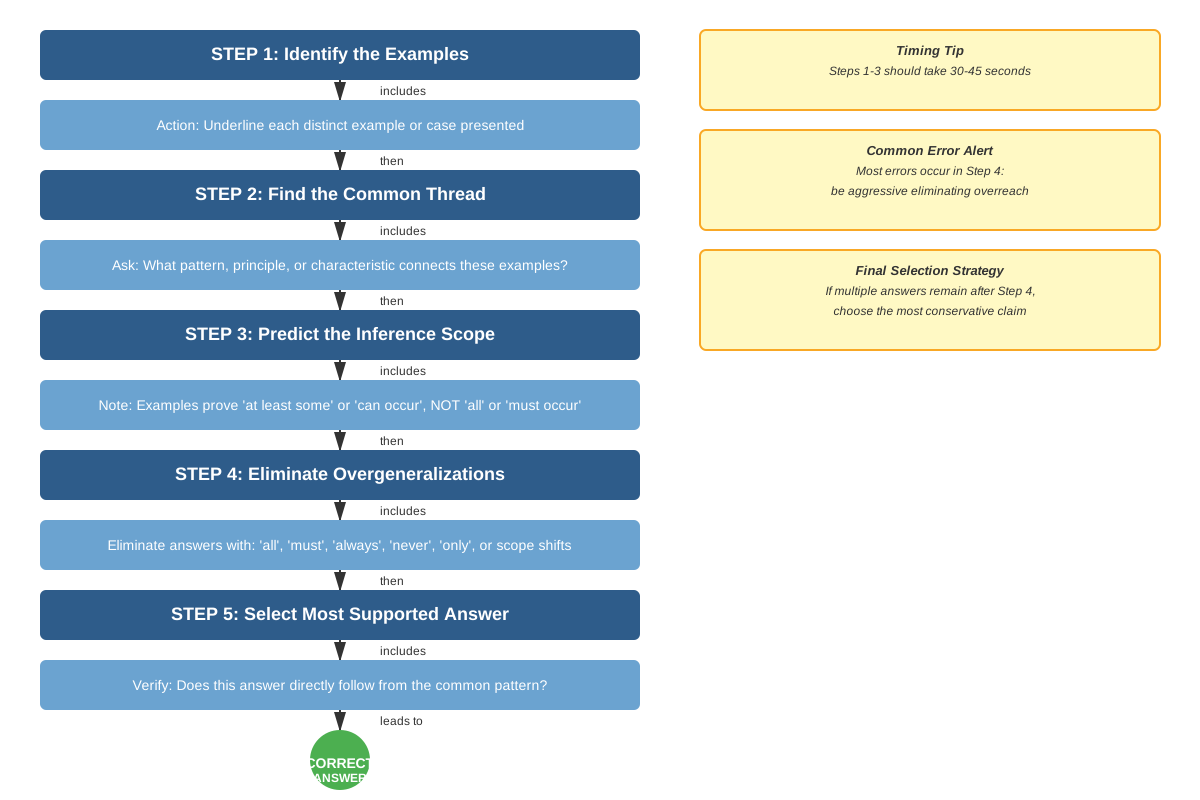
When approaching inference from examples questions on the LSAT, employ this systematic strategy:
Recognition Phase: Identify that you're dealing with inference from examples by watching for these trigger patterns in the stimulus:
- Multiple cases or situations presented without an explicit conclusion
- Phrases like "for example," "for instance," "consider the case of," or "in one study"
- A series of parallel scenarios or contrasting situations
- Question stems asking what "can be properly inferred," "is most strongly supported," or "must be true"
Analysis Phase: Before looking at answer choices, complete these steps:
- Count and categorize the examples: Are they parallel (similar) or contrasting (different)?
- Identify the common thread: What feature appears in all examples?
- Note the scope: How many examples? What categories do they represent?
- Anticipate the inference: What must be true given these examples?
Elimination Phase: Use these criteria to eliminate wrong answers:
- Scope violations: Eliminate answers using "all," "always," "never," or "must" when examples show "some," "can," or "sometimes"
- New concepts: Eliminate answers introducing factors not mentioned in any example
- Causal claims: Be suspicious of answers claiming causation when examples only show correlation
- Reversed logic: Eliminate answers that flip sufficient and necessary conditions
- Too narrow: Occasionally, wrong answers are too restrictive, failing to capture what all examples demonstrate
Exam Tip: In Must Be True questions with examples, the correct answer often sounds less interesting than wrong answers. Don't be seduced by dramatic or surprising claims—choose the answer that's definitively proven by the examples, even if it seems obvious.
Time Management: Inference from examples questions typically require 1:00-1:30 minutes. Spend 30-40 seconds analyzing the examples and identifying the common thread, then 20-30 seconds per answer choice. If you're spending more than 1:45, you're likely overthinking—return to what the examples definitively prove.
Process of Elimination Priorities: Eliminate in this order:
- First pass: Scope violations and new concepts (usually eliminates 2-3 answers)
- Second pass: Causal claims and reversed logic (usually eliminates 1-2 more)
- Final decision: Choose the answer that's most conservative and fully supported
Memory Techniques
SCOPE Acronym for evaluating answer choices:
- Specificity: Is the answer too broad or too narrow for the examples?
- Causation: Does it claim causation when examples show only correlation?
- Outside concepts: Does it introduce factors not in the examples?
- Proof: Is it proven by the examples or merely consistent with them?
- Extremes: Does it use absolute language ("all," "never") unsupported by examples?
The "At Least" Visualization: When examples show a pattern, visualize the correct answer starting with "at least" or "in some cases." This mental frame prevents overgeneralization. If you can't add "at least" to an answer without changing its meaning, it's probably too broad.
The Common Thread Technique: Imagine the examples as beads on a string—the string is the common thread (the valid inference). If an answer choice doesn't thread through all the beads, it's wrong. This visualization helps identify what all examples share versus unique features of individual examples.
The Scope Spectrum: Visualize a spectrum from "narrow" to "broad":
Too Narrow ← → Correct Scope ← → Too Broad
(misses some examples) (covers all examples) (extends beyond examples)
Position each answer choice on this spectrum. The correct answer sits in the middle, covering all examples without exceeding them.
The "Must vs. Might" Mantra: Before selecting an answer, ask: "Must this be true, or might it merely be true?" In Must Be True questions, "might be true" isn't good enough—the examples must prove the answer.
Summary
Inference from examples represents a high-yield LSAT Logical Reasoning pattern where specific cases, instances, or illustrations serve as evidence from which conclusions must be drawn. The fundamental skill involves identifying what multiple examples collectively demonstrate while avoiding overgeneralization, causal claims unsupported by the evidence, and scope violations. The LSAT tests this through Must Be True questions, Principle questions, and Main Point questions, making it essential for test success. Valid inferences stay within the scope of the examples, focus on common threads across all cases, use appropriately qualified language, and avoid introducing concepts not present in the examples. The most common traps involve answers that are too broad (claiming "all" when examples show "some"), that confuse correlation with causation, or that introduce new factors not mentioned in the stimulus. Success requires careful scope management, distinguishing between what examples prove versus what they merely suggest, and selecting answers that are definitively supported rather than merely consistent with the examples. Mastering this topic provides a significant advantage because it appears in 15-20% of Logical Reasoning questions and builds foundational skills for evaluating evidence throughout the LSAT.
Key Takeaways
- Inference from examples questions require identifying what specific cases collectively prove, not what they suggest or make possible—focus on what must be true given the examples.
- The most common wrong answers involve overgeneralization—extending conclusions beyond the scope of the examples by using "all," "always," or "must" when examples support only "some," "can," or "at least in these cases."
- Valid inferences focus on the common thread connecting all examples, not unique features of individual cases—what appears in every example is what you can infer.
- Examples showing correlation (X and Y occur together) do not support inferences about causation (X causes Y) without additional evidence establishing the causal mechanism.
- Scope management is critical—the correct answer will be appropriately qualified with language like "at least some," "in certain cases," or "possible" rather than absolute terms.
- Contrasting examples (cases that differ in one key respect) typically support inferences about what the difference reveals, while parallel examples support inferences about shared features.
- The correct answer must be proven by the examples, not merely consistent with them—many wrong answers could be true but aren't necessarily true based on the evidence provided.
Related Topics
Principle Questions: Inference from examples provides the foundation for Principle questions, where students must identify the general rule that specific examples illustrate. Mastering inference from examples enables progression to extracting abstract principles from concrete cases, a more advanced skill that appears frequently in both Logical Reasoning sections.
Parallel Reasoning: Understanding the structure of reasoning from examples is essential for Parallel Reasoning questions, where students must match the logical pattern of an argument. Many parallel reasoning questions involve matching how examples support conclusions, making this topic directly applicable.
Strengthen and Weaken Questions: Additional examples can strengthen arguments by providing more evidence for a pattern, or weaken arguments by presenting counterexamples. Understanding how examples function as evidence prepares students to evaluate how new examples affect argument strength.
Flaw Questions: Many flawed arguments commit errors in reasoning from examples—overgeneralizing from limited cases, assuming causation from correlation, or drawing conclusions from unrepresentative examples. Recognizing valid inference from examples helps identify these common flaws.
Sufficient Assumption and Necessary Assumption Questions: These question types often involve arguments that use examples as evidence. Understanding what examples prove versus what they assume helps identify gaps in reasoning that assumptions must fill.
Practice CTA
Now that you've mastered the core concepts of inference from examples, it's time to apply this knowledge to actual LSAT questions. The practice questions and flashcards will reinforce your understanding of how to identify valid inferences, avoid scope violations, and distinguish between what examples prove versus what they merely suggest. Remember that this topic appears in 15-20% of Logical Reasoning questions—every minute spent practicing inference from examples directly translates to points on test day. Approach each practice question systematically: identify the example structure, find the common thread, assess the scope, and eliminate answers that exceed what the examples support. Your ability to draw precise, well-supported inferences from specific cases is not just an LSAT skill—it's the foundation of legal reasoning itself. You've got this!
Sign up free to keep reading
Create a free AnvayaPrep account to finish this LSAT guide on Inference from examples — plus flashcards and practice questions.