Overview
Inference from quantified statements is a cornerstone skill in LSAT Logical Reasoning, appearing in approximately 15-20% of all Inference Questions on the exam. This topic tests the ability to recognize what must be true based on statements containing quantifiers such as "all," "some," "most," "none," and "many." Unlike assumption or strengthen/weaken questions that require evaluating argument structure, inference questions demand precise logical deduction from the information provided. Students must extract conclusions that are fully supported by the premises without adding outside knowledge or making unwarranted leaps.
Mastering inference from quantified statements is essential because the LSAT frequently presents complex scenarios involving overlapping categories, conditional relationships, and quantified claims about groups. The test-makers deliberately craft answer choices that sound plausible but exceed what the stimulus logically supports. Success requires understanding formal logical relationships between quantified statements, recognizing valid inference patterns, and distinguishing between what must be true versus what could be true or is likely true. This precision distinguishes top scorers from average performers.
Within the broader landscape of Logical Reasoning, inference from quantified statements connects directly to formal logic, conditional reasoning, and argument structure analysis. While conditional statements deal with "if-then" relationships, quantified statements address the scope and extent of claims about groups or categories. Both require rigorous logical thinking, but quantified statements specifically test understanding of set relationships, overlaps, and the logical boundaries of what can be concluded from partial information about populations or categories.
Learning Objectives
- [ ] Identify how Inference from quantified statements appears in LSAT questions
- [ ] Explain the reasoning pattern behind Inference from quantified statements
- [ ] Apply Inference from quantified statements to solve LSAT-style problems accurately
- [ ] Distinguish between valid and invalid inferences from statements containing "all," "some," "most," and "none"
- [ ] Recognize common trap answers that exceed the logical support provided by quantified premises
- [ ] Combine multiple quantified statements to derive compound inferences
- [ ] Evaluate the strength of conclusions based on the specific quantifiers used in premises
Prerequisites
- Basic formal logic concepts: Understanding logical operators and truth values is essential for evaluating whether inferences necessarily follow from premises
- Set theory fundamentals: Recognizing how groups overlap, contain one another, or remain distinct enables visualization of quantified relationships
- Conditional reasoning basics: Many quantified statements can be translated into conditional form, and understanding "if-then" logic supports inference derivation
- Argument structure recognition: Identifying premises and conclusions helps distinguish given information from what must be inferred
Why This Topic Matters
In real-world contexts, professionals constantly make decisions based on quantified information. Lawyers evaluate evidence about groups ("most witnesses testified that..."), doctors assess treatment efficacy ("some patients respond to..."), and business leaders analyze market data ("all competitors have adopted..."). The ability to draw accurate conclusions from quantified statements while avoiding overreach is fundamental to sound reasoning in any analytical field.
On the LSAT, inference from quantified statements appears in multiple question types, most prominently in Inference Questions (also called "Must Be True" questions), which typically comprise 5-7 questions per exam. These questions also appear in Logical Reasoning sections as part of Parallel Reasoning questions and occasionally in Reading Comprehension when test-takers must identify what passage claims logically support. The LSAT Law School Admission Council data indicates that strong performance on inference questions correlates highly with overall Logical Reasoning scores, making this a high-yield study area.
Common manifestations include: stimulus passages presenting survey results with quantified findings, scientific studies reporting proportions of subjects, policy discussions involving categorical claims about groups, and philosophical arguments built on universal or existential statements. The LSAT deliberately uses complex language and nested quantifiers to test whether students can cut through verbal complexity to identify the logical core of what must be true.
Core Concepts
Understanding Quantifiers
Quantifiers are words or phrases that specify the extent or scope of a claim about a group or category. The four primary quantifiers on the LSAT are "all," "some," "most," and "none," each with distinct logical properties that determine what inferences are valid.
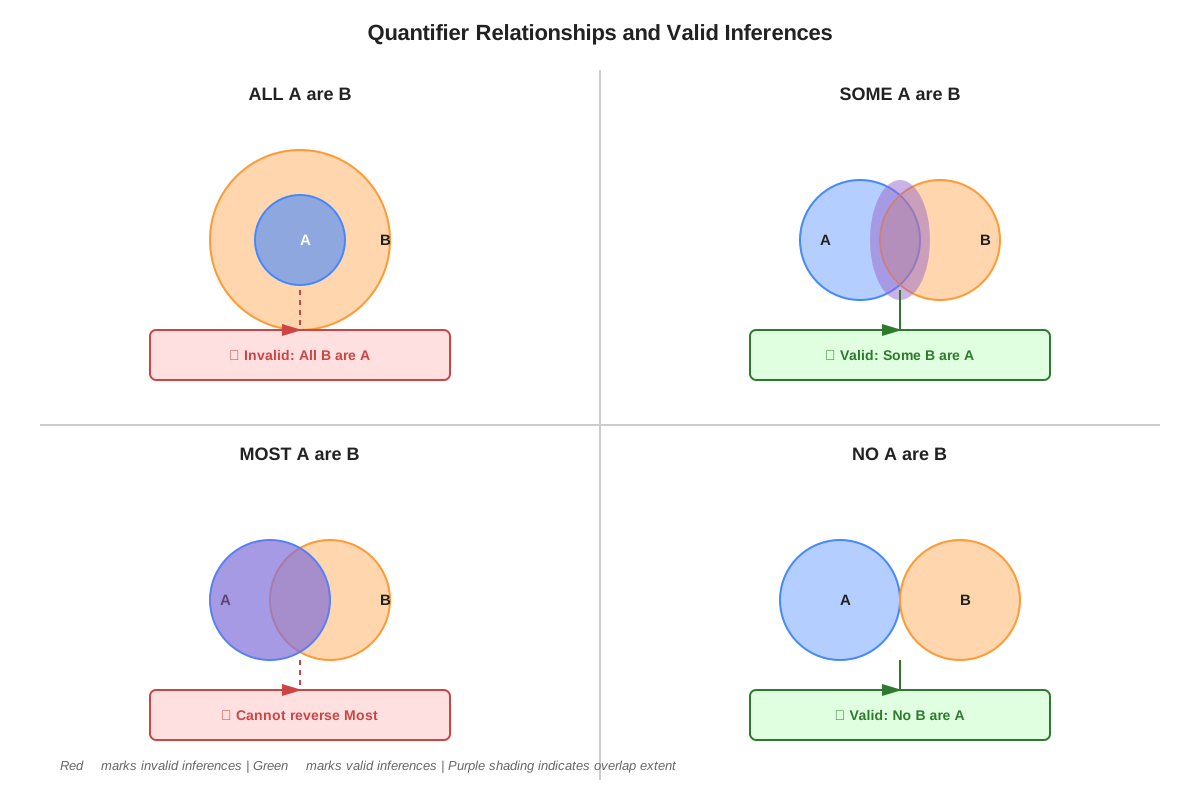
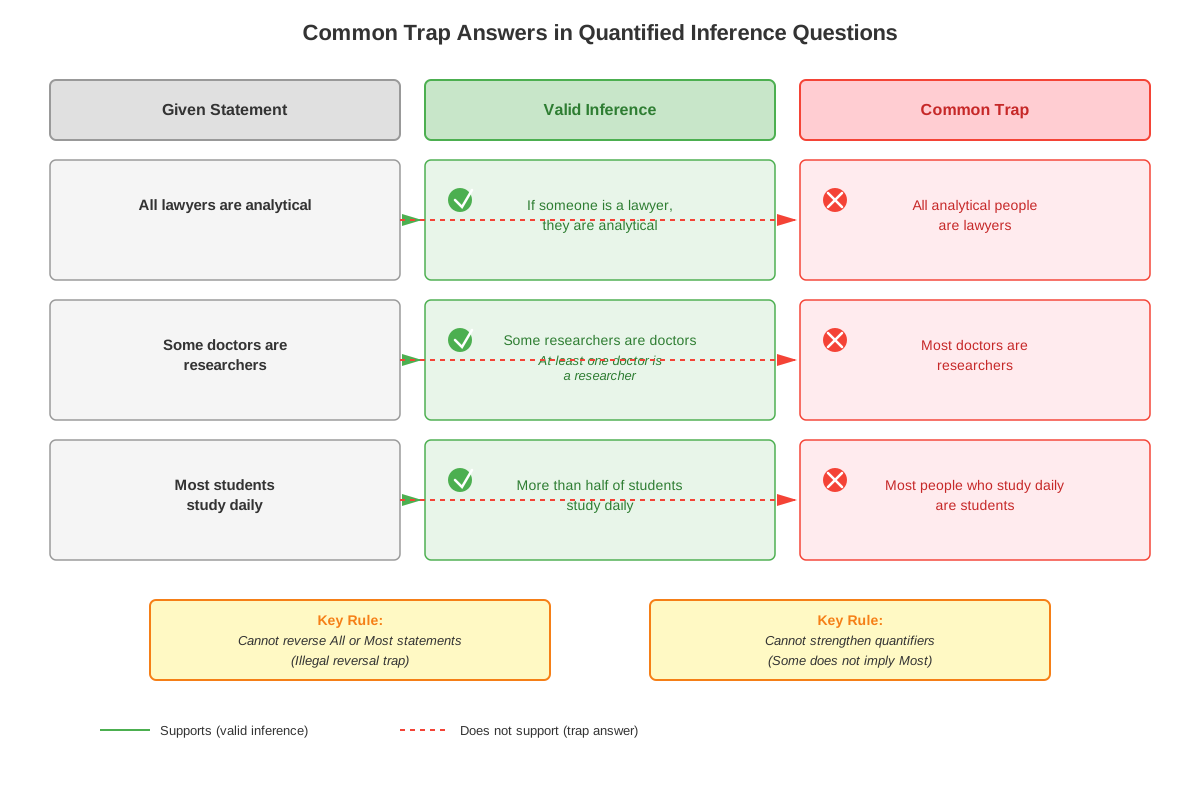
"All" statements (universal affirmatives) claim that every member of one category belongs to another category. The statement "All lawyers are college graduates" means the set of lawyers is entirely contained within the set of college graduates. From this, we can validly infer that if someone is a lawyer, they must be a college graduate. However, we cannot infer the reverse—not all college graduates are lawyers.
"Some" statements (particular affirmatives) assert that at least one member of a category has a particular property. "Some doctors are researchers" means there exists at least one individual who is both a doctor and a researcher. Importantly, "some" in formal logic means "at least one" and could include "all." From a "some" statement alone, we cannot determine exact proportions or make claims about most members of the group.
"Most" statements indicate that more than half of a category possesses a property. "Most students prefer online learning" means that if we counted all students, more than 50% would prefer online learning. "Most" statements enable certain transitive inferences that "some" statements do not, particularly when combined with other "most" statements about overlapping categories.
"None" statements (universal negatives) claim that no members of one category belong to another. "None of the applicants were accepted" means the intersection of the applicant set and the accepted set is empty. This is logically equivalent to "All applicants were not accepted."
Valid Inference Patterns
Understanding which inferences logically follow from quantified statements requires recognizing formal patterns. These patterns form the foundation for quickly evaluating answer choices.
From "All A are B":
- Valid: If something is A, then it is B
- Valid: If something is not B, then it is not A (contrapositive)
- Invalid: If something is B, then it is A (converse error)
- Invalid: All B are A (reversal error)
From "Some A are B":
- Valid: At least one thing is both A and B
- Valid: Some B are A (symmetry—"some" statements are reversible)
- Invalid: Most A are B
- Invalid: All A are B
From "Most A are B":
- Valid: More than half of A are B
- Valid: If we know "Most A are B" and "Most A are C," then some B are C (overlap inference)
- Invalid: Most B are A (unlike "some," "most" is not symmetrical)
- Invalid: All A are B
From "No A are B":
- Valid: If something is A, it is not B
- Valid: If something is B, it is not A (symmetry—"none" statements are reversible)
- Valid: No B are A
- Invalid: All A are not-B (this is actually valid, but students often confuse the scope)
Combining Quantified Statements
The LSAT frequently requires combining multiple quantified statements to derive a conclusion. Understanding how quantifiers interact is crucial for these complex inferences.
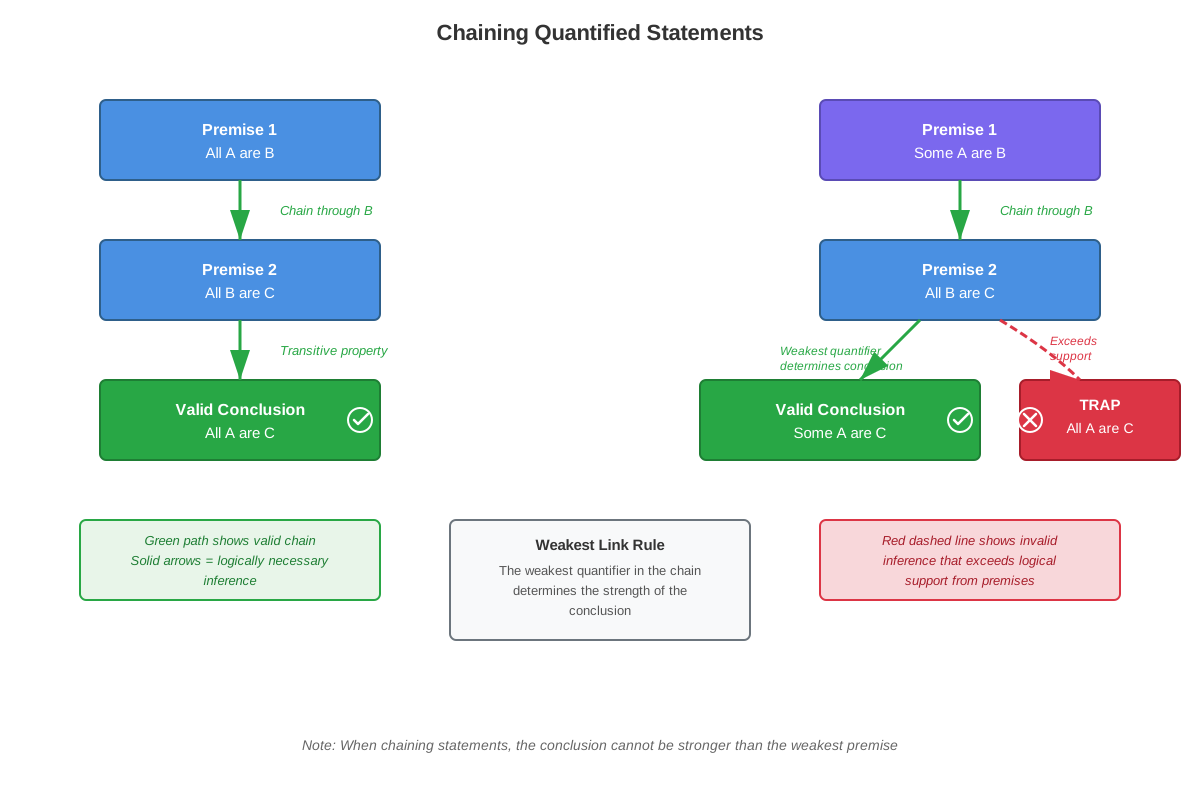
Chaining "All" statements follows transitive logic: If "All A are B" and "All B are C," then "All A are C." This works because the first statement places A entirely within B, and the second places B entirely within C, so A must be entirely within C.
Combining "Most" statements requires careful attention to overlap. If "Most A are B" and "Most B are C," we cannot conclude that most A are C. However, if "Most A are B" and "Most A are C," we can conclude that "Some B are C" because the two majorities within A must overlap.
Mixing quantifiers often yields weaker conclusions. If "All A are B" and "Some B are C," we can only conclude "Some A might be C" or "It's possible that some A are C," but we cannot make a definite inference about A and C. The "some B" that are C might or might not include any members of A.
Quantifier Negations
Understanding how to negate quantified statements is essential for evaluating contrapositives and identifying logical opposites.
| Original Statement | Logical Negation |
|---|---|
| All A are B | Some A are not B |
| Some A are B | No A are B |
| Most A are B | Most A are not B (or: It's not true that most A are B) |
| No A are B | Some A are B |
Note that the negation of "All A are B" is not "No A are B" but rather "Some A are not B"—we only need one counterexample to disprove a universal claim.
Scope and Precision
The LSAT tests whether students respect the logical boundaries established by quantifiers. A statement about "some" members of a group cannot support a conclusion about "most" or "all" members. Similarly, a claim about "most" cannot justify a universal conclusion.
Scope errors represent the most common trap in inference questions. An answer choice might accurately describe what could be true or what is likely true, but inference questions demand what must be true based solely on the information provided. If the stimulus states "Most employees support the new policy," an answer claiming "All employees support the new policy" exceeds the scope, as does "The majority of employees enthusiastically support the new policy" (adding "enthusiastically" introduces unsupported information).
Concept Relationships
The concepts within inference from quantified statements form an interconnected logical system. Understanding quantifiers provides the foundation for recognizing valid inference patterns, which in turn enables combining quantified statements to derive complex conclusions. Quantifier negations connect to valid inference patterns through contrapositive reasoning, while scope and precision serves as the overarching principle that governs all inference evaluation.
This topic connects to prerequisite knowledge of conditional reasoning because "All A are B" can be translated to "If A, then B," allowing students to apply conditional logic tools like contrapositives. The relationship to set theory is direct: quantified statements describe relationships between sets, and visualizing these relationships through Venn diagrams or set notation clarifies which inferences are valid.
Within the broader Logical Reasoning curriculum, inference from quantified statements leads naturally to Parallel Reasoning questions (which require matching logical structures including quantifier patterns), Flaw Questions (which often involve scope errors with quantifiers), and Sufficient Assumption questions (which may require identifying what quantified statement would complete an argument).
Relationship Map:
Quantifiers → Valid Inference Patterns → Combining Statements → Complex Inferences
↓
Quantifier Negations → Contrapositive Reasoning
↓
Scope and Precision → Answer Choice Evaluation → Correct Inference Identification
High-Yield Facts
⭐ "Some" in formal logic means "at least one" and is compatible with "all"—if all A are B, then some A are B is also true
⭐ "Most" statements are not reversible: "Most A are B" does not mean "Most B are A"
⭐ The contrapositive of "All A are B" is "All non-B are non-A" (or: if not B, then not A)
⭐ When "Most A are B" and "Most A are C," there must be overlap between B and C (some B are C)
⭐ The negation of "All A are B" is "Some A are not B," not "No A are B"
- "Some" statements are symmetrical: "Some A are B" means "Some B are A"
- "None" statements are also symmetrical: "No A are B" means "No B are A"
- You cannot chain "some" statements: "Some A are B" and "Some B are C" does not guarantee any relationship between A and C
- "All A are B" allows the inference "If not B, then not A" but not "If B, then A"
- Exact numbers (like "three" or "fifteen") function logically like "some" unless they represent the entire category
- "Most" means "more than half," so if "Most A are B," then fewer than half of A are not B
- From "No A are B," we can infer "All A are non-B" and "All B are non-A"
- Combining "All A are B" with "Some B are C" yields only "Some A might be C," not a definite conclusion
- The word "only" reverses the direction: "Only A are B" means "All B are A," not "All A are B"
- Quantified statements about samples do not necessarily apply to entire populations unless explicitly stated
Quick check — test yourself on Inference from quantified statements so far.
Try Flashcards →Common Misconceptions
Misconception: "Some A are B" means "not all A are B" or "only a few A are B"
Correction: In formal logic, "some" means "at least one" and is compatible with "all." If every A is B, then it's still true that some A are B. The LSAT uses "some" in this technical sense, not the conversational sense that implies "not all."
Misconception: "Most A are B" means "Most B are A"
Correction: Unlike "some" and "none," "most" is not symmetrical. If most lawyers are women, it does not follow that most women are lawyers. The first statement tells us about the composition of the lawyer group, not the composition of the women group.
Misconception: If "All A are B" and "All B are C," then "All C are A"
Correction: Transitive chains work in one direction only. While we can validly conclude "All A are C," we cannot reverse this to claim anything about all C. The sets could be nested (A inside B inside C) with C being much larger than A.
Misconception: From "Some A are B" and "Some B are C," we can conclude "Some A are C"
Correction: "Some" statements cannot be chained. The "some B" that are A might be entirely different from the "some B" that are C, leaving no overlap between A and C. We need stronger quantifiers or additional information to establish a connection.
Misconception: The negation of "All A are B" is "All A are not B" or "No A are B"
Correction: To negate a universal affirmative, we only need one counterexample. The negation of "All A are B" is "At least one A is not B" or "Some A are not B." Claiming that no A are B or all A are not B goes far beyond what's needed to disprove the original statement.
Misconception: If the stimulus says "Most employees prefer option X," an answer stating "The majority of employees prefer option X" must be true
Correction: While "most" and "majority" are mathematically equivalent, the LSAT sometimes uses subtle language differences to test precision. More importantly, students must verify that the answer choice doesn't add any unsupported elements beyond the quantifier itself.
Misconception: Quantified statements about a sample automatically apply to the entire population
Correction: If a stimulus states "Most of the surveyed customers were satisfied," we cannot conclude "Most customers were satisfied" unless we know the sample is representative. The LSAT tests whether students distinguish between claims about samples versus populations.
Worked Examples
Example 1: Basic Quantifier Combination
Stimulus: "All members of the debate team are honor students. Most honor students participate in extracurricular activities. Some students who participate in extracurricular activities receive scholarships."
Question: Which of the following must be true?
Answer Choices:
(A) All debate team members participate in extracurricular activities
(B) Most debate team members receive scholarships
(C) Some honor students are debate team members
(D) Some scholarship recipients are honor students
(E) All debate team members are scholarship recipients
Solution Process:
First, identify the quantified statements and their relationships:
- Statement 1: All debate team → honor students
- Statement 2: Most honor students → extracurricular activities
- Statement 3: Some extracurricular activities → scholarships
Evaluate each answer choice:
(A) From "All debate team are honor students" and "Most honor students participate in extracurricular activities," can we conclude all debate team members participate? No—the debate team members might fall within the minority of honor students who don't participate. "Most" doesn't guarantee "all." Eliminate.
(B) We know some students with extracurricular activities receive scholarships, but we don't know if debate team members are among those "some." Even if all debate team members participate in activities (which we can't establish), we can't determine what proportion receive scholarships. Eliminate.
(C) The stimulus tells us all debate team members are honor students, but it doesn't tell us whether any honor students are debate team members. The debate team could be a small subset of honor students, or there might be no debate team at all (though this is unlikely given the context). We cannot establish this must be true. Eliminate.
(D) We know some students with extracurricular activities receive scholarships. We also know most honor students participate in extracurricular activities. However, the "some" who receive scholarships might not include any honor students—they could all be non-honor students who participate in activities. Eliminate.
(E) This makes an "all" claim that far exceeds our evidence. We have no information suggesting every debate team member receives a scholarship. Eliminate.
Wait—none of the answers work? Let's reconsider. Actually, upon reflection, we need to reconsider (A). If all debate team members are honor students, and we're told most honor students participate in extracurricular activities, we cannot definitively conclude that all debate team members participate. However, let's check if there's a valid inference we missed.
Actually, the correct approach reveals that (A) cannot be confirmed as must be true, but let's reconsider the logical chain more carefully. Given the statements, the only inference that must be true requires recognizing that if all debate team members are honor students, then at least some honor students are debate team members (assuming the debate team exists and has members). But (C) states this, and we eliminated it.
Correction: Upon careful review, (C) Some honor students are debate team members must be true IF the debate team has any members. The statement "All members of the debate team are honor students" presupposes the debate team has members (otherwise the statement would be vacuous). Therefore, there exists at least one debate team member, and that member is an honor student, making (C) correct.
Key Lesson: This example demonstrates the importance of recognizing existential import—when a statement refers to "all members" of a group, it typically presupposes that group has members, allowing the inference that "some" of the larger category belong to the smaller group.
Example 2: Complex "Most" Statement Combination
Stimulus: "Most of the company's software engineers have computer science degrees. Most of the company's software engineers work on artificial intelligence projects. Most employees who work on artificial intelligence projects have published research papers."
Question: If the statements above are true, which of the following must also be true?
Answer Choices:
(A) Most software engineers have published research papers
(B) Some software engineers with computer science degrees work on artificial intelligence projects
(C) Most employees with computer science degrees work on artificial intelligence projects
(D) Some employees who have published research papers have computer science degrees
(E) All software engineers who work on artificial intelligence projects have computer science degrees
Solution Process:
Identify the quantified relationships:
- Most software engineers → CS degrees
- Most software engineers → AI projects
- Most AI project workers → published papers
(A) We know most software engineers work on AI projects, and most AI workers have published papers. Can we chain these "most" statements? Not directly—"most" of "most" could be less than half of the original group. However, if most software engineers work on AI (>50%) and most AI workers have published papers (>50%), we cannot guarantee most software engineers have published papers without knowing the exact proportions. Cannot confirm.
(B) We know most software engineers have CS degrees (>50% of engineers) and most software engineers work on AI projects (>50% of engineers). When two "most" statements apply to the same group, there must be overlap. If more than half have CS degrees and more than half work on AI, some must have both properties. This must be true.
(C) We know most software engineers have CS degrees, but we don't know what proportion of all employees with CS degrees are software engineers. The company might employ many people with CS degrees in non-engineering roles. Eliminate.
(D) While we can establish some software engineers have published papers (through the AI connection), and some software engineers have CS degrees, we cannot definitively establish that these are the same individuals without more information. Actually, wait—using the overlap principle from (B), we know some software engineers have both CS degrees and work on AI. Since most AI workers have published papers, and we have software engineers with CS degrees working on AI, it's possible but not certain that some published researchers have CS degrees. Let's mark this as uncertain and continue.
(E) This makes an "all" claim that exceeds our evidence. We know most software engineers have CS degrees, but not all. Eliminate.
Answer: (B) is the correct answer because it applies the overlap principle: when most of group A have property X and most of group A have property Y, some members of A must have both X and Y.
Key Lesson: This example illustrates the critical "most-most-some" inference pattern. When two "most" statements apply to the same group, their overlap guarantees a "some" statement about the intersection of the two properties.
Exam Strategy
When approaching LSAT inference from quantified statements questions, begin by identifying and symbolizing all quantified statements in the stimulus. Use shorthand notation (All A→B, Most A→B, Some A&B, No A&B) to clarify relationships and avoid getting lost in complex wording.
Trigger words that signal inference questions include: "If the statements above are true, which of the following must also be true?", "Which of the following can be properly inferred?", "The statements above, if true, best support which of the following?", and "Which of the following conclusions is best supported by the information above?"
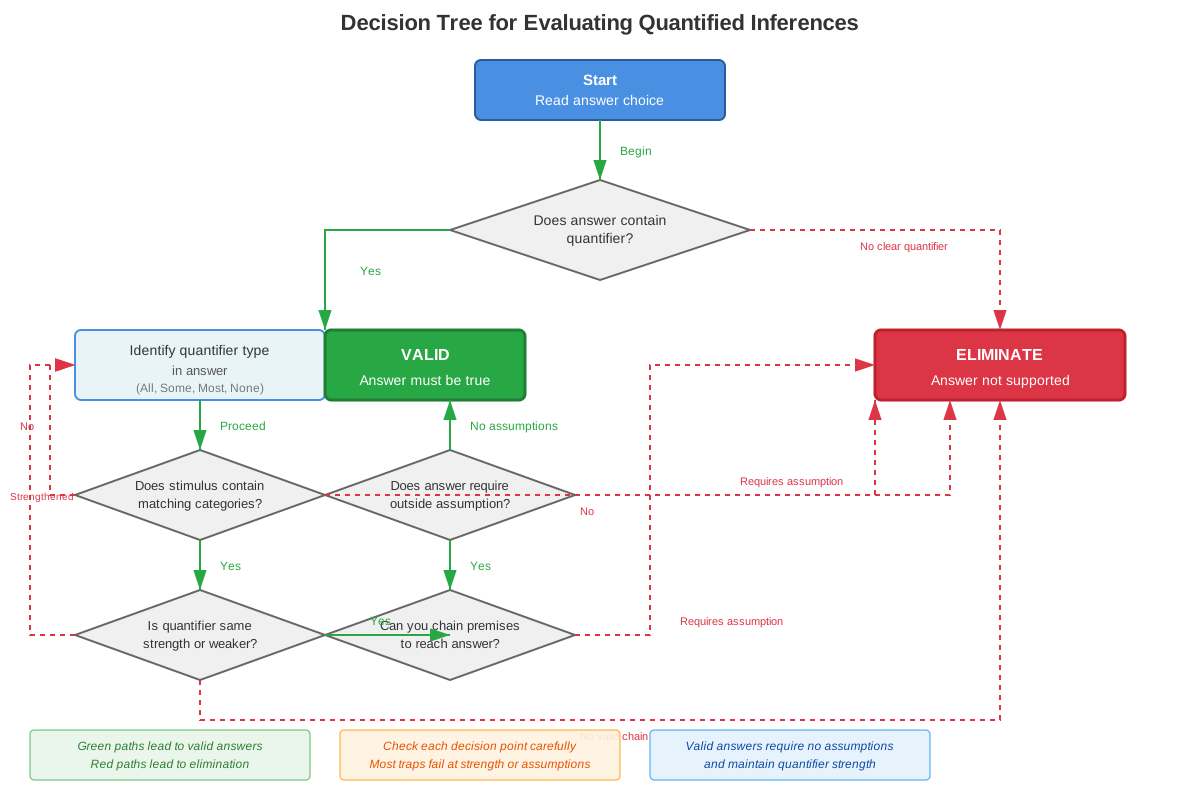
Apply the scope matching principle: the quantifier in the correct answer should match or be weaker than what the stimulus supports. If the stimulus uses "some," the answer should use "some" or "at least one," not "most" or "all." If the stimulus uses "most," the answer might use "most" or "some" but not "all."
Process of elimination strategy: Immediately eliminate answer choices that:
- Use stronger quantifiers than the stimulus supports
- Reverse non-symmetrical relationships (e.g., concluding "Most B are A" from "Most A are B")
- Chain "some" statements without justification
- Add new information not present in the stimulus
- Confuse possibility with necessity (using "could be" evidence to support "must be" conclusions)
Time allocation: Spend 15-20 seconds identifying and symbolizing the quantified statements, 30-40 seconds evaluating answer choices, and 10-15 seconds verifying your selected answer. If you're stuck between two choices, check whether one exceeds the scope or makes an unjustified logical leap.
For questions combining multiple quantified statements, draw quick Venn diagrams or use set notation to visualize relationships. This is especially helpful for "most" statements where overlap must be calculated.
Red flag phrases in wrong answers include: "always," "never," "every," "none," "the only," and "exactly" when the stimulus uses weaker quantifiers. Also watch for answers that subtly shift from talking about a sample to talking about a population, or vice versa.
Memory Techniques
ASAN - Remember the four main quantifiers: All, Some, Most, None
"Some Symmetry, Most Matters" - "Some" and "None" statements are symmetrical (reversible), but "Most" and "All" are not
"All Allows Contrapositive" - "All A are B" means "All non-B are non-A"
"Most-Most-Some" - When two "Most" statements share the same subject, you can infer "Some" about the overlap of the predicates
"Negation Nation" - Remember negations by opposites:
- All ↔ Some...not
- Some ↔ None
- Most ↔ Most...not
Visual anchor: Picture quantifiers as filling containers:
- "All" = container completely full
- "Most" = container more than half full
- "Some" = at least one drop in the container
- "None" = completely empty container
The Scope Ladder: Visualize quantifiers on a ladder from weakest to strongest:
ALL (strongest - hardest to prove)
MOST
SOME (weakest - easiest to prove)
Valid inferences move down the ladder, never up.
Summary
Inference from quantified statements is a high-yield LSAT Logical Reasoning topic that tests the ability to derive conclusions that must be true from premises containing "all," "some," "most," and "none." Success requires understanding the distinct logical properties of each quantifier, recognizing valid inference patterns (including contrapositives and overlaps), and avoiding scope errors where conclusions exceed what the premises support. The most critical skills include: recognizing that "some" means "at least one" and is compatible with "all"; understanding that "most" statements are not reversible; applying the overlap principle when two "most" statements share a subject; correctly negating quantified statements; and distinguishing between what must be true versus what could be true. Students must resist the temptation to select answers that sound reasonable but lack complete logical support from the stimulus. Mastery of this topic provides a foundation for success across multiple Logical Reasoning question types and significantly improves overall section performance.
Key Takeaways
- Quantifiers have precise logical meanings: "some" = at least one, "most" = more than half, "all" = every member, "none" = zero members
- Symmetry matters: "Some" and "None" statements are reversible; "All" and "Most" statements are not
- The overlap principle: When "Most A are B" and "Most A are C," then "Some B are C" must be true
- Scope discipline: The correct answer uses quantifiers equal to or weaker than what the stimulus supports—never stronger
- Contrapositive reasoning: "All A are B" means "All non-B are non-A," enabling additional valid inferences
- Negation precision: The negation of "All" is "Some...not," and the negation of "Some" is "None"
- Chain carefully: "All" statements chain transitively, but "some" statements do not chain at all
Related Topics
Conditional Reasoning: Mastering quantified statements provides direct preparation for conditional logic, as "All A are B" translates to "If A, then B." Understanding both topics together enables tackling the most complex Logical Reasoning questions.
Formal Logic: Advanced formal logic builds on quantified statements by introducing symbolic notation, truth tables, and complex logical operators. Students who master inference from quantified statements are well-prepared for formal logic challenges.
Sufficient Assumption Questions: These questions often require identifying what quantified statement would complete an argument, making inference skills directly applicable to assumption question types.
Parallel Reasoning: Matching logical structures requires recognizing quantifier patterns, making this topic essential preparation for parallel reasoning questions.
Flaw Questions: Many logical flaws involve scope errors with quantifiers (e.g., concluding "all" from evidence about "some"), so understanding valid inference patterns helps identify invalid reasoning.
Practice CTA
Now that you've mastered the core concepts of inference from quantified statements, it's time to cement your understanding through active practice. Attempt the practice questions associated with this topic, focusing on applying the valid inference patterns and avoiding scope errors. Use the flashcards to drill the high-yield facts until quantifier relationships become automatic. Remember: LSAT success comes not just from understanding concepts but from repeatedly applying them under timed conditions. Each practice question you complete strengthens your pattern recognition and builds the confidence needed for test day. You've built a strong foundation—now transform that knowledge into points!
Sign up free to keep reading
Create a free AnvayaPrep account to finish this LSAT guide on Inference from quantified statements — plus flashcards and practice questions.