Overview
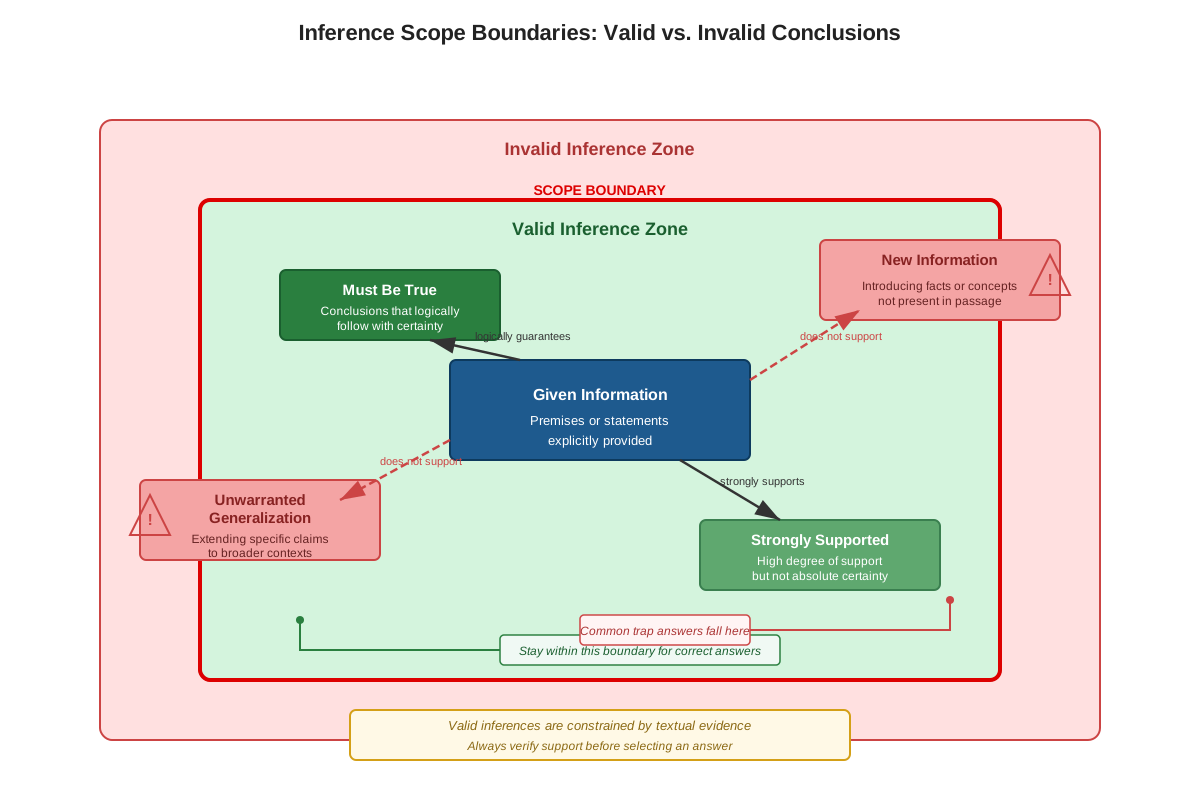
Inference scope is one of the most critical concepts tested in LSAT Logical Reasoning sections, appearing in approximately 15-20% of all Logical Reasoning questions. Understanding inference scope means recognizing the precise boundaries of what can and cannot be legitimately concluded from a given set of premises. On the LSAT, inference questions require test-takers to identify statements that must be true, are strongly supported, or logically follow from the information provided—without adding assumptions or extending beyond what the evidence warrants.
The challenge of LSAT inference scope lies in distinguishing between what is explicitly supported by the passage and what merely seems plausible or likely. Many test-takers fall into the trap of selecting answer choices that introduce new information, make unwarranted generalizations, or extend the argument beyond its logical boundaries. Mastering inference scope requires developing a disciplined approach to reading comprehension that focuses on textual precision and logical constraints. This skill is fundamental because it underlies not only inference questions but also strengthens performance on assumption, strengthen/weaken, and flaw questions.
Within the broader landscape of Logical Reasoning, inference scope serves as a foundational skill that connects to conditional reasoning, formal logic, and argument structure analysis. While other question types ask you to evaluate or modify arguments, inference questions test your ability to extract only what is logically guaranteed or strongly supported by the given information. This makes inference scope essential for developing the analytical rigor required throughout the entire LSAT.
Learning Objectives
- [ ] Identify how Inference scope appears in LSAT questions
- [ ] Explain the reasoning pattern behind Inference scope
- [ ] Apply Inference scope to solve LSAT-style problems accurately
- [ ] Distinguish between statements that must be true versus statements that could be true
- [ ] Recognize common scope violations in incorrect answer choices
- [ ] Evaluate the strength of support between premises and potential inferences
- [ ] Apply quantifier restrictions (some, most, all) to determine valid inference boundaries
Prerequisites
- Basic formal logic: Understanding of logical operators (and, or, if-then) is essential because inference questions often involve conditional statements and logical relationships that determine what can be validly concluded.
- Argument structure identification: Recognizing premises and conclusions helps distinguish between what is given as evidence and what must be inferred from that evidence.
- Reading comprehension fundamentals: The ability to parse complex sentences and identify key claims is necessary because inference scope depends on precise understanding of what the passage actually states.
- Quantifier logic: Familiarity with terms like "all," "some," "most," and "none" is crucial because these determine the scope and strength of valid inferences.
Why This Topic Matters
Inference scope is not merely an academic exercise—it reflects the type of careful reasoning required in legal analysis, policy evaluation, and critical decision-making. Lawyers must constantly distinguish between what evidence actually proves versus what it merely suggests. This same discipline applies to medical diagnosis, scientific research, and business strategy, where drawing conclusions beyond the scope of available data can lead to costly errors.
On the LSAT, inference questions appear in multiple forms: "Which one of the following must be true?", "Which one of the following is most strongly supported?", "Which one of the following can be properly inferred?", and "If the statements above are true, which one of the following must also be true?" These questions typically constitute 4-6 questions per Logical Reasoning section, making them one of the highest-yield question types. Recent LSAT administrations have shown an increased emphasis on inference questions that combine multiple conditional statements or require careful attention to quantifier scope.
Inference scope appears most commonly in passages that present factual information, research findings, statistical data, or descriptive scenarios. The LSAT frequently tests whether students can avoid three common scope errors: over-generalizing from limited data, introducing outside assumptions, and confusing correlation with causation. Questions may present complex scenarios involving multiple actors, conditional relationships, or comparative statements, all designed to test whether students can maintain strict logical boundaries.
Core Concepts
Understanding Inference Scope
Inference scope refers to the precise range of conclusions that can be legitimately drawn from a given set of premises. On the LSAT, this concept operates under a strict standard: valid inferences must be supported by the text without requiring additional assumptions or external knowledge. The scope of an inference is determined by three key factors: the strength of the language used in the premises, the logical relationships between statements, and the quantifiers that limit or expand the applicability of claims.
When evaluating inference scope, students must distinguish between necessary inferences (conclusions that must be true if the premises are true) and possible inferences (conclusions that could be true but are not guaranteed). The LSAT primarily tests necessary inferences or those that are "most strongly supported," meaning they have a very high probability of being true given the premises.
Quantifier Restrictions and Scope
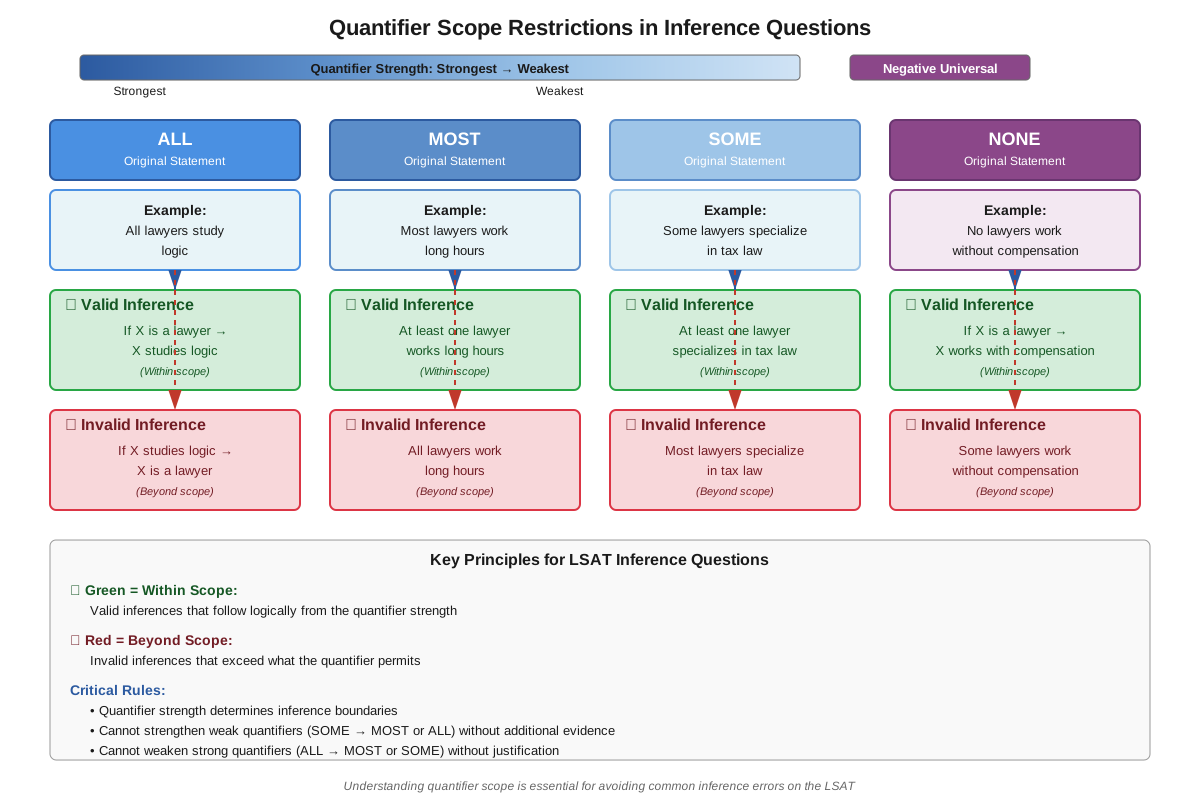
Quantifiers establish the boundaries of inference scope by specifying how broadly a statement applies. Understanding these restrictions is essential for avoiding scope violations:
| Quantifier | Scope | Valid Inference | Invalid Inference |
|---|---|---|---|
| All X are Y | Universal | Every member of X has property Y | Most X are Y (weakening not allowed) |
| Most X are Y | Majority | More than half of X are Y | All X are Y (strengthening not allowed) |
| Some X are Y | Existential | At least one X is Y | Most X are Y (quantifying up not allowed) |
| No X are Y | Universal negative | Zero X have property Y | Some X are not Y (already covered) |
The LSAT frequently tests whether students respect these quantifier boundaries. For example, if a passage states "Most lawyers work long hours," you cannot infer "All lawyers work long hours" or even "Lawyer Smith works long hours" (because Smith might be in the minority). However, you can infer "At least some lawyers work long hours" because "most" logically includes "some."
Conditional Statements and Inference Boundaries
Conditional statements (if-then relationships) create specific inference pathways while prohibiting others. The valid inferences from a conditional statement are strictly limited:
Given: If A → B (If A, then B)
Valid inferences:
- When A occurs, B must occur (direct application)
- If B does not occur, A did not occur (contrapositive: ¬B → ¬A)
Invalid inferences (scope violations):
- If B occurs, A occurred (affirming the consequent)
- If A does not occur, B does not occur (denying the antecedent)
The LSAT exploits these scope limitations by creating answer choices that commit these logical fallacies. For instance, if a passage states "If the company is profitable, it will expand," you cannot infer that expansion proves profitability—other factors might cause expansion.
Combining Multiple Premises
Many LSAT inference questions require combining two or more premises to reach a valid conclusion. The scope of the resulting inference is constrained by the most restrictive element in the chain:
Example chain:
- All managers attend the meeting (All M → A)
- Some employees who attend the meeting receive bonuses (Some A → B)
Valid inference: Some managers might receive bonuses (the connection is possible but not guaranteed because "some" doesn't specify which attendees get bonuses)
Invalid inference: All managers receive bonuses (this violates the "some" restriction in premise 2)
Temporal and Contextual Scope
Inference scope also includes temporal and contextual limitations. If a passage describes a situation "in 2020" or "during the recession," valid inferences are bounded by those conditions. The LSAT tests whether students inappropriately generalize beyond these constraints:
- Temporal scope: "Sales increased last quarter" does not support "Sales will increase next quarter"
- Contextual scope: "This policy works in urban areas" does not support "This policy works in rural areas"
- Conditional scope: "When interest rates are low, housing sales increase" does not support "Housing sales are currently increasing" (unless we know interest rates are currently low)
Strength of Support
The LSAT distinguishes between different levels of inferential support:
- Must be true: The conclusion is logically necessary given the premises (deductive certainty)
- Most strongly supported: The conclusion has very high probability given the premises (strong inductive support)
- Could be true: The conclusion is consistent with the premises but not required (mere possibility)
Most LSAT inference questions ask for what "must be true" or is "most strongly supported." Answer choices that are merely possible or plausible—but not required by the premises—fall outside the acceptable inference scope.
Concept Relationships
Inference scope serves as the foundation for multiple Logical Reasoning skills. The concept connects directly to conditional reasoning because conditional statements establish clear boundaries for valid inferences through their if-then structure. When students understand inference scope, they can better identify what follows from conditional premises and avoid common errors like affirming the consequent.
The relationship flows as follows: Quantifier logic → determines → Inference scope boundaries → which enables → Valid conclusion identification → which prevents → Scope violation errors
Inference scope also connects to assumption questions through an inverse relationship. While inference questions ask what must follow from the premises, assumption questions ask what unstated premise is required. Understanding inference scope helps identify when an argument has made a logical leap beyond what the evidence supports, revealing the gap that an assumption must fill.
Additionally, inference scope relates to strengthen and weaken questions because these question types often hinge on whether new information falls within or outside the scope of the original argument. An answer choice that introduces information beyond the argument's scope typically cannot strengthen or weaken it effectively.
The progression of mastery follows this path: Basic formal logic → Quantifier restrictions → Inference scope → Complex multi-premise inferences → Argument evaluation skills
High-Yield Facts
⭐ Inference scope is determined by the most restrictive quantifier or condition in a chain of reasoning—if any premise uses "some" or "might," the conclusion cannot claim "all" or "must."
⭐ The contrapositive is the only valid inference from a conditional statement beyond direct application—reversing or negating only one part creates a scope violation.
⭐ "Most" statements cannot be combined to guarantee a conclusion—even if "most X are Y" and "most Y are Z," it's possible that no X are Z.
⭐ Temporal and contextual qualifiers strictly limit inference scope—conclusions cannot extend beyond the specified time period or context without additional evidence.
⭐ Valid inferences never require introducing new concepts not mentioned in the premises—if an answer choice discusses elements absent from the passage, it exceeds the inference scope.
- Correlation statements ("X is associated with Y") do not support causal inferences ("X causes Y") without additional evidence establishing the causal mechanism.
- Comparative statements establish relative relationships but not absolute values—"X is larger than Y" doesn't tell us whether X is objectively large.
- Existential claims ("some X are Y") are the weakest form of inference and can be derived from any stronger quantifier (most, all).
- Negating a universal statement ("not all X are Y") only establishes that at least one X is not Y, not that most or no X are Y.
- When premises conflict with common sense or real-world knowledge, valid inferences must follow the premises as stated, not external assumptions.
Quick check — test yourself on Inference scope so far.
Try Flashcards →Common Misconceptions
Misconception: If most X are Y and most Y are Z, then most X must be Z.
Correction: This commits a quantifier scope error. "Most" means more than 50%, but the overlapping groups might not create a majority connection. For example, if 51% of X are Y, and 51% of Y are Z, it's mathematically possible that the 51% of X that are Y fall entirely within the 49% of Y that are not Z, meaning potentially 0% of X are Z.
Misconception: A statement that "could be true" based on the premises is a valid inference.
Correction: LSAT inference questions typically require what "must be true" or is "most strongly supported," not merely what is possible. An answer choice that is consistent with the premises but not required by them falls outside the acceptable inference scope.
Misconception: If the passage doesn't explicitly contradict an answer choice, that choice is a valid inference.
Correction: Valid inferences require positive support from the premises, not merely the absence of contradiction. The passage might be silent on many topics that are neither supported nor contradicted.
Misconception: Real-world knowledge can be used to evaluate inference questions if the conclusion seems reasonable.
Correction: LSAT inference questions must be answered based solely on the information provided in the passage. Even if an answer choice states something true in the real world, it's incorrect if it's not supported by the passage text.
Misconception: Conditional statements work in both directions—if A leads to B, then B indicates A.
Correction: This confuses a conditional with a biconditional. "If A then B" only guarantees B when A occurs; it says nothing about what happens when B occurs without A. This is a classic scope violation called "affirming the consequent."
Misconception: Stronger language in an answer choice makes it more likely to be correct because it sounds more confident.
Correction: The opposite is often true on inference questions. Stronger language (all, must, always, never) is harder to support and more likely to violate scope, while appropriately qualified language (some, may, can) often better reflects what the premises actually support.
Worked Examples
Example 1: Quantifier Scope
Passage: "Most of the company's senior executives have MBA degrees. All employees with MBA degrees from top-tier programs receive priority consideration for promotion. Chen is a senior executive with an MBA from a top-tier program."
Question: Which of the following must be true?
Answer Choices:
(A) Chen will receive a promotion
(B) Chen receives priority consideration for promotion
(C) Most senior executives receive priority consideration for promotion
(D) All senior executives have MBA degrees
(E) Chen is the only senior executive with an MBA from a top-tier program
Analysis:
Let's map the logical structure:
- Premise 1: Most senior executives → MBA (but not all)
- Premise 2: All (top-tier MBA) → priority consideration
- Premise 3: Chen = senior executive AND top-tier MBA
Evaluating each choice:
(A) Scope violation: "Priority consideration" does not guarantee promotion; this adds an unsupported inference about the outcome of consideration.
(B) Correct: Chen has a top-tier MBA (Premise 3), and all people with top-tier MBAs receive priority consideration (Premise 2). By direct application of the conditional, Chen must receive priority consideration. This stays within scope.
(C) Scope violation: We know "most senior executives have MBAs" but not whether those MBAs are from top-tier programs. The conditional only applies to top-tier MBAs, so we cannot extend it to most senior executives.
(D) Scope violation: Premise 1 states "most," not "all." This answer choice illegitimately strengthens the quantifier.
(E) Scope violation: The passage provides no information about other senior executives' MBA origins. This introduces a uniqueness claim unsupported by the text.
Key takeaway: This question tests whether students respect quantifier boundaries ("most" vs. "all") and avoid extending conditionals beyond their stated scope.
Example 2: Multi-Premise Integration
Passage: "Every participant in the study who exercised regularly showed improved cardiovascular health. Some participants who showed improved cardiovascular health also reported better sleep quality. No participant who reported better sleep quality experienced increased stress levels during the study period."
Question: If the statements above are true, which one of the following must also be true?
Answer Choices:
(A) All participants who exercised regularly reported better sleep quality
(B) Some participants who exercised regularly did not experience increased stress levels
(C) No participants experienced increased stress levels during the study
(D) Most participants who exercised regularly showed improved cardiovascular health
(E) Some participants who showed improved cardiovascular health exercised regularly
Analysis:
Let's map the logical chain:
- Premise 1: All (regular exercise) → improved cardiovascular health
- Premise 2: Some (improved cardiovascular health) → better sleep quality
- Premise 3: All (better sleep quality) → NOT increased stress
Evaluating each choice:
(A) Scope violation: Premise 2 only establishes that "some" people with improved cardiovascular health reported better sleep, not all. Since all exercisers have improved cardiovascular health, we only know that some (not all) exercisers might have better sleep.
(B) Correct: Here's the logical chain: All exercisers → improved cardiovascular health (P1). Some with improved cardiovascular health → better sleep (P2). All with better sleep → NOT increased stress (P3). Therefore, at least some exercisers must be in the group that has better sleep (from P2), and those people definitely did not experience increased stress (from P3). This inference respects all quantifier restrictions.
(C) Scope violation: We only know that people with better sleep quality didn't experience increased stress. The passage doesn't tell us about participants who didn't report better sleep quality—they might have experienced increased stress.
(D) Scope violation: Premise 1 states "every" (all) participant who exercised regularly showed improvement, not "most." This answer choice weakens the quantifier without justification.
(E) Scope violation: This reverses the conditional in Premise 1. We know exercise leads to improved cardiovascular health, but we don't know if improved cardiovascular health only comes from exercise—other factors might cause it.
Key takeaway: This question tests the ability to trace inferences through multiple premises while respecting quantifier restrictions at each step. The correct answer requires combining all three premises while maintaining the "some" restriction from Premise 2.
Exam Strategy
When approaching inference questions on the LSAT, implement this systematic process:
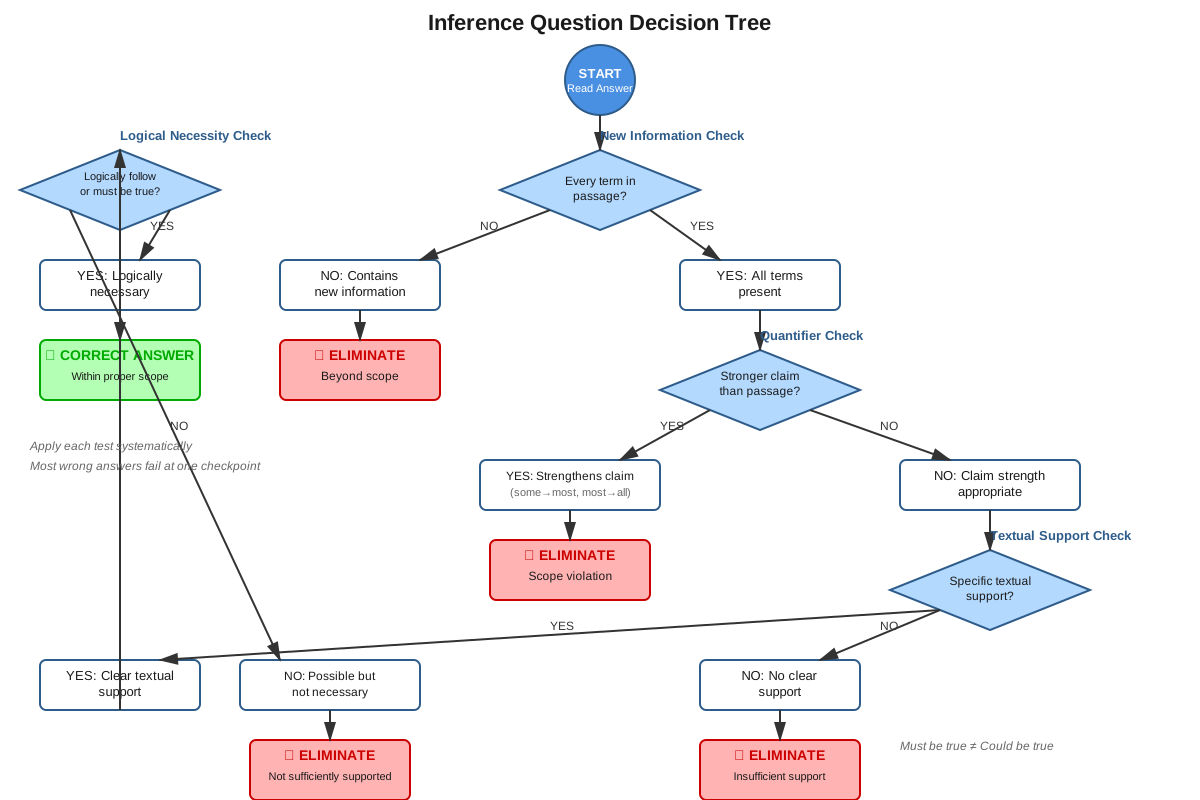
Step 1: Identify the question type. Look for trigger phrases: "must be true," "most strongly supported," "properly inferred," "follows logically," or "must also be true." These signal that you need to find an answer within the strict scope of the premises.
Step 2: Map the logical structure. Before looking at answer choices, identify:
- All quantifiers (all, most, some, none)
- Conditional relationships (if-then statements)
- Temporal or contextual limitations
- Key terms and their relationships
Step 3: Predict the inference. When possible, anticipate what must follow from the premises before reading answer choices. This prevents you from being swayed by attractive but incorrect options.
Step 4: Apply the "prove it" test. For each answer choice, ask: "Can I prove this using only the information given?" If you need to add assumptions, make logical leaps, or rely on outside knowledge, the choice exceeds the inference scope.
Step 5: Eliminate scope violations systematically:
Watch for these common scope violations: - Quantifier shifts (some → most, most → all) - Reversed conditionals (if A→B, concluding B→A) - Temporal extensions (past → future, specific time → general) - New concept introduction (terms not in the passage) - Causal claims from correlational data
Time allocation: Spend 1:00-1:15 minutes on straightforward inference questions with simple premises, but allocate up to 1:45 minutes for complex questions involving multiple conditional statements or quantifier combinations. The time investment in careful analysis prevents costly errors.
Trigger words to watch for:
- "Must be true" = highest standard, deductive certainty required
- "Most strongly supported" = very high probability, near-certainty
- "Properly inferred" = logically follows without assumptions
- "Could be true" = mere consistency (rare on LSAT, lower standard)
Process of elimination strategy: On inference questions, four answer choices typically commit scope violations. Actively look for the specific type of violation in each wrong answer—this trains your eye to spot scope issues more quickly and confirms your elimination decisions.
Memory Techniques
SCOPE Acronym for checking inference validity:
- Supported by text (not assumptions)
- Conditionals respected (no reversals)
- Only stated time/context (no extensions)
- Precise quantifiers maintained (no shifts)
- Explicit concepts only (no new terms)
Quantifier Hierarchy Visualization: Picture a pyramid with "ALL" at the top (strongest, hardest to prove), "MOST" in the middle, and "SOME" at the base (weakest, easiest to prove). Valid inferences can only move down the pyramid (from stronger to weaker), never up.
The Fence Metaphor: Think of inference scope as a fenced area. The premises build the fence, and valid inferences must stay inside it. Answer choices that jump the fence—even if they land in plausible territory—are scope violations.
Conditional Direction Reminder: "If A then B" flows like water downhill: A→B. Water doesn't flow uphill (B→A) without a pump (additional information). The contrapositive is like a mirror reflection: ¬B→¬A.
The "Some" Safety Net: When in doubt between answer choices, the one with weaker quantifiers ("some," "may," "can") is often safer because it's harder to violate scope with qualified language. Extreme language ("all," "never," "must") requires extreme support.
Summary
Inference scope represents the boundaries of what can be legitimately concluded from a given set of premises on the LSAT. Mastering this concept requires understanding how quantifiers (all, most, some, none) establish logical limits, how conditional statements create specific inference pathways while prohibiting others, and how temporal and contextual qualifiers restrict the applicability of conclusions. Valid inferences must be supported by the text without introducing new assumptions, extending beyond stated conditions, or shifting quantifier strength. The LSAT tests inference scope through questions asking what "must be true" or is "most strongly supported," with incorrect answers typically committing scope violations such as quantifier shifts, reversed conditionals, temporal extensions, or introduction of new concepts. Success on these questions demands disciplined reading that distinguishes between what is explicitly supported versus what merely seems plausible, combined with systematic elimination of answer choices that exceed the logical boundaries established by the premises.
Key Takeaways
- Inference scope is determined by the most restrictive element in a chain of reasoning—quantifiers, conditionals, and contextual limitations all constrain what can be validly concluded
- Valid inferences require positive support from the premises, not merely the absence of contradiction or consistency with the passage
- Quantifier shifts (some→most→all) in either direction represent scope violations unless explicitly supported by the premises
- Conditional statements only support their direct application and contrapositive; reversing or partially negating them exceeds inference scope
- Temporal, contextual, and conditional qualifiers strictly limit inference scope—conclusions cannot extend beyond specified boundaries without additional evidence
- The "prove it" test is essential: if you cannot demonstrate an answer choice using only the given information, it violates inference scope
- Weaker, more qualified language in answer choices often signals appropriate scope, while extreme language requires extreme support from the premises
Related Topics
Assumption Questions: Understanding inference scope helps identify logical gaps in arguments. While inference questions ask what must follow from complete information, assumption questions reveal what unstated premise is needed when an argument makes a scope leap. Mastering inference scope enables you to spot when conclusions exceed their evidential support.
Conditional Logic and Formal Logic: These topics provide the structural foundation for inference scope. Advanced study of sufficient and necessary conditions, logical operators, and formal logic notation deepens your ability to trace valid inferences through complex logical chains.
Strengthen and Weaken Questions: These question types often hinge on scope considerations. Answer choices that introduce information outside the argument's scope typically cannot affect it, while those that operate within scope can strengthen or weaken the reasoning.
Flaw Questions: Many logical flaws involve scope violations—overgeneralizing from limited data, confusing correlation with causation, or making unwarranted assumptions. Understanding inference scope helps you identify these reasoning errors.
Must Be True vs. Most Strongly Supported: This advanced distinction within inference questions explores the difference between deductive certainty and strong inductive support, refining your understanding of inferential strength and scope.
Practice CTA
Now that you understand the principles of inference scope, it's time to apply these concepts to actual LSAT questions. The practice questions and flashcards will challenge you to identify scope violations, trace multi-premise inferences, and distinguish between valid and invalid conclusions under timed conditions. Remember: inference scope is a skill that improves dramatically with deliberate practice. Each question you analyze strengthens your ability to maintain logical boundaries and avoid the attractive traps the LSAT sets. Approach the practice materials with the systematic strategies outlined in this guide, and you'll develop the disciplined reasoning that separates top scorers from the rest. Your investment in mastering inference scope will pay dividends across all Logical Reasoning question types.
Sign up free to keep reading
Create a free AnvayaPrep account to finish this LSAT guide on Inference scope — plus flashcards and practice questions.