Overview
Inference with conditional chains represents one of the most powerful and frequently tested reasoning patterns on the LSAT Logical Reasoning section. This topic involves connecting multiple conditional statements together to derive new, valid conclusions that follow necessarily from the given premises. When the LSAT presents a series of "if-then" statements, test-takers must recognize how these statements link together and what new information can be logically deduced from the chain. Mastering this skill is essential because conditional reasoning appears in approximately 25-30% of all Logical Reasoning questions, and chains of conditionals represent the most complex and high-value subset of these questions.
The fundamental principle behind lsat inference with conditional chains is transitive reasoning: if A leads to B, and B leads to C, then A must lead to C. However, LSAT questions complicate this basic pattern by introducing multiple branches, negative conditions (contrapositives), and distractors that appear valid but violate logical rules. Students who can quickly diagram conditional chains, recognize valid inferences, and eliminate invalid conclusions gain a significant competitive advantage on test day.
Within the broader landscape of logical reasoning, conditional chains connect directly to formal logic, sufficient and necessary conditions, and contrapositive reasoning. These chains also appear embedded within other question types, including Must Be True questions, Cannot Be True questions, and even some Strengthen/Weaken questions where understanding the logical structure is essential. The ability to work with conditional chains is foundational for achieving scores in the 165+ range, as these questions often separate high scorers from average performers.
Learning Objectives
- [ ] Identify how Inference with conditional chains appears in LSAT questions
- [ ] Explain the reasoning pattern behind Inference with conditional chains
- [ ] Apply Inference with conditional chains to solve LSAT-style problems accurately
- [ ] Diagram complex conditional chains using standard notation within 30 seconds
- [ ] Recognize and apply contrapositive reasoning within multi-step conditional chains
- [ ] Distinguish between valid inferences and common logical fallacies in conditional reasoning
- [ ] Evaluate answer choices systematically by testing them against conditional chain structures
Prerequisites
- Basic conditional logic (if-then statements): Understanding simple sufficient and necessary conditions is essential because chains build upon individual conditional relationships
- Contrapositive formation: The ability to correctly negate and reverse conditional statements is required because chains often require working backward through contrapositives
- Logical notation and diagramming: Familiarity with arrow notation (A → B) enables quick visualization of complex chains
- Necessary vs. sufficient conditions: Distinguishing between these two types of conditions prevents directional errors when connecting statements
- Basic inference question structure: Understanding what "must be true" versus "could be true" means provides the foundation for evaluating chain-based conclusions
Why This Topic Matters
In real-world contexts, conditional chain reasoning appears constantly in legal analysis, policy evaluation, contract interpretation, and regulatory compliance. Attorneys must regularly trace through complex "if-then" relationships in statutes and case law to determine what conclusions follow necessarily from established facts. For example, determining eligibility for a legal remedy often requires working through multiple conditional requirements that build upon each other.
On the LSAT specifically, inference questions involving conditional chains appear in 8-12 questions per test on average, making them one of the highest-yield topics for focused study. These questions typically appear as "Must Be True" questions, "Must Be False" questions, or "Which one of the following can be properly inferred" questions. The LSAT tests conditional chains because they assess pure logical reasoning ability—the core skill required for legal analysis—without requiring specialized knowledge.
Conditional chains appear in several distinct formats on the exam: (1) explicit chains where multiple if-then statements are presented sequentially in the stimulus, (2) embedded chains where conditional relationships are expressed through various linguistic constructions ("only if," "unless," "requires," "depends on"), and (3) implicit chains where test-takers must recognize unstated conditional relationships from context. Questions may ask what must be true given the chain, what cannot be true, or what additional information would allow a specific conclusion to be drawn. The most challenging versions combine conditional chains with quantifiers ("some," "most," "all") or introduce multiple independent chains that may or may not connect.
Core Concepts
Conditional Statement Fundamentals
A conditional statement establishes a relationship between two conditions where one (the sufficient condition) guarantees the other (the necessary condition). The standard form is "If A, then B," represented as A → B. In this relationship, A is sufficient for B (A's occurrence is enough to guarantee B), and B is necessary for A (B must occur whenever A occurs). Understanding this directional relationship is crucial because conditional chains depend on correctly linking the necessary condition of one statement to the sufficient condition of another.
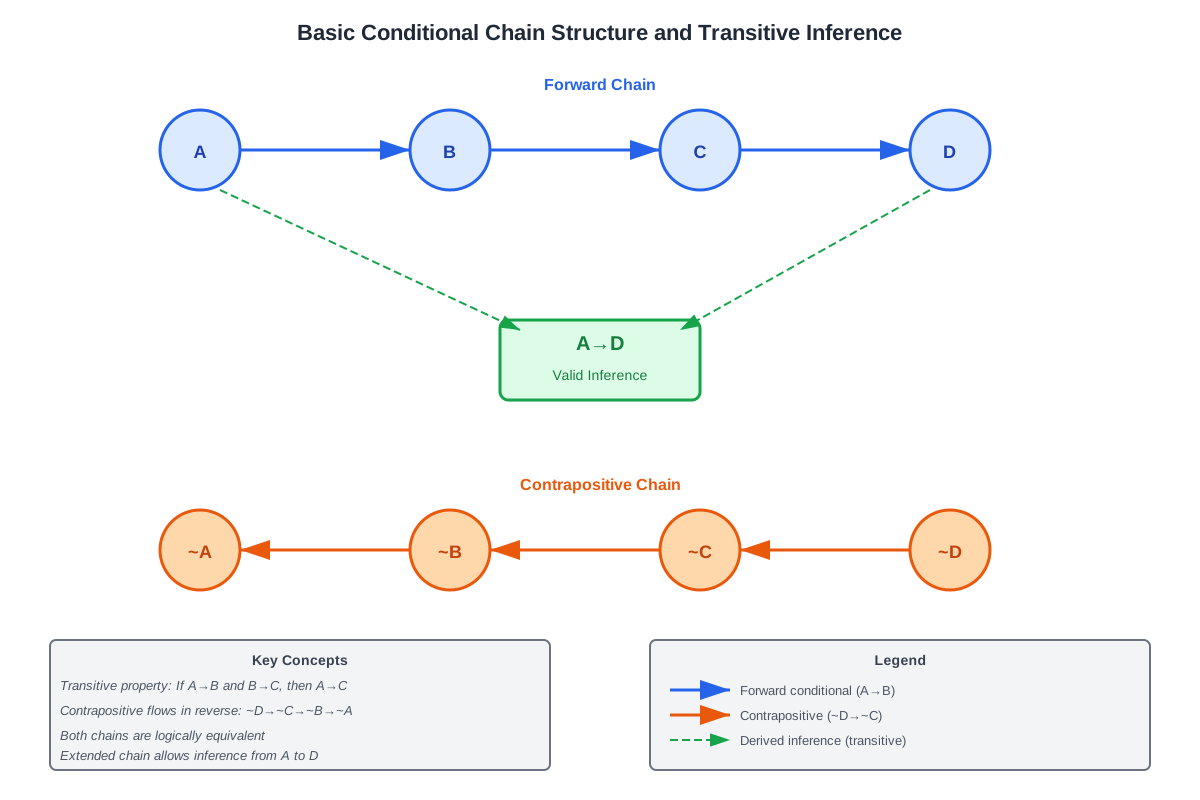
The contrapositive of any conditional statement is logically equivalent to the original and is formed by negating both terms and reversing the direction: A → B becomes ~B → ~A (if not B, then not A). This equivalence is fundamental to working with chains because valid inferences often require moving backward through a chain using contrapositives. For example, if we know A → B → C, we can also conclude ~C → ~B → ~A.
Building Conditional Chains
A conditional chain forms when the necessary condition of one statement matches the sufficient condition of another statement, allowing them to be linked. For example:
- Statement 1: If someone studies diligently (D), they will understand the material (U): D → U
- Statement 2: If someone understands the material (U), they will pass the exam (P): U → P
- Chain: D → U → P (If someone studies diligently, they will pass the exam)
The key principle is that chains connect through matching terms: the consequent (necessary condition) of one statement must match the antecedent (sufficient condition) of the next. This creates a transitive relationship where the sufficient condition of the first statement guarantees the necessary condition of the last statement.
Valid Chain Inferences
From a conditional chain A → B → C → D, several types of valid inferences can be drawn:
- Direct forward inferences: If A occurs, then D must occur (following the chain forward)
- Contrapositive chain inferences: If D does not occur, then A cannot occur (~D → ~C → ~B → ~A)
- Partial chain inferences: If B occurs, then D must occur (entering the chain at any point and following forward)
- Negative partial inferences: If C does not occur, then A and B cannot occur (using the contrapositive from any point backward)
What cannot be validly inferred from A → B → C → D:
- Reverse inferences without negation: If D occurs, we cannot conclude anything definite about A, B, or C (the chain only works forward or backward with negation)
- Affirming the necessary: If B occurs, we cannot conclude that A occurred (B might occur for other reasons)
- Denying the sufficient: If A does not occur, we cannot conclude anything about B, C, or D (they might still occur for other reasons)
Complex Chain Structures
LSAT questions often present more sophisticated chain structures:
Branching chains occur when one condition leads to multiple consequences or when multiple conditions lead to the same consequence:
     → B → D
A →
     → C → E
From this structure, we can infer A → D and A → E, but we cannot determine any relationship between B and C or between D and E.
Converging chains occur when multiple independent sufficient conditions lead to the same necessary condition:
A →
     C → D
B →
Here, either A or B is sufficient for D (through C), but D does not tell us whether A or B occurred.
Circular chains appear when conditions form a loop (A → B → C → A), which means all conditions are logically equivalent—if any one occurs, all must occur, and if any one fails to occur, none can occur.
Linguistic Variations
The LSAT expresses conditional relationships through diverse language patterns that must all be recognized and diagrammed correctly:
| Linguistic Form | Example | Diagram |
|---|---|---|
| If...then | If it rains, the game is cancelled | R → C |
| Only if | The game occurs only if it doesn't rain | G → ~R |
| Unless | The game is cancelled unless it's sunny | ~S → C (or G → S) |
| Requires/Needs | Winning requires practice | W → P |
| Depends on | Success depends on effort | S → E |
| Without | Without water, plants die | ~W → D |
| All/Every | All members must pay dues | M → D |
The most commonly confused construction is "only if," which reverses the intuitive direction: "A only if B" means A → B (not B → A). Similarly, "unless" statements require careful translation: "A unless B" typically means ~B → A, which is equivalent to ~A → B.
Chain Diagramming Strategy
Effective chain diagramming follows a systematic process:
- Identify all conditional statements in the stimulus, marking sufficient and necessary conditions
- Translate each statement into arrow notation, being especially careful with "only if," "unless," and negative terms
- Look for matching terms where the necessary condition of one statement matches the sufficient condition of another
- Connect matching terms to form chains, drawing a single continuous arrow path
- Write the contrapositive chain below the original chain for reference
- Identify all valid inferences that can be drawn from the complete chain structure
For complex stimuli with multiple chains, create separate diagrams for each independent chain and note any terms that appear in multiple chains, as these may allow cross-chain inferences.
Concept Relationships
The concepts within conditional chain reasoning build upon each other in a hierarchical structure. Basic conditional statements form the foundation, as chains cannot exist without understanding individual if-then relationships. Contrapositive reasoning extends this foundation by providing the logical equivalent that enables backward movement through chains. These two concepts combine to create simple two-statement chains, which demonstrate the transitive property of conditional logic.
Complex chain structures (branching, converging, circular) represent advanced applications that require mastery of simple chains plus the ability to track multiple pathways simultaneously. Linguistic variations cut across all levels, as any conditional statement—simple or within a chain—can be expressed through diverse language patterns. Finally, valid versus invalid inferences represents the synthesis of all other concepts, requiring test-takers to apply their understanding of chain structure, contrapositive reasoning, and logical rules to evaluate specific conclusions.
The relationship to prerequisite topics is direct: basic conditional logic provides the building blocks (individual statements), contrapositive formation provides the tool for bidirectional reasoning, and logical notation provides the language for efficient analysis. Conditional chains also connect forward to related topics like formal logic with quantifiers (where chains may include "some" or "most" statements), assumption questions (where missing links in chains must be identified), and parallel reasoning questions (where chain structures must be matched across different content).
The conceptual flow can be mapped as: Individual Conditionals → Contrapositive Mastery → Simple Chains (A → B → C) → Complex Structures (branching/converging) → Linguistic Recognition → Valid Inference Evaluation → Timed Application on LSAT Questions.
High-Yield Facts
⭐ A conditional chain A → B → C allows the valid inference A → C, but does NOT allow the inference C → A without negation
⭐ The contrapositive of a chain reverses the entire sequence and negates all terms: A → B → C becomes ~C → ~B → ~A
⭐ "Only if" reverses the intuitive direction: "A only if B" means A → B (B is necessary for A)
⭐ Chains connect when the necessary condition (consequent) of one statement matches the sufficient condition (antecedent) of another
⭐ From a conditional chain, you can never make a definite conclusion by affirming the necessary condition or denying the sufficient condition
- "Unless" statements translate to: "A unless B" means ~B → A (which is logically equivalent to ~A → B)
- In branching chains where A leads to both B and C, knowing A tells you both B and C occur, but knowing B or C individually tells you nothing definite about the other
- Circular chains (A → B → C → A) mean all conditions are logically equivalent—they all occur together or none occur
- Multiple sufficient conditions leading to the same necessary condition (A → C and B → C) means either A or B is enough for C, but C doesn't tell you which occurred
- When a chain includes negative terms (~A → B → ~C), the contrapositive must negate the negatives: C → ~B → A
- The LSAT frequently includes answer choices that commit the "affirming the consequent" fallacy (concluding A from B in an A → B relationship)
- Conditional chains can extend through any number of links, and the transitive property holds regardless of chain length
Quick check — test yourself on Inference with conditional chains so far.
Try Flashcards →Common Misconceptions
Misconception: If A → B → C, and C is true, then A must be true.
Correction: Conditional chains only allow forward inferences (from sufficient to necessary) or backward inferences with negation (contrapositive). Knowing C is true tells us nothing definite about A or B because other factors might have caused C. Only if C is false can we conclude something definite (that A and B are also false).
Misconception: "A only if B" means the same as "If A, then B" and "If B, then A."
Correction: "A only if B" means only one thing: A → B (if A, then B). It does NOT mean B → A. The word "only" indicates that B is necessary for A, not that B is sufficient for A. This is one of the most commonly tested linguistic traps on the LSAT.
Misconception: In a chain A → B → C, if B is true, then A must be true.
Correction: This commits the "affirming the consequent" fallacy. B is necessary for A, but not sufficient for A. B might occur for reasons unrelated to A. You can only make backward inferences through a chain when using negation (the contrapositive).
Misconception: If two conditional statements share a common term, they can always be chained together.
Correction: Statements can only be chained when the necessary condition of one matches the sufficient condition of another. If both statements have the same term as their sufficient condition (A → B and A → C) or both have it as their necessary condition (B → A and C → A), they cannot be directly chained, though they do create branching or converging structures.
Misconception: "Unless" means "if," so "A unless B" translates to "If A, then B."
Correction: "Unless" introduces a necessary condition for the negative. "A unless B" means "If not B, then A" (~B → A), which is equivalent to "If not A, then B" (~A → B). This is not the same as "If A, then B." The LSAT frequently exploits confusion about "unless" statements.
Misconception: In a conditional chain, if the sufficient condition doesn't occur, then the necessary condition cannot occur.
Correction: This commits the "denying the antecedent" fallacy. If A → B → C and A doesn't occur, we cannot conclude anything about B or C. They might still occur for other reasons. The chain only tells us what must happen when A does occur, not what happens when A doesn't occur.
Misconception: Longer chains are always more restrictive and allow more inferences than shorter chains.
Correction: While longer chains do create more intermediate connections, they don't necessarily allow more useful inferences. A chain A → B → C → D → E allows the same basic types of inferences as A → B (forward inference and contrapositive), just with more steps. The complexity comes from tracking the steps correctly, not from having fundamentally more inferential power.
Worked Examples
Example 1: Classic Chain with Contrapositive Application
Stimulus: "All students who complete the advanced seminar receive honors. Everyone who receives honors is invited to the conference. Only those invited to the conference may present research. Maria did not present research."
Step 1 - Identify and diagram each conditional statement:
- "All students who complete the advanced seminar receive honors": Complete Seminar (CS) → Honors (H)
- "Everyone who receives honors is invited to the conference": H → Invited to Conference (IC)
- "Only those invited to the conference may present research": Present Research (PR) → IC (remember: "only" reverses direction)
- "Maria did not present research": ~PR
Step 2 - Connect the chain:
CS → H → IC ← PR
Wait—this doesn't form a single chain because PR → IC doesn't connect forward. Let me reconsider: PR → IC means if you present research, you must be invited. This actually fits: CS → H → IC, and separately, PR → IC.
Actually, the chain should be: CS → H → IC, and PR → IC tells us that IC is necessary for PR.
Step 3 - Rewrite for clarity:
- Forward chain: CS → H → IC
- Additional statement: PR → IC
- Given fact: ~PR (Maria did not present research)
Step 4 - Apply contrapositive reasoning:
Since PR → IC, the contrapositive is ~IC → ~PR. But we're told ~PR, which doesn't allow us to conclude anything about IC (that would be affirming the consequent).
However, we can work with the full chain. The contrapositive of CS → H → IC is ~IC → ~H → ~CS.
Step 5 - What can we conclude about Maria?
We know ~PR. From PR → IC, we cannot conclude anything definite about whether Maria was invited to the conference (she might have been invited but chose not to present, or she might not have been invited).
If we knew ~IC (not invited), we could use ~IC → ~H → ~CS to conclude Maria didn't complete the seminar and didn't receive honors. But we don't know ~IC for certain.
Valid inference: We cannot definitively conclude whether Maria completed the seminar, received honors, or was invited to the conference based solely on knowing she didn't present research. The chain doesn't allow backward inference without negating the necessary condition.
Invalid inference: "Maria did not complete the advanced seminar" (this would require knowing ~IC, which we don't)
Example 2: Complex Branching Chain
Stimulus: "If the legislation passes, then either the budget increases or new taxes are imposed. If the budget increases, social programs expand. If new taxes are imposed, economic growth slows. The legislation passed."
Step 1 - Diagram the statements:
- "If the legislation passes, then either the budget increases or new taxes are imposed": Legislation Passes (LP) → (Budget Increases (BI) OR New Taxes (NT))
- "If the budget increases, social programs expand": BI → Social Programs Expand (SPE)
- "If new taxes are imposed, economic growth slows": NT → Economic Growth Slows (EGS)
- "The legislation passed": LP
Step 2 - Map the branching structure:
         → BI → SPE
LP →  OR
         → NT → EGS
Step 3 - Apply the given information:
We know LP is true. From LP → (BI OR NT), we can conclude that at least one of BI or NT must be true (possibly both).
Step 4 - Evaluate possible conclusions:
Must be true: At least one of the following is true: either social programs expand OR economic growth slows (or both). This follows necessarily because LP guarantees (BI OR NT), and BI guarantees SPE while NT guarantees EGS.
Could be true but not certain:
- Both social programs expand AND economic growth slows (if both BI and NT occur)
- Social programs expand but economic growth doesn't slow (if only BI occurs)
- Economic growth slows but social programs don't expand (if only NT occurs)
Cannot be determined: Whether BI or NT (or both) actually occurred—we only know at least one did.
Must be false: Neither social programs expand NOR economic growth slows. This is impossible because LP guarantees at least one branch occurs.
Valid inference for an LSAT question: "Either social programs expand or economic growth slows" is a must-be-true inference. An answer choice stating "Both the budget increases and new taxes are imposed" would be incorrect because the "or" in the original statement doesn't require both to occur.
Exam Strategy
When approaching inference questions involving conditional chains on the LSAT, follow this systematic process:
Recognition triggers: Watch for these phrases that signal conditional chain questions:
- Multiple "if-then" statements in a single stimulus
- Language like "only if," "unless," "requires," "depends on," "without," appearing multiple times
- Statements that build upon each other sequentially
- Question stems asking "Which one of the following must be true?" or "Which one of the following can be properly inferred?"
Immediate action steps:
- Diagram immediately (15-20 seconds): Don't try to hold complex chains in your head. Write out each conditional using arrow notation as you read.
- Look for matching terms: Scan your diagrams for terms that appear as both a necessary condition in one statement and a sufficient condition in another.
- Draw the complete chain: Connect all linkable statements into a single chain or identify multiple independent chains.
- Write the contrapositive: Quickly write the contrapositive chain below your original diagram.
Answer choice evaluation strategy:
- Test each answer choice against your diagram: Don't rely on intuition; trace through the chain for each option.
- Eliminate choices that go backward without negation: Any answer that concludes a sufficient condition from a necessary condition without negation is wrong.
- Eliminate choices that deny the sufficient or affirm the necessary: These are classic fallacies that appear in wrong answers.
- Look for partial chain inferences: Correct answers often involve entering the chain at an intermediate point or using the contrapositive from a middle term.
- Be suspicious of extreme language: Words like "always," "never," "only," or "must" in answer choices require very strong support from the chain.
Time management:
- Allocate 1:30-2:00 minutes for conditional chain questions (slightly more than average)
- Spend 20-30 seconds diagramming upfront—this investment saves time and prevents errors
- If you can't connect statements into a chain after 30 seconds, move on and return if time permits
- Don't second-guess clear diagram-based conclusions; trust your notation
Common trap patterns to avoid:
- Reverse inference trap: Answer choices that state "If C, then A" when the chain is A → B → C
- Partial reversal trap: Statements like "If B, then A" in an A → B → C chain (affirming the consequent)
- Unnecessary complexity: Answer choices that introduce new terms or relationships not present in the stimulus
- "Could be true" disguised as "must be true": Statements that are possible but not necessary given the chain
Pro tip: On difficult conditional chain questions, if you can eliminate three answers quickly using basic fallacy recognition (reverse inference, affirming consequent, denying antecedent), you can make an educated guess between the remaining two even if you're not certain about the complete chain structure.
Memory Techniques
Mnemonic for valid inference types - "FORWARD or CONTRA-BACK":
- FORWARD: Follow the chain forward from any sufficient condition to its necessary conditions
- CONTRA-BACK: Use the contrapositive to go backward through the chain with negation
Visualization for "only if" - The ONLY Gate:
Picture "only if" as a gate that ONLY opens one way. "A only if B" means A can only happen if B is present—B is the gatekeeper for A. This reinforces that A → B (A requires B), not B → A.
Acronym for common conditional indicators - "IRON RULES":
- If...then (standard form: If A, then B = A → B)
- Requires (A requires B = A → B)
- Only if (A only if B = A → B, B is necessary)
- Needs (A needs B = A → B)
- Relies on (A relies on B = A → B)
- Unless (A unless B = ~B → A)
- Lacks/without (Without A, B = ~A → B)
- Every/All (All A are B = A → B)
- Sufficient (A is sufficient for B = A → B)
Chain connection memory device - "Match the Middle":
Chains connect when you "match the middle"—the necessary condition (end/middle) of one statement matches the sufficient condition (beginning/middle) of the next. Visualize puzzle pieces that only fit when the shapes match.
Contrapositive formation - "Flip and Nip":
- Flip: Reverse the arrow direction
- Nip: Negate both terms (add or remove the "not")
Example: A → B becomes ~B → ~A (flip the arrow, nip both terms)
Fallacy avoidance - "Never Go Back Without Black":
You can never go backward through a chain (from necessary to sufficient) without "black"—the negation symbol (~). This reminds you that reverse inferences require contrapositive reasoning.
Summary
Inference with conditional chains represents a critical high-yield topic for LSAT Logical Reasoning, testing the ability to connect multiple if-then statements and derive valid conclusions. The core principle is transitive reasoning: when conditional statements link together (A → B → C), valid inferences can be drawn by following the chain forward or by using the contrapositive to reason backward with negation. Success requires recognizing diverse linguistic expressions of conditional relationships (especially "only if" and "unless"), accurately diagramming chain structures, and distinguishing valid inferences from common fallacies like affirming the consequent or denying the antecedent. The LSAT tests this skill through Must Be True questions, Cannot Be True questions, and inference questions, often presenting complex branching or converging chain structures. Mastery demands systematic diagramming, careful attention to the direction of conditional relationships, and disciplined application of logical rules. Students who can quickly visualize chains, apply contrapositive reasoning, and eliminate fallacious answer choices gain significant advantages on test day, as these questions frequently separate high scorers from average performers.
Key Takeaways
- Conditional chains connect when the necessary condition of one statement matches the sufficient condition of another, allowing transitive inferences through the chain
- Valid inferences from chains move forward (sufficient to necessary) or backward with negation (contrapositive); reverse inferences without negation are always invalid
- "Only if" reverses intuitive direction: "A only if B" means A → B (B is necessary for A), not B → A
- The contrapositive of a chain reverses the entire sequence and negates all terms: A → B → C becomes ~C → ~B → ~A
- Systematic diagramming using arrow notation is essential for complex chains; attempting to track chains mentally leads to errors under time pressure
- Common wrong answers exploit fallacies: affirming the consequent (concluding A from B in A → B), denying the antecedent (concluding ~B from ~A), and reverse inferences without negation
- Branching and converging chain structures require careful analysis of what can be definitively concluded versus what remains uncertain
Related Topics
Formal Logic with Quantifiers: Extends conditional chain reasoning by incorporating "some," "most," and "all" statements, requiring understanding of how quantified statements interact with conditional chains and what inferences remain valid when certainty is reduced.
Sufficient and Necessary Assumptions: Builds on conditional chain knowledge by identifying missing links in arguments—the unstated conditional statements needed to complete a chain and make a conclusion valid.
Parallel Reasoning with Conditional Structures: Applies chain recognition skills to matching argument structures across different content domains, requiring identification of identical conditional patterns regardless of subject matter.
Contrapositive and Negation in Complex Arguments: Deepens understanding of how negation works in conditional statements, especially when dealing with compound conditions, "and/or" statements, and multiple negations within chains.
Formal Logic Diagramming Techniques: Expands diagramming skills beyond basic chains to include advanced notation systems for complex logical relationships, quantifiers, and multi-layered argument structures.
Practice CTA
Now that you've mastered the core concepts of inference with conditional chains, it's time to put your knowledge into practice. Work through the practice questions systematically, diagramming each chain before evaluating answer choices. Use the flashcards to reinforce recognition of linguistic variations and common fallacy patterns. Remember: conditional chain questions reward systematic, disciplined analysis over intuitive reasoning. The more you practice diagramming and applying the rules, the faster and more accurate you'll become. These questions are highly learnable—consistent practice with proper technique will translate directly into points on test day. You've got this!
Sign up free to keep reading
Create a free AnvayaPrep account to finish this LSAT guide on Inference with conditional chains — plus flashcards and practice questions.