Overview
Inference with multiple speakers represents a critical question type within LSAT Logical Reasoning sections that tests the ability to draw valid conclusions from dialogue or debate between two or more individuals. Unlike single-passage inference questions, these problems require synthesizing information from multiple perspectives, identifying points of agreement or disagreement, and determining what must be true based on the combined statements of all speakers. This question format appears regularly on the LSAT and demands careful attention to what each speaker explicitly states, what they commit themselves to, and what logical relationships exist between their positions.
The LSAT frequently presents these questions as dialogues between two speakers—often named individuals like "Alex" and "Jordan"—who discuss a particular issue, present arguments, or respond to each other's claims. The test-taker must navigate the logical terrain created by both speakers' contributions, avoiding the trap of focusing on only one speaker's position while missing crucial information from the other. Success requires identifying the logical commitments each speaker makes and determining what conclusions necessarily follow from the combination of their statements.
This topic connects fundamentally to broader inference questions skills in Logical Reasoning, including the ability to distinguish between what is stated and what is implied, recognize logical relationships, and avoid unwarranted assumptions. Multiple-speaker inferences also relate closely to Point at Issue questions, Method of Reasoning questions, and Principle questions, as they all require careful analysis of argumentative structure and logical relationships. Mastering this topic strengthens overall analytical reading skills essential for achieving a competitive LSAT score.
Learning Objectives
- [ ] Identify how Inference with multiple speakers appears in LSAT questions
- [ ] Explain the reasoning pattern behind Inference with multiple speakers
- [ ] Apply Inference with multiple speakers to solve LSAT-style problems accurately
- [ ] Distinguish between what each speaker explicitly commits to versus what they leave open
- [ ] Recognize common patterns of agreement and disagreement between speakers
- [ ] Evaluate answer choices by testing them against both speakers' statements simultaneously
- [ ] Identify when speakers are addressing the same issue versus talking past each other
Prerequisites
- Basic inference skills: Understanding how to draw valid conclusions from stated premises is essential, as multiple-speaker questions build upon this foundational skill by adding complexity through multiple perspectives.
- Argument structure recognition: Familiarity with identifying premises, conclusions, and logical relationships enables students to parse each speaker's position accurately before synthesizing them.
- Conditional reasoning: Many multiple-speaker dialogues involve conditional statements, and recognizing these structures helps identify what each speaker commits to logically.
- Distinction between necessary and sufficient conditions: This understanding prevents students from drawing conclusions that go beyond what the speakers' statements actually support.
Why This Topic Matters
Multiple-speaker inference questions appear with high frequency on the LSAT, typically comprising 2-4 questions per Logical Reasoning section. These questions test critical thinking skills that extend far beyond standardized testing into legal practice, where attorneys must synthesize multiple perspectives, identify areas of agreement and disagreement, and draw valid conclusions from complex dialogues. The ability to track multiple viewpoints simultaneously while maintaining logical precision mirrors the analytical demands of reading case law, evaluating witness testimony, and constructing legal arguments.
On the LSAT, these questions commonly appear in several formats: "Which one of the following can be properly inferred from the dialogue above?", "The dialogue provides the most support for which one of the following?", or "The statements above, if true, most strongly support which one of the following?" The test-makers favor this question type because it efficiently assesses multiple competencies simultaneously—reading comprehension, logical reasoning, and the ability to synthesize information from multiple sources.
Understanding this topic matters practically because it represents one of the most predictable question types on the LSAT. Once students master the systematic approach to analyzing multiple-speaker dialogues, they can consistently earn points on these questions, which often prove more straightforward than complex single-passage arguments. The skills developed here also transfer directly to Reading Comprehension passages that present multiple viewpoints and to the comparative reading passages that appear in every LSAT.
Core Concepts
The Structure of Multiple-Speaker Dialogues
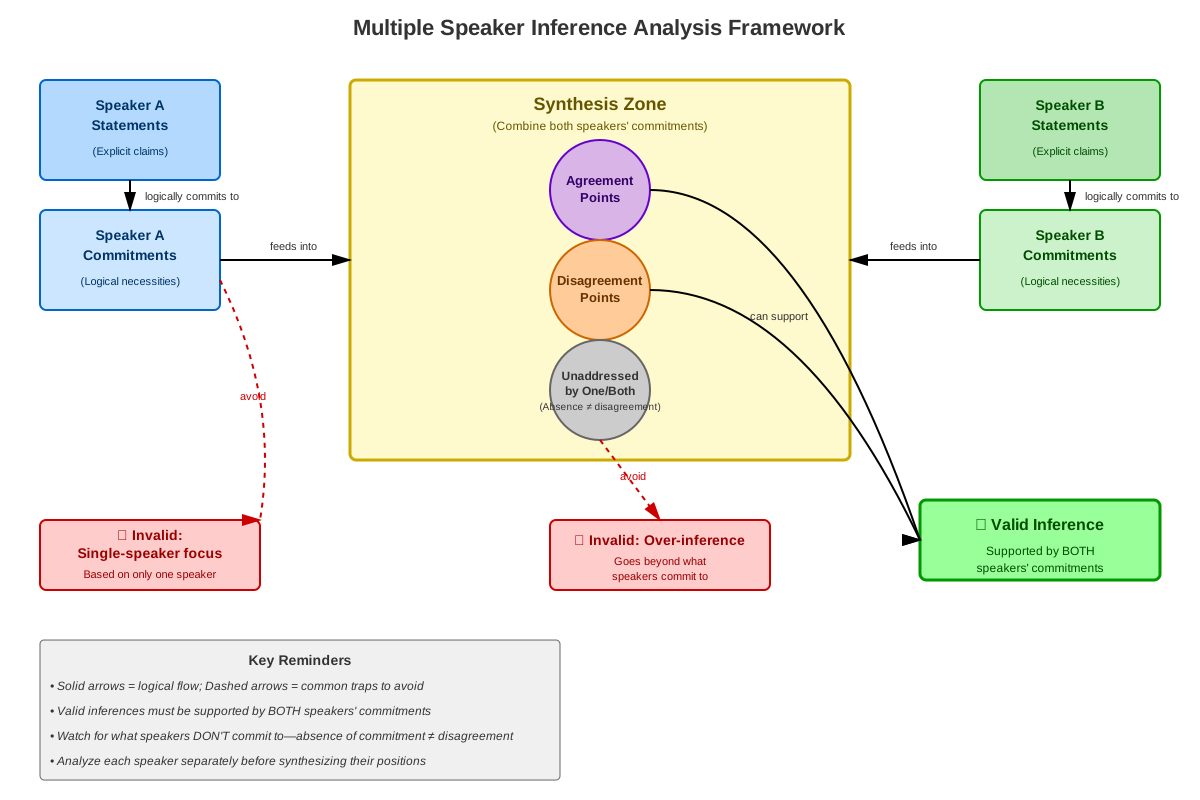
Inference with multiple speakers questions present a dialogue format where two or more individuals make statements about a topic. Each speaker's contribution represents a set of logical commitments—claims they endorse and positions they adopt. The fundamental task involves determining what must be true given the combination of all speakers' statements. Unlike Point at Issue questions that ask what speakers disagree about, pure inference questions ask what follows logically from their combined statements.
The typical structure includes:
- Speaker A makes an initial statement or argument
- Speaker B responds, either agreeing, disagreeing, or adding information
- The question stem asks what can be inferred from the dialogue
- Answer choices present potential conclusions, only one of which must be true
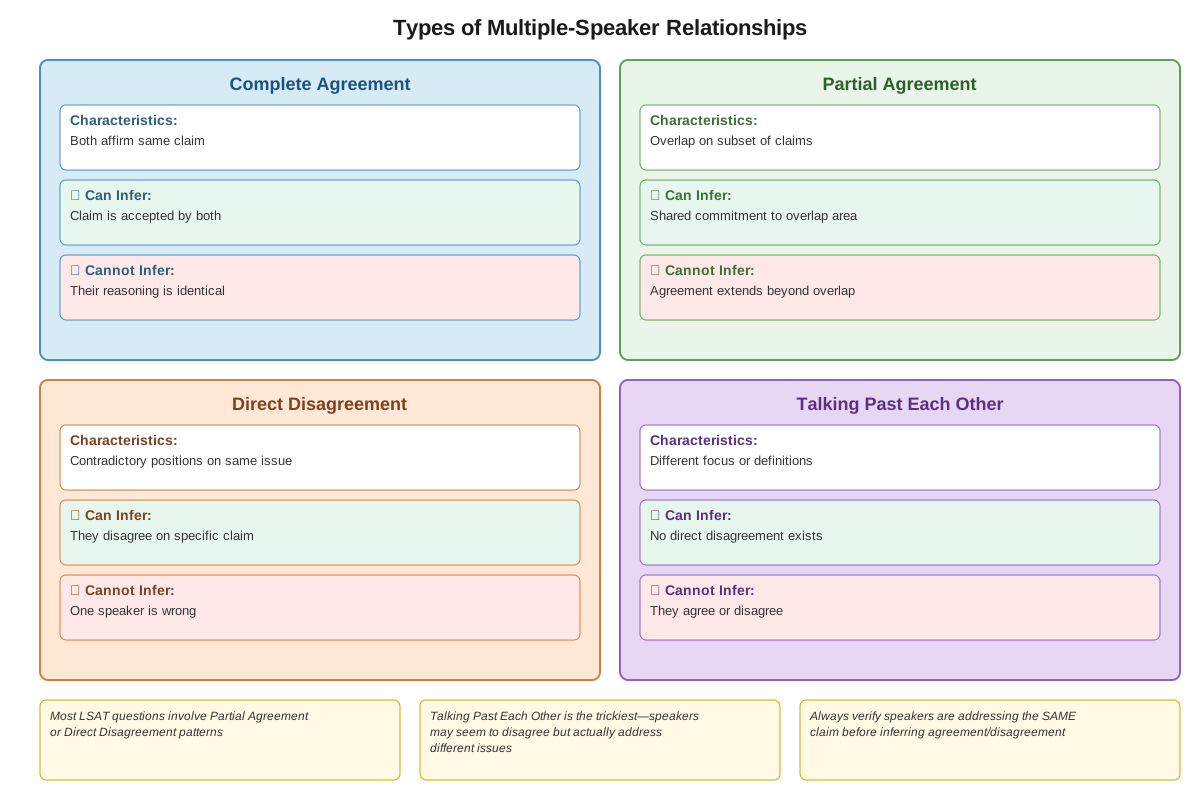
Types of Logical Relationships Between Speakers
Multiple-speaker dialogues create several distinct logical relationships that test-takers must recognize:
| Relationship Type | Description | Inference Implications |
|---|---|---|
| Complete Agreement | Both speakers endorse the same claim | The agreed-upon claim can be inferred with certainty |
| Partial Agreement | Speakers agree on some points but not others | Only the shared commitments support valid inferences |
| Direct Disagreement | Speakers take opposing positions on the same claim | At least one speaker must be incorrect (though both could be) |
| Independent Claims | Speakers address related but distinct points | Inferences may combine both perspectives without conflict |
| Conditional Relationships | One speaker's claim triggers or relates to another's | Valid inferences follow conditional logic rules |
Identifying Each Speaker's Commitments
A critical skill involves determining precisely what each speaker commits to through their statements. Speakers commit to:
- Explicit claims: Statements directly asserted ("The policy will reduce costs")
- Logical implications: Conclusions that necessarily follow from their statements
- Presuppositions: Assumptions required for their argument to make sense
- Conditional commitments: If-then relationships they endorse
Speakers do NOT commit to:
- Statements they merely consider without endorsing
- Positions they attribute to others without agreeing
- Implications that could be true but don't necessarily follow
- Extreme versions of moderate claims they make
The Synthesis Process
Solving multiple-speaker inference questions requires a systematic synthesis process:
- Read Speaker A's statement carefully: Identify all explicit claims and immediate logical implications
- Read Speaker B's statement carefully: Determine whether B agrees, disagrees, or adds independent information
- Identify the logical relationship: Determine how the speakers' positions relate to each other
- Consider combined implications: What must be true if both speakers' statements are accurate?
- Evaluate answer choices: Test each against both speakers' commitments
Common Patterns in Multiple-Speaker Inferences
The LSAT employs recurring patterns in these questions:
Pattern 1: Shared Premise, Different Conclusions
- Both speakers accept the same factual premise
- Each draws different conclusions from that premise
- Valid inferences include the shared premise and what follows from both conclusions
Pattern 2: Complementary Information
- Speaker A provides one piece of information
- Speaker B provides a different, compatible piece
- Valid inferences combine both pieces of information
Pattern 3: Conditional Chain
- Speaker A establishes a conditional relationship (If X, then Y)
- Speaker B establishes another conditional (If Y, then Z)
- Valid inferences include the chained relationship (If X, then Z)
Pattern 4: Qualification or Limitation
- Speaker A makes a broad claim
- Speaker B accepts the claim but adds a qualification or exception
- Valid inferences must respect the qualification
Avoiding Common Traps
Multiple-speaker questions include predictable wrong answer types:
- Single-speaker inferences: Conclusions that follow from only one speaker's statement but ignore the other
- Overgeneralizations: Taking a limited claim and extending it beyond what's supported
- Reversed conditionals: Confusing sufficient and necessary conditions from speakers' statements
- Assumed disagreements: Inferring conflict where speakers address different aspects of an issue
- Extreme language: Answer choices using "always," "never," or "only" when speakers made moderate claims
Concept Relationships
The core concepts within multiple-speaker inference questions form an interconnected analytical framework. The structure of multiple-speaker dialogues provides the foundation upon which all other concepts build. Understanding this structure enables recognition of types of logical relationships between speakers, which determines the appropriate analytical approach. These relationships directly influence how to identify each speaker's commitments, as the nature of the relationship (agreement, disagreement, or independence) affects what each speaker logically endorses.
The process of identifying commitments feeds into the synthesis process, where individual positions combine to generate valid inferences. This synthesis must account for common patterns that appear repeatedly on the LSAT, allowing efficient recognition and solution of familiar question structures. Throughout this analytical chain, awareness of common traps prevents errors by highlighting what NOT to infer.
This topic connects to prerequisite knowledge of basic inference skills by adding the complexity of multiple perspectives. The conditional reasoning prerequisite becomes particularly relevant when speakers make if-then statements that must be combined. The topic also relates forward to Point at Issue questions (which ask what speakers disagree about rather than what can be inferred) and to Method of Reasoning questions (which may ask how one speaker responds to another). Mastering multiple-speaker inferences strengthens the broader skill of tracking complex logical relationships across extended passages.
High-Yield Facts
⭐ Multiple-speaker inference questions ask what must be true given ALL speakers' statements combined, not what any single speaker believes.
⭐ A valid inference must be consistent with every speaker's statements; if it contradicts even one speaker, it cannot be correct.
⭐ Speakers only commit to what they explicitly state and what necessarily follows from their statements, not to possibilities they mention without endorsing.
⭐ When speakers agree on a claim, that claim can be inferred with certainty and often appears in correct answers.
⭐ The correct answer to a multiple-speaker inference question is often more moderate than the speakers' individual claims, representing only what both positions support.
- Multiple-speaker questions typically appear 2-4 times per Logical Reasoning section, making them high-frequency question types.
- Wrong answers frequently present conclusions that follow from only one speaker's statement while ignoring the other speaker's contribution.
- When speakers make conditional statements, valid inferences may involve chaining those conditionals together or applying one speaker's sufficient condition to another's necessary condition.
- If speakers disagree about a factual claim, the inference cannot assume either speaker is correct unless additional information establishes which position is accurate.
- Answer choices using extreme language ("always," "never," "impossible," "certainly") are rarely correct unless both speakers use similarly extreme language.
- The dialogue format does not require speakers to directly respond to each other; they may make independent claims about related topics.
- Correct inferences often identify what both speakers would accept as true, even if they disagree about other matters.
Common Misconceptions
Misconception: If two speakers disagree, the correct inference must identify their point of disagreement.
Correction: Multiple-speaker inference questions ask what can be concluded from the dialogue, not what speakers disagree about. The correct answer might identify a point of agreement, a logical consequence of their combined statements, or what must be true regardless of their disagreement. Point of disagreement questions are a separate question type with different question stems.
Misconception: Whatever Speaker B says in response to Speaker A represents a direct rebuttal or disagreement.
Correction: Speaker B may agree with Speaker A while adding information, may address a different aspect of the issue, or may provide complementary information without disagreeing. The logical relationship must be determined from the content of the statements, not assumed from the dialogue format.
Misconception: If a speaker doesn't explicitly reject a claim, they implicitly accept it.
Correction: Speakers only commit to positions they explicitly endorse or that necessarily follow from their statements. Silence or failure to address a claim does not constitute acceptance. The LSAT tests precise logical reasoning, not assumptions about what speakers might believe.
Misconception: The correct answer will always combine information from both speakers.
Correction: While many correct answers do synthesize both perspectives, some valid inferences follow from just one speaker's statement when that statement alone supports a definite conclusion. The key is that the inference must be consistent with (not contradicted by) all speakers' statements.
Misconception: Longer, more complex answer choices are more likely to be correct because they seem more sophisticated.
Correction: The LSAT often makes incorrect answers longer and more complex to appear authoritative while including subtle logical flaws. Correct answers are frequently more straightforward and directly supported by the speakers' statements. Evaluate based on logical validity, not length or complexity.
Quick check — test yourself on Inference with multiple speakers so far.
Try Flashcards →Worked Examples
Example 1: Complementary Information Pattern
Dialogue:
Keisha: The new traffic management system has reduced average commute times by 15% during peak hours. This improvement has been consistent across all major routes in the city.
Marcus: While commute times have decreased, the system has increased fuel consumption for the average driver by 8% because it routes vehicles through longer distances to avoid congestion.
Question: Which one of the following can be properly inferred from the dialogue?
Answer Choices:
(A) The traffic management system has been more beneficial than harmful overall.
(B) Drivers now spend less time commuting but use more fuel per trip than before the system was implemented.
(C) The system should be modified to reduce the increased fuel consumption.
(D) Keisha and Marcus disagree about whether the system has reduced commute times.
(E) The longer routes required by the system are the sole cause of increased fuel consumption.
Solution Process:
Step 1: Identify Keisha's commitments
- The system reduced average commute times by 15% during peak hours
- This improvement is consistent across all major routes
- Keisha commits to the factual claim about reduced commute times
Step 2: Identify Marcus's commitments
- Marcus explicitly agrees that commute times have decreased ("While commute times have decreased")
- The system has increased fuel consumption by 8%
- The increased fuel consumption results from longer routing distances
- Marcus does NOT claim this is the only cause, just that it's a cause
Step 3: Identify the logical relationship
- This is a complementary information pattern
- Both speakers agree commute times decreased
- Marcus adds new information about fuel consumption
- No disagreement exists between them
Step 4: Evaluate answer choices
(A) Incorrect: Neither speaker makes a value judgment about overall benefit versus harm. This requires weighing time savings against fuel costs, which neither speaker does.
(B) Correct: This directly combines both speakers' factual claims. Keisha establishes that drivers spend less time commuting (15% reduction). Marcus establishes that drivers use more fuel per trip (8% increase). Both claims can be true simultaneously, and the answer choice accurately reflects this combination without adding unsupported conclusions.
(C) Incorrect: Neither speaker recommends modifications. This is a normative claim (what should be done) that goes beyond the descriptive claims both speakers make.
(D) Incorrect: Marcus explicitly agrees with Keisha about reduced commute times ("While commute times have decreased"). They do not disagree on this point.
(E) Incorrect: Marcus states the longer routes are a cause ("because it routes vehicles through longer distances") but doesn't claim this is the sole cause. The word "sole" makes this too extreme.
Connection to Learning Objectives: This example demonstrates how to identify the complementary information pattern, recognize what each speaker commits to, and synthesize their statements into a valid inference without adding unsupported conclusions.
Example 2: Conditional Chain Pattern
Dialogue:
Dr. Patel: Any medication that effectively treats bacterial infections without significant side effects should be made widely available. The new antibiotic compound meets both criteria, as clinical trials show it eliminates infections in 94% of cases with only minor, temporary side effects reported.
Dr. Chen: I agree that medications meeting those criteria should be widely available. However, we must also consider that any antibiotic made widely available will inevitably lead to some degree of bacterial resistance developing over time.
Question: The statements above, if true, most strongly support which one of the following?
Answer Choices:
(A) The new antibiotic compound should not be made widely available.
(B) Dr. Chen disagrees with Dr. Patel about whether the new antibiotic should be widely available.
(C) Some degree of bacterial resistance to the new antibiotic compound will inevitably develop over time.
(D) The new antibiotic compound does not effectively treat bacterial infections.
(E) Bacterial resistance is a more important consideration than treatment effectiveness.
Solution Process:
Step 1: Identify Dr. Patel's commitments
- Conditional claim: If [treats infections effectively + no significant side effects] → [should be widely available]
- Factual claim: The new antibiotic meets both conditions
- Logical implication: The new antibiotic should be made widely available (modus ponens)
Step 2: Identify Dr. Chen's commitments
- Agreement with Patel's conditional principle
- Additional conditional: If [antibiotic widely available] → [bacterial resistance will develop]
- Dr. Chen does NOT say the antibiotic shouldn't be made available
Step 3: Identify the logical relationship
- This is a conditional chain pattern
- Both accept: [new antibiotic meets criteria] → [should be widely available]
- Dr. Chen adds: [widely available] → [resistance develops]
- Combined chain: [new antibiotic meets criteria] → [should be widely available] → [resistance develops]
Step 4: Evaluate answer choices
(A) Incorrect: Neither speaker concludes the antibiotic should not be made available. Dr. Chen raises a consideration but doesn't reject the conclusion that it should be available.
(B) Incorrect: Dr. Chen explicitly agrees with Dr. Patel's principle. He adds information about consequences but doesn't disagree about whether the antibiotic should be available.
(C) Correct: Following the conditional chain: Dr. Patel establishes the antibiotic should be widely available (because it meets the criteria). Dr. Chen establishes that if an antibiotic is widely available, resistance will develop. Therefore, resistance to this new antibiotic will inevitably develop. This validly combines both speakers' commitments through conditional reasoning.
(D) Incorrect: Dr. Patel explicitly states the antibiotic effectively treats infections (94% success rate). Neither speaker questions this effectiveness.
(E) Incorrect: Neither speaker makes a comparative value judgment about which consideration is more important. Dr. Chen raises resistance as an additional consideration but doesn't claim it outweighs effectiveness.
Connection to Learning Objectives: This example illustrates how to recognize conditional statements from each speaker, chain them together logically, and draw valid conclusions from the combined conditional relationships while avoiding the trap of assuming disagreement where none exists.
Exam Strategy
Approaching Multiple-Speaker Questions Systematically
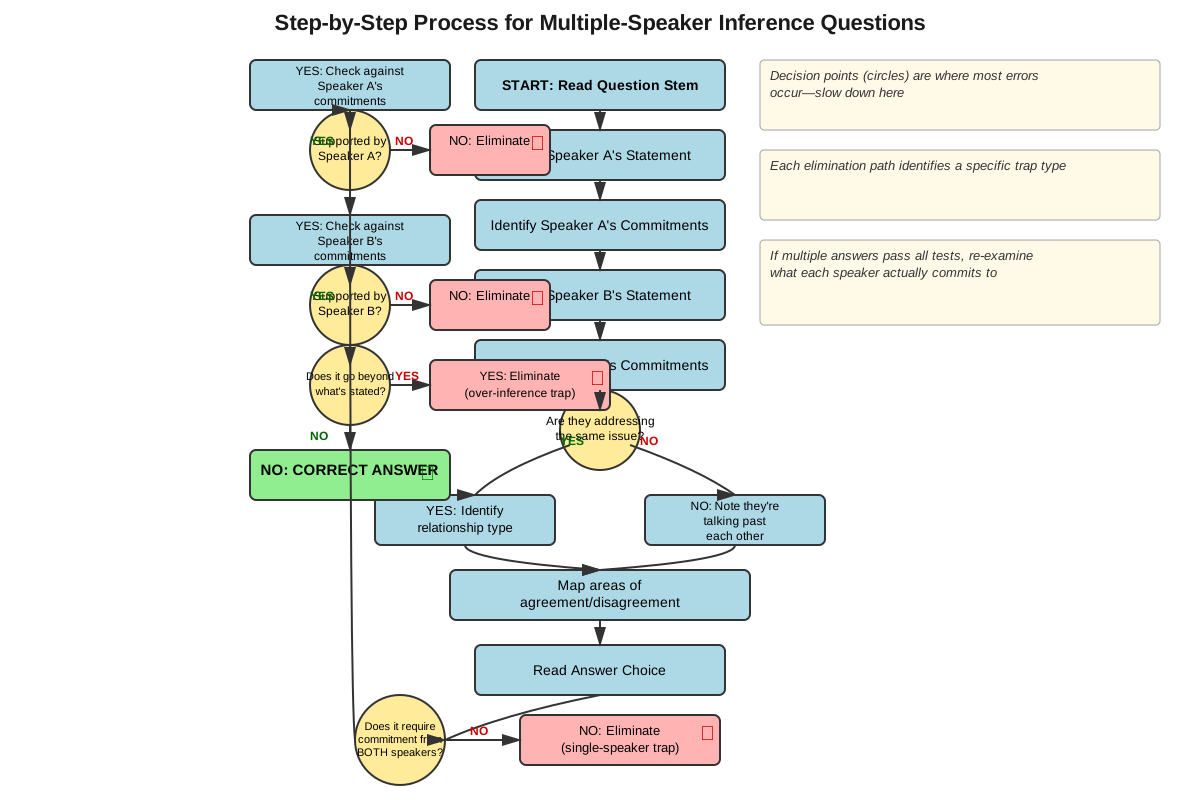
When encountering a multiple-speaker inference question, follow this strategic approach:
- Read the question stem first: Confirm it's asking for an inference ("can be properly inferred," "most strongly supported") rather than a point of disagreement or method of reasoning.
- Read Speaker A's statement actively: Underline or mentally note explicit claims and identify any conditional statements or strong logical commitments.
- Read Speaker B's statement with Speaker A in mind: Determine immediately whether B agrees, disagrees, or adds independent information. Note any explicit agreements ("I agree that...") or disagreements ("However...").
- Predict the relationship: Before looking at answer choices, mentally categorize the dialogue (complementary information, shared premise, conditional chain, etc.).
- Evaluate answer choices systematically: Test each choice against BOTH speakers' statements, eliminating any that contradict either speaker or go beyond what both support.
Trigger Words and Phrases
Agreement indicators (suggesting the correct answer may involve shared commitments):
- "I agree that..."
- "You're right that..."
- "That's true, but..."
- "While [accepting previous claim]..."
Conditional language (suggesting potential conditional chains):
- "If...then..."
- "Any...should/must/will..."
- "Whenever...always..."
- "Only if..."
Qualification markers (suggesting the inference must respect limitations):
- "However..."
- "But..."
- "Although..."
- "Except..."
- "Unless..."
Extreme language in answer choices (usually incorrect):
- "Always," "never," "impossible," "certainly," "only," "must"
- Exception: When speakers themselves use extreme language
Process of Elimination Tips
Eliminate answer choices that:
- Contradict either speaker: If an answer choice conflicts with what either speaker explicitly states, it cannot be correct.
- Require assumptions beyond the dialogue: Valid inferences follow necessarily from the statements; they don't require additional assumptions about unstated facts.
- Focus on only one speaker: While not always wrong, be suspicious of answers that ignore one speaker's contribution entirely.
- Make value judgments unsupported by the speakers: If speakers present facts but don't evaluate them, answers saying something "should" or "ought" to happen are likely incorrect.
- Use extreme language without support: Unless both speakers commit to extreme positions, moderate answer choices are more likely correct.
Time Allocation Advice
Exam Tip: Allocate approximately 1:20-1:30 for multiple-speaker inference questions. They typically require less time than complex single-passage arguments because the dialogue format makes the logical structure more transparent.
Spend time distribution:
- 20-30 seconds: Reading and analyzing the dialogue
- 10-15 seconds: Identifying the logical relationship
- 40-50 seconds: Evaluating answer choices
If stuck between two answer choices, test each against both speakers' statements systematically. The correct answer will be consistent with both; the incorrect answer will subtly contradict one speaker or require an unsupported assumption.
Memory Techniques
The BOTH Acronym
Remember that valid inferences must satisfy BOTH speakers:
- Both speakers' statements must support it
- Only what's stated or necessarily follows counts
- Test each answer against each speaker
- Heed qualifications and limitations
The Three C's of Speaker Commitments
Speakers commit to three types of claims:
- Claims they explicitly state
- Consequences that logically follow
- Conditions they endorse (if-then relationships)
They do NOT commit to:
- Considerations they mention without endorsing
- Conclusions they attribute to others
- Conjectures they raise as possibilities
Visualization Strategy: The Venn Diagram Approach
Mentally visualize two overlapping circles representing each speaker's commitments:
- Left circle: Everything Speaker A commits to
- Right circle: Everything Speaker B commits to
- Overlapping section: Shared commitments (often where correct answers lie)
- Outside both circles: Claims neither speaker supports (always incorrect)
The correct inference typically falls in the overlapping section or represents a logical consequence of combining information from both circles.
The "Would Both Accept?" Test
For each answer choice, ask: "Would both speakers accept this statement as true based on what they said?" If the answer is yes, it's likely correct. If either speaker would reject it or hasn't committed to it, eliminate it.
Summary
Multiple-speaker inference questions test the ability to synthesize information from dialogue between two or more individuals and draw valid conclusions from their combined statements. Success requires identifying what each speaker explicitly commits to, recognizing the logical relationship between their positions (agreement, disagreement, or complementary information), and determining what must be true given both speakers' statements. The key analytical skill involves avoiding single-speaker focus while ensuring the inference is consistent with all speakers' commitments. Common patterns include complementary information, conditional chains, and shared premises with different conclusions. Wrong answers typically contradict one speaker, focus on only one speaker's position, use extreme language unsupported by the dialogue, or require assumptions beyond what's stated. A systematic approach—reading each speaker carefully, identifying their commitments, recognizing the relationship pattern, and testing answer choices against both speakers—enables consistent success on these high-frequency LSAT questions.
Key Takeaways
- Valid inferences from multiple-speaker dialogues must be consistent with ALL speakers' statements, not just one speaker's position
- Identify what each speaker explicitly commits to versus what they merely consider or attribute to others
- Recognize common patterns: complementary information, conditional chains, shared premises, and qualifications
- The correct answer is often more moderate than individual speakers' claims, representing only what both positions support
- Eliminate answer choices that contradict either speaker, use extreme language without support, or require unsupported assumptions
- When speakers agree on a claim, that shared commitment frequently appears in or supports the correct answer
- Test each answer choice systematically against both speakers' statements using the "Would both accept?" criterion
Related Topics
Point at Issue Questions: While multiple-speaker inference questions ask what can be concluded from the dialogue, Point at Issue questions ask specifically what the speakers disagree about. Mastering inference questions provides the analytical foundation for identifying precise points of disagreement.
Method of Reasoning Questions with Multiple Speakers: These questions ask how one speaker responds to another (by analogy, by counterexample, by questioning an assumption, etc.). Understanding speaker commitments from inference questions transfers directly to analyzing argumentative methods.
Principle Questions with Application: Some principle questions present a dialogue and ask which principle the speakers' reasoning illustrates. The skill of identifying what speakers commit to applies directly to matching their reasoning with abstract principles.
Parallel Reasoning with Multiple Arguments: Just as multiple-speaker questions require tracking two perspectives simultaneously, parallel reasoning questions require comparing argument structures. The analytical discipline developed here strengthens parallel reasoning skills.
Practice CTA
Now that you've mastered the core concepts of inference with multiple speakers, it's time to apply these skills to actual LSAT-style questions. The practice questions and flashcards will reinforce your ability to identify speaker commitments, recognize logical relationships, and draw valid inferences from dialogues. Each practice question you complete strengthens your pattern recognition and builds the confidence needed to tackle these questions efficiently on test day. Remember: multiple-speaker inference questions are among the most predictable on the LSAT—consistent practice with the systematic approach outlined here will translate directly into points on your score. Start practicing now to cement these high-yield skills!
Sign up free to keep reading
Create a free AnvayaPrep account to finish this LSAT guide on Inference with multiple speakers — plus flashcards and practice questions.