Overview
Inference with rates represents a critical reasoning pattern that appears frequently on the LSAT Logical Reasoning section. This topic involves drawing valid conclusions from statements about rates, ratios, proportions, and comparative quantities. Unlike straightforward numerical calculations, LSAT questions testing this concept require test-takers to understand the logical relationships between rates and totals, percentages and absolute numbers, and comparative versus absolute changes. The challenge lies not in mathematical computation but in recognizing what can and cannot be validly inferred from rate-based information.
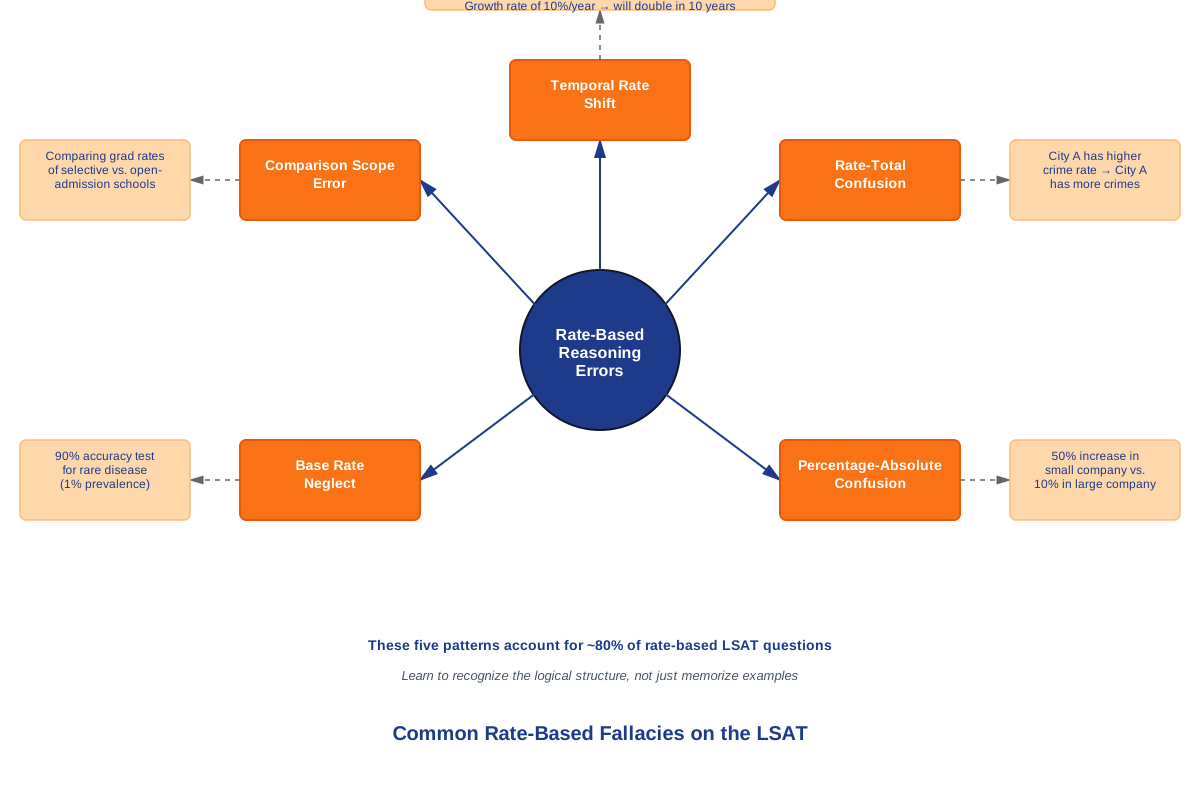
The LSAT tests logical reasoning skills by presenting arguments that confuse rates with totals, percentages with raw numbers, or relative changes with absolute magnitudes. A classic example involves an argument stating that "City A has a higher crime rate than City B" and concluding that "City A has more total crimes than City B"—a conclusion that fails to account for population differences. Mastering inference questions involving rates requires developing a systematic approach to distinguishing between what the premises actually support versus what seems intuitively plausible but lacks logical foundation.
This topic connects intimately with broader LSAT skills including Must Be True questions, Strengthen/Weaken questions involving statistical reasoning, and Flaw questions that exploit rate-based confusion. Understanding lsat inference with rates provides a foundation for analyzing quantitative reasoning throughout the exam, appearing in approximately 10-15% of Logical Reasoning questions and occasionally in Reading Comprehension passages discussing statistical studies or comparative data.
Learning Objectives
- [ ] Identify how Inference with rates appears in LSAT questions
- [ ] Explain the reasoning pattern behind Inference with rates
- [ ] Apply Inference with rates to solve LSAT-style problems accurately
- [ ] Distinguish between valid and invalid inferences involving rates versus totals
- [ ] Recognize common logical fallacies that exploit rate-based reasoning
- [ ] Evaluate arguments that shift between percentages, proportions, and absolute quantities
- [ ] Construct counterexamples to test the validity of rate-based inferences
Prerequisites
- Basic understanding of percentages and proportions: Essential for recognizing when arguments shift between relative and absolute quantities
- Familiarity with LSAT question types: Necessary to identify how rate-based reasoning appears across Must Be True, Strengthen/Weaken, and Flaw questions
- Fundamental logical reasoning skills: Required to evaluate whether conclusions follow necessarily from premises
- Understanding of sufficient versus necessary conditions: Helps distinguish between what must be true versus what could be true given rate information
Why This Topic Matters
Rate-based reasoning appears throughout professional and academic contexts, from interpreting medical studies and economic reports to evaluating policy proposals and business analytics. Legal professionals regularly encounter statistical evidence, epidemiological data, and comparative analyses where distinguishing valid from invalid rate-based inferences proves essential. The ability to critically evaluate such reasoning protects against manipulation through misleading statistics and supports sound decision-making based on quantitative evidence.
On the LSAT, inference with rates appears in approximately 3-5 questions per exam across both Logical Reasoning sections. These questions typically manifest as Must Be True questions requiring identification of valid inferences, Flaw questions exposing rate-based reasoning errors, or Strengthen/Weaken questions involving statistical evidence. The topic also appears in Parallel Reasoning questions where the logical structure involves rate comparisons, and occasionally in Reading Comprehension passages analyzing studies or comparative data.
Common manifestations include arguments about crime statistics (rates versus totals), health outcomes (risk factors versus absolute cases), economic indicators (growth rates versus total production), educational achievement (percentage improvements versus absolute score changes), and demographic trends (proportional changes versus population shifts). The LSAT frequently tests whether students can recognize that knowing a rate increased does not establish whether the total increased, or that one group has a higher percentage does not mean it has a larger absolute number.
Core Concepts
The Rate-Total Distinction
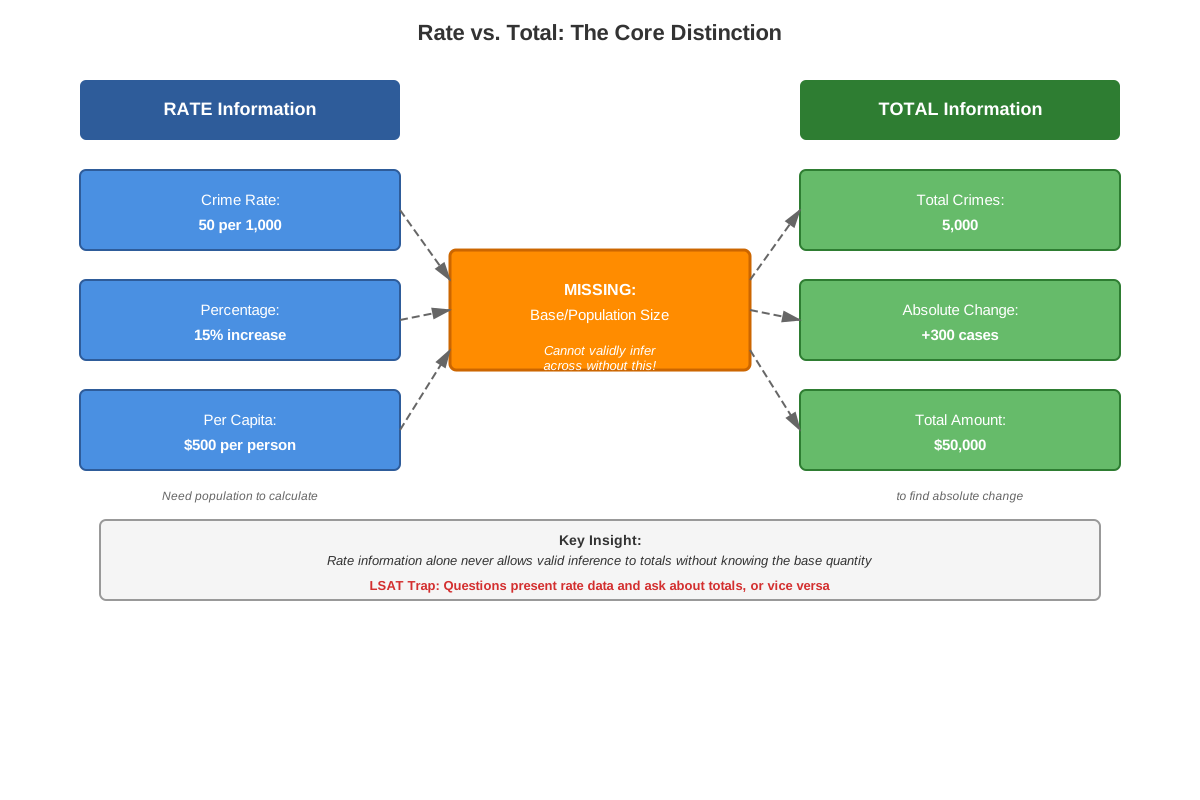
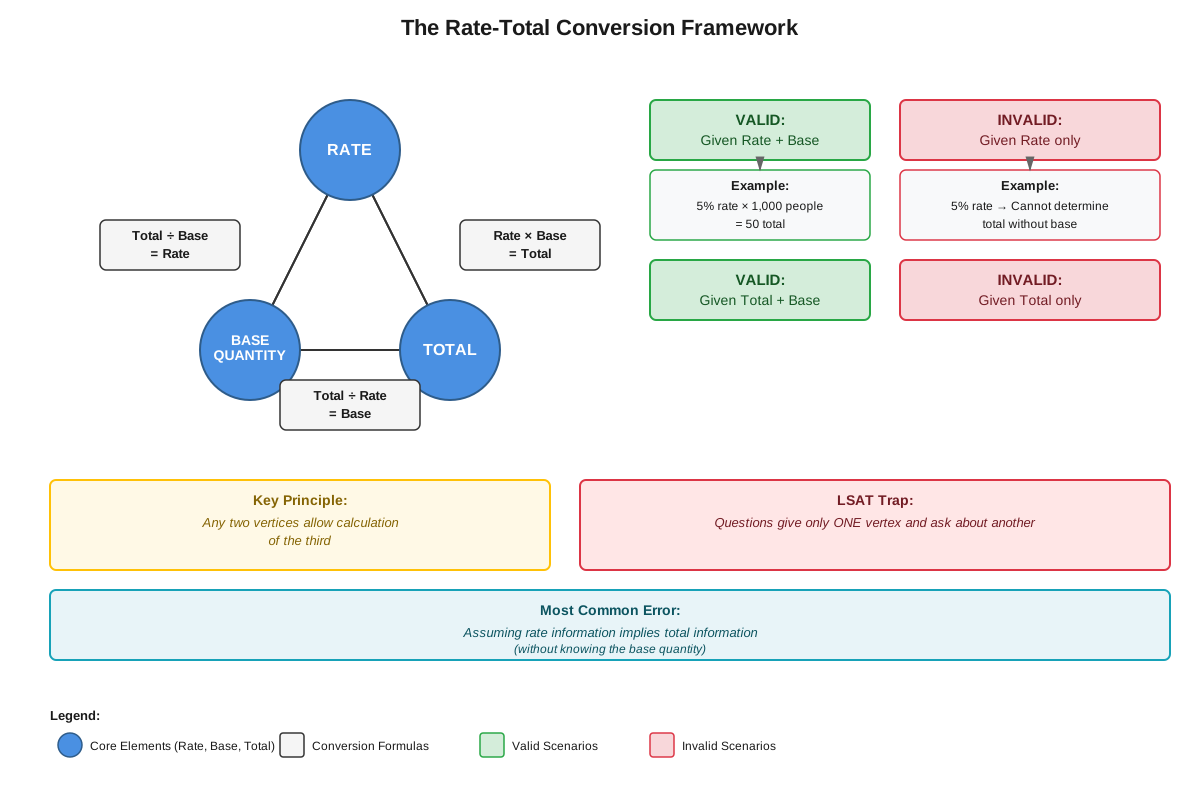
The fundamental concept underlying inference with rates involves understanding that rates (percentages, proportions, ratios) and totals (absolute numbers, raw counts) represent different types of information that cannot be directly converted without additional data. A rate expresses a relationship between two quantities, typically as a fraction, percentage, or ratio. A total represents an absolute quantity or count.
The critical logical principle: knowing a rate does not determine a total, and knowing a total does not determine a rate, unless you also know the base quantity. For example, if 30% of Group A supports a policy and 20% of Group B supports it, we cannot conclude which group has more total supporters without knowing the size of each group. If Group A has 100 members (30 supporters) and Group B has 200 members (40 supporters), Group B actually has more supporters despite the lower rate.
| Information Given | What Can Be Inferred | What Cannot Be Inferred |
|---|---|---|
| Rate only | Comparisons between rates | Absolute quantities or totals |
| Total only | Absolute quantity comparisons | Rates or percentages |
| Rate + Base | Total quantity | Comparisons to other groups without their data |
| Change in rate | Direction of proportional change | Whether total increased or decreased |
Percentage Change Versus Absolute Change
A second critical distinction involves understanding that percentage changes and absolute changes represent different information. An item increasing from $10 to $20 represents a 100% increase but only a $10 absolute increase. An item increasing from $1,000 to $1,100 represents a 10% increase but a $100 absolute increase—ten times the absolute change despite the smaller percentage.
The LSAT exploits this distinction by presenting arguments that conclude something about absolute changes based solely on percentage changes, or vice versa. For instance: "Company A's profits increased 50% while Company B's increased only 10%, therefore Company A gained more profit than Company B." This conclusion is invalid without knowing the starting profits—if Company B started with profits ten times larger than Company A, it could have gained more absolute profit despite the smaller percentage increase.
Rate Comparisons and Population Differences
When comparing rates between groups of different sizes, the group with the higher rate does not necessarily have the larger absolute number. This principle appears frequently in LSAT questions involving crime rates, disease prevalence, test score improvements, or any per-capita measurement.
Example structure: "City X has a higher crime rate per 1,000 residents than City Y. Therefore, City X has more total crimes than City Y." This reasoning fails because if City Y has a sufficiently larger population, it could have more total crimes despite the lower rate. If City X has 10,000 residents with a crime rate of 50 per 1,000 (500 total crimes) and City Y has 100,000 residents with a rate of 10 per 1,000 (1,000 total crimes), City Y has more total crimes.
Changes in Rates Versus Changes in Totals
A particularly subtle distinction involves understanding that a rate can increase while the total decreases, or a rate can decrease while the total increases. This occurs when both the numerator and denominator of the rate change, but at different speeds or in different directions.
Example: If a company had 100 employees with 20 working remotely (20% rate), and later has 80 employees with 20 working remotely (25% rate), the rate increased while the total remained constant. If the company later has 60 employees with 18 working remotely (30% rate), the rate increased further while the total actually decreased. Conversely, if the company grows to 200 employees with 30 working remotely (15% rate), the total increased while the rate decreased.
Valid Inferences from Rate Information
Despite these limitations, certain inferences remain valid when working with rates. Understanding what can be legitimately concluded proves as important as recognizing invalid inferences:
- Rate comparisons remain valid: If Group A has a higher rate than Group B, this comparison holds regardless of group sizes
- Directional changes in rates: If a rate increases, the numerator grew faster than the denominator (or the denominator decreased faster than the numerator)
- Proportional relationships: If two groups have the same rate and the same base, they have the same total
- Relative risk: Higher rates indicate higher probability for individual members, even if totals differ
The Scope Limitation Principle
Rate-based information applies only to the specific population and time period measured. An argument that extends rate-based conclusions beyond the measured scope commits a logical error. For example, knowing that 60% of surveyed voters support a candidate does not establish that 60% of all voters support the candidate—the sample might not represent the broader population. Similarly, knowing a rate for one year does not establish the rate for other years.
Concept Relationships
The rate-total distinction serves as the foundation for all other concepts in this topic. Understanding this core principle enables recognition of percentage change versus absolute change issues, since percentages represent rates of change rather than absolute magnitudes. The rate-total distinction directly leads to understanding population difference problems, as these involve comparing rates across different base quantities.
Changes in rates versus changes in totals builds upon the rate-total distinction by adding temporal dynamics—examining how both rates and totals evolve over time and recognizing that their changes need not align. This concept connects to the scope limitation principle, as temporal changes raise questions about whether rate information from one period applies to another.
Valid inferences from rate information synthesizes all previous concepts by establishing what conclusions remain logically sound despite the limitations identified. This concept connects back to fundamental LSAT skills of distinguishing necessary from possible conclusions.
Relationship map: Rate-Total Distinction → Population Differences + Percentage vs. Absolute Change → Changes in Rates vs. Totals → Scope Limitations → Valid Inferences (synthesis)
High-Yield Facts
⭐ A higher rate does not establish a higher total without knowing the base quantities being compared
⭐ A rate can increase while the total decreases, or decrease while the total increases
⭐ Percentage change and absolute change represent different information that cannot be interconverted without knowing starting values
⭐ Knowing only a rate provides no information about absolute quantities
⭐ Rate information applies only to the specific population and time period measured
- A 50% increase followed by a 50% decrease does not return to the original value
- Comparing rates requires consistent denominators (per capita, per 1,000, per year, etc.)
- The group with the fastest-growing rate does not necessarily have the fastest-growing total
- Average rates across groups cannot be calculated by averaging the individual rates without weighting by group size
- A rate of zero establishes that the total is zero, but this is the only rate that determines a specific total
- If two groups have identical rates and one group's base doubles, that group's total also doubles
Quick check — test yourself on Inference with rates so far.
Try Flashcards →Common Misconceptions
Misconception: If City A has a higher crime rate than City B, City A must have more total crimes.
Correction: Crime rate is crimes per unit population. A smaller city with a high rate could have fewer total crimes than a larger city with a lower rate. The rate comparison tells us nothing about total crimes without knowing populations.
Misconception: If a company's profit margin (rate) increased, its total profits must have increased.
Correction: Profit margin is profit divided by revenue. If revenue decreased substantially, total profits could decrease even as the profit margin increased. A company earning $10 profit on $100 revenue (10% margin) could later earn $8 profit on $40 revenue (20% margin)—higher margin but lower total profit.
Misconception: If 60% of Group A and 40% of Group B have a characteristic, Group A must have more members with that characteristic.
Correction: Without knowing group sizes, no conclusion about totals is possible. If Group B is three times larger than Group A, it would have more members with the characteristic despite the lower percentage.
Misconception: A 25% increase in rate means a 25% increase in total.
Correction: These represent different calculations. A rate increasing from 20% to 25% is a 25% increase in the rate (5 percentage points / 20 percentage points), but this tells us nothing about how the total changed without knowing how the base changed.
Misconception: If the percentage of students passing increased from 70% to 80%, more students passed.
Correction: If the total number of students decreased sufficiently, fewer students could have passed despite the higher percentage. For example, 70% of 100 students (70 passing) versus 80% of 80 students (64 passing).
Misconception: Averaging rates across groups can be done by adding the rates and dividing by the number of groups.
Correction: Rates must be weighted by the size of each group. If Group A (100 members) has a 30% rate and Group B (900 members) has a 10% rate, the combined rate is not 20% but rather 12% (120 total / 1,000 total).
Worked Examples
Example 1: Crime Rate Inference
Question: A recent study found that Millville's burglary rate increased by 15% over the past year, while Laketown's burglary rate increased by only 8%. Which of the following can be properly inferred from this information?
(A) Millville experienced more burglaries this year than Laketown
(B) The number of burglaries in Millville increased more than the number in Laketown
(C) Millville's burglary rate this year is higher than Laketown's burglary rate
(D) The percentage increase in Millville's burglary rate exceeded the percentage increase in Laketown's burglary rate
(E) Millville is a more dangerous city than Laketown
Analysis:
Step 1: Identify what information is provided. We know the percentage change in burglary rates for two cities, but we don't know the actual rates, the populations, or the total number of burglaries.
Step 2: Evaluate each answer choice against the rate-total distinction.
(A) Invalid: We don't know the total burglaries. Even if Millville's rate increased more, Laketown could have a much larger population and thus more total burglaries.
(B) Invalid: We don't know the absolute change in burglaries. Laketown's 8% increase could represent more burglaries if it started with a much higher total. Additionally, we don't know population changes—if Millville's population decreased while burglaries stayed constant, the rate would increase without any increase in total burglaries.
(C) Invalid: We only know the rates increased by different percentages, not which city has the higher current rate. If Laketown started with a rate of 100 per 1,000 and increased 8% (to 108), while Millville started with a rate of 50 per 1,000 and increased 15% (to 57.5), Laketown still has the higher rate.
(D) Valid: This directly restates the given information. A 15% increase in rate is definitionally a larger percentage increase than an 8% increase in rate.
(E) Invalid: "Dangerous" is undefined and would require information beyond burglary rates. Additionally, we don't even know which city has the higher burglary rate currently.
Answer: (D)
Connection to learning objectives: This example demonstrates identifying how inference with rates appears in LSAT questions (comparing percentage changes in rates) and applying the reasoning pattern to eliminate invalid inferences about totals, absolute changes, and current rate comparisons.
Example 2: Educational Achievement
Question: At Riverside High School, the percentage of students scoring proficient or above on standardized tests increased from 65% to 75% between 2020 and 2023. At Mountainview High School, the percentage increased from 80% to 85% during the same period. Which of the following must be true?
(A) More students at Riverside scored proficient or above in 2023 than in 2020
(B) Mountainview had more students score proficient or above than Riverside in both years
(C) The number of students scoring proficient or above increased at both schools
(D) Riverside's improvement in test scores exceeded Mountainview's improvement
(E) In 2023, a higher percentage of Mountainview students scored proficient or above than Riverside students
Analysis:
Step 1: Identify the information provided. We have percentage changes at two schools but no information about total student populations or how those populations changed.
Step 2: Apply the rate-total distinction and changes in rates versus totals principle.
(A) Invalid: The percentage increased, but if Riverside's total student population decreased sufficiently, fewer students could have scored proficient. Example: 65% of 1,000 students (650) versus 75% of 800 students (600).
(B) Invalid: We don't know the schools' sizes. Riverside could be much larger and have more proficient students despite lower percentages.
(C) Invalid: For the same reason as (A), if either school's population decreased enough, the number of proficient students could have decreased despite the percentage increasing.
(D) Invalid: This depends on how we measure "improvement." Riverside's percentage increased by 10 percentage points (or 15.4% relative increase: 10/65), while Mountainview's increased by 5 percentage points (or 6.25% relative increase: 5/80). By percentage points, Riverside improved more; by relative percentage, Riverside also improved more. However, without knowing totals, we cannot compare absolute numbers of additional students scoring proficient. The answer choice is ambiguous enough that it cannot be confirmed as "must be true."
(E) Valid: This directly compares the 2023 percentages: 85% > 75%. This must be true based on the given information.
Answer: (E)
Connection to learning objectives: This example illustrates explaining the reasoning pattern (distinguishing percentage changes from absolute changes and current percentages from historical changes) and recognizing common fallacies (assuming percentage increases mean total increases).
Exam Strategy
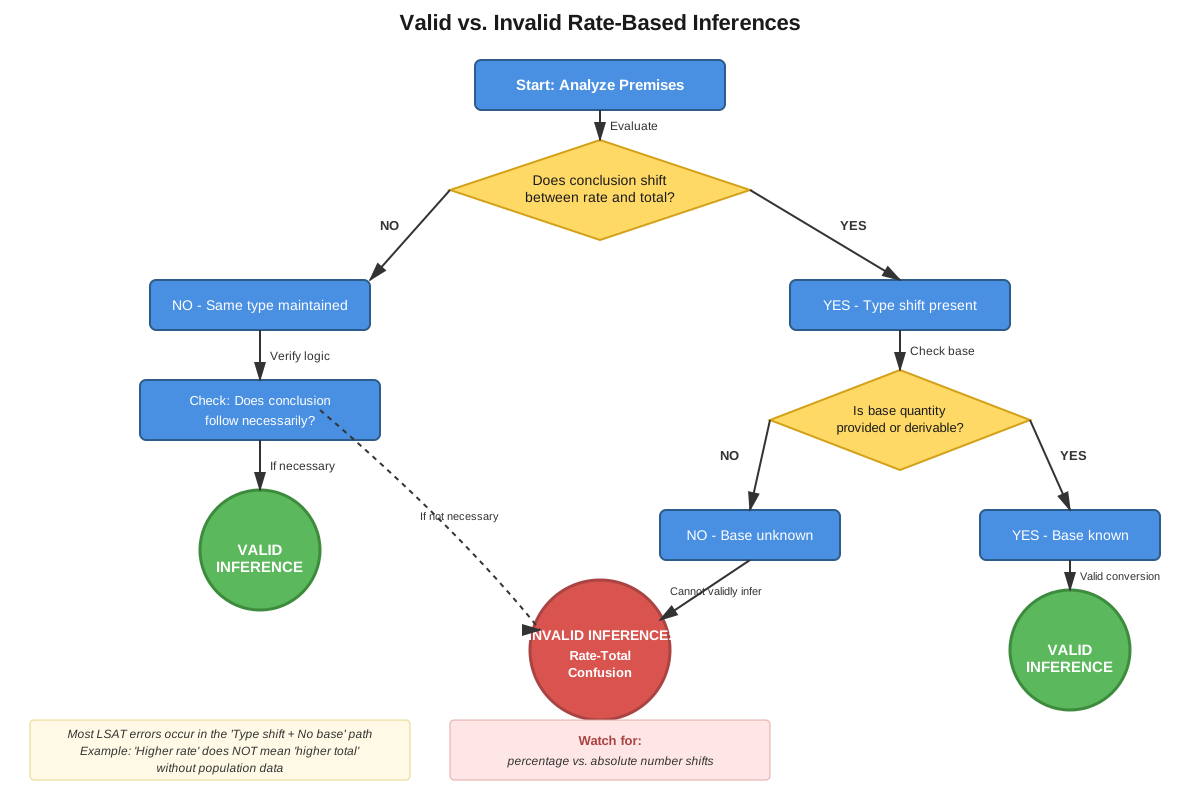
When approaching inference questions involving rates on the LSAT, implement this systematic process:
Step 1: Identify rate-based language. Watch for trigger words including: percentage, rate, per capita, proportion, ratio, fraction, likelihood, probability, average, median, growth rate, and comparative terms like "higher rate" or "faster growth."
Step 2: Distinguish rates from totals. Immediately note whether the stimulus provides rates, totals, or both. If only rates are given, eliminate answer choices that make claims about absolute quantities. If only totals are given, eliminate choices about rates or percentages.
Step 3: Check for base quantity information. Determine whether the stimulus provides the denominator or base population. Without this information, conversions between rates and totals are impossible.
Step 4: Watch for temporal shifts. Note whether the argument discusses changes over time. A rate increasing does not establish that the total increased—both could change independently.
Step 5: Verify scope consistency. Ensure that conclusions don't extend beyond the measured population or time period. Rate information about surveyed individuals doesn't establish rates for non-surveyed populations.
Exam Tip: In Must Be True questions, the correct answer often makes a modest claim that directly follows from the rate information given, while wrong answers make stronger claims about totals or absolute changes that aren't supported.
Process of elimination strategy: Systematically eliminate answer choices that:
- Claim knowledge of totals when only rates are provided
- Claim knowledge of rates when only totals are provided
- Assume groups are the same size without evidence
- Confuse percentage change with absolute change
- Extend conclusions beyond the measured scope
- Assume rates and totals change in the same direction
Time allocation: Spend 15-20 seconds identifying what type of quantitative information is provided (rates, totals, changes, comparisons), then 30-40 seconds evaluating answer choices against the rate-total distinction. Don't rush—these questions reward careful logical analysis over quick intuition.
Memory Techniques
R.A.T.E.S. Framework for evaluating rate-based arguments:
- Rate or Total: Identify which type of information is provided
- Absolute or Relative: Determine if changes are absolute numbers or percentages
- Time period: Note the temporal scope of the data
- Equal bases: Check if comparison groups are the same size
- Scope: Verify conclusions don't exceed the measured population
Visualization strategy: When encountering rate problems, quickly sketch two groups with different sizes. For example, draw a small circle (Group A) and a large circle (Group B). Shade 60% of the small circle and 40% of the large circle. Visually, the shaded portion of the large circle can exceed the shaded portion of the small circle despite the lower percentage—reinforcing that higher rates don't guarantee higher totals.
The "Population Matters" mantra: Whenever you see rate comparisons, mentally repeat "population matters" to remind yourself that rate differences don't establish total differences without knowing base quantities.
Acronym for invalid inferences - CHEAP:
- Changing rates means changing totals
- Higher rate means higher total
- Equal percentage means equal absolute change
- Averaging rates by simple addition
- Past rates apply to current situations
Remember these as common traps to avoid.
Summary
Inference with rates represents a critical LSAT skill requiring test-takers to distinguish between rates (percentages, proportions, ratios) and totals (absolute quantities), recognize that these represent different types of information that cannot be interconverted without knowing base quantities, and identify invalid inferences that confuse these concepts. The fundamental principle underlying this topic is that knowing a rate provides no information about absolute quantities, and knowing a total provides no information about rates, unless the base quantity is also known. Additionally, rates and totals can change independently—a rate can increase while the total decreases, or vice versa, depending on how both the numerator and denominator change. The LSAT exploits these distinctions by presenting arguments that make unwarranted leaps from rate information to conclusions about totals, from percentage changes to absolute changes, or from one population to another. Mastering this topic requires systematic analysis of what information is actually provided, careful attention to scope limitations, and disciplined elimination of answer choices that exceed what the premises logically support.
Key Takeaways
- Rates and totals are fundamentally different: A rate comparison tells you nothing about absolute quantities without knowing base populations
- Higher rates don't mean higher totals: The group with a lower percentage can have a larger absolute number if its base population is sufficiently larger
- Rates and totals can change in opposite directions: A rate can increase while the total decreases, or decrease while the total increases
- Percentage change differs from absolute change: A larger percentage increase doesn't necessarily mean a larger absolute increase
- Scope matters: Rate information applies only to the specific population and time period measured
- Valid inferences are modest: Correct answers typically make limited claims directly supported by the given rate information
- Systematic analysis beats intuition: Use the R.A.T.E.S. framework to avoid common traps and identify what can actually be inferred
Related Topics
Causal Reasoning with Statistical Evidence: Building on rate-based inference, this topic examines how arguments use statistical correlations to support causal claims, requiring analysis of whether rate differences establish causal relationships or merely reflect correlation.
Sampling and Generalization: This topic extends scope limitation principles by examining when conclusions about a sample can be generalized to a broader population, connecting to the principle that rate information applies only to measured populations.
Necessary versus Sufficient Conditions in Quantitative Contexts: This advanced topic explores how rate information relates to conditional reasoning, such as whether a high rate of a condition is necessary or sufficient for an outcome.
Flaw Questions with Statistical Reasoning: Mastering inference with rates enables recognition of common statistical flaws, including unrepresentative samples, confused rates and totals, and inappropriate comparisons.
Practice CTA
Now that you've mastered the core concepts of inference with rates, it's time to apply this knowledge to actual LSAT questions. The practice questions and flashcards will reinforce your ability to distinguish rates from totals, identify invalid inferences, and systematically evaluate rate-based arguments under timed conditions. Remember: this topic appears frequently on the LSAT, and developing fluency with rate-based reasoning will directly improve your score. Approach each practice question methodically using the R.A.T.E.S. framework, and review any mistakes to identify patterns in your reasoning. You've built a strong foundation—now strengthen it through deliberate practice!
Sign up free to keep reading
Create a free AnvayaPrep account to finish this LSAT guide on Inference with rates — plus flashcards and practice questions.