Overview
Inference with some and most represents one of the most frequently tested logical reasoning patterns on the LSAT. This topic focuses on understanding how quantifiers—specifically "some" and "most"—function in logical statements and what valid conclusions can be drawn when these quantifiers are combined across multiple premises. Mastering this skill is essential because the LSAT regularly presents arguments that require test-takers to recognize what must be true, could be true, or cannot be true based on statements containing these quantifiers.
The ability to work with "some" and "most" statements forms a cornerstone of logical reasoning proficiency on the LSAT. These quantifier-based inferences appear not only in dedicated inference questions but also in Must Be True questions, Cannot Be True questions, and even in evaluating the logical structure of arguments in Strengthen/Weaken questions. Understanding the precise logical relationships these quantifiers create allows test-takers to eliminate incorrect answer choices confidently and identify logically valid conclusions with certainty.
Within the broader landscape of Logical Reasoning, inference questions involving quantifiers connect directly to formal logic, conditional reasoning, and argument structure analysis. While conditional statements deal with "if-then" relationships, quantifier statements deal with proportional relationships within groups. Both require rigorous logical thinking, but quantifier logic demands particular attention to what can and cannot be validly inferred when combining statements. The precision required for LSAT inference with some and most questions makes this topic a high-yield area for score improvement, as these questions reward careful analysis and punish hasty assumptions.
Learning Objectives
- [ ] Identify how Inference with some and most appears in LSAT questions
- [ ] Explain the reasoning pattern behind Inference with some and most
- [ ] Apply Inference with some and most to solve LSAT-style problems accurately
- [ ] Distinguish between valid and invalid inferences when combining "some" and "most" statements
- [ ] Recognize the logical boundaries of what can be concluded from quantifier statements
- [ ] Evaluate answer choices by testing them against the logical constraints of quantifier premises
- [ ] Construct chain inferences using multiple "some" and "most" statements correctly
Prerequisites
- Basic formal logic notation: Understanding how to represent logical statements symbolically helps track relationships between groups and their properties
- Set theory fundamentals: Recognizing how groups overlap, intersect, and relate to one another provides the conceptual foundation for quantifier logic
- Conditional reasoning basics: While distinct from quantifier logic, conditional reasoning shares the requirement for precise logical analysis and valid inference patterns
- Argument structure recognition: Identifying premises and conclusions in LSAT passages enables proper application of quantifier inference rules
Why This Topic Matters
In real-world contexts, quantifier reasoning appears constantly in policy discussions, scientific claims, legal arguments, and everyday decision-making. When someone claims "most voters support this policy" or "some regulations harm small businesses," understanding what logically follows—and what doesn't—becomes crucial for critical thinking. Legal reasoning, in particular, frequently involves arguments about proportions, majorities, and partial overlaps between categories, making this skill directly relevant to law school and legal practice.
On the LSAT, inference questions involving "some" and "most" appear with remarkable frequency. Approximately 15-20% of Logical Reasoning questions involve quantifier logic in some form, and pure inference questions with these quantifiers typically appear 2-4 times per test section. These questions are considered medium difficulty, meaning they effectively separate high scorers from average performers. Test-takers who master quantifier inference can reliably secure these points, while those who rely on intuition often fall into carefully constructed trap answers.
This topic appears in several distinct question formats on the LSAT. Most commonly, the stimulus presents 2-3 statements using "some" and "most," followed by a question asking "Which one of the following must be true?" or "Which one of the following can be properly inferred?" Less frequently, the question may ask what cannot be true or what could be false. The answer choices typically include one logically valid inference and four statements that either go beyond what the premises establish or directly contradict valid inference rules. Understanding the precise logical boundaries of quantifier statements is essential for navigating these questions successfully.
Core Concepts
Understanding "Some" in Logical Reasoning
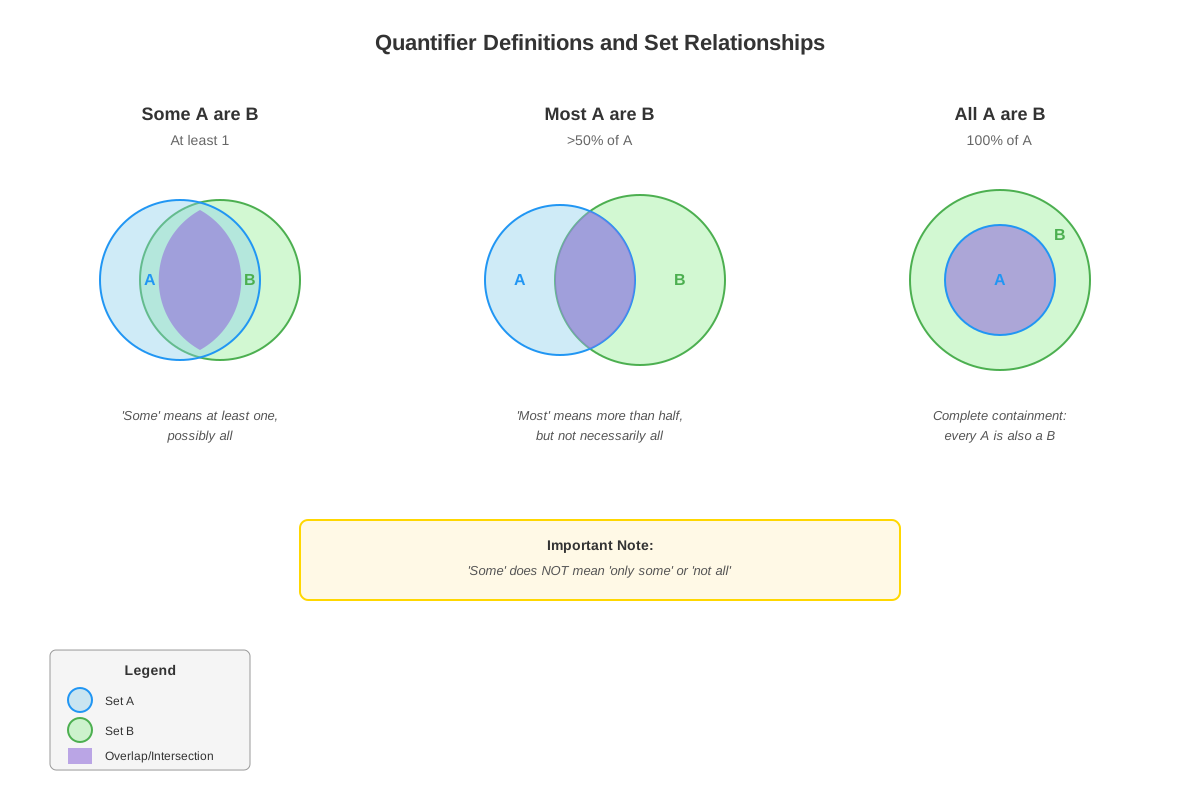
The quantifier "some" has a precise logical meaning on the LSAT that differs from casual usage. In formal logic, "some" means "at least one, possibly all." This definition is crucial: when the LSAT states "some lawyers are judges," this means at least one lawyer is a judge, but it could be that all lawyers are judges. The statement remains true in both scenarios.
Key properties of "some" statements:
- "Some A are B" is logically equivalent to "Some B are A" (reversibility)
- "Some A are B" means at least one member of group A is also in group B
- "Some A are B" tells us nothing definite about "most" or "all"
- "Some A are not B" is a distinct statement and cannot be inferred from "Some A are B"
The reversibility of "some" statements is particularly important for LSAT questions. If the stimulus states "Some professors teach ethics," you can validly conclude "Some ethics teachers are professors." This bidirectional relationship holds universally for "some" statements.
Understanding "Most" in Logical Reasoning
The quantifier "most" means "more than half" in LSAT logic. When a statement claims "most students study logic," this means more than 50% of students study logic. This precise definition enables specific inference patterns that test-takers must master.
Critical properties of "most" statements:
- "Most A are B" means more than 50% of group A is also in group B
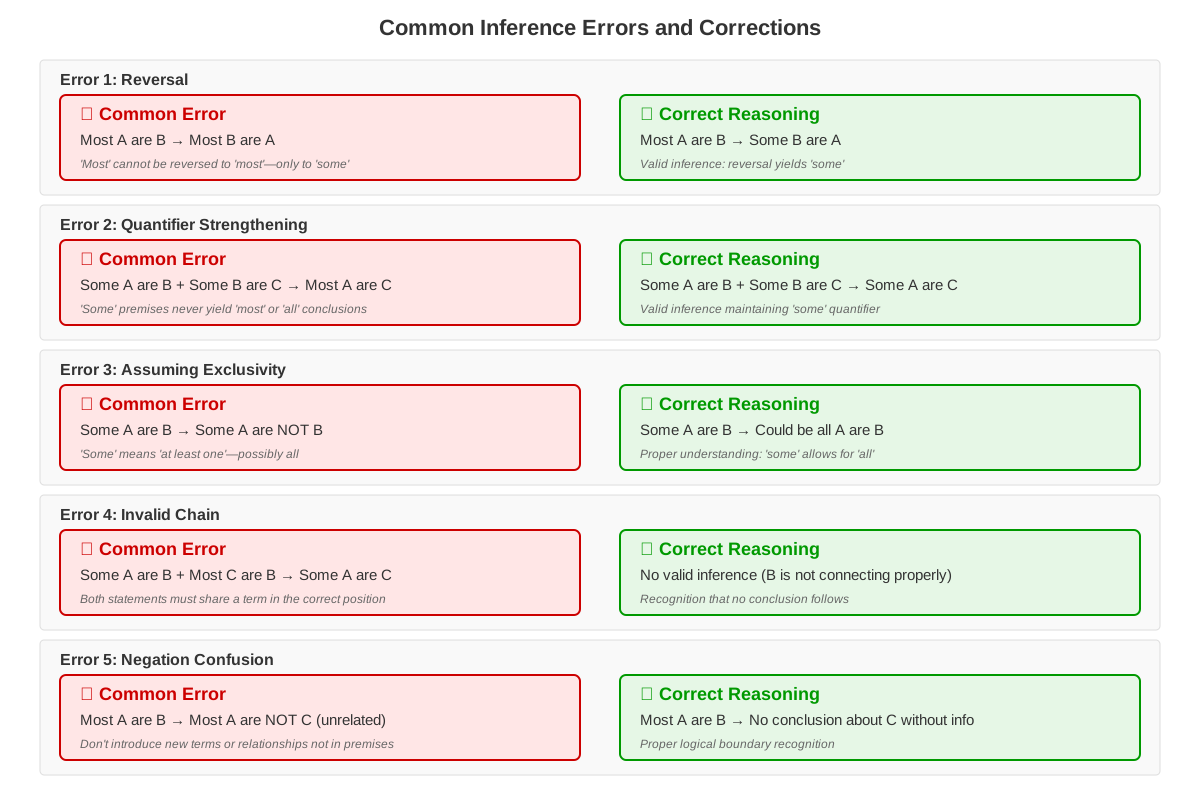
- "Most A are B" does NOT reverse (we cannot conclude "Most B are A")
- Two "most" statements about the same group guarantee overlap
- "Most" is stronger than "some" (if most A are B, then some A are B)
The non-reversibility of "most" statements creates a common trap on the LSAT. If "most lawyers are graduates of top schools," we cannot conclude that "most graduates of top schools are lawyers." The first group (lawyers) might be small, while the second group (top school graduates) might be large, making lawyers a small percentage of top school graduates even though they constitute most of the lawyer population.
Combining "Some" Statements
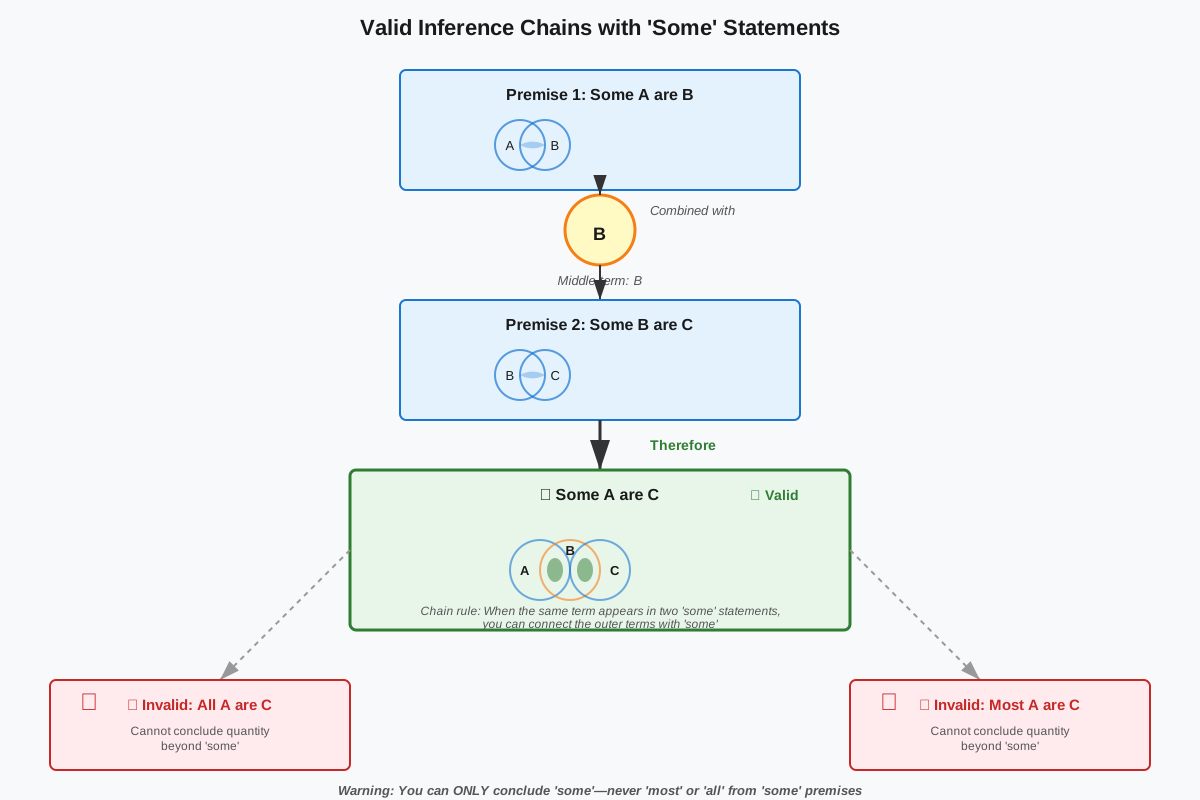
When combining multiple "some" statements, the key principle is that "some" chains do not guarantee further inferences. Consider these premises:
- Some A are B
- Some B are C
From these statements, we cannot validly conclude "Some A are C." The members of A that are in B might be entirely different from the members of B that are in C. However, we can conclude "Some B are both A and C" because we know at least one B is an A, and at least one B is a C (though these might be different B's).
The only reliable inference from chaining "some" statements is that the middle term (B in the example above) contains members with each property, but we cannot conclude that any single member has both properties unless explicitly stated.
Combining "Most" Statements
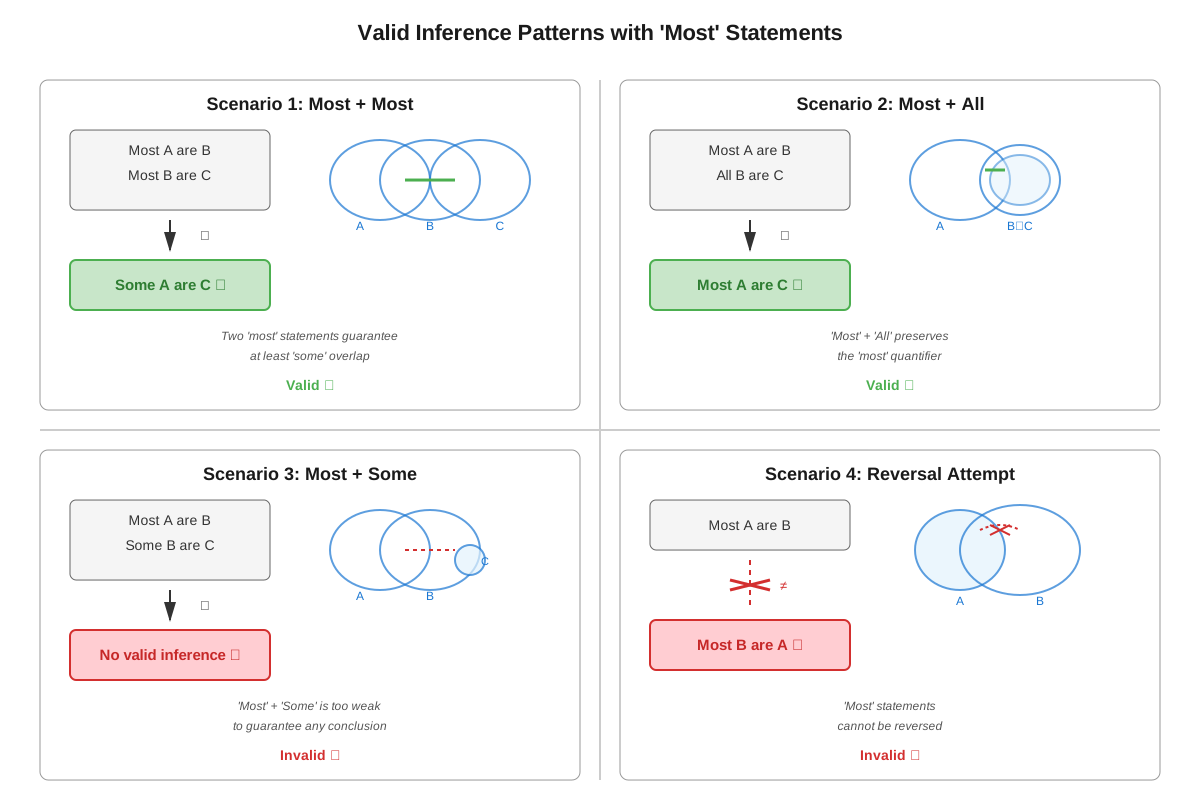
When combining "most" statements, powerful inference patterns emerge. The fundamental rule: if most A are B, and most B are C, then some A must be C. This works because of mathematical necessity—the overlaps must intersect.
Consider the logic numerically:
- If most A are B (>50% of A)
- And most B are C (>50% of B)
- Then the portion of A that is B (>50%) must overlap with the portion of B that is C (>50%)
- Therefore, some A must be C
This principle extends: two "most" statements about the same group guarantee overlap. If "most students study math" and "most students study history," then some students must study both math and history. The mathematical reasoning: if >50% study math and >50% study history, these groups must overlap (they cannot both be true if they were completely separate, as that would require >100% of students).
Combining "Some" and "Most" Statements
When combining "some" and "most" statements, the inference possibilities are limited. Generally, a "some" statement combined with a "most" statement does not yield a guaranteed inference about a third category.
Example:
- Some A are B
- Most B are C
We cannot conclude "Some A are C" because the "some A" that are B might fall entirely within the minority of B that are not C. The "most" statement tells us about the majority of B's, but our "some A" might be in the minority portion.
However, if the statements are structured differently, inferences become possible:
- Most A are B
- Some B are C
Here we can conclude "Some A are C" is possible but not guaranteed. The key is recognizing what must be true versus what could be true.
Negations and Quantifiers
Understanding how negation interacts with quantifiers is essential for LSAT success. The negation of "most" is "most are not" or "half or fewer." The negation of "some" is "none."
| Statement | Negation |
|---|---|
| Most A are B | Most A are not B (or: Half or fewer A are B) |
| Some A are B | No A are B |
| All A are B | Some A are not B |
| No A are B | Some A are B |
These negations appear frequently in Cannot Be True questions and in evaluating answer choices that contradict the stimulus.
Valid Inference Patterns Summary
| Premises | Valid Inference |
|---|---|
| Some A are B | Some B are A |
| Most A are B | Some A are B |
| Most A are B, Most A are C | Some A are both B and C |
| Most A are B, Most B are C | Some A are C |
| All A are B, Some B are C | Some A are C |
| All A are B, Most B are C | Most A are C |
Concept Relationships
The concepts within quantifier inference build systematically upon one another. Understanding "some" → enables recognition of reversibility → which distinguishes it from "most" → leading to proper combination rules. The foundation begins with precise definitions of each quantifier, then progresses to single-statement inferences (like reversibility), and culminates in multi-statement inference chains.
The relationship between "some" and "most" is hierarchical: "most" is a stronger claim than "some," meaning any "most" statement automatically establishes a "some" statement. This relationship enables certain inference patterns while blocking others. When combining statements, the strength of the quantifiers determines what can be concluded—two strong claims ("most" + "most") yield guaranteed inferences, while weaker combinations ("some" + "some") do not.
Quantifier inference connects to conditional reasoning through the concept of logical necessity. Just as conditional statements establish what must follow if the sufficient condition is met, quantifier statements establish what must be true given the proportional relationships. Both require distinguishing between what must be true, what could be true, and what cannot be true—a fundamental skill across all Logical Reasoning question types.
The connection to argument structure analysis appears when quantifier statements serve as premises supporting a conclusion. Recognizing whether the conclusion validly follows from quantifier premises requires applying the inference rules systematically. This connects to assumption questions, strengthen/weaken questions, and flaw questions where the logical gap involves improper quantifier inference.
Quick check — test yourself on Inference with some and most so far.
Try Flashcards →High-Yield Facts
⭐ "Some" means "at least one, possibly all" and is always reversible: If some A are B, then some B are A.
⭐ "Most" means "more than half" and is NOT reversible: Most A are B does not mean most B are A.
⭐ Two "most" statements about the same group guarantee overlap: If most A are B and most A are C, then some A must be both B and C.
⭐ Chaining two "most" statements yields "some": If most A are B and most B are C, then some A must be C.
⭐ "Some" chains do not guarantee further inferences: Some A are B and some B are C does not mean some A are C.
- "Most" automatically establishes "some": If most A are B, then some A are B is definitely true.
- The negation of "some A are B" is "no A are B" (not "some A are not B").
- The negation of "most A are B" is "most A are not B" or "half or fewer A are B."
- Three "most" statements about the same group guarantee that some members have all three properties.
- "Some A are not B" and "Some A are B" can both be true simultaneously—they are not contradictory.
- When an answer choice goes beyond what the premises establish, it is wrong even if it seems plausible.
- Valid inferences from quantifier statements are mathematically certain, not merely probable.
Common Misconceptions
Misconception: "Some" means "not all" or "only a few."
Correction: "Some" means "at least one, possibly all." If all A are B, then "some A are B" is true. The LSAT uses "some" in its formal logic sense, which includes the possibility of totality.
Misconception: "Most A are B" can be reversed to "Most B are A."
Correction: "Most" statements are not reversible. Most lawyers might be graduates of elite schools, but most elite school graduates are not lawyers (since elite schools produce graduates in many fields). The directionality matters critically.
Misconception: If some A are B and some B are C, then some A must be C.
Correction: This inference is invalid. The "some A" that are B might be completely different from the "some B" that are C, with no overlap between A and C. "Some" chains do not guarantee transitivity.
Misconception: "Most" means "all" or "almost all."
Correction: "Most" means specifically "more than half"—it could be 51% or 99%, but it establishes only that the majority has the property. Do not strengthen "most" to "all" in your reasoning.
Misconception: If most A are B, and some C are A, then some C must be B.
Correction: This inference is not guaranteed. The "some C" that are A might fall entirely within the minority of A that are not B. The "most" statement does not tell us about every subset of A.
Misconception: Answer choices that are possibly true based on the premises are correct for Must Be True questions.
Correction: Must Be True questions require answers that are guaranteed by the premises, not merely consistent with them. An answer that could be true but is not necessitated by the premises is incorrect.
Worked Examples
Example 1: Combining Two "Most" Statements
Stimulus: Most philosophy majors study logic. Most philosophy majors study ethics.
Question: Which one of the following must be true?
Answer Choices:
(A) Most philosophy majors study both logic and ethics.
(B) Some philosophy majors study both logic and ethics.
(C) Most students who study logic also study ethics.
(D) Some students who study logic are philosophy majors.
(E) All philosophy majors study either logic or ethics.
Analysis:
Step 1: Identify the quantifiers and structure.
- Premise 1: Most philosophy majors → study logic (>50% of philosophy majors)
- Premise 2: Most philosophy majors → study ethics (>50% of philosophy majors)
Step 2: Apply the inference rule for two "most" statements about the same group.
When two "most" statements share the same subject (philosophy majors), the groups must overlap. If >50% study logic and >50% study ethics, some must study both (otherwise we would need >100% of philosophy majors, which is impossible).
Step 3: Evaluate each answer choice.
(A) Incorrect: We know some must study both, but we cannot conclude that most study both. The overlap could be as small as 1% (if 51% study logic and 51% study ethics, only 2% must overlap).
(B) Correct: This must be true based on the two "most" statements about the same group. The mathematical necessity guarantees overlap.
(C) Incorrect: This reverses and combines the statements improperly. We know nothing about "most students who study logic"—philosophy majors might be a tiny subset of logic students.
(D) Incorrect: While this could be true, it is not guaranteed by the premises. We are told about philosophy majors, not about all logic students.
(E) Incorrect: This is too strong. While most study logic and most study ethics, we cannot conclude that all study at least one of these subjects. A small minority might study neither.
Connection to Learning Objectives: This example demonstrates identifying the inference pattern (two "most" statements about the same group), explaining the reasoning (mathematical necessity of overlap), and applying it to eliminate wrong answers and select the correct one.
Example 2: Invalid "Some" Chain
Stimulus: Some attorneys specialize in tax law. Some tax law specialists work for corporations.
Question: Which one of the following can be properly inferred from the statements above?
Answer Choices:
(A) Some attorneys work for corporations.
(B) Some corporate workers are attorneys.
(C) Some tax law specialists are attorneys.
(D) Most attorneys do not specialize in tax law.
(E) Some attorneys who specialize in tax law work for corporations.
Analysis:
Step 1: Identify the quantifiers and structure.
- Premise 1: Some attorneys → tax law specialists
- Premise 2: Some tax law specialists → work for corporations
Step 2: Recognize this is a "some" chain, which does not guarantee transitivity.
The attorneys who specialize in tax law (from premise 1) might be entirely different from the tax law specialists who work for corporations (from premise 2). We cannot conclude that any attorney works for a corporation.
Step 3: Evaluate each answer choice.
(A) Incorrect: This attempts to chain the two "some" statements, which is invalid. The overlap between attorneys and tax law specialists might not intersect with the overlap between tax law specialists and corporate workers.
(B) Incorrect: This makes the same invalid inference as (A), just reversed.
(C) Correct: This is simply the reversal of premise 1. Since "some attorneys specialize in tax law," we can reverse this to "some tax law specialists are attorneys." This is a valid application of "some" reversibility.
(D) Incorrect: We cannot infer anything about "most" from a "some" statement. Premise 1 tells us only that some attorneys specialize in tax law, which is consistent with most doing so or most not doing so.
(E) Incorrect: This is the invalid chain inference. We know some attorneys specialize in tax law, and we know some tax law specialists work for corporations, but we cannot conclude these are the same individuals.
Connection to Learning Objectives: This example demonstrates recognizing an invalid inference pattern (some chain), explaining why it fails (no guaranteed overlap), and identifying the valid inference (reversibility of "some").
Exam Strategy
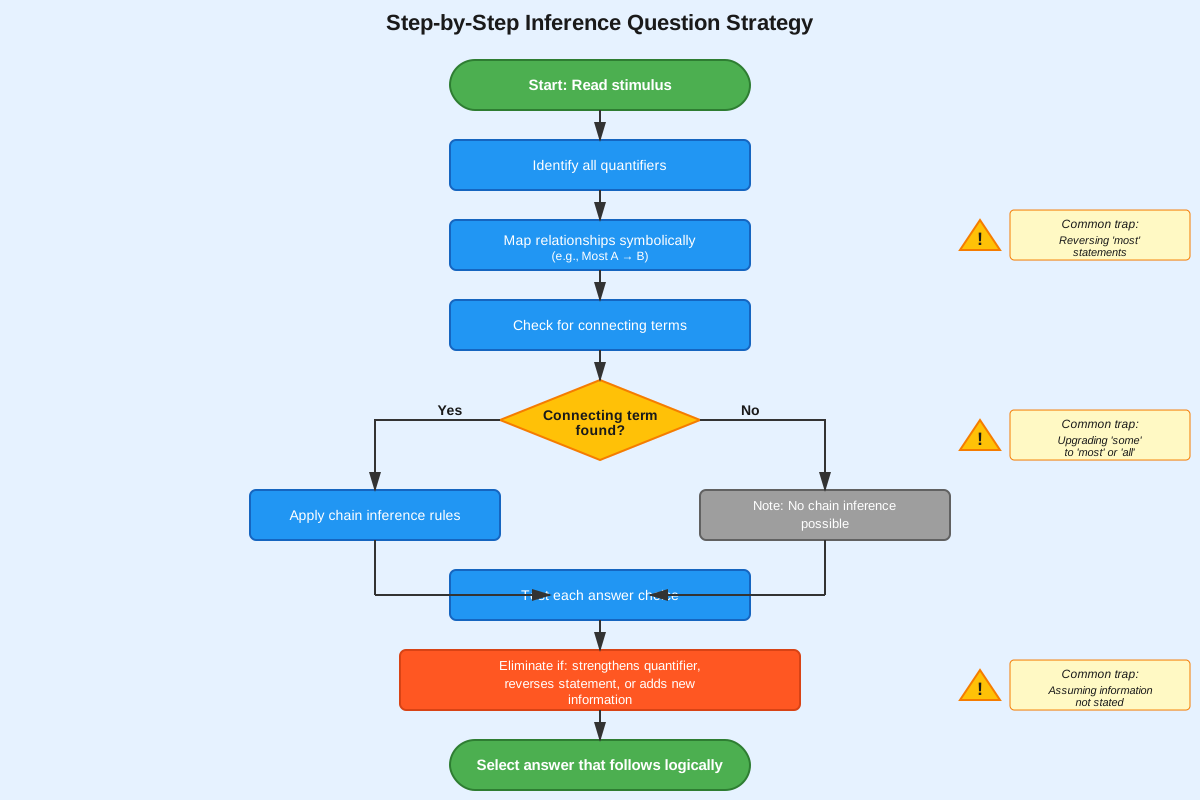
When approaching inference questions involving "some" and "most," follow this systematic process:
Step 1: Identify all quantifiers in the stimulus (typically 15-20 seconds). Circle or mentally note each instance of "some," "most," "all," or "none." Determine which groups are being related and in what direction.
Step 2: Check for valid inference patterns (20-30 seconds). Ask yourself:
- Are there two "most" statements about the same group? (Guarantees overlap)
- Are there two "most" statements in a chain? (Guarantees "some" inference)
- Are there "some" statements that can be reversed?
- Is someone trying to reverse a "most" statement? (Invalid)
Step 3: Predict the inference before looking at answers (10-15 seconds). Based on the valid patterns you identified, predict what must be true. This prevents trap answers from seeming attractive.
Step 4: Eliminate answers using process of elimination (30-45 seconds):
- Eliminate any answer that reverses "most" improperly
- Eliminate any answer that chains "some" statements
- Eliminate any answer that goes beyond what the premises establish
- Eliminate any answer that contradicts valid inferences
Trigger words and phrases to watch for:
- "Must be true" vs. "could be true" (different standards of proof)
- "Some" appearing in answer choices when premises only establish possibility
- "Most" appearing in answer choices when premises only establish "some"
- Reversed relationships (A→B in premise, but B→A in answer)
Time allocation: Spend approximately 1:15-1:30 on these questions. They reward careful analysis but do not require extensive reading. If you find yourself spending more than 1:45, you may be overthinking—return to the basic inference rules.
Common trap patterns:
- Answer choices that are plausible but not guaranteed
- Answer choices that reverse "most" statements
- Answer choices that chain "some" statements invalidly
- Answer choices that strengthen "some" to "most" or "most" to "all"
Exam Tip: If you are stuck between two answers, test each against the premises by trying to construct a scenario where the premises are true but the answer is false. If you can construct such a scenario, the answer is not guaranteed and therefore wrong for Must Be True questions.
Memory Techniques
Mnemonic for "Some" properties: "REAL"
- Reversible (some A are B = some B are A)
- Exists (at least one exists)
- All possible (could mean all)
- Limited inference (chains don't work)
Mnemonic for "Most" properties: "MONGO"
- More than half
- Overlap guaranteed (two "most" about same group)
- Not reversible
- Guarantees "some"
- One-way direction matters
Visualization for two "most" statements: Picture a circle representing the group (e.g., philosophy majors). Shade more than half for property B (studies logic) and shade more than half for property C (studies ethics). The shadings must overlap—there is no way to shade more than half twice without overlap. This visual makes the mathematical necessity concrete.
Acronym for invalid inferences: "SCRAM"
- Some chains (don't work)
- Converse most (can't reverse)
- Ratcheting up (some to most, most to all)
- Assuming totality (some doesn't mean all)
- Mixing groups (watch which group the quantifier applies to)
Memory aid for valid "most" chains: "Most-Most-Some" (two "most" in a chain yields "some"). Repeat this phrase when you see two "most" statements connecting different groups.
Summary
Inference with some and most constitutes a high-yield, frequently tested component of LSAT Logical Reasoning. The core principle is understanding the precise logical meaning of each quantifier: "some" means at least one (possibly all) and is reversible, while "most" means more than half and is not reversible. Valid inferences emerge from specific patterns—two "most" statements about the same group guarantee overlap, and two "most" statements in a chain guarantee a "some" conclusion. Invalid inferences typically involve reversing "most" statements or attempting to chain "some" statements without guaranteed overlap. Success on these questions requires recognizing the pattern in the stimulus, applying the appropriate inference rule, and eliminating answer choices that go beyond what the premises establish or that rely on invalid inference patterns. The mathematical certainty underlying these inferences means that correct answers are guaranteed by the premises, not merely consistent with them. Mastering this topic provides reliable points on the LSAT and builds the logical precision necessary for law school success.
Key Takeaways
- "Some" means "at least one, possibly all" and is always reversible; "most" means "more than half" and is never reversible
- Two "most" statements about the same group mathematically guarantee that some members have both properties
- Chaining two "most" statements (most A are B, most B are C) guarantees that some A are C
- "Some" chains do not guarantee further inferences—the overlaps might not intersect
- Valid inferences are mathematically certain, not merely possible or probable
- Watch for trap answers that reverse "most," chain "some," or strengthen quantifiers beyond what premises establish
- Process of elimination is powerful: eliminate answers that violate inference rules before selecting the correct answer
Related Topics
Conditional Reasoning and Sufficient/Necessary Conditions: While quantifier logic deals with proportional relationships, conditional logic deals with if-then relationships. Mastering both enables handling complex Logical Reasoning questions that combine these elements.
Formal Logic and Diagramming: Advanced formal logic techniques provide systematic methods for representing and manipulating quantifier statements, particularly useful for complex stimuli with multiple quantifiers.
Must Be True vs. Most Strongly Supported Questions: Understanding the distinction between what must be true (guaranteed by premises) and what is most strongly supported (best inference even if not certain) builds on quantifier inference skills.
Argument Structure and Assumption Questions: Recognizing when an argument's conclusion goes beyond what its quantifier premises establish helps identify assumptions and logical gaps, connecting quantifier inference to broader argument analysis skills.
Practice CTA
Now that you have mastered the core concepts of inference with some and most, it is time to apply these skills to actual LSAT-style questions. Work through the practice questions systematically, using the inference rules and elimination strategies covered in this guide. Pay particular attention to identifying the quantifier patterns in each stimulus before evaluating answer choices. Review the flashcards to reinforce the key inference rules and common trap patterns. Consistent practice with these question types will build the speed and accuracy necessary for test day success. Remember: these questions reward precision and systematic analysis—trust the inference rules, and the correct answers will become clear. You have the tools; now apply them with confidence!
Sign up free to keep reading
Create a free AnvayaPrep account to finish this LSAT guide on Inference with some and most — plus flashcards and practice questions.