Overview
Inference with time order represents a critical reasoning pattern tested extensively on the LSAT's Logical Reasoning sections. This question type requires test-takers to draw valid conclusions from statements that describe events, conditions, or states occurring in a specific temporal sequence. Unlike simple chronological ordering, these questions demand that students recognize what must be true based on the temporal relationships explicitly stated or necessarily implied in the stimulus. The LSAT frequently embeds time-order relationships within complex factual scenarios, requiring careful attention to words like "before," "after," "until," "since," "while," and "during" to establish the logical constraints that govern what can be validly inferred.
Mastering inference questions involving temporal reasoning is essential because these questions appear regularly across both Logical Reasoning sections, often accounting for 15-20% of all inference-type questions. The LSAT tests this skill because temporal reasoning is fundamental to legal analysis—understanding the sequence of events is crucial for establishing causation, determining liability, interpreting contracts, and analyzing statutory requirements. Students who can accurately track temporal relationships and recognize their logical implications gain a significant advantage on test day.
Within the broader landscape of LSAT inference with time order questions, this topic connects directly to conditional reasoning, formal logic, and argument structure analysis. Time-order inferences often interact with causal reasoning (since causes must precede effects), sufficient and necessary conditions (where temporal priority may establish logical relationships), and the distinction between what is stated versus what can be proven. Understanding how temporal markers constrain possible inferences is foundational for advanced Logical Reasoning skills and serves as a gateway to more complex question types involving multiple conditional statements and layered logical relationships.
Learning Objectives
- [ ] Identify how Inference with time order appears in LSAT questions
- [ ] Explain the reasoning pattern behind Inference with time order
- [ ] Apply Inference with time order to solve LSAT-style problems accurately
- [ ] Distinguish between valid temporal inferences and unsupported temporal assumptions
- [ ] Recognize temporal indicator words and phrases that signal time-order relationships
- [ ] Evaluate answer choices by testing them against established temporal constraints
- [ ] Combine temporal reasoning with other logical principles to solve complex inference questions
Prerequisites
- Basic conditional logic: Understanding "if-then" relationships is essential because temporal sequences often create conditional constraints (if X happened before Y, then certain conclusions follow)
- Formal logic fundamentals: Familiarity with necessary and sufficient conditions helps distinguish what must be true from what might be true in temporal scenarios
- Reading comprehension skills: The ability to parse complex sentences and identify logical relationships is required to extract temporal information accurately
- Understanding of inference question structure: Knowledge of how LSAT inference questions are constructed and what makes an answer choice valid or invalid provides the foundation for applying temporal reasoning
Why This Topic Matters
Temporal reasoning pervades legal practice and everyday decision-making. Attorneys must reconstruct event sequences from witness testimony, determine whether contractual obligations were met within specified timeframes, and establish whether one party's actions preceded (and potentially caused) another's harm. Judges interpret statutes that contain temporal requirements, and legal arguments frequently hinge on proving that certain events occurred in a particular order. The LSAT tests temporal inference because it measures a fundamental skill that law students will apply throughout their legal education and careers.
On the LSAT, inference questions with time-order elements appear in approximately 3-5 questions per test, distributed across both Logical Reasoning sections. These questions typically present as "must be true" questions, though they occasionally appear as "could be true" or "cannot be true" variants. The temporal component may be the primary focus of the question or may be embedded within a more complex logical structure involving multiple reasoning patterns. According to LSAT preparation data, students who master temporal reasoning improve their Logical Reasoning scores by an average of 2-3 points, as this skill helps them avoid common traps and confidently eliminate incorrect answer choices.
Common manifestations include: stimulus passages describing historical sequences of events with gaps that must be filled through inference; scenarios involving overlapping time periods where students must determine what was true during specific intervals; statements about when conditions began or ended that require calculating what must have been true at intermediate points; and complex narratives where multiple temporal markers must be tracked simultaneously to reach a valid conclusion. The LSAT often combines temporal reasoning with causal claims, creating questions where students must recognize that temporal priority is necessary but not sufficient for establishing causation.
Core Concepts
Temporal Markers and Indicators
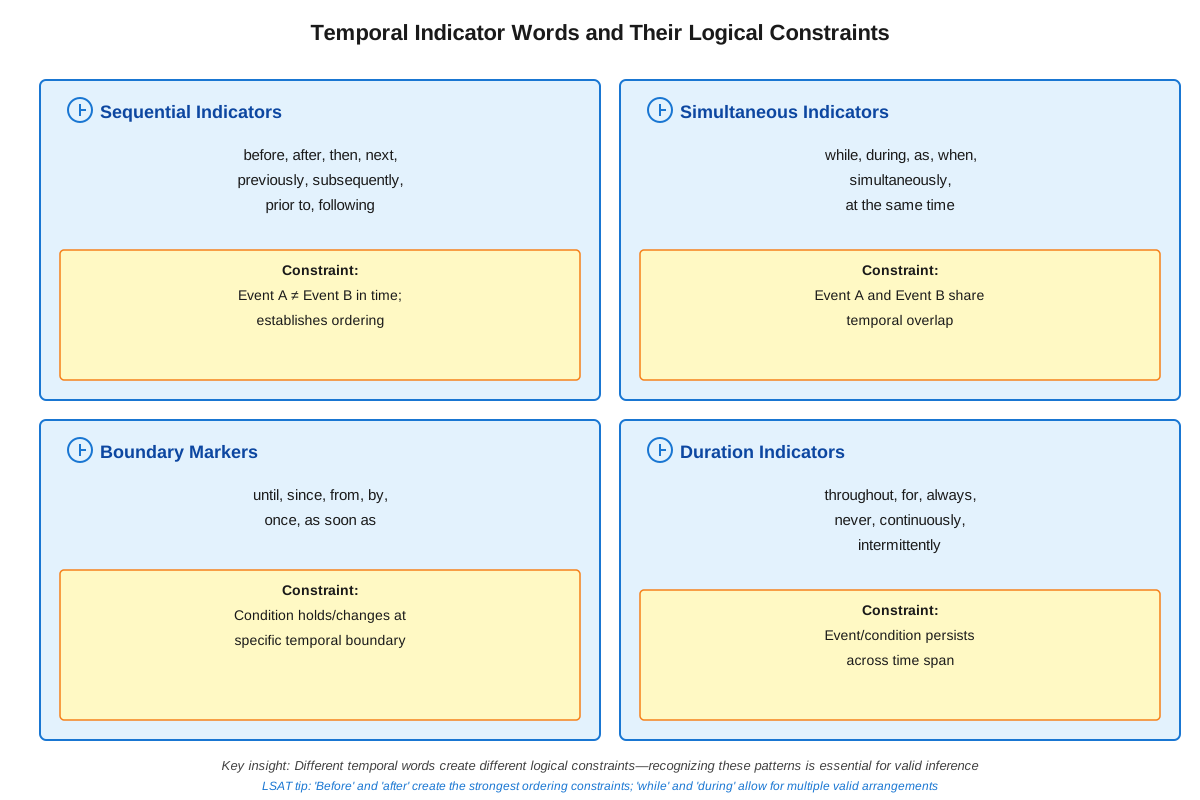
Temporal markers are words and phrases that signal time relationships between events, states, or conditions. Recognizing these indicators is the first step in solving inference questions with time order. The most common markers include:
- Sequential markers: "before," "after," "then," "next," "subsequently," "previously," "prior to," "following"
- Simultaneous markers: "while," "during," "as," "when," "at the same time"
- Duration markers: "until," "since," "throughout," "for [time period]," "from...to"
- Boundary markers: "began," "ended," "started," "finished," "ceased," "commenced"
Each marker creates specific logical constraints. For example, if the stimulus states "Event A occurred before Event B," this establishes that A precedes B in time, which means any valid inference must respect this ordering. The LSAT exploits students' tendency to overlook subtle temporal distinctions—for instance, "during" implies overlap but not complete coincidence, while "throughout" suggests continuous presence across an entire period.
The Logic of Temporal Sequences
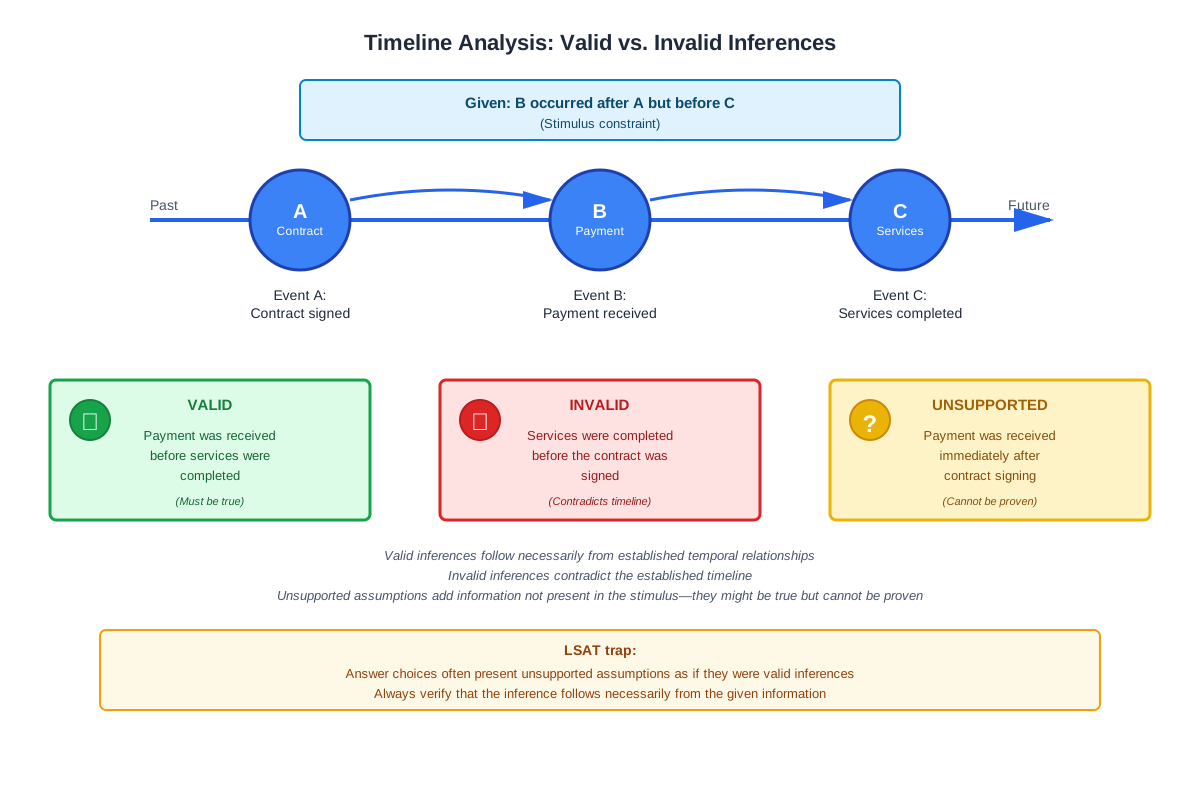
Temporal sequences create transitive relationships: if A occurs before B, and B occurs before C, then A must occur before C. This transitivity is fundamental to solving complex time-order problems where multiple events must be arranged. However, the LSAT tests whether students recognize the limits of what can be inferred. Knowing that A precedes C does not tell us whether other events (D, E, F) occurred between them, nor does it establish any causal relationship.
Consider this structure:
- Event A happens at time T1
- Event B happens at time T2
- T1 < T2 (T1 is earlier than T2)
Valid inferences include: A happened before B; B happened after A; A did not happen after B; B did not happen before A. Invalid inferences include: A caused B; nothing happened between A and B; A and B are the only relevant events; the time gap between A and B was short/long (unless specified).
Overlapping Time Periods
Many LSAT questions involve overlapping time periods where multiple conditions or states exist simultaneously. These questions require tracking what was true during specific intervals. Consider: "Sarah worked at Company X from 2010 to 2015. She earned her MBA in 2013. Company X only hired employees with graduate degrees after 2012."
This creates several temporal zones:
- 2010-2012: Sarah worked at X without an MBA
- 2013-2015: Sarah worked at X with an MBA
- After 2012: X's hiring policy changed
A valid inference: Sarah was hired before the graduate degree requirement took effect. An invalid inference: Sarah was the only employee without a graduate degree (we only know about the hiring policy, not retention).
Temporal Gaps and What Cannot Be Inferred
The LSAT frequently tests whether students recognize temporal gaps—periods about which the stimulus provides no information. If told "The law was passed in 1995 and repealed in 2000," students cannot infer what happened during 1995-2000 unless additional information is provided. Common traps include answer choices that assume:
- Continuous states (that something true at T1 and T3 was also true at T2)
- Immediate succession (that events described sequentially happened without intervening events)
- Uniform conditions (that conditions described for one time period applied to all periods)
Temporal Boundaries and State Changes
Understanding when states begin and end is crucial. The LSAT distinguishes between:
| Temporal Expression | Logical Meaning | What Can Be Inferred |
|---|---|---|
| "Until X happened" | State continued up to X | State was true before X; state ended when X occurred |
| "Since X happened" | State began at X and continues | State is currently true; state was not true before X |
| "Before X happened" | Event preceded X | Event occurred; X had not yet occurred at that time |
| "After X happened" | Event followed X | X occurred first; event occurred subsequently |
| "While X was true" | Simultaneous condition | Overlap existed; does not specify complete duration |
The distinction between "until" and "before" is particularly important: "until" implies continuation up to a boundary, while "before" simply establishes precedence without implying duration.
Combining Temporal and Conditional Logic
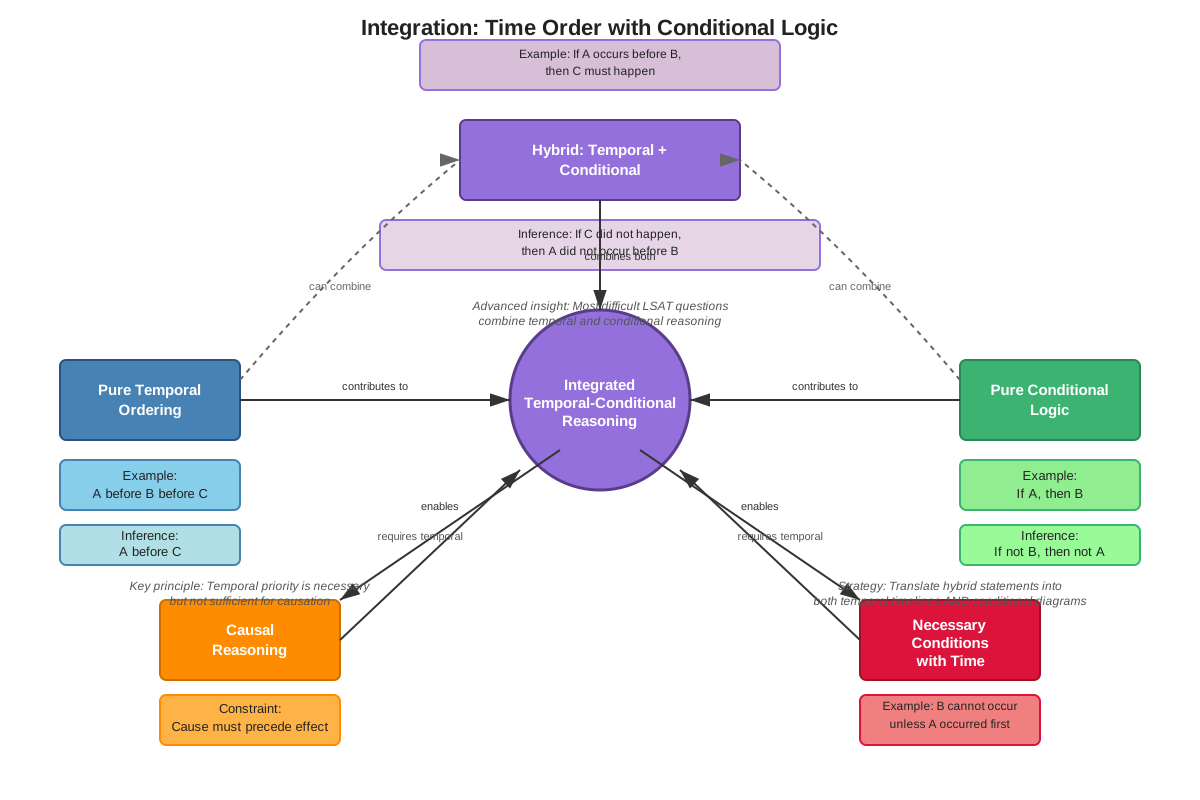
Advanced LSAT questions combine temporal reasoning with conditional statements. For example: "Anyone who joined before 2015 received lifetime benefits. Maria joined in 2014." The temporal fact (Maria joined in 2014) triggers the conditional (joining before 2015 → lifetime benefits), allowing the inference that Maria received lifetime benefits.
The temporal component establishes whether the sufficient condition is met. Students must recognize that:
- Temporal priority can trigger conditional relationships
- Conditional relationships may have temporal components in their conditions
- The validity of the inference depends on both the temporal fact and the conditional rule being correctly applied
Concept Relationships
The concepts within temporal inference reasoning form an interconnected system. Temporal markers serve as the foundation, allowing students to identify and extract time relationships from stimulus passages. These markers establish temporal sequences, which may be simple (A before B) or complex (multiple events with various relationships). When sequences involve multiple events, transitive relationships allow students to derive additional orderings not explicitly stated.
Overlapping time periods represent a more complex application where multiple temporal sequences or states exist simultaneously, requiring students to track what was true during specific intervals. This concept connects directly to temporal boundaries and state changes, as understanding when states begin and end is necessary to determine what was true during overlapping periods. Both of these concepts require careful attention to temporal gaps—recognizing what cannot be inferred is as important as recognizing what can be inferred.
The entire system connects to conditional logic when temporal facts trigger or satisfy conditional statements, creating a hybrid reasoning pattern: Temporal Markers → Temporal Sequences → (if complex) Transitive Relationships → (if involving states) Overlapping Periods/Boundaries → (if combined with rules) Conditional Logic Application → Valid Inference.
This topic builds on prerequisite knowledge of basic conditional logic and formal logic fundamentals, as temporal reasoning often interacts with these systems. It also connects to broader inference question strategies, as the same principles for evaluating "must be true" claims apply—but with the added dimension of temporal constraints. Mastering temporal inference prepares students for more advanced topics like causal reasoning (where temporal priority is necessary but insufficient for causation) and complex argument analysis (where reconstructing event sequences is essential for evaluating conclusions).
High-Yield Facts
⭐ Temporal markers create logical constraints that limit what can be validly inferred; recognizing these markers is the first step in solving time-order questions.
⭐ If A occurs before B and B occurs before C, then A must occur before C (transitivity), but this does not establish causation or rule out intervening events.
⭐ "Until X" means a state continued up to X and ended when X occurred; "since X" means a state began at X and continues to the present.
⭐ Overlapping time periods require tracking what was true during specific intervals; a condition true at T1 and T3 is not necessarily true at T2 without additional information.
⭐ Temporal priority is necessary but not sufficient for causation; the LSAT frequently includes wrong answers that confuse temporal sequence with causal relationship.
- "Before" establishes precedence but does not imply immediate precedence or specify the duration of the gap between events.
- "While" and "during" indicate overlap but do not specify whether the overlap is complete or partial; additional information is needed to determine exact temporal relationships.
- Temporal gaps represent periods about which the stimulus provides no information; valid inferences cannot extend into these gaps without explicit support.
- When temporal facts trigger conditional statements, both the temporal relationship and the conditional rule must be correctly applied to reach a valid inference.
- The LSAT often presents events in non-chronological order in the stimulus; reconstructing the actual timeline is essential before evaluating answer choices.
- Boundary markers ("began," "ended," "started," "ceased") indicate state changes; understanding when states change is crucial for determining what was true during specific periods.
- Multiple temporal markers in a single stimulus create a network of constraints; all constraints must be satisfied simultaneously for an inference to be valid.
Quick check — test yourself on Inference with time order so far.
Try Flashcards →Common Misconceptions
Misconception: If two events are described sequentially in the stimulus, they must have occurred immediately one after the other with no intervening events.
Correction: Sequential description does not imply immediate succession. The LSAT frequently describes events in order without specifying whether other events occurred between them. Only explicit temporal markers like "immediately after" or "directly following" establish immediate succession.
Misconception: If Event A occurred before Event B, then A caused B or contributed to B occurring.
Correction: Temporal priority is necessary but not sufficient for causation. While causes must precede their effects, not everything that precedes an event causes it. The LSAT exploits this confusion by offering answer choices that leap from temporal sequence to causal claims without justification.
Misconception: If a condition was true at the beginning and end of a period, it must have been true throughout the entire period.
Correction: Without explicit information about the intervening time, we cannot assume continuity. A condition might have changed and then changed back. For example, if someone lived in Boston in 2010 and again in 2020, we cannot infer they lived there continuously from 2010-2020.
Misconception: "Until X happened" and "before X happened" mean the same thing and can be used interchangeably.
Correction: "Until" implies continuation up to a boundary point and cessation at that point, while "before" simply establishes that something occurred prior to X without implying duration or continuation. "She worked there until 2015" means she stopped in 2015; "She worked there before 2015" means she worked there at some point prior to 2015 but doesn't specify when she stopped.
Misconception: When the stimulus describes multiple time periods, all the information applies to all periods unless otherwise specified.
Correction: Information is temporally bounded by the context in which it appears. A statement about conditions "in 2015" does not apply to 2014 or 2016 without additional support. Students must carefully track which facts apply to which time periods and avoid extending claims beyond their specified temporal scope.
Misconception: If we know A happened before B and C happened before D, we can determine the relationship between B and C.
Correction: Without information connecting the two sequences, we cannot determine the relationship between events in different sequences. B might precede C, C might precede B, or they might be simultaneous—all are possible without additional constraints.
Worked Examples
Example 1: Basic Temporal Sequence with Conditional Logic
Stimulus: "The museum acquired its first impressionist painting in 1923. Throughout the 1920s, the museum only displayed works that had been in its permanent collection for at least two years. The museum's impressionist gallery opened to the public in 1926."
Question: Which one of the following must be true?
Answer Choices:
(A) The impressionist painting acquired in 1923 was displayed in the impressionist gallery when it opened in 1926.
(B) The museum displayed its first impressionist painting no earlier than 1925.
(C) The museum acquired additional impressionist paintings between 1923 and 1926.
(D) The impressionist gallery contained only paintings acquired before 1924.
(E) The museum displayed no impressionist paintings before 1926.
Solution:
Step 1: Extract temporal facts and constraints.
- Fact 1: First impressionist painting acquired in 1923
- Fact 2: Rule for 1920s: only display works in collection ≥2 years
- Fact 3: Impressionist gallery opened in 1926
Step 2: Apply the temporal constraint to the conditional rule.
The painting acquired in 1923 would have been in the collection for 2 years by 1925. Therefore, it could have been displayed starting in 1925.
Step 3: Evaluate each answer choice.
(A) Incorrect: We know the painting could have been displayed in 1926, but we don't know that it was displayed in the impressionist gallery specifically. The gallery opening and the painting being displayed are separate facts.
(B) Correct: The painting was acquired in 1923. The rule states it could only be displayed after being in the collection for at least 2 years. 1923 + 2 years = 1925. Therefore, the earliest it could have been displayed is 1925. This must be true.
(C) Incorrect: We have no information about additional acquisitions. The stimulus only tells us about the first impressionist painting.
(D) Incorrect: We don't know what paintings were in the gallery or when they were acquired. The gallery opened in 1926, but we have no information about its contents.
(E) Incorrect: As established in analyzing choice (B), the first impressionist painting could have been displayed as early as 1925, which is before 1926.
Key Takeaway: This question combines temporal facts (acquisition in 1923) with a conditional rule (display only after 2 years in collection). The valid inference requires calculating when the temporal constraint was satisfied (1925) and recognizing that this establishes the earliest possible display date.
Example 2: Overlapping Time Periods with State Changes
Stimulus: "Dr. Chen practiced medicine in California from 1998 until 2005. She obtained her California medical license in 2000. California law requires all practicing physicians to hold a valid state medical license. In 2003, California began requiring all licensed physicians to complete annual continuing education courses."
Question: Which one of the following can be properly inferred from the statements above?
Answer Choices:
(A) Dr. Chen practiced medicine illegally in California for at least two years.
(B) Dr. Chen completed continuing education courses in 2004.
(C) Dr. Chen was the only physician practicing without a license before 2000.
(D) The continuing education requirement did not exist when Dr. Chen began practicing in California.
(E) Dr. Chen stopped practicing medicine because of the continuing education requirement.
Solution:
Step 1: Create a timeline with all relevant facts.
- 1998: Dr. Chen began practicing in California
- 2000: Dr. Chen obtained California license
- 2003: Continuing education requirement began
- 2005: Dr. Chen stopped practicing in California
Step 2: Identify the temporal zones and what was true in each.
- 1998-2000: Dr. Chen practiced without a California license (but law required license)
- 2000-2003: Dr. Chen practiced with license; no continuing education requirement
- 2003-2005: Dr. Chen practiced with license; continuing education required
Step 3: Evaluate each answer choice against the timeline.
(A) Correct: From 1998-2000 (at least two years), Dr. Chen practiced without a license, but California law required all practicing physicians to hold a valid license. Therefore, her practice during this period violated the legal requirement, making it illegal practice. This must be true based on the temporal facts and the legal requirement.
(B) Incorrect: While the continuing education requirement began in 2003, we have no information about whether Dr. Chen actually completed courses in 2004. She may have completed them, or she may have stopped practicing, or she may have violated the requirement. This cannot be inferred.
(C) Incorrect: The stimulus provides no information about other physicians. We only know about Dr. Chen's situation.
(D) Correct: The continuing education requirement began in 2003, and Dr. Chen began practicing in 1998. Therefore, the requirement did not exist when she began practicing. This must be true.
(E) Incorrect: We know Dr. Chen stopped practicing in 2005 and that the continuing education requirement began in 2003, but we have no information establishing a causal connection between these facts. Temporal correlation does not establish causation.
Note: This question has two correct answers as written (A and D), which would not occur on an actual LSAT. For instructional purposes, both demonstrate valid temporal inferences: (A) requires recognizing overlapping time periods where conflicting conditions existed, while (D) requires comparing the start dates of two different facts.
Key Takeaway: Questions involving overlapping time periods require careful tracking of what was true during each interval. State changes (like obtaining a license or a new requirement taking effect) create boundaries that divide the timeline into distinct zones with different conditions.
Exam Strategy
When approaching inference questions with temporal elements on the LSAT, employ a systematic process to avoid common traps and maximize accuracy:
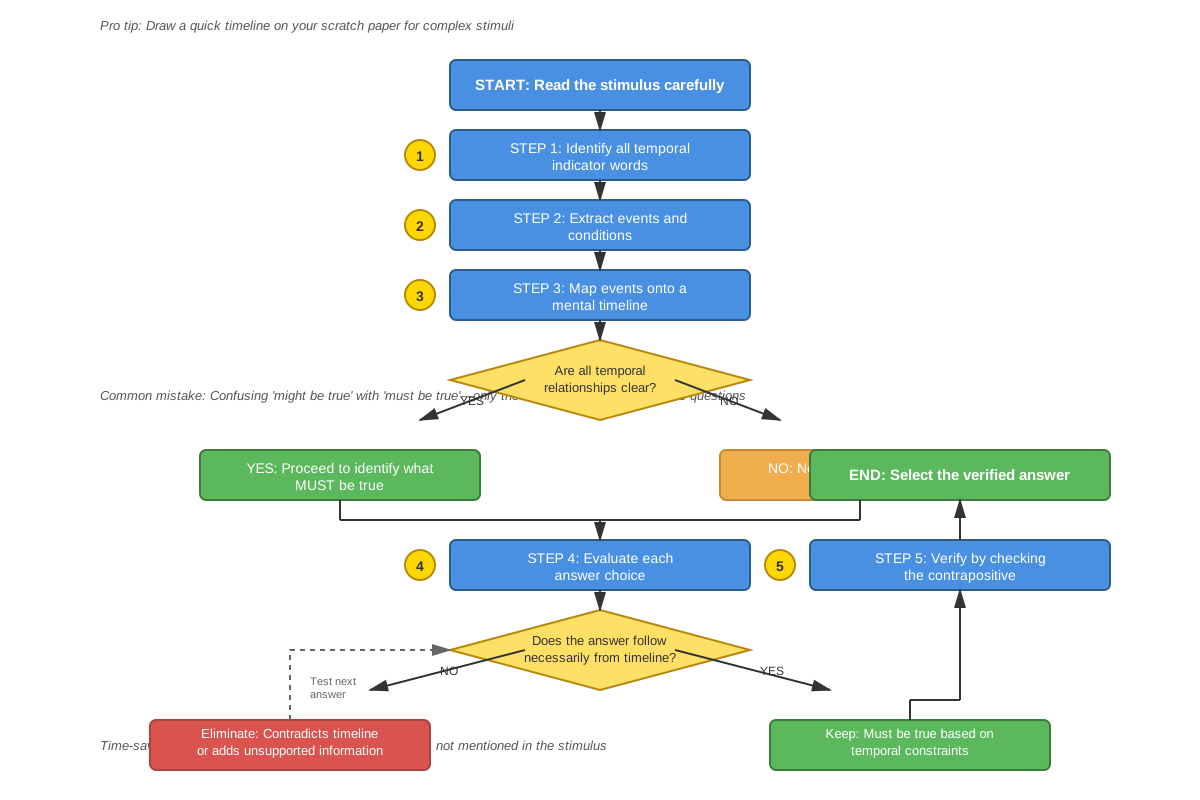
Step 1: Identify and mark all temporal indicators as you read the stimulus. Circle or underline words like "before," "after," "until," "since," "while," "during," and any specific dates or time periods. This active reading ensures you don't miss crucial temporal information.
Step 2: Construct a mental or written timeline if the stimulus involves multiple events or time periods. Arrange events in chronological order, even if the stimulus presents them non-chronologically. Mark any gaps where information is missing. This visualization prevents confusion and helps you track complex temporal relationships.
Step 3: Note what you DON'T know as carefully as what you do know. Identify temporal gaps, periods about which no information is provided, and relationships that are not established. Many wrong answers exploit assumptions about these gaps.
Step 4: Watch for temporal-causal confusion in answer choices. The LSAT frequently offers wrong answers that leap from "A happened before B" to "A caused B" or "A explains B." Temporal priority alone never establishes causation on the LSAT without additional support.
Trigger words and phrases to watch for:
- "Must be true": Requires absolute certainty based on temporal constraints
- "Could be true": Only needs to be possible given the temporal facts
- "Cannot be true": Must violate established temporal constraints
- "Most strongly supported": Allows for high probability rather than certainty
Process-of-elimination tips:
- Eliminate any answer choice that requires information about temporal gaps not addressed in the stimulus
- Eliminate choices that confuse temporal sequence with causation
- Eliminate choices that assume continuity across time periods without support
- Eliminate choices that extend facts beyond their specified temporal boundaries
- Eliminate choices that contradict the established temporal sequence
Time allocation: Spend 15-20 seconds carefully reading and mapping the temporal relationships in the stimulus. This upfront investment prevents costly mistakes and actually saves time by making answer choice evaluation faster and more confident. For complex stimuli with multiple time periods, spending an extra 10 seconds creating a timeline can prevent 30+ seconds of confusion when evaluating answer choices.
Exam Tip: If you find yourself confused about temporal relationships, pause and create a simple timeline with events in chronological order. This 10-second investment clarifies the logical structure and prevents careless errors.
Memory Techniques
BUST Mnemonic for evaluating temporal inferences:
- Boundaries: Identify when states begin and end
- Until vs. Before: Distinguish continuation from simple precedence
- Sequence: Establish chronological order of events
- Transitivity: Apply transitive property to multiple relationships
The Timeline Visualization: When reading a stimulus with temporal elements, visualize a horizontal line with events marked as points and states marked as segments. This mental image helps track overlapping periods and identify gaps.
The "What Changed?" Question: For stimuli involving multiple time periods, ask "What changed between Period 1 and Period 2?" State changes are often the key to valid inferences.
GAPS Acronym for what you cannot infer:
- Gaps in the timeline (periods with no information)
- Assumptions about continuity (that conditions remained constant)
- Priority equals causation (temporal sequence establishes cause)
- Simultaneity without evidence (that events occurred at the same time)
The "Before/After/During" Sorting Strategy: As you read, mentally sort facts into three categories: what happened before a key event, what happened after, and what happened during. This organization clarifies temporal relationships and makes inference evaluation more systematic.
Summary
Inference with time order represents a high-yield LSAT question type that tests the ability to draw valid conclusions from temporally structured information. Success requires recognizing temporal markers, constructing accurate timelines, understanding the logical constraints created by temporal relationships, and distinguishing between what must be true and what cannot be inferred. The core principle is that temporal facts create boundaries and sequences that limit possible inferences—students must respect these constraints while avoiding common traps like assuming continuity across gaps, confusing temporal sequence with causation, or extending facts beyond their specified temporal scope. Mastery involves systematic processing: identify temporal indicators, construct a timeline, note gaps and boundaries, apply transitive relationships where appropriate, and carefully evaluate answer choices against established temporal constraints. The LSAT rewards students who recognize that temporal reasoning is precise and limited—valid inferences follow necessarily from stated temporal facts, while invalid inferences make unsupported assumptions about gaps, causation, or continuity. By combining careful reading, systematic timeline construction, and rigorous logical evaluation, students can consistently identify correct answers and avoid the predictable traps that appear in wrong answer choices.
Key Takeaways
- Temporal markers (before, after, until, since, while, during) create logical constraints that determine what can and cannot be validly inferred from a stimulus
- Transitive relationships allow you to derive additional temporal orderings (if A before B and B before C, then A before C), but do not establish causation or rule out intervening events
- Temporal gaps represent periods about which the stimulus provides no information; valid inferences cannot extend into these gaps without explicit support
- "Until" implies continuation and cessation, while "before" simply establishes precedence; these distinctions are frequently tested and must be carefully observed
- Overlapping time periods require tracking what was true during specific intervals; conditions true at different times do not necessarily overlap without additional information
- Temporal priority never establishes causation on the LSAT without additional support; wrong answers frequently exploit this confusion
- Systematic timeline construction is the most reliable strategy for complex temporal reasoning questions, preventing confusion and enabling confident answer choice evaluation
Related Topics
Causal Reasoning: Builds directly on temporal inference skills, as establishing that A preceded B is necessary (but not sufficient) for arguing that A caused B. Mastering temporal reasoning provides the foundation for evaluating causal arguments.
Conditional Logic with Temporal Components: Advanced questions combine "if-then" statements with temporal constraints, requiring students to determine when sufficient conditions are satisfied based on temporal facts.
Formal Logic and Sequencing Games: The temporal reasoning skills developed here transfer directly to Logic Games, particularly sequencing games where determining the order of events is central to solving the puzzle.
Argument Structure Analysis: Understanding temporal relationships is essential for analyzing arguments, as many arguments depend on establishing the sequence of events or the timing of conditions.
Strengthen and Weaken Questions with Temporal Elements: These question types often require recognizing how additional temporal information would affect an argument's validity, building on the inference skills developed in this topic.
Practice CTA
Now that you have mastered the core concepts of inference with time order, it's time to apply these skills to actual LSAT-style questions. The practice questions and flashcards will reinforce your understanding of temporal markers, test your ability to construct accurate timelines, and challenge you to distinguish valid inferences from common traps. Consistent practice with these materials will build the automaticity and confidence you need to excel on test day. Remember: temporal reasoning is a learnable skill that improves dramatically with deliberate practice. Each question you work through strengthens your ability to recognize patterns, avoid traps, and select correct answers efficiently. You've built the foundation—now apply it!
Sign up free to keep reading
Create a free AnvayaPrep account to finish this LSAT guide on Inference with time order — plus flashcards and practice questions.