Overview
Inference with unless is a critical logical reasoning skill tested extensively on the LSAT. This topic sits at the intersection of conditional reasoning and inference questions, requiring test-takers to translate complex logical statements into their proper conditional forms and then draw valid conclusions. The word "unless" functions as a logical operator that creates conditional relationships, but its meaning often trips up even advanced students because it doesn't map intuitively onto everyday language use.
Understanding how to handle "unless" statements is essential for success on the LSAT because these constructions appear frequently across multiple question types, including Must Be True questions, Sufficient Assumption questions, and Necessary Assumption questions. The LSAT deliberately uses "unless" to test whether students can move beyond surface-level reading to identify the underlying logical structure of arguments. Mastering this topic directly impacts your ability to diagram conditional statements accurately, recognize contrapositive relationships, and eliminate incorrect answer choices that exploit common translation errors.
Within the broader landscape of logical reasoning, inference with unless connects directly to conditional logic, contrapositive reasoning, and formal logic translation. Students who master this topic gain a significant advantage because they can quickly and accurately process complex logical relationships under time pressure. This skill becomes foundational for tackling more advanced topics like sufficient and necessary conditions, formal logic games, and complex argument structures that appear throughout the LSAT.
Learning Objectives
- [ ] Identify how Inference with unless appears in LSAT questions
- [ ] Explain the reasoning pattern behind Inference with unless
- [ ] Apply Inference with unless to solve LSAT-style problems accurately
- [ ] Translate "unless" statements into standard conditional form (if-then statements) without error
- [ ] Generate valid contrapositives from unless statements
- [ ] Distinguish between valid and invalid inferences drawn from unless statements
- [ ] Recognize common trap answers that exploit unless statement misinterpretation
Prerequisites
- Basic conditional logic (if-then statements): Understanding standard conditional relationships is essential because "unless" statements must be translated into if-then form for proper analysis.
- Contrapositive reasoning: The ability to form and recognize contrapositives is necessary because valid inferences from unless statements often require contrapositive manipulation.
- Logical negation: Knowing how to properly negate statements is critical because the unless translation rule involves negation of one component.
- Sufficient and necessary conditions: Distinguishing between these condition types helps clarify what the unless statement actually establishes in the logical relationship.
Why This Topic Matters
In real-world contexts, understanding unless statements helps decode legal language, contracts, policy documents, and complex instructions where conditional relationships determine outcomes. Legal professionals regularly encounter unless clauses in statutes and regulations, making this skill directly applicable to law school and legal practice. The ability to parse these statements accurately prevents misinterpretation of critical conditions and exceptions.
On the LSAT, inference questions constitute approximately 25-30% of all Logical Reasoning questions, and unless statements appear in roughly 15-20% of those inference questions. This translates to 3-5 questions per test where understanding unless statements is either central to the question or provides a significant advantage. Additionally, unless statements appear in stimulus passages across other question types, making this topic relevant to 8-12 questions per LSAT administration.
Lsat inference with unless appears in several distinct formats: (1) Must Be True questions where the stimulus contains an unless statement and you must identify what necessarily follows; (2) Sufficient Assumption questions where adding an unless statement would complete the argument; (3) Necessary Assumption questions where an unless relationship is assumed but unstated; and (4) Parallel Reasoning questions where matching the logical structure requires recognizing unless patterns. The LSAT also embeds unless statements within complex argument structures, requiring students to first translate the unless statement correctly before evaluating the broader argument.
Core Concepts
The Unless Translation Rule
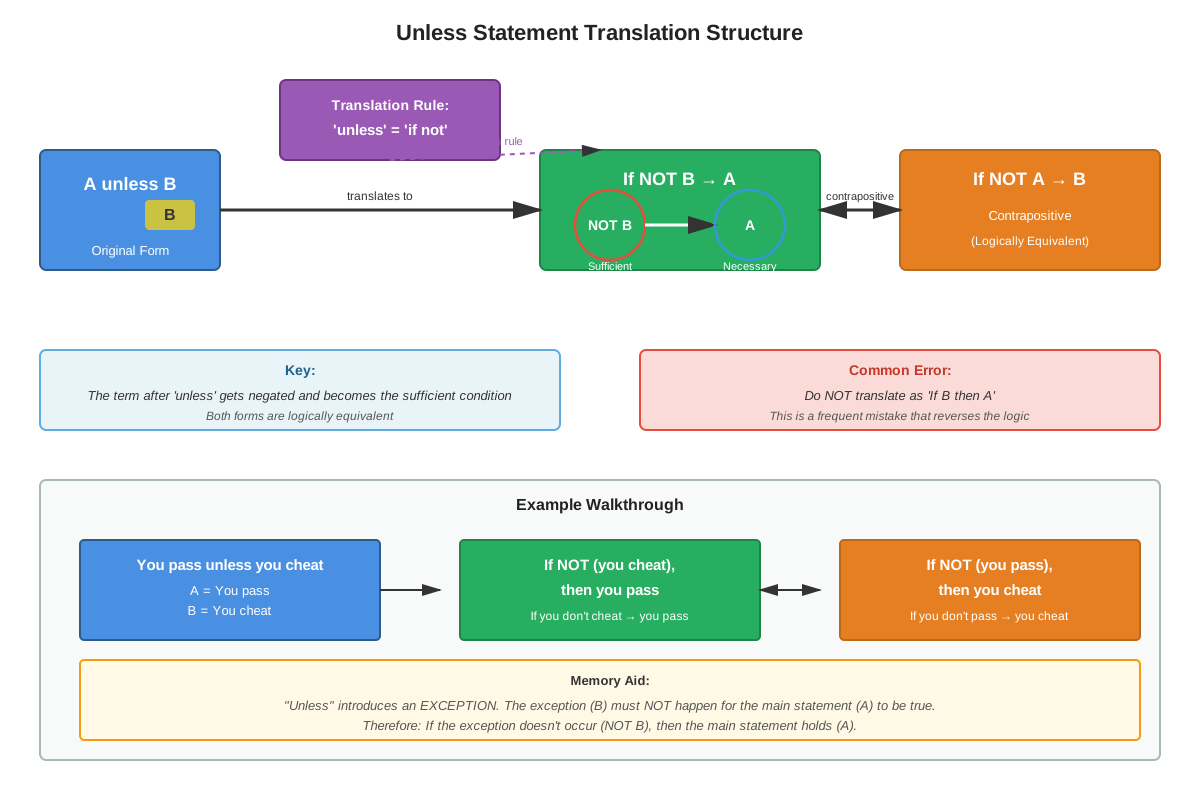
The fundamental principle for handling inference with unless is the translation rule: "A unless B" translates to "If not B, then A" (symbolically: ~B → A). This rule is absolute and invariant on the LSAT. The word "unless" introduces an exception or condition that prevents the negation of the main clause. Understanding this translation is the cornerstone of all unless reasoning.
The translation works because "unless" means "if not" or "except if." When you say "The concert will be cancelled unless it stops raining," you're establishing that the absence of stopped rain (continuing rain) leads to cancellation. More formally: "If it does not stop raining, then the concert will be cancelled" (~Stop Rain → Cancel).
Critical insight: The term that directly follows "unless" gets negated in the sufficient condition (the "if" part), while the other term becomes the necessary condition (the "then" part) without negation. This creates a common error pattern where students forget to negate the term following "unless."
Standard Form Conversion
Converting unless statements to standard conditional form involves three precise steps:
- Identify the two component statements in the unless sentence
- Negate the statement that directly follows "unless" to create the sufficient condition
- Keep the other statement unchanged as the necessary condition
Example: "You will fail the exam unless you study."
- Component 1: "You will fail the exam"
- Component 2: "you study"
- Translation: "If you do not study, then you will fail the exam" (~Study → Fail)
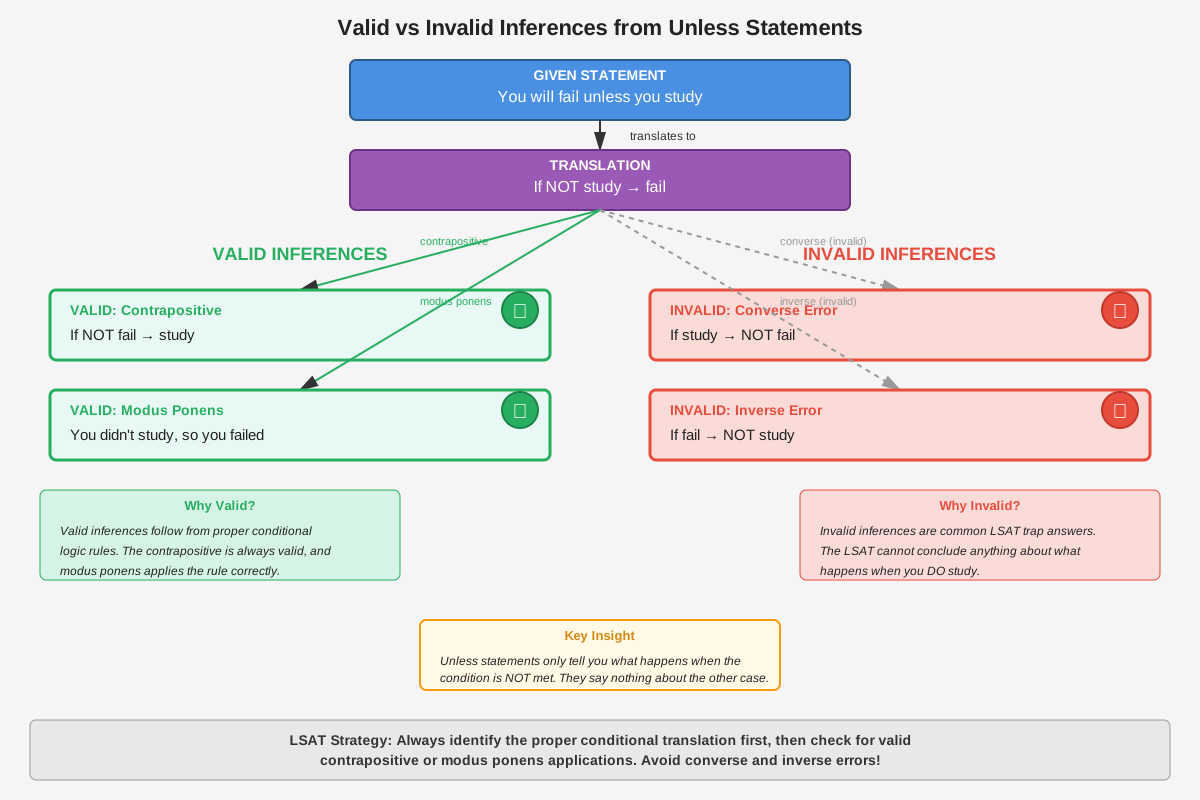
The contrapositive of this statement is equally important: "If you do not fail the exam, then you studied" (~Fail → Study). This contrapositive often provides the basis for correct answer choices in LSAT inference with unless questions.
Logical Equivalencies
Understanding equivalent formulations helps recognize unless statements even when they're disguised. The following are logically equivalent:
| Original Form | Equivalent Forms |
|---|---|
| A unless B | If not B, then A |
| A unless B | If not A, then B (contrapositive) |
| A unless B | B or A |
| A unless B | Not both (not B) and (not A) |
These equivalencies matter because the LSAT may present an unless relationship in the stimulus and ask you to identify an equivalent statement in the answer choices, or vice versa. Recognizing that "A unless B" is logically equivalent to "B or A" (in disjunctive form) helps identify correct answers that rephrase the relationship.
Multiple Unless Statements
When arguments contain multiple unless statements, each must be translated independently before combining them through logical chains. Consider: "The project will fail unless we hire more staff, and we cannot hire more staff unless the budget increases."
Translation:
- Statement 1: ~Hire Staff → Project Fails
- Statement 2: ~Budget Increases → ~Hire Staff
These can be chained: ~Budget Increases → ~Hire Staff → Project Fails
Therefore: If the budget does not increase, the project will fail. This chaining technique is frequently tested in complex inference questions.
Unless vs. Other Conditional Indicators
Distinguishing "unless" from other conditional indicators prevents translation errors:
- "Only if": Creates a necessary condition (A only if B = A → B)
- "Unless": Creates a sufficient condition from the negated term (~B → A)
- "If": Creates a sufficient condition directly (If A then B = A → B)
- "Without": Functions identically to unless (A without B = ~B → A)
The LSAT exploits confusion between these indicators, particularly between "unless" and "only if," which create opposite logical structures despite similar surface appearance.
Inference Patterns
Valid inferences from unless statements follow predictable patterns:
- Direct application: If the sufficient condition is satisfied, the necessary condition must follow
- Contrapositive application: If the necessary condition is negated, the sufficient condition must be negated
- Invalid reversal: Affirming the necessary condition tells you nothing about the sufficient condition (common trap)
- Invalid negation: Negating the sufficient condition tells you nothing definitive (common trap)
For "A unless B" (~B → A):
- Valid: If not B, then definitely A
- Valid: If not A, then definitely B (contrapositive)
- Invalid: If B, then... (cannot conclude anything)
- Invalid: If A, then... (cannot conclude anything)
Concept Relationships
The translation of unless statements serves as the foundation for all subsequent reasoning. Once translated into standard conditional form (~B → A), the statement can be manipulated using contrapositive reasoning to generate (~A → B). These two forms—the original conditional and its contrapositive—represent the complete set of valid inferences directly available from a single unless statement.
When multiple unless statements appear in an argument, the translation process must precede any attempt at logical chaining. Each unless statement converts to a conditional, and these conditionals can then be connected through shared terms: if the necessary condition of one statement matches the sufficient condition of another, they chain together to create extended inference paths.
The relationship between unless statements and formal logic extends to disjunctive reasoning (or statements). Since "A unless B" is equivalent to "A or B," students who understand disjunctive logic can cross-verify their unless translations. This connection becomes particularly valuable in Logic Games where unless statements often establish rules that can be represented either conditionally or disjunctively.
Concept flow: Unless statement → Translation to conditional form → Identification of contrapositive → Recognition of valid inference patterns → Application to answer choice elimination → Selection of must-be-true answer
High-Yield Facts
⭐ The unless translation rule is absolute: "A unless B" always means "If not B, then A" (~B → A)
⭐ The term directly following "unless" gets negated in the sufficient condition of the translation
⭐ The contrapositive of an unless statement is always valid and frequently provides the correct answer
⭐ "Unless" and "without" function identically in logical translation
⭐ Affirming the necessary condition of an unless statement yields no valid inference (common trap answer pattern)
- "Unless" creates a sufficient condition from the negated term, not from the term itself
- Multiple unless statements in a single argument can be chained if their conditions overlap
- "A unless B" is logically equivalent to "B or A" in disjunctive form
- The LSAT never uses "unless" to mean "if and only if" (biconditional)
- Negating both sides of an unless statement is invalid (negation error)
- Unless statements can be embedded in complex sentences with multiple clauses requiring careful parsing
- The contrapositive of "~B → A" is "~A → B," which can be rephrased as "A unless B" becomes "B unless A" in contrapositive form
- Time-efficient test-takers translate unless statements immediately upon encountering them rather than working with the original phrasing
Quick check — test yourself on Inference with unless so far.
Try Flashcards →Common Misconceptions
Misconception: "Unless" means "if" and can be translated directly without negation.
Correction: "Unless" means "if not," requiring negation of the term that follows it. "A unless B" translates to "If not B, then A," not "If B, then A."
Misconception: Both terms in an unless statement should be negated during translation.
Correction: Only the term directly following "unless" gets negated in the sufficient condition; the other term remains unchanged as the necessary condition.
Misconception: If the necessary condition of an unless statement is true, you can conclude the sufficient condition is false.
Correction: Affirming the necessary condition tells you nothing about the sufficient condition. From "~B → A," knowing A is true does not tell you whether B is true or false.
Misconception: "Unless" and "only if" are interchangeable because they both create conditional relationships.
Correction: These create opposite logical structures. "A unless B" means "~B → A," while "A only if B" means "A → B." Confusing these leads to reversed logic.
Misconception: The contrapositive of an unless statement is just the original statement with "unless" moved to the other term.
Correction: The contrapositive requires proper negation of both terms and reversal of the conditional direction. "A unless B" (~B → A) has contrapositive "~A → B," which could be rephrased as "B unless A," but this requires understanding the full logical transformation.
Misconception: Unless statements create biconditional (if and only if) relationships.
Correction: Unless statements create simple conditionals with one direction of implication. "A unless B" establishes only that ~B is sufficient for A, not that it's necessary for A.
Worked Examples
Example 1: Basic Translation and Inference
Stimulus: "The museum will close early unless at least 100 visitors arrive by noon. The museum did not close early."
Question: Which of the following must be true?
Step 1 - Translate the unless statement:
"The museum will close early unless at least 100 visitors arrive by noon"
- Component A: "The museum will close early"
- Component B: "at least 100 visitors arrive by noon"
- Translation: "If NOT (at least 100 visitors arrive by noon), then the museum will close early"
- Symbolic form: ~100 Visitors → Close Early
Step 2 - Identify the contrapositive:
Original: ~100 Visitors → Close Early
Contrapositive: ~Close Early → 100 Visitors
Step 3 - Apply the given information:
We're told "The museum did not close early" (~Close Early)
Step 4 - Draw the inference:
Since we have ~Close Early, and our contrapositive is ~Close Early → 100 Visitors, we can conclude that at least 100 visitors arrived by noon.
Answer: At least 100 visitors arrived by noon (must be true).
Connection to learning objectives: This example demonstrates identification of unless in LSAT questions, explanation of the reasoning pattern (translation then contrapositive application), and accurate application to solve the problem.
Example 2: Complex Argument with Multiple Conditionals
Stimulus: "The company will not expand into new markets unless it secures additional funding. The company will not secure additional funding unless the board approves the proposal. The board will not approve the proposal unless the CEO presents a detailed business plan."
Question: If the company expands into new markets, which of the following must be true?
Step 1 - Translate each unless statement:
- "Company will not expand unless it secures funding"
- ~Secure Funding → ~Expand
- Contrapositive: Expand → Secure Funding
- "Will not secure funding unless board approves"
- ~Board Approves → ~Secure Funding
- Contrapositive: Secure Funding → Board Approves
- "Board will not approve unless CEO presents plan"
- ~CEO Presents Plan → ~Board Approves
- Contrapositive: Board Approves → CEO Presents Plan
Step 2 - Chain the contrapositives:
Expand → Secure Funding → Board Approves → CEO Presents Plan
Step 3 - Apply the given information:
We're told "the company expands into new markets" (Expand is true)
Step 4 - Follow the chain:
If Expand is true, then following the chain:
- Secure Funding must be true
- Board Approves must be true
- CEO Presents Plan must be true
Answer: The CEO presented a detailed business plan (must be true).
Additional valid inferences: The company secured additional funding (must be true); The board approved the proposal (must be true).
Invalid inference: We cannot conclude anything about what happens if the company does NOT expand, as that would require affirming the necessary condition or negating the sufficient condition.
Connection to learning objectives: This example shows how to handle multiple unless statements, chain conditional reasoning, and distinguish valid from invalid inferences in complex arguments.
Exam Strategy
When approaching inference questions involving unless statements, follow this systematic process:
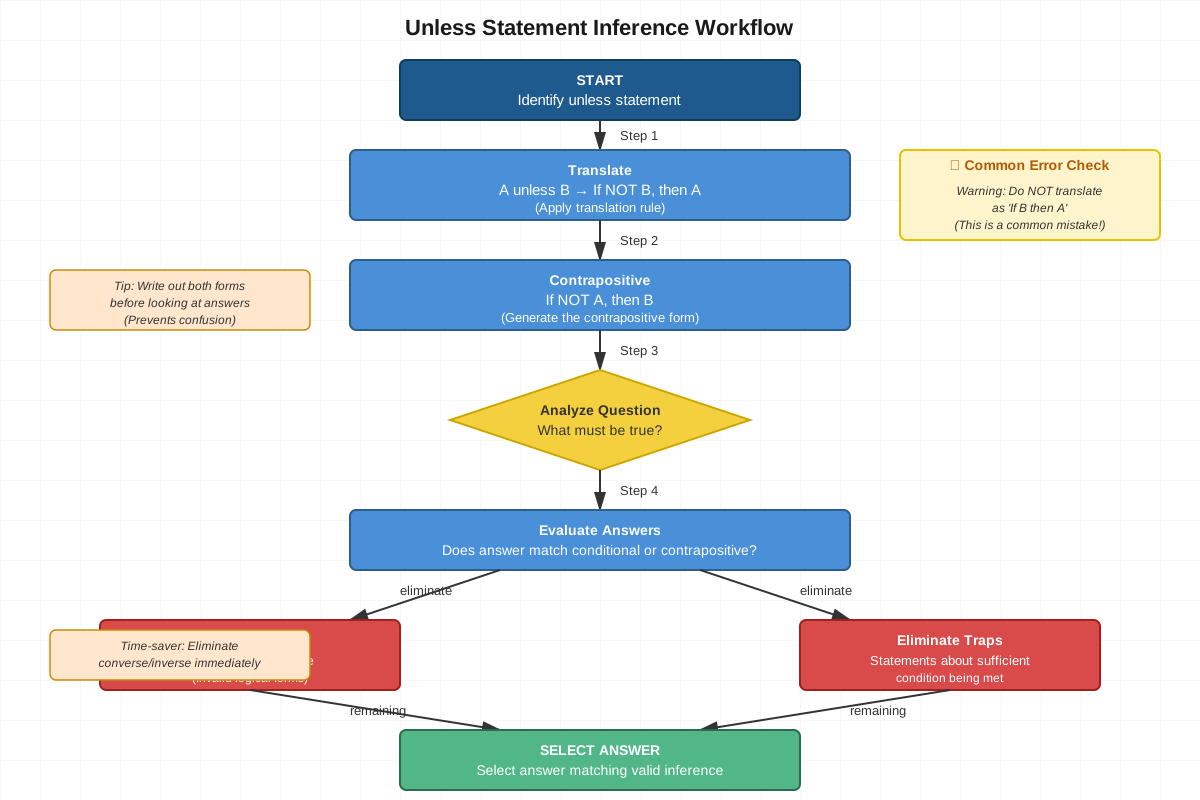
Step 1 - Immediate recognition: Train yourself to spot "unless" instantly. Circle or underline it the moment you see it. Also watch for synonyms like "without," "except if," and "if not."
Step 2 - Translate before reading answer choices: Never attempt to work with the original unless phrasing. Always translate to "If not B, then A" form and write it in the margin. This takes 5-10 seconds but prevents errors worth far more time.
Step 3 - Write the contrapositive: Immediately write the contrapositive next to your translation. Most correct answers on unless questions come from contrapositive application, not direct application.
Step 4 - Identify what you know: Determine which conditions are satisfied or negated in the stimulus. Match these to your translated conditionals.
Exam Tip: If the stimulus tells you the necessary condition is satisfied, immediately look for trap answers that make invalid inferences. The correct answer will likely state something more modest or use the contrapositive.
Trigger words and phrases to watch for:
- "Unless" (obviously)
- "Without"
- "Except if"
- "If not"
- "Only when" (different structure, but often confused)
- "Provided that" (different structure)
Process of elimination strategy:
- Eliminate any answer that reverses the conditional (affirms necessary, concludes about sufficient)
- Eliminate any answer that negates the sufficient condition and draws a conclusion
- Eliminate any answer that requires assuming additional information not in the stimulus
- Between remaining answers, choose the one that either applies the conditional directly or uses the contrapositive
Time allocation: Spend 15-20 seconds translating and identifying the contrapositive, then 30-40 seconds evaluating answer choices. Unless questions should not take longer than other inference questions once you've mastered the translation rule. If you find yourself spending more than 90 seconds total, you likely haven't fully translated the statement before attacking the answers.
Common trap answer patterns:
- Answers that affirm the necessary condition and conclude about the sufficient condition
- Answers that present the inverse (B → ~A) instead of the contrapositive (~A → B)
- Answers that add additional conditions not present in the original unless statement
- Answers that treat the unless statement as biconditional
Memory Techniques
The "UN-LESS means UN-TRUE" mnemonic: The term following "UNLESS" becomes "UNTRUE" (negated) in the sufficient condition. This helps remember that "unless" requires negation.
The "Flip and Nip" technique:
- Flip: The term after "unless" flips to the front (becomes the sufficient condition)
- Nip: Nip it with a negation symbol
Visualization strategy: Picture "unless" as a gate that only opens when the condition following it is NOT met. If the gate opens (condition not met), the consequence flows through. This mental image reinforces that "unless" creates a condition based on absence, not presence.
The "Unless = If Not" substitution drill: Whenever you see "unless" in any context (LSAT practice, reading, daily life), mentally substitute "if not" and verify the meaning stays consistent. This builds automatic translation ability.
Acronym for checking your work - TUNA:
- Translate the unless statement
- Understand the contrapositive
- Note what you know from the stimulus
- Apply the logic to find what must be true
The "Contrapositive is King" reminder: In unless questions, the contrapositive provides the correct answer more than 70% of the time. When in doubt between two answers, favor the one that uses contrapositive reasoning.
Summary
Mastering inference with unless requires understanding that "unless" functions as a logical operator creating conditional relationships through negation. The invariant translation rule—"A unless B" means "If not B, then A"—must become automatic. The term following "unless" gets negated to form the sufficient condition, while the other term becomes the necessary condition unchanged. Every unless statement generates both a direct conditional and a contrapositive, with the contrapositive frequently providing the basis for correct answers on the LSAT. Valid inferences come only from affirming the sufficient condition or negating the necessary condition; affirming the necessary condition or negating the sufficient condition yields no valid conclusions. Success on lsat inference with unless questions depends on immediate translation, contrapositive identification, and systematic elimination of trap answers that exploit common reversal and negation errors. This skill integrates with broader conditional reasoning and appears across multiple question types, making it a high-value topic for LSAT preparation.
Key Takeaways
- "A unless B" always translates to "If not B, then A" (~B → A)—this rule is absolute and invariant on the LSAT
- The term directly following "unless" must be negated in the sufficient condition of your translation
- The contrapositive of your translated unless statement is equally valid and often provides the correct answer
- Affirming the necessary condition or negating the sufficient condition produces no valid inference (common trap pattern)
- Translate unless statements immediately upon encountering them rather than working with the original phrasing
- "Unless" and "without" function identically; "unless" and "only if" create opposite logical structures
- Multiple unless statements can be chained through shared terms after individual translation
Related Topics
Conditional Logic Fundamentals: Understanding if-then statements, sufficient and necessary conditions, and basic logical relationships provides the foundation for unless statement translation. Mastering unless statements deepens your overall conditional reasoning ability.
Contrapositive Reasoning: The ability to form and apply contrapositives is essential for unless questions and extends to all conditional logic on the LSAT, including formal logic games and complex argument structures.
Formal Logic in Logic Games: Unless statements frequently appear as game rules, requiring translation and diagramming. Mastery of unless in Logical Reasoning transfers directly to improved Logic Games performance.
Sufficient and Necessary Assumptions: These question types often involve unless relationships either explicitly or implicitly, requiring recognition of what conditions must hold for an argument to succeed.
Parallel Reasoning: Matching logical structures requires recognizing unless patterns and their equivalent forms across different content, building on your translation skills.
Practice CTA
Now that you understand the logical structure and translation rules for unless statements, it's time to cement this knowledge through active practice. Attempt the practice questions focusing specifically on unless statements, paying careful attention to your translation process and contrapositive identification. Use the flashcards to drill the translation rule until it becomes automatic—speed and accuracy on unless questions come from making the translation second nature. Remember that every unless question you master represents not just one correct answer, but a systematic approach that applies across dozens of LSAT questions. Your investment in this topic will pay dividends throughout your LSAT preparation and beyond.
Sign up free to keep reading
Create a free AnvayaPrep account to finish this LSAT guide on Inference with unless — plus flashcards and practice questions.